
Introduction to Garbage Collection Garbage Collection It automatically
Introduction to Garbage Collection
Garbage Collection • It automatically reclaims memory occupied by objects that are no longer in use • It frees the programmer from manually dealing with memory deallocation • The benefits of garbage collection – increased reliability – decoupling of memory management from other software engineering concerns – Less developer time spent chasing memory management errors 2
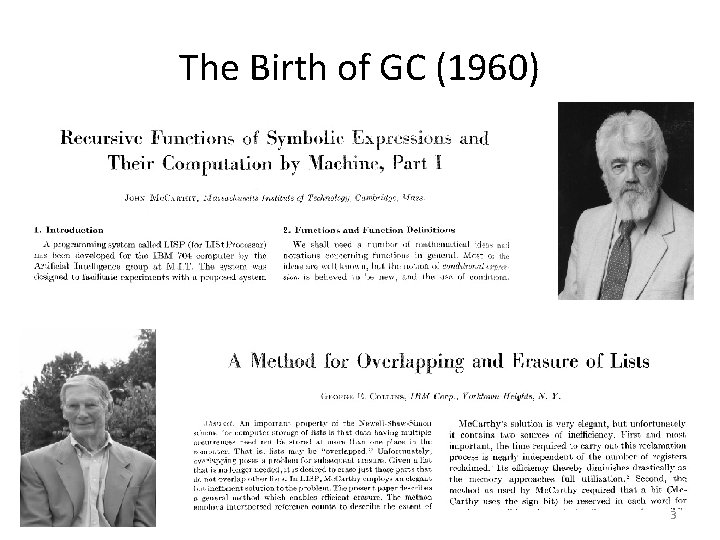
The Birth of GC (1960) 3
![Garbage Collection • Garbage collection was introduced in LISP [Mc. Carthy, 1960] and it](http://slidetodoc.com/presentation_image_h2/1db3cc7d035683530419587cdbf82539/image-4.jpg "Garbage Collection • Garbage collection was introduced in LISP [Mc. Carthy, 1960] and it")
Garbage Collection • Garbage collection was introduced in LISP [Mc. Carthy, 1960] and it has gained popularity through Java and. NET • It is also included in languages such as Haskell, Java. Script, PHP, Perl, Python, and Smalltalk • Today garbage collection is ubiquitous • Garbage collection is an integral part of modern programming languages 4
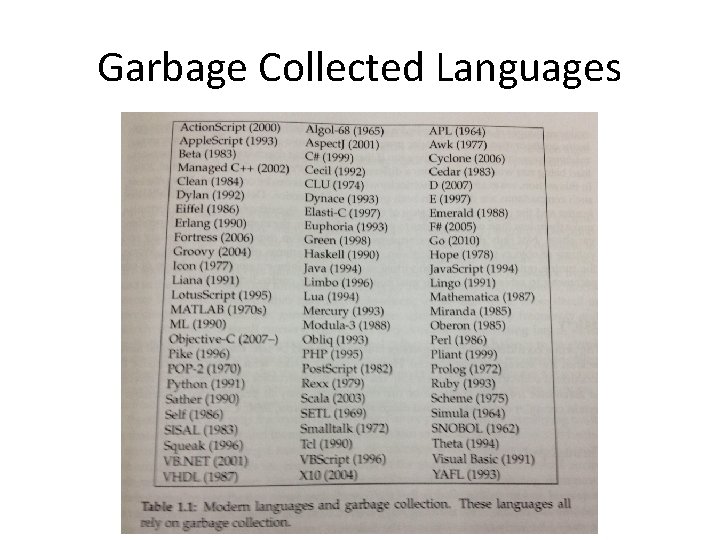
Garbage Collected Languages
Memory Management • Programs require data to execute and this data is typically stored in memory • Memory can be allocated – statically where memory requirements for the data are fixed ahead-of-time – on the stack where the lifetime of the data is tightly bound with the currently executing method – dynamically, where memory requirements are determined during execution – potentially changing between individual executions of the same program
Memory Management • Dynamically allocated memory can be managed either explicitly or automatically by the program • Popular programming languages, such as C/C++ require the programmer to explicitly manage memory through primitives – malloc and free for C – tedious and error-prone. • Managed languages, such as Java/. NET use a garbage collector to automatically free memory
Terminology • The area of memory used for dynamic object allocation is known as the heap • The process of reclaiming unused memory is known as garbage collection, a term coined by Mc. Carthy • Following Dijkstra, from the point of view of the garbage collector, the term mutator refers the application or program that mutates the heap – Mutator time - the time when the mutator is running – GC time - the time when the garbage collector is running
Terminology • Collectors that must stop the mutator to perform collection are known as stop the world collectors • Concurrent collectors reclaim objects while the application continues to execute • Collectors that employ more than one thread to do the collection work are parallel collectors. A parallel collector can either be stop the world or concurrent • Some collectors require knowledge of the runtime roots, all references into the heap held by runtime including stacks, registers, statics
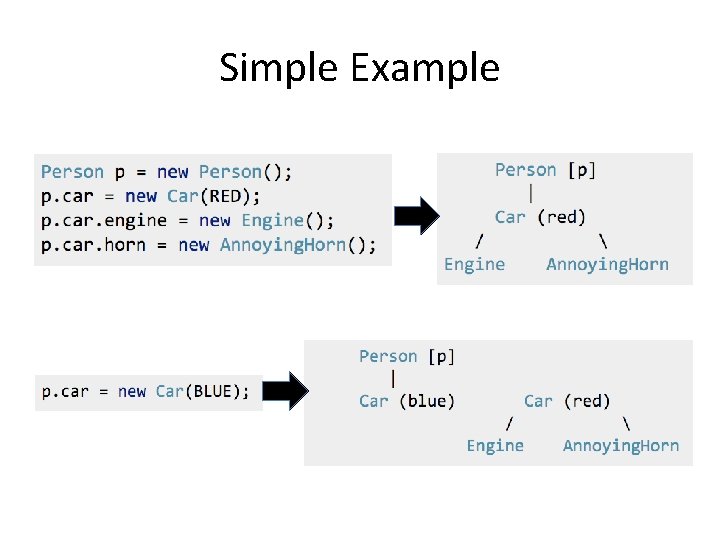
Simple Example
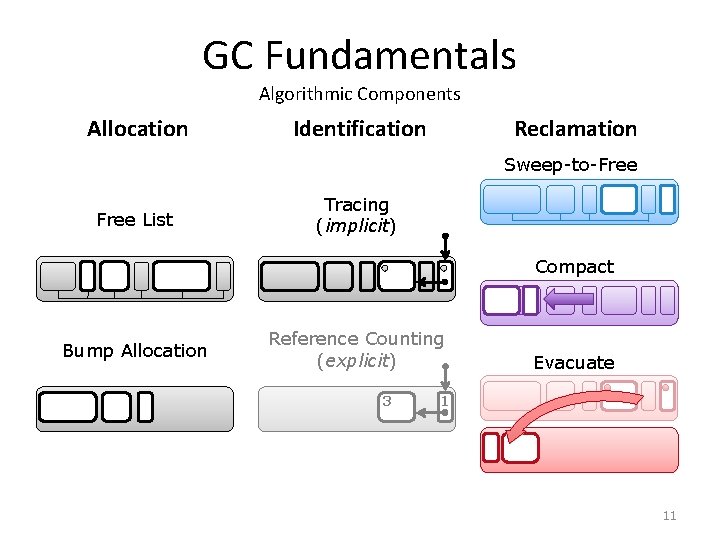
GC Fundamentals Algorithmic Components Allocation Identification Reclamation Sweep-to-Free List Tracing (implicit) Compact ` Bump Allocation Reference Counting (explicit) 3 Evacuate 1 11
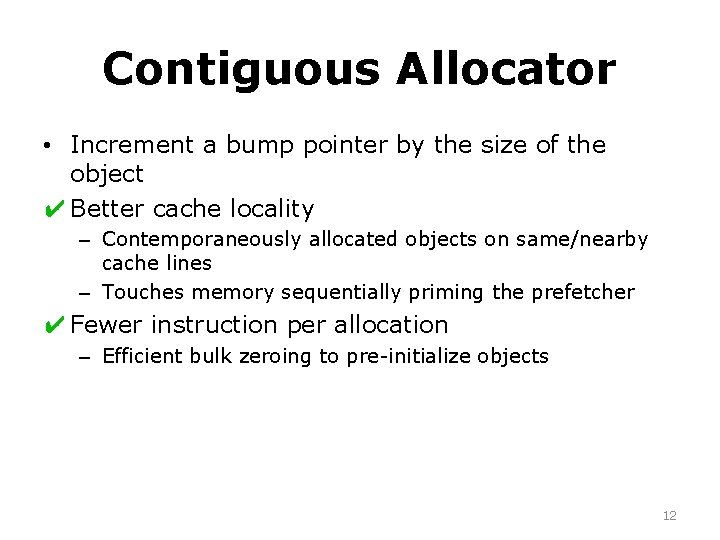
Contiguous Allocator • Increment a bump pointer by the size of the object ✔ Better cache locality – Contemporaneously allocated objects on same/nearby cache lines – Touches memory sequentially priming the prefetcher ✔ Fewer instruction per allocation – Efficient bulk zeroing to pre-initialize objects 12
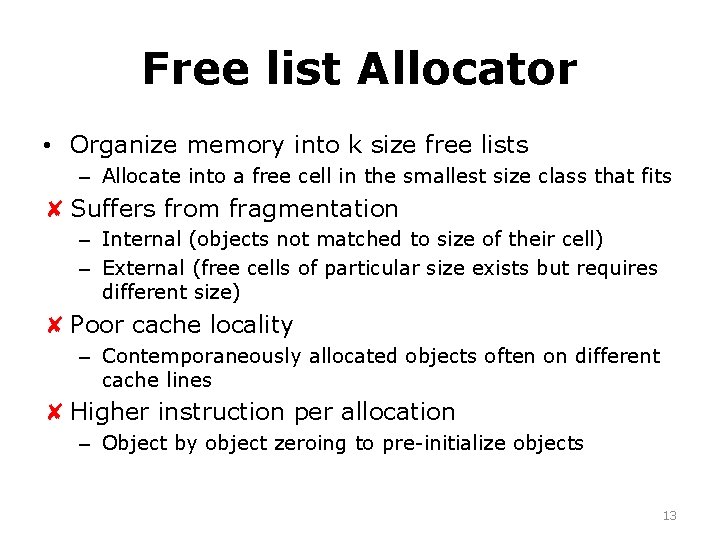
Free list Allocator • Organize memory into k size free lists – Allocate into a free cell in the smallest size class that fits ✘ Suffers from fragmentation – Internal (objects not matched to size of their cell) – External (free cells of particular size exists but requires different size) ✘ Poor cache locality – Contemporaneously allocated objects often on different cache lines ✘ Higher instruction per allocation – Object by object zeroing to pre-initialize objects 13
![Tracing [Mc. Carthy 1960] Roots B A D C ✗ E ✗ F 14](http://slidetodoc.com/presentation_image_h2/1db3cc7d035683530419587cdbf82539/image-14.jpg "Tracing [Mc. Carthy 1960] Roots B A D C ✗ E ✗ F 14")
Tracing [Mc. Carthy 1960] Roots B A D C ✗ E ✗ F 14
![Reference Counting [Collins 1960] Roots 1 1 ✗ 1 2 1 0 1 2](http://slidetodoc.com/presentation_image_h2/1db3cc7d035683530419587cdbf82539/image-15.jpg "Reference Counting [Collins 1960] Roots 1 1 ✗ 1 2 1 0 1 2")
Reference Counting [Collins 1960] Roots 1 1 ✗ 1 2 1 0 1 2 1 15
![GC Fundamentals Canonical Garbage Collectors Mark-Sweep [Mc. Carthy 1960] Sweep-to-Free-list + trace + sweep-to-free](http://slidetodoc.com/presentation_image_h2/1db3cc7d035683530419587cdbf82539/image-16.jpg "GC Fundamentals Canonical Garbage Collectors Mark-Sweep [Mc. Carthy 1960] Sweep-to-Free-list + trace + sweep-to-free")
GC Fundamentals Canonical Garbage Collectors Mark-Sweep [Mc. Carthy 1960] Sweep-to-Free-list + trace + sweep-to-free Mark-Compact [Styger 1967] Bump allocation + trace + compact Compact ` Evacuate Semi-Space [Cheney 1970] Bump allocation + trace + evacuate 16
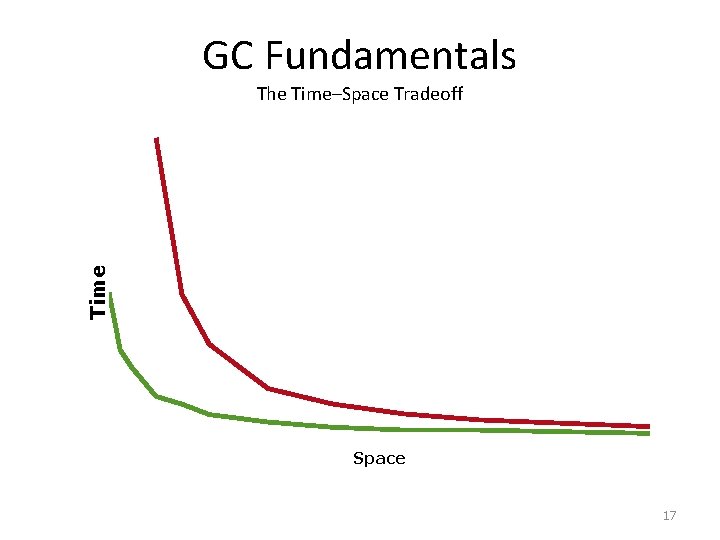
GC Fundamentals Time The Time–Space Tradeoff Space 17
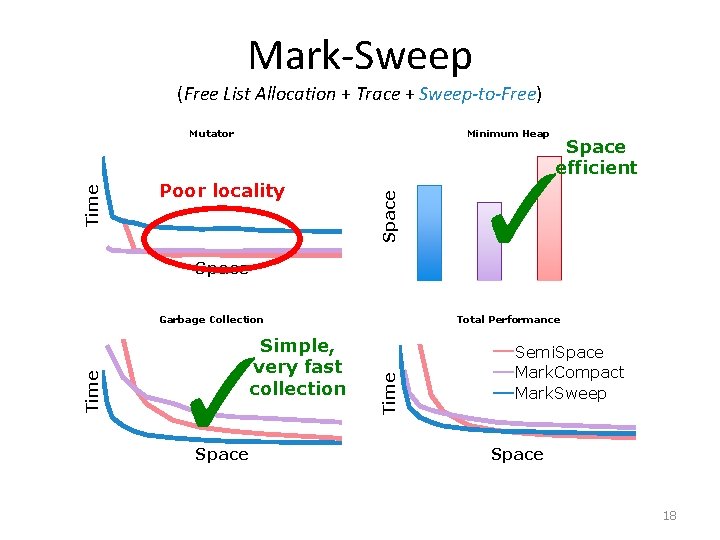
Mark-Sweep (Free List Allocation + Trace + Sweep-to-Free) Minimum Heap Poor locality Space Time Mutator Space efficient ✓ Space Simple, very fast collection ✓ Space Total Performance Time Garbage Collection Semi. Space Mark. Compact Mark. Sweep Space 18
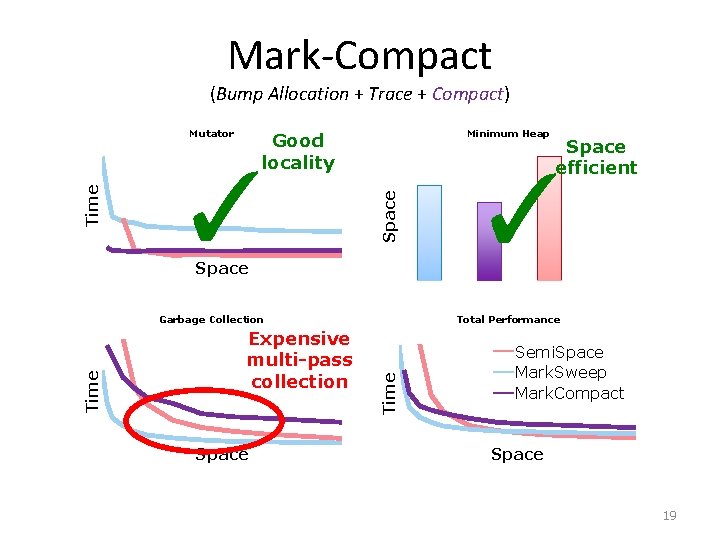
Mark-Compact (Bump Allocation + Trace + Compact) Minimum Heap Good locality ✓ Space Time Mutator Space efficient ✓ Space Expensive multi-pass collection Space Total Performance Time Garbage Collection Semi. Space Mark. Sweep Mark. Compact Space 19
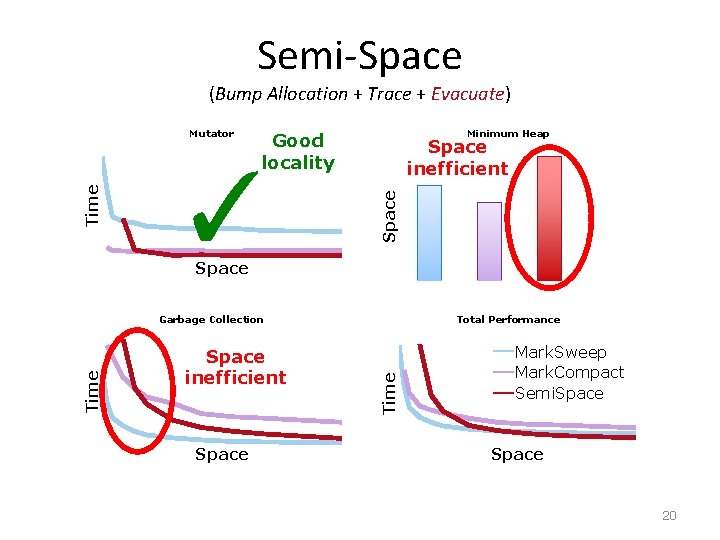
Semi-Space (Bump Allocation + Trace + Evacuate) Minimum Heap Good locality ✓ Space inefficient Space Time Mutator Space inefficient Space Total Performance Time Garbage Collection Mark. Sweep Mark. Compact Semi. Space 20
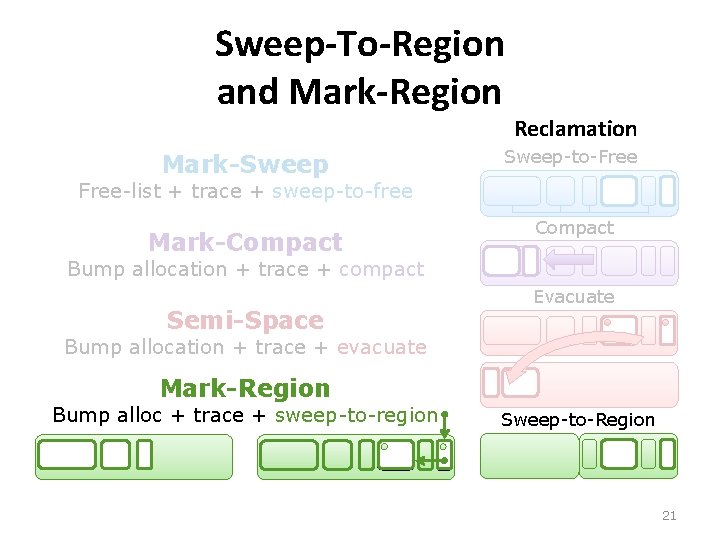
Sweep-To-Region and Mark-Region Mark-Sweep Reclamation Sweep-to-Free-list + trace + sweep-to-free Mark-Compact Bump allocation + trace + compact Semi-Space Evacuate ` Bump allocation + trace + evacuate Mark-Region Bump alloc + trace + sweep-to-region Sweep-to-Region 21
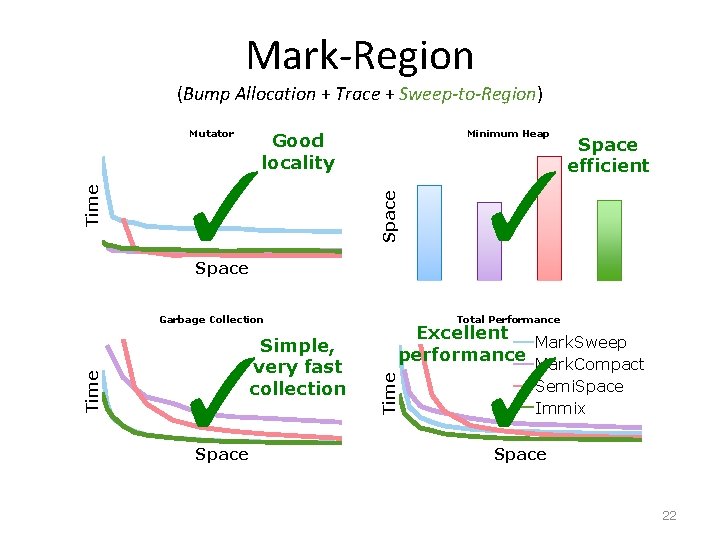
Mark-Region (Bump Allocation + Trace + Sweep-to-Region) Minimum Heap Good locality ✓ Space Time Mutator Space efficient ✓ Space Simple, very fast collection ✓ Space Total Performance Excellent Mark. Sweep performance Mark. Compact Time Garbage Collection ✓ Semi. Space Immix Space 22
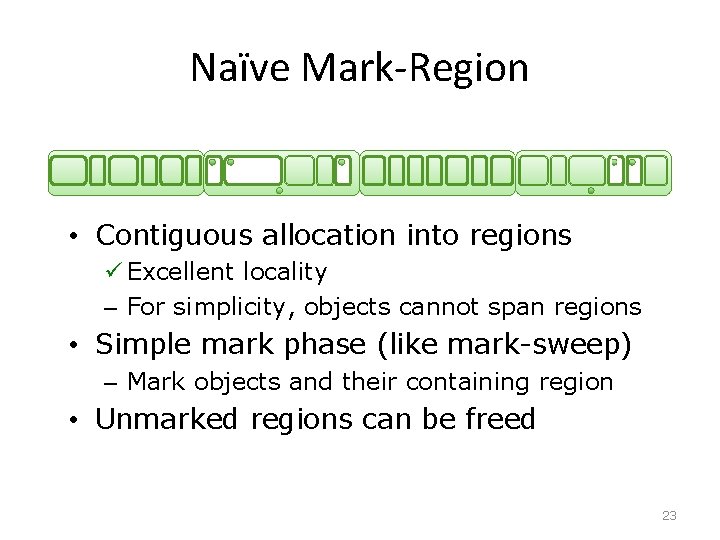
Naïve Mark-Region 0 • Contiguous allocation into regions ü Excellent locality – For simplicity, objects cannot span regions • Simple mark phase (like mark-sweep) – Mark objects and their containing region • Unmarked regions can be freed 23
![Generational [Ungar 1984] • Most objects die young Nursery space Mature space 24](http://slidetodoc.com/presentation_image_h2/1db3cc7d035683530419587cdbf82539/image-24.jpg "Generational [Ungar 1984] • Most objects die young Nursery space Mature space 24")
Generational [Ungar 1984] • Most objects die young Nursery space Mature space 24
![Immix object mark [Blackburn and Mc. Kinley 2008] recyclable lines line mark block 0](http://slidetodoc.com/presentation_image_h2/1db3cc7d035683530419587cdbf82539/image-25.jpg "Immix object mark [Blackburn and Mc. Kinley 2008] recyclable lines line mark block 0")
Immix object mark [Blackburn and Mc. Kinley 2008] recyclable lines line mark block 0 • Contiguous allocation into regions line – 256 B lines and 32 KB blocks – Objects span lines but not blocks • Simple mark phase – Mark objects and containing regions • Free unmarked regions • Recycled allocation and defragmentation 25
- Slides: 25