
Introduction to Fusion Nuclear Technology and Blanket Concepts
Introduction to Fusion Nuclear Technology and Blanket Concepts Mohamed Abdou (web: http: //www. fusion. ucla. edu/abdou/) Distinguished Professor of Engineering and Applied Science Director, Center for Energy Science and Technology (CESTAR) (http: //www. cestar. seas. ucla. edu/) Director, Fusion Science and Technology Center (http: //www. fusion. ucla. edu/) University of California, Los Angeles (UCLA) Lecture 2 at the Xi’an Jiaotong University, Xi’an, China August 2007 1
Introduction to Fusion Nuclear Technology and Blanket Concepts Outline • Definitions • FNT components and functions, impact of vacuum vessel on the blanket • World supply of tritium • Fusion D-T fuel cycle and issues, T breeding, neutron multipliers, structural materials • Types of blankets, solid breeder blanket concepts and issues, liquid breeder blanket concepts and issues • Stages of FNT testing • Role of ITER and why it is important but not sufficient for FNT DEMO development 2

FNT: Components from Edge of Plasma to TFC Blanket / Divertor immediately circumscribe the plasma Poloidal Ring Coil Cryostat Coil Gap Rib Panel Blanket Maint. Port Plasma Vacuum Vessel Center Solenoid Coil Toroidal Coil JAEA DEMO Design 3
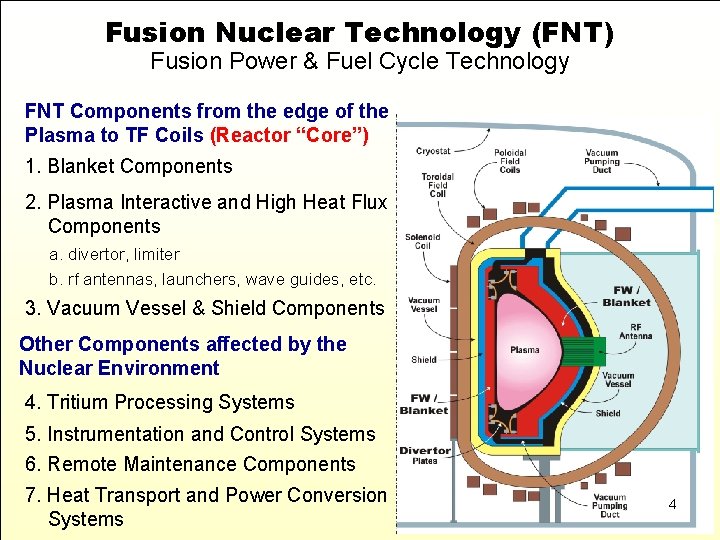
Fusion Nuclear Technology (FNT) Fusion Power & Fuel Cycle Technology FNT Components from the edge of the Plasma to TF Coils (Reactor “Core”) 1. Blanket Components 2. Plasma Interactive and High Heat Flux Components a. divertor, limiter b. rf antennas, launchers, wave guides, etc. 3. Vacuum Vessel & Shield Components Other Components affected by the Nuclear Environment 4. Tritium Processing Systems 5. Instrumentation and Control Systems 6. Remote Maintenance Components 7. Heat Transport and Power Conversion Systems 4
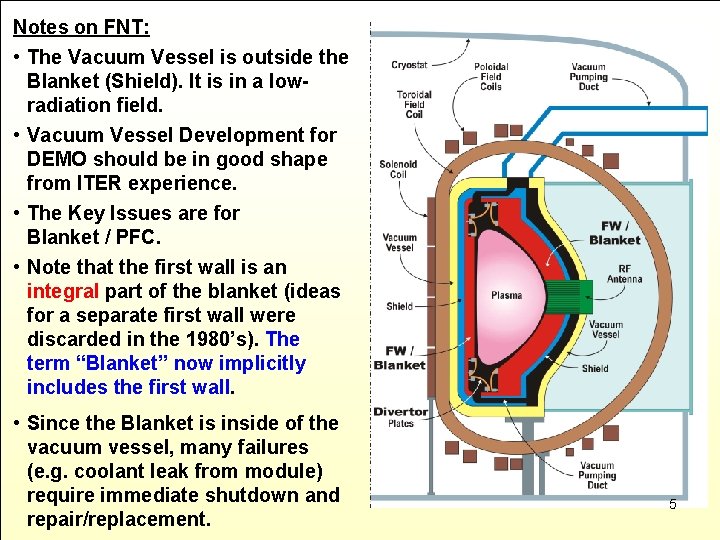
Notes on FNT: • The Vacuum Vessel is outside the Blanket (Shield). It is in a lowradiation field. • Vacuum Vessel Development for DEMO should be in good shape from ITER experience. • The Key Issues are for Blanket / PFC. • Note that the first wall is an integral part of the blanket (ideas for a separate first wall were discarded in the 1980’s). The term “Blanket” now implicitly includes the first wall. • Since the Blanket is inside of the vacuum vessel, many failures (e. g. coolant leak from module) require immediate shutdown and repair/replacement. 5
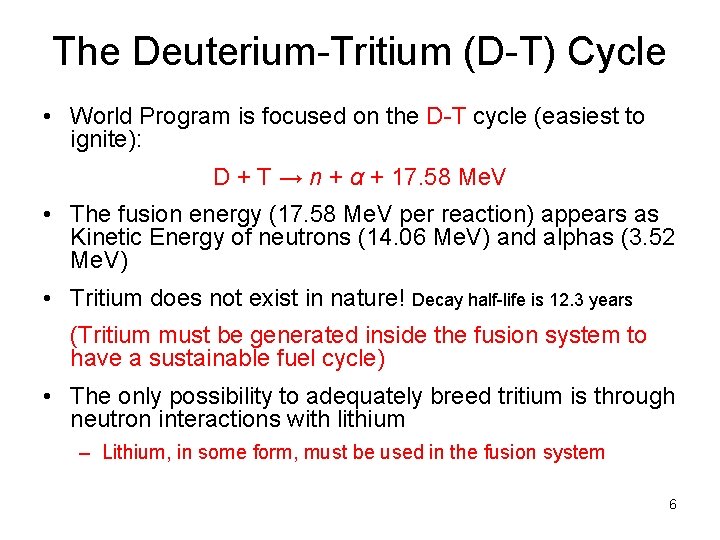
The Deuterium-Tritium (D-T) Cycle • World Program is focused on the D-T cycle (easiest to ignite): D + T → n + α + 17. 58 Me. V • The fusion energy (17. 58 Me. V per reaction) appears as Kinetic Energy of neutrons (14. 06 Me. V) and alphas (3. 52 Me. V) • Tritium does not exist in nature! Decay half-life is 12. 3 years (Tritium must be generated inside the fusion system to have a sustainable fuel cycle) • The only possibility to adequately breed tritium is through neutron interactions with lithium – Lithium, in some form, must be used in the fusion system 6
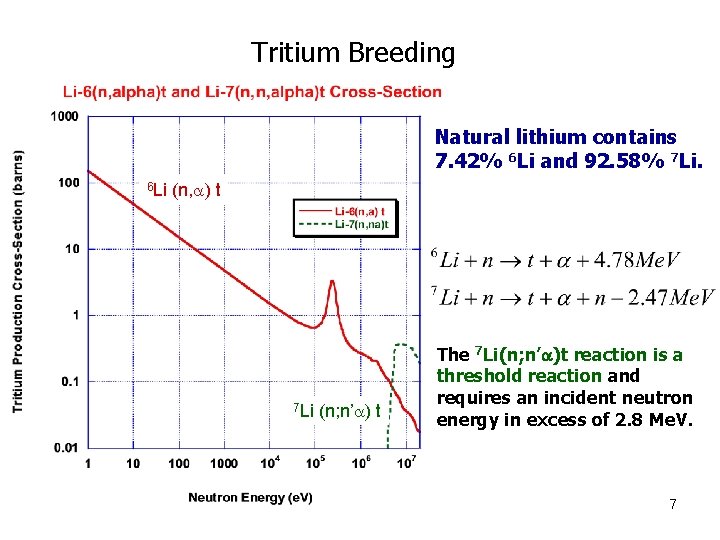
Tritium Breeding Natural lithium contains 7. 42% 6 Li and 92. 58% 7 Li. 6 Li (n, a) t 7 Li (n; n’a) t The 7 Li(n; n’a)t reaction is a threshold reaction and requires an incident neutron energy in excess of 2. 8 Me. V. 7

Shield Blanket Vacuum vessel Radiation Plasma Neutrons First Wall Tritium breeding zone Coolant for energy conversion Magnets 8
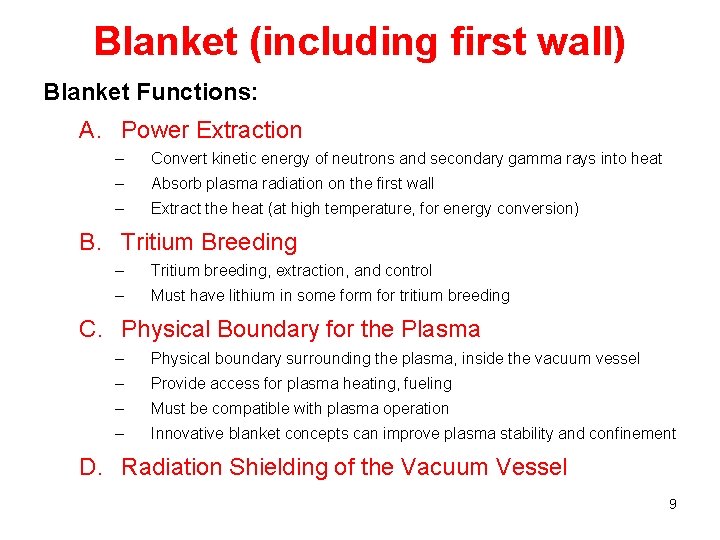
Blanket (including first wall) Blanket Functions: A. Power Extraction – Convert kinetic energy of neutrons and secondary gamma rays into heat – Absorb plasma radiation on the first wall – Extract the heat (at high temperature, for energy conversion) B. Tritium Breeding – Tritium breeding, extraction, and control – Must have lithium in some form for tritium breeding C. Physical Boundary for the Plasma – Physical boundary surrounding the plasma, inside the vacuum vessel – Provide access for plasma heating, fueling – Must be compatible with plasma operation – Innovative blanket concepts can improve plasma stability and confinement D. Radiation Shielding of the Vacuum Vessel 9
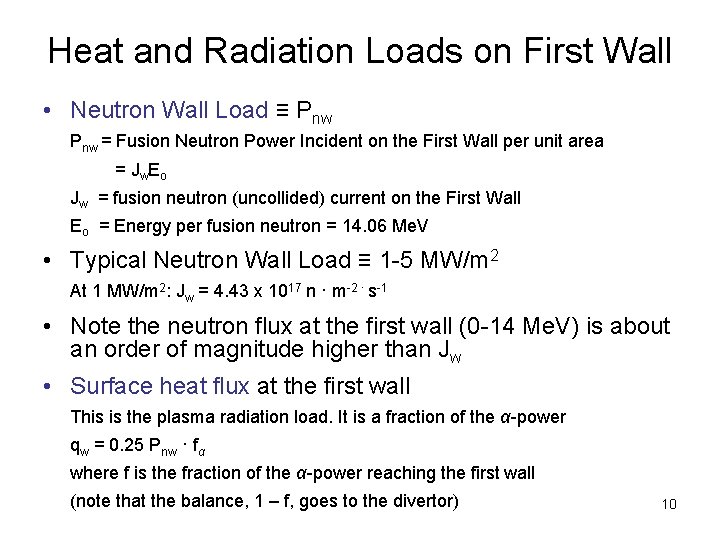
Heat and Radiation Loads on First Wall • Neutron Wall Load ≡ Pnw = Fusion Neutron Power Incident on the First Wall per unit area = Jw. Eo Jw = fusion neutron (uncollided) current on the First Wall Eo = Energy per fusion neutron = 14. 06 Me. V • Typical Neutron Wall Load ≡ 1 -5 MW/m 2 At 1 MW/m 2: Jw = 4. 43 x 1017 n · m-2 · s-1 • Note the neutron flux at the first wall (0 -14 Me. V) is about an order of magnitude higher than Jw • Surface heat flux at the first wall This is the plasma radiation load. It is a fraction of the α-power qw = 0. 25 Pnw · fα where f is the fraction of the α-power reaching the first wall (note that the balance, 1 – f, goes to the divertor) 10
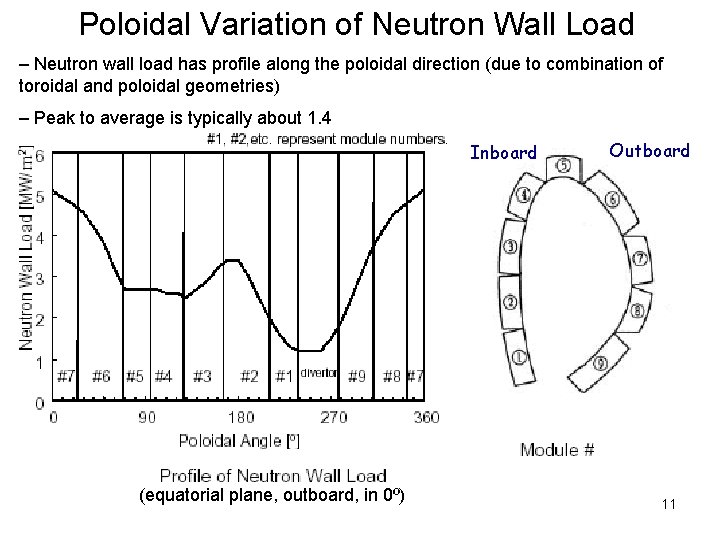
Poloidal Variation of Neutron Wall Load – Neutron wall load has profile along the poloidal direction (due to combination of toroidal and poloidal geometries) – Peak to average is typically about 1. 4 Inboard (equatorial plane, outboard, in 0º) Outboard 11
12
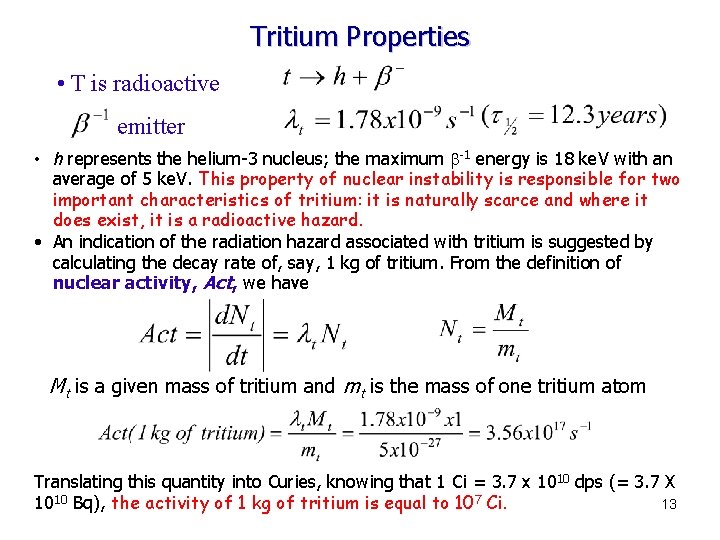
Tritium Properties • T is radioactive emitter • h represents the helium-3 nucleus; the maximum b-1 energy is 18 ke. V with an average of 5 ke. V. This property of nuclear instability is responsible for two important characteristics of tritium: it is naturally scarce and where it does exist, it is a radioactive hazard. • An indication of the radiation hazard associated with tritium is suggested by calculating the decay rate of, say, 1 kg of tritium. From the definition of nuclear activity, Act, we have Mt is a given mass of tritium and mt is the mass of one tritium atom Translating this quantity into Curies, knowing that 1 Ci = 3. 7 x 10¹⁰ dps (= 3. 7 X 10¹⁰ Bq), the activity of 1 kg of tritium is equal to 107 Ci. 13
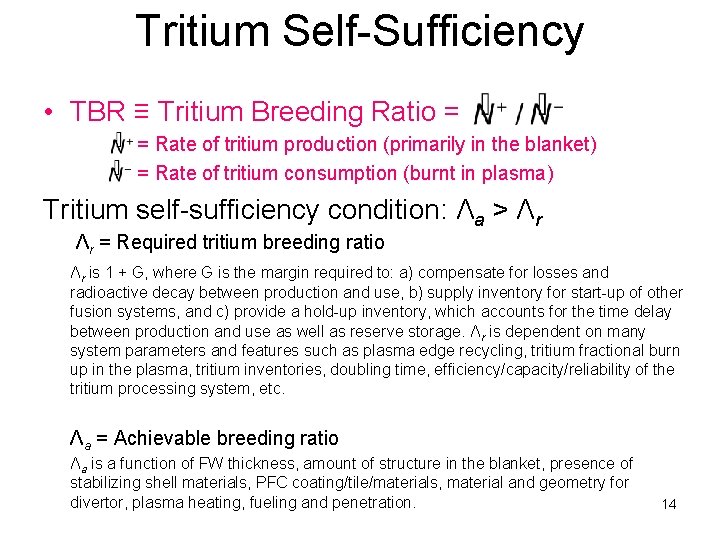
Tritium Self-Sufficiency • TBR ≡ Tritium Breeding Ratio = = Rate of tritium production (primarily in the blanket) = Rate of tritium consumption (burnt in plasma) Tritium self-sufficiency condition: Λa > Λr Λr = Required tritium breeding ratio Λr is 1 + G, where G is the margin required to: a) compensate for losses and radioactive decay between production and use, b) supply inventory for start-up of other fusion systems, and c) provide a hold-up inventory, which accounts for the time delay between production and use as well as reserve storage. Λr is dependent on many system parameters and features such as plasma edge recycling, tritium fractional burn up in the plasma, tritium inventories, doubling time, efficiency/capacity/reliability of the tritium processing system, etc. Λa = Achievable breeding ratio Λa is a function of FW thickness, amount of structure in the blanket, presence of stabilizing shell materials, PFC coating/tile/materials, material and geometry for divertor, plasma heating, fueling and penetration. 14
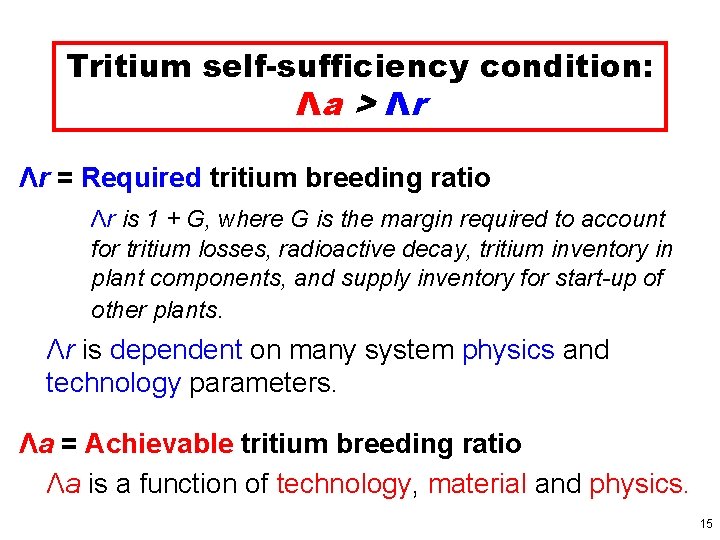
Tritium self-sufficiency condition: Λa > Λr Λr = Required tritium breeding ratio Λr is 1 + G, where G is the margin required to account for tritium losses, radioactive decay, tritium inventory in plant components, and supply inventory for start-up of other plants. Λr is dependent on many system physics and technology parameters. Λa = Achievable tritium breeding ratio Λa is a function of technology, material and physics. 15
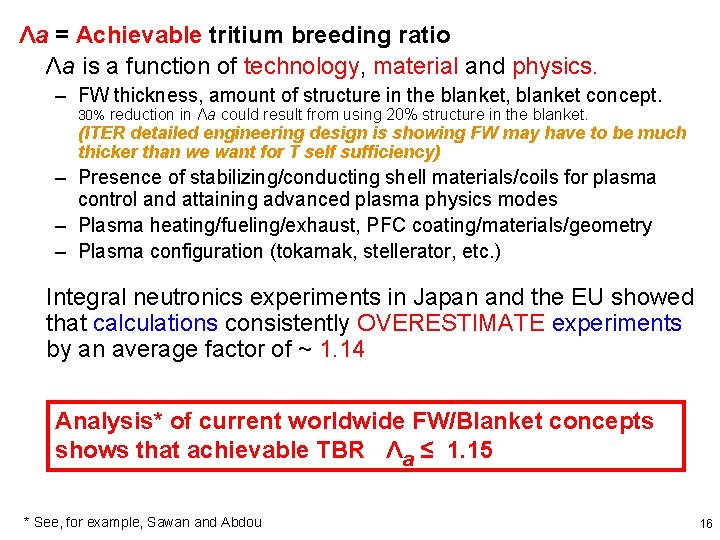
Λa = Achievable tritium breeding ratio Λa is a function of technology, material and physics. – FW thickness, amount of structure in the blanket, blanket concept. 30% reduction in Λa could result from using 20% structure in the blanket. (ITER detailed engineering design is showing FW may have to be much thicker than we want for T self sufficiency) – Presence of stabilizing/conducting shell materials/coils for plasma control and attaining advanced plasma physics modes – Plasma heating/fueling/exhaust, PFC coating/materials/geometry – Plasma configuration (tokamak, stellerator, etc. ) Integral neutronics experiments in Japan and the EU showed that calculations consistently OVERESTIMATE experiments by an average factor of ~ 1. 14 Analysis* of current worldwide FW/Blanket concepts shows that achievable TBR Λa ≤ 1. 15 * See, for example, Sawan and Abdou 16
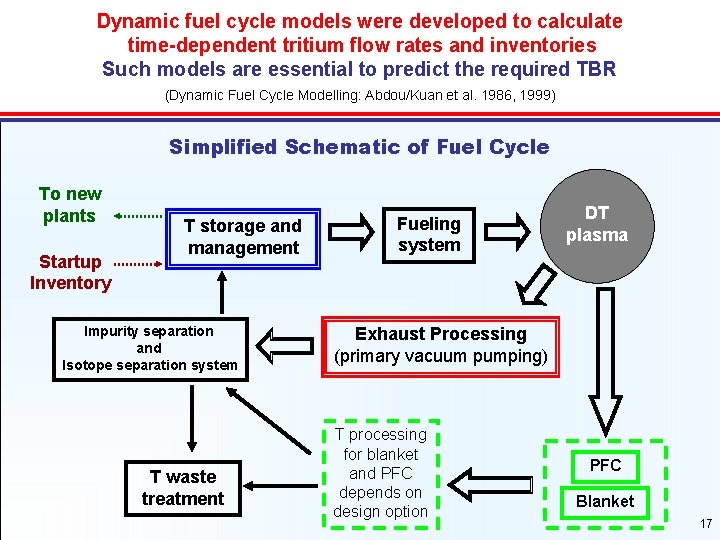
Dynamic fuel cycle models were developed to calculate time-dependent tritium flow rates and inventories Such models are essential to predict the required TBR (Dynamic Fuel Cycle Modelling: Abdou/Kuan et al. 1986, 1999) Simplified Schematic of Fuel Cycle To new plants Startup Inventory T storage and management Impurity separation and Isotope separation system T waste treatment Fueling system DT plasma Exhaust Processing (primary vacuum pumping) T processing for blanket and PFC depends on design option PFC Blanket 17
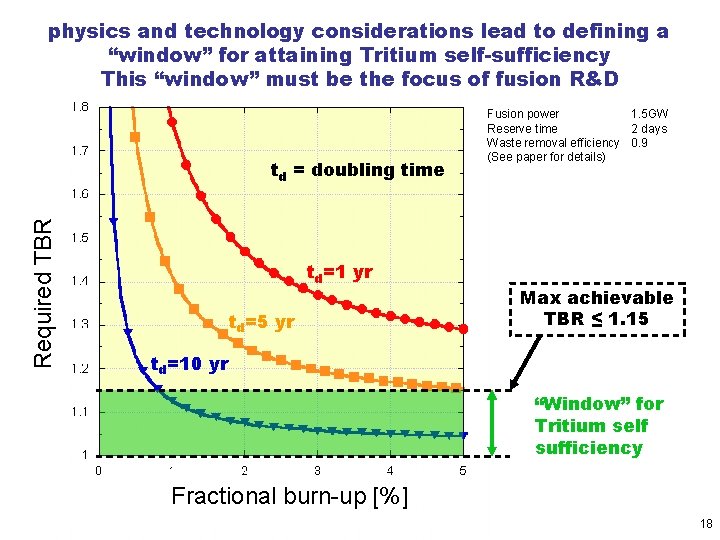
physics and technology considerations lead to defining a “window” for attaining Tritium self-sufficiency This “window” must be the focus of fusion R&D Required TBR td = doubling time td=1 yr td=5 yr Fusion power 1. 5 GW Reserve time 2 days Waste removal efficiency 0. 9 (See paper for details) Max achievable TBR ≤ 1. 15 td=10 yr “Window” for Tritium self sufficiency Fractional burn-up [%] 18
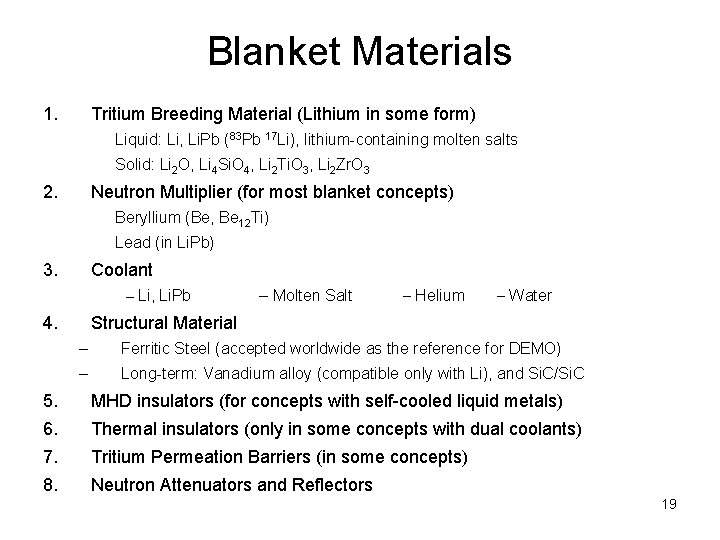
Blanket Materials 1. Tritium Breeding Material (Lithium in some form) Liquid: Li, Li. Pb (83 Pb 17 Li), lithium-containing molten salts Solid: Li 2 O, Li 4 Si. O 4, Li 2 Ti. O 3, Li 2 Zr. O 3 2. Neutron Multiplier (for most blanket concepts) Beryllium (Be, Be 12 Ti) Lead (in Li. Pb) 3. Coolant – Li, Li. Pb 4. – Molten Salt – Helium – Water Structural Material – Ferritic Steel (accepted worldwide as the reference for DEMO) – Long-term: Vanadium alloy (compatible only with Li), and Si. C/Si. C 5. MHD insulators (for concepts with self-cooled liquid metals) 6. Thermal insulators (only in some concepts with dual coolants) 7. Tritium Permeation Barriers (in some concepts) 8. Neutron Attenuators and Reflectors 19
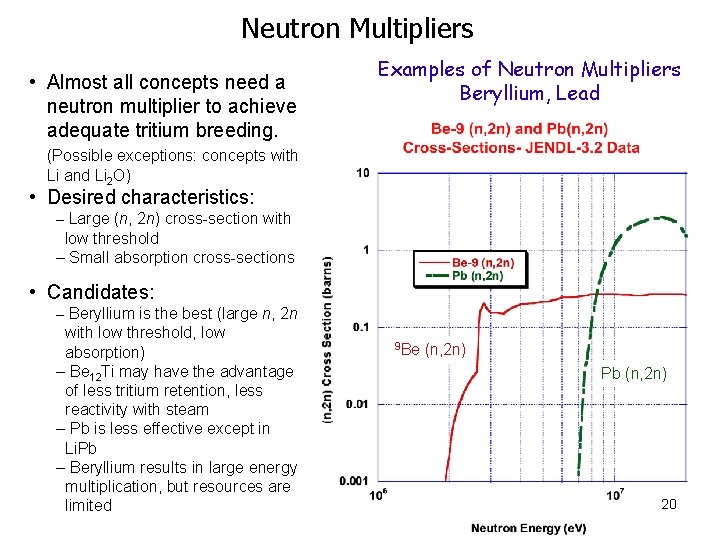
Neutron Multipliers • Almost all concepts need a neutron multiplier to achieve adequate tritium breeding. Examples of Neutron Multipliers Beryllium, Lead (Possible exceptions: concepts with Li and Li 2 O) • Desired characteristics: – Large (n, 2 n) cross-section with low threshold – Small absorption cross-sections • Candidates: – Beryllium is the best (large n, 2 n with low threshold, low absorption) – Be 12 Ti may have the advantage of less tritium retention, less reactivity with steam – Pb is less effective except in Li. Pb – Beryllium results in large energy multiplication, but resources are limited 9 Be (n, 2 n) Pb (n, 2 n) 20
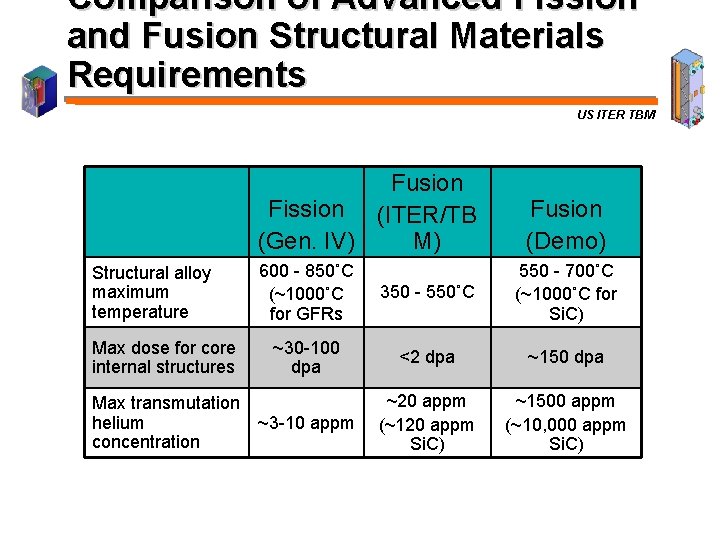
Comparison of Advanced Fission and Fusion Structural Materials Requirements US ITER TBM Fusion Fission (ITER/TB (Gen. IV) M) Structural alloy maximum temperature Max dose for core internal structures Fusion (Demo) 600 - 850˚C (~1000˚C for GFRs 350 - 550˚C 550 - 700˚C (~1000˚C for Si. C) ~30 -100 dpa <2 dpa ~150 dpa ~20 appm (~120 appm Si. C) ~1500 appm (~10, 000 appm Si. C) Max transmutation ~3 -10 appm helium concentration
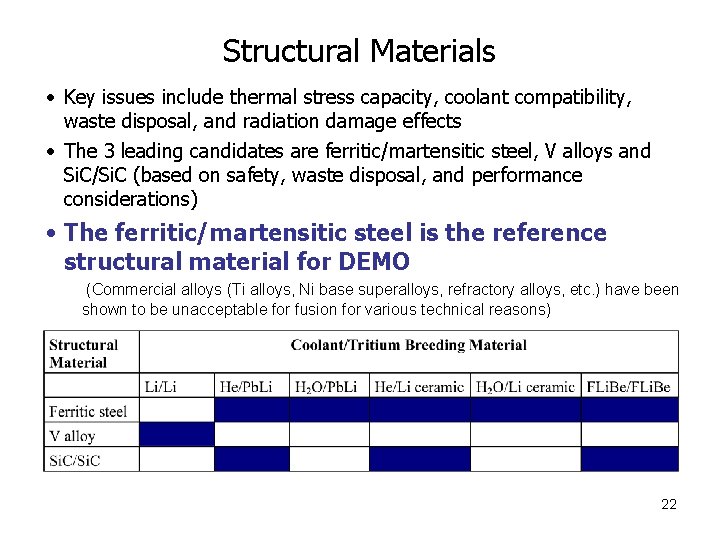
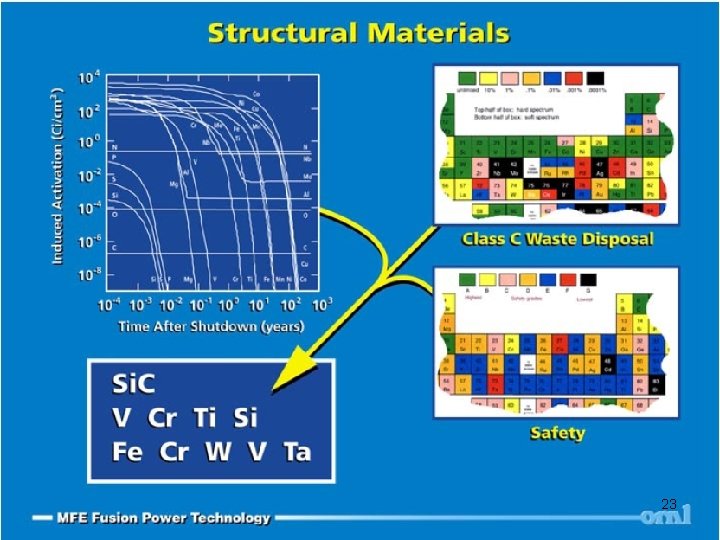
Structural Materials • Key issues include thermal stress capacity, coolant compatibility, waste disposal, and radiation damage effects • The 3 leading candidates are ferritic/martensitic steel, V alloys and Si. C/Si. C (based on safety, waste disposal, and performance considerations) • The ferritic/martensitic steel is the reference structural material for DEMO (Commercial alloys (Ti alloys, Ni base superalloys, refractory alloys, etc. ) have been shown to be unacceptable for fusion for various technical reasons) 22
23
24
Fission (PWR) Fusion structure Coal Tritium in fusion 25
Blanket Concepts (many concepts proposed worldwide) A. B. Solid Breeder Concepts – Always separately cooled – Solid Breeder: Lithium Ceramic (Li 2 O, Li 4 Si. O 4, Li 2 Ti. O 3, Li 2 Zr. O 3) – Coolant: Helium or Water Liquid Breeder Concepts Liquid breeder can be: a) Liquid metal (high conductivity, low Pr): Li, or 83 Pb 17 Li b) Molten salt (low conductivity, high Pr): Flibe (Li. F)n · (Be. F 2), Flinabe (Li. F-Be. F 2 -Na. F) B. 1. Self-Cooled – Liquid breeder is circulated at high enough speed to also serve as coolant B. 2. Separately Cooled – A separate coolant is used (e. g. , helium) – The breeder is circulated only at low speed for tritium extraction B. 3. Dual Coolant – FW and structure are cooled with separate coolant (He) – Breeding zone is self-cooled 26
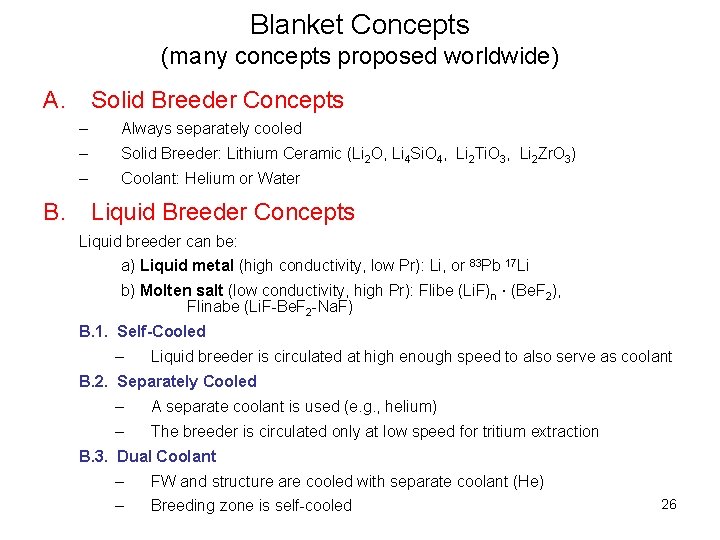
Solid Breeder Blanket Concepts The idea of a solid breeder blanket is to have the lithium-containing tritium breeder as non-mobile and to reduce lithium and tritium inventory as described in M. A. Abdou, L. J. Wittenberg, and C. W. Maynard, "A Fusion Design Study of Nonmobile Blankets with Low Lithium and Tritium Inventories", Nuclear Technology, 26: 400– 419 (1975). – Always separately cooled – Coolant: Helium or Water – Solid Breeder: Lithium Ceramic (Li 2 O, Li 4 Si. O 4, Li 2 Ti. O 3, Li 2 Zr. O 3) – A neutron multiplier is always required to achieve TBR > 1 (with the possible exception of Li 2 O) because inelastic scattering in non-lithium elements render Li-7 ineffective – Only Beryllium (or Be 12 Ti) is possible (lead is not practical as a separate multiplier) – Structure is typically Reduced Activation Ferritic Steel (RAFS) 27
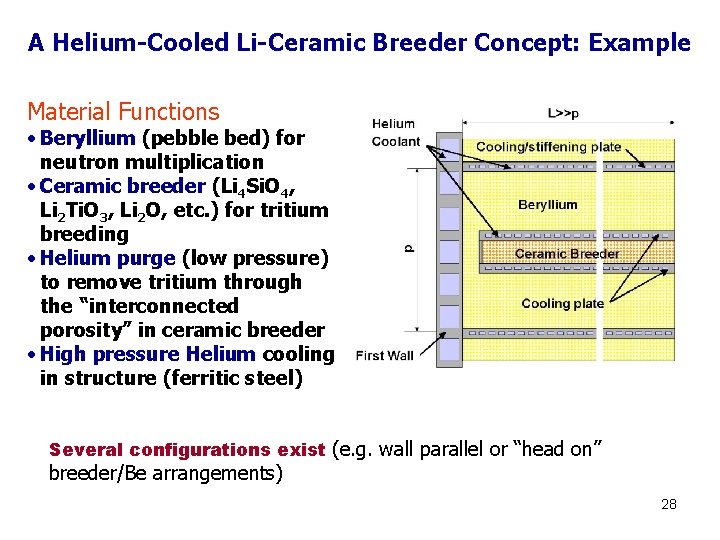
A Helium-Cooled Li-Ceramic Breeder Concept: Example Material Functions • Beryllium (pebble bed) for neutron multiplication • Ceramic breeder (Li 4 Si. O 4, Li 2 Ti. O 3, Li 2 O, etc. ) for tritium breeding • Helium purge (low pressure) to remove tritium through the “interconnected porosity” in ceramic breeder • High pressure Helium cooling in structure (ferritic steel) Several configurations exist (e. g. wall parallel or “head on” breeder/Be arrangements) 28
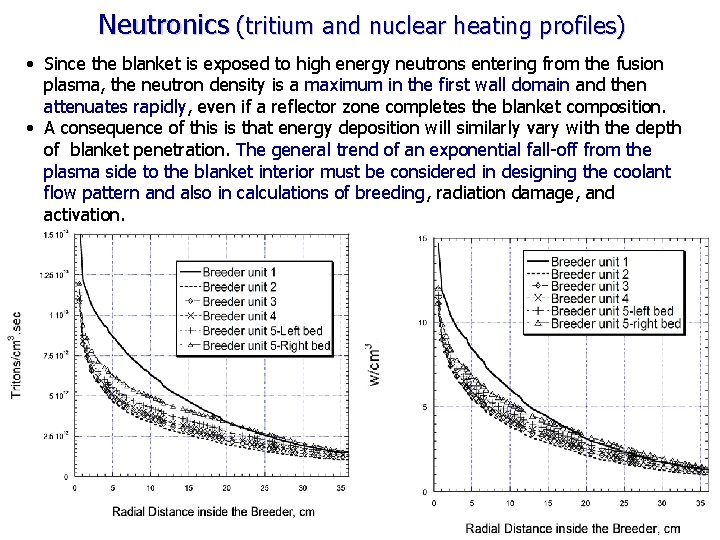
Neutronics (tritium and nuclear heating profiles) • Since the blanket is exposed to high energy neutrons entering from the fusion plasma, the neutron density is a maximum in the first wall domain and then attenuates rapidly, even if a reflector zone completes the blanket composition. • A consequence of this is that energy deposition will similarly vary with the depth of blanket penetration. The general trend of an exponential fall-off from the plasma side to the blanket interior must be considered in designing the coolant flow pattern and also in calculations of breeding, radiation damage, and activation.
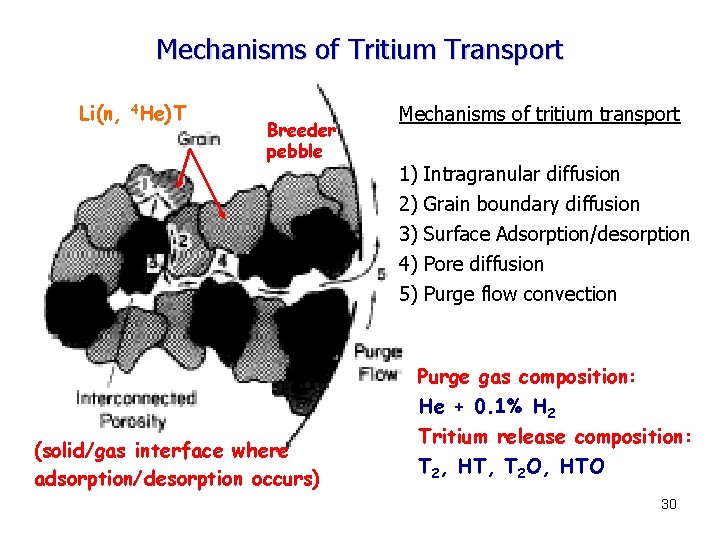
Mechanisms of Tritium Transport Li(n, 4 He)T Breeder pebble (solid/gas interface where adsorption/desorption occurs) Mechanisms of tritium transport 1) 2) 3) 4) 5) Intragranular diffusion Grain boundary diffusion Surface Adsorption/desorption Pore diffusion Purge flow convection Purge gas composition: He + 0. 1% H 2 Tritium release composition: T 2, HT, T 2 O, HTO 30
“Temperature Window” for Solid Breeders • The operating temperature of the solid breeder is limited to an acceptable “temperature window”: Tmin– Tmax – Tmin, lower temperature limit, is based on acceptable tritium transport characteristics (typically bulk diffusion). Tritium diffusion is slow at lower temperatures and leads to unacceptable tritium inventory retained in the solid breeder – Tmax, maximum temperature limit, to avoid sintering (thermal and radiation-induced sintering) which could inhibit tritium release; also to avoid mass transfer (e. g. , Li. OT vaporization) • The limitations on allowable temperature window, combined with the low thermal conductivity, place limits on allowable power density and achievable TBR 31
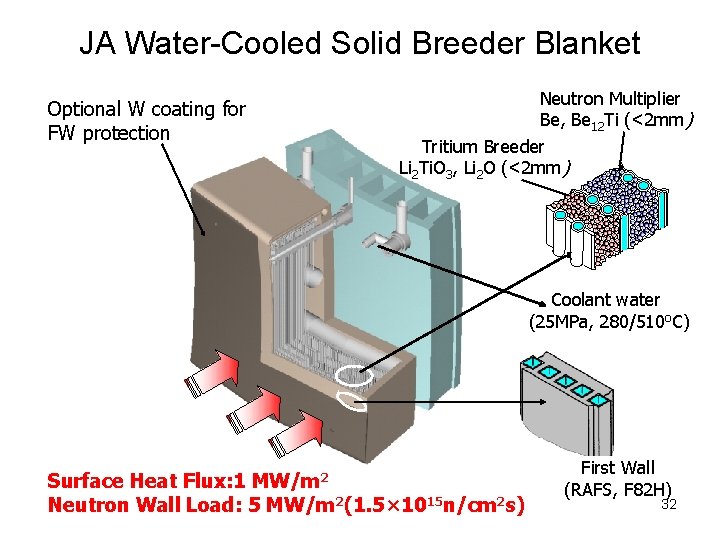
JA Water-Cooled Solid Breeder Blanket Optional W coating for FW protection Neutron Multiplier Be, Be 12 Ti (<2 mm) Tritium Breeder Li 2 Ti. O 3, Li 2 O (<2 mm) Coolant water (25 MPa, 280/510 o. C) Surface Heat Flux: 1 MW/m 2 Neutron Wall Load: 5 MW/m 2(1. 5× 10¹⁵ n/cm 2 s) First Wall (RAFS, F 82 H) 32
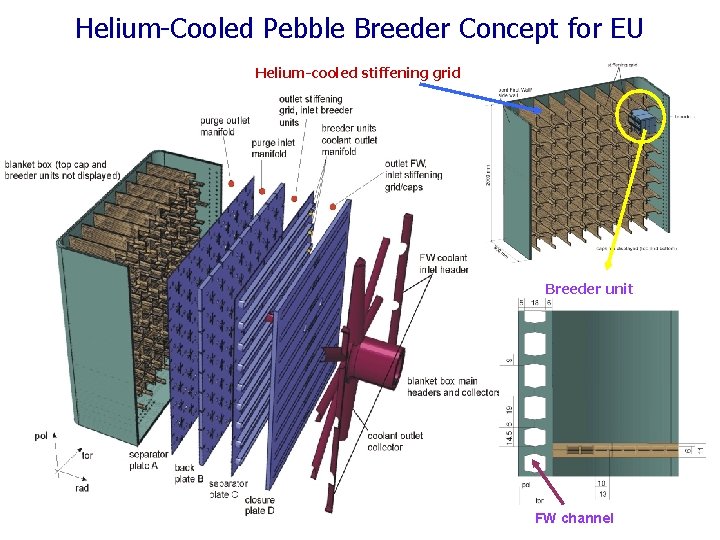
Helium-Cooled Pebble Breeder Concept for EU Helium-cooled stiffening grid Breeder unit FW channel
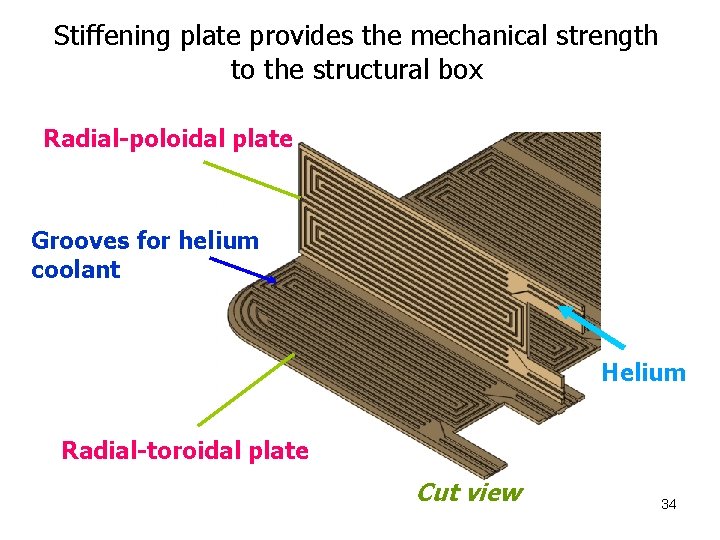
Stiffening plate provides the mechanical strength to the structural box Radial-poloidal plate Grooves for helium coolant Helium Radial-toroidal plate Cut view 34
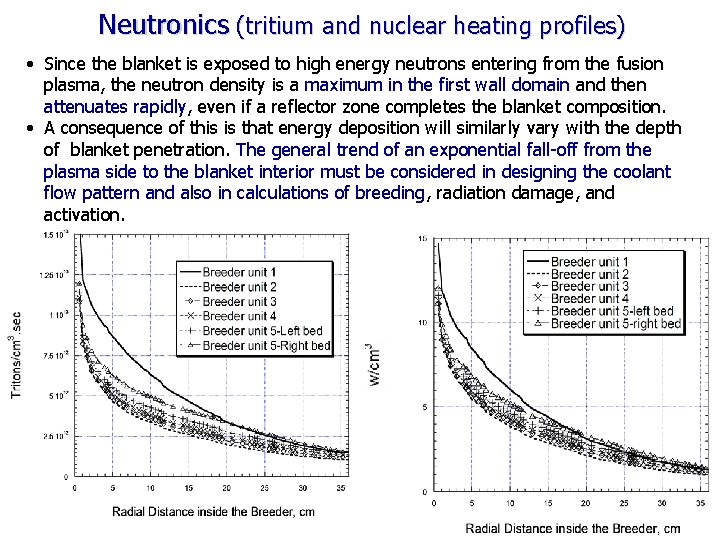
Neutronics (tritium and nuclear heating profiles) • Since the blanket is exposed to high energy neutrons entering from the fusion plasma, the neutron density is a maximum in the first wall domain and then attenuates rapidly, even if a reflector zone completes the blanket composition. • A consequence of this is that energy deposition will similarly vary with the depth of blanket penetration. The general trend of an exponential fall-off from the plasma side to the blanket interior must be considered in designing the coolant flow pattern and also in calculations of breeding, radiation damage, and activation.
Solid Breeder Concepts: Key Advantages and Disadvantages Advantages • Non-mobile breeder permits, in principle, selection of a coolant that avoids problems related to safety, corrosion, MHD Disadvantages • Low thermal conductivity, k, of solid breeder ceramics – Intrinsically low even at 100% of theoretical density (~ 1 -3 W · m-1 · c-1 for ternary ceramics) – k is lower at the 20 -40% porosity required for effective tritium release – Further reduction in k under irradiation • Low k, combined with the allowable operating “temperature window” for solid breeders, results in: – Limitations on power density, especially behind first wall and next to the neutron multiplier (limits on wall load and surface heat flux) – Limits on achievable tritium breeding ratio (beryllium must always be used; still TBR is limited) because of increase in structure-to-breeder ratio • A number of key issues that are yet to be resolved (all liquid and solid breeder concepts have feasibility issues) 36
Solid Breeder Blanket Issues Ø Tritium self-sufficiency Ø Breeder/Multiplier/structure interactive effects under nuclear heating and irradiation Ø Tritium inventory, recovery and control; development of tritium permeation barriers Ø Effective thermal conductivity, interface thermal conductance, thermal control Ø Allowable operating temperature window for breeder Ø Failure modes, effects, and rates Ø Mass transfer Ø Temperature limits for structural materials and coolants Ø Mechanical loads caused by major plasma disruption Ø Response to off-normal conditions 37
Liquid Breeders • Many liquid breeder concepts exist, all of which have key feasibility issues. Selection can not prudently be made before additional R&D results become available. • Type of Liquid Breeder: Two different classes of materials with markedly different issues. a) Liquid Metal: Li, 83 Pb 17 Li High conductivity, low Pr number Dominant issues: MHD, chemical reactivity for Li, tritium permeation for Li. Pb b) Molten Salt: Flibe (Li. F)n · (Be. F 2), Flinabe (Li. F-Be. F 2 -Na. F) Low conductivity, high Pr number Dominant Issues: Melting point, chemistry, tritium control 38
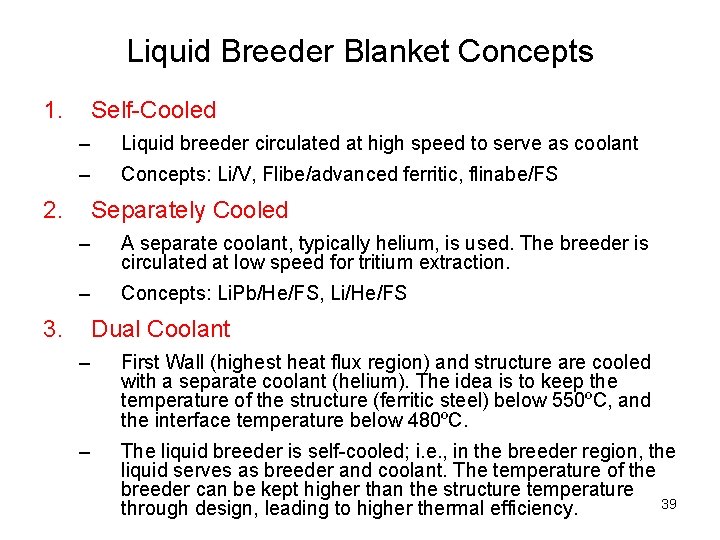
Liquid Breeder Blanket Concepts 1. Self-Cooled – Liquid breeder circulated at high speed to serve as coolant – Concepts: Li/V, Flibe/advanced ferritic, flinabe/FS 2. Separately Cooled – A separate coolant, typically helium, is used. The breeder is circulated at low speed for tritium extraction. – Concepts: Li. Pb/He/FS, Li/He/FS 3. Dual Coolant – First Wall (highest heat flux region) and structure are cooled with a separate coolant (helium). The idea is to keep the temperature of the structure (ferritic steel) below 550ºC, and the interface temperature below 480ºC. – The liquid breeder is self-cooled; i. e. , in the breeder region, the liquid serves as breeder and coolant. The temperature of the breeder can be kept higher than the structure temperature 39 through design, leading to higher thermal efficiency.
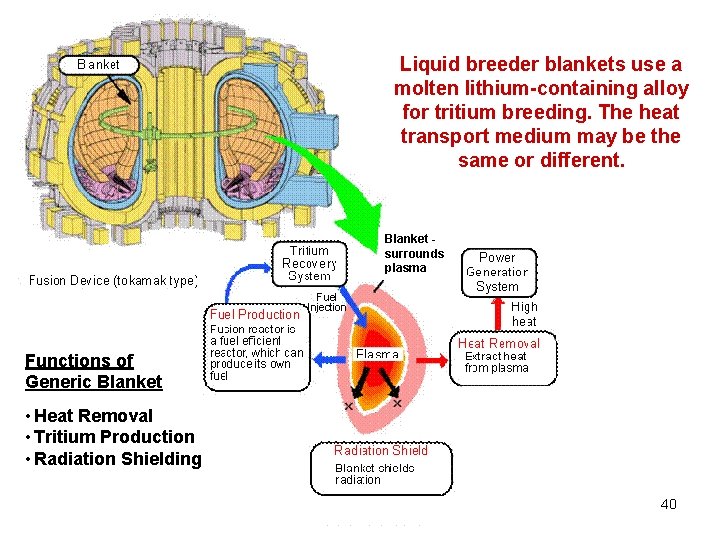
Liquid breeder blankets use a molten lithium-containing alloy for tritium breeding. The heat transport medium may be the same or different. Blanket - surrounds plasma Functions of Generic Blanket • Heat Removal • Tritium Production • Radiation Shielding 40
Advantages of Liquid Metal Blankets LM Blankets have the Potential for: § High heat removal § Adequate tritium breeding ratio appears possible without beryllium neutron multiplier in Li, Pb. Li (Pb serves as a multiplier in Pb. Li). (Note that molten slats, e. g flibe has beryllium part of the salt and generally requires additional separate Be. ) § Relatively simple design § Low pressure, low pumping power (if MHD problems can be overcome) See BCSS for review of many possible blanket systems. 41
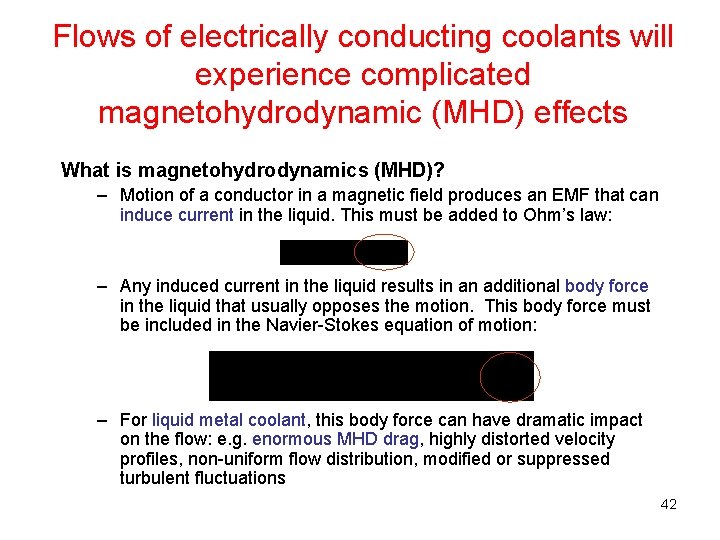
Flows of electrically conducting coolants will experience complicated magnetohydrodynamic (MHD) effects What is magnetohydrodynamics (MHD)? – Motion of a conductor in a magnetic field produces an EMF that can induce current in the liquid. This must be added to Ohm’s law: – Any induced current in the liquid results in an additional body force in the liquid that usually opposes the motion. This body force must be included in the Navier-Stokes equation of motion: – For liquid metal coolant, this body force can have dramatic impact on the flow: e. g. enormous MHD drag, highly distorted velocity profiles, non-uniform flow distribution, modified or suppressed turbulent fluctuations 42
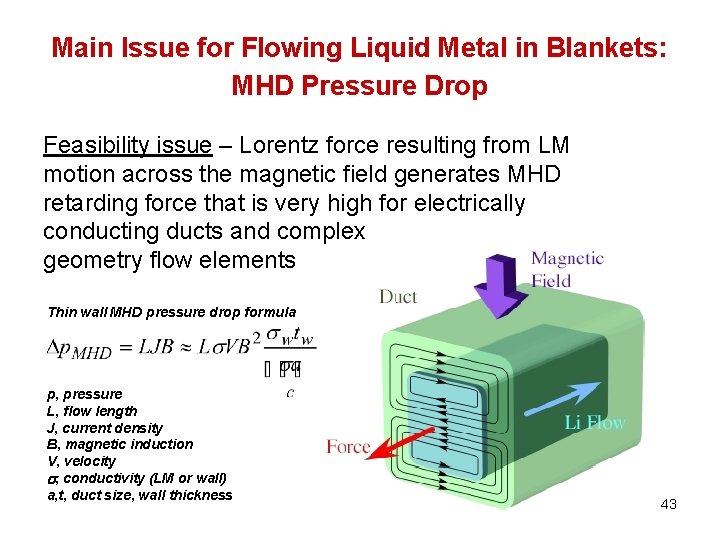
Main Issue for Flowing Liquid Metal in Blankets: MHD Pressure Drop Feasibility issue – Lorentz force resulting from LM motion across the magnetic field generates MHD retarding force that is very high for electrically conducting ducts and complex geometry flow elements Thin wall MHD pressure drop formula p, pressure L, flow length J, current density B, magnetic induction V, velocity , conductivity (LM or wall) a, t, duct size, wall thickness 43
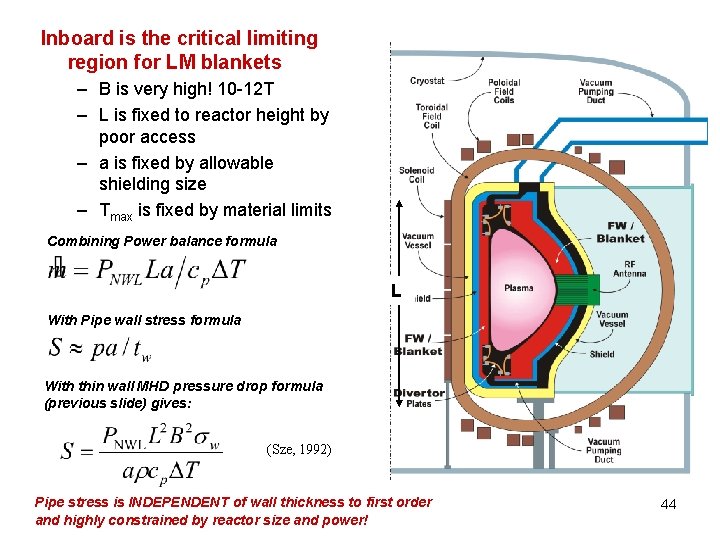
Inboard is the critical limiting region for LM blankets – B is very high! 10 -12 T – L is fixed to reactor height by poor access – a is fixed by allowable shielding size – Tmax is fixed by material limits Combining Power balance formula L With Pipe wall stress formula With thin wall MHD pressure drop formula (previous slide) gives: (Sze, 1992) Pipe stress is INDEPENDENT of wall thickness to first order and highly constrained by reactor size and power! 44
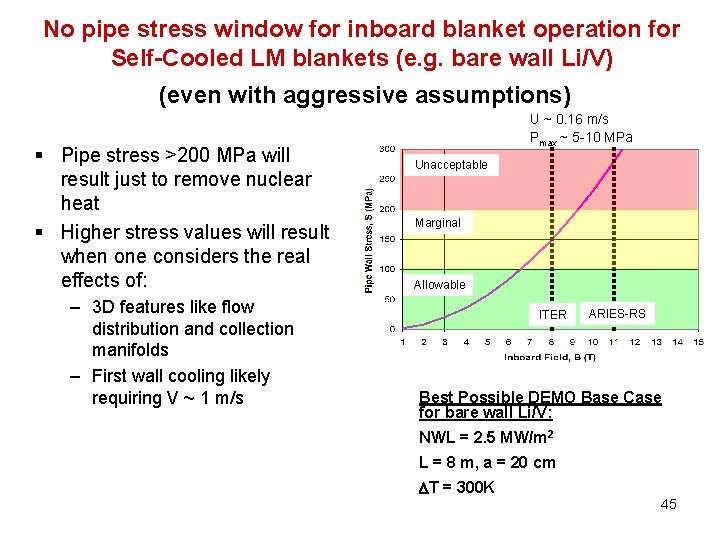
No pipe stress window for inboard blanket operation for Self-Cooled LM blankets (e. g. bare wall Li/V) (even with aggressive assumptions) § Pipe stress >200 MPa will result just to remove nuclear heat § Higher stress values will result when one considers the real effects of: – 3 D features like flow distribution and collection manifolds – First wall cooling likely requiring V ~ 1 m/s U ~ 0. 16 m/s Pmax ~ 5 -10 MPa Unacceptable Marginal Allowable ITER ARIES-RS Best Possible DEMO Base Case for bare wall Li/V: NWL = 2. 5 MW/m 2 L = 8 m, a = 20 cm T = 300 K 45
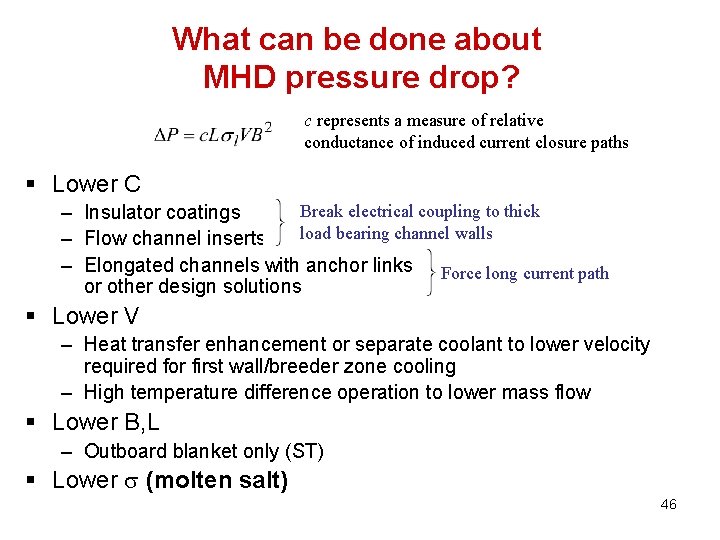
What can be done about MHD pressure drop? c represents a measure of relative conductance of induced current closure paths § Lower C Break electrical coupling to thick – Insulator coatings load bearing channel walls – Flow channel inserts – Elongated channels with anchor links Force long current path or other design solutions § Lower V – Heat transfer enhancement or separate coolant to lower velocity required for first wall/breeder zone cooling – High temperature difference operation to lower mass flow § Lower B, L – Outboard blanket only (ST) § Lower (molten salt) 46
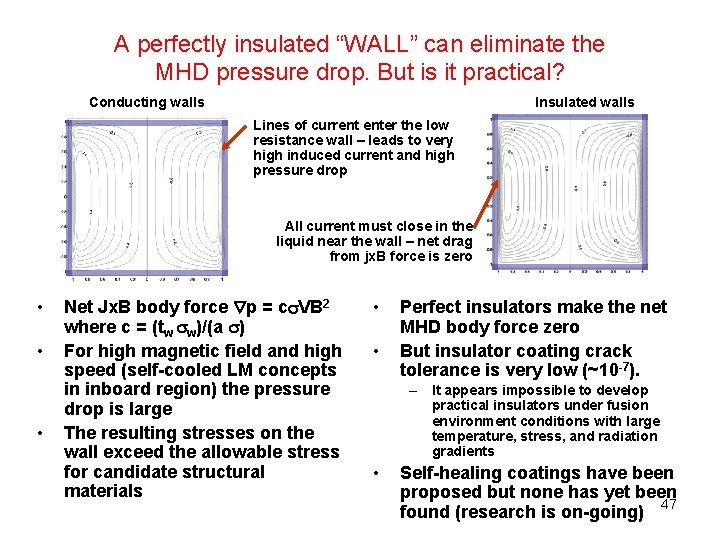
A perfectly insulated “WALL” can eliminate the MHD pressure drop. But is it practical? Conducting walls Insulated walls Lines of current enter the low resistance wall – leads to very high induced current and high pressure drop All current must close in the liquid near the wall – net drag from jx. B force is zero • • • Net Jx. B body force p = c VB 2 where c = (tw w)/(a ) For high magnetic field and high speed (self-cooled LM concepts in inboard region) the pressure drop is large The resulting stresses on the wall exceed the allowable stress for candidate structural materials • • Perfect insulators make the net MHD body force zero But insulator coating crack tolerance is very low (~10 -7). – It appears impossible to develop practical insulators under fusion environment conditions with large temperature, stress, and radiation gradients • Self-healing coatings have been proposed but none has yet been found (research is on-going) 47
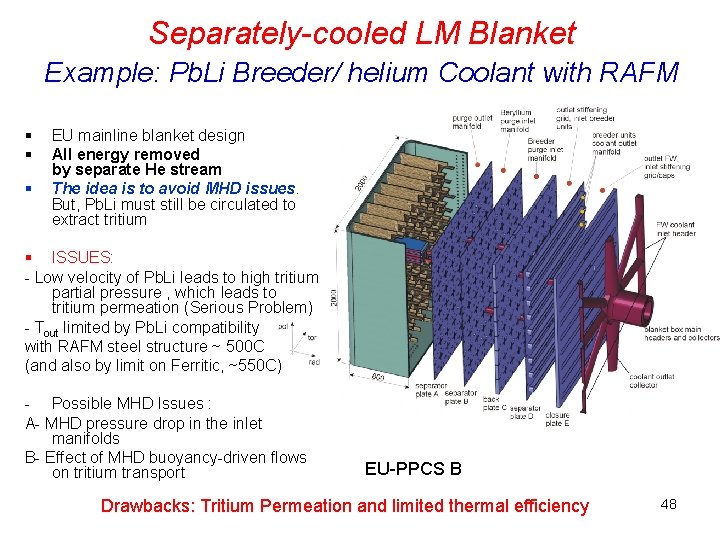
Separately-cooled LM Blanket Example: Pb. Li Breeder/ helium Coolant with RAFM § § § EU mainline blanket design All energy removed by separate He stream The idea is to avoid MHD issues. But, Pb. Li must still be circulated to extract tritium § ISSUES: - Low velocity of Pb. Li leads to high tritium partial pressure , which leads to tritium permeation (Serious Problem) - Tout limited by Pb. Li compatibility with RAFM steel structure ~ 500 C (and also by limit on Ferritic, ~550 C) - Possible MHD Issues : A- MHD pressure drop in the inlet manifolds B- Effect of MHD buoyancy-driven flows on tritium transport EU-PPCS B Drawbacks: Tritium Permeation and limited thermal efficiency 48
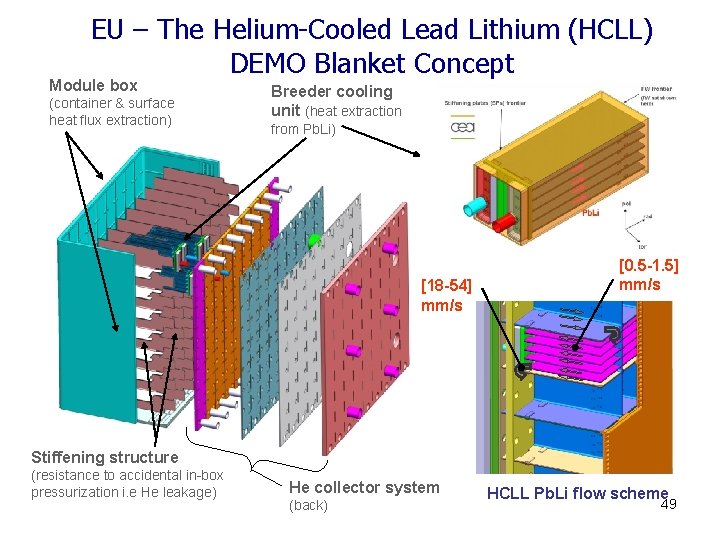
EU – The Helium-Cooled Lead Lithium (HCLL) DEMO Blanket Concept Module box (container & surface heat flux extraction) Breeder cooling unit (heat extraction from Pb. Li) [18 -54] mm/s [0. 5 -1. 5] mm/s Stiffening structure (resistance to accidental in-box pressurization i. e He leakage) He collector system (back) HCLL Pb. Li flow scheme 49
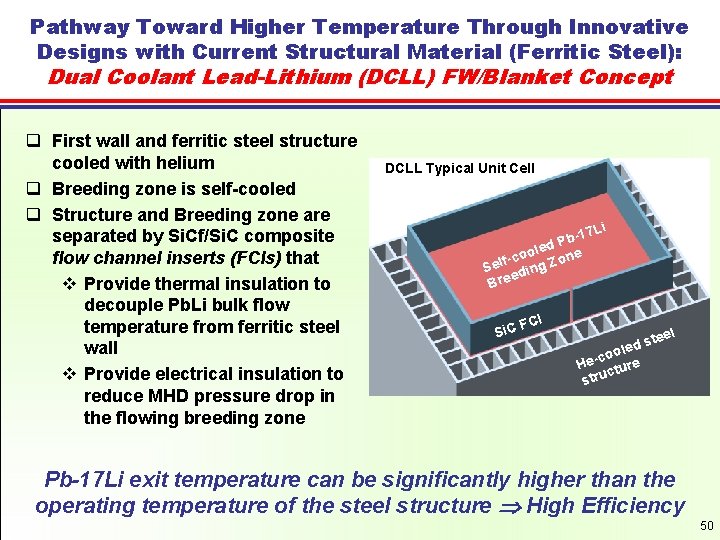
Pathway Toward Higher Temperature Through Innovative Designs with Current Structural Material (Ferritic Steel): Dual Coolant Lead-Lithium (DCLL) FW/Blanket Concept q First wall and ferritic steel structure cooled with helium q Breeding zone is self-cooled q Structure and Breeding zone are separated by Si. Cf/Si. C composite flow channel inserts (FCIs) that v Provide thermal insulation to decouple Pb. Li bulk flow temperature from ferritic steel wall v Provide electrical insulation to reduce MHD pressure drop in the flowing breeding zone DCLL Typical Unit Cell Li b-17 P d oole one c f l Se ding Z e Bre FCI Si. C eel d st e l o co He- ture c stru Pb-17 Li exit temperature can be significantly higher than the operating temperature of the steel structure High Efficiency 50
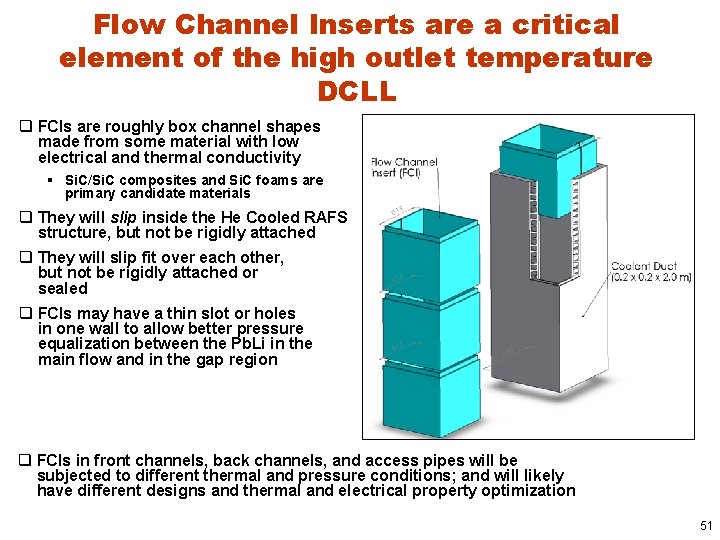
Flow Channel Inserts are a critical element of the high outlet temperature DCLL q FCIs are roughly box channel shapes made from some material with low electrical and thermal conductivity § Si. C/Si. C composites and Si. C foams are primary candidate materials q They will slip inside the He Cooled RAFS structure, but not be rigidly attached q They will slip fit over each other, but not be rigidly attached or sealed q FCIs may have a thin slot or holes in one wall to allow better pressure equalization between the Pb. Li in the main flow and in the gap region q FCIs in front channels, back channels, and access pipes will be subjected to different thermal and pressure conditions; and will likely have different designs and thermal and electrical property optimization 51
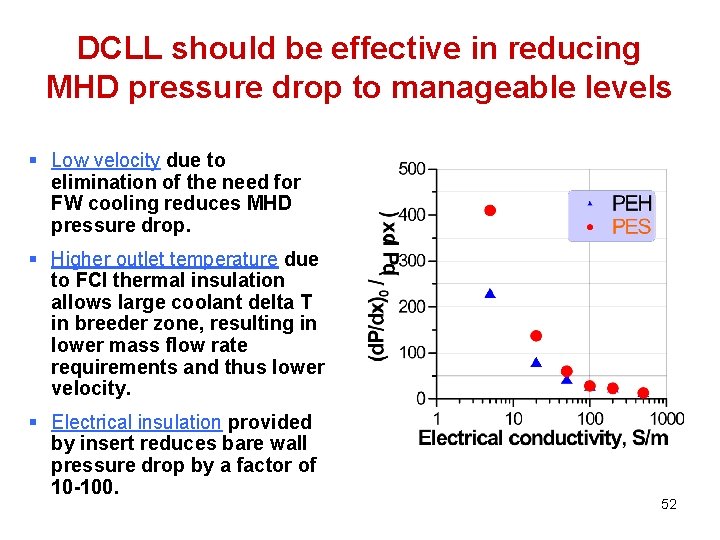
DCLL should be effective in reducing MHD pressure drop to manageable levels § Low velocity due to elimination of the need for FW cooling reduces MHD pressure drop. § Higher outlet temperature due to FCI thermal insulation allows large coolant delta T in breeder zone, resulting in lower mass flow rate requirements and thus lower velocity. § Electrical insulation provided by insert reduces bare wall pressure drop by a factor of 10 -100. 52
Si. Cf/Si. C FCI REQUIREMENTS • Si. C=1 -100 S/m: 101 -103 reduction of MHD pressure drop • k Si. C=1 -10 W/m-K: heat leakage is <10% of the total power (DEMO) • The optimal ( Si. C, k Si. C)* is strongly dependent on thermofluid MHD and should be determined by design tradeoffs, taking into account: - P (<1 -2 MPa) - heat leakage (<10 -15% of the total power) - temperature gradient (<150 -200 K per 5 mm FCI) - Pb. Li-Fe interface temperature (<470 -500 C) • Suggested (DEMO): k Si. C~2 W/m-K; Si. C~100 S/m (S. Smolentsev, N. Morley, M. Abdou, MHD and Thermal Issues of the Si. Cf/Si. C FCI, FST, July 2006 ) * Only k and (across the FCI) are important 53
FCI RELATED R&D Material science • Development of low-conductivity • grade 2 -D woven Si. Cf/Si. C with a • thin surface sealing layer to avoid soaking of Pb. Li into pores • (e. g. using CVD) • Improvement of crack resistance • Reliable measurements of • Si. Cf/Si. C properties at 300 to 800 C, including effect of irradiation • Fabrication of complex shape FCIs with pressure equalization openings and overlap sections Thermofluid MHD Effectiveness of FCI as electrical and thermal insulator Pressure equalization (slot or holes ? ) Effect of FCI on flow balancing in normal and abnormal (cracked FCI) conditions Optimal location of the FCIs in the module 54
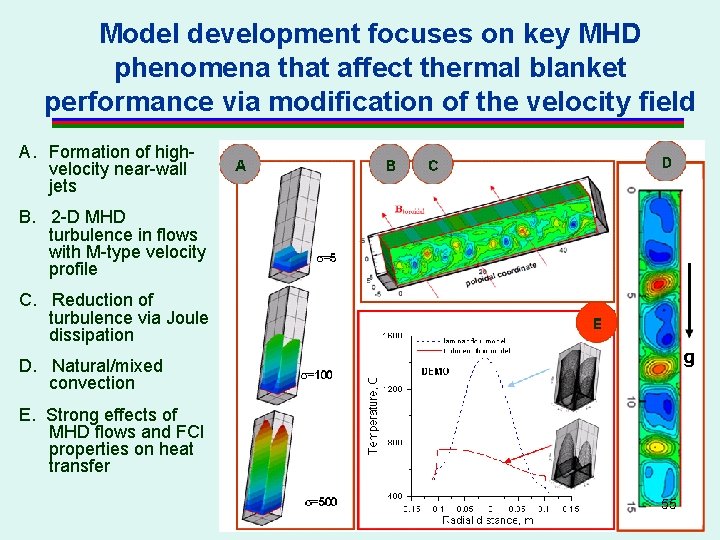
Model development focuses on key MHD phenomena that affect thermal blanket performance via modification of the velocity field A. Formation of highvelocity near-wall jets B. 2 -D MHD turbulence in flows with M-type velocity profile C. Reduction of turbulence via Joule dissipation D. Natural/mixed convection E. Strong effects of MHD flows and FCI properties on heat transfer 55
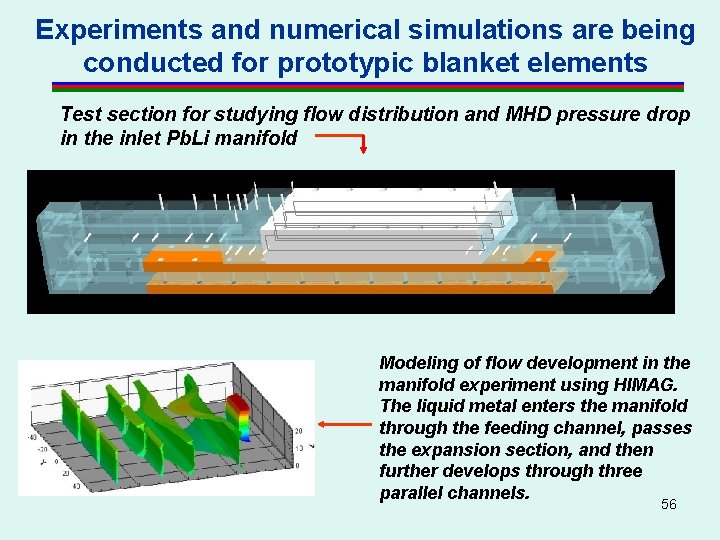
Experiments and numerical simulations are being conducted for prototypic blanket elements Test section for studying flow distribution and MHD pressure drop in the inlet Pb. Li manifold Modeling of flow development in the manifold experiment using HIMAG. The liquid metal enters the manifold through the feeding channel, passes the expansion section, and then further develops through three parallel channels. 56
Molten Salt Blanket Concepts • Lithium-containing molten salts are used as the coolant for the Molten Salt Reactor Experiment (MSRE) • Examples of molten salt are: – Flibe: (Li. F)n · (Be. F 2) – Flinabe: (Li. F-Be. F 2 -Na. F) • The melting point for flibe is high (460ºC for n = 2, 380ºC for n = 1) • Flinabe has a lower melting point (recent measurement at SNL gives about 300ºC) • Flibe has low electrical conductivity, low thermal conductivity 57
Molten Salt Concepts: Advantages and Issues Advantages • Very low pressure operation • Very low tritium solubility • Low MHD interaction • Relatively inert with air and water • Pure material compatible with many structural materials • Relatively low thermal conductivity allows dual coolant concept (high thermal efficiency) without the use of flow-channel inserts Disadvantages • High melting temperature • Need additional Be for tritium breeding • Transmutation products may cause high corrosion • Low tritium solubility means high tritium partial pressure (tritium control problem) • Limited heat removal capability, unless operating at high Re (not an issue for 58 dual-coolant concepts)
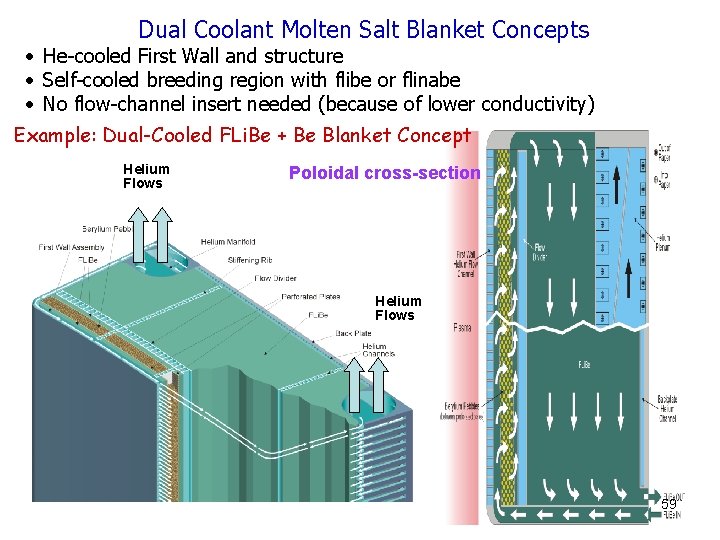
Dual Coolant Molten Salt Blanket Concepts • He-cooled First Wall and structure • Self-cooled breeding region with flibe or flinabe • No flow-channel insert needed (because of lower conductivity) Example: Dual-Cooled FLi. Be + Be Blanket Concept Helium Flows Poloidal cross-section Helium Flows 59
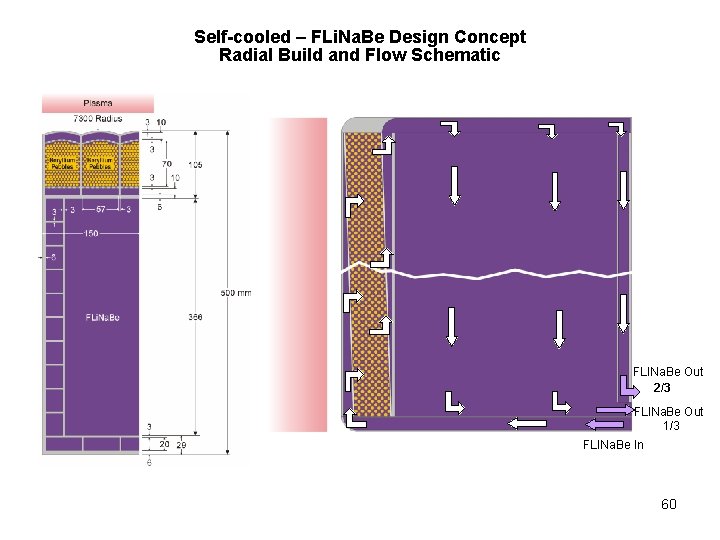
Self-cooled – FLi. Na. Be Design Concept Radial Build and Flow Schematic FLINa. Be Out 2/3 FLINa. Be Out 1/3 FLINa. Be In 60
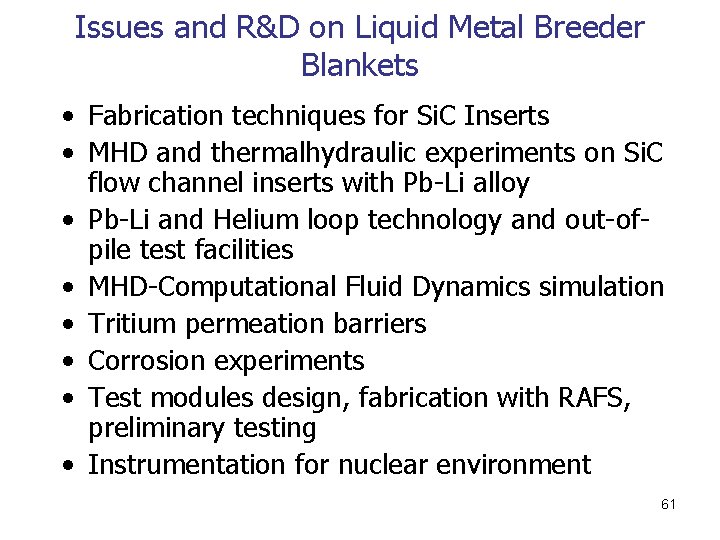
Issues and R&D on Liquid Metal Breeder Blankets • Fabrication techniques for Si. C Inserts • MHD and thermalhydraulic experiments on Si. C flow channel inserts with Pb-Li alloy • Pb-Li and Helium loop technology and out-ofpile test facilities • MHD-Computational Fluid Dynamics simulation • Tritium permeation barriers • Corrosion experiments • Test modules design, fabrication with RAFS, preliminary testing • Instrumentation for nuclear environment 61
Lessons learned: The most challenging problems in FNT are at the INTERFACES • Examples: – MHD insulators – Thermal insulators – Corrosion (liquid/structure interface temperature limit) – Tritium permeation • Research on these interfaces must be done jointly by blanket and materials researchers 62
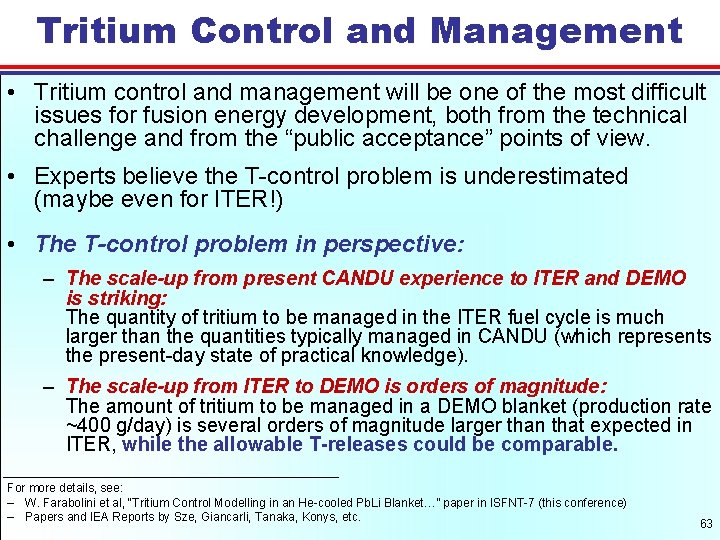
Tritium Control and Management • Tritium control and management will be one of the most difficult issues for fusion energy development, both from the technical challenge and from the “public acceptance” points of view. • Experts believe the T-control problem is underestimated (maybe even for ITER!) • The T-control problem in perspective: – The scale-up from present CANDU experience to ITER and DEMO is striking: The quantity of tritium to be managed in the ITER fuel cycle is much larger than the quantities typically managed in CANDU (which represents the present-day state of practical knowledge). – The scale-up from ITER to DEMO is orders of magnitude: The amount of tritium to be managed in a DEMO blanket (production rate ~400 g/day) is several orders of magnitude larger than that expected in ITER, while the allowable T-releases could be comparable. For more details, see: – W. Farabolini et al, “Tritium Control Modelling in an He-cooled Pb. Li Blanket…” paper in ISFNT-7 (this conference) – Papers and IEA Reports by Sze, Giancarli, Tanaka, Konys, etc. 63
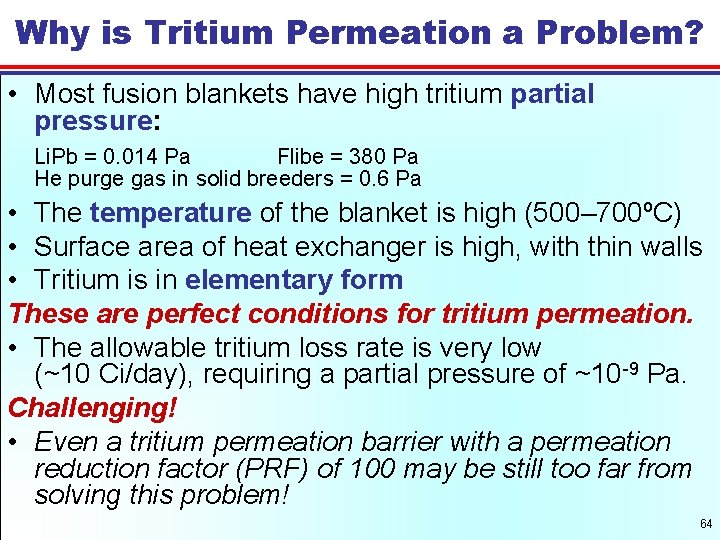
Why is Tritium Permeation a Problem? • Most fusion blankets have high tritium partial pressure: Li. Pb = 0. 014 Pa Flibe = 380 Pa He purge gas in solid breeders = 0. 6 Pa • The temperature of the blanket is high (500– 700ºC) • Surface area of heat exchanger is high, with thin walls • Tritium is in elementary form These are perfect conditions for tritium permeation. • The allowable tritium loss rate is very low (~10 Ci/day), requiring a partial pressure of ~10 -9 Pa. Challenging! • Even a tritium permeation barrier with a permeation reduction factor (PRF) of 100 may be still too far from solving this problem! 64
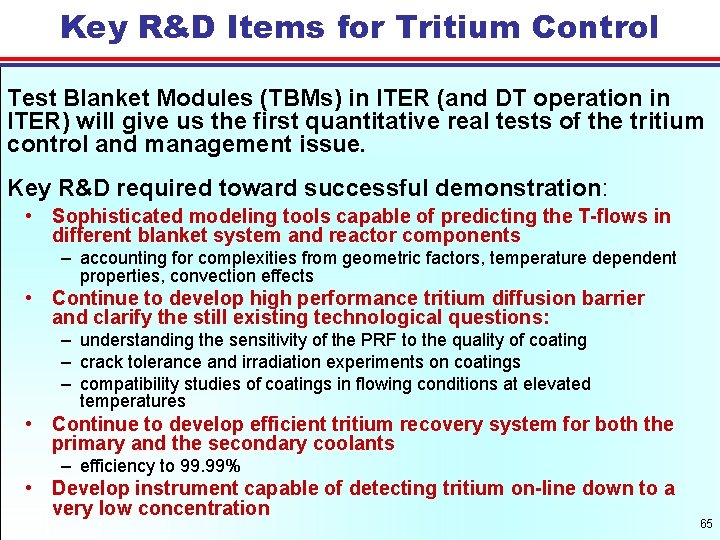
Key R&D Items for Tritium Control Test Blanket Modules (TBMs) in ITER (and DT operation in ITER) will give us the first quantitative real tests of the tritium control and management issue. Key R&D required toward successful demonstration: • Sophisticated modeling tools capable of predicting the T-flows in different blanket system and reactor components – accounting for complexities from geometric factors, temperature dependent properties, convection effects • Continue to develop high performance tritium diffusion barrier and clarify the still existing technological questions: – understanding the sensitivity of the PRF to the quality of coating – crack tolerance and irradiation experiments on coatings – compatibility studies of coatings in flowing conditions at elevated temperatures • Continue to develop efficient tritium recovery system for both the primary and the secondary coolants – efficiency to 99. 99% • Develop instrument capable of detecting tritium on-line down to a very low concentration 65
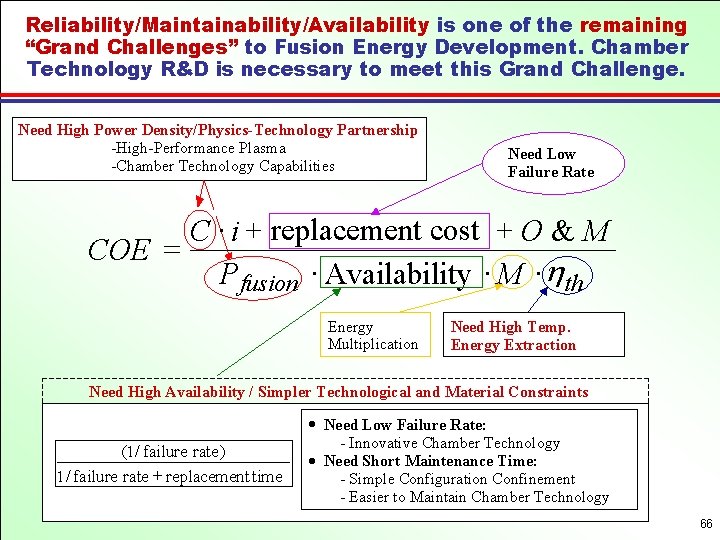
Reliability/Maintainability/Availability is one of the remaining “Grand Challenges” to Fusion Energy Development. Chamber Technology R&D is necessary to meet this Grand Challenge. Need High Power Density/Physics-Technology Partnership -High-Performance Plasma -Chamber Technology Capabilities Need Low Failure Rate C × i + replacement cost + O & M COE = P fusion × Availability × M × h th Energy Multiplication Need High Temp. Energy Extraction Need High Availability / Simpler Technological and Material Constraints (1 / failure rate ) 1 / failure rate + replacement time · Need Low Failure Rate: - Innovative Chamber Technology · Need Short Maintenance Time: - Simple Configuration Confinement - Easier to Maintain Chamber Technology 66
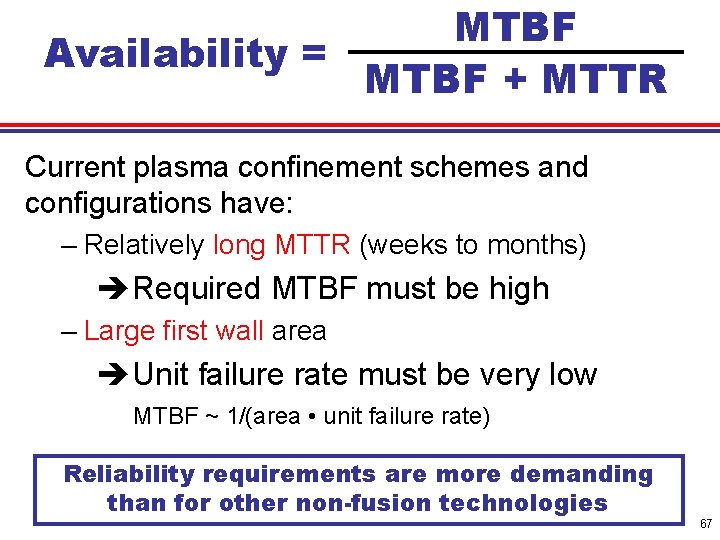
MTBF Availability = MTBF + MTTR Current plasma confinement schemes and configurations have: – Relatively long MTTR (weeks to months) èRequired MTBF must be high – Large first wall area èUnit failure rate must be very low MTBF ~ 1/(area • unit failure rate) Reliability requirements are more demanding than for other non-fusion technologies 67
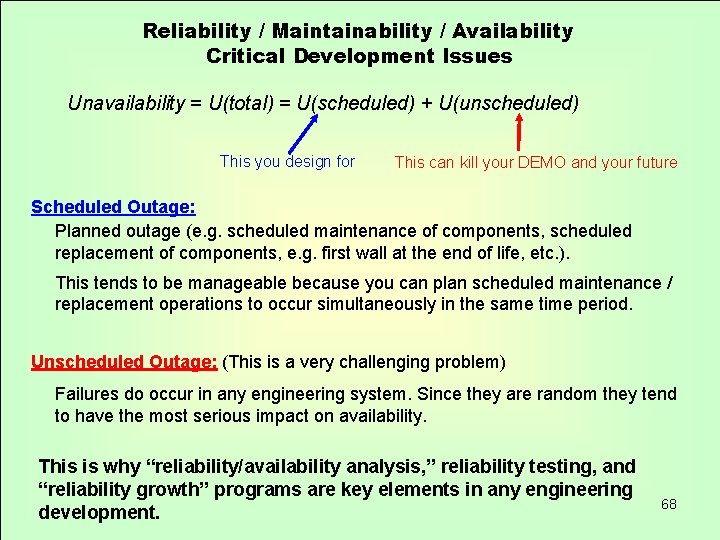
Reliability / Maintainability / Availability Critical Development Issues Unavailability = U(total) = U(scheduled) + U(unscheduled) This you design for This can kill your DEMO and your future Scheduled Outage: Planned outage (e. g. scheduled maintenance of components, scheduled replacement of components, e. g. first wall at the end of life, etc. ). This tends to be manageable because you can plan scheduled maintenance / replacement operations to occur simultaneously in the same time period. Unscheduled Outage: (This is a very challenging problem) Failures do occur in any engineering system. Since they are random they tend to have the most serious impact on availability. This is why “reliability/availability analysis, ” reliability testing, and “reliability growth” programs are key elements in any engineering development. 68
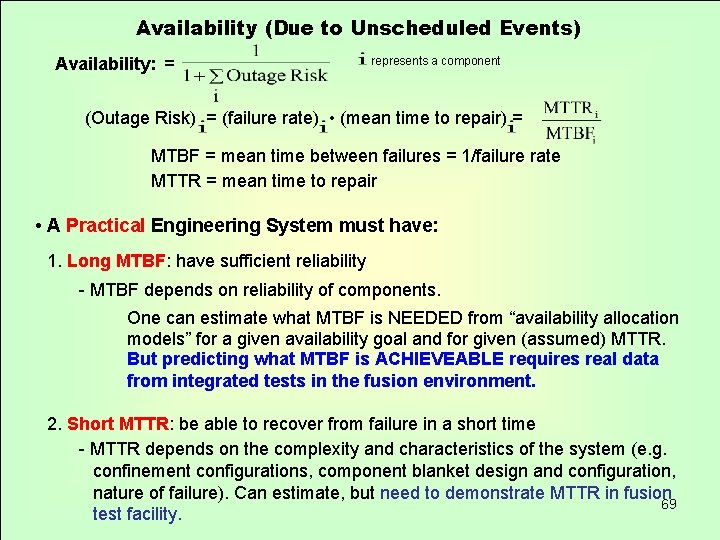
Availability (Due to Unscheduled Events) Availability: = represents a component (Outage Risk) = (failure rate) • (mean time to repair) = MTBF = mean time between failures = 1/failure rate MTTR = mean time to repair • A Practical Engineering System must have: 1. Long MTBF: have sufficient reliability - MTBF depends on reliability of components. One can estimate what MTBF is NEEDED from “availability allocation models” for a given availability goal and for given (assumed) MTTR. But predicting what MTBF is ACHIEVEABLE requires real data from integrated tests in the fusion environment. 2. Short MTTR: be able to recover from failure in a short time - MTTR depends on the complexity and characteristics of the system (e. g. confinement configurations, component blanket design and configuration, nature of failure). Can estimate, but need to demonstrate MTTR in fusion 69 test facility.
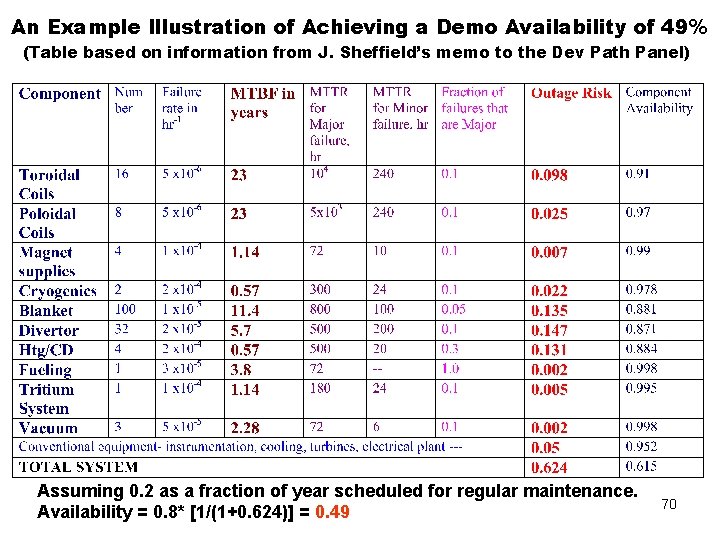
An Example Illustration of Achieving a Demo Availability of 49% (Table based on information from J. Sheffield’s memo to the Dev Path Panel) Assuming 0. 2 as a fraction of year scheduled for regular maintenance. Availability = 0. 8* [1/(1+0. 624)] = 0. 49 70
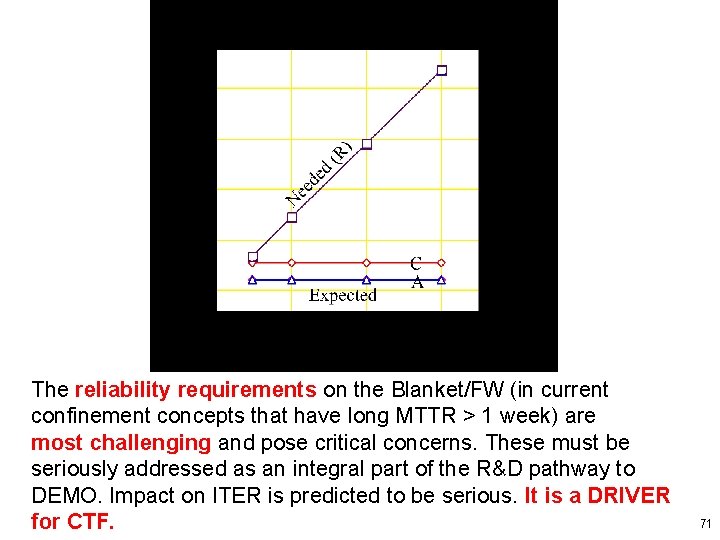
The reliability requirements on the Blanket/FW (in current confinement concepts that have long MTTR > 1 week) are most challenging and pose critical concerns. These must be seriously addressed as an integral part of the R&D pathway to DEMO. Impact on ITER is predicted to be serious. It is a DRIVER for CTF. 71
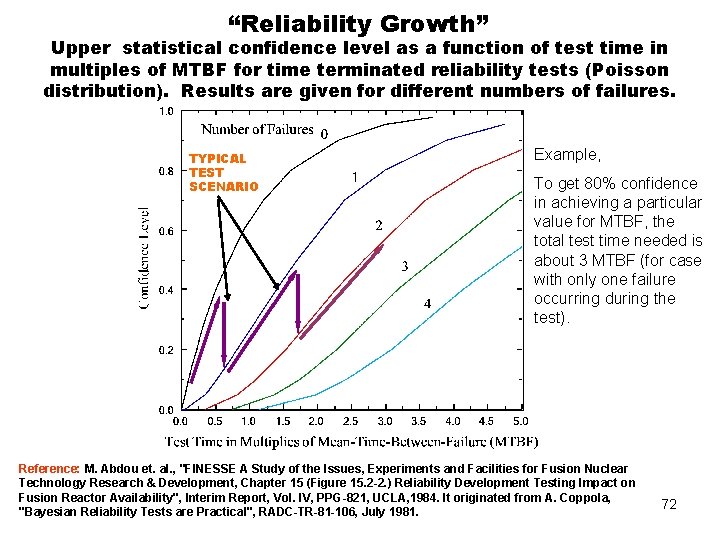
“Reliability Growth” Upper statistical confidence level as a function of test time in multiples of MTBF for time terminated reliability tests (Poisson distribution). Results are given for different numbers of failures. TYPICAL TEST SCENARIO Example, To get 80% confidence in achieving a particular value for MTBF, the total test time needed is about 3 MTBF (for case with only one failure occurring during the test). Reference: M. Abdou et. al. , "FINESSE A Study of the Issues, Experiments and Facilities for Fusion Nuclear Technology Research & Development, Chapter 15 (Figure 15. 2 -2. ) Reliability Development Testing Impact on Fusion Reactor Availability", Interim Report, Vol. IV, PPG-821, UCLA, 1984. It originated from A. Coppola, "Bayesian Reliability Tests are Practical", RADC-TR-81 -106, July 1981. 72
Reliability/Availability is a challenge to fusion, particularly blanket/PFC, development • Fusion System has many major components (TFC, PFC, plasma heating, vacuum vessel, blanket, divertor, tritium system, fueling, etc. ) - Each component is required to have high availability • All systems except the reactor core (blanket/PFC) will have reliability data from ITER and other facilities • There is NO data for blanket/PFC (we do not even know if any present blanket concept is feasible) • Estimates using available data from fission and aerospace for unit failure rates and using the surface area of a tokamak show: PROBABLE MTBF for Blanket ~ 0. 01 to 0. 2 yr compared to REQUIRED MTBF of many years Aggressive “Reliability Growth” Program We must have an aggressive “reliability growth” program for the blanket / PFC (beyond demonstrating engineering feasibility) 1) All new technologies go through a reliability growth program 2) Must be “aggressive” because extrapolation from other technologies (e. g. fission) strongly indicates we have a serious CHALLENGE 73
Summary of Critical R&D Issues for Fusion Nuclear Technology 1. 2. D-T fuel cycle tritium self-sufficiency in a practical system 3. 2. Tritium extraction and inventory in the solid/liquid breeders under actual operating conditions Thermomechanical loadings and response of blanket and PFC components under normal and off-normal operation Materials interactions and compatibility Identification and characterization of failure modes, effects, and rates in blankets and PFC’s Engineering feasibility and reliability of electric (MHD) insulators and tritium permeation barriers under thermal / mechanical / electrical / magnetic / nuclear loadings with high temperature and stress gradients Tritium permeation, control and inventory in blanket and PFC Lifetime of blanket, PFC, and other FNT components Remote maintenance with acceptable machine shutdown time 3. 4. 5. 6. 7. 8. 9. depends on many physics and engineering parameters / details: e. g. fractional burn-up in plasma, tritium inventories, FW thickness, penetrations, passive coils, etc.
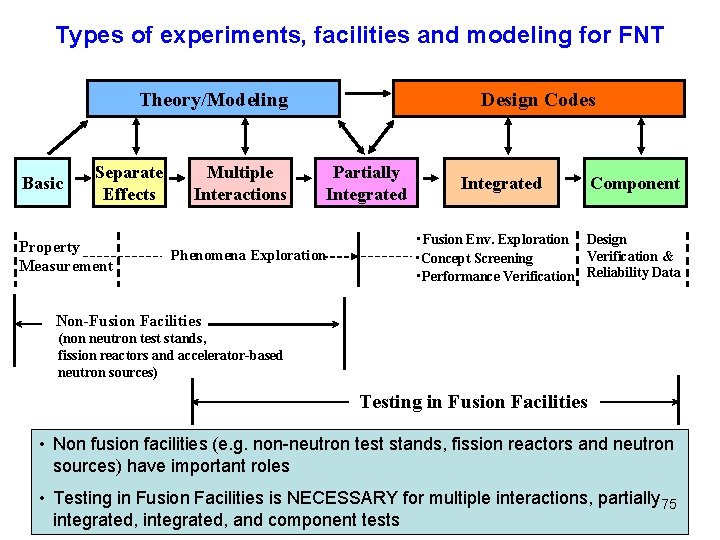
Types of experiments, facilities and modeling for FNT Theory/Modeling Basic Separate Effects Property Measurement Multiple Interactions Design Codes Partially Integrated Phenomena Exploration Integrated Component • Fusion Env. Exploration Design Verification & • Concept Screening • Performance Verification Reliability Data Non-Fusion Facilities (non neutron test stands, fission reactors and accelerator-based neutron sources) Testing in Fusion Facilities • Non fusion facilities (e. g. non-neutron test stands, fission reactors and neutron sources) have important roles • Testing in Fusion Facilities is NECESSARY for multiple interactions, partially 75 integrated, and component tests
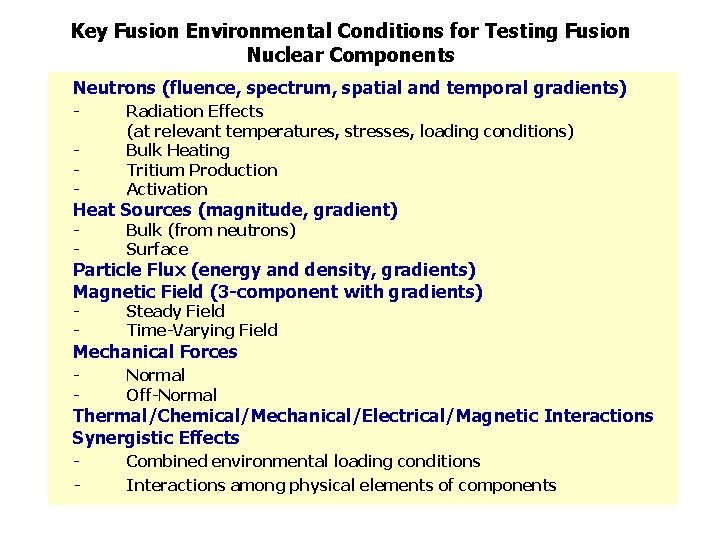
Key Fusion Environmental Conditions for Testing Fusion Nuclear Components Neutrons (fluence, spectrum, spatial and temporal gradients) - Radiation Effects (at relevant temperatures, stresses, loading conditions) Bulk Heating Tritium Production Activation - Bulk (from neutrons) Surface - Steady Field Time-Varying Field - Normal Off-Normal - Combined environmental loading conditions Interactions among physical elements of components Heat Sources (magnitude, gradient) Particle Flux (energy and density, gradients) Magnetic Field (3 -component with gradients) Mechanical Forces Thermal/Chemical/Mechanical/Electrical/Magnetic Interactions Synergistic Effects
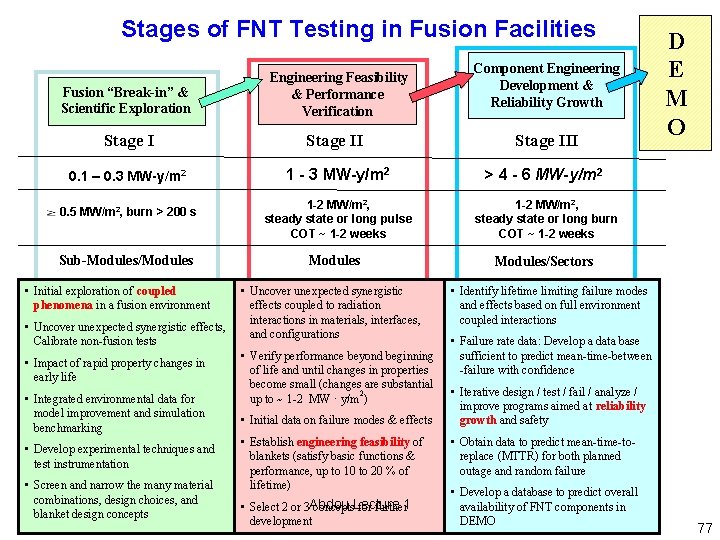
Stages of FNT Testing in Fusion Facilities Fusion “Break-in” & Scientific Exploration Stage I 2 0. 1 – 0. 3 MW-y/m 0. 5 MW/m 2, burn > 200 s Sub-Modules/Modules • Initial exploration of coupled phenomena in a fusion environment • Uncover unexpected synergistic effects, Calibrate non-fusion tests • Impact of rapid property changes in early life • Integrated environmental data for model improvement and simulation benchmarking • Develop experimental techniques and test instrumentation • Screen and narrow the many material combinations, design choices, and blanket design concepts Engineering Feasibility & Performance Verification Component Engineering Development & Reliability Growth Stage III 1 - 3 MW-y/m 2 > 4 - 6 MW-y/m 2 1 -2 MW/m 2, steady state or long pulse COT ~ 1 -2 weeks 1 -2 MW/m 2, steady state or long burn COT ~ 1 -2 weeks Modules • Uncover unexpected synergistic effects coupled to radiation interactions in materials, interfaces, and configurations • Verify performance beyond beginning of life and until changes in properties become small (changes are substantial 2 up to ~ 1 -2 MW · y/m ) • Initial data on failure modes & effects • Establish engineering feasibility of blankets (satisfy basic functions & performance, up to 10 to 20 % of lifetime) • Select 2 or 3 Abdou Lecture 1 concepts for further development D E M O Modules/Sectors • Identify lifetime limiting failure modes and effects based on full environment coupled interactions • Failure rate data: Develop a data base sufficient to predict mean-time-between -failure with confidence • Iterative design / test / fail / analyze / improve programs aimed at reliability growth and safety • Obtain data to predict mean-time-toreplace (MTTR) for both planned outage and random failure • Develop a database to predict overall availability of FNT components in DEMO 77
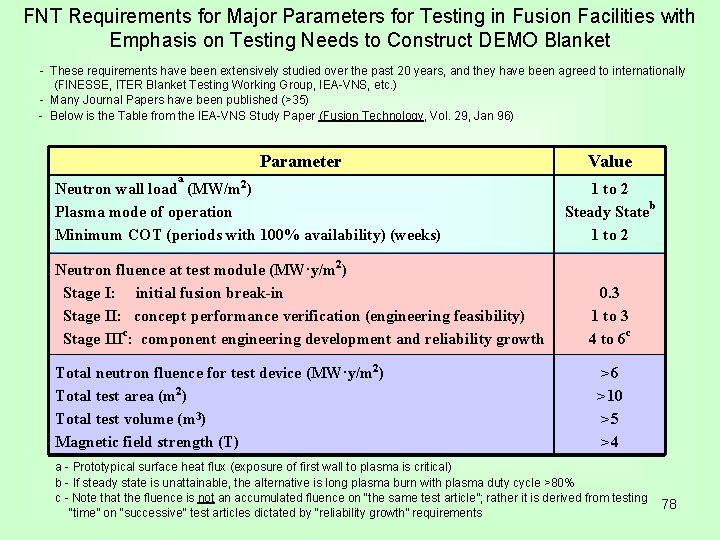
FNT Requirements for Major Parameters for Testing in Fusion Facilities with Emphasis on Testing Needs to Construct DEMO Blanket - These requirements have been extensively studied over the past 20 years, and they have been agreed to internationally (FINESSE, ITER Blanket Testing Working Group, IEA-VNS, etc. ) - Many Journal Papers have been published (>35) - Below is the Table from the IEA-VNS Study Paper (Fusion Technology, Vol. 29, Jan 96) Parameter a Neutron wall load (MW/m 2) Plasma mode of operation Minimum COT (periods with 100% availability) (weeks) Neutron fluence at test module (MW·y/m 2) Stage I: initial fusion break-in Stage II: concept performance verification (engineering feasibility) Stage IIIc: component engineering development and reliability growth Total neutron fluence for test device (MW·y/m 2) Total test area (m 2) Total test volume (m 3) Magnetic field strength (T) Value 1 to 2 Steady Stateb 1 to 2 0. 3 1 to 3 4 to 6 c >6 >10 >5 >4 a - Prototypical surface heat flux (exposure of first wall to plasma is critical) b - If steady state is unattainable, the alternative is long plasma burn with plasma duty cycle >80% c - Note that the fluence is not an accumulated fluence on “the same test article”; rather it is derived from testing 78 “time” on “successive” test articles dictated by “reliability growth” requirements
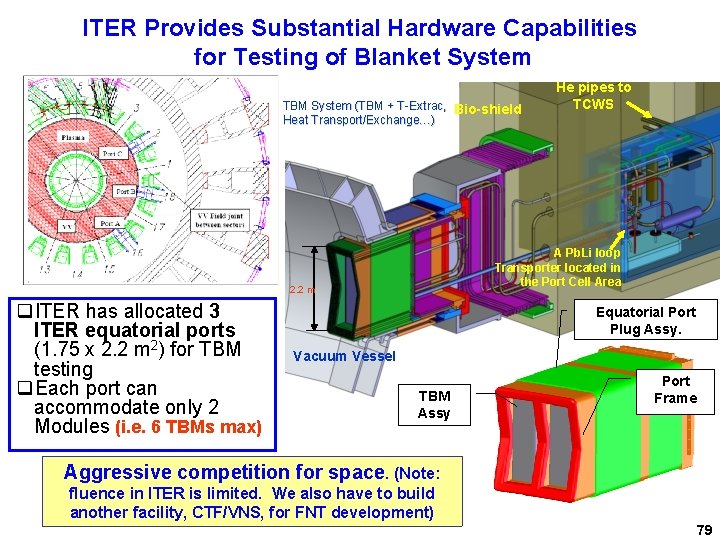
ITER Provides Substantial Hardware Capabilities for Testing of Blanket System TBM System (TBM + T-Extrac , Bio-shield TBM System (TBM + T-Extrac, Heat Transport/Exchange…) A Pb. Li loop Transporter located in the Port Cell Area 2. 2 m q. ITER has allocated 3 ITER equatorial ports (1. 75 x 2. 2 m 2) for TBM testing q. Each port can accommodate only 2 Modules (i. e. 6 TBMs max) He pipes to TCWS Equatorial Port Plug Assy. Vacuum Vessel TBM Assy Port Frame Aggressive competition for space. (Note: fluence in ITER is limited. We also have to build another facility, CTF/VNS, for FNT development) 79
What is CTF (VNS)? • The idea of CTF is to build a small size, low fusion power DT plasma-based device in which Fusion Nuclear Technology experiments (for engineering development and reliability growth) can be performed in the relevant fusion environment: 1 - at the smallest possible scale, cost, and risk, and 2 - with practical strategy for solving the tritium consumption and supply issues for FNT development. - In MFE: small-size, low fusion power can be obtained in a driven, low-Q, plasma device. (But the minimum fusion power for tokamak is >100 MW. ) • This is a faster, much less expensive approach than testing in a large, ignited/high Q plasma device for which tritium consumption, and cost of operating to high fluence are very high (unaffordable!, not practical). 80
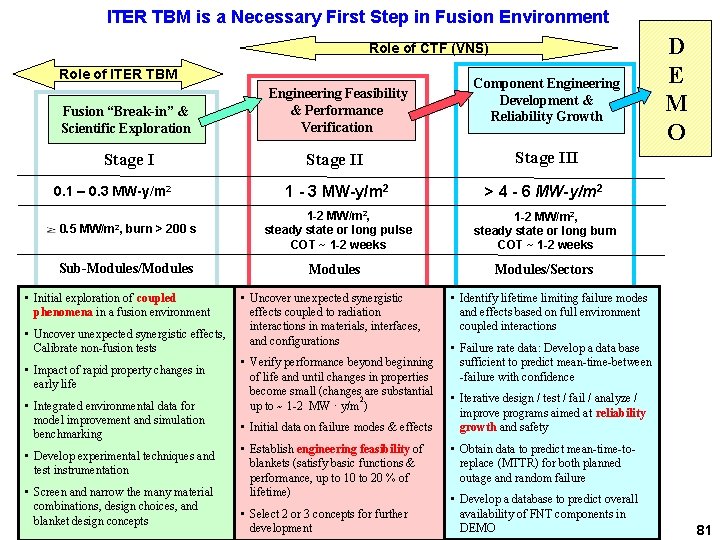
ITER TBM is a Necessary First Step in Fusion Environment Role of CTF (VNS) Role of ITER TBM Component Engineering Development & Reliability Growth Fusion “Break-in” & Scientific Exploration Engineering Feasibility & Performance Verification Stage III 1 - 3 MW-y/m 2 > 4 - 6 MW-y/m 2 1 -2 MW/m 2, steady state or long pulse COT ~ 1 -2 weeks 1 -2 MW/m 2, steady state or long burn COT ~ 1 -2 weeks 0. 1 – 0. 3 MW-y/m 2 0. 5 MW/m 2, burn > 200 s Sub-Modules/Modules • Initial exploration of coupled phenomena in a fusion environment • Uncover unexpected synergistic effects, Calibrate non-fusion tests • Impact of rapid property changes in early life • Integrated environmental data for model improvement and simulation benchmarking • Develop experimental techniques and test instrumentation • Screen and narrow the many material combinations, design choices, and blanket design concepts Modules • Uncover unexpected synergistic effects coupled to radiation interactions in materials, interfaces, and configurations • Verify performance beyond beginning of life and until changes in properties become small (changes are substantial 2 up to ~ 1 -2 MW · y/m ) • Initial data on failure modes & effects • Establish engineering feasibility of blankets (satisfy basic functions & performance, up to 10 to 20 % of lifetime) • Select 2 or 3 concepts for further development D E M O Modules/Sectors • Identify lifetime limiting failure modes and effects based on full environment coupled interactions • Failure rate data: Develop a data base sufficient to predict mean-time-between -failure with confidence • Iterative design / test / fail / analyze / improve programs aimed at reliability growth and safety • Obtain data to predict mean-time-toreplace (MTTR) for both planned outage and random failure • Develop a database to predict overall availability of FNT components in DEMO 81
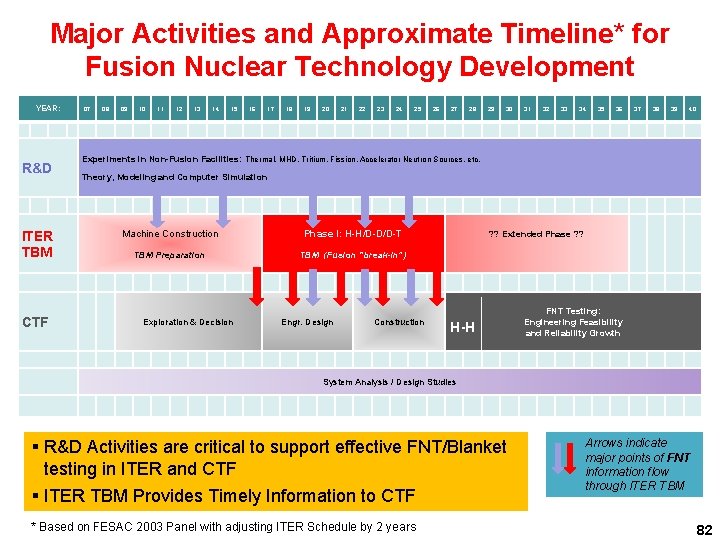
Major Activities and Approximate Timeline* for Fusion Nuclear Technology Development YEAR: R&D ITER TBM CTF 07 08 09 10 11 12 13 14 15 16 17 18 19 20 21 22 23 24 25 26 27 28 29 30 31 32 33 34 35 36 37 38 39 40 Experiments in Non-Fusion Facilities: Thermal, MHD, Tritium, Fission, Accelerator Neutron Sources, etc. Theory, Modeling and Computer Simulation Machine Construction Phase I: H-H/D-D/D-T TBM Preparation TBM (Fusion “break-in”) Exploration & Decision Engr. Design Construction ? ? Extended Phase ? ? H-H FNT Testing: Engineering Feasibility and Reliability Growth System Analysis / Design Studies § R&D Activities are critical to support effective FNT/Blanket testing in ITER and CTF § ITER TBM Provides Timely Information to CTF * Based on FESAC 2003 Panel with adjusting ITER Schedule by 2 years Arrows indicate major points of FNT information flow through ITER TBM 82
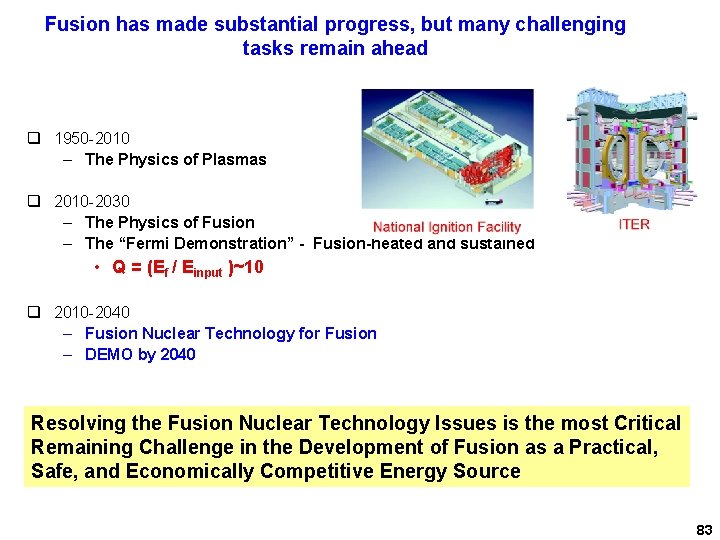
Fusion has made substantial progress, but many challenging tasks remain ahead q 1950 -2010 – The Physics of Plasmas q 2010 -2030 – The Physics of Fusion – The “Fermi Demonstration” - Fusion-heated and sustained • Q = (Ef / Einput )~10 q 2010 -2040 – Fusion Nuclear Technology for Fusion – DEMO by 2040 Resolving the Fusion Nuclear Technology Issues is the most Critical Remaining Challenge in the Development of Fusion as a Practical, Safe, and Economically Competitive Energy Source 83
APPENDIX 84
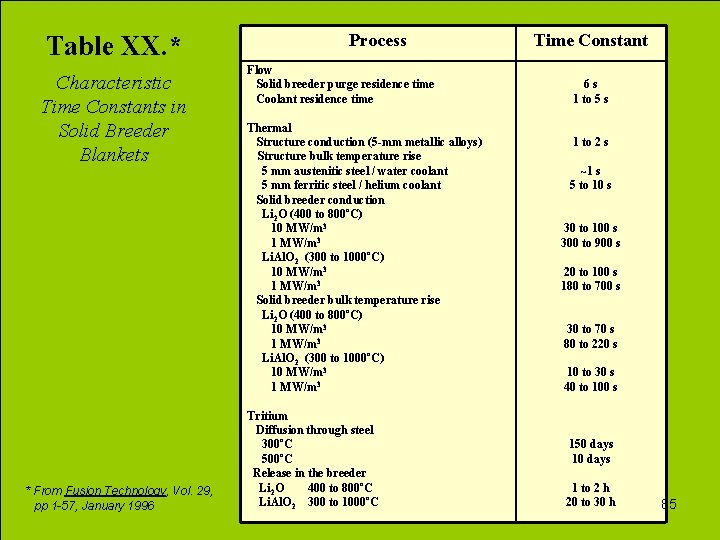
Table XX. * Characteristic Time Constants in Solid Breeder Blankets * From Fusion Technology, Vol. 29, pp 1 -57, January 1996 Process Flow Solid breeder purge residence time Coolant residence time Thermal Structure conduction (5 -mm metallic alloys) Structure bulk temperature rise 5 mm austenitic steel / water coolant 5 mm ferritic steel / helium coolant Solid breeder conduction Li 2 O (400 to 800ºC) 10 MW/m 3 1 MW/m 3 Li. Al. O 2 (300 to 1000ºC) 10 MW/m 3 1 MW/m 3 Solid breeder bulk temperature rise Li 2 O (400 to 800ºC) 10 MW/m 3 1 MW/m 3 Li. Al. O 2 (300 to 1000ºC) 10 MW/m 3 1 MW/m 3 Tritium Diffusion through steel 300ºC 500ºC Release in the breeder Li 2 O 400 to 800ºC Li. Al. O 2 300 to 1000ºC Time Constant 6 s 1 to 5 s 1 to 2 s ~1 s 5 to 10 s 30 to 100 s 300 to 900 s 20 to 100 s 180 to 700 s 30 to 70 s 80 to 220 s 10 to 30 s 40 to 100 s 150 days 1 to 2 h 20 to 30 h 85
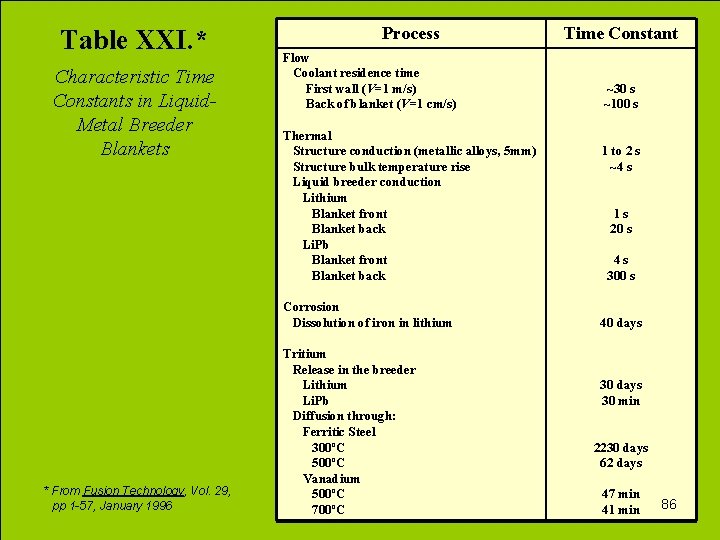
Table XXI. * Characteristic Time Constants in Liquid. Metal Breeder Blankets Process Flow Coolant residence time First wall (V=1 m/s) Back of blanket (V=1 cm/s) Thermal Structure conduction (metallic alloys, 5 mm) Structure bulk temperature rise Liquid breeder conduction Lithium Blanket front Blanket back Li. Pb Blanket front Blanket back Corrosion Dissolution of iron in lithium * From Fusion Technology, Vol. 29, pp 1 -57, January 1996 Tritium Release in the breeder Lithium Li. Pb Diffusion through: Ferritic Steel 300ºC 500ºC Vanadium 500ºC 700ºC Time Constant ~30 s ~100 s 1 to 2 s ~4 s 1 s 20 s 4 s 300 s 40 days 30 min 2230 days 62 days 47 min 86 41 min
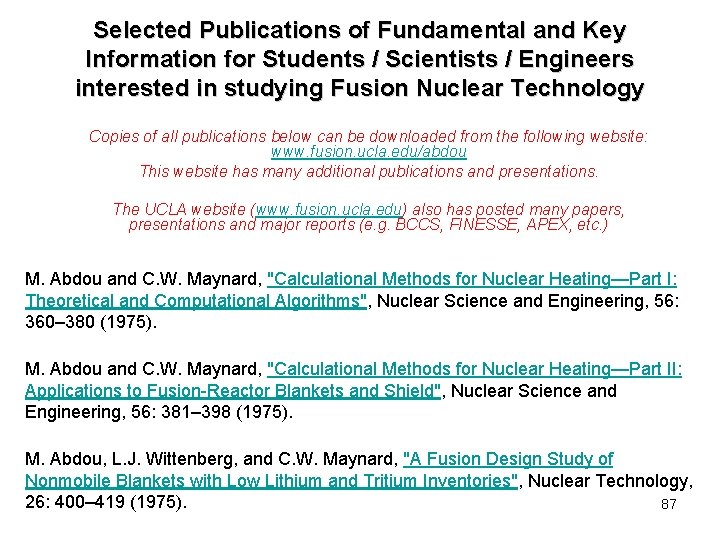
Selected Publications of Fundamental and Key Information for Students / Scientists / Engineers interested in studying Fusion Nuclear Technology Copies of all publications below can be downloaded from the following website: www. fusion. ucla. edu/abdou This website has many additional publications and presentations. The UCLA website (www. fusion. ucla. edu) also has posted many papers, presentations and major reports (e. g. BCCS, FINESSE, APEX, etc. ) M. Abdou and C. W. Maynard, "Calculational Methods for Nuclear Heating—Part I: Theoretical and Computational Algorithms", Nuclear Science and Engineering, 56: 360– 380 (1975). M. Abdou and C. W. Maynard, "Calculational Methods for Nuclear Heating—Part II: Applications to Fusion-Reactor Blankets and Shield", Nuclear Science and Engineering, 56: 381– 398 (1975). M. Abdou, L. J. Wittenberg, and C. W. Maynard, "A Fusion Design Study of Nonmobile Blankets with Low Lithium and Tritium Inventories", Nuclear Technology, 26: 400– 419 (1975). 87
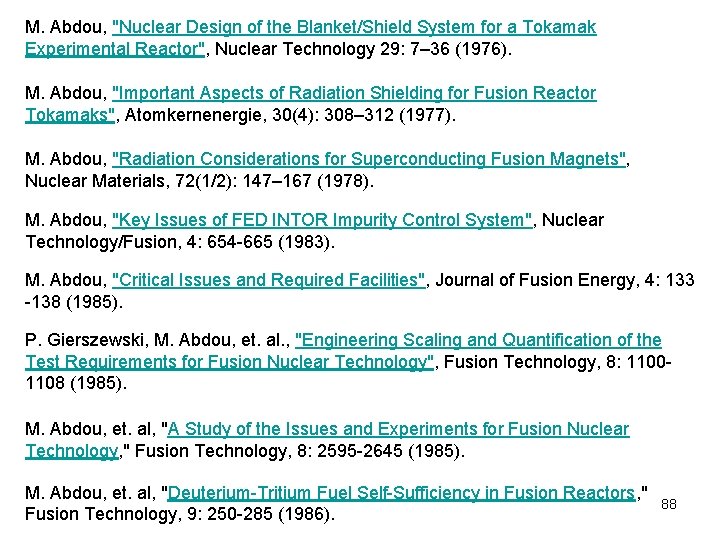
M. Abdou, "Nuclear Design of the Blanket/Shield System for a Tokamak Experimental Reactor", Nuclear Technology 29: 7– 36 (1976). M. Abdou, "Important Aspects of Radiation Shielding for Fusion Reactor Tokamaks", Atomkernenergie, 30(4): 308– 312 (1977). M. Abdou, "Radiation Considerations for Superconducting Fusion Magnets", Nuclear Materials, 72(1/2): 147– 167 (1978). M. Abdou, "Key Issues of FED INTOR Impurity Control System", Nuclear Technology/Fusion, 4: 654 -665 (1983). M. Abdou, "Critical Issues and Required Facilities", Journal of Fusion Energy, 4: 133 -138 (1985). P. Gierszewski, M. Abdou, et. al. , "Engineering Scaling and Quantification of the Test Requirements for Fusion Nuclear Technology", Fusion Technology, 8: 11001108 (1985). M. Abdou, et. al, "A Study of the Issues and Experiments for Fusion Nuclear Technology, " Fusion Technology, 8: 2595 -2645 (1985). M. Abdou, et. al, "Deuterium-Tritium Fuel Self-Sufficiency in Fusion Reactors, " Fusion Technology, 9: 250 -285 (1986). 88
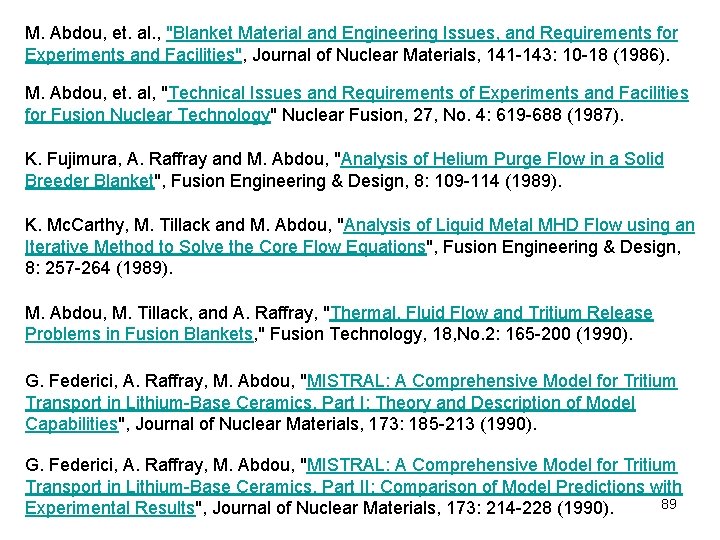
M. Abdou, et. al. , "Blanket Material and Engineering Issues, and Requirements for Experiments and Facilities", Journal of Nuclear Materials, 141 -143: 10 -18 (1986). M. Abdou, et. al, "Technical Issues and Requirements of Experiments and Facilities for Fusion Nuclear Technology" Nuclear Fusion, 27, No. 4: 619 -688 (1987). K. Fujimura, A. Raffray and M. Abdou, "Analysis of Helium Purge Flow in a Solid Breeder Blanket", Fusion Engineering & Design, 8: 109 -114 (1989). K. Mc. Carthy, M. Tillack and M. Abdou, "Analysis of Liquid Metal MHD Flow using an Iterative Method to Solve the Core Flow Equations", Fusion Engineering & Design, 8: 257 -264 (1989). M. Abdou, M. Tillack, and A. Raffray, "Thermal, Fluid Flow and Tritium Release Problems in Fusion Blankets, " Fusion Technology, 18, No. 2: 165 -200 (1990). G. Federici, A. Raffray, M. Abdou, "MISTRAL: A Comprehensive Model for Tritium Transport in Lithium-Base Ceramics. Part I: Theory and Description of Model Capabilities", Journal of Nuclear Materials, 173: 185 -213 (1990). G. Federici, A. Raffray, M. Abdou, "MISTRAL: A Comprehensive Model for Tritium Transport in Lithium-Base Ceramics. Part II: Comparison of Model Predictions with 89 Experimental Results", Journal of Nuclear Materials, 173: 214 -228 (1990).
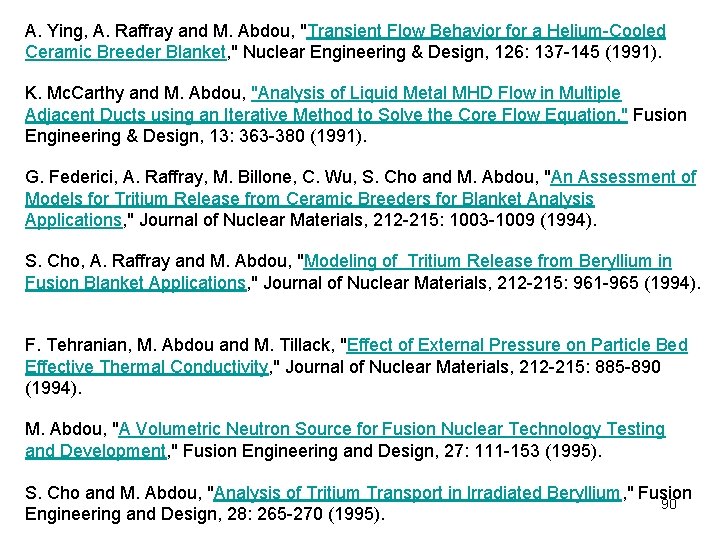
A. Ying, A. Raffray and M. Abdou, "Transient Flow Behavior for a Helium-Cooled Ceramic Breeder Blanket, " Nuclear Engineering & Design, 126: 137 -145 (1991). K. Mc. Carthy and M. Abdou, "Analysis of Liquid Metal MHD Flow in Multiple Adjacent Ducts using an Iterative Method to Solve the Core Flow Equation, " Fusion Engineering & Design, 13: 363 -380 (1991). G. Federici, A. Raffray, M. Billone, C. Wu, S. Cho and M. Abdou, "An Assessment of Models for Tritium Release from Ceramic Breeders for Blanket Analysis Applications, " Journal of Nuclear Materials, 212 -215: 1003 -1009 (1994). S. Cho, A. Raffray and M. Abdou, "Modeling of Tritium Release from Beryllium in Fusion Blanket Applications, " Journal of Nuclear Materials, 212 -215: 961 -965 (1994). F. Tehranian, M. Abdou and M. Tillack, "Effect of External Pressure on Particle Bed Effective Thermal Conductivity, " Journal of Nuclear Materials, 212 -215: 885 -890 (1994). M. Abdou, "A Volumetric Neutron Source for Fusion Nuclear Technology Testing and Development, " Fusion Engineering and Design, 27: 111 -153 (1995). S. Cho and M. Abdou, "Analysis of Tritium Transport in Irradiated Beryllium, " Fusion 90 Engineering and Design, 28: 265 -270 (1995).
M. Xu, M. Abdou, and A. Raffray, "Thermal Conductivity of a Beryllium Gas Packed Bed, " Fusion Engineering and Design, 27: 240 -246 (1995). F. Tehranian and M. Abdou, "Experimental Study of the Effect of External Pressure on Particle Bed Effective Thermal Properties, " Fusion Technology, 27: 298 -313 (1995). M. Abdou, et al, "Japan Atomic Energy Research Institute/United States Integral Neutronics Experiments and Analyses for Tritium Breeding, Nuclear Heating, and Induced Radioactivity, " Fusion Technology, 28, No. 1: 5 -38 (1995). M. Abdou, et al, "Results of an International Study on a High-Volume Plasma-Based Neutron Source for Fusion Blanket Development, " Fusion Technology, 29: 1 -57 (1996). R. Abelson and M. Abdou, "Experimental Evaluation of the Interface Heat Conductance between Roughened Beryllium and Stainless Steel Surfaces", Journal of Nuclear Materials, 233 -237: 847 -851 (1996). L. Zhang, M. Abdou, "Kerma factor evaluation and its application in nuclear heating experiment analysis", Fusion Engineering and Design, 36: 479 -503 (1997). 91
A. Ying, M. Abdou, "Analysis of Thermomechanical Interactions and Properties of Ceramic Breeder Blankets", Fusion Engineering and Design, 39 -40: 651 -657 (1998). M. Abdou, A. Ying, and Z. Lu, "Thermal and Mechanical Properties of Ceramic Blanket Particle Bed Materials: Numerical Derivation", Journal of Nuclear Materials, 258 -263: 576 -581 (1998). M. Abdou and the APEX Team, "Exploring Novel High Power Density Concepts for Attractive Fusion Systems", Fusion Engineering & Design, 45, No. 1: 145 -167 (1999). W. Kuan and M. Abdou, "A New Approach for Assessing the Required Tritium Breeding Ratio and Startup Inventory in Future Fusion Reactors", Fusion Technology, 35: 309 -353 (1999). S. Cho, M. Abdou, "Analysis of Tritium Kinetics of SIBELIUS Beryllium", Fusion Engineering and Design, 51 -52: 85 -91 (2000). M. Abdou, et. al. "On the Exploration of Innovative Concepts for Fusion Chamber Technology", Fusion Engineering and Design, 54: 181 -247 (2001). R. Abelson and M. Abdou, "Experimental Measurement of the Interface Heat Conductance between Nonconforming Beryllium and Type 316 Stainless Steel Surfaces Subjected to Nonuniform Thermal Deformations", Fusion Technology, 39: 157 -188 (2001). 92
Z. Lu, M. Abdou, A. Ying, "3 -D Micromechanical Modeling of Packed Beds", Journal of Nuclear Materials, 299: 101 -110 (2001). M. Ni, M. Abdou, “Temporal Second-Order Accuracy SIMPLE-Type Method for Unsteady Incompressible Flows”, Numerical Heat Transfer B, 46: 529 -548 (2004). M. Abdou, et. al. , "Overview of Fusion Blanket R&D in the U. S. over the Last Decade, " Nuclear Engineering and Technology, 37: 5 (2005). S. Smolentsev, N. Morley, M. Abdou, "Code Development for Analysis of MHD Pressure Drop Reduction in a Liquid Metal Blanket using Insulation Technique", Fusion Engineering and Design, 73, 83 -93 (2005). S. Smolentsev, M. Abdou, N. Morley, M. Sawan, S. Malang, C. Wong, "Numerical Analysis of MHD Flow and Heat Transfer in a Poloidal Channel of the DCLL Blanket with a Si. Cf/Si. C Flow Channel Insert", Fusion Engineering & Design, 81: (1– 7), 549– 553 (2006) A. Ying, M. Abdou, P. Calderoni, S. Sharafat, M. Youssef, Z. An, A. Abou-Sena, E. Kim, S. Reyes, S. Willms, R. Kurtz, "Solid Breeder Test Blanket Module Design and Analysis", Fusion Engineering & Design, 81: (1– 7), 659– 664 (2006) M. Sawan, M. Abdou, "Physics and Technology Conditions for attaining Tritium Self. Sufficiency for the DT Fuel Cycle", Fusion Engineering & Design, 81: (8– 14), 1131– 93 1144 (2006)
A. Abou-Sena, A. Ying, M. Abdou, “Experimental Measurements of the Effective Thermal Conductivity of a Lithium Titanate (Li 2 Ti. O 3) Pebbles-Packed Bed”, Journal of Materials Processing Technology, 181: 206 -212 (2007). 94
- Slides: 94