
INTRODUCTION TO FUNGI What is fungi A group
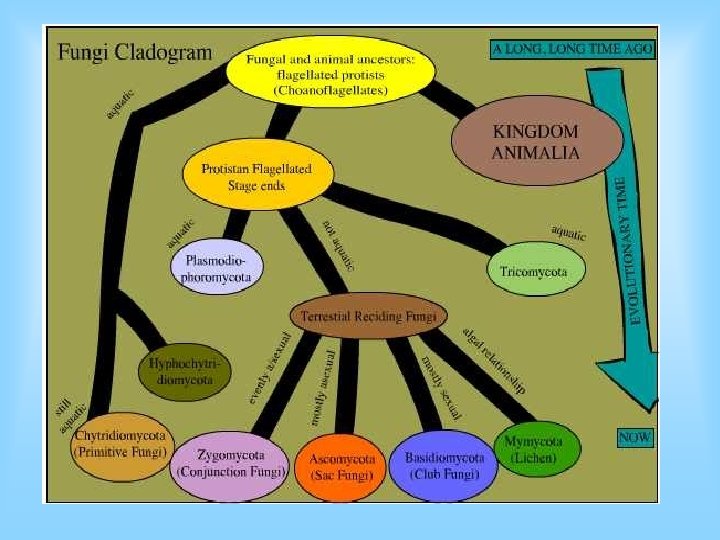

- Slides: 47
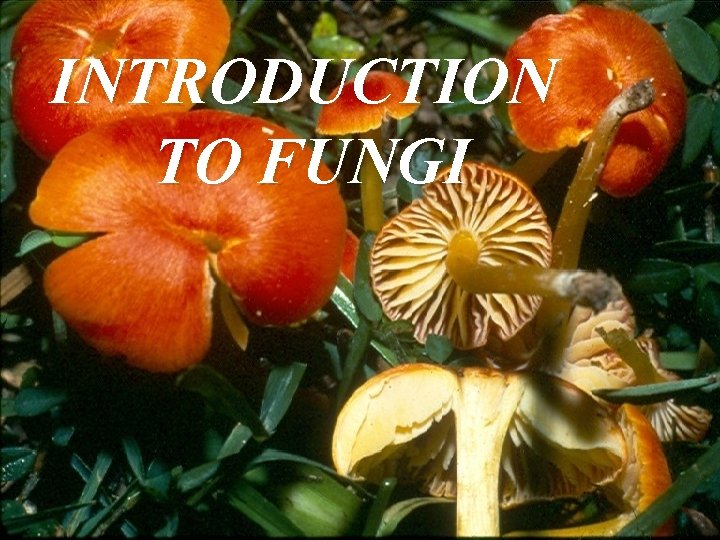
INTRODUCTION TO FUNGI
What is fungi? A group of those plants whose form is a thallus, build up of single cell or cells that possess definite cell wall and nucleus but lack chlorophyll and differentition of vascular tissues.
The Characteristics of Fungi • • • Fungi are plants Hyphae = tubular units of construction Heterotrophic by absorption Reproduce by spores Ecologically impotant roles Body form -unicellular * multicellular, such as mycelial cords, rhizomorphs, and fruit bodies (mushrooms)
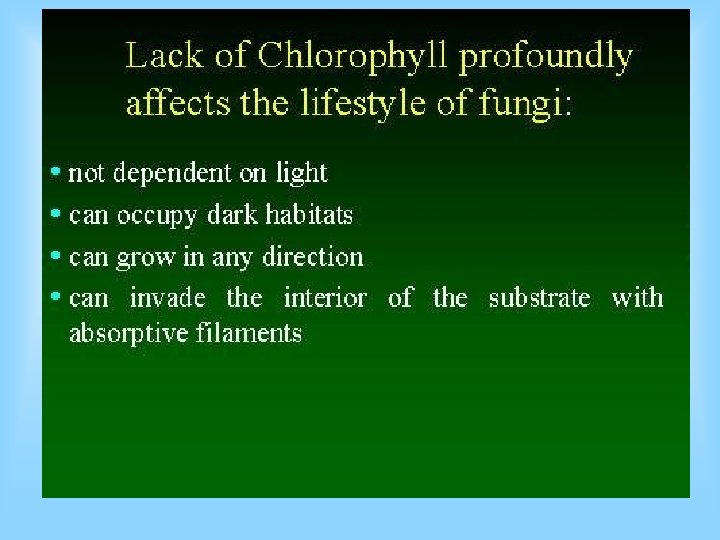
Habitat (occurrence) • • • Large group; more than 1, 000 species distributed throughout the world. Ubiquitous, occur in almost every habitat where organic matter is available. Do not require light for growth Flourish well in moist, dark and warm conditions Some grow as parasites on other plants and animals.
Habit (Mode of life) • Saprophyte (a) obligate saprophytes (b) facultative parasites • Parasites (a) obligate parasites (b) facultative saprophytes
Nutrition • Incapable of synthesizing their own • • food Heterotrophic in their mode of nutrition Need both organic and inorganic nutrition from external source
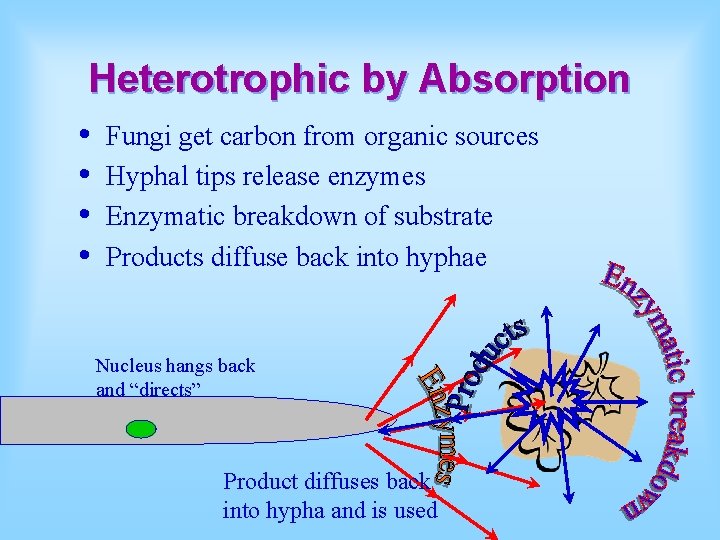
Heterotrophic by Absorption • • Fungi get carbon from organic sources Hyphal tips release enzymes Enzymatic breakdown of substrate Products diffuse back into hyphae Nucleus hangs back and “directs” Product diffuses back into hypha and is used
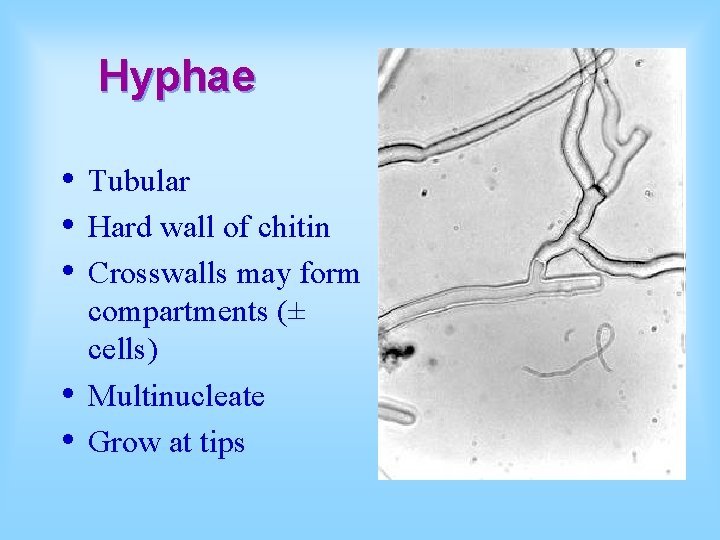
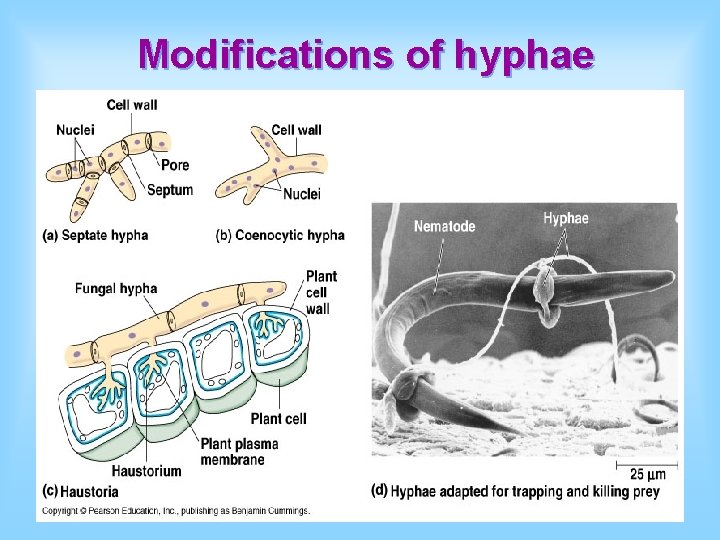
Somatic or vegetative structure of plant body • Most fungi grow as thread-like filamentous microscopic structures called hyphae, which are microscopic filaments between 2– 10 µm in diameter and up to several centimeters in length, and which collectively form the mycelium. Hyphae can be septate, i. e. , divided into compartments separated by a septum, each compartment containing one or more nuclei, or can be coenocytic, i. e. , lacking hyphal compartmentalization.
Hyphae • • • Tubular Hard wall of chitin Crosswalls may form compartments (± cells) Multinucleate Grow at tips
• However, septa have pores, such as the dolipore septa in the basidiomycetes that allow cytoplasm, organelles, and sometimes nuclei to pass through. Coenocytic hyphae are essentially multinucleate supercells. Many species have developed specialized structures for nutrient uptake from living hosts; examples include haustoria in plant parasites of most phyla, and arbuscules of several mycorrhizal fungi, which penetrate into the host cells to consume nutrients.
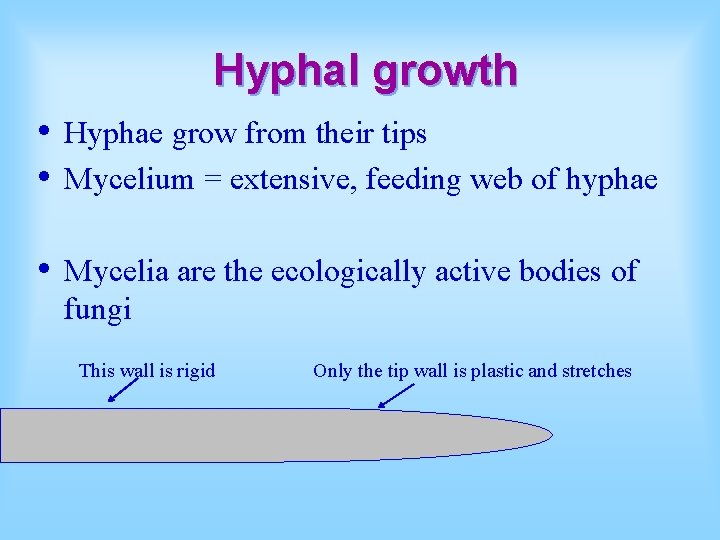
Hyphal growth • • Hyphae grow from their tips Mycelium = extensive, feeding web of hyphae • Mycelia are the ecologically active bodies of fungi This wall is rigid Only the tip wall is plastic and stretches
Modifications of hyphae
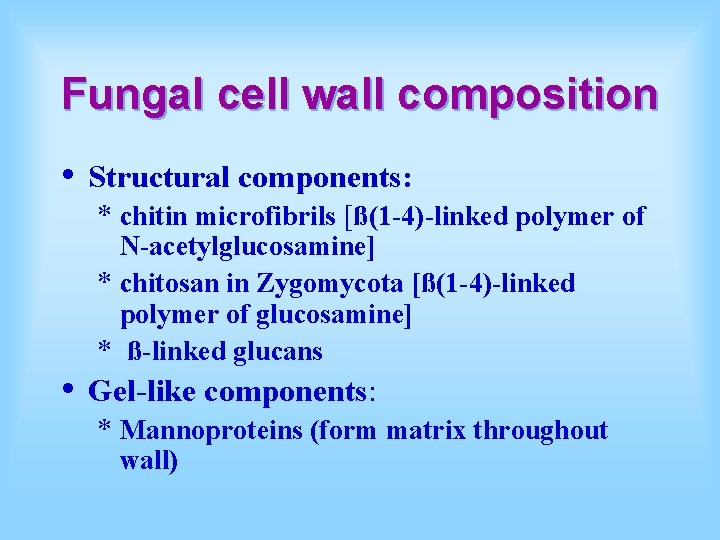
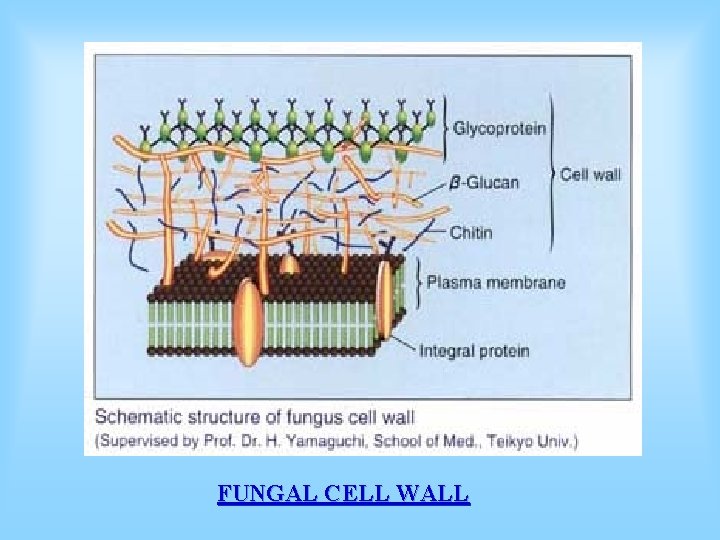
Fungal cell wall composition • • Structural components: * chitin microfibrils [ß(1 -4)-linked polymer of N-acetylglucosamine] * chitosan in Zygomycota [ß(1 -4)-linked polymer of glucosamine] * ß-linked glucans Gel-like components: * Mannoproteins (form matrix throughout wall)
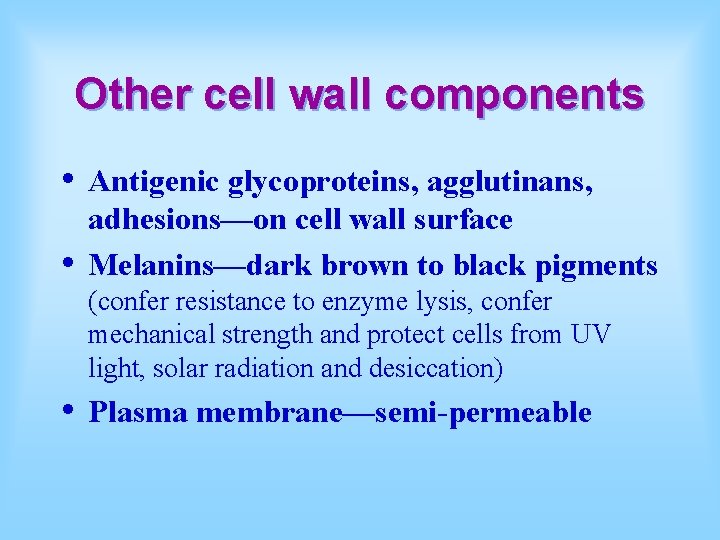
Other cell wall components • • Antigenic glycoproteins, agglutinans, adhesions—on cell wall surface Melanins—dark brown to black pigments (confer resistance to enzyme lysis, confer mechanical strength and protect cells from UV light, solar radiation and desiccation) • Plasma membrane—semi-permeable
FUNGAL CELL WALL
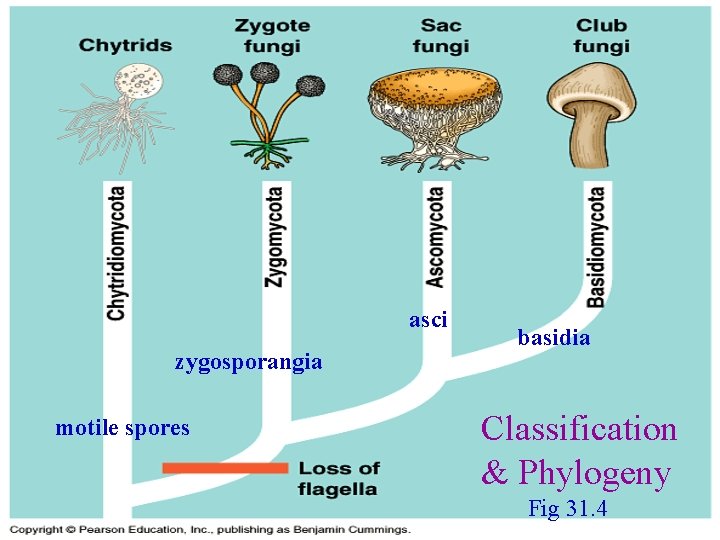
asci zygosporangia motile spores basidia Classification & Phylogeny Fig 31. 4
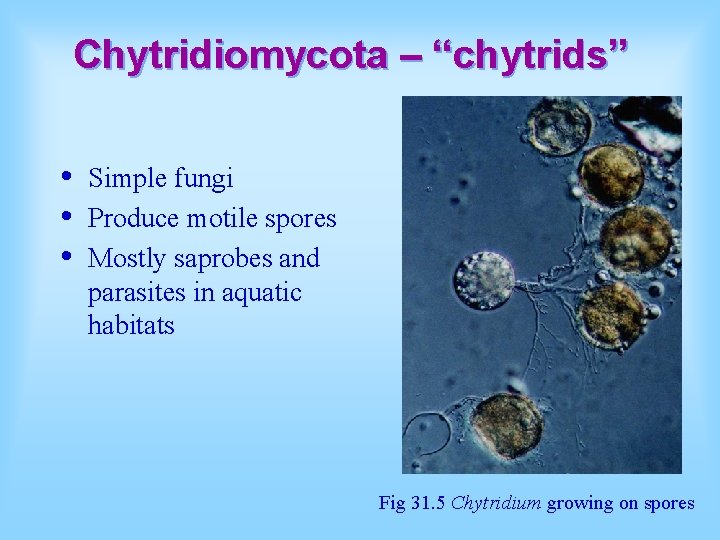
Chytridiomycota – “chytrids” • • • Simple fungi Produce motile spores Mostly saprobes and parasites in aquatic habitats Fig 31. 5 Chytridium growing on spores
Chytridiomycota (Primitive Fungi): • • • Division Chytridiomycota, being exceedingly simple organisms, are the most similar to primitive fungi of any phyum of fungi. crucial decomposers, feeding on living and decaying organisms. live in aquatic and semi-aquatic environments (even damp soil), in both salt and freshwater bodies of water. distinguished by their flagellated spores or gametes, which help the reproductive units repel through water. their walls are reinforced by chitin, and are the only fungi which contain cellulose. Scientists examine Chytridiomycota to give them an idea of what the first fungi looked like
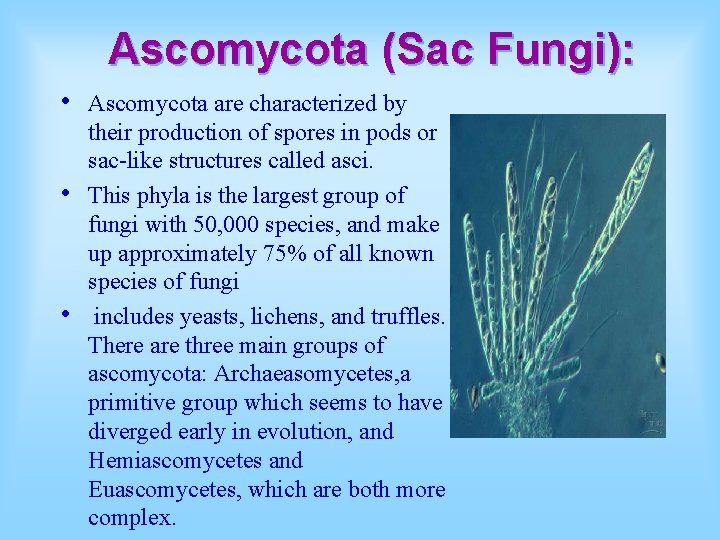
Ascomycota (Sac Fungi): • • • Ascomycota are characterized by their production of spores in pods or sac-like structures called asci. This phyla is the largest group of fungi with 50, 000 species, and make up approximately 75% of all known species of fungi includes yeasts, lichens, and truffles. There are three main groups of ascomycota: Archaeasomycetes, a primitive group which seems to have diverged early in evolution, and Hemiascomycetes and Euascomycetes, which are both more complex.
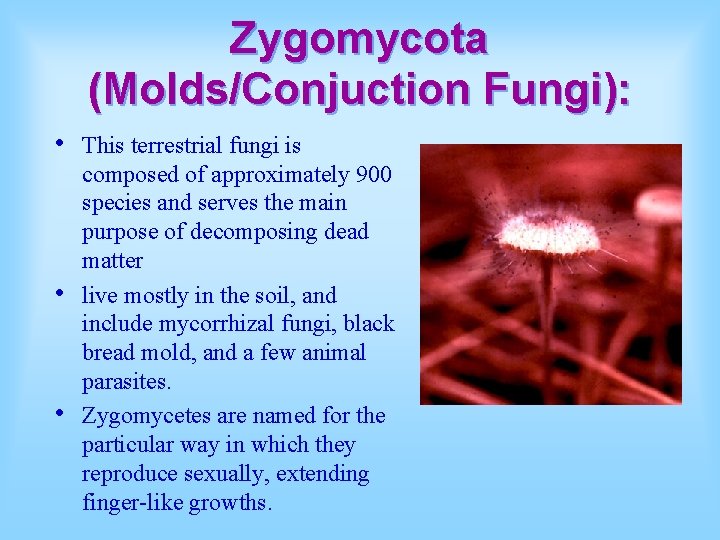
Zygomycota (Molds/Conjuction Fungi): • • • This terrestrial fungi is composed of approximately 900 species and serves the main purpose of decomposing dead matter live mostly in the soil, and include mycorrhizal fungi, black bread mold, and a few animal parasites. Zygomycetes are named for the particular way in which they reproduce sexually, extending finger-like growths.
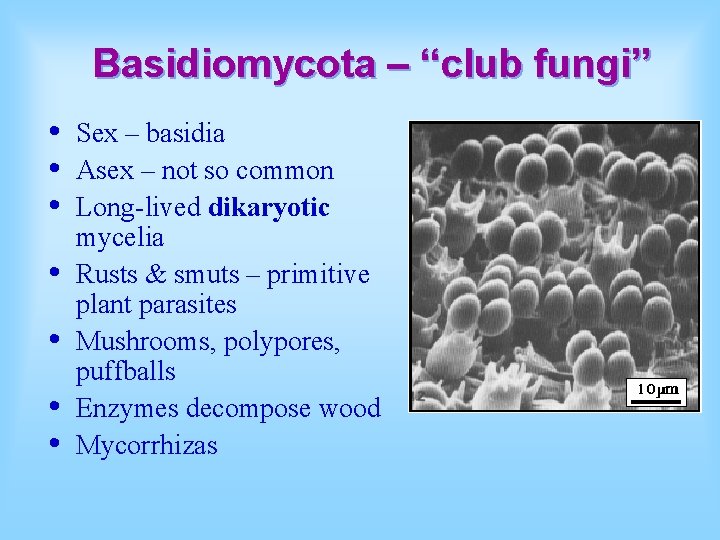
Basidiomycota – “club fungi” • • Sex – basidia Asex – not so common Long-lived dikaryotic mycelia Rusts & smuts – primitive plant parasites Mushrooms, polypores, puffballs Enzymes decompose wood Mycorrhizas
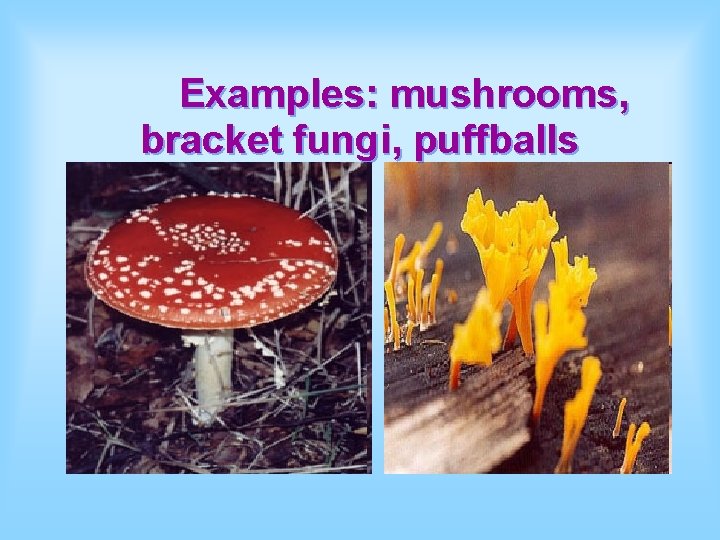
Examples: mushrooms, bracket fungi, puffballs
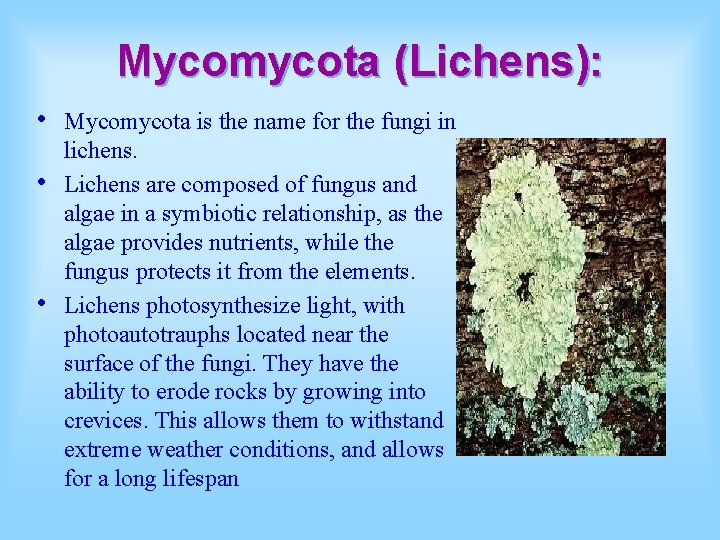
Mycomycota (Lichens): • • • Mycomycota is the name for the fungi in lichens. Lichens are composed of fungus and algae in a symbiotic relationship, as the algae provides nutrients, while the fungus protects it from the elements. Lichens photosynthesize light, with photoautotrauphs located near the surface of the fungi. They have the ability to erode rocks by growing into crevices. This allows them to withstand extreme weather conditions, and allows for a long lifespan
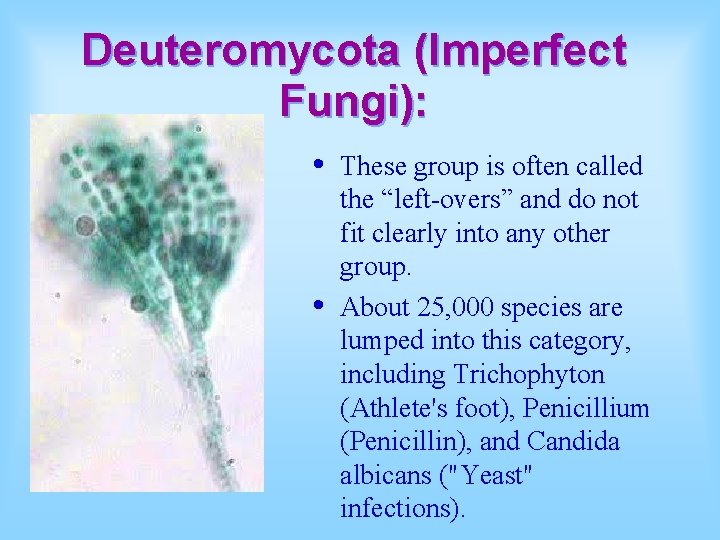
Deuteromycota (Imperfect Fungi): • • These group is often called the “left-overs” and do not fit clearly into any other group. About 25, 000 species are lumped into this category, including Trichophyton (Athlete's foot), Penicillium (Penicillin), and Candida albicans ("Yeast" infections).
Mycorrhizas • • “Fungus roots” Mutualism between: * Fungus (nutrient & water uptake for plant) * Plant (carbohydrate for fungus) • Several kinds * Zygomycota – hyphae invade root cells * Ascomycota & Basidiomycota – hyphae invade root but don’t penetrate cells • Extremely important ecological role of fungi!
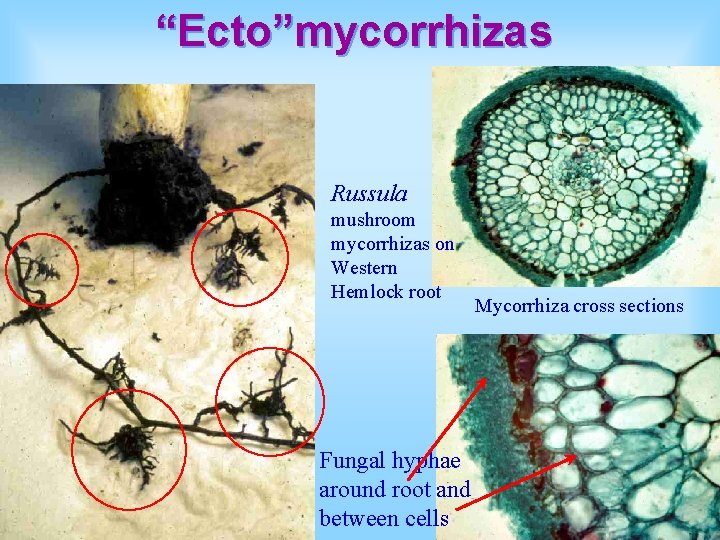
“Ecto”mycorrhizas Russula mushroom mycorrhizas on Western Hemlock root Mycorrhiza cross sections Fungal hyphae around root and between cells
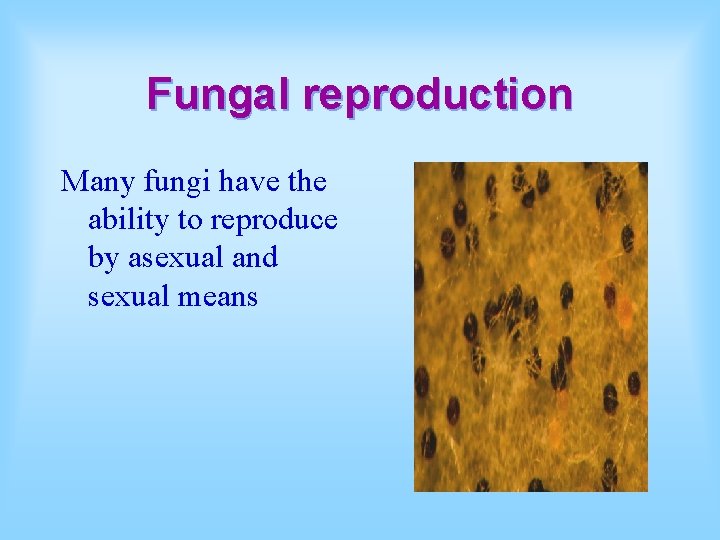
Fungal reproduction Many fungi have the ability to reproduce by asexual and sexual means
Fungal reproduction • Anamorph= asexual stage * Mitospore=spore formed via asexual reproduction (mitosis), commonly called a conidium or sporangiospore • Teleomorph= sexual stage * Meiospore=spore formed via sexual reproduction (e. g. , resulting from meiosis), type of spore varies by phylum
ASEXUAL REPRODUCTION • • • FRAGMENTATION BUDDING FISSION OIDIA CHLAMYDOSPORES – (a) sporangiospores (b) conidia
MODES OF SEXUAL REPRODUCTION • • • PLANOGAMETIC COPULATION GAMETANGIAL CONTACT GAMETANGIAL COPULATION SPERMATISATION SOMATOGAMY (PSEUDOGAMY)
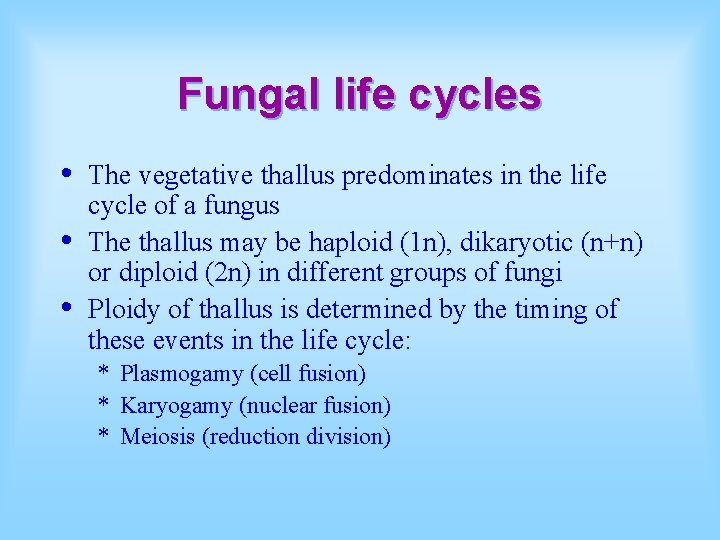
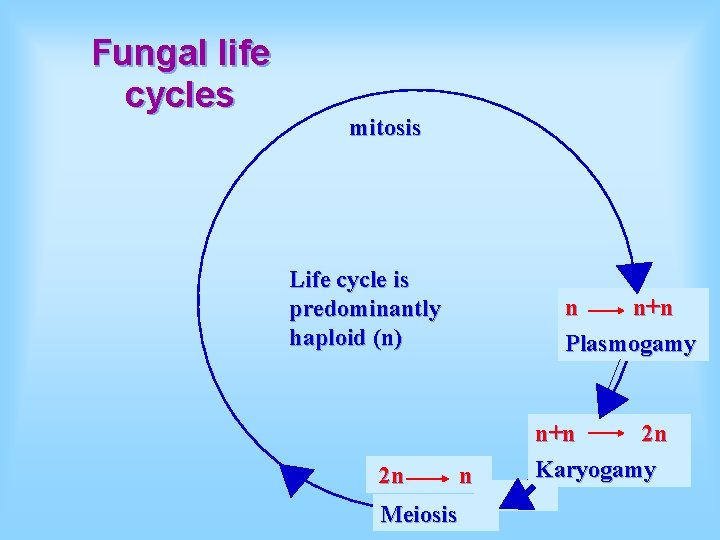
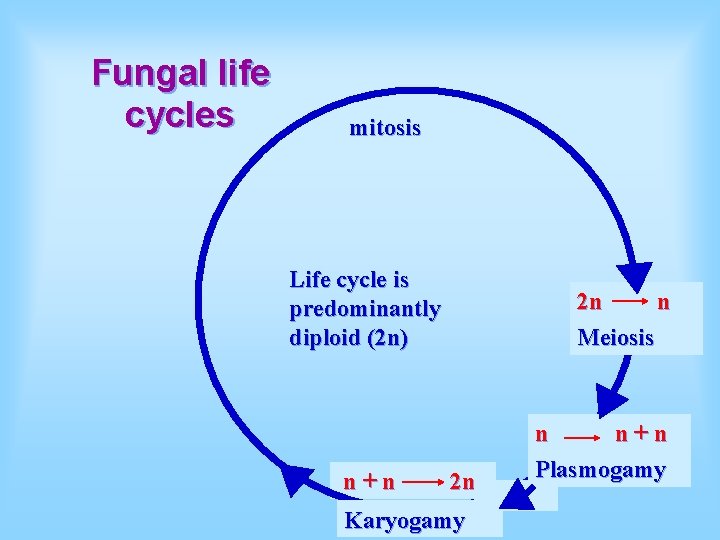
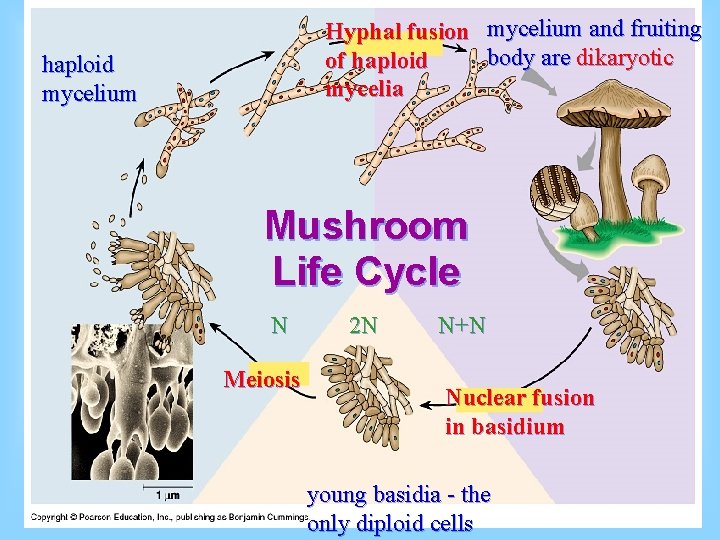
Fungal life cycles • • • The vegetative thallus predominates in the life cycle of a fungus The thallus may be haploid (1 n), dikaryotic (n+n) or diploid (2 n) in different groups of fungi Ploidy of thallus is determined by the timing of these events in the life cycle: * Plasmogamy (cell fusion) * Karyogamy (nuclear fusion) * Meiosis (reduction division)
Fungal life cycles mitosis Life cycle is predominantly haploid (n) 2 n Meiosis n n+n Plasmogamy n n+n 2 n Karyogamy
Fungal life cycles mitosis Life cycle is predominantly diploid (2 n) n+n 2 n n Meiosis 2 n Karyogamy n n+n Plasmogamy
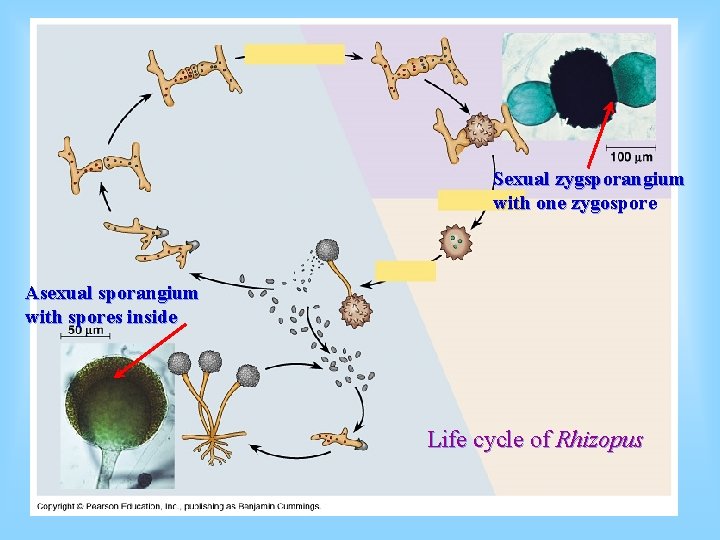
Sexual zygsporangium with one zygospore Asexual sporangium with spores inside Life cycle of Rhizopus
Hyphal fusion mycelium and fruiting body are dikaryotic of haploid mycelia haploid mycelium Mushroom Life Cycle N 2 N N+N Meiosis Nuclear fusion in basidium young basidia - the only diploid cells
HUMAN-FUNGUS INTERACTIONS • • Beneficial Effects of Fungi * Decomposition - nutrient and carbon recycling. * Biosynthetic factories. Can be used to produce drugs, antibiotics, alcohol, acids, food (e. g. , fermented products, mushrooms). * Model organisms for biochemical and genetic studies. Harmful Effects of Fungi * Destruction of food, lumber, paper, and cloth. * Animal and human diseases, including allergies. * Toxins produced by poisonous mushrooms and within food (e. g. , grain, cheese, etc. ). * Plant diseases.
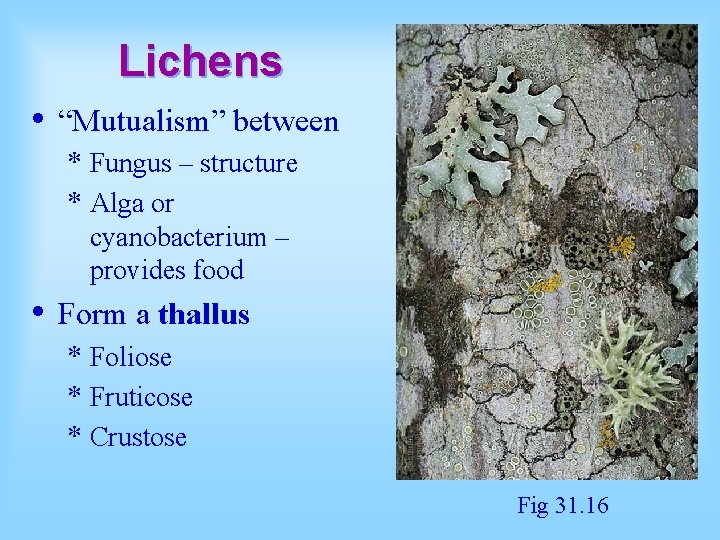
Lichens • “Mutualism” between * Fungus – structure * Alga or cyanobacterium – provides food • Form a thallus * Foliose * Fruticose * Crustose Fig 31. 16
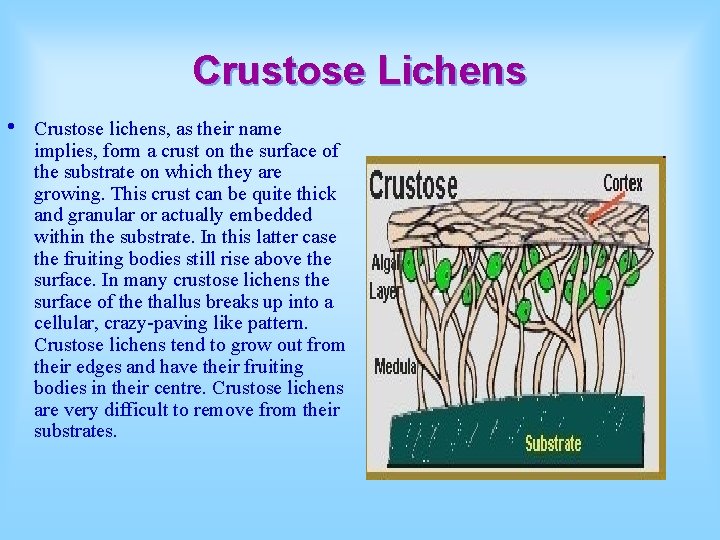
Crustose Lichens • Crustose lichens, as their name implies, form a crust on the surface of the substrate on which they are growing. This crust can be quite thick and granular or actually embedded within the substrate. In this latter case the fruiting bodies still rise above the surface. In many crustose lichens the surface of the thallus breaks up into a cellular, crazy-paving like pattern. Crustose lichens tend to grow out from their edges and have their fruiting bodies in their centre. Crustose lichens are very difficult to remove from their substrates.
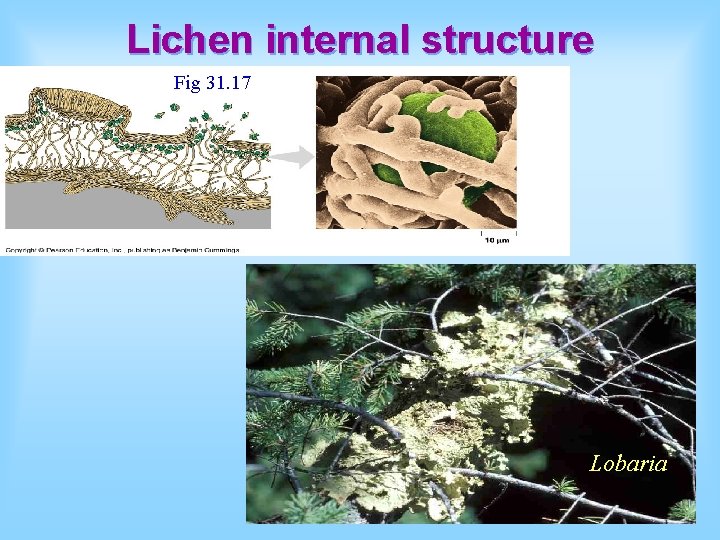
Lichen internal structure Fig 31. 17 Lobaria
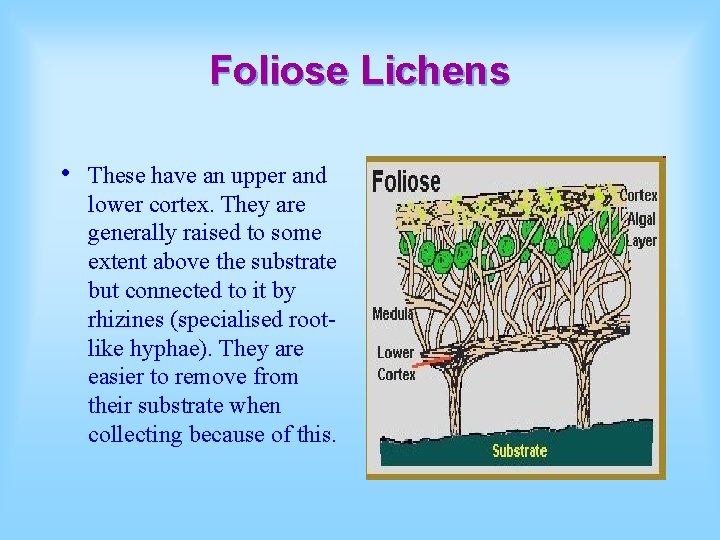
Foliose Lichens • These have an upper and lower cortex. They are generally raised to some extent above the substrate but connected to it by rhizines (specialised rootlike hyphae). They are easier to remove from their substrate when collecting because of this.
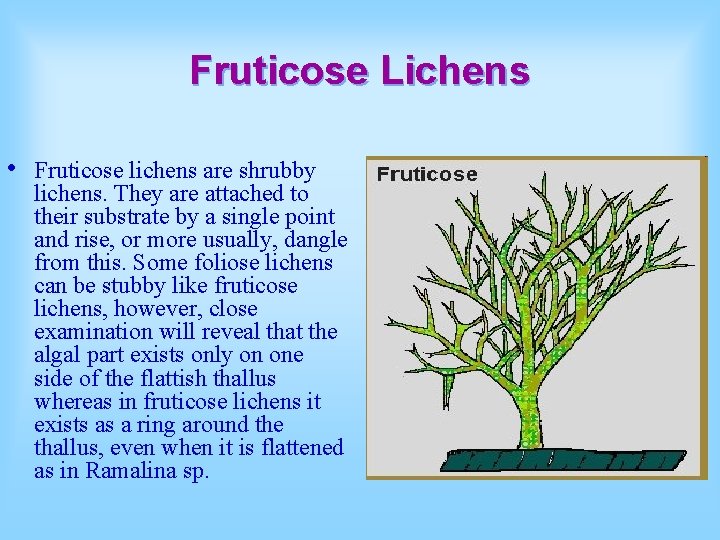
Fruticose Lichens • Fruticose lichens are shrubby lichens. They are attached to their substrate by a single point and rise, or more usually, dangle from this. Some foliose lichens can be stubby like fruticose lichens, however, close examination will reveal that the algal part exists only on one side of the flattish thallus whereas in fruticose lichens it exists as a ring around the thallus, even when it is flattened as in Ramalina sp.
Growth and Development in Lichens • Lichens will and do grow on just about everything, natural or manmade. Different species of lichens prefer, or only grow on different substrates. Thus some species will be found on smooth barked trees, some on rough barked and some on only one species of tree. Also some lichens grow on basic rocks while others only grow on acidic rocks and some have particular mineral requirements, thus Acarospora sinopica only grows on rocks with a high iron content.
• However where ever they grow lichens grow slowly so what ever it is they are growing on, the 'substrate' needs to have been around for a few years. Lichens grow differently at different times in their lives. When young and very small they grow slowly, then once they are reasonably well established they grow much more quickly, obviously when they are dying, for what ever reason they grow more slowly again, or not at all.
Lichens as biomonitors • • Thalli act like sponges Some species more sensitive Which species are present can indicate air quality (Most resistant species can also be analyzed for pollutants)