
Introduction to Functional Resources CSSA Cleveland Ohio 15
- Slides: 13
Introduction to Functional Resources CSSA Cleveland, Ohio 15 -19 October 2012 John Pietras GST, Inc.
Agenda § Purpose of presentation § Background of functional resources § Functional resource classes and types § Functional resource identification § Related functional resource briefings this week www. ccsds. org 2
Purpose § Introduce the background and concept for functional resource identifiers § Set the stage for related presentations to be made this week q q q www. ccsds. org Candidate standard monitored parameters Naming scheme for functional resources, and Integration of functional resources into Service Management 3
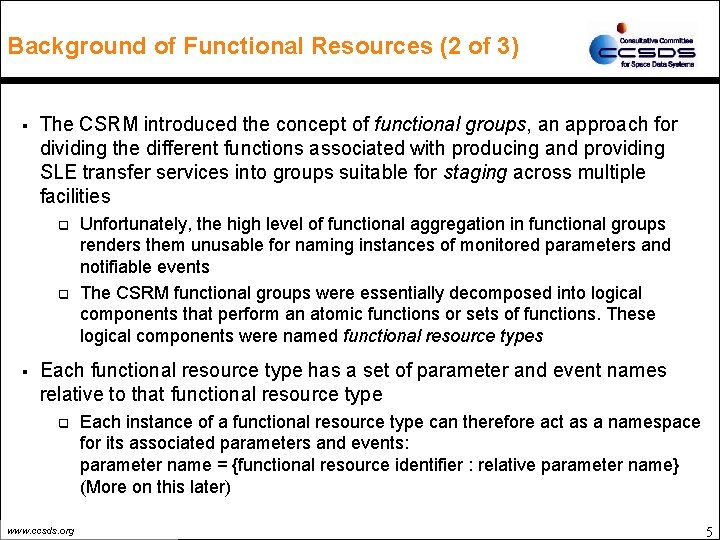
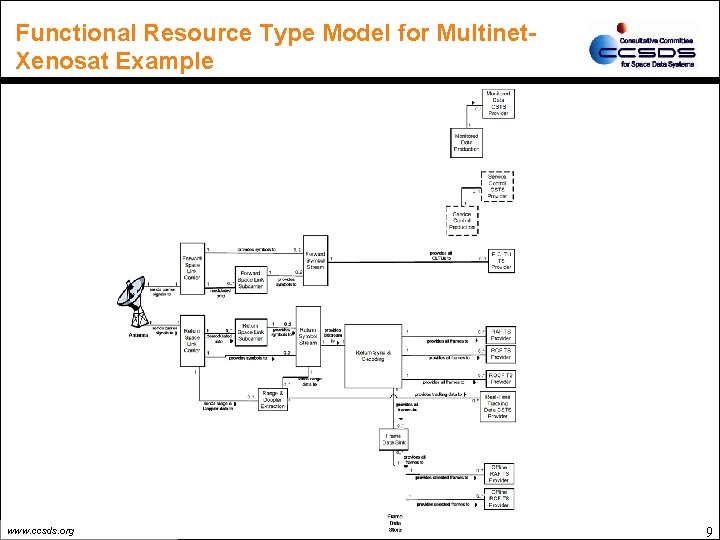
Background of Functional Resources (1 of 3) § The Monitored Data Cross Support Transfer Service (CSTS) is designed to report monitored parameters and notifiable events associated with an executing Service Package q Original notion of simple parameter names (e. g. , data_rate) was rendered inoperable due to the possibility of redundant occurrences of monitored parameters in a Service Package • q § E. g. , Concurrent S-Band X-Band return links, each with separate QPSK I and Q channels, results in 4 instances of data_rate Distinguished names could be derived from Service Management XMLformatted configuration information, but the resulting XPath names would often be long and hard to read Could there be a naming solution in the genesis of SLE/SM/CSTS – that is, the Cross Support Reference Model (CSRM)? www. ccsds. org 4
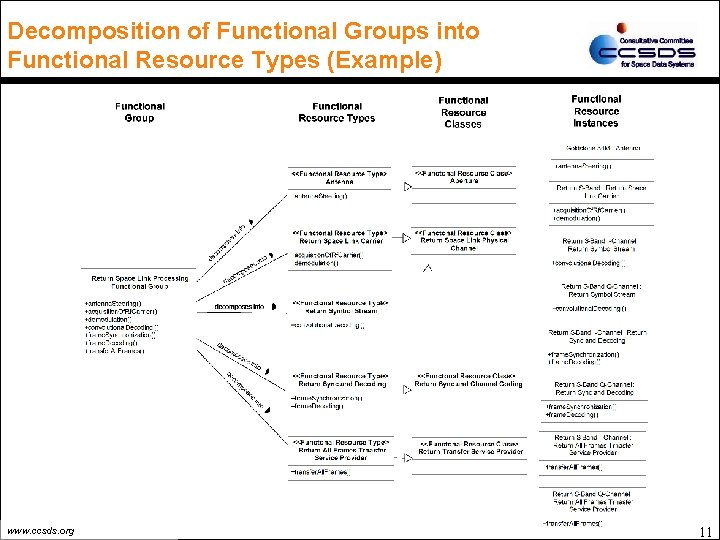
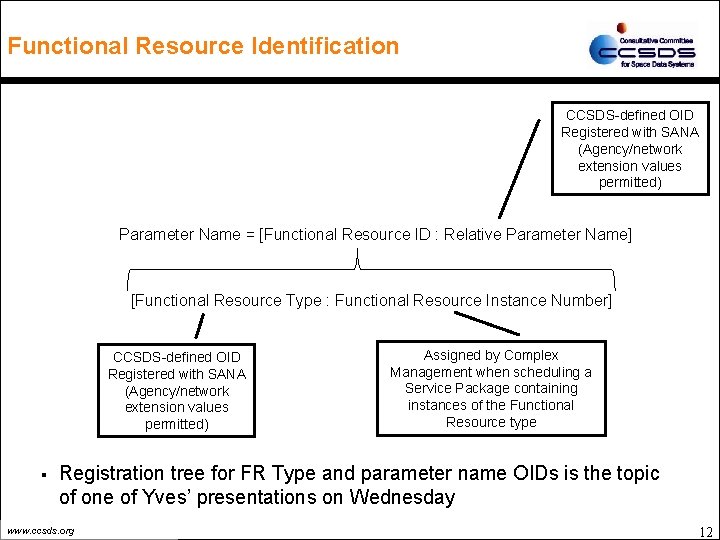
Background of Functional Resources (2 of 3) § The CSRM introduced the concept of functional groups, an approach for dividing the different functions associated with producing and providing SLE transfer services into groups suitable for staging across multiple facilities q q § Unfortunately, the high level of functional aggregation in functional groups renders them unusable for naming instances of monitored parameters and notifiable events The CSRM functional groups were essentially decomposed into logical components that perform an atomic functions or sets of functions. These logical components were named functional resource types Each functional resource type has a set of parameter and event names relative to that functional resource type q www. ccsds. org Each instance of a functional resource type can therefore act as a namespace for its associated parameters and events: parameter name = {functional resource identifier : relative parameter name} (More on this later) 5
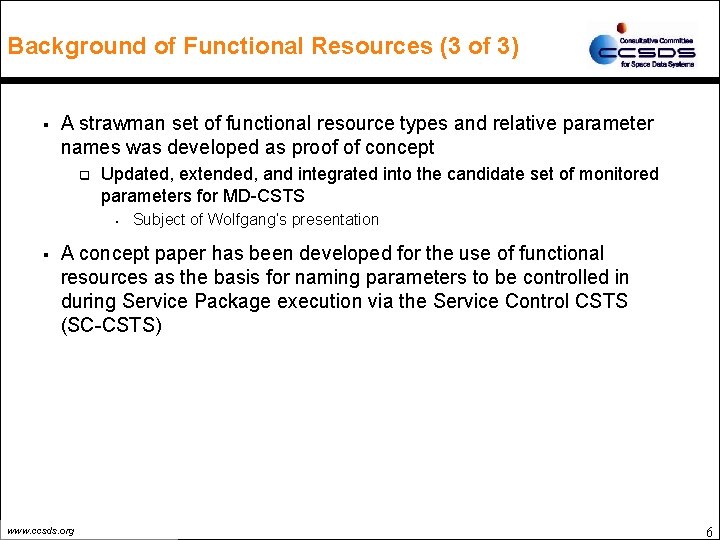
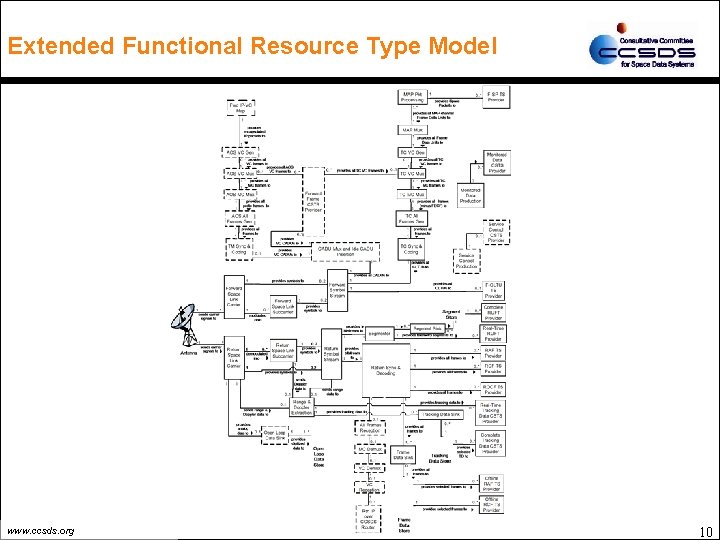
Background of Functional Resources (3 of 3) § A strawman set of functional resource types and relative parameter names was developed as proof of concept q Updated, extended, and integrated into the candidate set of monitored parameters for MD-CSTS • § Subject of Wolfgang’s presentation A concept paper has been developed for the use of functional resources as the basis for naming parameters to be controlled in during Service Package execution via the Service Control CSTS (SC-CSTS) www. ccsds. org 6
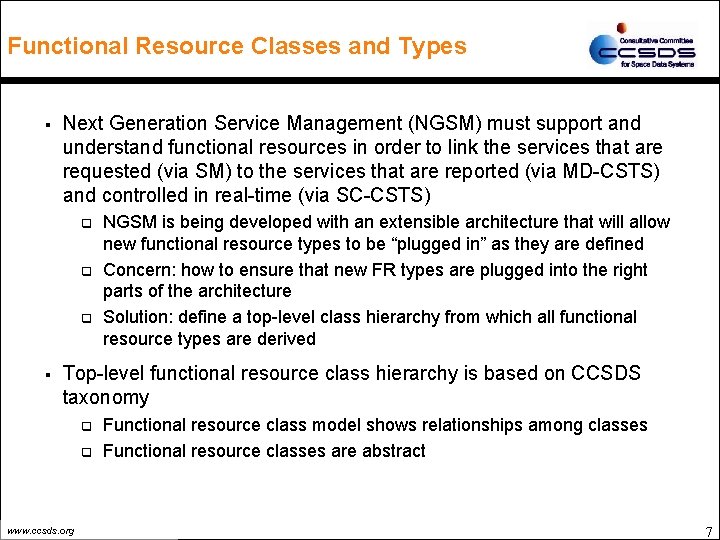
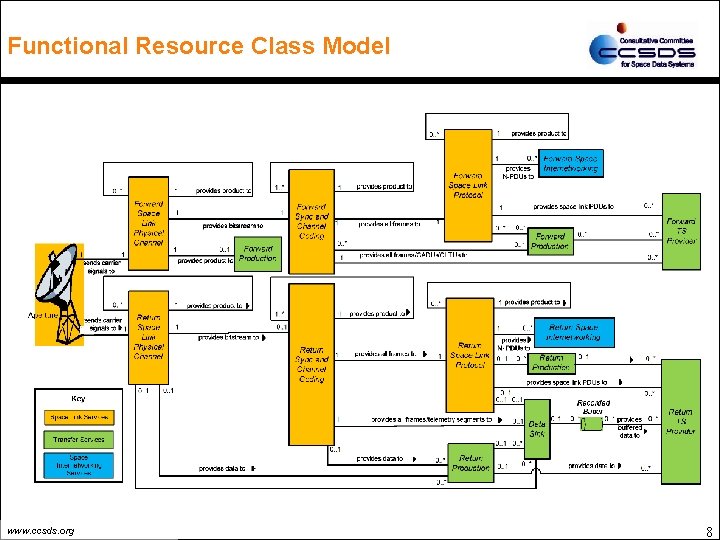
Functional Resource Classes and Types § Next Generation Service Management (NGSM) must support and understand functional resources in order to link the services that are requested (via SM) to the services that are reported (via MD-CSTS) and controlled in real-time (via SC-CSTS) q q q § NGSM is being developed with an extensible architecture that will allow new functional resource types to be “plugged in” as they are defined Concern: how to ensure that new FR types are plugged into the right parts of the architecture Solution: define a top-level class hierarchy from which all functional resource types are derived Top-level functional resource class hierarchy is based on CCSDS taxonomy q q www. ccsds. org Functional resource class model shows relationships among classes Functional resource classes are abstract 7
Functional Resource Class Model www. ccsds. org 8
Functional Resource Type Model for Multinet. Xenosat Example www. ccsds. org 9
Extended Functional Resource Type Model www. ccsds. org 10
Decomposition of Functional Groups into Functional Resource Types (Example) www. ccsds. org 11
Functional Resource Identification CCSDS-defined OID Registered with SANA (Agency/network extension values permitted) Parameter [Functional Resource ID : Parameter Type] Parameter. Name ==[Functional Resource ID : Relative Parameter Name] [Functional Resource Type : Functional Resource Instance Number] CCSDS-defined OID Registered with SANA (Agency/network extension values permitted) § Assigned by Complex Management when scheduling a Service Package containing instances of the Functional Resource type Registration tree for FR Type and parameter name OIDs is the topic of one of Yves’ presentations on Wednesday www. ccsds. org 12
Related Functional Resource Briefings § Candidate monitored parameters – Wolfgang Hell q § OID registration tree for functional resource type and parameter, event, and directive names – Yves Doat q § Joint CSTSWG/SMWG session, 1400 Wednesday, 17 October Use of functional resource type and parameter, event, and directive OIDs in the MD-CSTS - Yves Doat q § CSSA Plenary, Monday, 15 October Joint CSTSWG/SMWG session, 1400 Wednesday, 17 October Functional Resources in Service Management and Service Package Execution – John Pietras q www. ccsds. org Joint CSTSWG/SMWG session, 1400 Wednesday, 17 October 13