
INTRODUCTION TO FOSSILS WHAT IS A FOSSIL PRESERVED
- Slides: 16
INTRODUCTION TO FOSSILS
WHAT IS A FOSSIL? • PRESERVED REMAINS, • IMPRESSIONS • OR TRACES • OF ANY ONCE-LIVING THING FROM A PAST GEOLOGICAL AGE (GENERALLY AT LEAST 10, 000 YEARS AGO)
TWO CATEGORIES OF FOSSILS • BODY PART FOSSILS: • • Preserved body parts Usually the hard parts of the plant or animal Often shell, bone, scales, leaves, wood, teeth, claws and horns Soft parts are preserved less often but can tell scientists much more • TRACE FOSSILS: • Fossils from an action or behavior, NOT actual parts of the plant or animal • Impressions living things leave in mud or dirt which harden and keep their shape • Footprints or walkways, resting spots, burrows, borings, feeding damage
HOW DO FOSSILS FORM? • It’s rare for plants and animals to fossilize • Most plants and animals die and rot away; nothing is left • However, under certain conditions, a fossil can form • Most fossils form because the animal or plant is buried. It is easier for remains at the bottom of a river, lake or ocean to be covered by sand or mud than for land plants and animals to get buried. Therefore, fossils of aquatic plants and animals are more common than fossils of terrestrial plants and animals
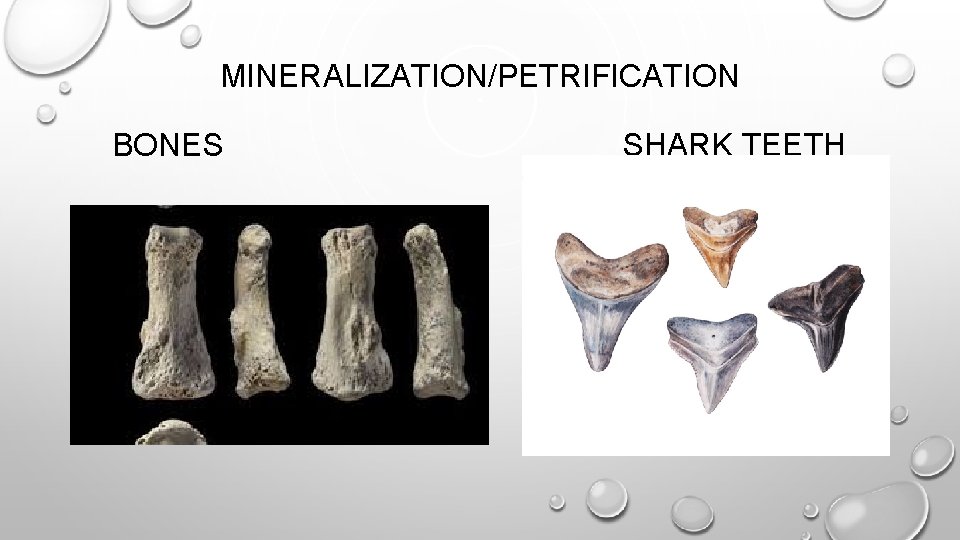
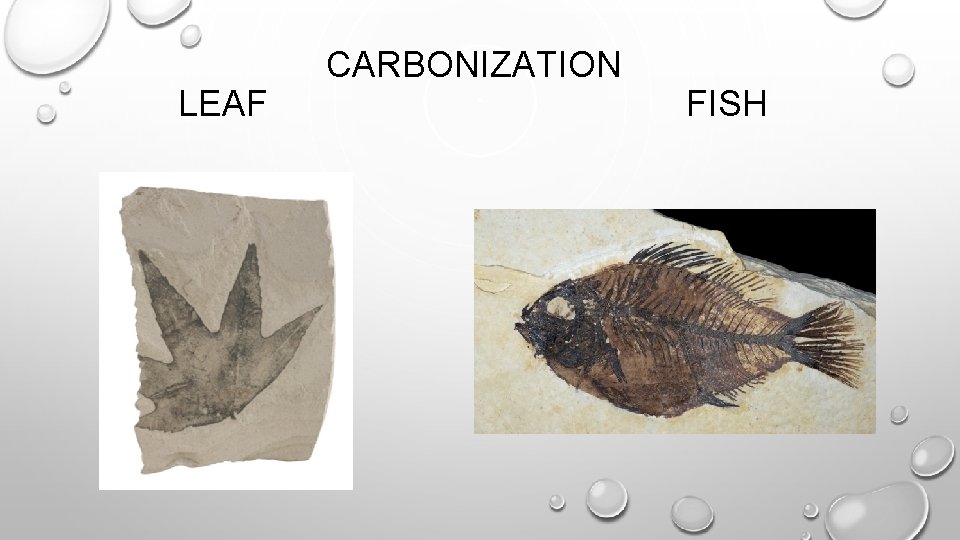
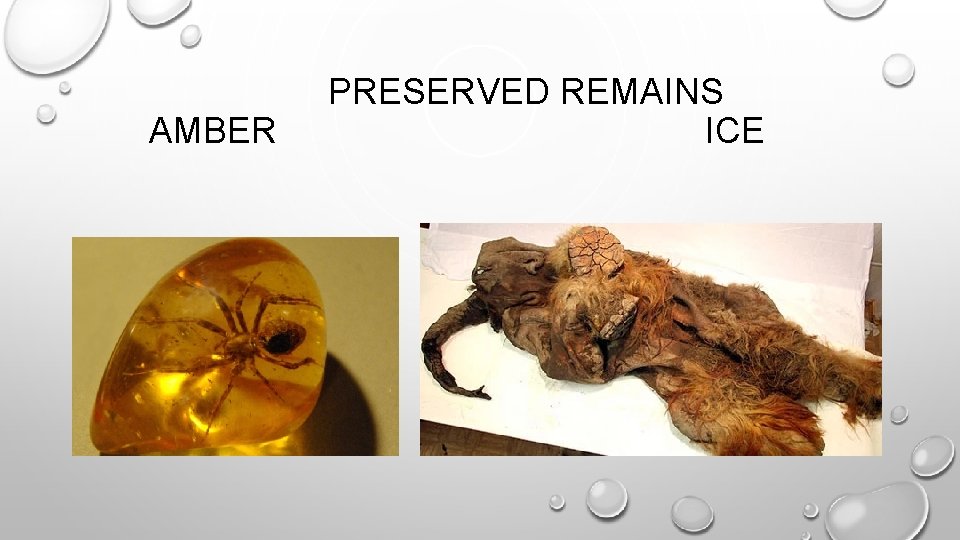
METHODS OF FOSSILIZATION • MINERALIZATION/PETRIFICATION • Remains become buried in mud, sand or volcanic ash • They begin to compact • Water seeps through and minerals in the water replace parts of the organism, leaving a rock replica behind. • CARBONIZATION • All of the organism except the carbon is removed over time, leaving a thin fossil • The carbon in the fossil is the same carbon that the organism was made of • PRESERVED REMAINS
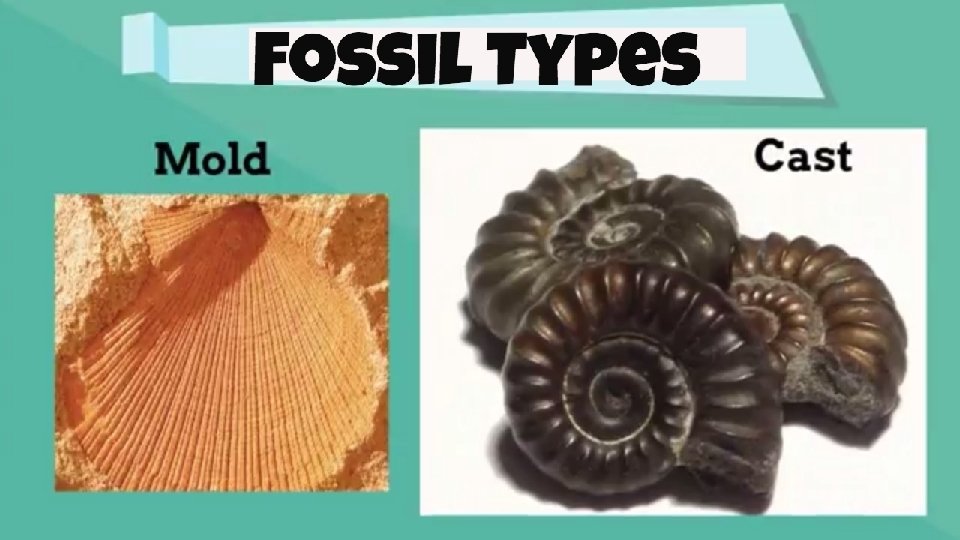
METHODS OF FOSSILIZATION • MOLDS • Molds form when something is pressed into soft mud and removed, leaving an impression, space or void. • CASTS • If buried remains dissolve and leave an impression, space or void (mold) which is later filled with minerals as water seeps through the sediment, then a cast is formed. The cast will be a different kind of mineral (or rock) than the surrounding rock.
MINERALIZATION/PETRIFICATION BONES SHARK TEETH
LEAF CARBONIZATION FISH
AMBER PRESERVED REMAINS ICE
FOSSIL ACTIVITY • FOR EACH FOSSIL DECIDE: • IS IT A BODY PART FOSSIL OR A TRACE FOSSIL? • WHAT KIND OF FOSSILIZATION IS IT? • MINERALIZATION/PETRIFICATION • CARBONIZATION • PRESERVED REMAINS • MOLD • CAST • WHAT IS IT?
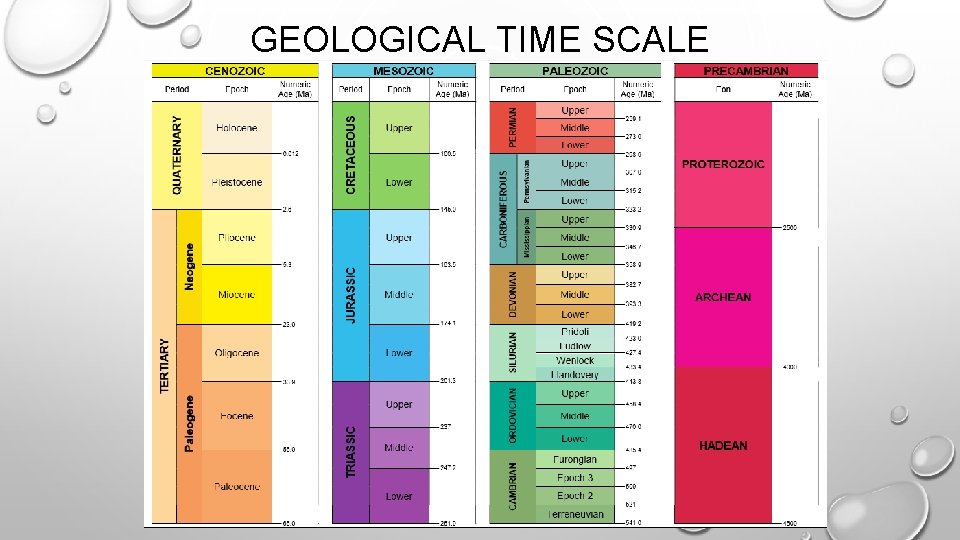
GEOLOGICAL TIME SCALE
PRECAMBRIAN SUPEREON • Earliest part of earth's history, 4. 5 -0. 5 BILLION years ago (bya), • � 88% of earth’s history • Earth forms, molten rock becomes land & oceans • Single-celled organisms evolve into multi-celled organisms, life is bacteria and other microbes
PALEOZOIC (ANCIENT LIFE) ERA • 542 -251 MILLION years ago (mya), lasts � 300 million years • Most invertebrate groups develop • Life moves onto the land • Plants become widespread. Ferns & the 1 st trees appear; modern conifers & ginkgo trees evolve • Insects grow to gigantic proportions • The 1 st vertebrates and 1 st herbivores arrive • Trilobites come and go • Warm seas teem with life: coral reefs, fish, nautiloids and ammonoids are abundant
MESOZOIC ERA (MIDDLE LIFE) • 252 to 66 mya, lasts � 200 million years • Includes Triassic, Jurassic & Cretaceous Periods • Age of Reptiles, Age of Dinosaurs, Age of Conifers • 1 st true mammals appear, as well as lizards, turtles, flying pterosaurs and ancestors of frogs, toads & salamanders. The dominant terrestrial vertebrates are dinosaurs, ancestors of birds. • Plant life became more modern: seed ferns give way to cycads and conifers; the 1 st flowering plants appear, spread rapidly, & become the dominant form of vegetation • In the oceans, ammonites, bivalves, & gastropods are dominant. Fishes, sharks & marine reptiles are common
CENOZOIC ERA (NEW LIFE) • 66 mya - today • Age of Mammals • Flowering plants evolve, diversify and specialize to specially adapt to local conditions • Non-avian dinosaurs, large swimming reptiles, ammonites, belemnites are extinct • Mammals, which 1 st appeared over 100 mya evolve and diversify to fill vacancies left by the extinction of the non-avian dinosaurs • Hoofed mammals appear & evolve into today’s many animals • Giant forms of mammals come and go • The 1 st hominids appear & evolve into modern humans • In the oceans, bivalves, gastropods & reef-building corals