
Introduction to Forensic Science Trace Evidence Glass Soil
![Soda-Lime Glass ¬ The most common and least expensive glass [1] – 90% of](https://slidetodoc.com/presentation_image_h/1bcde2f22118127a0ac6024a538cba3f/image-6.jpg "Soda-Lime Glass ¬ The most common and least expensive glass [1] – 90% of")
- Slides: 36
Introduction to Forensic Science Trace Evidence: Glass & Soil
Solving Crime Through Comparison of Glass & Soil Evidence ¬The identification of trace evidence involves the microscopic examination and comparison of the characteristics of glass and soil that are present at a crime scene.
The Importance of Glass as Trace Evidence ¬ Glass is often broken during the commission of a crime, particularly during burglaries, murders, automobile accidents, breaking and entering, and drive by shootings. ¬ Particles of broken glass often adhere to the clothing of the perpetrators. ¬ Glass is omnipresent in our environment.
The Importance of Glass as Trace Evidence ¬ Unlike biological evidence, glass remains unchanged by wind, rain, sleet, snow, and high and low temperatures. ¬ Glass is manufactured in many varieties and textures and is created by different processes. This allows an investigator to compare the specific type of glass more easily.
Types of Glass (by Chemical Composition) ¬Soda-lime glass ¬Lead glass ¬Borosilicate glass ¬Aluminosilicate glass ¬Ninety-six percent silica glass ¬Fused silica glass
Soda-Lime Glass ¬ The most common and least expensive glass [1] – 90% of glass manufactured is of this kind – Chemical composition: 60 -75% silica, 12 -18% soda, 5 -12% lime – This glass will break at high or sudden temperature changes and cannot withstand corrosive chemicals – Soda-lime was the first type of synthetic glass. ¬ [1] http: //www. cmog. org/page. cfm? page=279 1/8/04
Lead Glass ¬ Lead oxide is added to the glass mixture to create sparkling glass known as crystal or lead crystal. – Lead glass has at least 20% lead oxide – Lead glass's refractive index (light bending power) is greater than that of soda-lime glass – Is more expensive than soda-lime glass – Lead glass if favored for use in electrical applications because of its insulating properties
Borosilicate glass ¬Any silicate glass having at least 5% boric oxide (a. k. a. Pyrex) – Has high resistance to chemical corrosion – Has high resistance to temperature change – Useful for the manufacture of light bulbs, sealed-beam headlights, and cookie sheets
Aluminosilicate Glass ¬Similar to borosilicate glass – Aluminosilicate glass is used in the manufacture of resistors – Has even greater capacity that borosilicate glass to withstand high temperatures and chemicals – Used as the windowpanes on the inside of the space shuttle because of its ability to withstand the shuttle's cabin pressure in the vacuum of space.
96% Silica Glass ¬A type of borosilicate glass that has been processed to remove nearly all the non-silicate elements – Extremely heat resistant (900 degrees Celsius)
Fused Silica Glass ¬Pure silicon dioxide in a non-crystalline state – The most expensive glass – Hard to fabricate – Can withstand 1200' Celsius operating temperature for brief periods – Used in the space shuttle's outer windowpanes because of its ability to withstand high atmosphere reentry temperatures.
Physical Properties of Matter ¬Properties that describe a substance without referring to any other substance – Temperature – Weight – Mass – Density – Refractive Index – Dispersion
Physical Properties of Matter ¬ Temperature - the coldness or hotness of a substance; in describing many materials, it is useful to determine the temperature at which a substance boils or melts using either Celsius or Farenheit scales ¬ Weight - the force with which a body is attracted toward the earth or a celestial body by gravitation and which is equal to the product of the mass and the local gravitational acceleration ¬ Mass - the amount of matter an object contains (which stays the same no matter what force is acting on the object)
Physical Properties of Matter ¬ Density - mass per unit volume (i. e. the density of glass is greater than the density of water, therefore glass sinks when placed in water) – All glass has a density of at least 2. – If an equal volume of water and glass were weighed, the glass will weigh at least 2 times more than the water. – Density is one of the physical properties used most often to determine the characteristics of glass. – The density of a sample is the same if the sample is 12" x 12" or if the sample is 1" x 1".
Physical Properties of Matter ¬Refractive Index - the ratio of the speed of light in one medium such as a vacuum to that in another medium – The refractive index is one of the physical properties used most often to determine the characteristics of glass ¬Dispersion - the process of separating light into its component colors
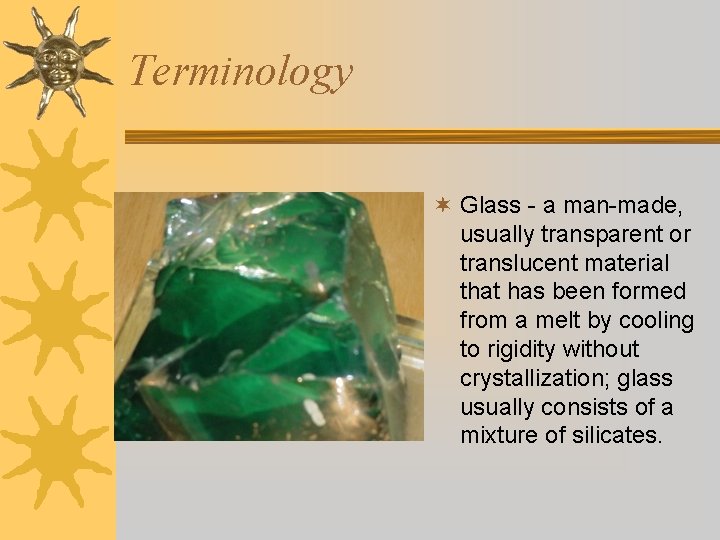
Terminology ¬ Glass - a man-made, usually transparent or translucent material that has been formed from a melt by cooling to rigidity without crystallization; glass usually consists of a mixture of silicates.
Terminology ¬ Naturally occurring glasslike materials formed from volcanoes – Obsidian - a dark natural glass formed by the cooling of molten lava – Pumice - a volcanic glass full of cavities and very light in weight used especially in powder form for smoothing and polishing. ¬ Hardness - the cohesion of the particles on the surface of a mineral as determined by its capacity to scratch another or be itself scratched -- compare MOHS' scale
Mohs Scale ¬ Devised by German mineralogist Friedrich Mohs, states the relative hardness of a mineral – Diamond - the mineral designated as the hardest at #10 – The ratings on the Mohs scale indicate a substance's scratching power. • A mineral is positioned on the scale directly below the highest mineral that is capable of scratching it, and above the highest mineral that it is capable of scratching. • The majority of glass falls within a narrow range on the Mohs scale.
Comparisons by Hardness & Density ¬Two most useful properties (of glass) forensic comparison purposes are its hardness and density ¬Non-optical physical properties – Surface textures – An investigator could easily distinguish the difference between a frosted glass and wire-reinforced sample of glass
Non-optical Physical Properties ¬ Shape - disparate shapes may assist the investigator in discounting evidence ¬ Thickness - This is another property of glass, which makes it easier to compare and identify. – For instance, window glass (at a residence in Pico Rivera, CA) broken during the commission of a burglary will not be the same thickness as bulletproof glass on the President's limousine.
Non-optical Physical Properties ¬ Markings on the glass surface - Markings and etchings on glass may be used to piece together the broken glass or to determine the orientation of the pieces. ¬ Presence of foreign substances on glass the presence of torn clothing, blood, and other contaminants may help the crime scene investigator to solve the crime
Optical Physical Properties ¬Optical physical properties – Absorption - opaque substances absorb light, transparent substances permit light to pass through them – The color of a piece of glass depends on its absorption of light – When examining a piece of glass, we look at both the shade and depth of the color
Refractive Index ¬ When comparing glass fragments, a glass fragment may be immersed in a liquid with a known refractive index. When viewed with a microscope, the glass fragment will be nearly invisible if the refractive index of the fragment is similar to the that of the liquid. ¬ The refractive index of the liquid can be found using a refractometer.
Comparison of Glass by Dispersion ¬Dispersion - the process of separating light into its component colors such that when a ray of light is projected through a sample, the light is dispersed into a spectrum (much like a prism), which allows the investigator to make further comparisons.
Flotation ¬A method of glass comparison, where a particle is immersed in liquid ¬The liquid's density is adjusted by the addition of either bromobenzene or bromoform until the liquid's density is equal to the density of the glass particle that appears suspended in the liquid.
Glass Evidence Glass comparison examinations can determine whether or not particles of glass originated from a broken source of glass. Glass fracture examinations can determine the direction and type of the breaking force and the sequence of shots.
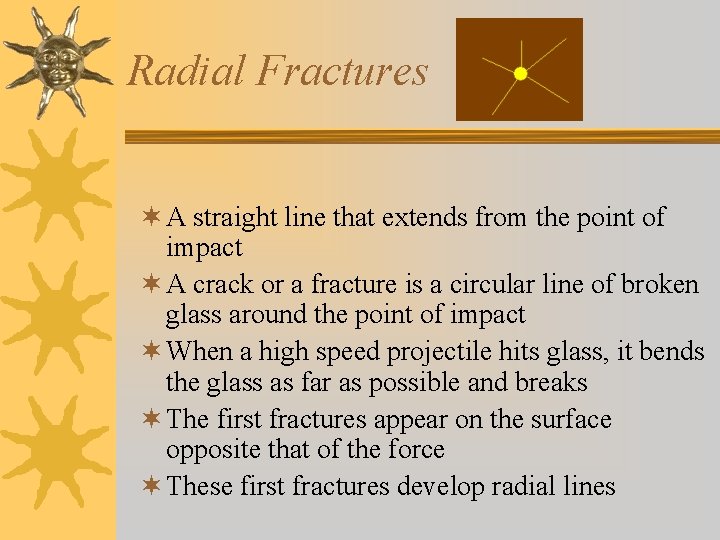
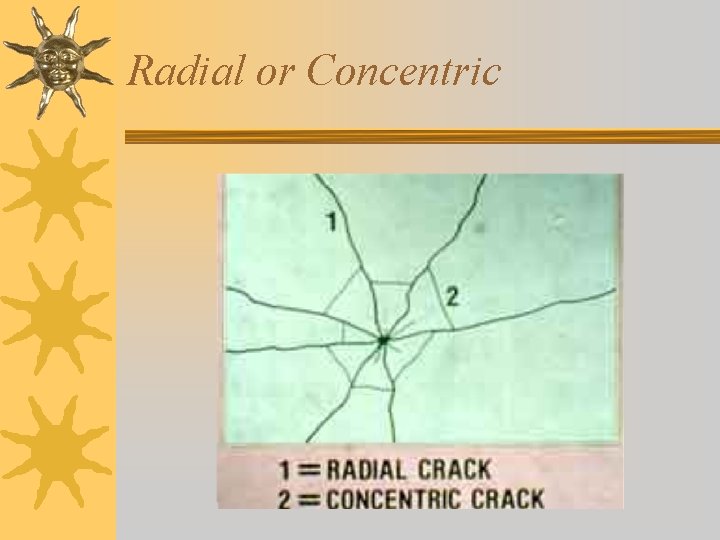
Radial Fractures ¬ A straight line that extends from the point of impact ¬ A crack or a fracture is a circular line of broken glass around the point of impact ¬ When a high speed projectile hits glass, it bends the glass as far as possible and breaks ¬ The first fractures appear on the surface opposite that of the force ¬ These first fractures develop radial lines
The 3 R Rule of Radial Fractures ¬ Radial crack forms a ¬ Right angle on the ¬ Reverse side of the force
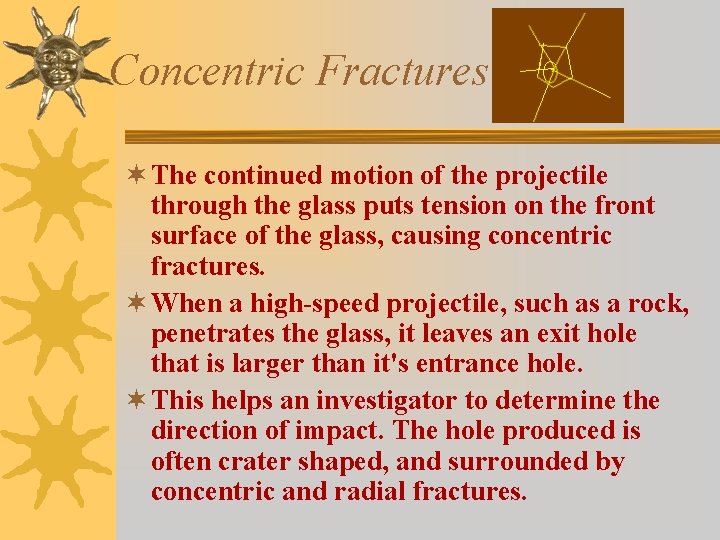
Concentric Fractures ¬ The continued motion of the projectile through the glass puts tension on the front surface of the glass, causing concentric fractures. ¬ When a high-speed projectile, such as a rock, penetrates the glass, it leaves an exit hole that is larger than it's entrance hole. ¬ This helps an investigator to determine the direction of impact. The hole produced is often crater shaped, and surrounded by concentric and radial fractures.
Radial or Concentric
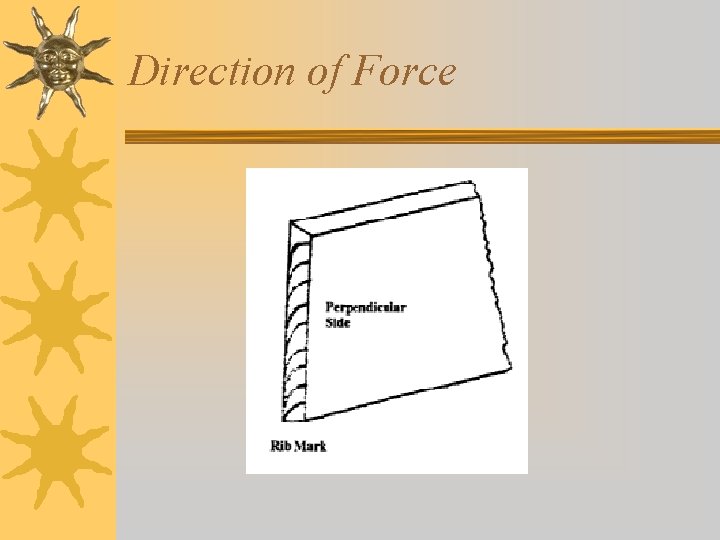
Direction of Force ¬ A determination of the direction of force in breaking a window pane can be determined by the direction of the rib marks--stress marks left on broken edges of glass that are perpendicular to one side. ¬ On radial fractures (those radiating from the center) the direction of the force used to break the window is on the same side as the tangential (almost parallel) parts of the rib marks.
Direction of Force
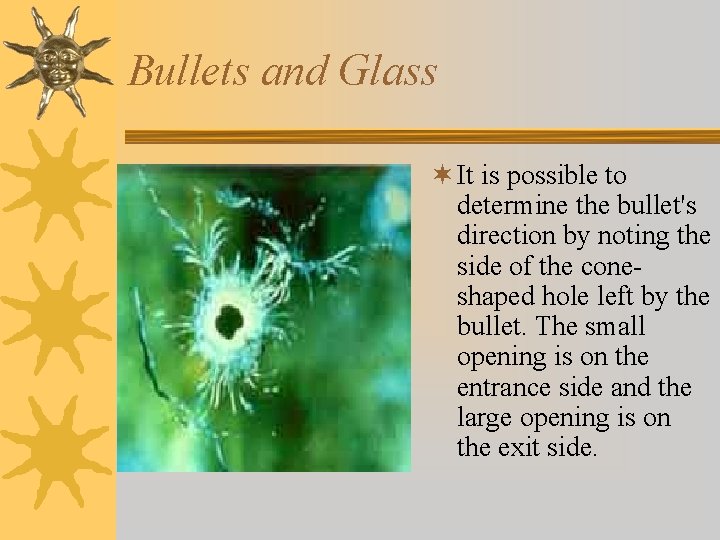
Bullets and Glass ¬ It is possible to determine the bullet's direction by noting the side of the coneshaped hole left by the bullet. The small opening is on the entrance side and the large opening is on the exit side.
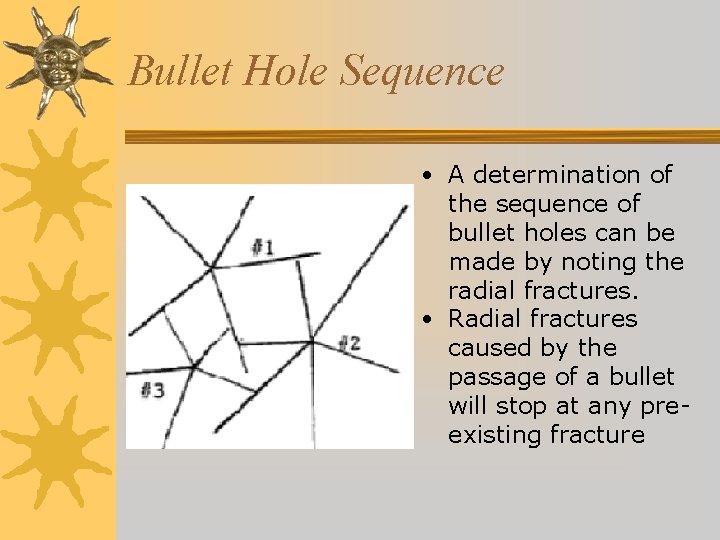
Bullet Hole Sequence • A determination of the sequence of bullet holes can be made by noting the radial fractures. • Radial fractures caused by the passage of a bullet will stop at any preexisting fracture
Collection of Glass Evidence ¬ Collect samples of glass that best represents the known glass. This can be done by collecting from the four corners of the window. ¬ When the glass you are collecting is not from a window, collect all glass. ¬ If more than one type of glass is broken, collect representative samples of each type.
Glass Labeling and Packaging ¬ Label the sides of the glass in the frame INSIDE and OUTSIDE ¬ Label the glass where it was removed in the frame such as TOP, BOTTOM, LEFT, and RIGHT. ¬ The round pillboxes are the best containers for small glass samples. ¬ Avoid using paper or glass containers. ¬ Do not process evidence for latent prints.