
Introduction to Flying History of Flight HISAVN 101
- Slides: 13
Introduction to Flying History of Flight HIS-AVN 101 Chapter 1 Pilot’s Handbook of Aeronautical Knowledge
History of Flight • Learning Objectives – Develop a basic understanding of the events that lead to the first successful flight by the Wright Brothers – Develop a basic understanding of the individuals involved in early aviation events
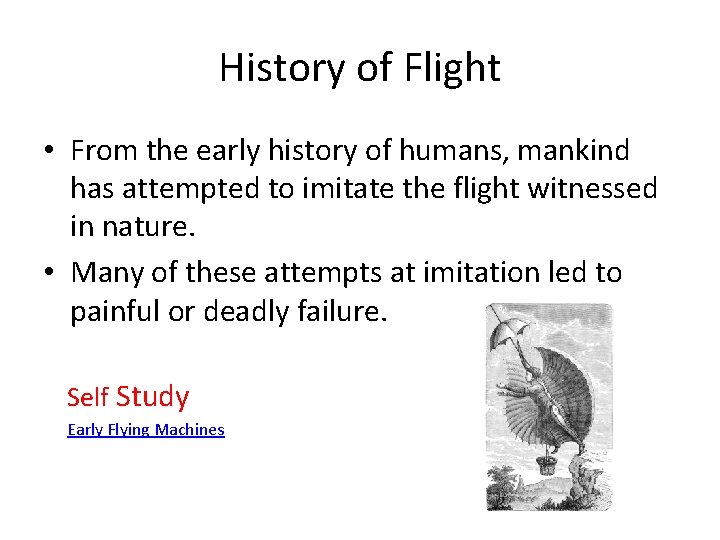
History of Flight • From the early history of humans, mankind has attempted to imitate the flight witnessed in nature. • Many of these attempts at imitation led to painful or deadly failure. Self Study Early Flying Machines
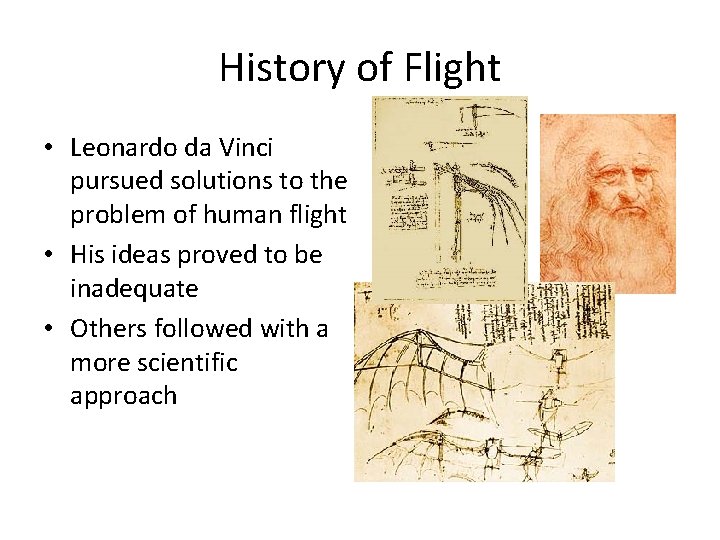
History of Flight • Leonardo da Vinci pursued solutions to the problem of human flight • His ideas proved to be inadequate • Others followed with a more scientific approach
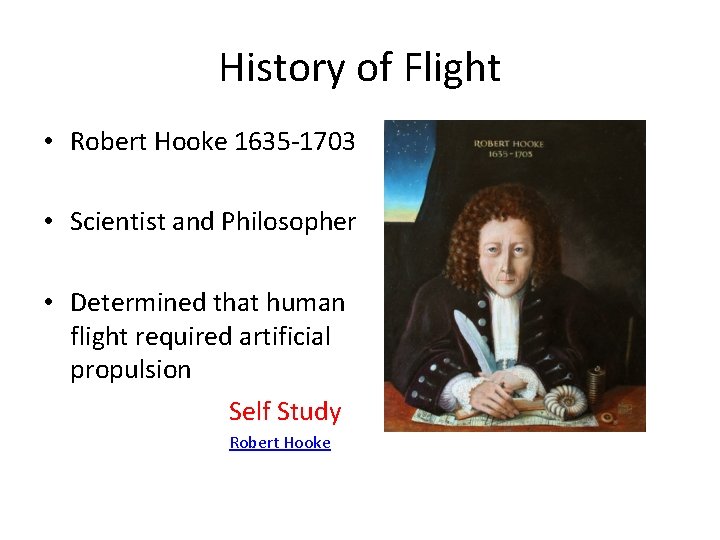
History of Flight • Robert Hooke 1635 -1703 • Scientist and Philosopher • Determined that human flight required artificial propulsion Self Study Robert Hooke
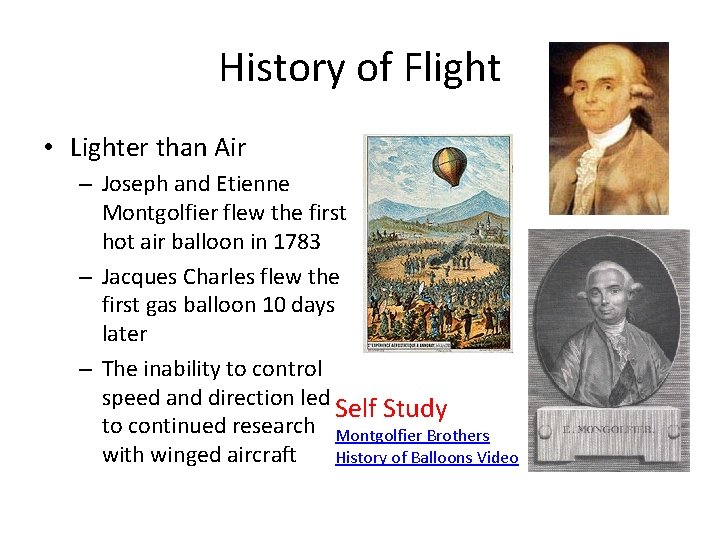
History of Flight • Lighter than Air – Joseph and Etienne Montgolfier flew the first hot air balloon in 1783 – Jacques Charles flew the first gas balloon 10 days later – The inability to control speed and direction led Self Study to continued research Montgolfier Brothers with winged aircraft History of Balloons Video
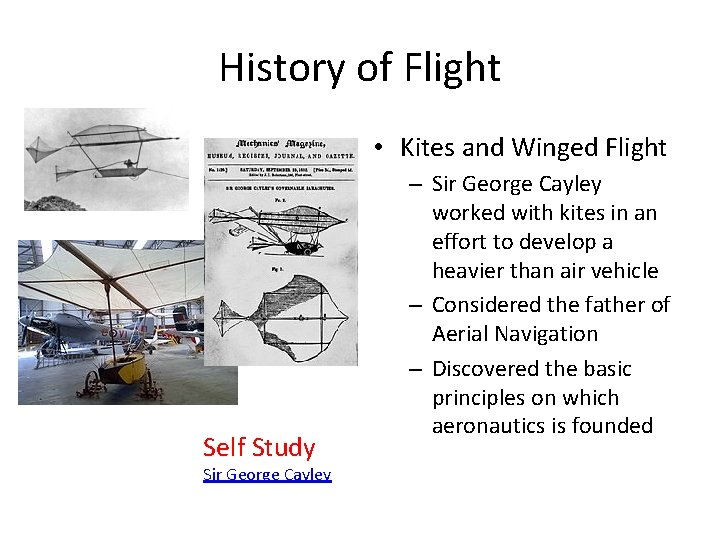
History of Flight • Kites and Winged Flight Self Study Sir George Cayley – Sir George Cayley worked with kites in an effort to develop a heavier than air vehicle – Considered the father of Aerial Navigation – Discovered the basic principles on which aeronautics is founded
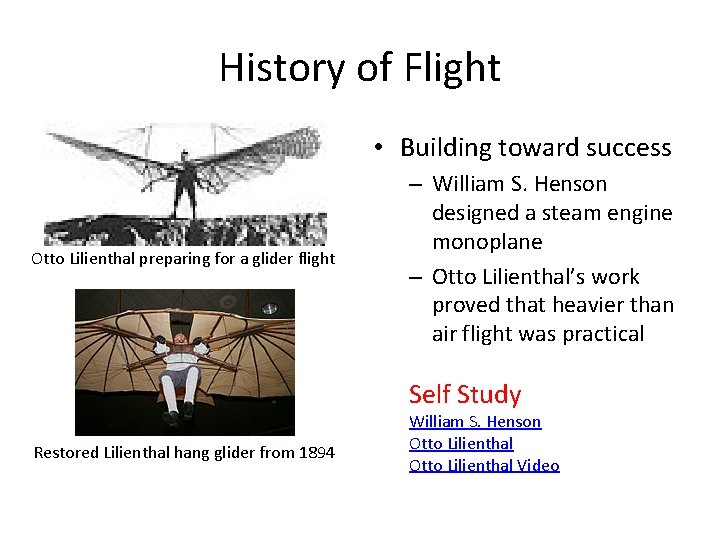
History of Flight • Building toward success Otto Lilienthal preparing for a glider flight – William S. Henson designed a steam engine monoplane – Otto Lilienthal’s work proved that heavier than air flight was practical Self Study Restored Lilienthal hang glider from 1894 William S. Henson Otto Lilienthal Video
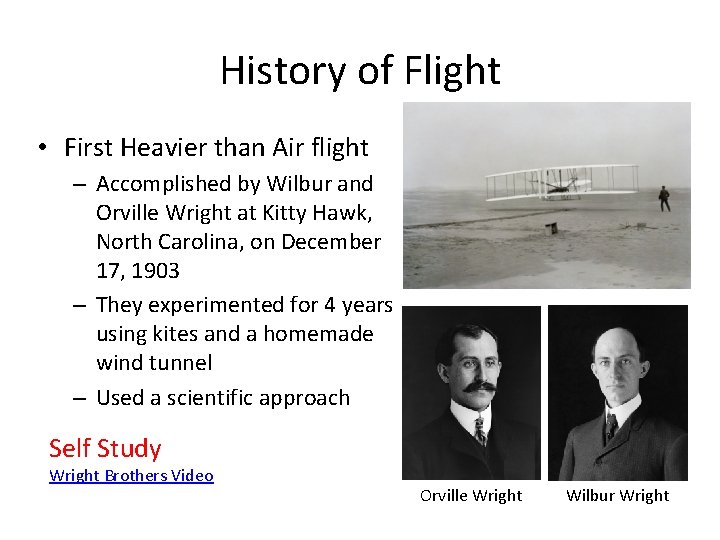
History of Flight • First Heavier than Air flight – Accomplished by Wilbur and Orville Wright at Kitty Hawk, North Carolina, on December 17, 1903 – They experimented for 4 years using kites and a homemade wind tunnel – Used a scientific approach Self Study Wright Brothers Video Orville Wright Wilbur Wright
History of Flight A. He carved the first airplane model out of stone B. He designed the first 1. Leonardo da Vinci functional airfoil contributed what to the advancement of modern C. He included the equations for lift in his secret code aviation? D. He did not make any consequential contributions to modern aviation Check on Learning
History of Flight Check on Learning A. Directional control 2. Balloons solved what control problem associated with human flight? B. Speed control C. Lift D. All of the above
History of Flight Check on Learning A. Sir George Cayley 3. Who spent his 84 years seeking to develop a heavier-than-air vehicle supported by kite-shaped wings? B. Robert Hooke C. Etienne Montgolfier D. William Henson
History of Flight This concludes the History of Flight slide show. The next class will cover the History of the Federal Aviation Administration (FAA) HIS-FAA 102