
Introduction to Fischer Tropsch Synthesis Rui Xu Department
- Slides: 41
Introduction to Fischer Tropsch Synthesis Rui Xu Department of Chemical Engineering Auburn University Jan 29 th, 2013 CHEN 4470 Process Design Practice
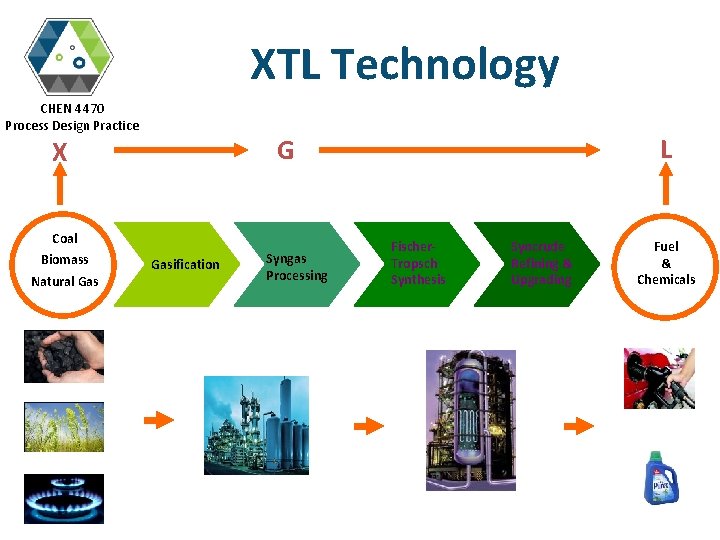
XTL Technology CHEN 4470 Process Design Practice Coal Biomass Natural Gas L G X Gasification Syngas Processing Fischer. Tropsch Synthesis Syncrude Refining & Upgrading Fuel & Chemicals
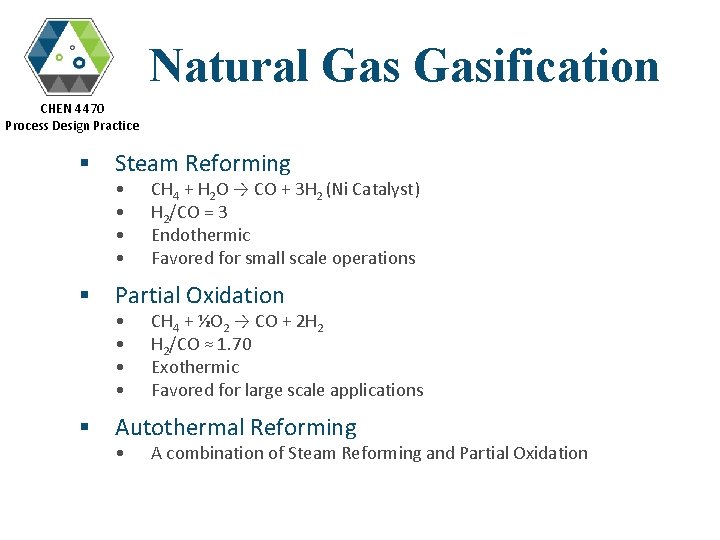
Natural Gasification CHEN 4470 Process Design Practice § Steam Reforming • • CH 4 + H 2 O → CO + 3 H 2 (Ni Catalyst) H 2/CO = 3 Endothermic Favored for small scale operations § Partial Oxidation • • CH 4 + ½O 2 → CO + 2 H 2 H 2/CO ≈ 1. 70 Exothermic Favored for large scale applications § Autothermal Reforming • A combination of Steam Reforming and Partial Oxidation
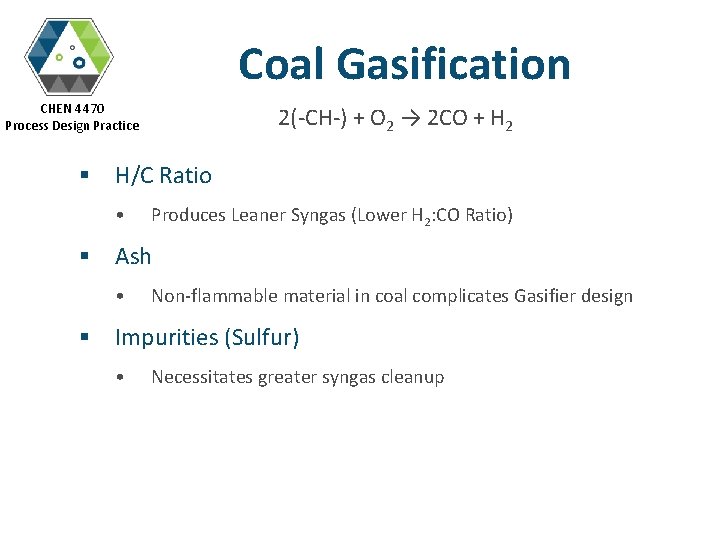
Coal Gasification CHEN 4470 Process Design Practice 2(-CH-) + O 2 → 2 CO + H 2 § H/C Ratio • Produces Leaner Syngas (Lower H 2: CO Ratio) § Ash • Non-flammable material in coal complicates Gasifier design § Impurities (Sulfur) • Necessitates greater syngas cleanup
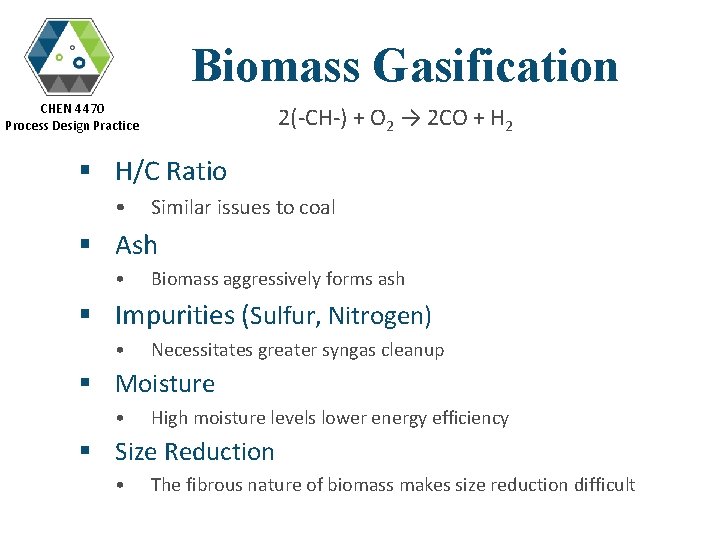
Biomass Gasification CHEN 4470 Process Design Practice 2(-CH-) + O 2 → 2 CO + H 2 § H/C Ratio • Similar issues to coal § Ash • Biomass aggressively forms ash § Impurities (Sulfur, Nitrogen) • Necessitates greater syngas cleanup § Moisture • High moisture levels lower energy efficiency § Size Reduction • The fibrous nature of biomass makes size reduction difficult
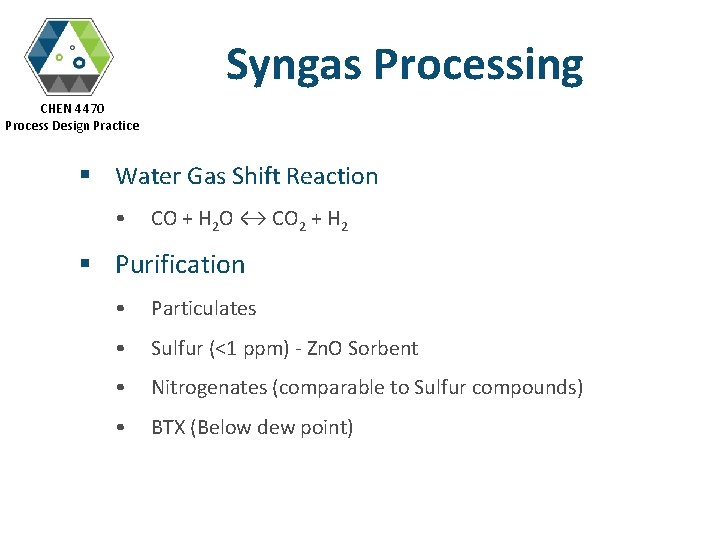
Syngas Processing CHEN 4470 Process Design Practice § Water Gas Shift Reaction • CO + H 2 O ↔ CO 2 + H 2 § Purification • Particulates • Sulfur (<1 ppm) - Zn. O Sorbent • Nitrogenates (comparable to Sulfur compounds) • BTX (Below dew point)
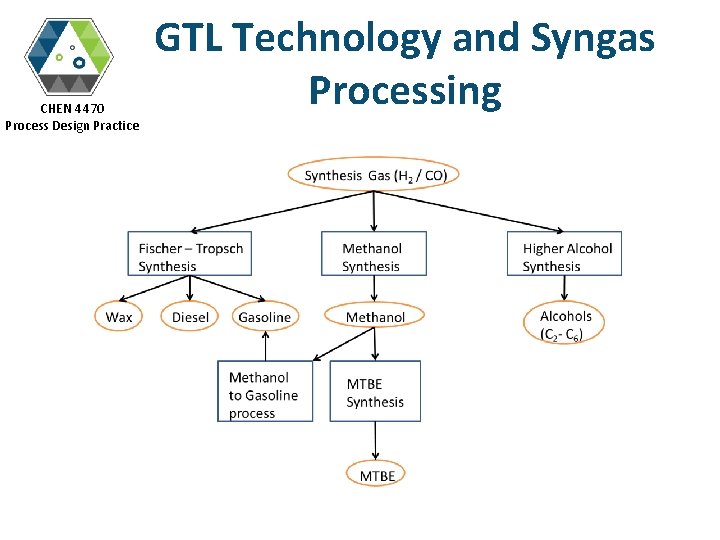
CHEN 4470 Process Design Practice GTL Technology and Syngas Processing
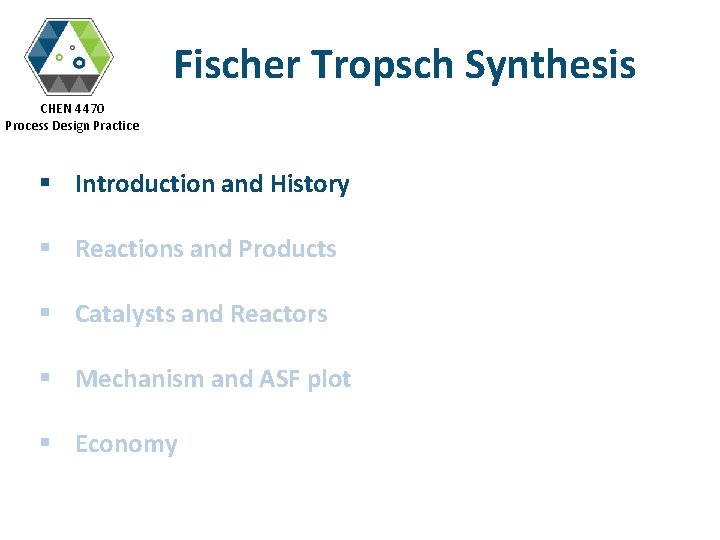
Fischer Tropsch Synthesis CHEN 4470 Process Design Practice § Introduction and History § Reactions and Products § Catalysts and Reactors § Mechanism and ASF plot § Economy
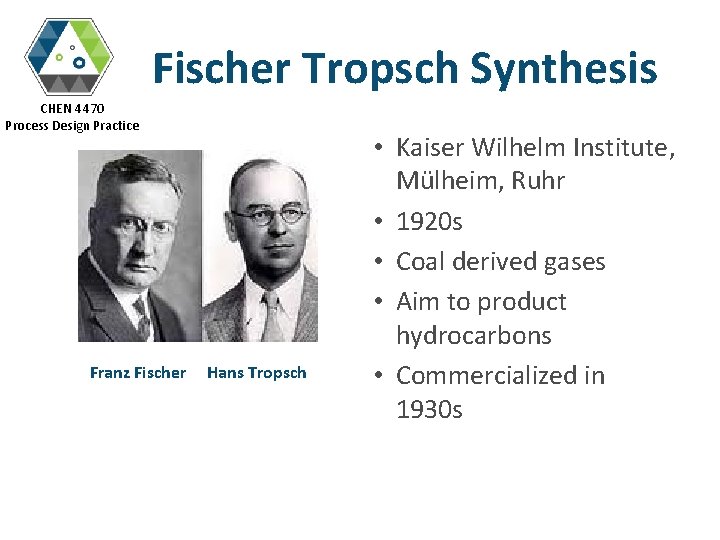
Fischer Tropsch Synthesis CHEN 4470 Process Design Practice Franz Fischer Hans Tropsch • Kaiser Wilhelm Institute, Mülheim, Ruhr • 1920 s • Coal derived gases • Aim to product hydrocarbons • Commercialized in 1930 s
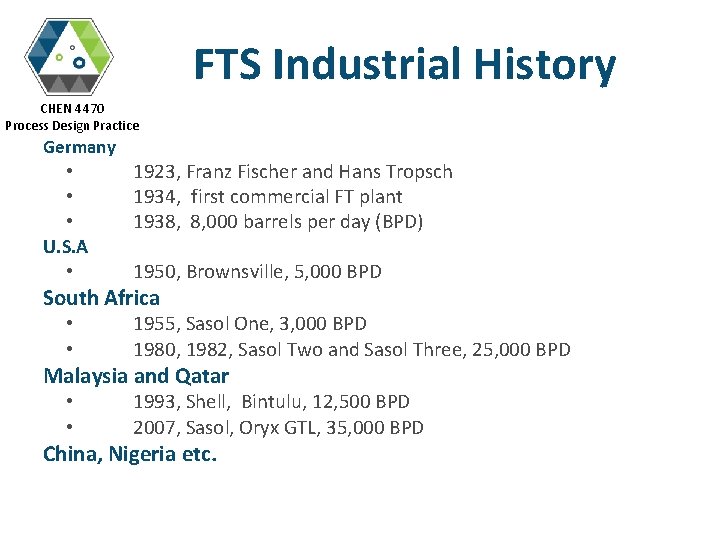
FTS Industrial History CHEN 4470 Process Design Practice Germany • • • U. S. A • 1923, Franz Fischer and Hans Tropsch 1934, first commercial FT plant 1938, 8, 000 barrels per day (BPD) 1950, Brownsville, 5, 000 BPD South Africa • • 1955, Sasol One, 3, 000 BPD 1980, 1982, Sasol Two and Sasol Three, 25, 000 BPD Malaysia and Qatar • • 1993, Shell, Bintulu, 12, 500 BPD 2007, Sasol, Oryx GTL, 35, 000 BPD China, Nigeria etc.
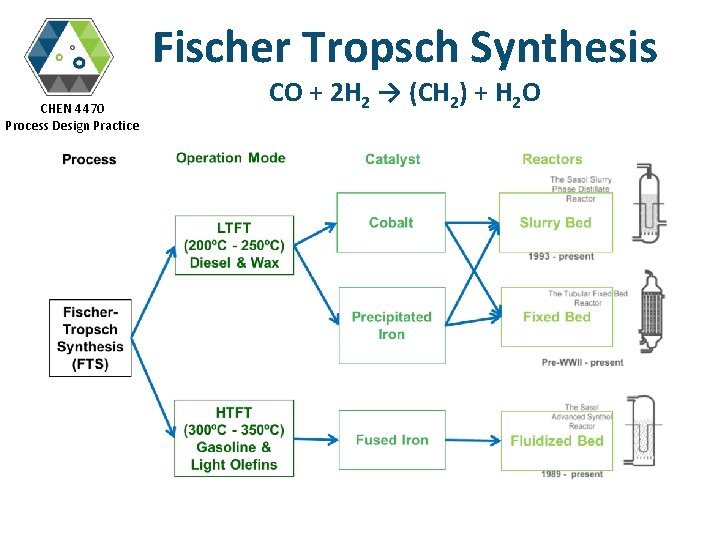
Fischer Tropsch Synthesis CHEN 4470 Process Design Practice CO + 2 H 2 → (CH 2) + H 2 O
Fischer Tropsch Synthesis CHEN 4470 Process Design Practice § Introduction and History § Reactions and Products § Catalysts and Reactors § Mechanism and ASF plot § Economy
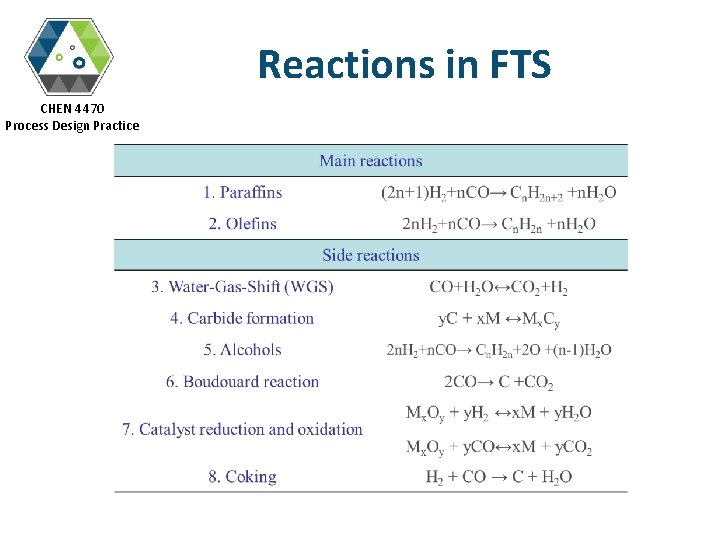
Reactions in FTS CHEN 4470 Process Design Practice
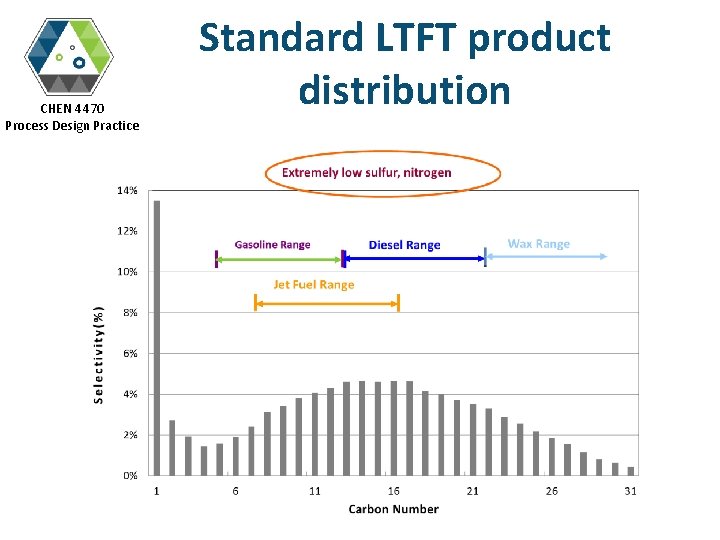
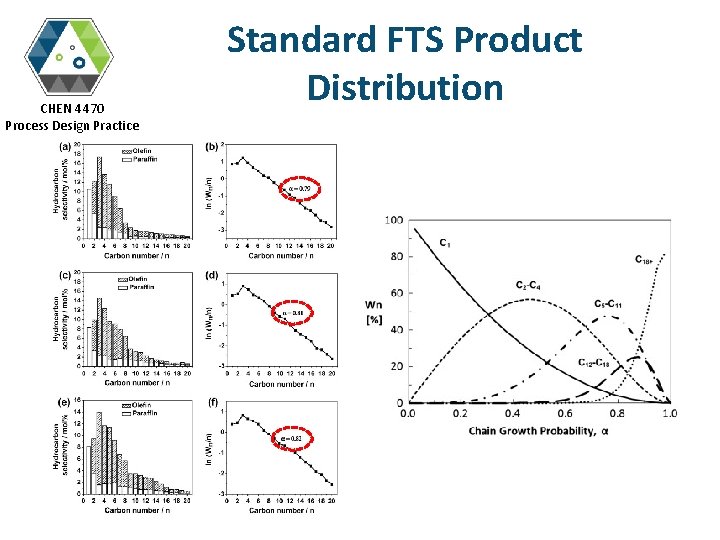
CHEN 4470 Process Design Practice Standard LTFT product distribution
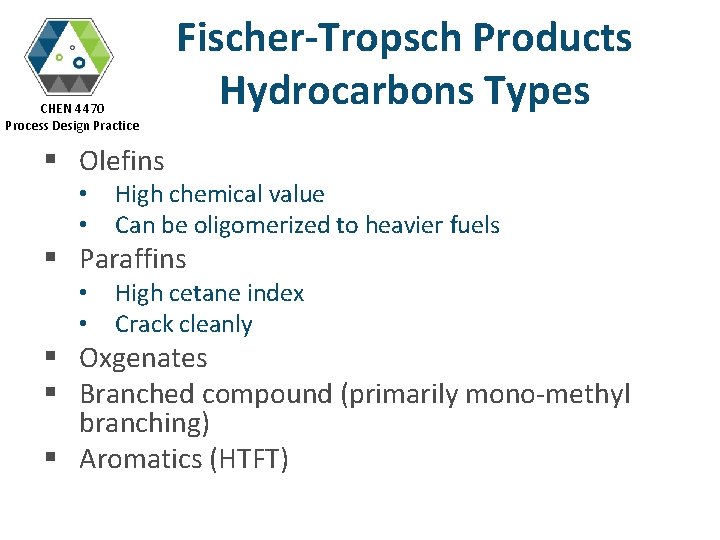
CHEN 4470 Process Design Practice Fischer-Tropsch Products Hydrocarbons Types § Olefins • • High chemical value Can be oligomerized to heavier fuels § Paraffins • • High cetane index Crack cleanly § Oxgenates § Branched compound (primarily mono-methyl branching) § Aromatics (HTFT)
Fischer Tropsch Synthesis CHEN 4470 Process Design Practice Ø Introduction and History Ø Reactions and Products Ø Catalysts and Reactors Ø Mechanism and ASF plot Ø Economy
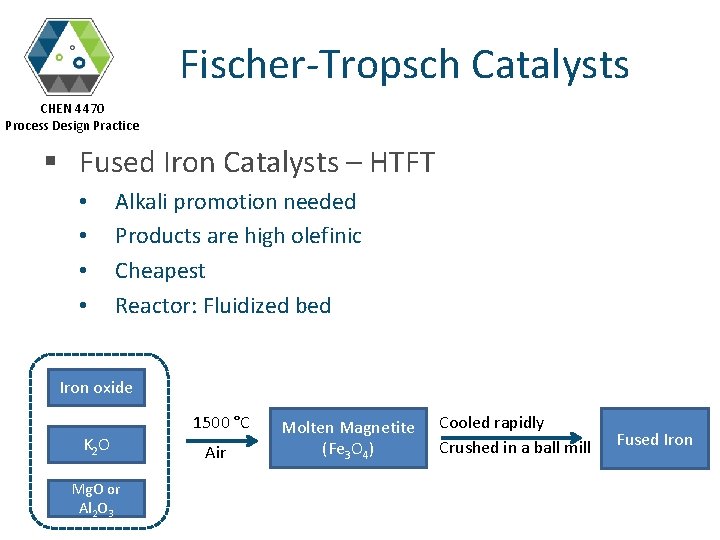
Fischer-Tropsch Catalysts CHEN 4470 Process Design Practice § Fused Iron Catalysts – HTFT • • Alkali promotion needed Products are high olefinic Cheapest Reactor: Fluidized bed Iron oxide K 2 O Mg. O or Al 2 O 3 1500 °C Air Molten Magnetite (Fe 3 O 4) Cooled rapidly Crushed in a ball mill Fused Iron
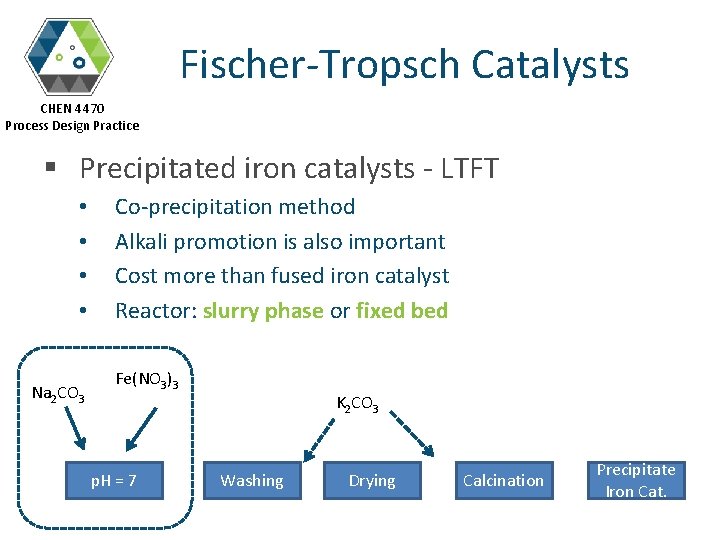
Fischer-Tropsch Catalysts CHEN 4470 Process Design Practice § Precipitated iron catalysts - LTFT • • Na 2 CO 3 Co-precipitation method Alkali promotion is also important Cost more than fused iron catalyst Reactor: slurry phase or fixed bed Fe(NO 3)3 p. H = 7 K 2 CO 3 Washing Drying Calcination Precipitate Iron Cat.
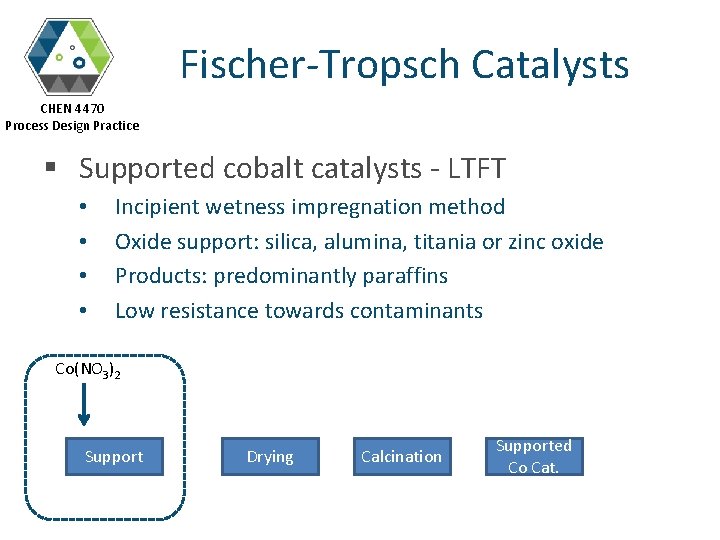
Fischer-Tropsch Catalysts CHEN 4470 Process Design Practice § Supported cobalt catalysts - LTFT • • Incipient wetness impregnation method Oxide support: silica, alumina, titania or zinc oxide Products: predominantly paraffins Low resistance towards contaminants Co(NO 3)2 Support Drying Calcination Supported Co Cat.
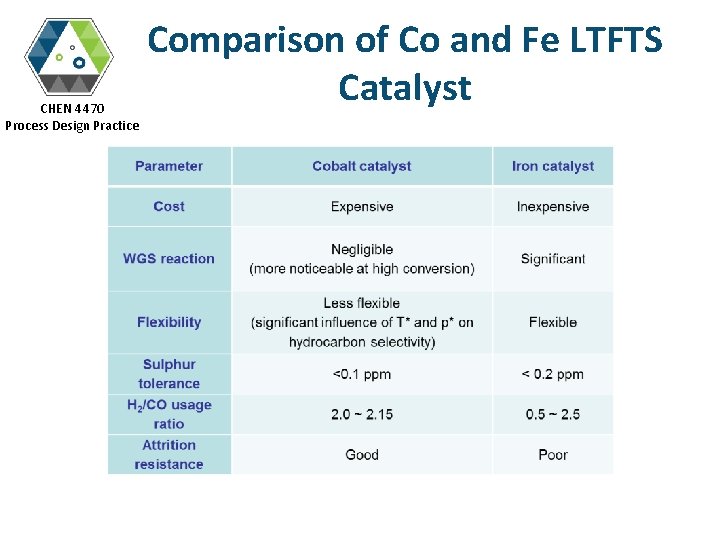
CHEN 4470 Process Design Practice Comparison of Co and Fe LTFTS Catalyst
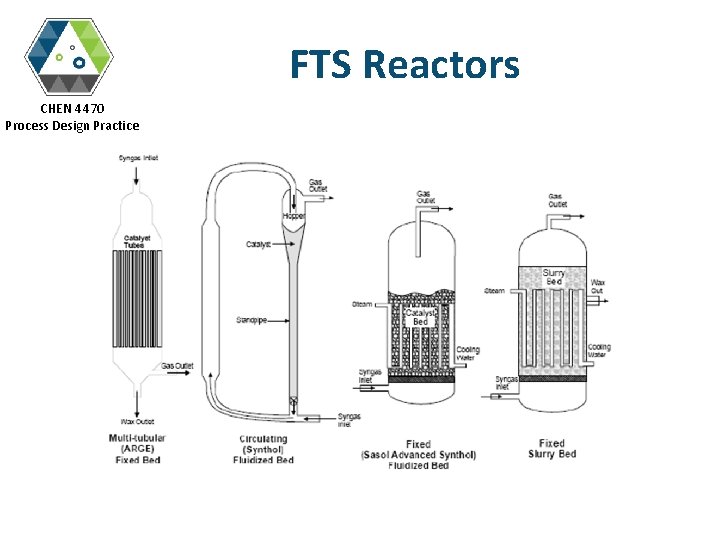
FTS Reactors CHEN 4470 Process Design Practice
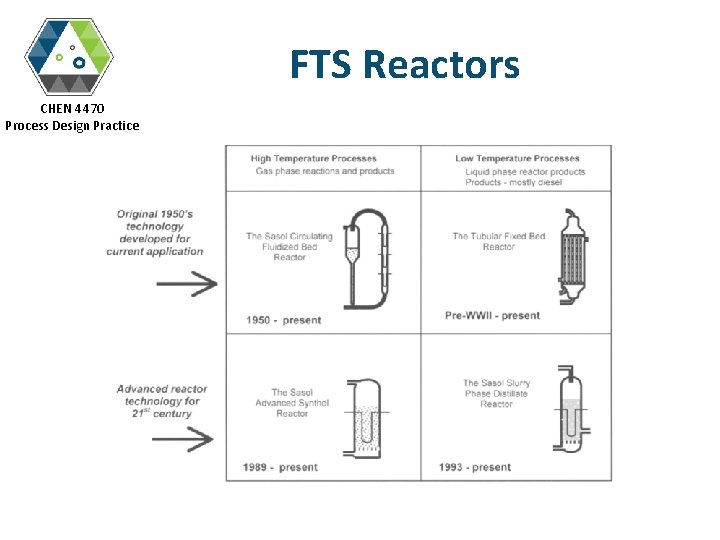
FTS Reactors CHEN 4470 Process Design Practice
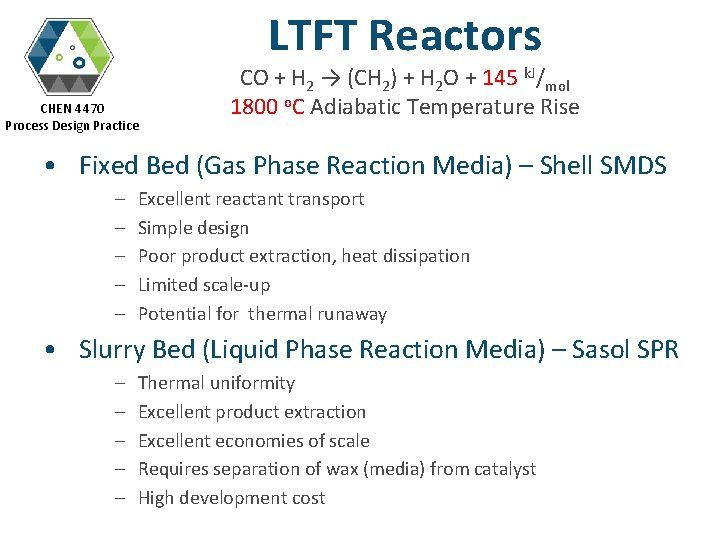
LTFT Reactors CHEN 4470 Process Design Practice CO + H 2 → (CH 2) + H 2 O + 145 k. J/mol 1800 o. C Adiabatic Temperature Rise • Fixed Bed (Gas Phase Reaction Media) – Shell SMDS – – – Excellent reactant transport Simple design Poor product extraction, heat dissipation Limited scale-up Potential for thermal runaway • Slurry Bed (Liquid Phase Reaction Media) – Sasol SPR – – – Thermal uniformity Excellent product extraction Excellent economies of scale Requires separation of wax (media) from catalyst High development cost
Fischer Tropsch Synthesis CHEN 4470 Process Design Practice Ø Introduction and History Ø Reactions and Products Ø Catalysts and Reactors Ø Mechanism and ASF plot Ø Economy
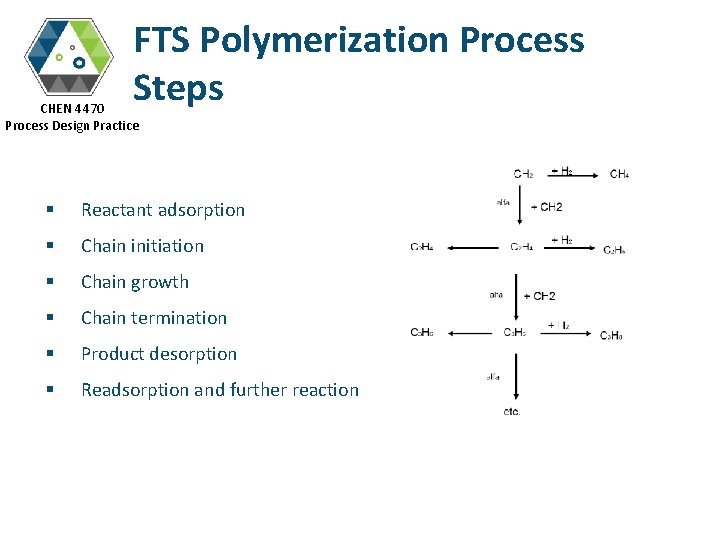
FTS Polymerization Process Steps CHEN 4470 Process Design Practice § Reactant adsorption § Chain initiation § Chain growth § Chain termination § Product desorption § Readsorption and further reaction
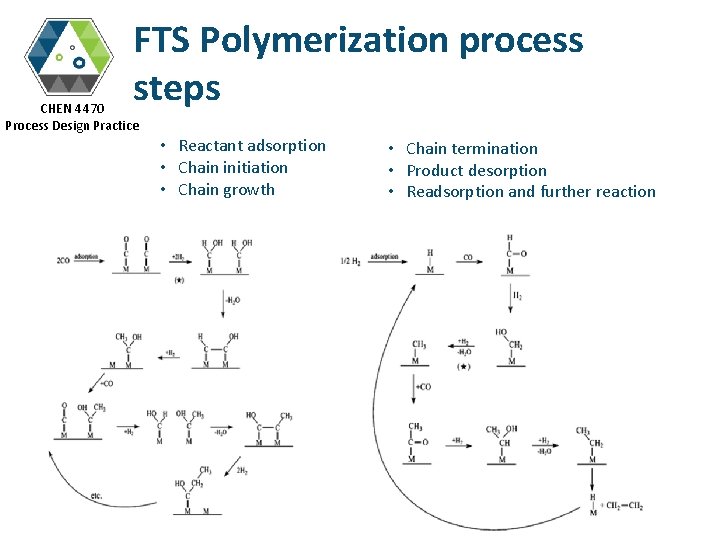
FTS Polymerization process steps CHEN 4470 Process Design Practice • Reactant adsorption • Chain initiation • Chain growth • Chain termination • Product desorption • Readsorption and further reaction
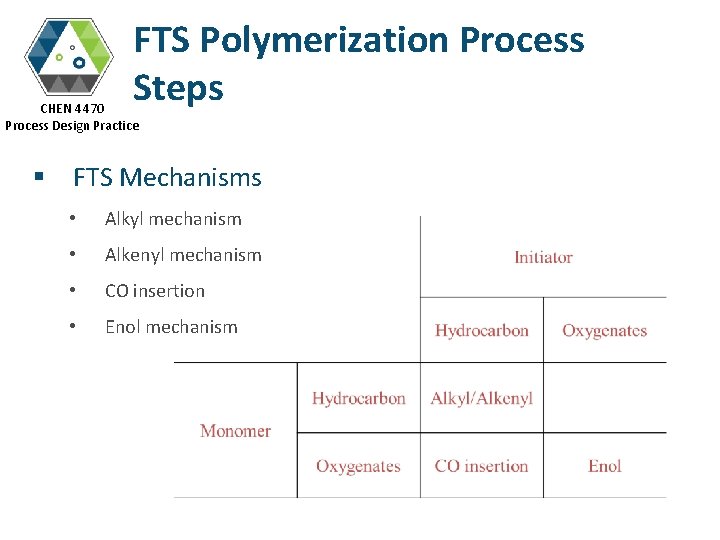
FTS Polymerization Process Steps CHEN 4470 Process Design Practice § FTS Mechanisms • Alkyl mechanism • Alkenyl mechanism • CO insertion • Enol mechanism
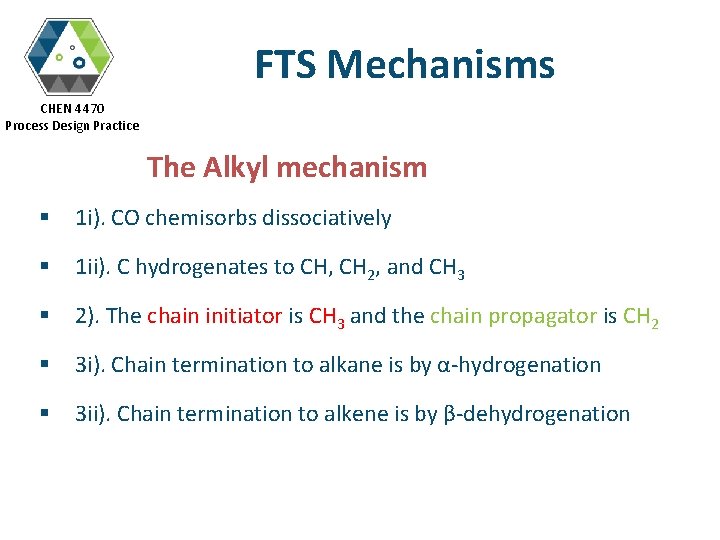
FTS Mechanisms CHEN 4470 Process Design Practice The Alkyl mechanism § 1 i). CO chemisorbs dissociatively § 1 ii). C hydrogenates to CH, CH 2, and CH 3 § 2). The chain initiator is CH 3 and the chain propagator is CH 2 § 3 i). Chain termination to alkane is by α-hydrogenation § 3 ii). Chain termination to alkene is by β-dehydrogenation
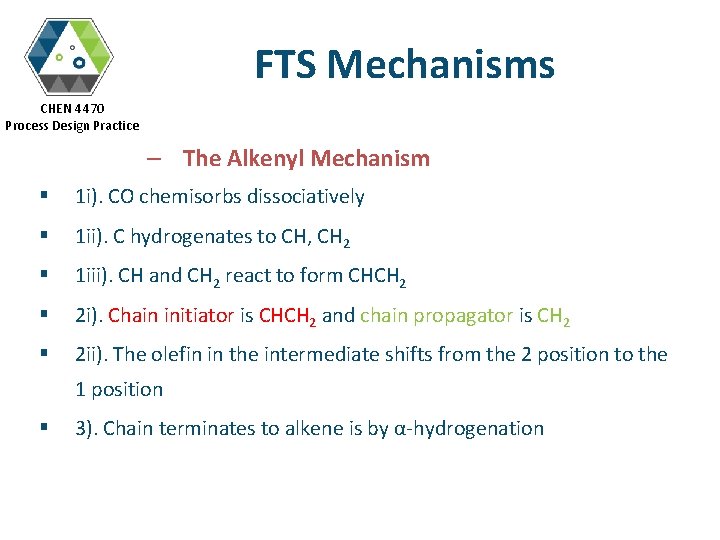
FTS Mechanisms CHEN 4470 Process Design Practice – The Alkenyl Mechanism § 1 i). CO chemisorbs dissociatively § 1 ii). C hydrogenates to CH, CH 2 § 1 iii). CH and CH 2 react to form CHCH 2 § 2 i). Chain initiator is CHCH 2 and chain propagator is CH 2 § 2 ii). The olefin in the intermediate shifts from the 2 position to the 1 position § 3). Chain terminates to alkene is by α-hydrogenation
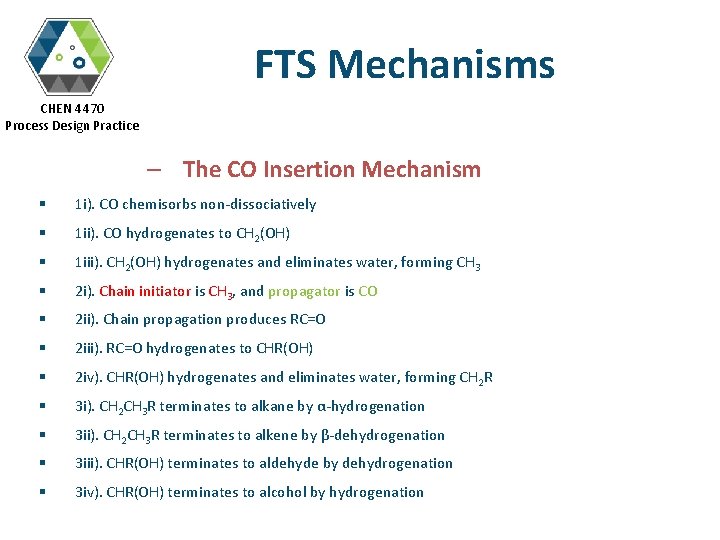
FTS Mechanisms CHEN 4470 Process Design Practice – The CO Insertion Mechanism § 1 i). CO chemisorbs non-dissociatively § 1 ii). CO hydrogenates to CH 2(OH) § 1 iii). CH 2(OH) hydrogenates and eliminates water, forming CH 3 § 2 i). Chain initiator is CH 3, and propagator is CO § 2 ii). Chain propagation produces RC=O § 2 iii). RC=O hydrogenates to CHR(OH) § 2 iv). CHR(OH) hydrogenates and eliminates water, forming CH 2 R § 3 i). CH 2 CH 3 R terminates to alkane by α-hydrogenation § 3 ii). CH 2 CH 3 R terminates to alkene by β-dehydrogenation § 3 iii). CHR(OH) terminates to aldehyde by dehydrogenation § 3 iv). CHR(OH) terminates to alcohol by hydrogenation
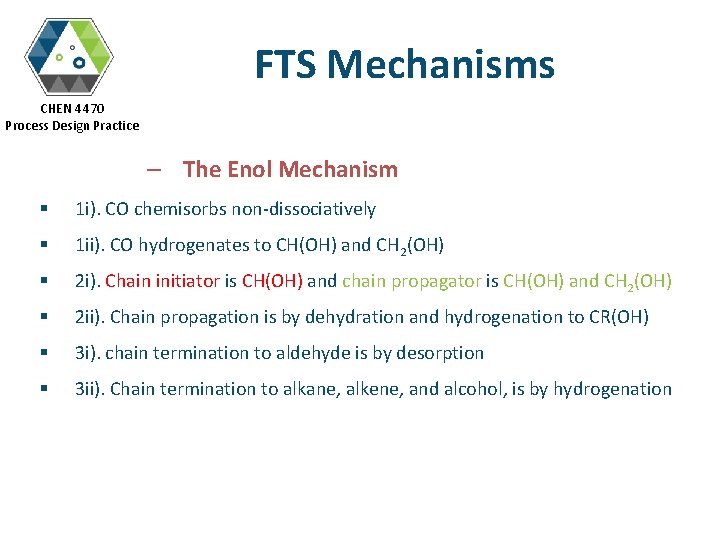
FTS Mechanisms CHEN 4470 Process Design Practice – The Enol Mechanism § 1 i). CO chemisorbs non-dissociatively § 1 ii). CO hydrogenates to CH(OH) and CH 2(OH) § 2 i). Chain initiator is CH(OH) and chain propagator is CH(OH) and CH 2(OH) § 2 ii). Chain propagation is by dehydration and hydrogenation to CR(OH) § 3 i). chain termination to aldehyde is by desorption § 3 ii). Chain termination to alkane, alkene, and alcohol, is by hydrogenation
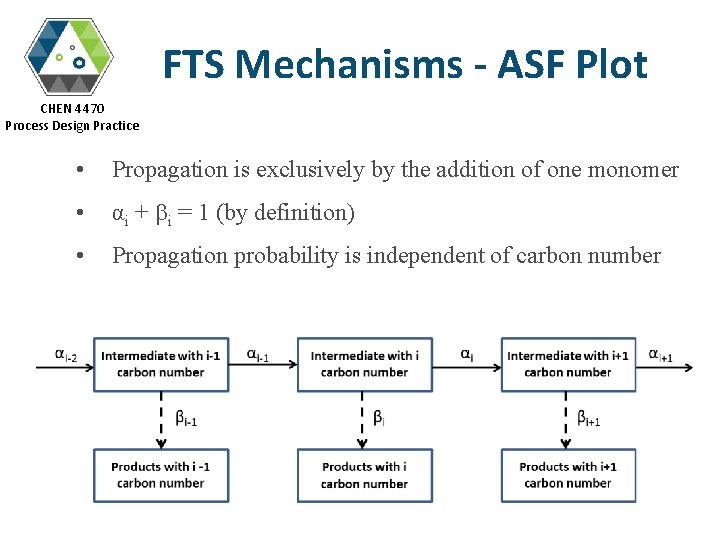
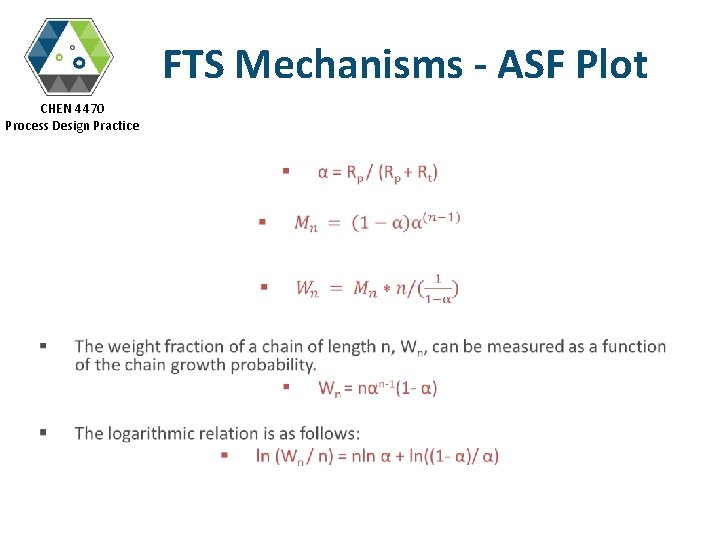
FTS Mechanisms - ASF Plot CHEN 4470 Process Design Practice • Propagation is exclusively by the addition of one monomer • αi + bi = 1 (by definition) • Propagation probability is independent of carbon number
FTS Mechanisms - ASF Plot CHEN 4470 Process Design Practice §
CHEN 4470 Process Design Practice Standard FTS Product Distribution
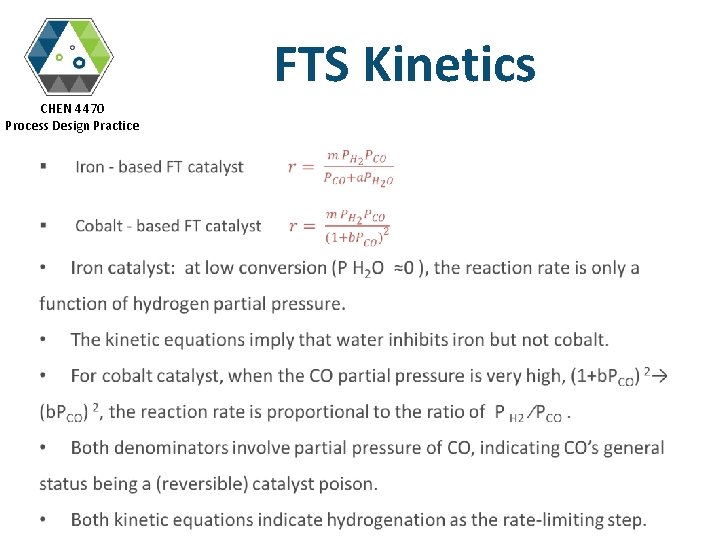
FTS Kinetics CHEN 4470 Process Design Practice §
Fischer Tropsch Synthesis CHEN 4470 Process Design Practice Ø Introduction and History Ø Reactions and Products Ø Catalysts and Reactors Ø Mechanism and ASF plot Ø Economy
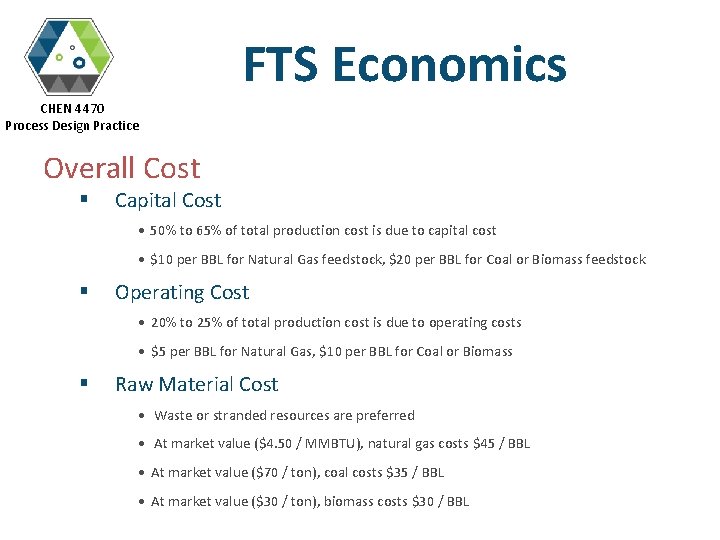
FTS Economics CHEN 4470 Process Design Practice Overall Cost § Capital Cost • 50% to 65% of total production cost is due to capital cost • $10 per BBL for Natural Gas feedstock, $20 per BBL for Coal or Biomass feedstock § Operating Cost • 20% to 25% of total production cost is due to operating costs • $5 per BBL for Natural Gas, $10 per BBL for Coal or Biomass § Raw Material Cost • Waste or stranded resources are preferred • At market value ($4. 50 / MMBTU), natural gas costs $45 / BBL • At market value ($70 / ton), coal costs $35 / BBL • At market value ($30 / ton), biomass costs $30 / BBL
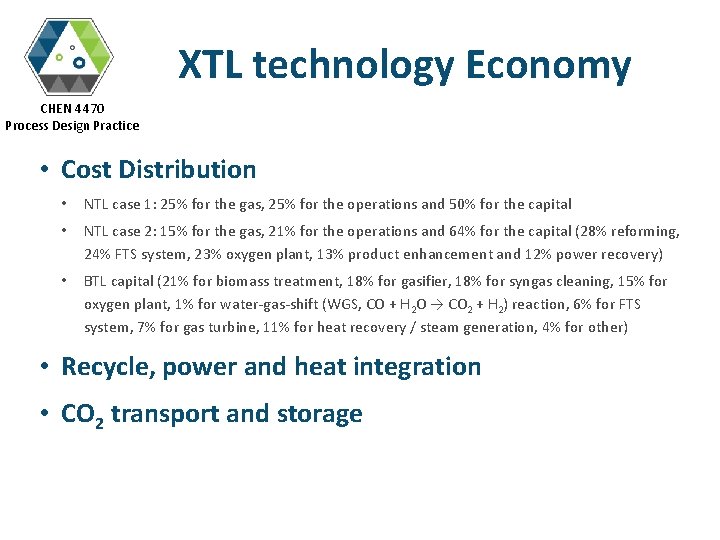
XTL technology Economy CHEN 4470 Process Design Practice • Cost Distribution • NTL case 1: 25% for the gas, 25% for the operations and 50% for the capital • NTL case 2: 15% for the gas, 21% for the operations and 64% for the capital (28% reforming, 24% FTS system, 23% oxygen plant, 13% product enhancement and 12% power recovery) • BTL capital (21% for biomass treatment, 18% for gasifier, 18% for syngas cleaning, 15% for oxygen plant, 1% for water-gas-shift (WGS, CO + H 2 O → CO 2 + H 2) reaction, 6% for FTS system, 7% for gas turbine, 11% for heat recovery / steam generation, 4% for other) • Recycle, power and heat integration • CO 2 transport and storage
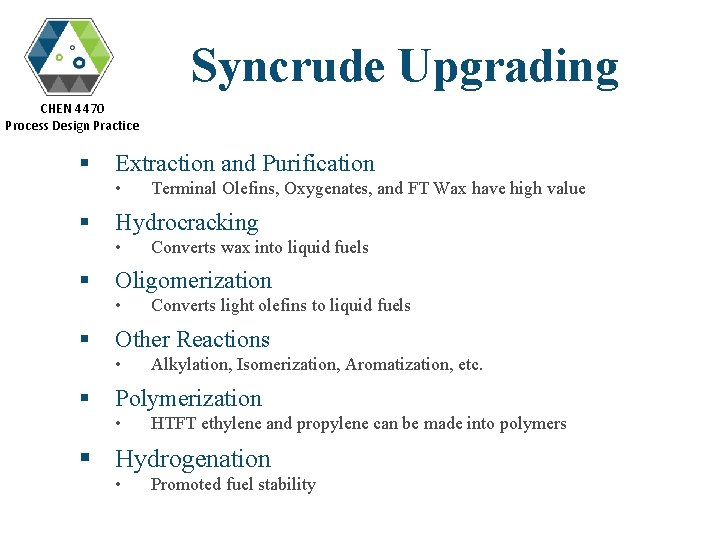
Syncrude Upgrading CHEN 4470 Process Design Practice § Extraction and Purification • § Hydrocracking • § Converts light olefins to liquid fuels Other Reactions • § Converts wax into liquid fuels Oligomerization • § Terminal Olefins, Oxygenates, and FT Wax have high value Alkylation, Isomerization, Aromatization, etc. Polymerization • HTFT ethylene and propylene can be made into polymers § Hydrogenation • Promoted fuel stability
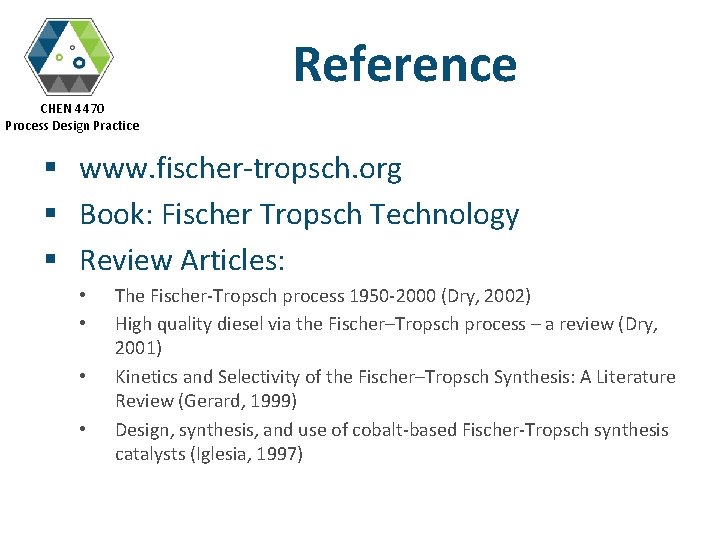
Reference CHEN 4470 Process Design Practice § www. fischer-tropsch. org § Book: Fischer Tropsch Technology § Review Articles: • • The Fischer-Tropsch process 1950 -2000 (Dry, 2002) High quality diesel via the Fischer–Tropsch process – a review (Dry, 2001) Kinetics and Selectivity of the Fischer–Tropsch Synthesis: A Literature Review (Gerard, 1999) Design, synthesis, and use of cobalt-based Fischer-Tropsch synthesis catalysts (Iglesia, 1997)
CHEN 4470 Process Design Practice