
Introduction to Finite Field Yunghsiang S Han Graduate
![Thm: In GF(2)[x], m ≥ 1, an irreducible polynomial of degree m pf: exercise](https://slidetodoc.com/presentation_image_h2/71d2bb2161e16b89982573640ea030db/image-16.jpg "Thm: In GF(2)[x], m ≥ 1, an irreducible polynomial of degree m pf: exercise")
![GF(42) GF(4)[z]/z 2+z+2, p(z) = z 2+z+2 Exponential Notation α=z α 15 = 1](https://slidetodoc.com/presentation_image_h2/71d2bb2161e16b89982573640ea030db/image-25.jpg "GF(42) GF(4)[z]/z 2+z+2, p(z) = z 2+z+2 Exponential Notation α=z α 15 = 1")
- Slides: 31
Introduction to Finite Field Yunghsiang S. Han Graduate Institute of Communication Engineering National Taipei University Modified from the lecture notes by Yuh-Ming Huang 8/28/2021 Abstract Algebra 1
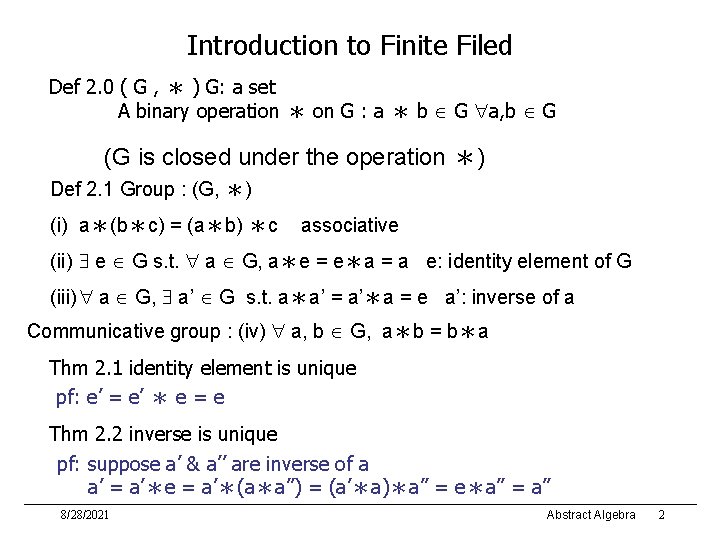
Introduction to Finite Filed Def 2. 0 ( G , * ) G: a set A binary operation * on G : a * b G a, b G (G is closed under the operation *) Def 2. 1 Group : (G, *) (i) a*(b*c) = (a*b) *c associative (ii) e G s. t. a G, a*e = e*a = a e: identity element of G (iii) a G, a’ G s. t. a*a’ = a’*a = e a’: inverse of a Communicative group : (iv) a, b G, a*b = b*a Thm 2. 1 identity element is unique pf: e’ = e’ * e = e Thm 2. 2 inverse is unique pf: suppose a’ & a’’ are inverse of a a’ = a’*e = a’*(a*a’’) = (a’*a)*a’’ = e*a’’ = a’’ 8/28/2021 Abstract Algebra 2
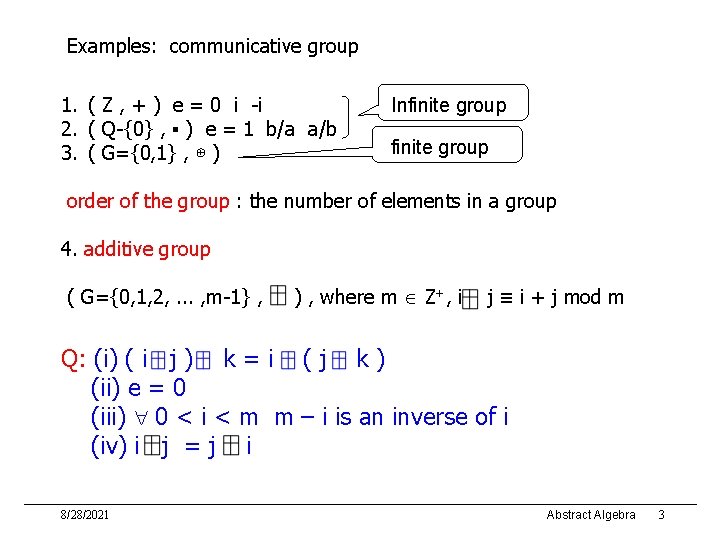
Examples: communicative group 1. ( Z , + ) e = 0 i -i 2. ( Q-{0} , ▪ ) e = 1 b/a a/b 3. ( G={0, 1} , ⊕ ) Infinite group order of the group : the number of elements in a group 4. additive group ( G={0, 1, 2, . . . , m-1} , ) , where m Z+, i j ≡ i + j mod m Q: (i) ( i j ) k = i ( j k ) (ii) e = 0 (iii) 0 < i < m m – i is an inverse of i (iv) i j = j i 8/28/2021 Abstract Algebra 3
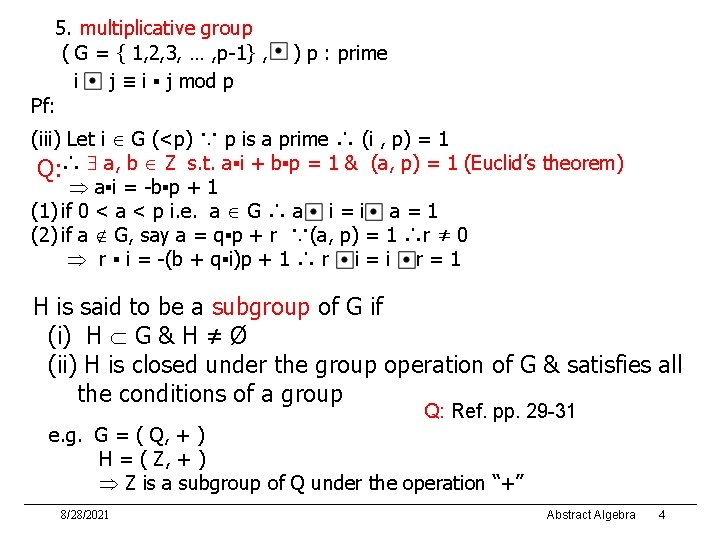
5. multiplicative group ( G = { 1, 2, 3, … , p-1} , i j ≡ i ▪ j mod p Pf: ) p : prime (iii) Let i G (<p) ∵ p is a prime ∴ (i , p) = 1 Q: ∴ a, b Z s. t. a▪i + b▪p = 1 & (a, p) = 1 (Euclid’s theorem) a▪i = -b▪p + 1 (1) if 0 < a < p i. e. a G ∴ a i = i a = 1 (2) if a G, say a = q▪p + r ∵(a, p) = 1 ∴r ≠ 0 r ▪ i = -(b + q▪i)p + 1 ∴ r i = i r = 1 H is said to be a subgroup of G if (i) H G & H ≠ Ø (ii) H is closed under the group operation of G & satisfies all the conditions of a group Q: Ref. pp. 29 -31 e. g. G = ( Q, + ) H = ( Z, + ) Z is a subgroup of Q under the operation “+” 8/28/2021 Abstract Algebra 4
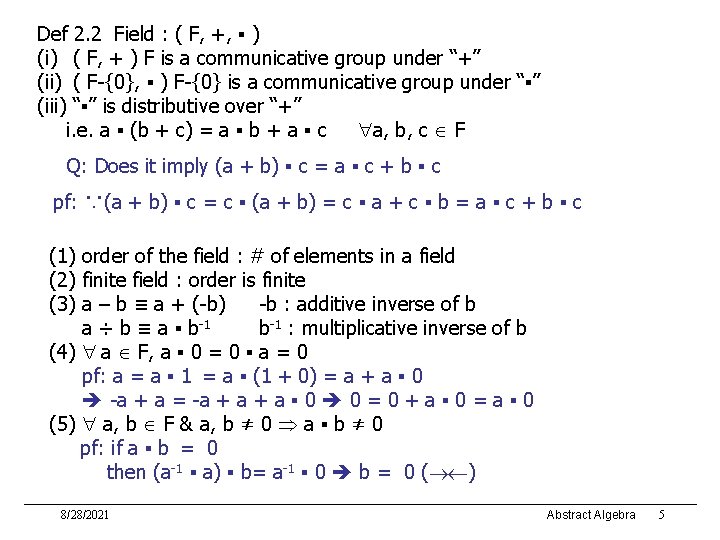
Def 2. 2 Field : ( F, +, ▪ ) (i) ( F, + ) F is a communicative group under “+” (ii) ( F-{0}, ▪ ) F-{0} is a communicative group under “▪” (iii) “▪” is distributive over “+” i. e. a ▪ (b + c) = a ▪ b + a ▪ c a, b, c F Q: Does it imply (a + b) ▪ c = a ▪ c + b ▪ c pf: ∵(a + b) ▪ c = c ▪ (a + b) = c ▪ a + c ▪ b = a ▪ c + b ▪ c (1) order of the field : # of elements in a field (2) finite field : order is finite (3) a – b ≡ a + (-b) -b : additive inverse of b a ÷ b ≡ a ▪ b-1 : multiplicative inverse of b (4) a F, a ▪ 0 = 0 ▪ a = 0 pf: a = a ▪ 1 = a ▪ (1 + 0) = a + a ▪ 0 -a + a = -a + a ▪ 0 0 = 0 + a ▪ 0 = a ▪ 0 (5) a, b F & a, b ≠ 0 a ▪ b ≠ 0 pf: if a ▪ b = 0 then (a-1 ▪ a) ▪ b= a-1 ▪ 0 b = 0 ( ) 8/28/2021 Abstract Algebra 5
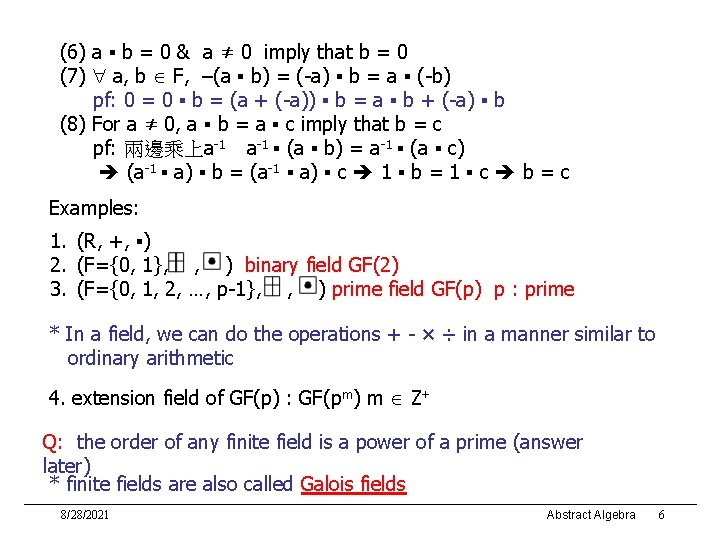
(6) a ▪ b = 0 & a ≠ 0 imply that b = 0 (7) a, b F, –(a ▪ b) = (-a) ▪ b = a ▪ (-b) pf: 0 = 0 ▪ b = (a + (-a)) ▪ b = a ▪ b + (-a) ▪ b (8) For a ≠ 0, a ▪ b = a ▪ c imply that b = c pf: 兩邊乘上a-1 ▪ (a ▪ b) = a-1 ▪ (a ▪ c) (a-1 ▪ a) ▪ b = (a-1 ▪ a) ▪ c 1 ▪ b = 1 ▪ c b = c Examples: 1. (R, +, ▪) 2. (F={0, 1}, , ) binary field GF(2) 3. (F={0, 1, 2, …, p-1}, , ) prime field GF(p) p : prime * In a field, we can do the operations + - × ÷ in a manner similar to ordinary arithmetic 4. extension field of GF(p) : GF(pm) m Z+ Q: the order of any finite field is a power of a prime (answer later) * finite fields are also called Galois fields 8/28/2021 Abstract Algebra 6
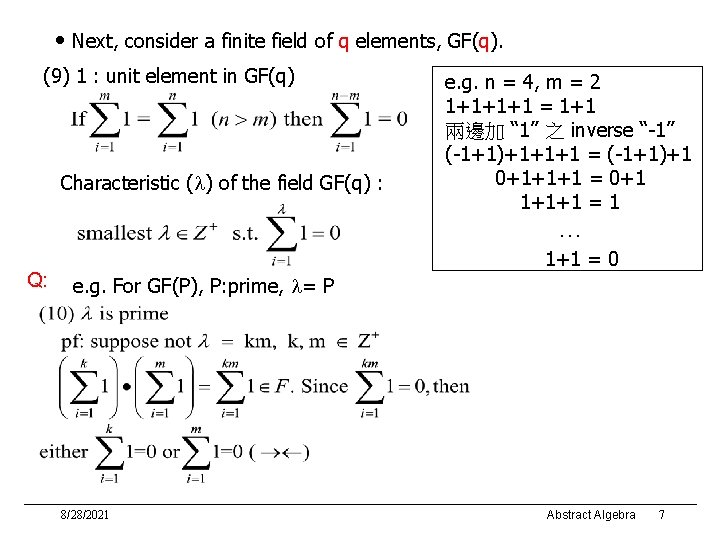
• Next, consider a finite field of q elements, GF(q). (9) 1 : unit element in GF(q) Characteristic ( ) of the field GF(q) : e. g. n = 4, m = 2 1+1+1+1 = 1+1 兩邊加 “ 1” 之 inverse “-1” (-1+1)+1+1+1 = (-1+1)+1 0+1+1+1 = 0+1 1+1+1 = 1 … Q: 1+1 = 0 e. g. For GF(P), P: prime, = P 8/28/2021 Abstract Algebra 7
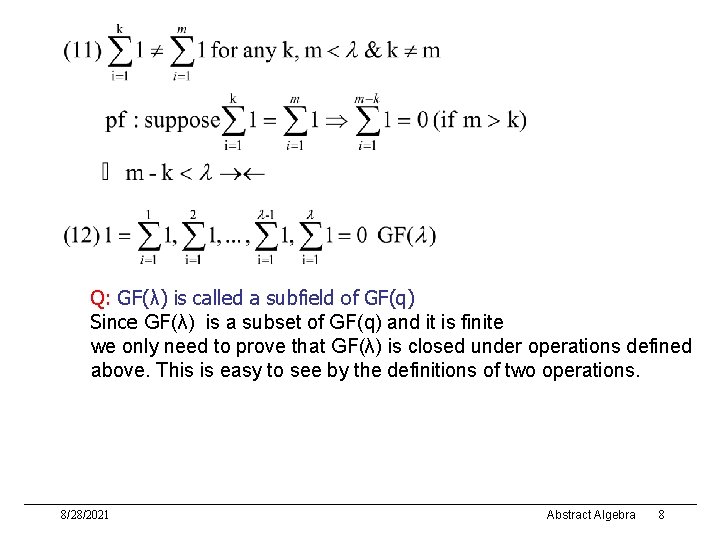
Q: GF(λ) is called a subfield of GF(q) Since GF(λ) is a subset of GF(q) and it is finite we only need to prove that GF(λ) is closed under operations defined above. This is easy to see by the definitions of two operations. 8/28/2021 Abstract Algebra 8
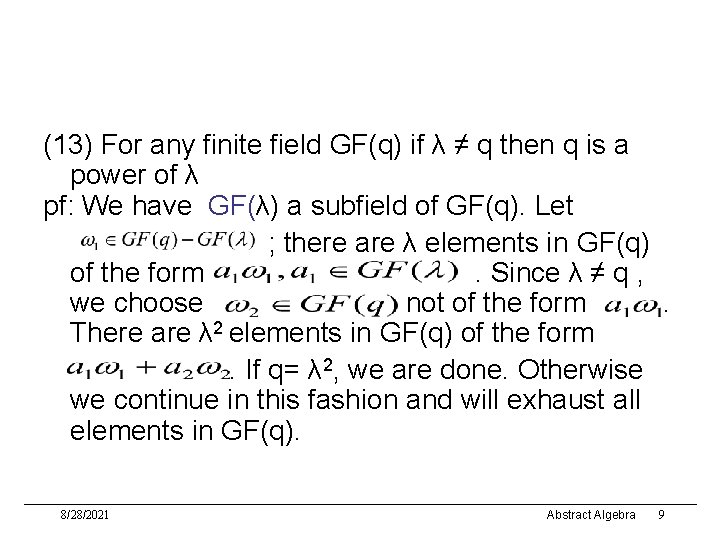
(13) For any finite field GF(q) if λ ≠ q then q is a power of λ pf: We have GF(λ) a subfield of GF(q). Let ; there are λ elements in GF(q) of the form. Since λ ≠ q , we choose not of the form. There are λ 2 elements in GF(q) of the form. If q= λ 2, we are done. Otherwise we continue in this fashion and will exhaust all elements in GF(q). 8/28/2021 Abstract Algebra 9
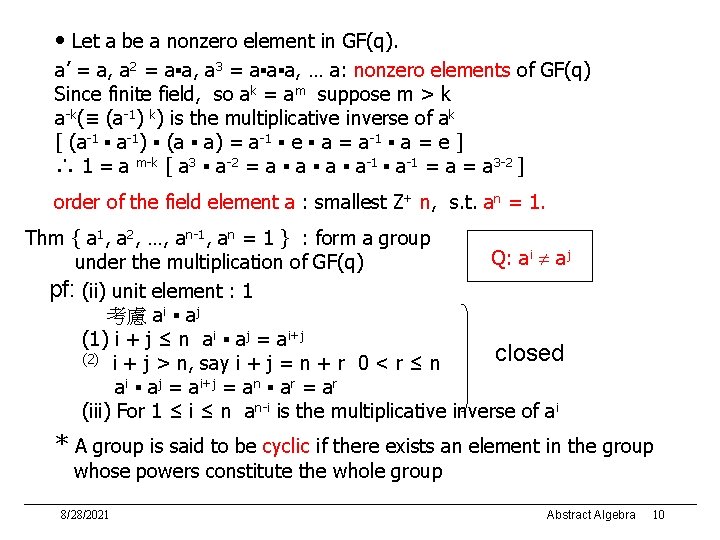
• Let a be a nonzero element in GF(q). a’ = a, a 2 = a▪a, a 3 = a▪a▪a, … a: nonzero elements of GF(q) Since finite field, so ak = am suppose m > k a-k(≡ (a-1) k) is the multiplicative inverse of ak [ (a-1 ▪ a-1) ▪ (a ▪ a) = a-1 ▪ e ▪ a = a-1 ▪ a = e ] ∴ 1 = a m-k [ a 3 ▪ a-2 = a ▪ a ▪ a-1 = a 3 -2 ] order of the field element a : smallest Z+ n, s. t. an = 1. Thm { a 1, a 2, …, an-1, an = 1 } : form a group Q: ai aj under the multiplication of GF(q) pf: (ii) unit element : 1 考慮 ai ▪ aj (1) i + j ≤ n ai ▪ aj = ai+j closed (2) i + j > n, say i + j = n + r 0 < r ≤ n ai ▪ aj = ai+j = an ▪ ar = ar (iii) For 1 ≤ i ≤ n an-i is the multiplicative inverse of ai * A group is said to be cyclic if there exists an element in the group whose powers constitute the whole group 8/28/2021 Abstract Algebra 10
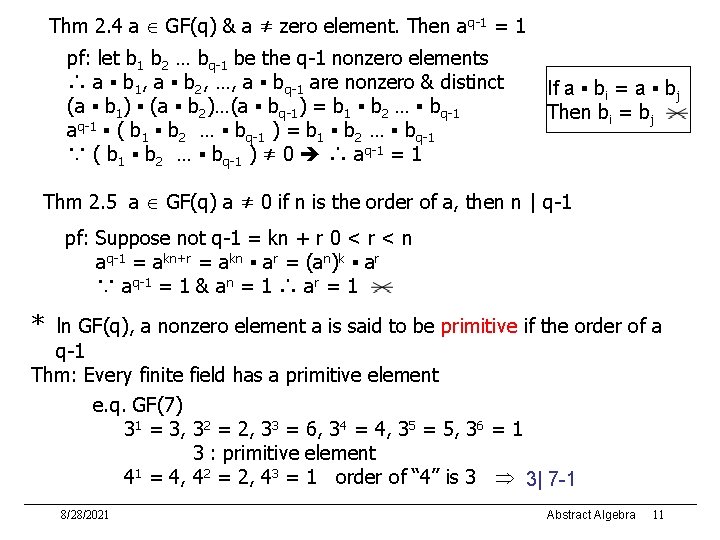
Thm 2. 4 a GF(q) & a ≠ zero element. Then aq-1 = 1 pf: let b 1 b 2 … bq-1 be the q-1 nonzero elements ∴ a ▪ b 1, a ▪ b 2, …, a ▪ bq-1 are nonzero & distinct (a ▪ b 1) ▪ (a ▪ b 2)…(a ▪ bq-1) = b 1 ▪ b 2 … ▪ bq-1 aq-1 ▪ ( b 1 ▪ b 2 … ▪ bq-1 ) = b 1 ▪ b 2 … ▪ bq-1 ∵ ( b 1 ▪ b 2 … ▪ bq-1 ) ≠ 0 ∴ aq-1 = 1 If a ▪ bi = a ▪ bj Then bi = bj Thm 2. 5 a GF(q) a ≠ 0 if n is the order of a, then n | q-1 pf: Suppose not q-1 = kn + r 0 < r < n aq-1 = akn+r = akn ▪ ar = (an)k ▪ ar ∵ aq-1 = 1 & an = 1 ∴ ar = 1 * ln GF(q), a nonzero element a is said to be primitive if the order of a q-1 Thm: Every finite field has a primitive element e. q. GF(7) 31 = 3, 32 = 2, 33 = 6, 34 = 4, 35 = 5, 36 = 1 3 : primitive element 41 = 4, 42 = 2, 43 = 1 order of “ 4” is 3 3| 7 -1 8/28/2021 Abstract Algebra 11
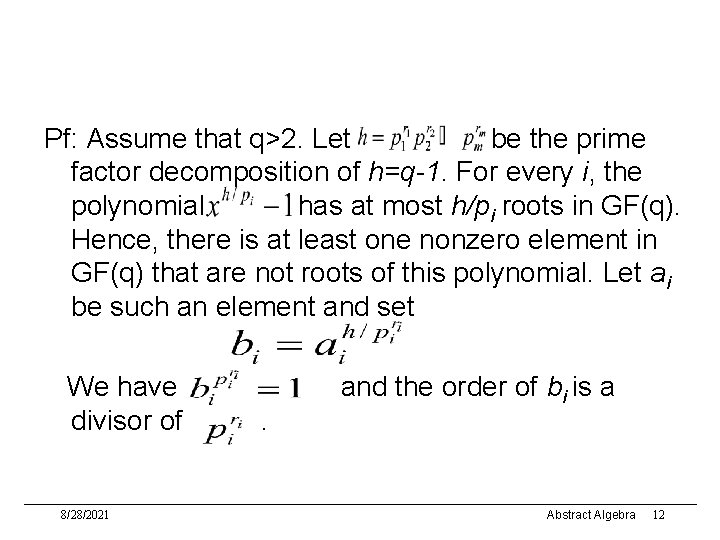
Pf: Assume that q>2. Let be the prime factor decomposition of h=q-1. For every i, the polynomial has at most h/pi roots in GF(q). Hence, there is at least one nonzero element in GF(q) that are not roots of this polynomial. Let ai be such an element and set We have divisor of 8/28/2021 . and the order of bi is a Abstract Algebra 12
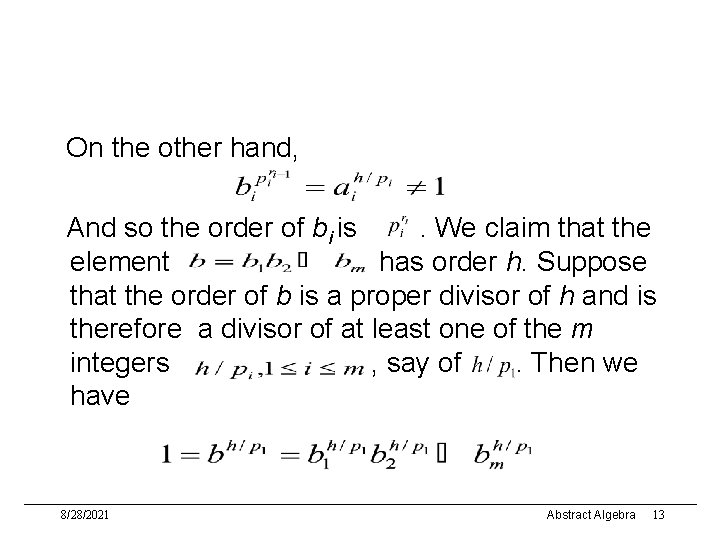
On the other hand, And so the order of bi is. We claim that the element has order h. Suppose that the order of b is a proper divisor of h and is therefore a divisor of at least one of the m integers , say of. Then we have 8/28/2021 Abstract Algebra 13
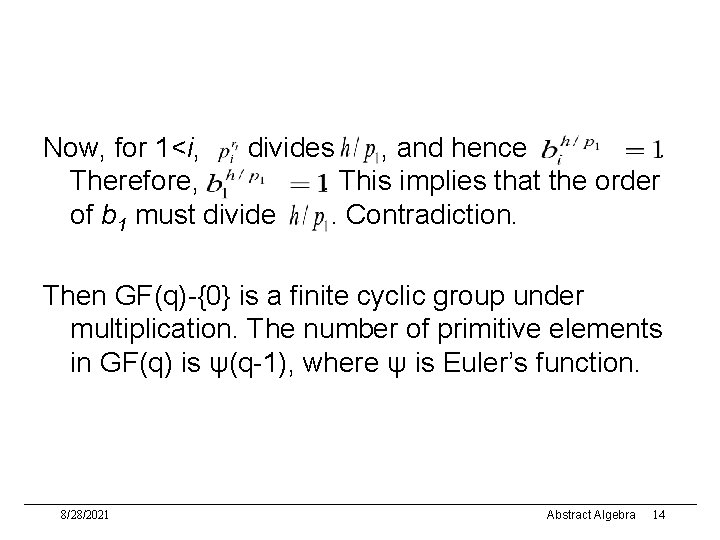
Now, for 1<i, divides , and hence. Therefore, . This implies that the order of b 1 must divide. Contradiction. Then GF(q)-{0} is a finite cyclic group under multiplication. The number of primitive elements in GF(q) is ψ(q-1), where ψ is Euler’s function. 8/28/2021 Abstract Algebra 14
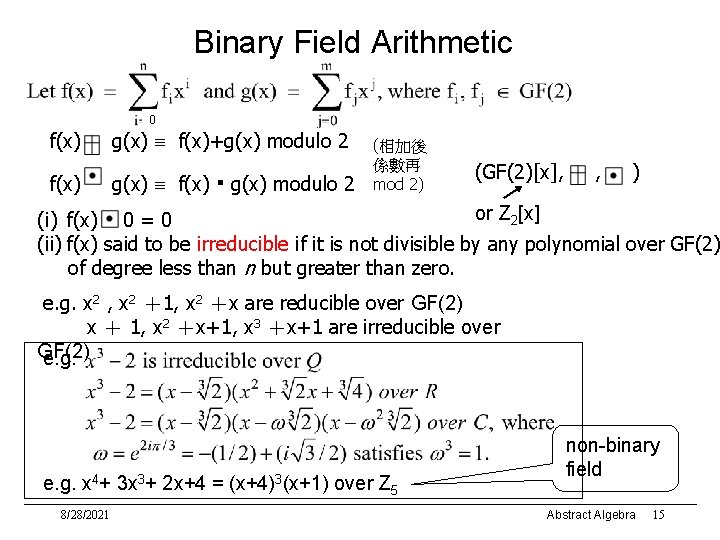
Binary Field Arithmetic 0 f(x) g(x) f(x)+g(x) modulo 2 f(x) g(x) f(x) ▪ g(x) modulo 2 (相加後 係數再 mod 2) (GF(2)[x], , ) or Z 2[x] (i) f(x) 0 = 0 (ii) f(x) said to be irreducible if it is not divisible by any polynomial over GF(2) of degree less than n but greater than zero. e. g. x 2 , x 2 +1, x 2 +x are reducible over GF(2) x + 1, x 2 +x+1, x 3 +x+1 are irreducible over GF(2) e. g. x 4+ 3 x 3+ 2 x+4 = (x+4)3(x+1) over Z 5 8/28/2021 non-binary field Abstract Algebra 15
Thm: In GF(2)[x], m ≥ 1, an irreducible polynomial of degree m pf: exercise Thm 2. 6 Any irreducible polynomial over GF(2) of degree m divides pf: It will be easy to prove when we learn the construction of an extension field. e. g. x 3 + x + 1 | x 7+1 i. e. x 7+1 = (x 4 +x 2 + x + 1)(x 3 + x + 1) *An irreducible polynomial p(x) of degree m is said to be primitive if the smallest positive integer n for which p(x) divides xn + 1 is n = 2 m - 1 e. g. x 4 + x + 1 | x 15 + 1 primitive x 4 + x 3 + x 2 + x + 1 | x 5 + 1 non-primitive * For a given m, there may be more than one primitive polynomial of degree m. 8/28/2021 Abstract Algebra 16
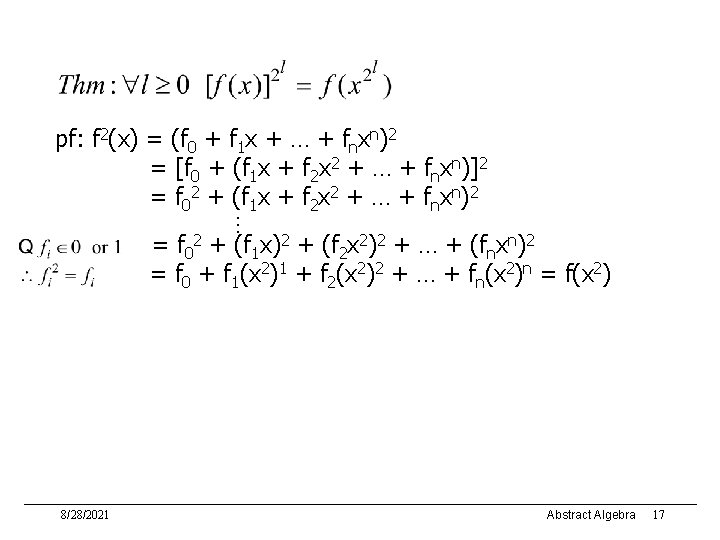
pf: f 2(x) = (f 0 + f 1 x + … + fnxn)2 = [f 0 + (f 1 x + f 2 x 2 + … + fnxn)]2 = f 02 + (f 1 x + f 2 x 2 + … + fnxn)2 … = f 02 + (f 1 x)2 + (f 2 x 2)2 + … + (fnxn)2 = f 0 + f 1(x 2)1 + f 2(x 2)2 + … + fn(x 2)n = f(x 2) 8/28/2021 Abstract Algebra 17
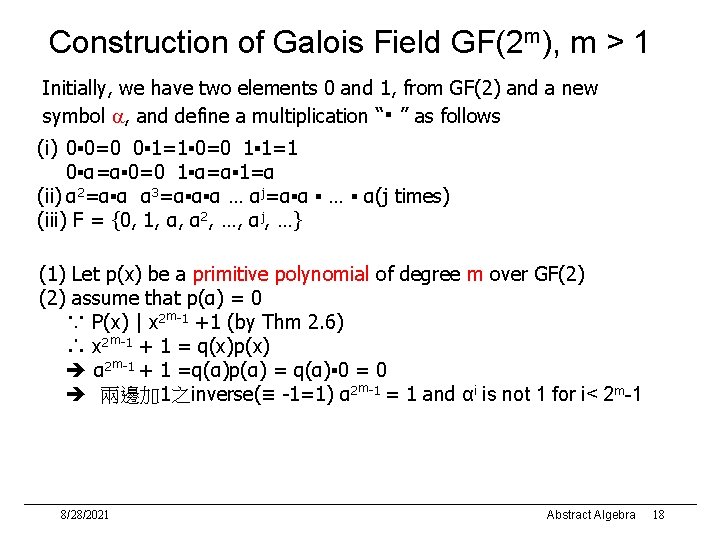
Construction of Galois Field GF(2 m), m > 1 Initially, we have two elements 0 and 1, from GF(2) and a new symbol , and define a multiplication “▪ ’’ as follows (i) 0▪ 0=0 0▪ 1=1▪ 0=0 1▪ 1=1 0▪α=α▪ 0=0 1▪α=α▪ 1=α (ii) α 2=α▪α α 3=α▪α▪α … αj=α▪α ▪ … ▪ α(j times) (iii) F = {0, 1, α, α 2, …, αj, …} (1) Let p(x) be a primitive polynomial of degree m over GF(2) assume that p(α) = 0 ∵ P(x) | x 2 m-1 +1 (by Thm 2. 6) ∴ x 2 m-1 + 1 = q(x)p(x) α 2 m-1 + 1 =q(α)p(α) = q(α)▪ 0 = 0 兩邊加 1之inverse(≡ -1=1) α 2 m-1 = 1 and αi is not 1 for i< 2 m-1 8/28/2021 Abstract Algebra 18
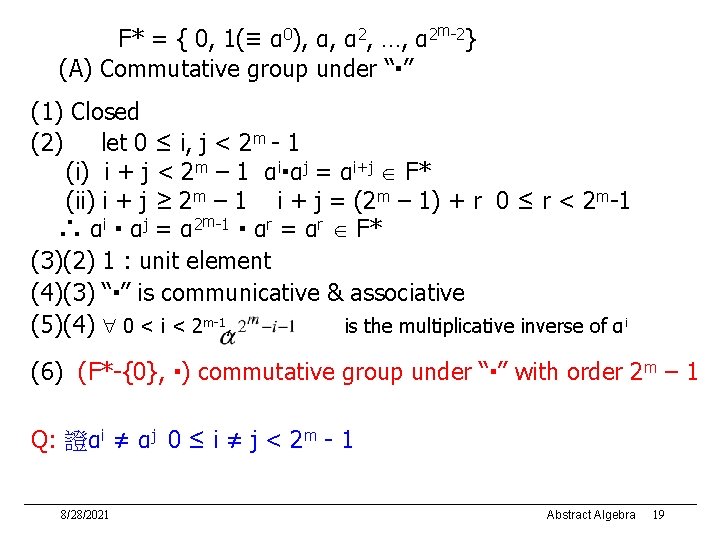
F* = { 0, 1(≡ α 0), α, α 2, …, α 2 m-2} (A) Commutative group under “▪” (1) Closed (2) let 0 ≤ i, j < 2 m - 1 (i) i + j < 2 m – 1 αi▪αj = αi+j F* (ii) i + j ≥ 2 m – 1 i + j = (2 m – 1) + r 0 ≤ r < 2 m-1 ∴ αi ▪ αj = α 2 m-1 ▪ αr = αr F* (3)(2) 1 : unit element (4)(3) “▪” is communicative & associative (5)(4) 0 < i < 2 m-1, is the multiplicative inverse of αi (6) (F*-{0}, ▪) commutative group under “▪” with order 2 m – 1 Q: 證αi ≠ αj 0 ≤ i ≠ j < 2 m - 1 8/28/2021 Abstract Algebra 19
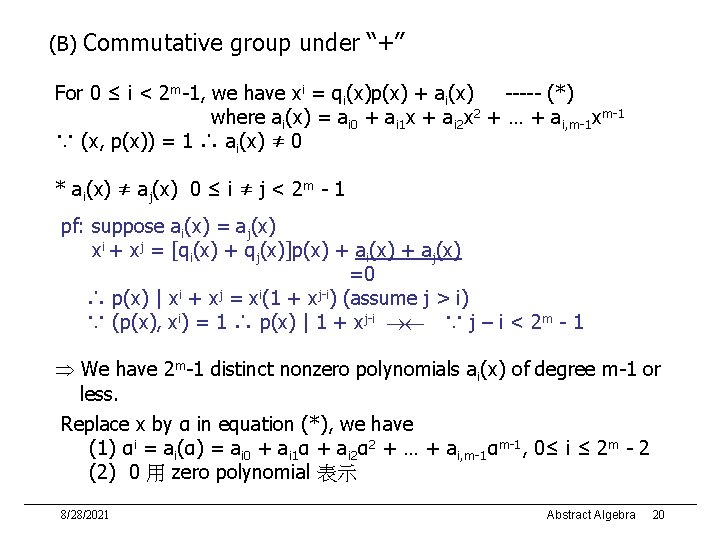
(B) Commutative group under “+” For 0 ≤ i < 2 m-1, we have xi = qi(x)p(x) + ai(x) ----- (*) where ai(x) = ai 0 + ai 1 x + ai 2 x 2 + … + ai, m-1 xm-1 ∵ (x, p(x)) = 1 ∴ ai(x) ≠ 0 * ai(x) ≠ aj(x) 0 ≤ i ≠ j < 2 m - 1 pf: suppose ai(x) = aj(x) xi + xj = [qi(x) + qj(x)]p(x) + ai(x) + aj(x) =0 ∴ p(x) | xi + xj = xi(1 + xj-i) (assume j > i) ∵ (p(x), xi) = 1 ∴ p(x) | 1 + xj-i ∵ j – i < 2 m - 1 We have 2 m-1 distinct nonzero polynomials ai(x) of degree m-1 or less. Replace x by α in equation (*), we have (1) αi = ai(α) = ai 0 + ai 1α + ai 2α 2 + … + ai, m-1αm-1, 0≤ i ≤ 2 m - 2 (2) 0 用 zero polynomial 表示 8/28/2021 Abstract Algebra 20
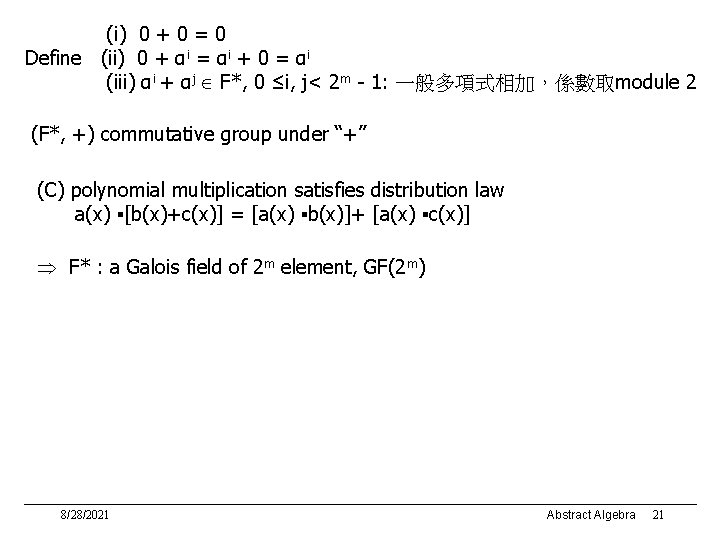
(i) 0 + 0 = 0 Define (ii) 0 + αi = αi + 0 = αi (iii) αi + αj F*, 0 ≤i, j< 2 m - 1: 一般多項式相加,係數取module 2 (F*, +) commutative group under “+” (C) polynomial multiplication satisfies distribution law a(x) ▪[b(x)+c(x)] = [a(x) ▪b(x)]+ [a(x) ▪c(x)] F* : a Galois field of 2 m element, GF(2 m) 8/28/2021 Abstract Algebra 21
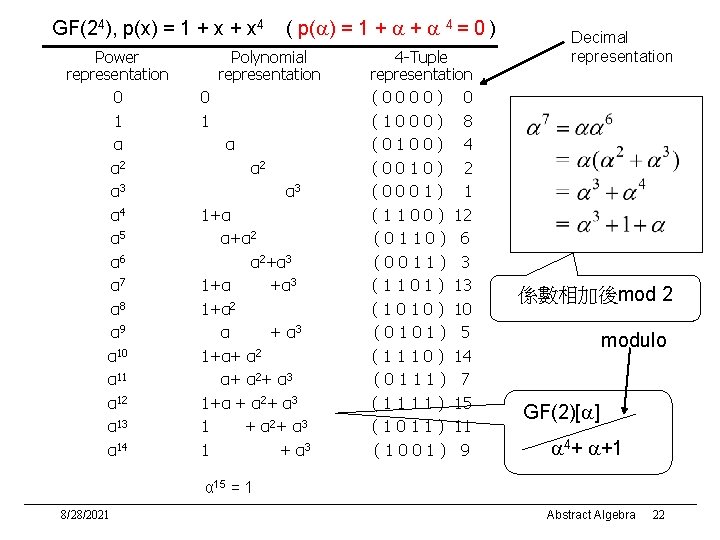
GF(24), p(x) = 1 + x 4 Power representation 0 1 α α 2 α 3 α 4 α 5 α 6 α 7 α 8 α 9 α 10 α 11 α 12 α 13 α 14 ( p( ) = 1 + + 4 = 0 ) Polynomial representation 0 1 α α 2 α 3 1+α α+α 2 α 2+α 3 1+α 2 α + α 3 1+α+ α 2+ α 3 1+α + α 2+ α 3 1 + α 3 4 -Tuple representation (0000) 0 (1000) 8 (0100) 4 (0010) 2 (0001) 1 ( 1 1 0 0 ) 12 (0110) 6 (0011) 3 ( 1 1 0 1 ) 13 ( 1 0 ) 10 (0101) 5 ( 1 1 1 0 ) 14 (0111) 7 ( 1 1 ) 15 ( 1 0 1 1 ) 11 (1001) 9 Decimal representation 係數相加後mod 2 modulo GF(2)[ ] 4+ +1 α 15 = 1 8/28/2021 Abstract Algebra 22
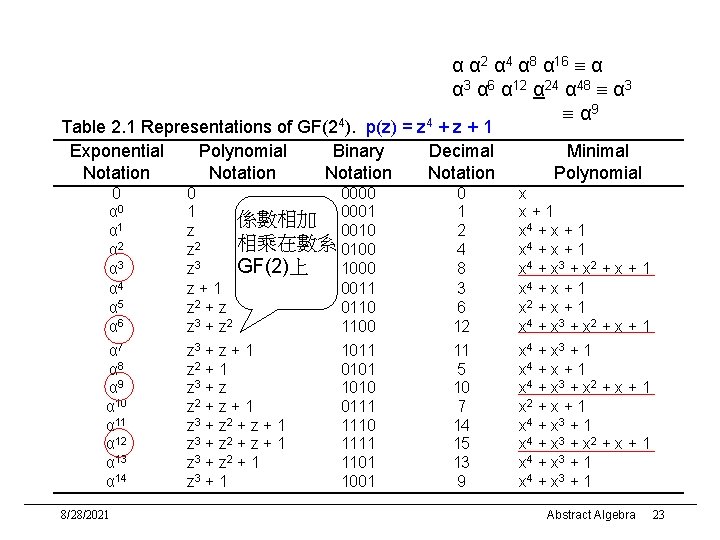
α α 2 α 4 α 8 α 16 α α 3 α 6 α 12 α 24 α 48 α 3 α 9 Table 2. 1 Representations of GF(24). p(z) = z 4 + z + 1 Exponential Polynomial Binary Decimal Notation 0 α 1 α 2 α 3 α 4 α 5 α 6 α 7 α 8 α 9 α 10 α 11 α 12 α 13 α 14 8/28/2021 0 0000 1 係數相加 0001 z 0010 相乘在數系 2 z 0100 GF(2)上 z 3 1000 z+1 0011 z 2 + z 0110 3 2 z +z 1100 z 3 + z + 1 1011 z 2 + 1 0101 z 3 + z 1010 2 z +z+1 0111 z 3 + z 2 + z + 1 1110 z 3 + z 2 + z + 1 1111 3 2 z +z +1 1101 3 z +1 1001 0 1 2 4 8 3 6 12 11 5 10 7 14 15 13 9 Minimal Polynomial x x+1 x 4 + x + 1 x 4 + x 3 + x 2 + x + 1 x 4 + x + 1 x 2 + x + 1 x 4 + x 3 + 1 x 4 + x 3 + x 2 + x + 1 x 4 + x 3 + x 2 + x + 1 x 4 + x 3 + 1 Abstract Algebra 23
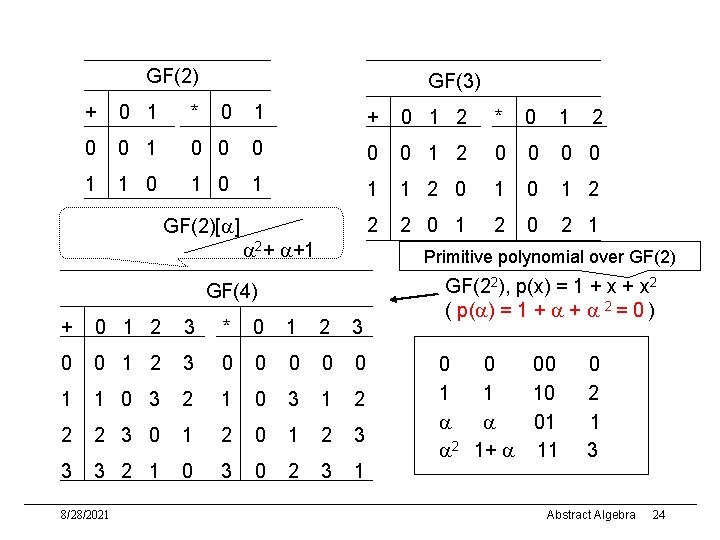
GF(2) GF(3) + 0 1 * 0 1 + 0 1 2 * 0 1 0 0 0 1 2 0 0 1 1 1 2 0 1 2 2 2 0 1 2 0 2 1 GF(2)[ ] 2+ +1 Primitive polynomial over GF(2) GF(4) + 0 1 2 3 * 0 1 2 3 0 0 0 1 1 0 3 2 1 0 3 1 2 2 2 3 0 1 2 3 3 3 2 1 0 3 0 2 3 1 8/28/2021 2 GF(22), p(x) = 1 + x 2 ( p( ) = 1 + + 2 = 0 ) 0 0 00 1 1 10 01 2 1+ 11 0 2 1 3 Abstract Algebra 24
GF(42) GF(4)[z]/z 2+z+2, p(z) = z 2+z+2 Exponential Notation α=z α 15 = 1 8/28/2021 0 α 1 α 2 α 3 α 4 α 5 α 6 α 7 α 8 α 9 α 10 α 11 α 12 α 13 α 14 Polynomial Notation Primitive polynomial over GF(4) Binary Notation 0 1 z z+2 3 z + 2 z + 1 係數相加 2 相乘在數系 2 z 2 z + 3 GF(4)上 z+3 2 z + 2 3 3 z 3 z + 1 2 z + 1 3 z + 3 00 01 10 12 32 11 02 20 23 13 22 03 30 31 21 33 Decimal Notation 0 1 4 6 14 5 2 8 11 7 10 3 12 13 9 15 Minimal Polynomial x+1 x 2 + x + 2 x 2 + x + 3 x 2 + 3 x + 1 x 2 + x + 2 x+2 x 2 +2 x + 1 x 2 + 2 x + 2 x 2 + x + 3 x 2 + 2 x + 1 x+3 x 2 + 3 x + 1 x 2 + 2 x + 2 x 2 + 3 x + 3 Abstract Algebra 25
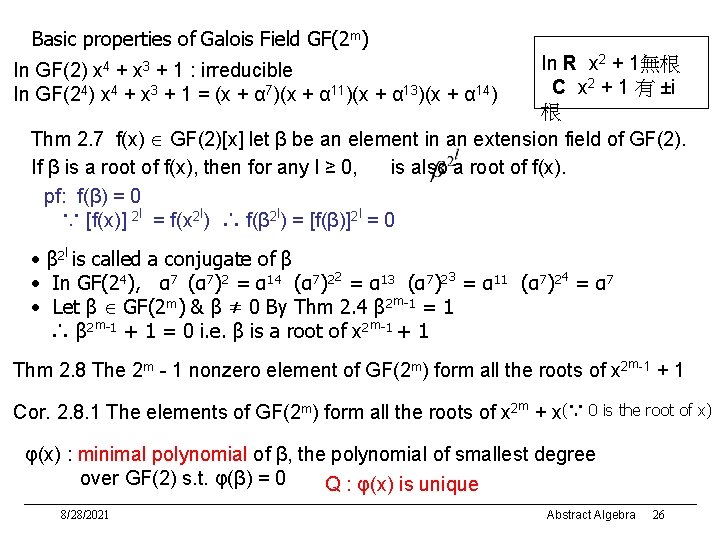
Basic properties of Galois Field GF(2 m) 2 + 1無根 In R x In GF(2) + + 1 : irreducible 2 + 1 有 ±i C x 4 4 3 7 11 13 14 In GF(2 ) x + 1 = (x + α )(x + α ) 根 Thm 2. 7 f(x) GF(2)[x] let β be an element in an extension field of GF(2). If β is a root of f(x), then for any l ≥ 0, is also a root of f(x). pf: f(β) = 0 ∵ [f(x)] 2 l = f(x 2 l) ∴ f(β 2 l) = [f(β)]2 l = 0 x 4 x 3 • β 2 l is called a conjugate of β • In GF(24), α 7 (α 7)2 = α 14 (α 7)22 = α 13 (α 7)23 = α 11 (α 7)24 = α 7 • Let β GF(2 m) & β ≠ 0 By Thm 2. 4 β 2 m-1 = 1 ∴ β 2 m-1 + 1 = 0 i. e. β is a root of x 2 m-1 + 1 Thm 2. 8 The 2 m - 1 nonzero element of GF(2 m) form all the roots of x 2 m-1 + 1 Cor. 2. 8. 1 The elements of GF(2 m) form all the roots of x 2 m + x(∵ 0 is the root of x) φ(x) : minimal polynomial of β, the polynomial of smallest degree over GF(2) s. t. φ(β) = 0 Q : φ(x) is unique 8/28/2021 Abstract Algebra 26
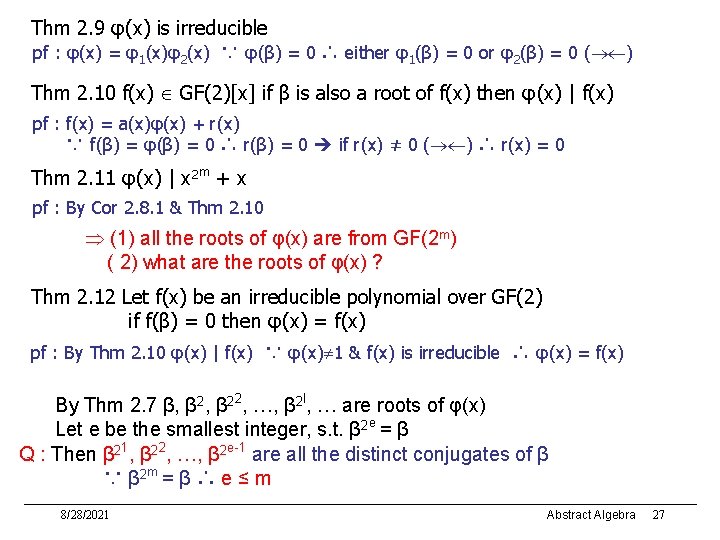
Thm 2. 9 φ(x) is irreducible pf : φ(x) = φ1(x)φ2(x) ∵ φ(β) = 0 ∴ either φ1(β) = 0 or φ2(β) = 0 ( ) Thm 2. 10 f(x) GF(2)[x] if β is also a root of f(x) then φ(x) | f(x) pf : f(x) = a(x)φ(x) + r(x) ∵ f(β) = φ(β) = 0 ∴ r(β) = 0 if r(x) ≠ 0 ( ) ∴ r(x) = 0 Thm 2. 11 φ(x) | x 2 m + x pf : By Cor 2. 8. 1 & Thm 2. 10 (1) all the roots of φ(x) are from GF(2 m) ( 2) what are the roots of φ(x) ? Thm 2. 12 Let f(x) be an irreducible polynomial over GF(2) if f(β) = 0 then φ(x) = f(x) pf : By Thm 2. 10 φ(x) | f(x) ∵ φ(x) 1 & f(x) is irreducible ∴ φ(x) = f(x) By Thm 2. 7 β, β 22, …, β 2 l, … are roots of φ(x) Let e be the smallest integer, s. t. β 2 e = β Q : Then β 21, β 22, …, β 2 e-1 are all the distinct conjugates of β ∵ β 2 m = β ∴ e ≤ m 8/28/2021 Abstract Algebra 27
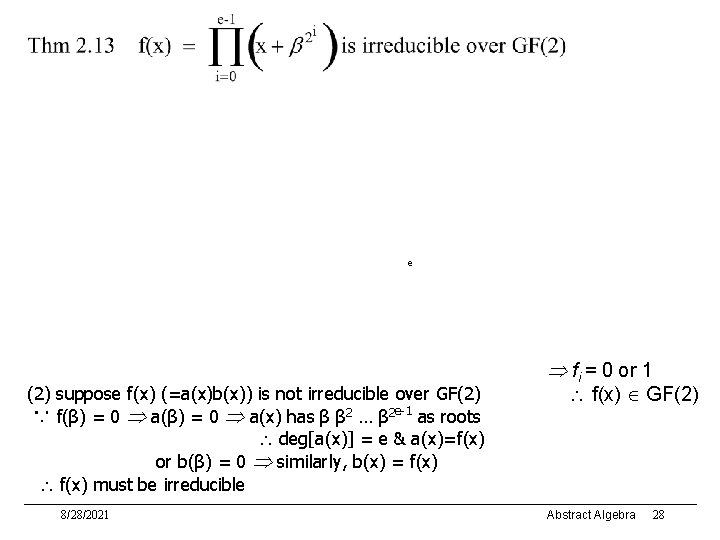
e (2) suppose f(x) (=a(x)b(x)) is not irreducible over GF(2) ∵ f(β) = 0 a(x) has β β 2 … β 2 e-1 as roots deg[a(x)] = e & a(x)=f(x) or b(β) = 0 similarly, b(x) = f(x) must be irreducible 8/28/2021 fi = 0 or 1 f(x) GF(2) Abstract Algebra 28
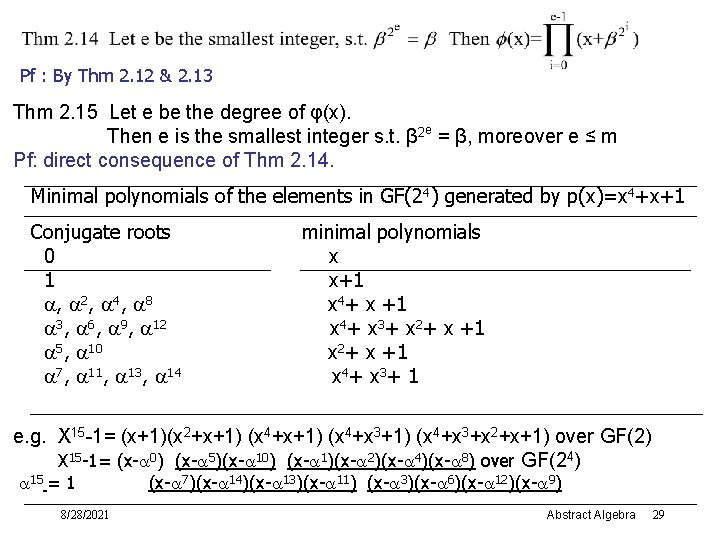
Pf : By Thm 2. 12 & 2. 13 Thm 2. 15 Let e be the degree of φ(x). Then e is the smallest integer s. t. β 2 e = β, moreover e ≤ m Pf: direct consequence of Thm 2. 14. Minimal polynomials of the elements in GF(24) generated by p(x)=x 4+x+1 Conjugate roots 0 1 , 2, 4, 8 3, 6, 9, 12 5, 10 7, 11, 13, 14 minimal polynomials x x+1 x 4+ x 3+ x 2+ x +1 x 4 + x 3 + 1 e. g. X 15 -1= (x+1)(x 2+x+1) (x 4+x 3+1) (x 4+x 3+x 2+x+1) over GF(2) X 15 -1= (x- 0) (x- 5)(x- 10) (x- 1)(x- 2)(x- 4)(x- 8) over GF(24) 15 = 1 8/28/2021 (x- 7)(x- 14)(x- 13)(x- 11) (x- 3)(x- 6)(x- 12)(x- 9) Abstract Algebra 29
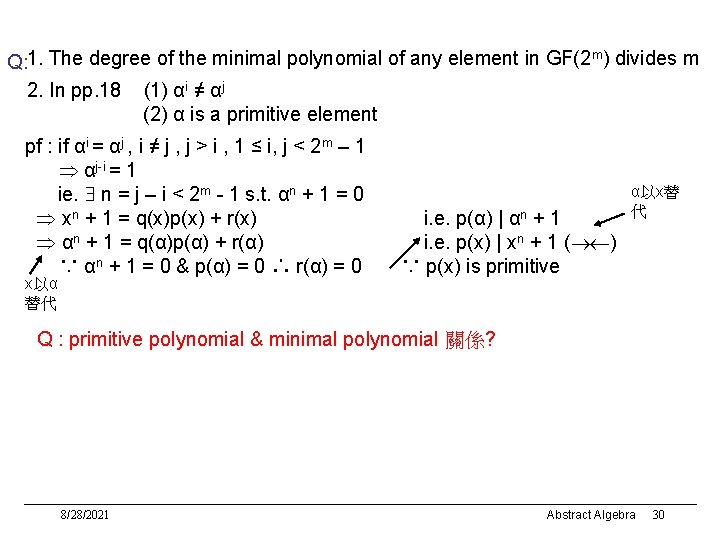
Q: 1. The degree of the minimal polynomial of any element in GF(2 m) divides m 2. In pp. 18 (1) αi ≠ αj (2) α is a primitive element pf : if αi = αj , i ≠ j , j > i , 1 ≤ i, j < 2 m – 1 αj-i = 1 ie. n = j – i < 2 m - 1 s. t. αn + 1 = 0 xn + 1 = q(x)p(x) + r(x) αn + 1 = q(α)p(α) + r(α) ∵ αn + 1 = 0 & p(α) = 0 ∴ r(α) = 0 x以α 替代 i. e. p(α) | αn + 1 i. e. p(x) | xn + 1 ( ) ∵ p(x) is primitive α以x替 代 Q : primitive polynomial & minimal polynomial 關係? 8/28/2021 Abstract Algebra 30
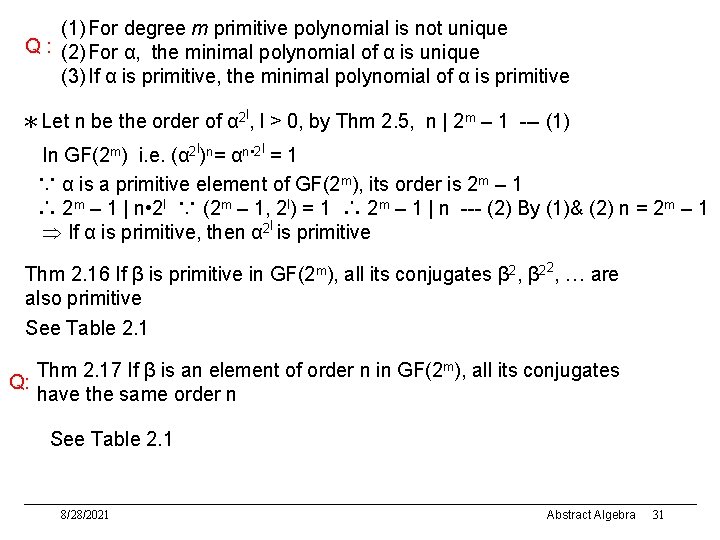
(1) For degree m primitive polynomial is not unique Q : (2) For α, the minimal polynomial of α is unique (3) If α is primitive, the minimal polynomial of α is primitive *Let n be the order of α 2 l, l > 0, by Thm 2. 5, n | 2 m – 1 --- (1) In GF(2 m) i. e. (α 2 l)n= αn • 2 l = 1 ∵ α is a primitive element of GF(2 m), its order is 2 m – 1 ∴ 2 m – 1 | n • 2 l ∵ (2 m – 1, 2 l) = 1 ∴ 2 m – 1 | n --- (2) By (1)& (2) n = 2 m – 1 If α is primitive, then α 2 l is primitive Thm 2. 16 If β is primitive in GF(2 m), all its conjugates β 2, β 22, … are also primitive See Table 2. 1 Thm 2. 17 If β is an element of order n in GF(2 m), all its conjugates Q: have the same order n See Table 2. 1 8/28/2021 Abstract Algebra 31