
Introduction to Financial Management Chapter 1 0 Mc
- Slides: 13
Introduction to Financial Management Chapter 1 0 Mc. Graw-Hill/Irwin © 2004 The Mc. Graw-Hill Companies, Inc. All rights reserved
Chapter Outline 1. 2. 3. 4. 5. 6. Basic Areas of Finance Financial Management Decisions Forms of Organization Goal of Financial Management The Agency Problem Financial Markets 1 Mc. Graw-Hill/Irwin © 2004 The Mc. Graw-Hill Companies, Inc. All rights reserved
1. Basic Areas Of Finance n Corporate finance (Business finance) n Investments n Financial institutions n International finance 2 Mc. Graw-Hill/Irwin © 2004 The Mc. Graw-Hill Companies, Inc. All rights reserved
Corporate Finance The study of financial decision making in business organizations. n The study of basic techniques a financial manager should have. n 3 Mc. Graw-Hill/Irwin © 2004 The Mc. Graw-Hill Companies, Inc. All rights reserved
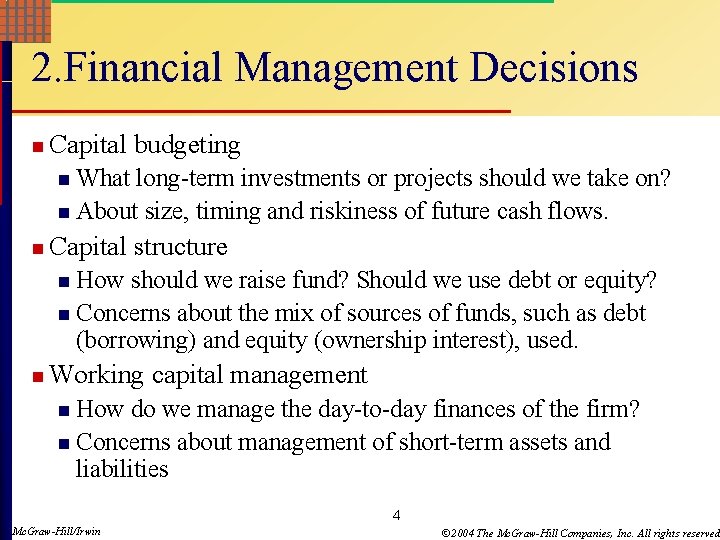
2. Financial Management Decisions n Capital budgeting What long-term investments or projects should we take on? n About size, timing and riskiness of future cash flows. n n Capital structure How should we raise fund? Should we use debt or equity? n Concerns about the mix of sources of funds, such as debt (borrowing) and equity (ownership interest), used. n n Working capital management How do we manage the day-to-day finances of the firm? n Concerns about management of short-term assets and liabilities n 4 Mc. Graw-Hill/Irwin © 2004 The Mc. Graw-Hill Companies, Inc. All rights reserved
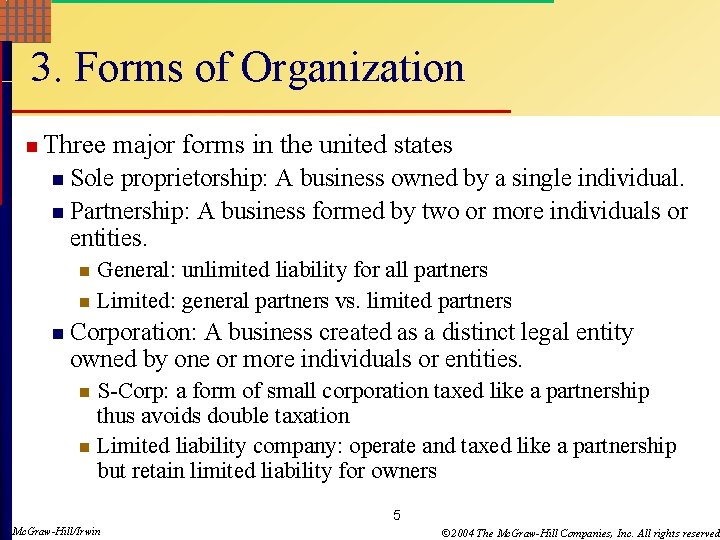
3. Forms of Organization n Three major forms in the united states Sole proprietorship: A business owned by a single individual. n Partnership: A business formed by two or more individuals or entities. n General: unlimited liability for all partners n Limited: general partners vs. limited partners n n Corporation: A business created as a distinct legal entity owned by one or more individuals or entities. S-Corp: a form of small corporation taxed like a partnership thus avoids double taxation n Limited liability company: operate and taxed like a partnership but retain limited liability for owners n 5 Mc. Graw-Hill/Irwin © 2004 The Mc. Graw-Hill Companies, Inc. All rights reserved
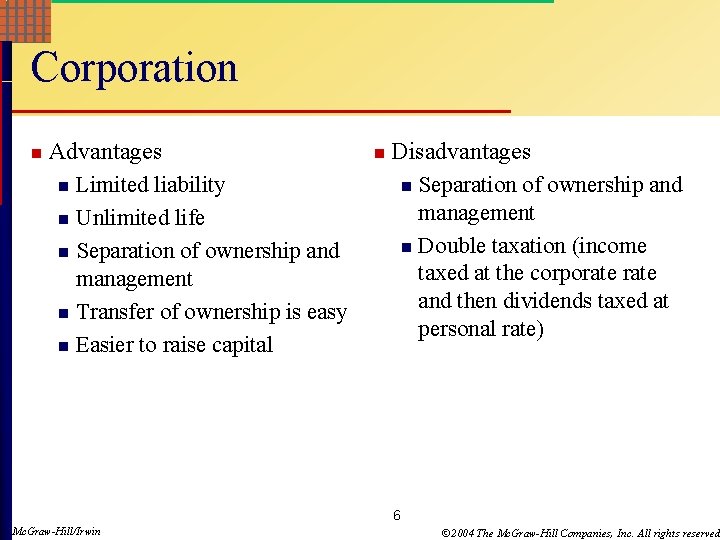
Corporation n Advantages n Limited liability n Unlimited life n Separation of ownership and management n Transfer of ownership is easy n Easier to raise capital n Disadvantages n Separation of ownership and management n Double taxation (income taxed at the corporate and then dividends taxed at personal rate) 6 Mc. Graw-Hill/Irwin © 2004 The Mc. Graw-Hill Companies, Inc. All rights reserved
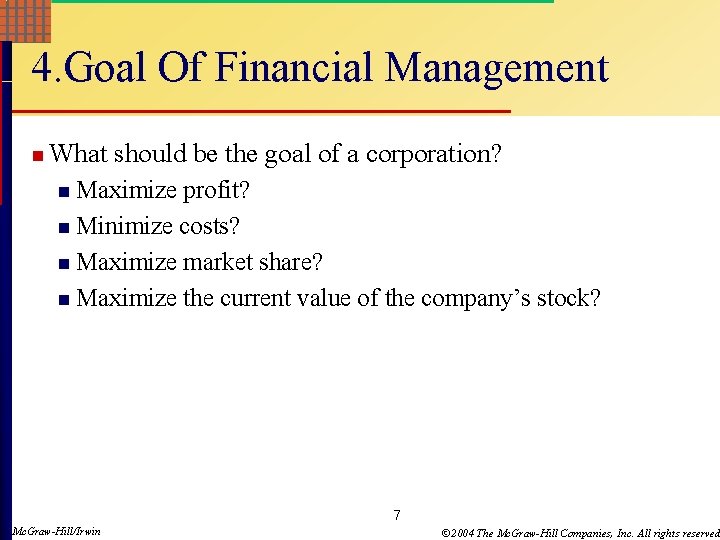
4. Goal Of Financial Management n What should be the goal of a corporation? Maximize profit? n Minimize costs? n Maximize market share? n Maximize the current value of the company’s stock? n 7 Mc. Graw-Hill/Irwin © 2004 The Mc. Graw-Hill Companies, Inc. All rights reserved
5. The Agency Problem n Agency relationship Principal hires an agent to represent their interest n Stockholders (principals) hire managers (agents) to run the company n n Agency n problem Conflict of interest between principal and agent n Management n goals and agency costs Agency costs: the costs of the conflict of interest between stockholders (principals) and management (agents). 8 Mc. Graw-Hill/Irwin © 2004 The Mc. Graw-Hill Companies, Inc. All rights reserved
Managing Managers n Managerial compensation Incentives can be used to align management and stockholder interests n The incentives need to be structured carefully to make sure that they achieve their goal n n Corporate n control The threat of a takeover may result in better management 9 Mc. Graw-Hill/Irwin © 2004 The Mc. Graw-Hill Companies, Inc. All rights reserved
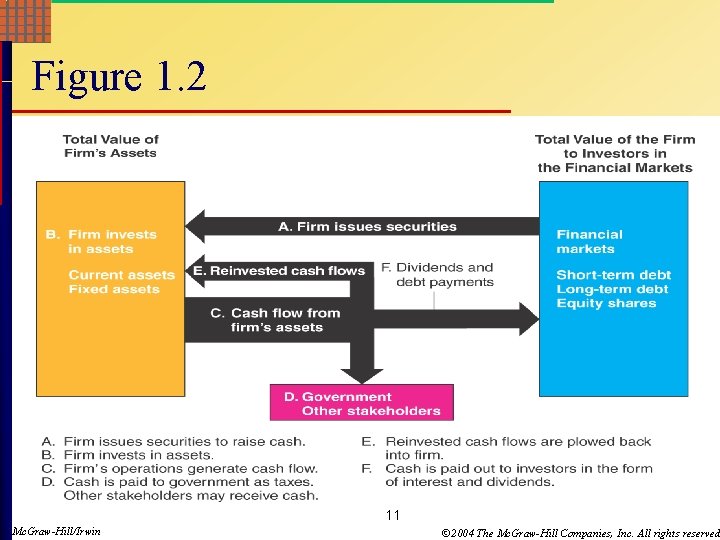
6. Financial Markets n Cash flows to the firm (Figure 1. 2) n Primary markets: original sale by governments and corporations n Public offerings vs. private placement n Secondary markets: securities bought and sold after the original sale n NYSE (New York Stock Exchange) vs. NASDAQ (National Association of Security Dealers Automated Quotations system) Auction vs. dealer markets n Listed (stocks that trade on an exchange are said to be listed) vs. over the counter securities n 10 Mc. Graw-Hill/Irwin © 2004 The Mc. Graw-Hill Companies, Inc. All rights reserved
Figure 1. 2 11 Mc. Graw-Hill/Irwin © 2004 The Mc. Graw-Hill Companies, Inc. All rights reserved
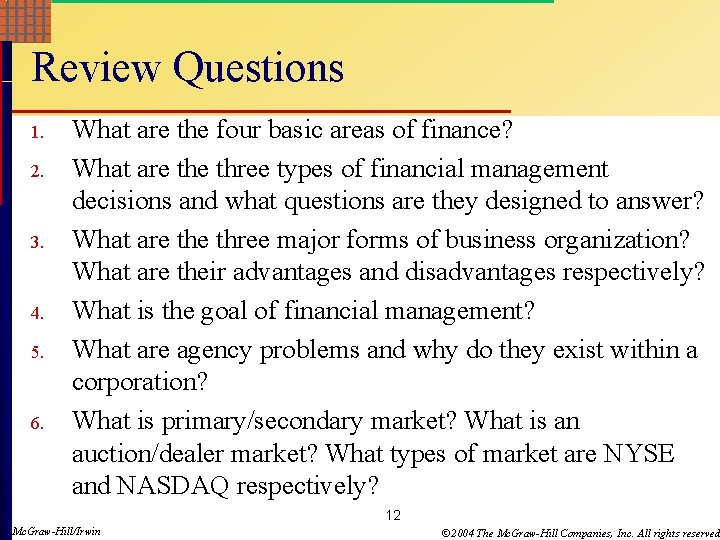
Review Questions 1. 2. 3. 4. 5. 6. What are the four basic areas of finance? What are three types of financial management decisions and what questions are they designed to answer? What are three major forms of business organization? What are their advantages and disadvantages respectively? What is the goal of financial management? What are agency problems and why do they exist within a corporation? What is primary/secondary market? What is an auction/dealer market? What types of market are NYSE and NASDAQ respectively? 12 Mc. Graw-Hill/Irwin © 2004 The Mc. Graw-Hill Companies, Inc. All rights reserved