
Introduction to Film Studies 1 Hollywood Cinema Lecture
- Slides: 12
Introduction to Film Studies 1: Hollywood Cinema Lecture One: A Vocabulary of Cinematic Techniques
The Birth of Cinema The Lumiére Brothers demonstrate their cinematograph: 28 th December 1895, Paris n Culmination of scientific developments over the C 19: n The discovery of ‘persistence of vision’; n The Zoetrope; flip books n The magic lantern; n The Praxinoscope n
The Birth of Cinema Kodak’s strip film n Edison’s Kinetoscope n Cinema as a sideshow attraction/novelty value n Camera trickery: Georges Méliès n The birth of narrative: The Great Train Robbery (USA 1903: Edwin S. Porter) n
D. W. Griffith: ‘Father of Film’ n n n Combining narrative techniques: cross-cutting, shot distance “America had effected, within a few brief years, the artistic maturing of the cinema. This was, practically speaking, the single-handed achievement of David Wark Griffith’ – David Robinson, World Cinema (London: Methuen, 1981), p. 56. “He put beauty and poetry into a cheap and tawdry sort of amusement”, Erich von Stroheim in Robinson, World Cinema, p. 56.
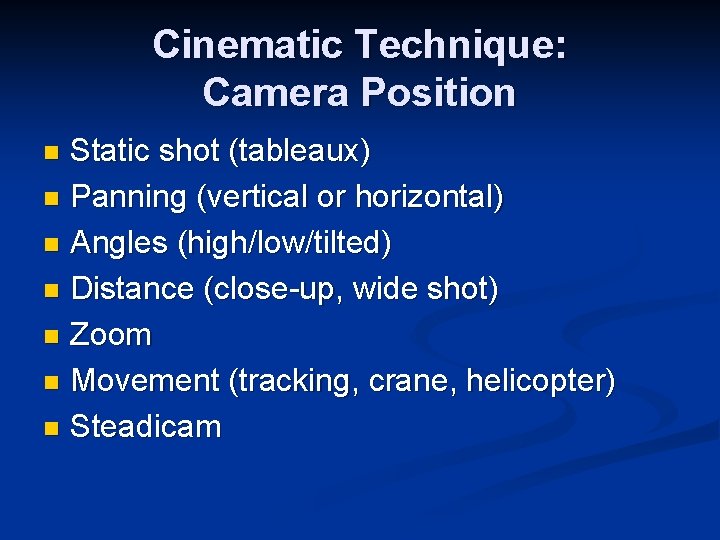
Cinematic Technique: Camera Position Static shot (tableaux) n Panning (vertical or horizontal) n Angles (high/low/tilted) n Distance (close-up, wide shot) n Zoom n Movement (tracking, crane, helicopter) n Steadicam n
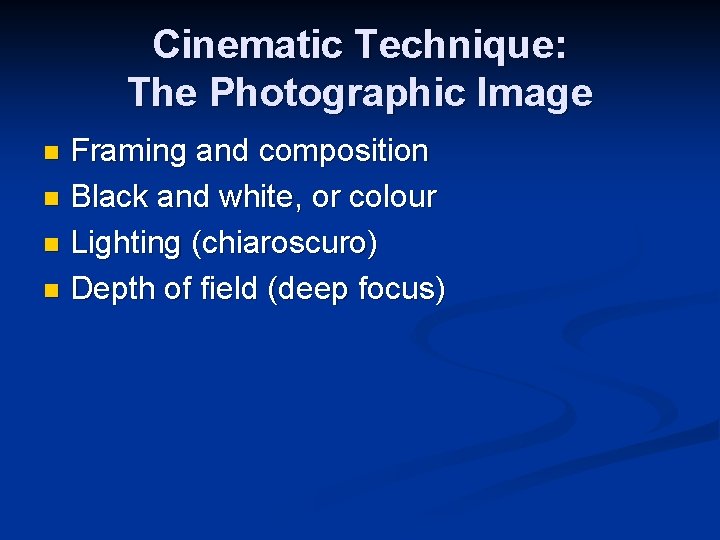
Cinematic Technique: The Photographic Image Framing and composition n Black and white, or colour n Lighting (chiaroscuro) n Depth of field (deep focus) n
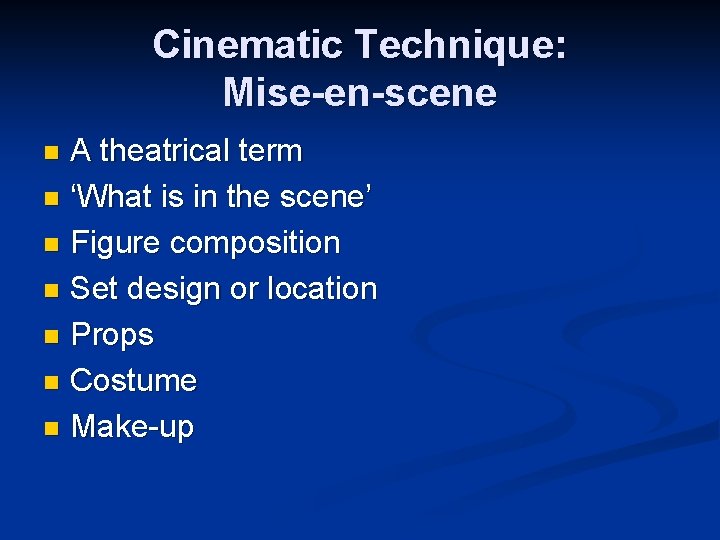
Cinematic Technique: Mise-en-scene A theatrical term n ‘What is in the scene’ n Figure composition n Set design or location n Props n Costume n Make-up n
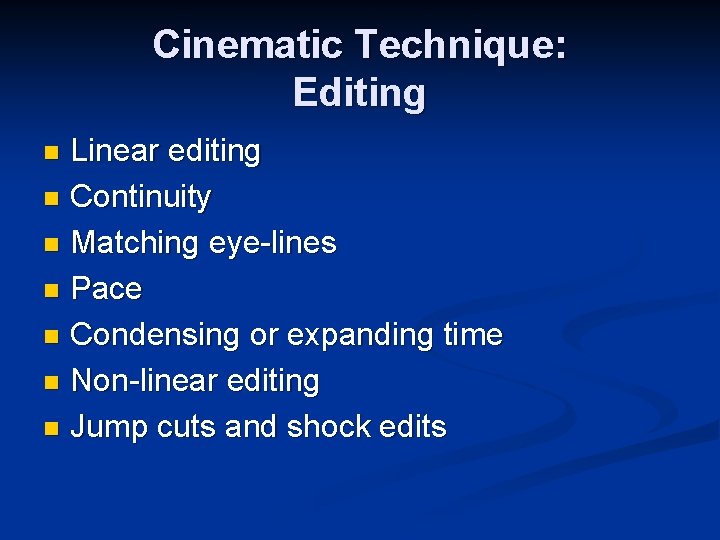
Cinematic Technique: Editing Linear editing n Continuity n Matching eye-lines n Pace n Condensing or expanding time n Non-linear editing n Jump cuts and shock edits n
Cinematic Technique: Sound Diegetic n Displaced diegetic (voice-over) n Non-diegetic n Music – underlining n Score vs. Recorded music n Effects n
Cinematic Technique: Special Effects (SFX) Slow-motion or speeded-up motion n Superimposition – blue screen, back projection, matte shots n Digital imaging n
Practical Film Analysis Breaking a film into sequences n Close textual analysis – finger on the pause button! n How is technique used? n What is the effect on the spectator? n What is the film-makers’ intention? n
Citizen Kane Orson Welles: background in theatre and radio; War of the Worlds broadcast; RKO; collaboration with Greg Tolland; learnt by watching films n The film’s reception: William Randolph Hearst; iconic critical status; Is this the best film ever made? n Style over substance? Just how many different techniques does Welles use in Citizen Kane n