
Introduction to File Systems beneath the surface David
Introduction to File Systems - beneath the surface David E. Culler CS 162 – Operating Systems and Systems Programming Lecture 4 Sept 8, 2014 Reading: A&D 3. 1 -3, 11. 1 -2 HW 0 due today HW 1: out
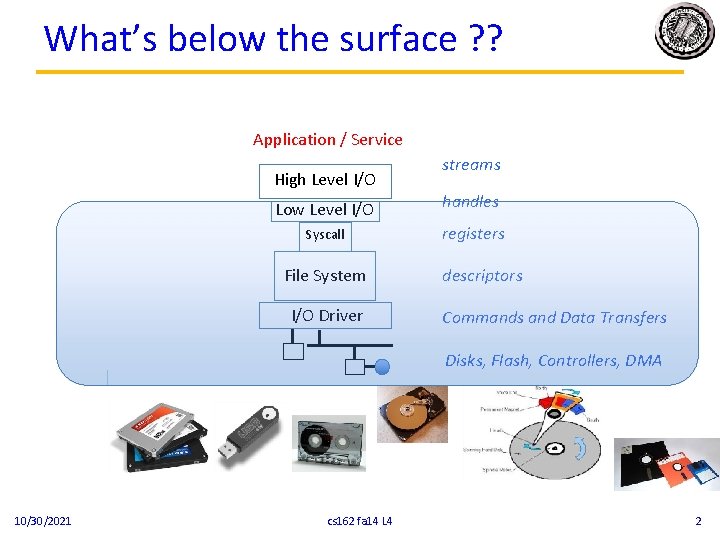
What’s below the surface ? ? Application / Service High Level I/O Low Level I/O Syscall File System I/O Driver streams handles registers descriptors Commands and Data Transfers Disks, Flash, Controllers, DMA 10/30/2021 cs 162 fa 14 L 4 2
File Intro recall exercise • What is the namespace introduced by the file system? • Like an address space, but structured names, rather than flat addresses 10/30/2021 cs 162 fa 14 L 4 3
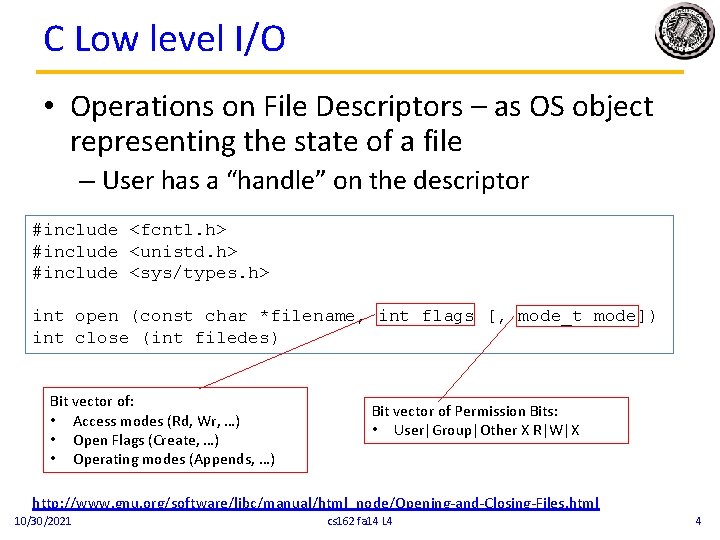
C Low level I/O • Operations on File Descriptors – as OS object representing the state of a file – User has a “handle” on the descriptor #include <fcntl. h> #include <unistd. h> #include <sys/types. h> int open (const char *filename, int flags [, mode_t mode]) int close (int filedes) Bit vector of: • Access modes (Rd, Wr, …) • Open Flags (Create, …) • Operating modes (Appends, …) Bit vector of Permission Bits: • User|Group|Other X R|W|X http: //www. gnu. org/software/libc/manual/html_node/Opening-and-Closing-Files. html 10/30/2021 cs 162 fa 14 L 4 4

C Low Level: standard descriptors #include <unistd. h> STDIN_FILENO - macro has value 0 STDOUT_FILENO - macro has value 1 STDERR_FILENO - macro has value 2 int fileno (FILE *stream) FILE * fdopen (int filedes, const char *opentype) • Crossing levels: File descriptors vs. streams • Don’t mix them! 10/30/2021 cs 162 fa 14 L 4 5
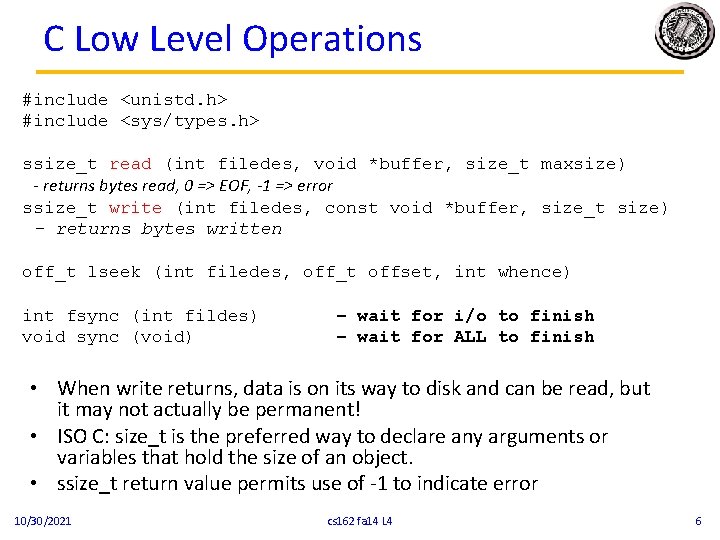
C Low Level Operations #include <unistd. h> #include <sys/types. h> ssize_t read (int filedes, void *buffer, size_t maxsize) - returns bytes read, 0 => EOF, -1 => error ssize_t write (int filedes, const void *buffer, size_t size) - returns bytes written off_t lseek (int filedes, off_t offset, int whence) int fsync (int fildes) void sync (void) – wait for i/o to finish – wait for ALL to finish • When write returns, data is on its way to disk and can be read, but it may not actually be permanent! • ISO C: size_t is the preferred way to declare any arguments or variables that hold the size of an object. • ssize_t return value permits use of -1 to indicate error 10/30/2021 cs 162 fa 14 L 4 6
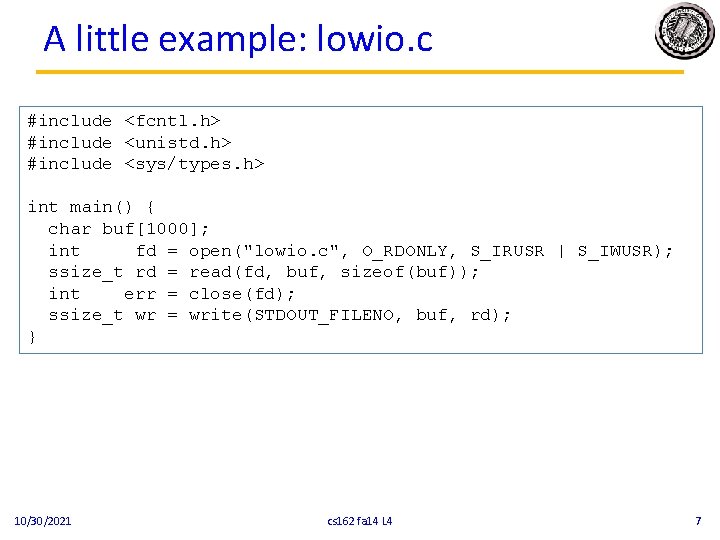
A little example: lowio. c #include <fcntl. h> #include <unistd. h> #include <sys/types. h> int main() { char buf[1000]; int fd = open("lowio. c", O_RDONLY, S_IRUSR | S_IWUSR); ssize_t rd = read(fd, buf, sizeof(buf)); int err = close(fd); ssize_t wr = write(STDOUT_FILENO, buf, rd); } 10/30/2021 cs 162 fa 14 L 4 7
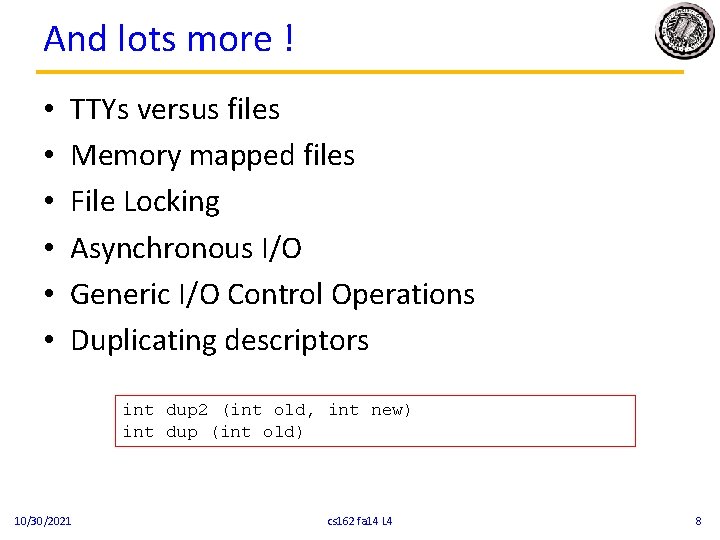
And lots more ! • • • TTYs versus files Memory mapped files File Locking Asynchronous I/O Generic I/O Control Operations Duplicating descriptors int dup 2 (int old, int new) int dup (int old) 10/30/2021 cs 162 fa 14 L 4 8
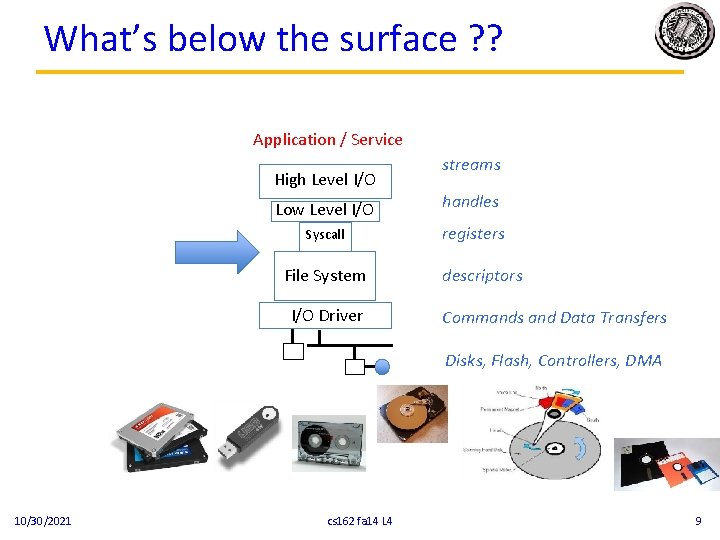
What’s below the surface ? ? Application / Service High Level I/O Low Level I/O Syscall File System I/O Driver streams handles registers descriptors Commands and Data Transfers Disks, Flash, Controllers, DMA 10/30/2021 cs 162 fa 14 L 4 9
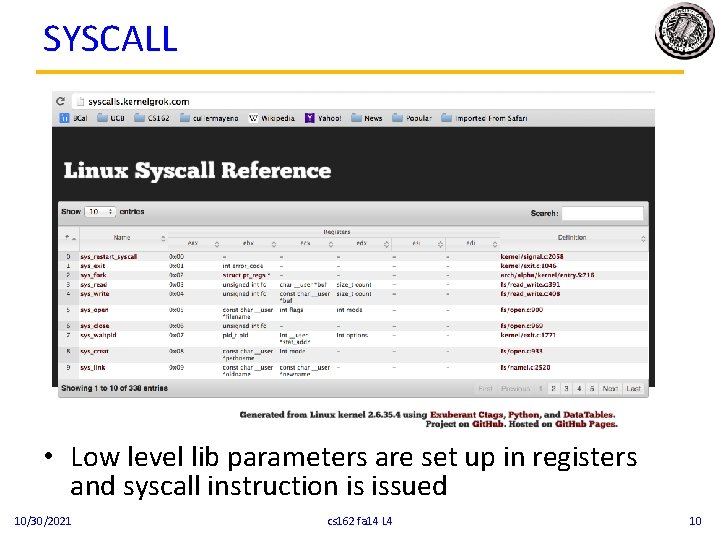
SYSCALL • Low level lib parameters are set up in registers and syscall instruction is issued 10/30/2021 cs 162 fa 14 L 4 10
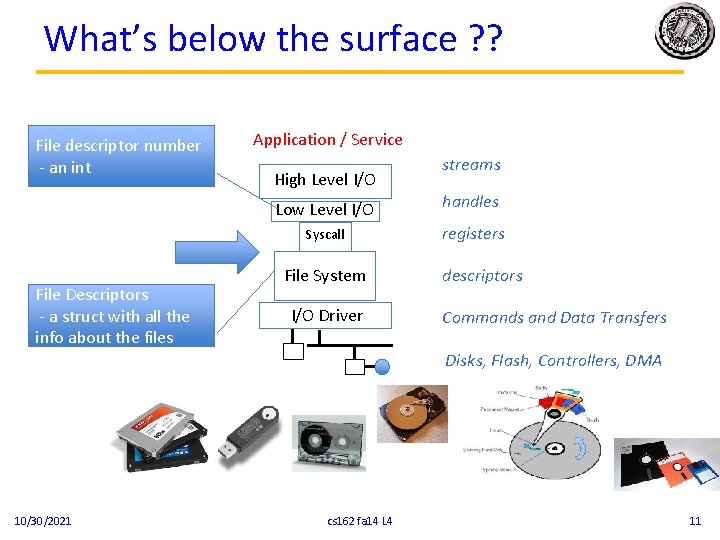
What’s below the surface ? ? File descriptor number - an int Application / Service High Level I/O Low Level I/O Syscall File Descriptors - a struct with all the info about the files File System I/O Driver streams handles registers descriptors Commands and Data Transfers Disks, Flash, Controllers, DMA 10/30/2021 cs 162 fa 14 L 4 11
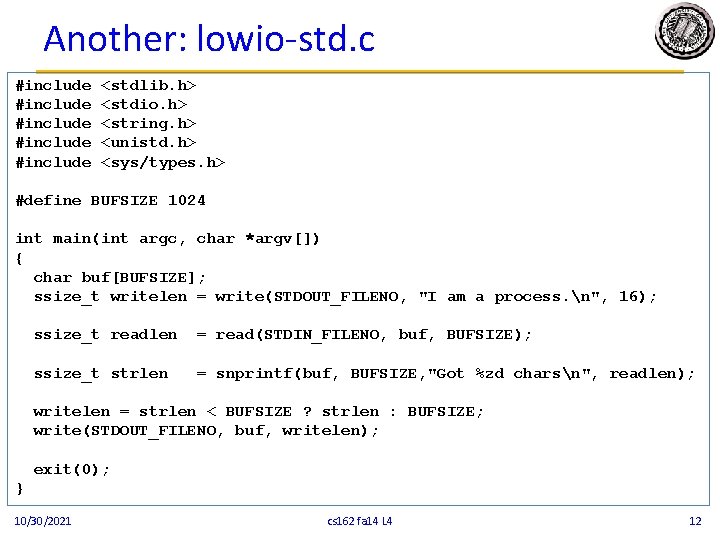
Another: lowio-std. c #include #include <stdlib. h> <stdio. h> <string. h> <unistd. h> <sys/types. h> #define BUFSIZE 1024 int main(int argc, char *argv[]) { char buf[BUFSIZE]; ssize_t writelen = write(STDOUT_FILENO, "I am a process. n", 16); ssize_t readlen = read(STDIN_FILENO, buf, BUFSIZE); ssize_t strlen = snprintf(buf, BUFSIZE, "Got %zd charsn", readlen); writelen = strlen < BUFSIZE ? strlen : BUFSIZE; write(STDOUT_FILENO, buf, writelen); exit(0); } 10/30/2021 cs 162 fa 14 L 4 12
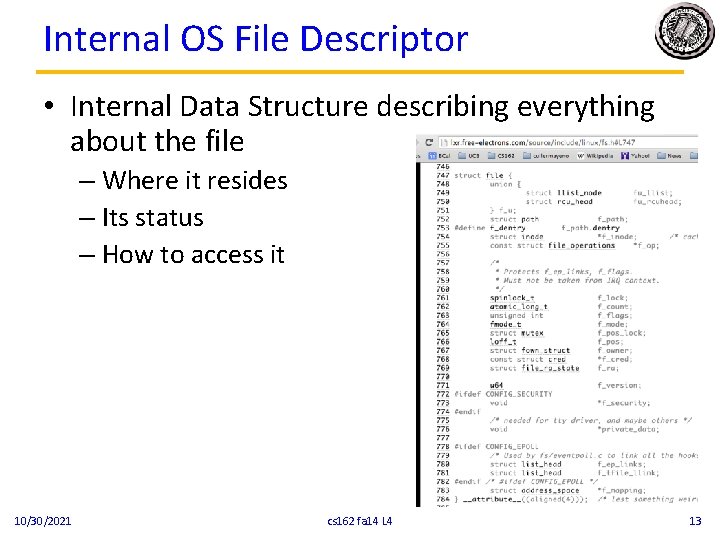
Internal OS File Descriptor • Internal Data Structure describing everything about the file – Where it resides – Its status – How to access it 10/30/2021 cs 162 fa 14 L 4 13

File System: from syscall to driver In fs/read_write. c ssize_t vfs_read(struct file *file, char __user *buf, size_t count, loff_t *pos) { ssize_t ret; if (!(file->f_mode & FMODE_READ)) return -EBADF; if (!file->f_op || (!file->f_op->read && !file->f_op->aio_read)) return -EINVAL; if (unlikely(!access_ok(VERIFY_WRITE, buf, count))) return -EFAULT; ret = rw_verify_area(READ, file, pos, count); if (ret >= 0) { count = ret; if (file->f_op->read) ret = file->f_op->read(file, buf, count, pos); else ret = do_sync_read(file, buf, count, pos); if (ret > 0) { fsnotify_access(file->f_path. dentry); add_rchar(current, ret); } inc_syscr(current); } return ret; } 10/30/2021 cs 162 fa 14 L 4 14
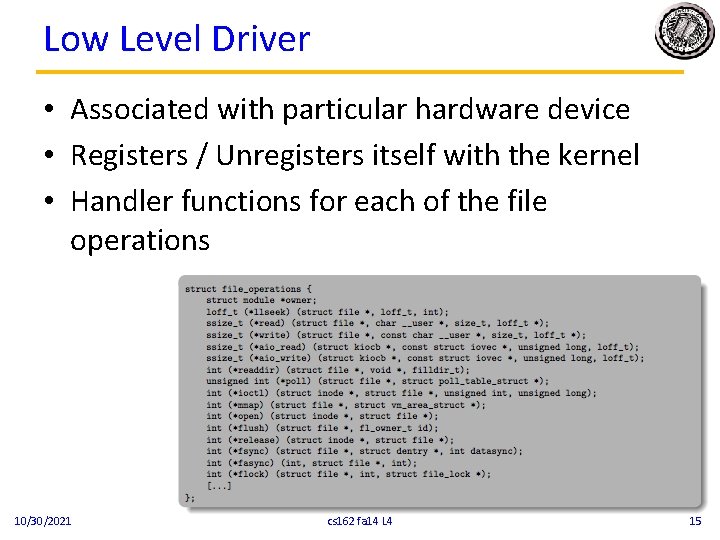
Low Level Driver • Associated with particular hardware device • Registers / Unregisters itself with the kernel • Handler functions for each of the file operations 10/30/2021 cs 162 fa 14 L 4 15
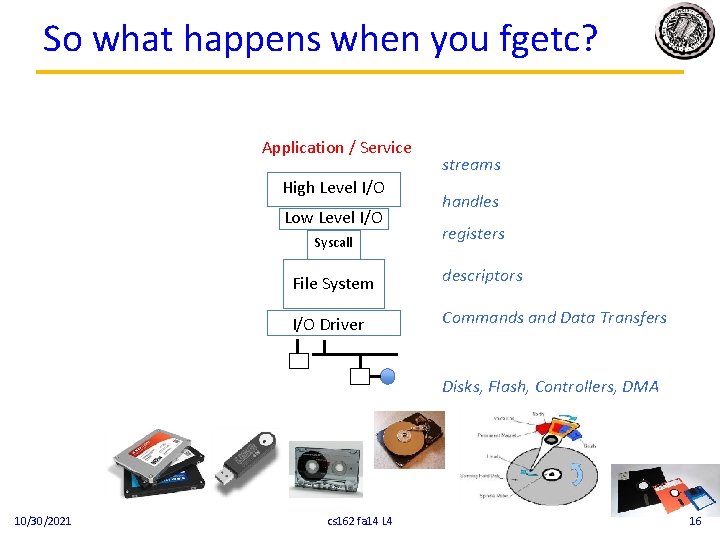
So what happens when you fgetc? Application / Service High Level I/O Low Level I/O Syscall streams handles registers File System descriptors I/O Driver Commands and Data Transfers Disks, Flash, Controllers, DMA 10/30/2021 cs 162 fa 14 L 4 16
Breather 10/30/2021 cs 162 fa 14 L 4 17
Question • Process is an instance of a program executing. – The fundamental OS responsibility • Processes do their work by processing and calling file system operations • Are their any operations on processes themselves? • exit ? 10/30/2021 cs 162 fa 14 L 4 18
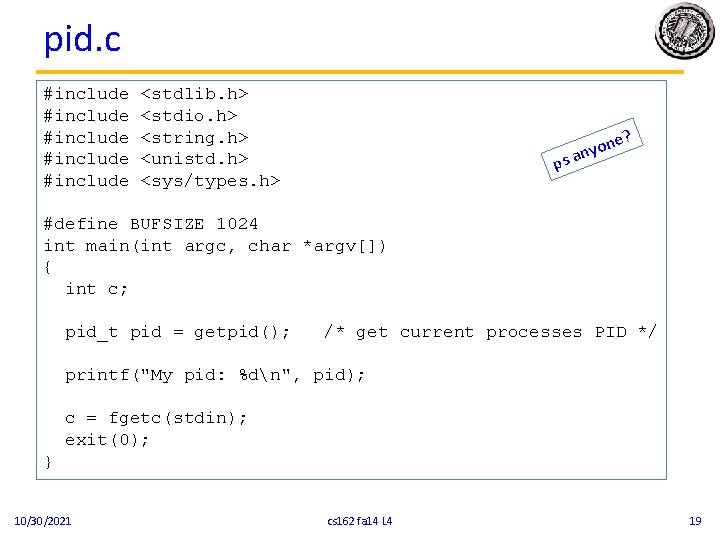
pid. c #include #include <stdlib. h> <stdio. h> <string. h> <unistd. h> <sys/types. h> ps e? on any #define BUFSIZE 1024 int main(int argc, char *argv[]) { int c; pid_t pid = getpid(); /* get current processes PID */ printf("My pid: %dn", pid); c = fgetc(stdin); exit(0); } 10/30/2021 cs 162 fa 14 L 4 19
Can a process create a process ? • Yes • Fork creates a copy of process 10/30/2021 cs 162 fa 14 L 4 20
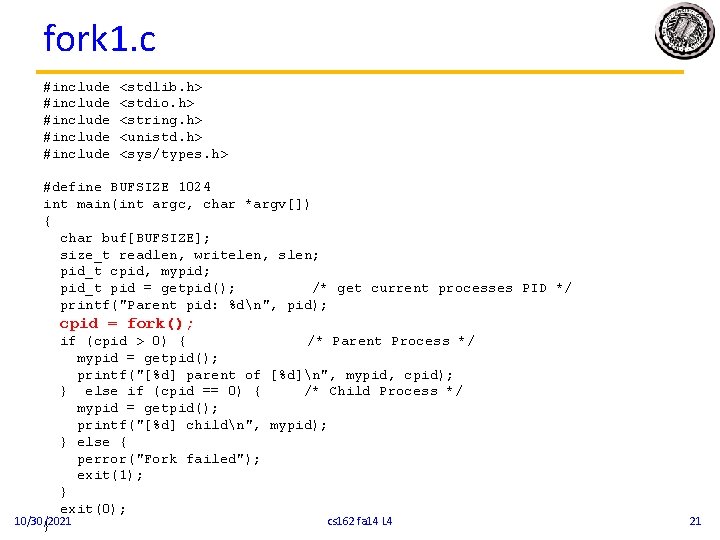
fork 1. c #include #include <stdlib. h> <stdio. h> <string. h> <unistd. h> <sys/types. h> #define BUFSIZE 1024 int main(int argc, char *argv[]) { char buf[BUFSIZE]; size_t readlen, writelen, slen; pid_t cpid, mypid; pid_t pid = getpid(); /* get current processes PID */ printf("Parent pid: %dn", pid); cpid = fork(); if (cpid > 0) { /* Parent Process */ mypid = getpid(); printf("[%d] parent of [%d]n", mypid, cpid); } else if (cpid == 0) { /* Child Process */ mypid = getpid(); printf("[%d] childn", mypid); } else { perror("Fork failed"); exit(1); } exit(0); 10/30/2021 } cs 162 fa 14 L 4 21
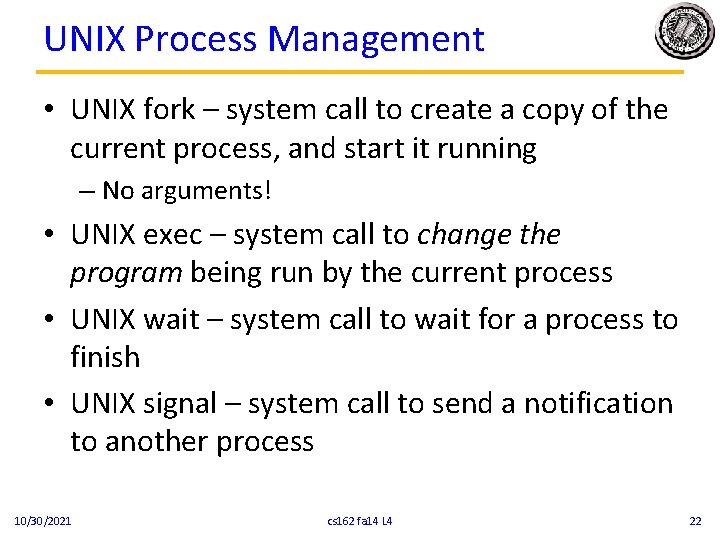
UNIX Process Management • UNIX fork – system call to create a copy of the current process, and start it running – No arguments! • UNIX exec – system call to change the program being run by the current process • UNIX wait – system call to wait for a process to finish • UNIX signal – system call to send a notification to another process 10/30/2021 cs 162 fa 14 L 4 22
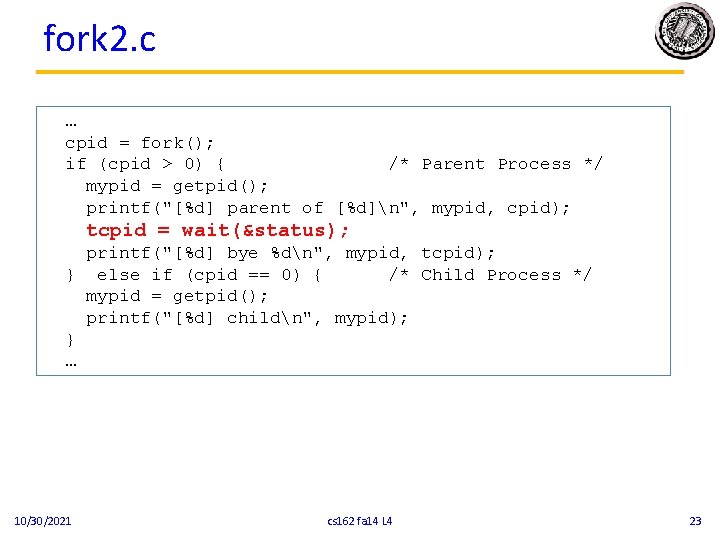
fork 2. c … cpid = fork(); if (cpid > 0) { /* Parent Process */ mypid = getpid(); printf("[%d] parent of [%d]n", mypid, cpid); tcpid = wait(&status); printf("[%d] bye %dn", mypid, tcpid); } else if (cpid == 0) { /* Child Process */ mypid = getpid(); printf("[%d] childn", mypid); } … 10/30/2021 cs 162 fa 14 L 4 23
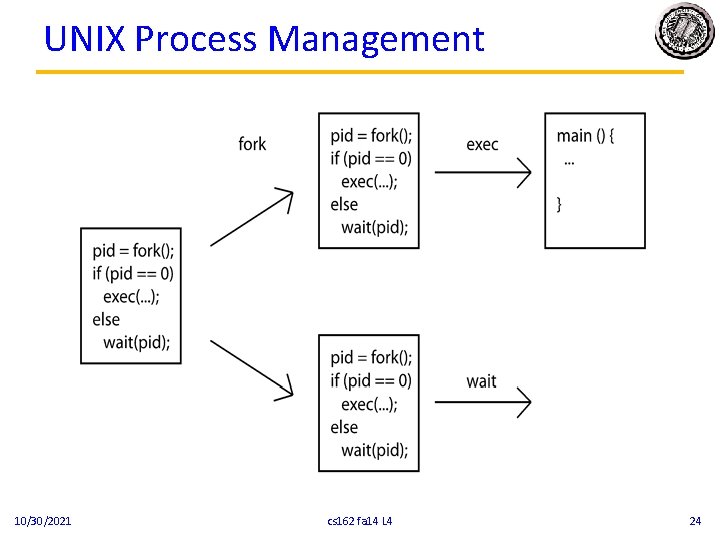
UNIX Process Management 10/30/2021 cs 162 fa 14 L 4 24
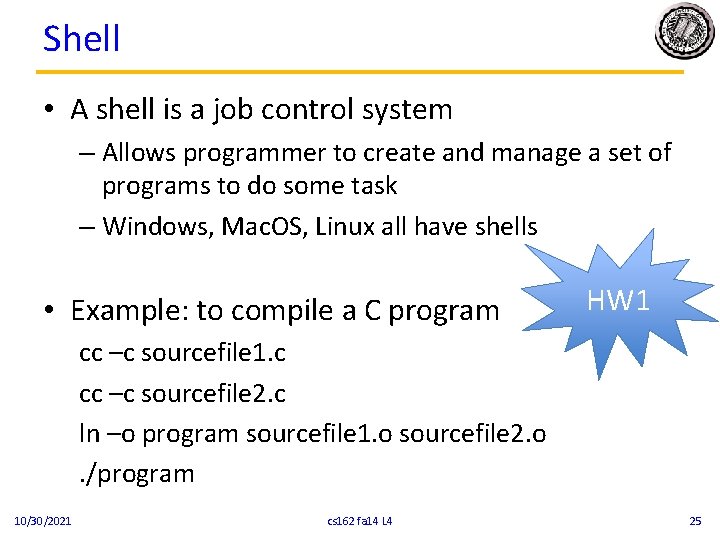
Shell • A shell is a job control system – Allows programmer to create and manage a set of programs to do some task – Windows, Mac. OS, Linux all have shells • Example: to compile a C program HW 1 cc –c sourcefile 1. c cc –c sourcefile 2. c ln –o program sourcefile 1. o sourcefile 2. o. /program 10/30/2021 cs 162 fa 14 L 4 25
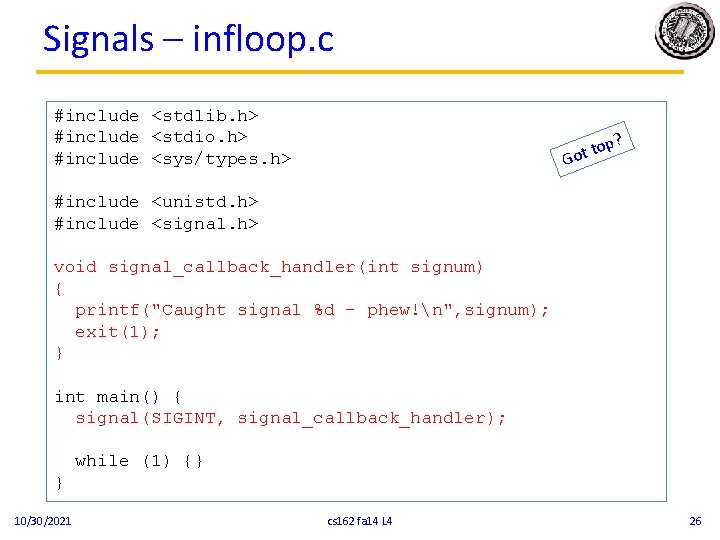
Signals – infloop. c #include <stdlib. h> #include <stdio. h> #include <sys/types. h> p? to Got #include <unistd. h> #include <signal. h> void signal_callback_handler(int signum) { printf("Caught signal %d - phew!n", signum); exit(1); } int main() { signal(SIGINT, signal_callback_handler); while (1) {} } 10/30/2021 cs 162 fa 14 L 4 26
![Process races: fork. c if (cpid > 0) { mypid = getpid(); printf("[%d] parent](http://slidetodoc.com/presentation_image_h2/fb651c049ad49d65486826eff98b3aa4/image-27.jpg "Process races: fork. c if (cpid > 0) { mypid = getpid(); printf(\"[%d] parent")
Process races: fork. c if (cpid > 0) { mypid = getpid(); printf("[%d] parent of [%d]n", mypid, cpid); for (i=0; i<100; i++) { printf("[%d] parent: %dn", mypid, i); // sleep(1); } } else if (cpid == 0) { mypid = getpid(); printf("[%d] childn", mypid); for (i=0; i>-100; i--) { printf("[%d] child: %dn", mypid, i); // sleep(1); } } 10/30/2021 cs 162 fa 14 L 4 27
BIG OS Concepts so far • • • Processes Address Space Protection Dual Mode Interrupt handlers (including syscall and trap) File System – Integrates processes, users, cwd, protection • Key Layers: OS Lib, Syscall, Subsystem, Driver – User handler on OS descriptors • Process control – fork, wait, signal --- exec 10/30/2021 cs 162 fa 14 L 4 28
Code for this lecture • • http: //cs 162. eecs. berkeley. edu/static/lectures/code 04/fork. c http: //cs 162. eecs. berkeley. edu/static/lectures/code 04/fork 1. c http: //cs 162. eecs. berkeley. edu/static/lectures/code 04/fork 2. c http: //cs 162. eecs. berkeley. edu/static/lectures/code 04/infloop. c http: //cs 162. eecs. berkeley. edu/static/lectures/code 04/lowio-std. c http: //cs 162. eecs. berkeley. edu/static/lectures/code 04/lowio. c http: //cs 162. eecs. berkeley. edu/static/lectures/code 04/pid. c 10/30/2021 cs 162 fa 14 L 4 29
- Slides: 29