
Introduction to Fieldbus Systems Wired CPN Hongwei Zhang
Introduction to Fieldbus Systems (Wired CPN) Hongwei Zhang hongwei@iastate. edu, 515 294 2143 http: //www. ece. iastate. edu/~hongwei
Outline n Context n History n Fieldbus characteristics n Industrial Ethernet: the new Fieldbus n Future evolution
Fieldbus: definition n IEC 61158 fieldbus standard A fieldbus is a digital, serial, multidrop, data bus for communication with industrial control and instrumentation devices such as – but not limited to – transducers, actuators and local controllers n Fieldbus Foundation A Fieldbus is a digital, two-way, multidrop communication link among intelligent measurement and control devices. It serves as a Local Area Network (LAN) for advanced process control, remote input/output and high speed factory automation applications n (-) Limited in application scope; only focused on industrial sectors
n Wiki Fieldbus is the name of a family of industrial computer network protocols used for real-time distributed control, standardized as IEC 61158 in 1999. n Our focus p p A fieldbus is simply a network used in automation, irrespective of topology, data rates, protocols, or real- time requirements. Broad application domains industrial process monitoring/control n ground vehicles, avionics, trains n building automation n energy and power systems etc n
Main features/motivations n Focused solutions for specific application fields n Smart devices n Limited resources n Distribution (i. e. , distributed systems) n Comprehensive concepts (beyond networks, including applications) n Flexibility & modularity n Maintainability Very much similar to those for “networked embedded systems”, a term not coined yet in 1980 s when fieldbus development began
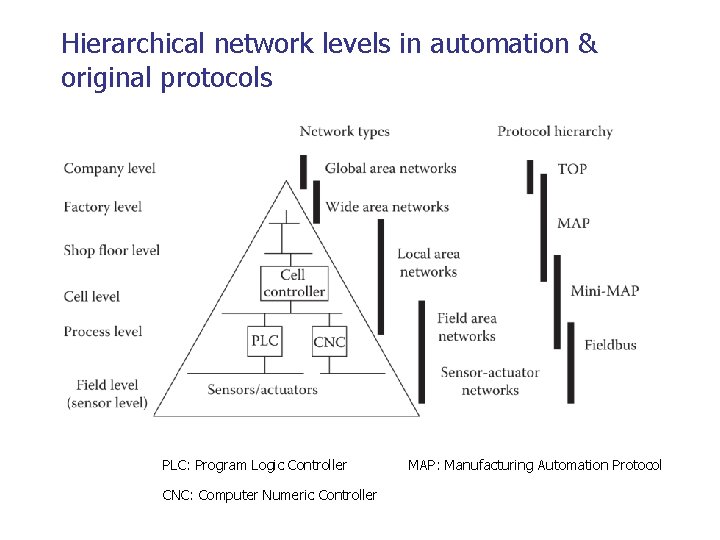
Hierarchical network levels in automation & original protocols PLC: Program Logic Controller CNC: Computer Numeric Controller MAP: Manufacturing Automation Protocol
Outline n Context n History n Fieldbus characteristics n Industrial Ethernet: the new Fieldbus n Future evolution
Early stages: major sources of influence n Communication engineering with large-scale telephone networks n Instrumentation and measurement systems with parallel buses and real-time requirements n Computer science with the introduction of high-level protocol design
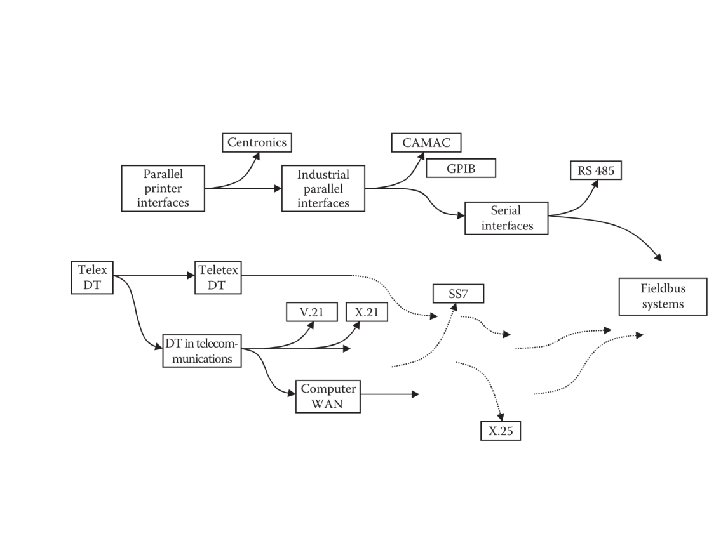
Evolution of fieldbuses n Different application requirements generated different solutions n A fierce selection process where not always the fittest survived, but often those with the highest marketing power behind them p Consequently, most of the newly developed systems vanished or remained restricted to small niches n Then, user organizations were founded to carry on the definition and promotion of the fieldbus systems independent of individual companies
n After the race for fieldbus developments, a race for standardization was launched n p National standardization relatively easy p International standardization difficult Status quo p Factory and process automation n Multiprotocol standards IEC 61158: support 8 technologies, i. e. , Foundation Fieldbus H 1, Control. Net, PROFIBUS, P-Net, FOUNDATION fieldbus HSE (High Speed Ethernet), Swift. Net (developed for Boeing, later withdrawn), World. FIP, Interbus n p IEC 61784 -1: industrial communication networks - profiles Standards in other domains
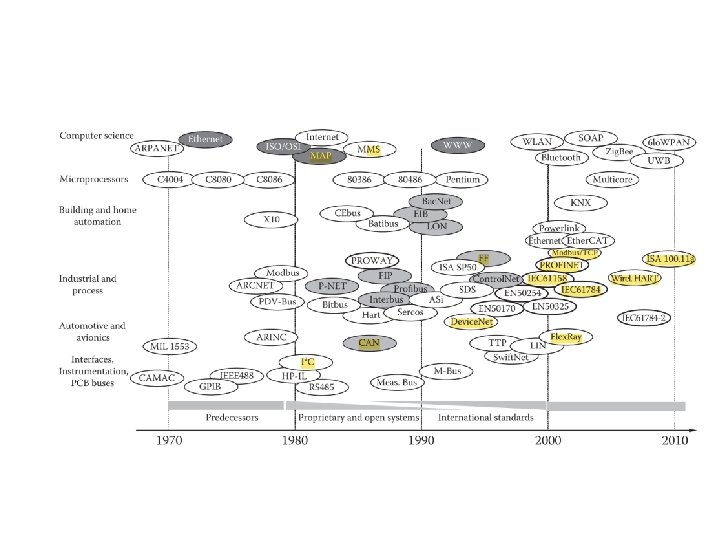
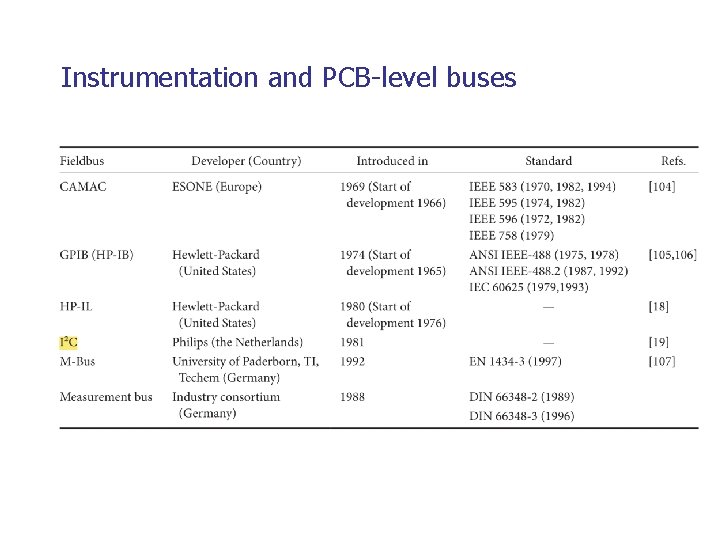
Instrumentation and PCB-level buses
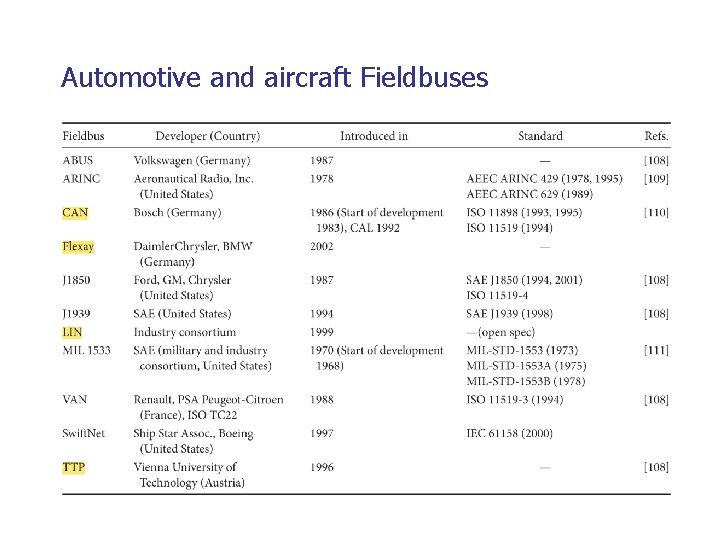
Automotive and aircraft Fieldbuses
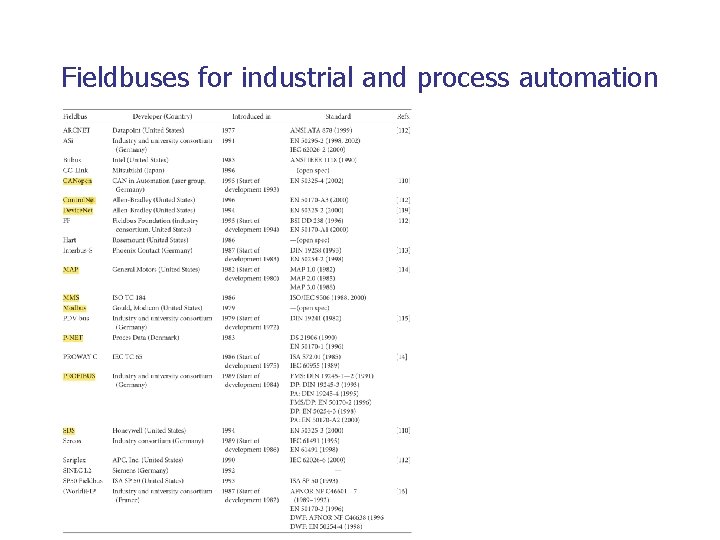
Fieldbuses for industrial and process automation
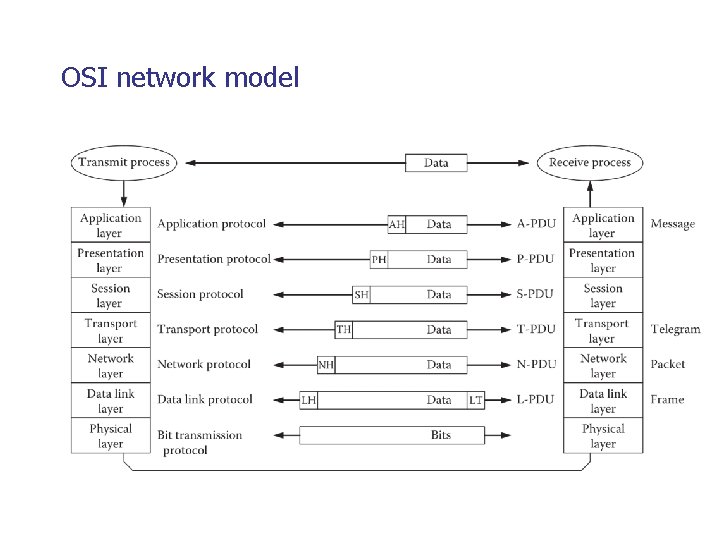
OSI network model
Outline n Context n History n Fieldbus characteristics n Industrial Ethernet: the new Fieldbus n Future evolution
Fieldbus characteristics n Just like today’s embedded system networks, fieldbus systems were always designed for efficiency p Data transfer: messages are rather short according to the limited size of process data that must be transmitted at a time p Protocol design and implementation: typical field devices do not provide ample computing resources n n For wireless networks, resources also constrained in power, radio bandwidth etc Characteristic application requirements in the individual areas with respect to real-time, topology, and economical constraints
Characteristic dimensions n Traffic characteristics and requirements n Fieldbus systems and OSI model n Network topologies n Medium access control n Communication paradigms n Fieldbus management
Traffic characteristics and requirements n Properties of the various data types inside a fieldbus system differ strongly according to the processes that must be automated n Application areas like manufacturing, process, and building automation pose different timing and consistency requirements that are not even invariant and consistent within the application areas
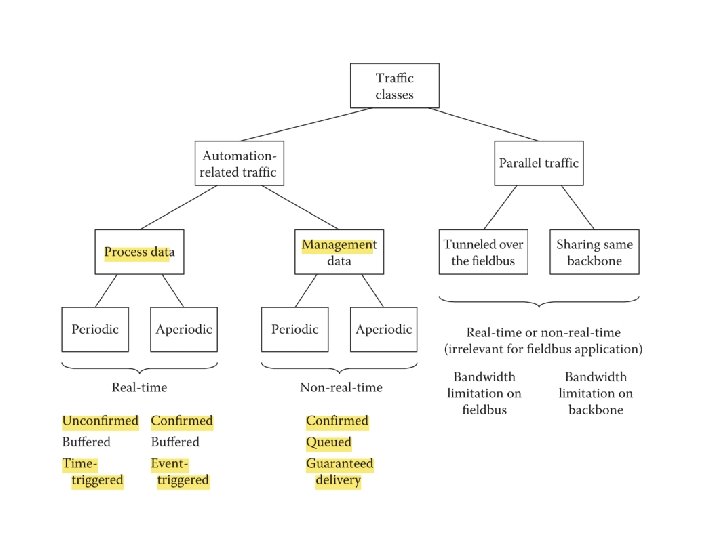
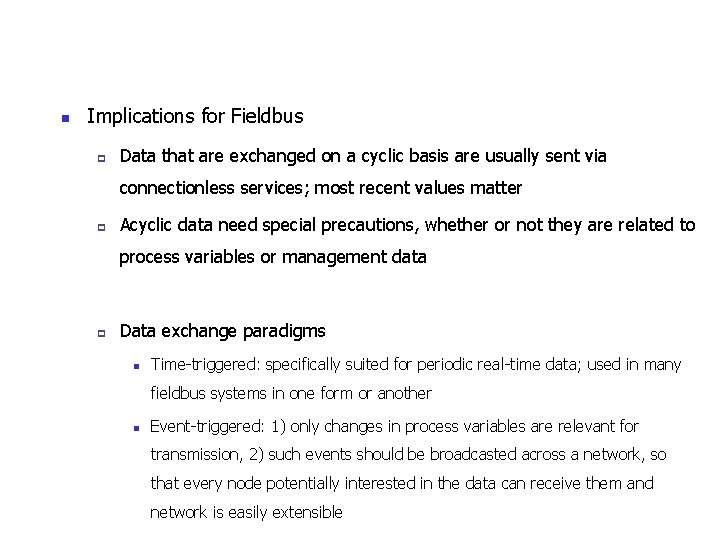
n Implications for Fieldbus p Data that are exchanged on a cyclic basis are usually sent via connectionless services; most recent values matter p Acyclic data need special precautions, whether or not they are related to process variables or management data p Data exchange paradigms n Time-triggered: specifically suited for periodic real-time data; used in many fieldbus systems in one form or another n Event-triggered: 1) only changes in process variables are relevant for transmission, 2) such events should be broadcasted across a network, so that every node potentially interested in the data can receive them and network is easily extensible
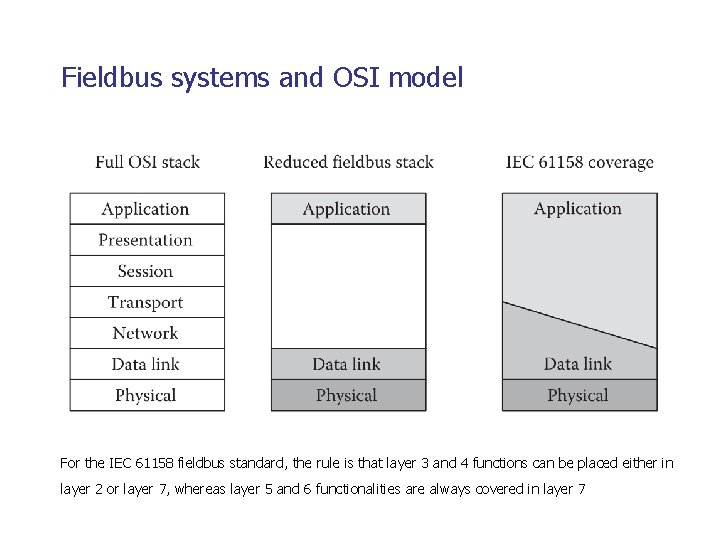
Fieldbus systems and OSI model For the IEC 61158 fieldbus standard, the rule is that layer 3 and 4 functions can be placed either in layer 2 or layer 7, whereas layer 5 and 6 functionalities are always covered in layer 7
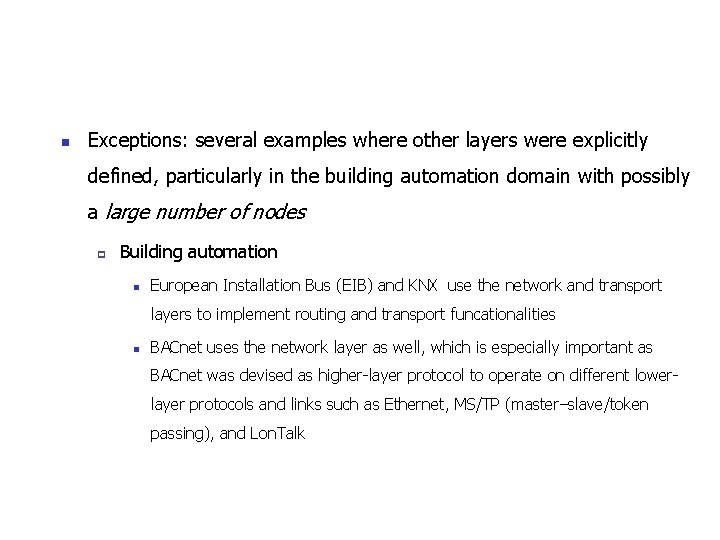
n Exceptions: several examples where other layers were explicitly defined, particularly in the building automation domain with possibly a large number of nodes p Building automation n European Installation Bus (EIB) and KNX use the network and transport layers to implement routing and transport funcationalities n BACnet uses the network layer as well, which is especially important as BACnet was devised as higher-layer protocol to operate on different lowerlayer protocols and links such as Ethernet, MS/TP (master–slave/token passing), and Lon. Talk
p Lon. Works: LON – Local Operating Networking n Designed as a general-purpose control network, even though mostly used for building automation today n In the Lon. Talk protocol, all seven OSI layers are defined, even though layer 6 is rather thin p Industrial and process automation n Control. Net and P-NET are particular in that they also implement layers 3 and 4
Network topologies n Influenced by the target applications and available interface technologies n Physical layer has to meet demanding requirements p Robustness p Immunity to electromagnetic disturbances p Intrinsic safety for hazardous areas p Cost
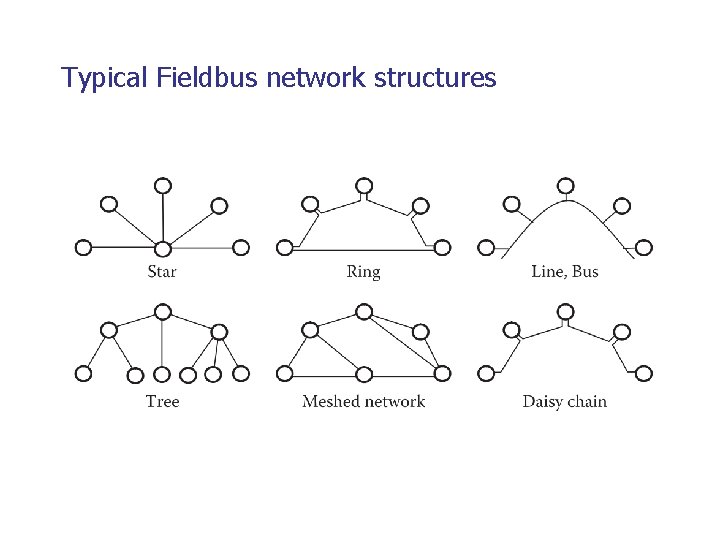
Typical Fieldbus network structures
n Star: early Fieldbus, switched Ethernet n Ring: INTERBUS, SERCOS p Daisy-chain: variant of ring; used in industrial Ethernet (e. g. , PROFINET) where nodes attached ring via small switches n Line/bus: most successful & commonly used fieldbus topology p Usually based on RS 485 interface p Up to 1200 m, 10 Mbps, and 256 nodes per segment, with repeaters between segments p Need proper electrical termination of the bus line to avoid signal reflections disturbing data transfer
n Tree p A common way to build hierarchical, relatively complex networks p Very common in building automation networks such as EIB, Lon. Works, or BACnet n Mesh p Lon. Works and P-NET offer the possibility for building meshes
Medium access control n Single-master vs. multi-master systems p Single-master (or master–slave) approach n Reflects the tradition of centralized, PLC-based automation systems n Typically used for fieldbus systems in the lowest levels of the automation pyramid where the roles of the nodes in the network can be clearly distributed p Multi-master approach n All nodes are equal and must share the communication medium in a fair manner n Mostly in building automation or in the middle level of the automation pyramid (i. e. , the cell level) n All fieldbus systems use a time division multiple access (TDMA)
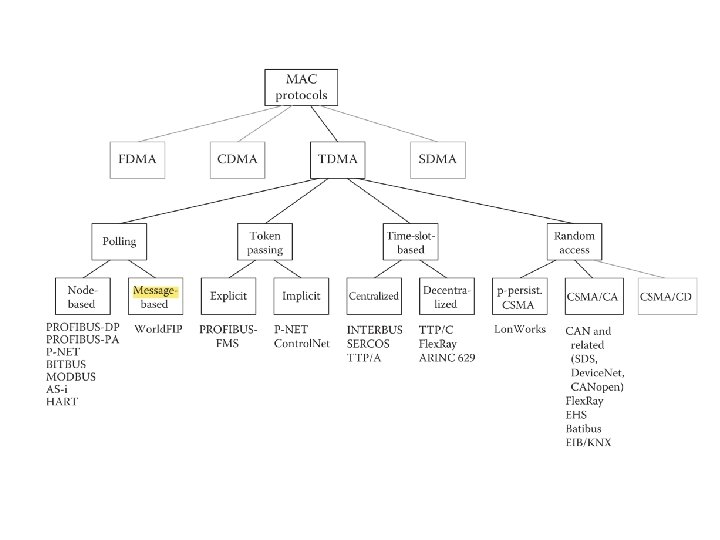
Polling n A master–slave access scheme where a slave node is allowed to send data only when explicitly told so by a central master n Data addressing p Device-centric: explicit node addressing p Data-centric: master requesting specific process variables (instead of addressing individual nodes) n Polling rates can be adaptive p In World. FIP, the polling mechanism accounts also for different periodicity requirements of the individual variables
n PROFIBUS-DP/PA and many Ethernet-based automation networks (such as PROFINET) use a dedicated portion of the bus cycle after the periodic traffic for aperiodic traffic
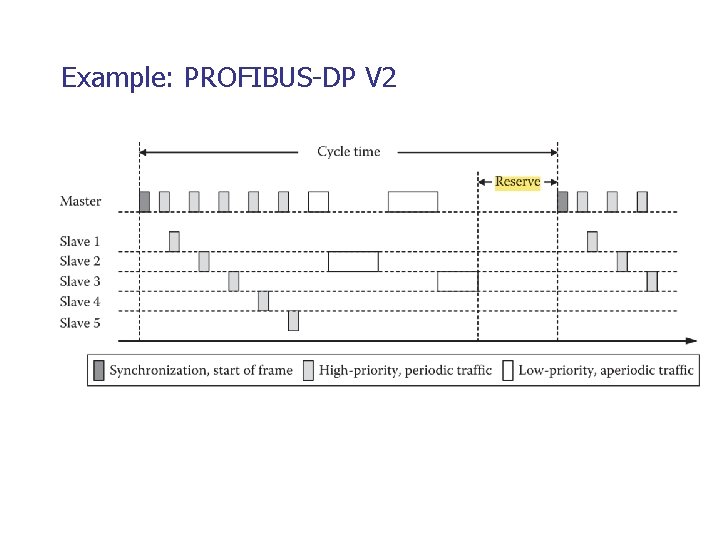
Example: PROFIBUS-DP V 2
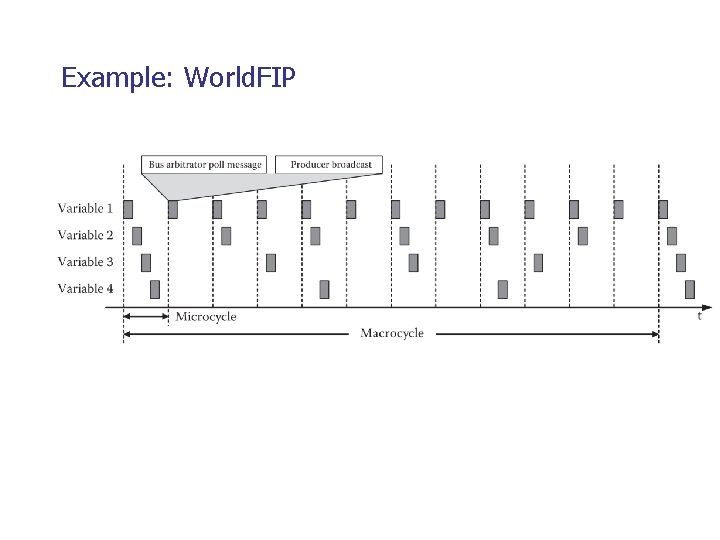
Example: World. FIP
Toking passing (TP) n n n Two forms of tokens p explicitly by means of a dedicated short message p implicitly by distributed, synchronized access counters (ACs) in all nodes Rules for ensuring p token is passed in a fair manner p errors such as lost or duplicate tokens are detected and resolved TP is often combined with an underlying master–slave mechanism for each node (i. e. , master) to control a subset of nodes
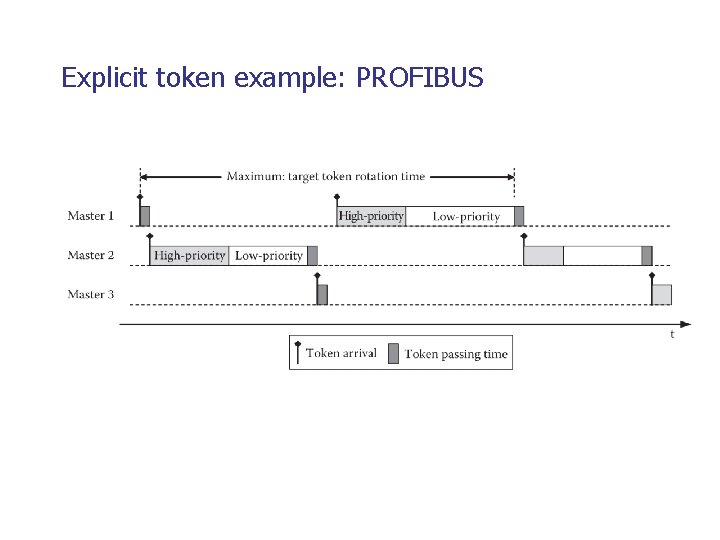
Explicit token example: PROFIBUS
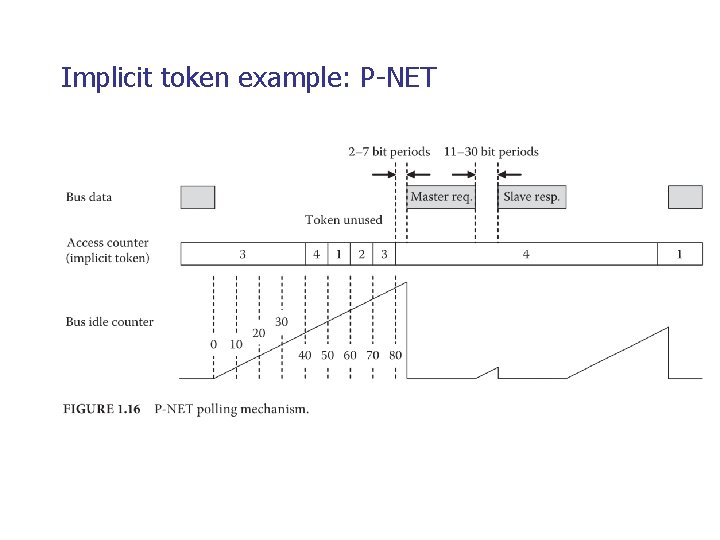
Implicit token example: P-NET
Time-slot-based access n Centralized TDMA p p n Dedicated bus master sending some sort of synchronization message at the start of the cycle E. g. , TTP/A, SERCOS Distributed TDMA p All devices synchronize themselves either by explicit clock synchronization mechanisms or by a set of timers that settle bus operation down to a stable steady state n p p requires proper error containment mechanisms to prevent faulty nodes from blocking the medium and jeopardizing real-time behavior (+) no single point of failure; suitable for safety- critical applications Examples n n TTP/C, Flex. Ray, ARINC 629 CAN was enhanced by superimposing TDMA structures, e. g. , in time-triggered CAN (TT-CAN) or flexible time-triggered CAN (FTT-CAN)
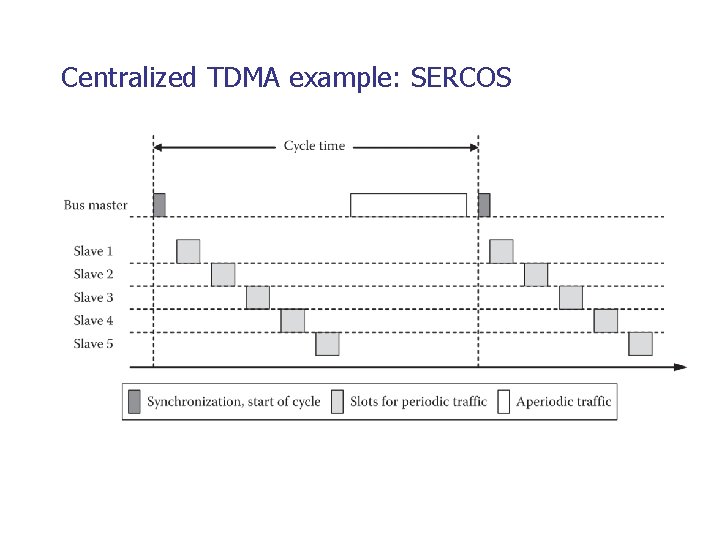
Centralized TDMA example: SERCOS
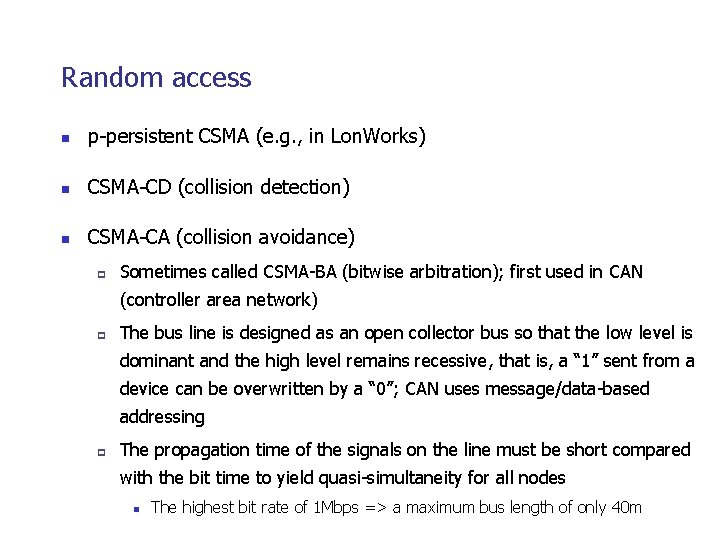
Random access n p-persistent CSMA (e. g. , in Lon. Works) n CSMA-CD (collision detection) n CSMA-CA (collision avoidance) p Sometimes called CSMA-BA (bitwise arbitration); first used in CAN (controller area network) p The bus line is designed as an open collector bus so that the low level is dominant and the high level remains recessive, that is, a “ 1” sent from a device can be overwritten by a “ 0”; CAN uses message/data-based addressing p The propagation time of the signals on the line must be short compared with the bit time to yield quasi-simultaneity for all nodes n The highest bit rate of 1 Mbps => a maximum bus length of only 40 m
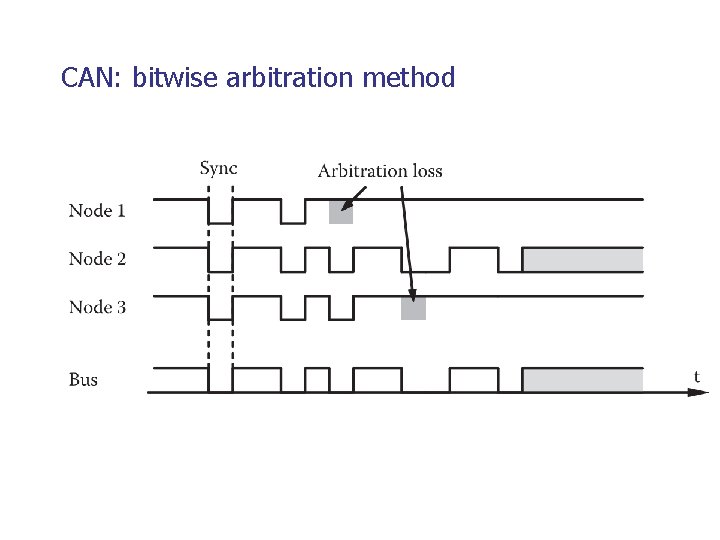
CAN: bitwise arbitration method
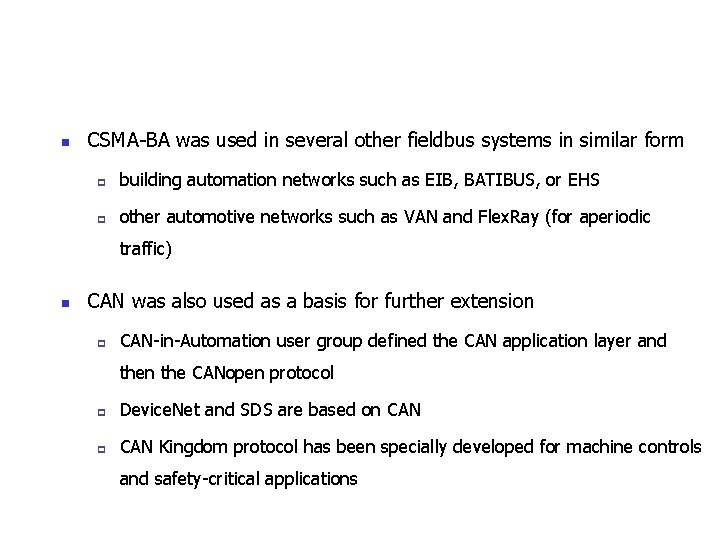
n CSMA-BA was used in several other fieldbus systems in similar form p building automation networks such as EIB, BATIBUS, or EHS p other automotive networks such as VAN and Flex. Ray (for aperiodic traffic) n CAN was also used as a basis for further extension p CAN-in-Automation user group defined the CAN application layer and then the CANopen protocol p Device. Net and SDS are based on CAN p CAN Kingdom protocol has been specially developed for machine controls and safety-critical applications
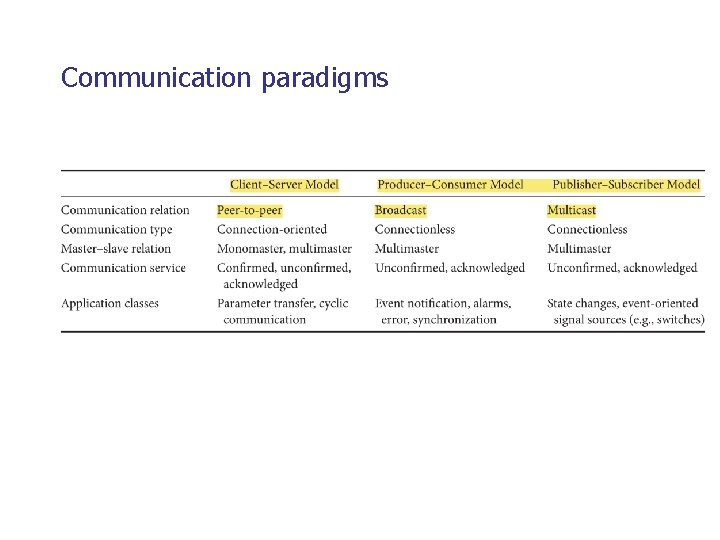
Communication paradigms
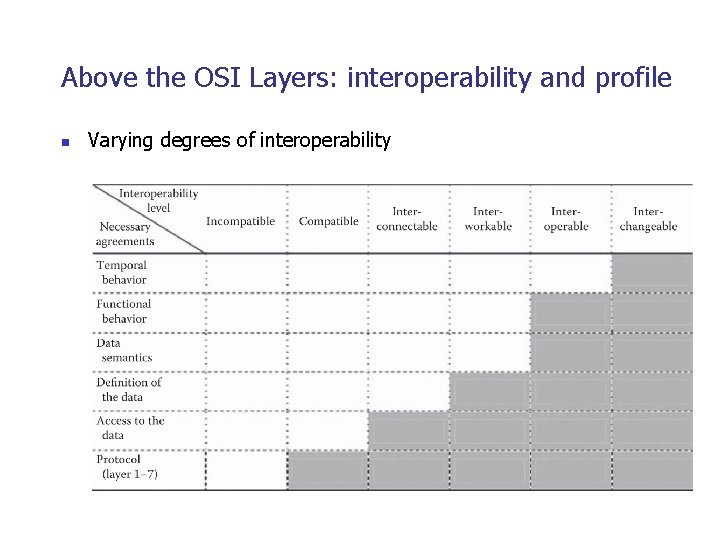
Above the OSI Layers: interoperability and profile n Varying degrees of interoperability
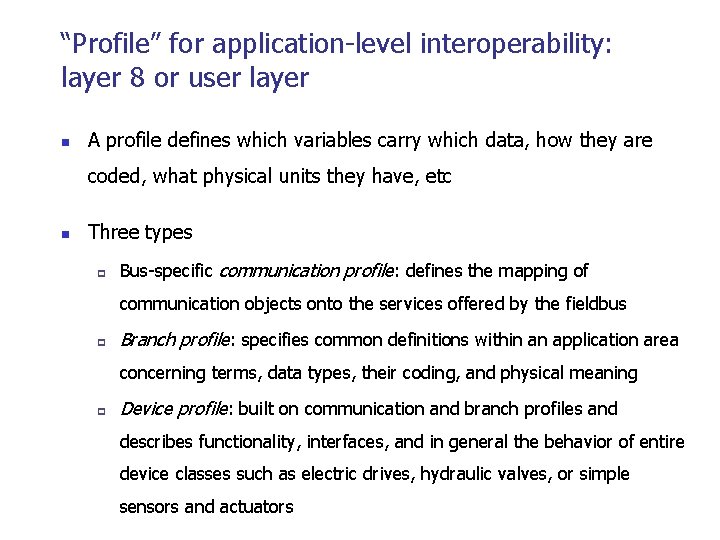
“Profile” for application-level interoperability: layer 8 or user layer n A profile defines which variables carry which data, how they are coded, what physical units they have, etc n Three types p Bus-specific communication profile: defines the mapping of communication objects onto the services offered by the fieldbus p Branch profile: specifies common definitions within an application area concerning terms, data types, their coding, and physical meaning p Device profile: built on communication and branch profiles and describes functionality, interfaces, and in general the behavior of entire device classes such as electric drives, hydraulic valves, or simple sensors and actuators
Fieldbus management n Proprietary, bus-specific solutions n Standard-based solutions p SNMP p XML as description language
Outline n Context n History n Fieldbus characteristics n Industrial Ethernet: the new Fieldbus n Future evolution
Industrial Ethernet: the new Fieldbus n Real-time Ethernet (RTE) performance classes based on application requirements on reaction time p ~100 ms: human-in-the-loop observation, process monitoring p <10 ms: most tooling machine control systems, e. g. , PLCs or PC-based control p n <1 ms: motion control Interoperability p As with traditional fieldbus systems, industrial Ethernets were tailored to specific needs => heterogeneity p Common time sync protocols based on IEEE 1588
p Main benefit of industrial Ethernet n all approaches allow for a standard TCP/UDP/IP communication channel in parallel to fieldbus communication p Separation of real-time and non-real-time traffic is accomplished at the Ethernet MAC level with n prioritization or TDMA schemes, and n appropriate bandwidth allocation strategies
Outline n Context n History n Fieldbus characteristics n Industrial Ethernet: the new Fieldbus n Future evolution
Future evolution n Wireless industrial networks p n Addresses dynamics and uncertainties of wireless communication Safety-critical industrial networks p E. g. , x-by-wire for vehicles and avionics p Mechanisms for enhancing reliability n sequence numbers n additional CRCs and confirmations n Timestamps n heartbeat functions n timeouts together with safety monitors and built-in test functions for the hardware components
Summary n Context n History n Fieldbus characteristics n Industrial Ethernet: the new Fieldbus n Future evolution
- Slides: 53