
Introduction to Fiction Literary Elements Setting Time Place



- Slides: 26
Introduction to Fiction – Literary Elements
Setting ■ Time ■ Place
Plot Climax Rising Action Exposition Falling Action Resolution
Exposition ■ Sets the stage for the Action ■ Introduces characters, setting & background
Rising Action ■ Begins with Inciting Incident ■ Conflicts complicate action ■ Foreshadows climax
Climax ■ The high point ■ Height of all action ■ Turning point in story
Falling Action ■ ■ Less tension Stories may not always have falling action
Resolution ■ Aka: Denouement ■ Loose ends are tied up ■ End of story
Point of View ■ 1 st person: story is told by one of the characters: Uses I ■ 3 rd person: Story told through the perspective of a detached observer. ■ 3 rd person omniscient: Story is told by an allknowing observer (from a god-like perspective) ■ 3 rd person limited: Story is followed through an extremely limited perspective of one character
Characterization ■ Characters are revealed through physical description, actions, dialogue, and what other characters say about them ■ Protagonist vs. Antagonist ■ Dynamic vs. Static ■ Round vs. Flat
Protagonist vs. Antagonist ■ Protagonist: The main character in a work of literature, who is involved in the central conflict of the story. ■ Antagonist: A principal character or force in opposition to the protagonist.
Dynamic vs. Static ■ Dynamic: Characters who change, grow or develop in some way ■ Static: Characters who do NOT change or grow
Round vs. Flat ■ Round: More fully developed characters; complex; seem real ■ Flat: Limited; one dimensional; only a couple of defining traits
Tone ■ The AUTHOR’S attitude toward his/her subject and/or subject ■ Ex. Sincere, flippant, sarcastic, angry, bitter, apologetic, remorseful.
Mood and Atmosphere ■ The READER’S emotional response to the story ■ How the story makes you feel ■ Emotional climate ■ Mood is always described w/ feelings or emotions ■ The spirit of the piece.
Irony ■ Words or events which contradict expectation ■ The opposite of what is anticipated ■ Ask yourself what does he/she expect? Then if the opposite occurs, it’s ironic. ■ 3 types
Verbal Irony ■ Words which seem to mean one thing on the surface but the opposite is intended in reality ■ Aka: Sarcasm ■ Ex. A guy drives up in an old beat up vehicle and you say, “Great car!”
Situational Irony ■ Events unfold in opposition to what the reader expects ■ The opposite of logical anticipation ■ Ex. The annual fireman’s BBQ fundraiser starts a forest fire. A guy breaks his leg while playing around with another buddy’s crutches.
Dramatic Irony ■ Words or situations which mean more to the reader than to one or more of the characters because the reader has access to additional information ■ The author has “told” the reader something that the character’s don’t know. ■ Ex. Horror/Scary movies
Foreshadowing ■A technique used by an author to HINT at events to come later in the story.
Flashback ■ A technique used by an author that interrupts the normal flow of events to look back in time
Conflict Man Versus Self (internal) These are internal battles that characters wage within themselves Man Versus Society (external) These are conflicts where your character’s firm beliefs are against norms that the entire society as a whole endorses. Man Versus Man (external) Most common. Characters will be opposed by or will oppose the actions, reactions, motivations of another character or characters. Man Versus Nature (external) Nature serves as the obstacle for characters. Man Versus Supernatural (external)
Symbolism ■ The use of a concrete object, name, place, event or character to represent an abstract idea. ■ Universal Symbol ■ Private Symbol
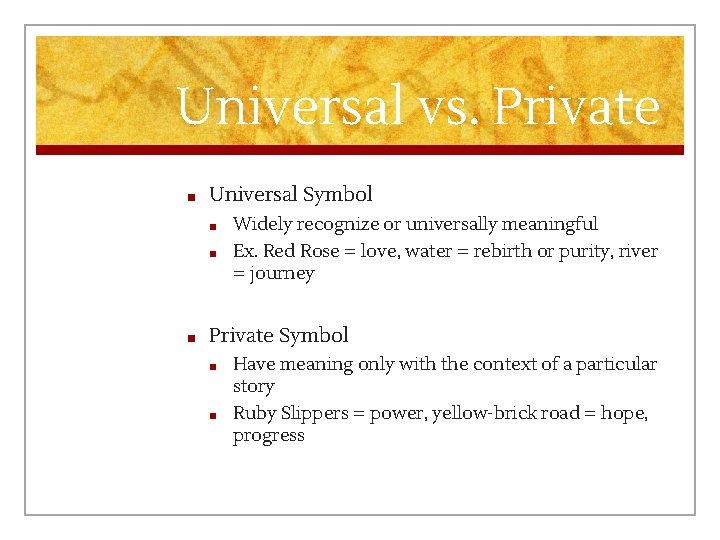
Universal vs. Private ■ ■ Universal Symbol ■ Widely recognize or universally meaningful ■ Ex. Red Rose = love, water = rebirth or purity, river = journey Private Symbol ■ Have meaning only with the context of a particular story ■ Ruby Slippers = power, yellow-brick road = hope, progress
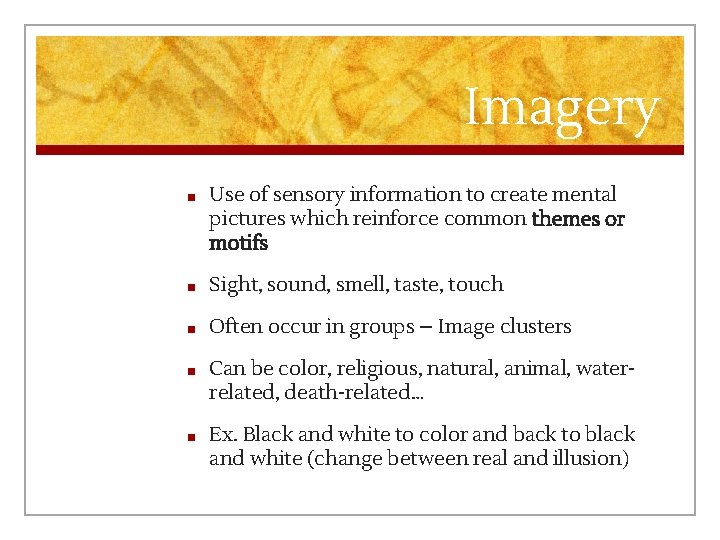
Imagery ■ Use of sensory information to create mental pictures which reinforce common themes or motifs ■ Sight, sound, smell, taste, touch ■ Often occur in groups – Image clusters ■ Can be color, religious, natural, animal, waterrelated, death-related… ■ Ex. Black and white to color and back to black and white (change between real and illusion)
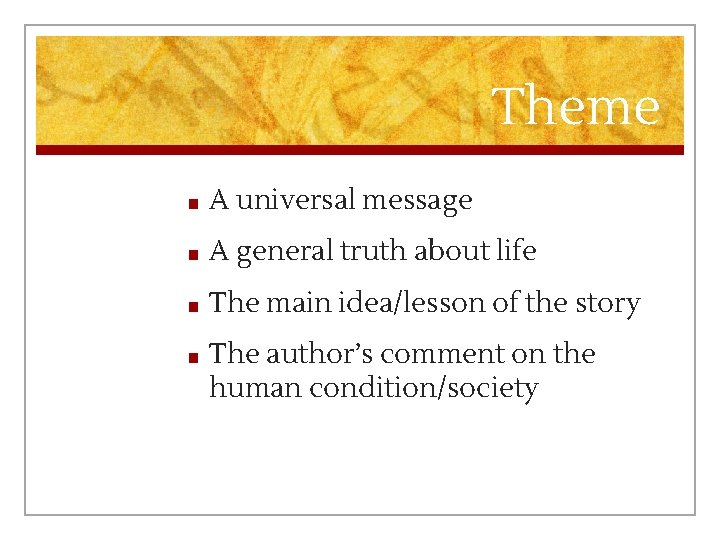
Theme ■ A universal message ■ A general truth about life ■ The main idea/lesson of the story ■ The author’s comment on the human condition/society