
Introduction to Feasibility Analysis Chapter 3 What Is
Introduction to Feasibility Analysis Chapter 3
What Is Feasibility Analysis? �Feasibility Analysis ◦ Preliminary evaluation of idea to determining if it’s worth pursuing ◦ Provides more secure notion that a business idea is viable �Did analysis, feasible business �Personal experience, observed others, surveyed customers �Did analysis, not feasible �No analysis, failed firm: Iridium (satellite phones) �Too complex technology, too long to develop, new technology took over, line of sight to satellite, large phone, low battery power
Preparing a Concept Statement � Concept Statement ◦ One page description of a business ◦ Given to people who provide feedback on the potential of the idea ◦ Purpose of feedback: �Give sense of the viability of the business idea �Suggestions for how the idea can be strengthened or altered before proceeding ◦ Prepare before feasibility analysis
Preparing a Concept Statement �Components of Concept Statement (similar to elevator pitch components) ◦ Description of the product or service ◦ Description of target market ◦ Benefits of the product or service (value proposition) ◦ Description of product/service differentiators ◦ Description of how product/service sold/ distributed ◦ Description of the founder(s) of the firm
When To Conduct a Feasibility Analysis �Timing of Feasibility Analysis ◦ After concept statement evaluation ◦ After opportunity recognition, before business plan ◦ Before a lot of resources are invested �Four Components of Full Feasibility Analysis ◦ Product/Service Feasibility ◦ Industry/Market Feasibility ◦ Organizational Feasibility ◦ Financial Feasibility (covered in finance class)
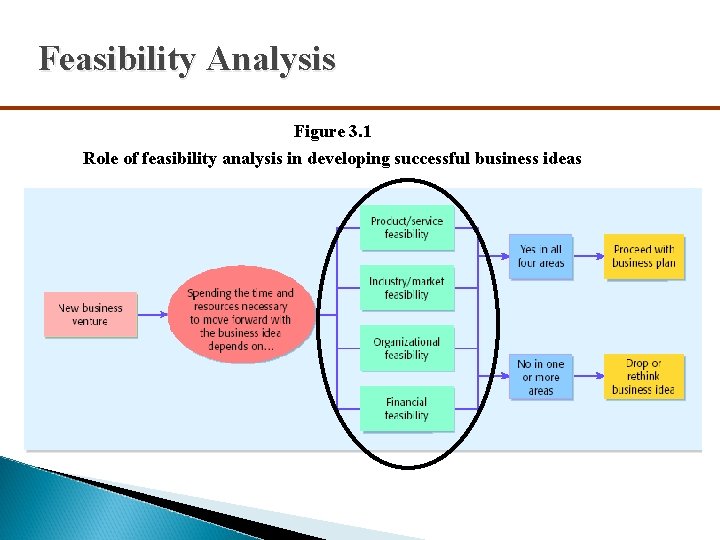
Feasibility Analysis Figure 3. 1 Role of feasibility analysis in developing successful business ideas
Overview of Full Feasibility Analysis (4 forms of feasibility analysis) � Product/Service Feasibility ◦ Composed of two primary tests � Concept testing � Usability testing � Industry/Market Feasibility ◦ Three primary issues a proposed business should consider: � Industry attractiveness � Market timeliness � Identification of a niche market. � Organizational Feasibility ◦ There are two primary issues to consider in this area: � Management prowess � Resource sufficiency � Financial Feasibility ◦ The most important issues to consider at this stage are: � Capital requirements � Financial rate of return � Overall attractiveness of the investment
Overview of Full Feasibility Analysis � Product/Service Feasibility ◦ Composed of two primary tests � Concept testing � Usability testing � Industry/Market Feasibility ◦ Three primary issues a proposed business should consider: � Industry attractiveness � Market timeliness � Identification of a niche market. � Organizational Feasibility ◦ There are two primary issues to consider in this area: � Management prowess � Resource sufficiency � Financial Feasibility ◦ The most important issues to consider at this stage are: � Capital requirements � Financial rate of return � Overall attractiveness of the investment

Product/Service Feasibility � � Product/Service Feasibility Analysis ◦ Assessment of overall appeal of proposed product/service ◦ Main idea: before rushing to development, be sure product/service is what prospective customers want Two components of product/service feasibility analysis: 1. Concept testing 2. Usability testing

Product/Service Feasibility: 1 st Component �Concept Testing ◦ Purpose: Gauge customer interest, desirability, purchase intentions ◦ Involves showing a representation of product/service to prospective users �Occurs before the prototype stage �Websites and graphic designs are taking this to a new level ◦ Concept test ≠ concept statement �Concept test: tests feasibility of specific product/service idea �Concept statement: is a preliminary evaluation of entire business idea
Product/Service Feasibility: 3 reasons to conduct 1. Validate underlying premises of product/ service idea • Use phone interviews, focus groups, watch consumers perform tasks, customer advisory boards • Ex: Pepsi. Co developed model of 5 types of teens and tries to predict how trends move through teen populations 2. Help developing idea • Iteratively show idea to potential customers and make changes along the way 3. Estimate potential market share • Survey questions • Market research surveys
Product/Service Feasibility: 2 nd Component �Usability Testing ◦ Purpose: determine ease-of-use and user’s perceptions of using product �While tempting to rush a product/service to market usability tests are good investments of resources �Eliminate potentially frustrating aspects of product/services �Involves creating a physical prototype and giving it to users, measuring usage results, and making modifications as necessary ◦ Iterative in nature ◦ Also called: user tests, beta tests, or field trials �http: //scholar. google. com
Product/Service Feasibility: 3 forms of usability testing 1. Basic Prototype: fairly simple prototype that is given to friends/colleagues for feedback • American Inventor • Gym class exercise mat 2. Elaborate Usability Test: large-scale tests for wellfunded or existing ventures • Lab testing, elaborate customer measurement devices (e. g. , Google), etc. 3. Hybrid Test: Follow-me-home testing (e. g. , day-inthe-life research)
Product/Service Feasibility: 5 Benefits 1. Getting product right the first time 2. Create a beta (or early adopter community) 3. Avoid obvious flaws in product/service design • Mobile. Star wireless “hotspots” 4. Use time and resources more efficiently 5. Potentially identify complementary product/ service offerings • i. Pod accessories
Overview of Full Feasibility Analysis � Product/Service Feasibility ◦ Composed of two primary tests � Concept testing � Usability testing � Industry/Market Feasibility ◦ Three primary issues a proposed business should consider: � Industry attractiveness � Market timeliness � Identification of a niche market. � Organizational Feasibility ◦ There are two primary issues to consider in this area: � Management prowess � Resource sufficiency � Financial Feasibility ◦ The most important issues to consider at this stage are: � Capital requirements � Financial rate of return � Overall attractiveness of the investment
Industry/Market Feasibility Analysis � ◦ Purpose: assess overall appeal of the market ◦ 3 primary issues to consider: 1. Industry attractiveness, 2. Market timeliness, and 3. Identification of a niche market
Industry/Market Feasibility Analysis: Industry Attractiveness �Issue 1: Industry Attractiveness ◦ Primary determinant of feasibility is attractiveness of industry chosen ◦ Characteristics of attractive industries: �Large and growing (growth is very important) �Industries are important to customers (e. g. , must haves vs. likes) �Early in the industry lifecycle to avoid price competition �Industries are not crowded with competitors ◦ How to assess industry attractiveness? �Forces in the broad environment (e. g. , technological, sociocultural/demographic, political/legal, economic, global trends) �Porter’s Five Forces analysis
Industry/Market Feasibility Analysis: Market Timeliness �Issue 2: Market Timeliness ◦ Will the market be receptive to the product/service? ◦ If it’s a modification on existing offerings (e. g. , cell phones with cameras) ask: �Is the window of opportunity open? �Are customers buying? �Are competitors making money? ◦ If it’s a breakthrough product/service (e. g. , Yahoo with internet search engines, e. Bay with online auctions, etc. ) ask: �Can we capture a first-mover advantage? �Example: Microsoft in computer operating systems �Will we suffer from a second-mover advantage? �Example: IBM vs. Dell in personal computer retailing
Industry/Market Feasibility Analysis: Niche Markets �Issue 3: Identification of a Niche Market ◦ Niche markets are places in larger market segments that represent narrower groups of customers ◦ 2 reasons for new firms to sell to niche markets: �Allows a firm to establish itself in industry and avoid competing against major competitors (e. g. , specialty retailers vs. Wal-Mart) �Allows a firm to focus on serving specialized markets very well �Avoids trying to be everything to everybody in a broad market ◦ Successful example: buyandhold. com and small scale investments ◦ Problematic example: Iridium and satellite phones (tried to serve everyone)
Overview of Full Feasibility Analysis � Product/Service Feasibility ◦ Composed of two primary tests � Concept testing � Usability testing � Industry/Market Feasibility ◦ Three primary issues a proposed business should consider: � Industry attractiveness � Market timeliness � Identification of a niche market. � Organizational Feasibility ◦ There are two primary issues to consider in this area: � Management prowess � Resource sufficiency � Financial Feasibility ◦ The most important issues to consider at this stage are: � Capital requirements � Financial rate of return � Overall attractiveness of the investment
Organizational Feasibility Analysis � Organizational Feasibility ◦ Purpose: determine if business has sufficient skills/resources to bring product/service to market successfully ◦ Non-financial factors important to consider here ◦ 2 primary issues to consider: 1. Management prowess 2. Resource sufficiency
Organizational Feasibility Analysis: Management Prowess �Issue 1: Management Prowess ◦ Firm must evaluate the ability of the management team ◦ Determine if has the passion and expertise to launch the venture ◦ 2 most important factors in this area: �Passion the solo entrepreneur/founding team has for the idea �Extent the entrepreneur/founding team understands the markets in which the firm will participate ◦ Ventures with established networks have an advantage ◦ Successful Example: e. Bay
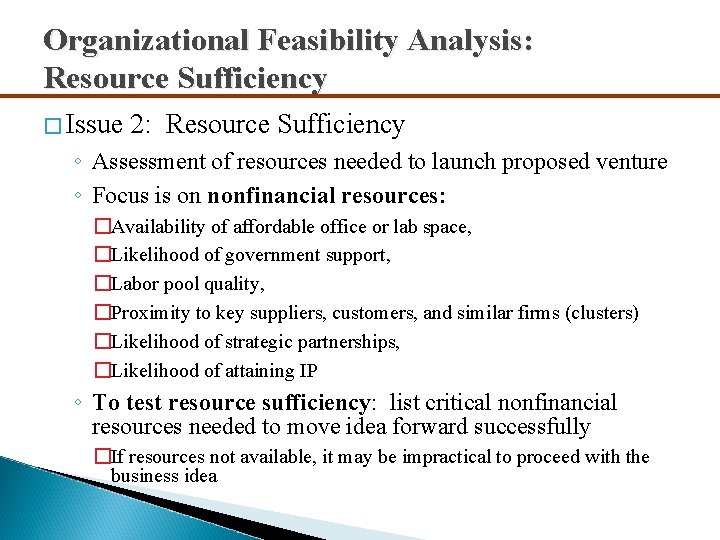
Organizational Feasibility Analysis: Resource Sufficiency � Issue 2: Resource Sufficiency ◦ Assessment of resources needed to launch proposed venture ◦ Focus is on nonfinancial resources: �Availability of affordable office or lab space, �Likelihood of government support, �Labor pool quality, �Proximity to key suppliers, customers, and similar firms (clusters) �Likelihood of strategic partnerships, �Likelihood of attaining IP ◦ To test resource sufficiency: list critical nonfinancial resources needed to move idea forward successfully �If resources not available, it may be impractical to proceed with the business idea
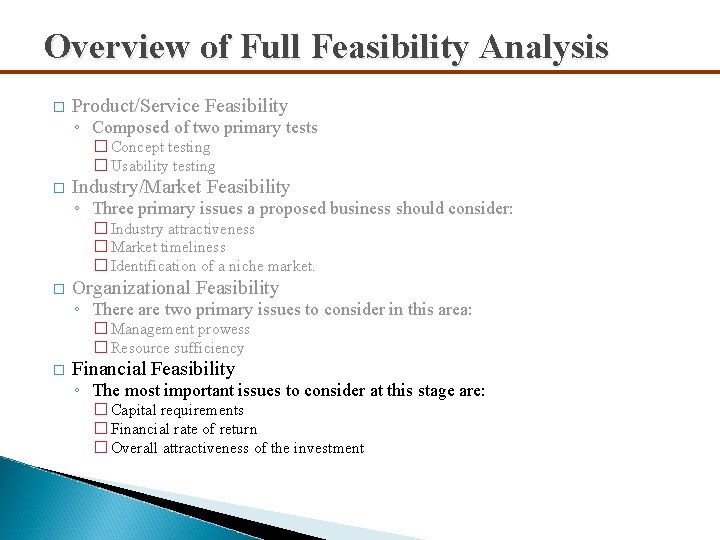
Overview of Full Feasibility Analysis � Product/Service Feasibility ◦ Composed of two primary tests � Concept testing � Usability testing � Industry/Market Feasibility ◦ Three primary issues a proposed business should consider: � Industry attractiveness � Market timeliness � Identification of a niche market. � Organizational Feasibility ◦ There are two primary issues to consider in this area: � Management prowess � Resource sufficiency � Financial Feasibility ◦ The most important issues to consider at this stage are: � Capital requirements � Financial rate of return � Overall attractiveness of the investment
- Slides: 24