
INTRODUCTION TO FARM AGRIBUSINESS MANAGEMENT AND DECISION MAKING
INTRODUCTION TO FARM/ AGRIBUSINESS MANAGEMENT AND DECISION MAKING Dr. John Jatoe Dept. of Agric. Econ. & Agribusiness University of Ghana Legon Farm Management by Kay, Edwards (and Duffy (various))
Lecture outline 2 Functions of Management Strategic Farm Management Tactical Decision Making Characteristics of Decisions The Decision-Making Environment in Agriculture farm management chapter 2
Lecture objectives 3 1. 2. 3. 4. 5. To understand the functions of management To present the steps in developing a strategic management plan for a farm or ranch or agribusiness To identify common goals of agribusiness/ farm and ranch managers, To explain the steps in the decisionmaking process To describe some unique characteristics of the decision-making environment for agriculture farm management chapter 2
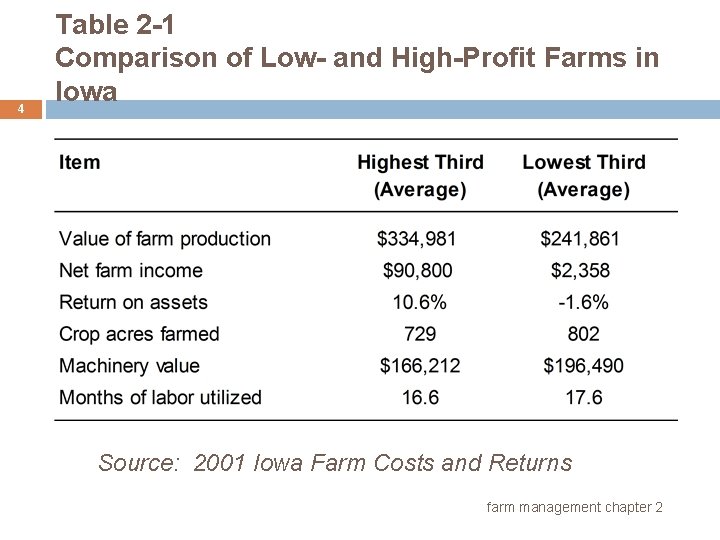
4 Table 2 -1 Comparison of Low- and High-Profit Farms in Iowa Source: 2001 Iowa Farm Costs and Returns farm management chapter 2
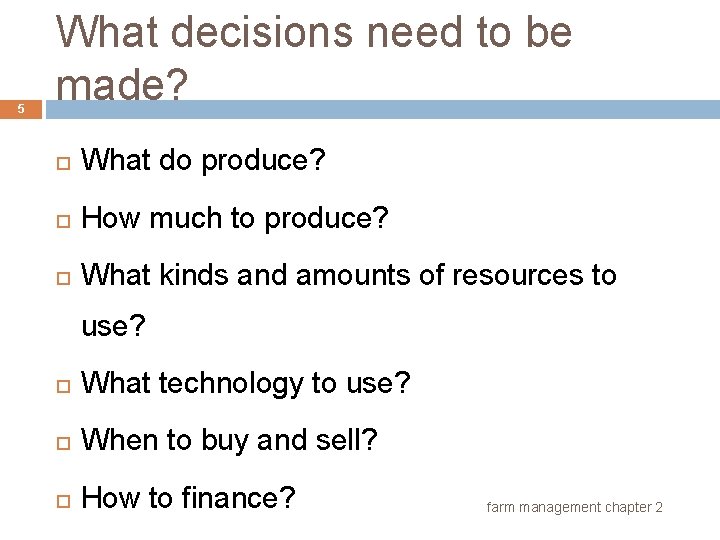
5 What decisions need to be made? What do produce? How much to produce? What kinds and amounts of resources to use? What technology to use? When to buy and sell? How to finance? farm management chapter 2
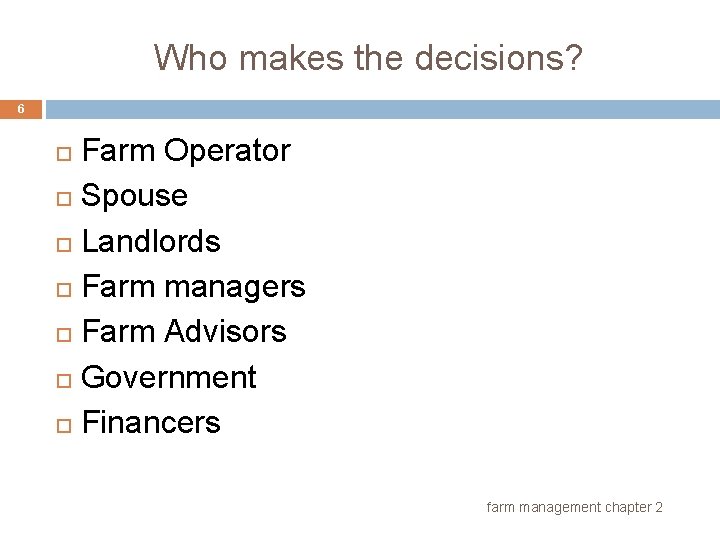
Who makes the decisions? 6 Farm Operator Spouse Landlords Farm managers Farm Advisors Government Financers farm management chapter 2
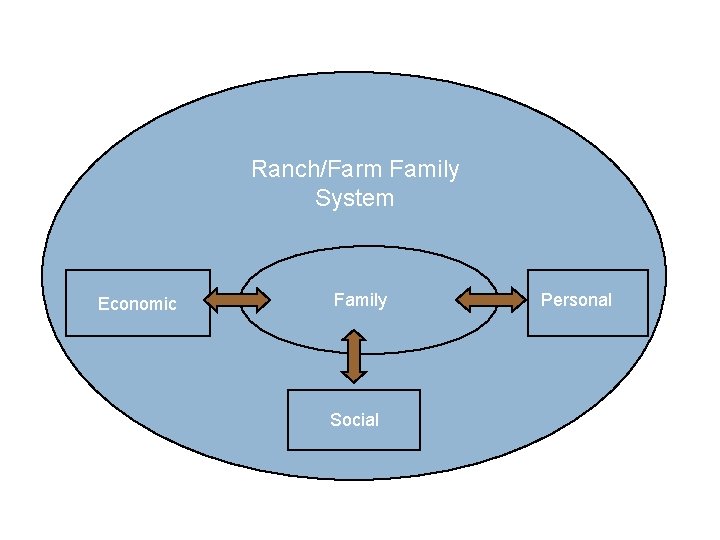
Ranch/Farm Family System Economic Family Social Personal
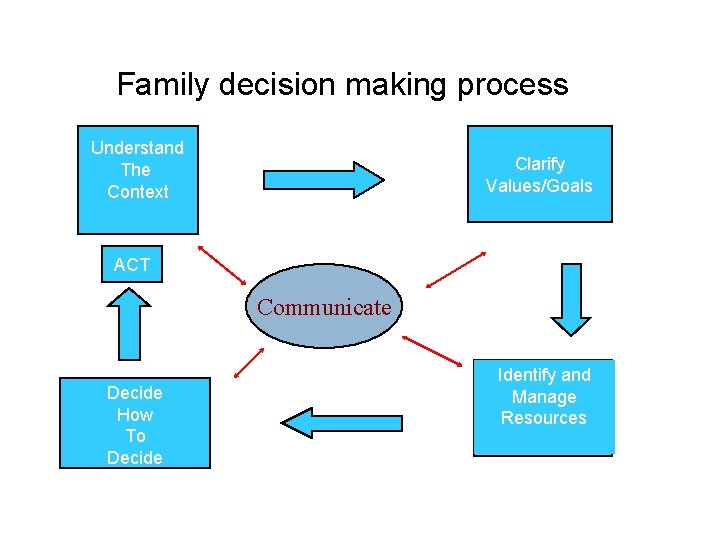
Family decision making process Understand The Context Clarify Values/Goals ACT Communicate Decide How To Decide Identify and Manage Resources Sean Brotherson, NDSU Extension Family Science Specialist
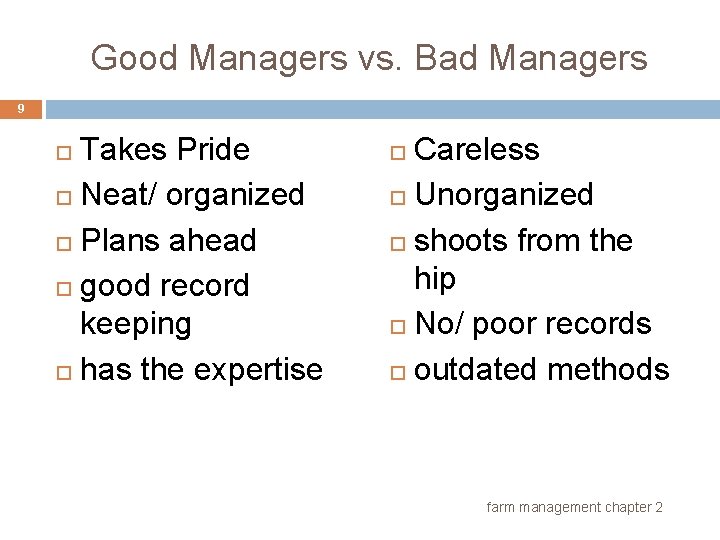
Good Managers vs. Bad Managers 9 Takes Pride Neat/ organized Plans ahead good record keeping has the expertise Careless Unorganized shoots from the hip No/ poor records outdated methods farm management chapter 2
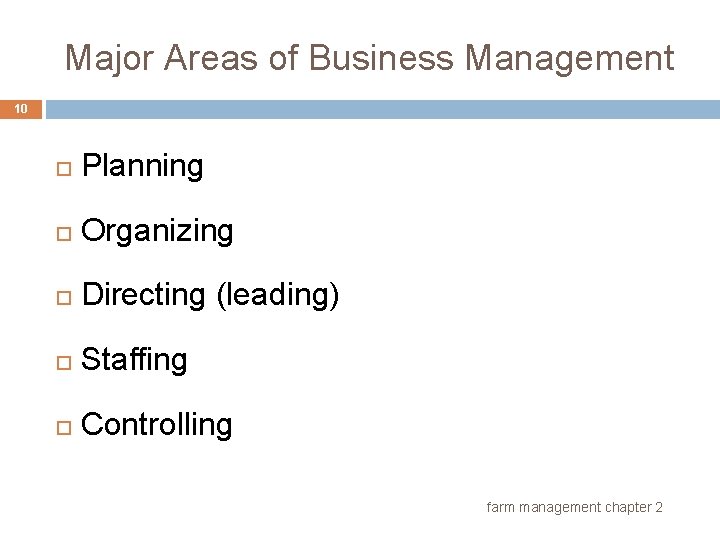
Major Areas of Business Management 10 Planning Organizing Directing (leading) Staffing Controlling farm management chapter 2
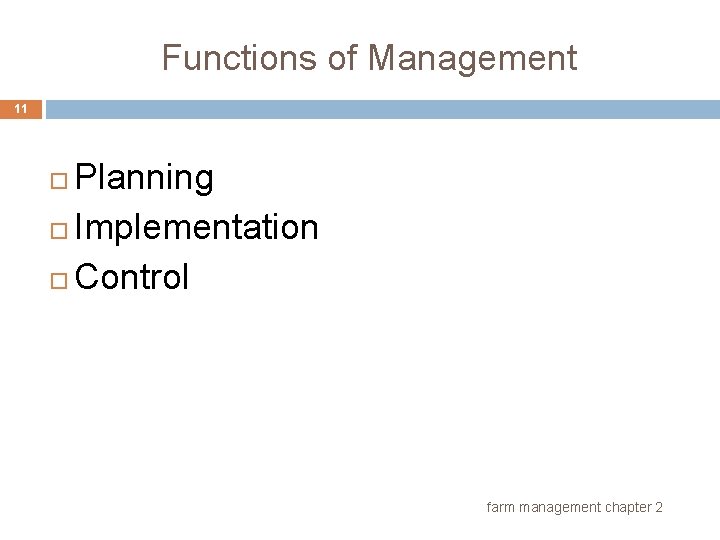
Functions of Management 11 Planning Implementation Control farm management chapter 2
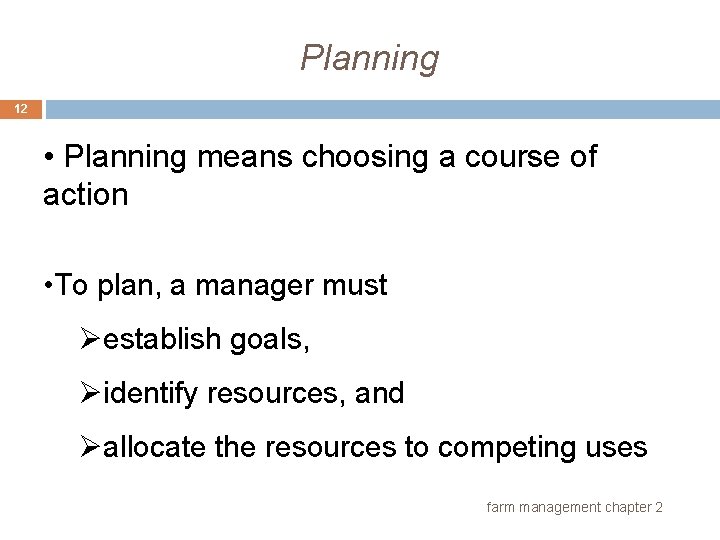
Planning 12 • Planning means choosing a course of action • To plan, a manager must Øestablish goals, Øidentify resources, and Øallocate the resources to competing uses farm management chapter 2
Implementation 13 • Once a plan is developed, it must be implemented, or set in motion • To implement, the manager must Øacquire the resources needed for the plan and Øoversee the process. • Coordinating, staffing, purchasing (procurement), and supervising fit under this function. farm management chapter 2
Control 14 • Control is the “feedback” function To control, the manager must Ømonitor results, Ørecord information, Øcompare results to a standard, and Øtake corrective action as needed farm management chapter 2
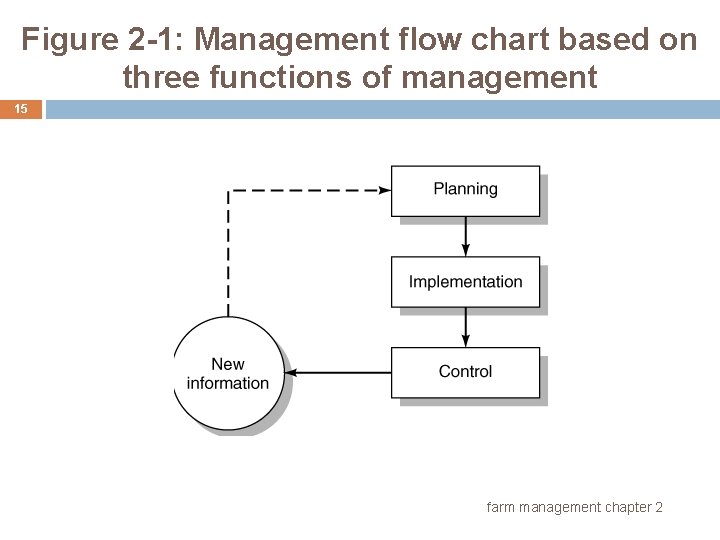
Figure 2 -1: Management flow chart based on three functions of management 15 farm management chapter 2
Strategic Farm Management 16 Strategic management consists of charting the overall long-term course of the business Tactical management consists of taking short-run actions that keep the business moving along that course until the destination is reached farm management chapter 2
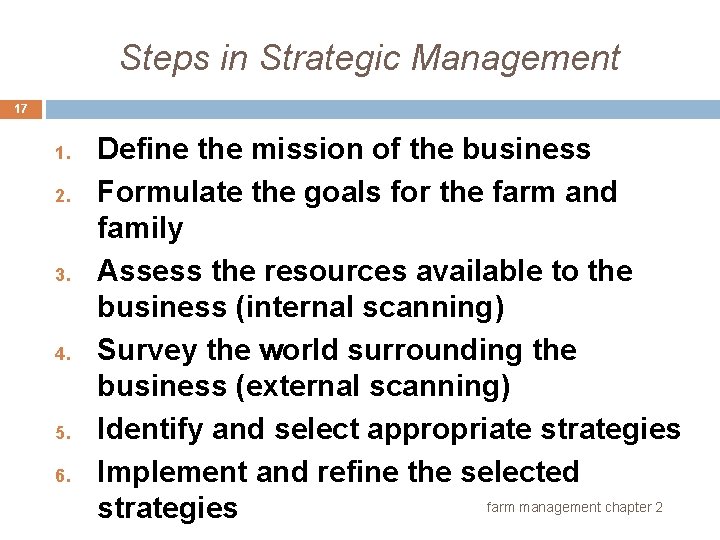
Steps in Strategic Management 17 1. 2. 3. 4. 5. 6. Define the mission of the business Formulate the goals for the farm and family Assess the resources available to the business (internal scanning) Survey the world surrounding the business (external scanning) Identify and select appropriate strategies Implement and refine the selected farm management chapter 2 strategies
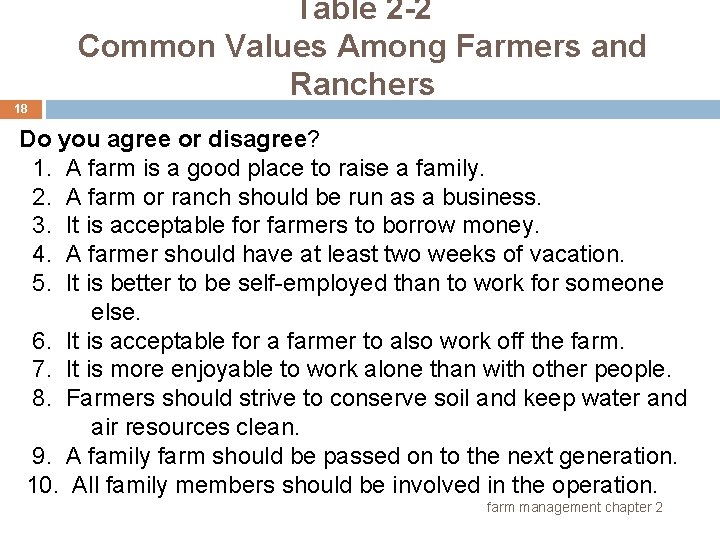
Table 2 -2 Common Values Among Farmers and Ranchers 18 Do you agree or disagree? 1. A farm is a good place to raise a family. 2. A farm or ranch should be run as a business. 3. It is acceptable for farmers to borrow money. 4. A farmer should have at least two weeks of vacation. 5. It is better to be self-employed than to work for someone else. 6. It is acceptable for a farmer to also work off the farm. 7. It is more enjoyable to work alone than with other people. 8. Farmers should strive to conserve soil and keep water and air resources clean. 9. A family farm should be passed on to the next generation. 10. All family members should be involved in the operation. farm management chapter 2
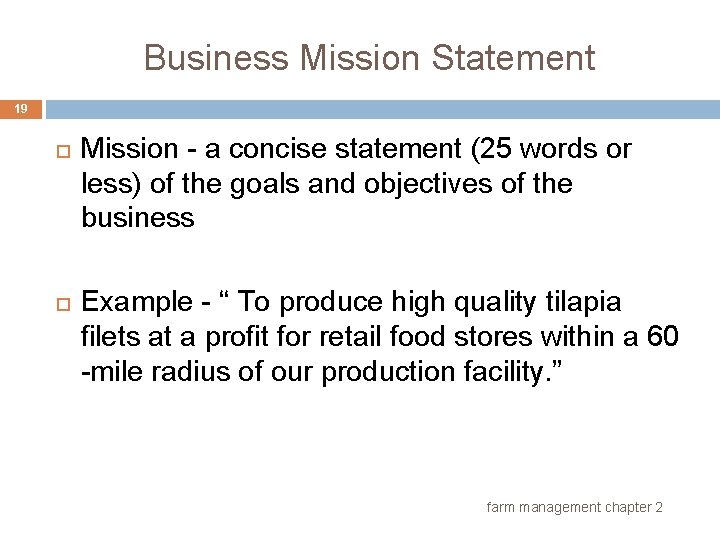
Business Mission Statement 19 Mission - a concise statement (25 words or less) of the goals and objectives of the business Example - “ To produce high quality tilapia filets at a profit for retail food stores within a 60 -mile radius of our production facility. ” farm management chapter 2
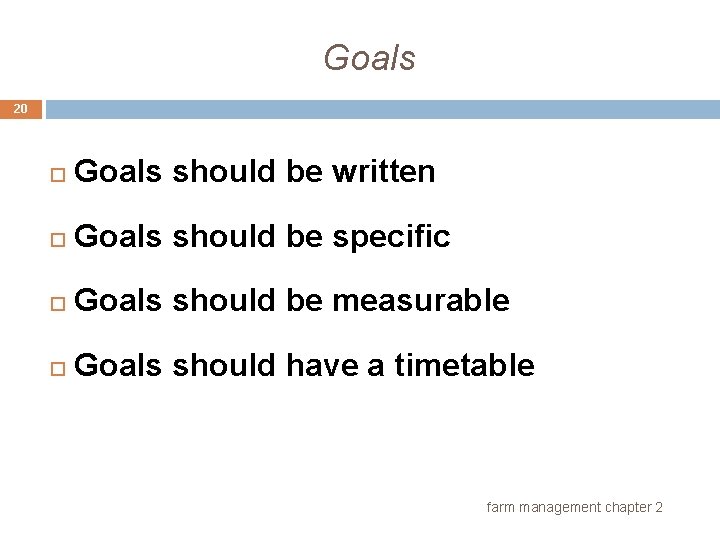
Goals 20 Goals should be written Goals should be specific Goals should be measurable Goals should have a timetable farm management chapter 2
Possible Goals 21 Survive, stay in business Maximize profits Maintain or increase standard of living Increase equity Maintain stable income Pass farm to next generation Increase free time Increase farm size (“growth”) Maintain or improve environmental quality farm management chapter 2
Assessing Resources 22 Physical resources: land, buildings, fences, breeding livestock, machinery and equipment, established perennial crops Human resources: skills of the operator and other employees, likes and dislikes of individuals Personal Resources: Personality, Creativity, Stress Management, Communication, Cooperation, Negotiation Financial resources: cash, other capital and farm management chapter 2 available credit
Surveying the Business Environment 23 Called “External scanning” The major types of crops produced haven’t changed much, but their characteristics are changing e. g. hybrids, GMOs A change may provide an opportunity or a threat e. g. rainfall variability farm management chapter 2
Identifying and Selecting Strategies 24 • Some businesses have more potential routes for reaching their goals than others because resources are more flexible • As the number of alternative uses for resources increases, so does the complexity of the manager’s decisions farm management chapter 2
Implementing and Refining 25 Manager must formulate action steps to implement the plan Manager must decide which information to collect to evaluate the success or failure of the plan Strategic management is an ongoing activity farm management chapter 2
Tactical Decision Making 26 1. Identify and define the problem or opportunity 2. Identify alternative solutions 3. Collect data and information 4. Analyze the alternatives and choose one 5. Implement the decision 6. Monitor and evaluate results 7. farm management chapter 2 Accept responsibility for the decision
Characteristics of Decisions 27 Importance Frequency Imminence Revocability Number of alternatives farm management chapter 2
The Decision-Making Environment 28 Fixed supply of land: Land base is essentially fixed, making decisions about land use, sale, or acquisition critical Biological processes and weather: Laws of nature place limits on manager’s decisions Small size: Often one person serves as management and labor Perfect competition: Producers are price takers farm management chapter 2
Four Basic Business Structures 29 Sole Proprietorship Partnership Corporation Cooperative farm management chapter 2
Business Structures cont’d 30 Sole Proprietorship One owner makes all decisions owner responsible for all liabilities can have multiple employees Partnership Owned by two or more people Owners are responsible for their share of liabilities Written agreements usually specify percent of ownership, responsibilities, and decision making process farm management chapter 2
Business Structures cont’d 31 Corporation Owned by stockholders Business is treated as a single entity Stockholders not personally responsible for liabilities of the business Returns profits in form of “dividends” to stockholders farm management chapter 2
Business Structures cont’d 32 Cooperative Owned by the users of the business Elected board of directors Profits are returned in the form of “patronage refunds” to users of the coop farm management chapter 2
Summary 33 • Good management means the difference between earning a profit or suffering a loss • The overall direction is defined through strategic planning • The strategic plan is carried out via a number of tactical decisions • Agricultural managers operate in an environment that differs from that of most other businesses farm management chapter 2
- Slides: 33