
INTRODUCTION TO FAMILIES IN CANADA HHS 4 U


- Slides: 33
INTRODUCTION TO FAMILIES IN CANADA HHS 4 U, Families in Canada Grade 12, Academic Sam Fairbloom Blyth Academy: Yorkville
Sam Fairbloom • B. A. , English Language and Literatures, University of Western Ontario • B. PS. , Intermediate/Senior, Niagara University – English – Social Sciences
Disciplines in the Social Sciences • Discipline: a specific branch of learning such as math, psychology, geography. • Choosing a discipline determines what observations you will make and which theoretical perspective will be used to organize and explain your ideas.
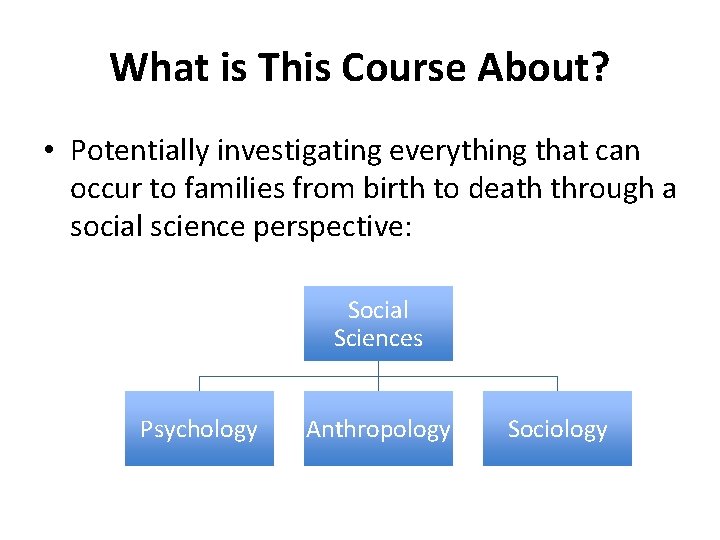
What is This Course About? • Potentially investigating everything that can occur to families from birth to death through a social science perspective: Social Sciences Psychology Anthropology Sociology
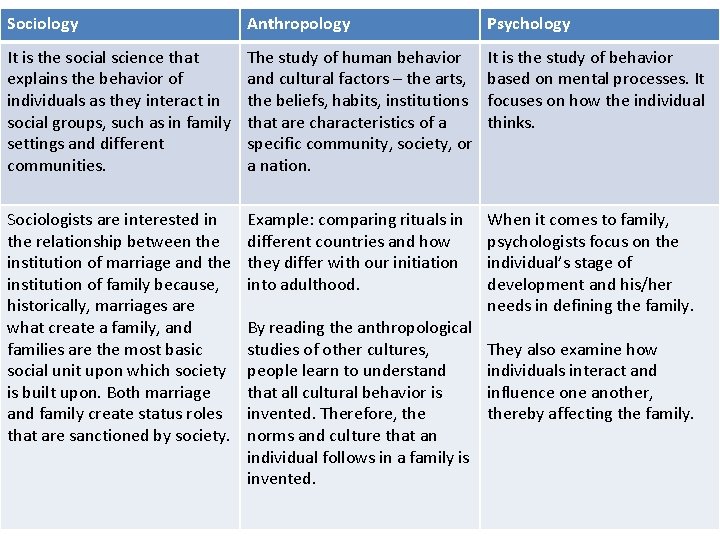
Sociology Anthropology Psychology SAP: Sociology, Anthropology, The study of human behavior It is the study of behavior and cultural factors – the arts, based on mental processes. It the. Psychology beliefs, habits, institutions focuses on how the individual It is the social science that explains the behavior of individuals as they interact in social groups, such as in family settings and different communities. Sociologists are interested in the relationship between the institution of marriage and the institution of family because, historically, marriages are what create a family, and families are the most basic social unit upon which society is built upon. Both marriage and family create status roles that are sanctioned by society. that are characteristics of a thinks. specific community, society, or a nation. Example: comparing rituals in different countries and how they differ with our initiation into adulthood. By reading the anthropological studies of other cultures, people learn to understand that all cultural behavior is invented. Therefore, the norms and culture that an individual follows in a family is invented. When it comes to family, psychologists focus on the individual’s stage of development and his/her needs in defining the family. They also examine how individuals interact and influence one another, thereby affecting the family.
What would ____ ask? • Select a topic that interests you about families in Canada. – What would an anthropologists ask about the topic? – What would a sociologist ask? – What would a psychologist ask?
Why Should You Stay in This Course? Social sciences are important because they help students understand families, communities, and society of their own and of others, which helps them better understand themselves. Students leave the course with a better understanding of how people think, live, and interact with one another around the world in various cultures, communities, and societies. It is important that students develop their abilities to hold informed discussions on the world around them: “social, cultural, economic, technological, environmental, and wellness issues”, and the ability to comprehend complex issues, and diversity. Overall, social sciences are important because they prepare student for a world that does not exist and provides them the proper tools for understanding the world now, and in the future.
What can I do to Expect Success? • There will not be a lot of homework in this class, so take advantage of class time • Connect to the material • Finish the assignments on time • Interact and ask questions • Take notes • Connect the material to your everyday life
Course Website • https: //fairbloomhhs 4 u. wordpress. com/ • Email: fairbloom. blyth@gmail. com
Unit Briefs 1. Approach to the Study of Families and Individuals 2. Individuals in a Diverse Society 3. Intimate Relationships and Marriage in a Diverse Family 4. Diversity – The Global Network 5. Hot Topic – Burning Issues 6. Independent Study Project
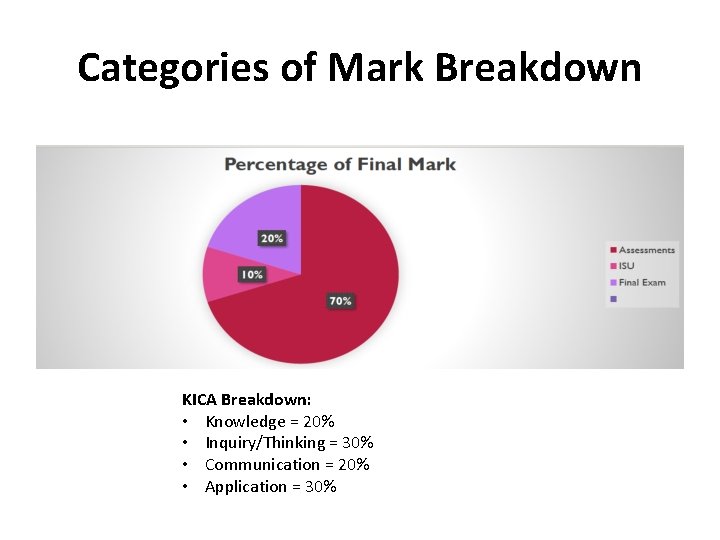
Categories of Mark Breakdown KICA Breakdown: • Knowledge = 20% • Inquiry/Thinking = 30% • Communication = 20% • Application = 30%
Introductions • Fill out Questionnaire • Your name • University/College you want to attend OR what you hope to do after high school • Places you want to travel and have traveled to • Favorite and least favorite school subjects • A little paragraph about your family
Goals of This Course You will… • To understand appreciate the variability in Canadian families • To understand the historical, cultural, and sociological roots of this variability • To study how Canadian families reflect change in society, and how they shape change • Learn about the research that scholars in this discipline conduct • Develop your critical thinking ability • Learn to distinguish between trustworthy and suspect sources of information • Improve your communication skills
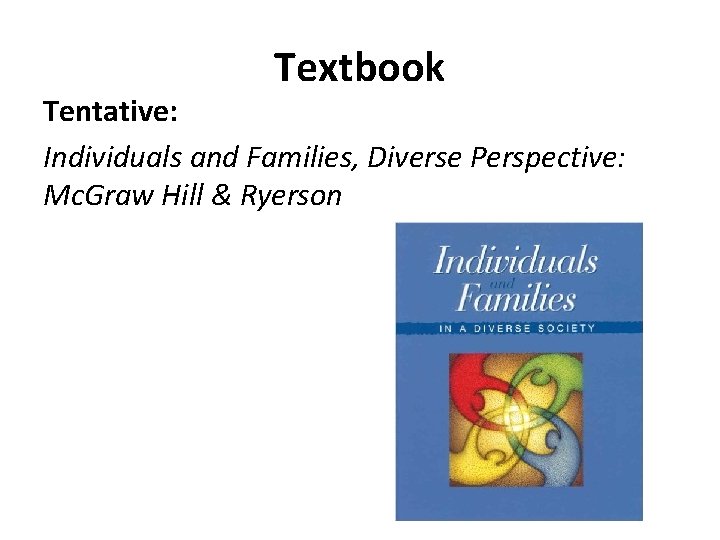
Textbook Tentative: Individuals and Families, Diverse Perspective: Mc. Graw Hill & Ryerson
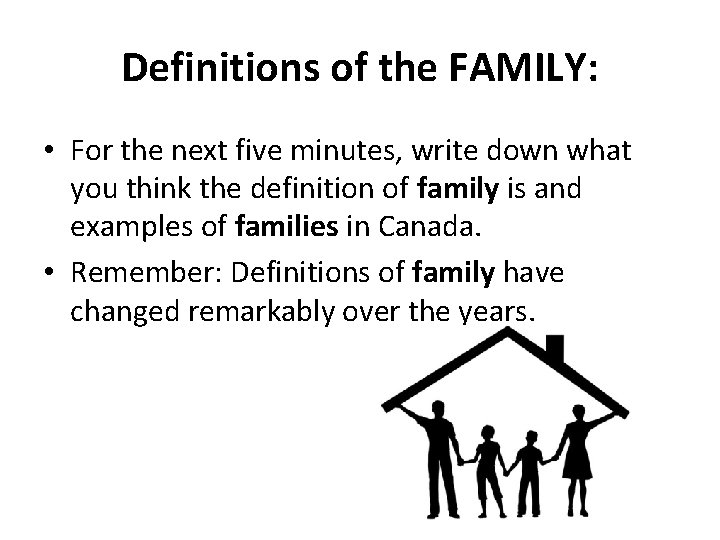
Definitions of the FAMILY: • For the next five minutes, write down what you think the definition of family is and examples of families in Canada. • Remember: Definitions of family have changed remarkably over the years.
The Basics of Family • In all societies, individuals live in families. • You were likely born and raised in a family. When you reach maturity, you will probably leave your family, and start a new family. • This cycle of human life has continued for tens of thousands of years • Each family is made up of several individuals. Therefore, to understand the family, one must understand the individual.
Sample Definitions • A social group characterized by common residence, economic cooperation and reproduction. It includes adults of both sexes, at least two of whom maintain a socially approved sexual relationship, and one or more children, own or adopted, of the sexually cohabiting adults (Murdoch 1949). • A married couple or other group of adult kinsfolk who cooperate economically and in the upbringing of children, and all or most of whom share a common dwelling. (Gough 1971). • A residential kin group composed of a woman, her dependent children, and at least one adult male joined through marriage or blood relationship (Haviland 1997).
Statistic Canada’s “census family” • A now-married couple (with or without children of either or both spouses), a couple living common-law (with or without children of either or both partners), or a lone parent of any marital status, with at least one child living in the same dwelling. A couple living common-law may be of opposite or same sex. “Children” in a census family include grandchildren living with their grand-parent(s) but with no parents present.
Vanier Institute of the Family’s Definition • Any combination of two or more persons who are bound together over time by ties of mutual consent, birth, and/or adoption or placement and who, together, assume responsibilities for variant combinations of some of the following: Physical maintenance and care of group members Addition of new members through procreation or adoption Socialization of children Social control of members Production, consumption, distribution of good and services, and – Affective nurturance – love – – –
Functions of a Family • No society can survive unless the individual in a family has certain basic functions, such as reproduction, provision of food, educating their young etc. • Function is a basic and universal action or purpose, such as reproduction or the provision of food, that enables individuals and families to survive. • There are macro functions and micro functions. What do you think macro and micro functions might be?
Functions of the Family • Responsible for the addition of new members through reproduction because of the extended dependency of infants. • Families provide physical care for their members. • Responsible for socializing children. Teaching them the norms and customs of the society. • Responsible for controlling the behavior of their members to maintain order within the family and within the society in which they live. • Responsible for maintaining more and motivate individuals to participate in society. Participation in appropriate social roles to the health of society (soup kitchen, volunteering, echoing).
Important Concepts • Family of Origin or Family of Orientation: The family you were “born into” and/or raised in • Family of Procreation: The family you form through marriage or cohabitation and in which you raise your children • Nuclear Family: – “Usually regarded as married parents and their children… ‘standard North american family’ or SNAF” (WARD 2006). – “Typically includes a couple and their children, sharing the same household” (Albanese 2007).
Important Concepts • Extended Family: – “The nuclear family and other relatives” (Ward 2006). – “Several generations (grandparents, aunts, uncles, cousins) who share a household (Albanese 2007). – “A collective of nuclear families, related by ties of blood, that live together in one household (Haviland 1997). – We all have various combinations of relatives who constitute near family and more distant family.
Three Main Eras 1. Early Colonization (i. e. fur trade, exploration) 2. Agricultural settlement 3. Early industrialization • Traders and trappers were around in the 17 th & 18 th centuries • Few European women: “Country wives” • Attempts by the government and church to regularize relationships, ensure a sufficient supply of women • Effects on indigenous groups with forcible introduction of patriarchy.
Settlers: 18 th and 19 th Centuries • Farm families numerically predominant • Work of all members required (men, women, younger children, older children) • Benefits of large families • Shop keeping, artisanal, and farm families of preindustrial times were laboring units, practicing an interdependent family economy • By mid-19 th century, the productive aspects of domestic labor by unpaid women and children were gradually moving into the marketplace • Shift to early Industrialism (from 1850 on) produced separate spheres • Wage labor took men out of and away from homes • This coincides with emergence of “cult of domesticity’ and relegation of women to the household sphere
Canadian Families in 2001 What are the major trends?
Household Trends • More private households • Fewer person per household • Youth leaving home at later ages and returning • More individuals living alone • More three-generation families
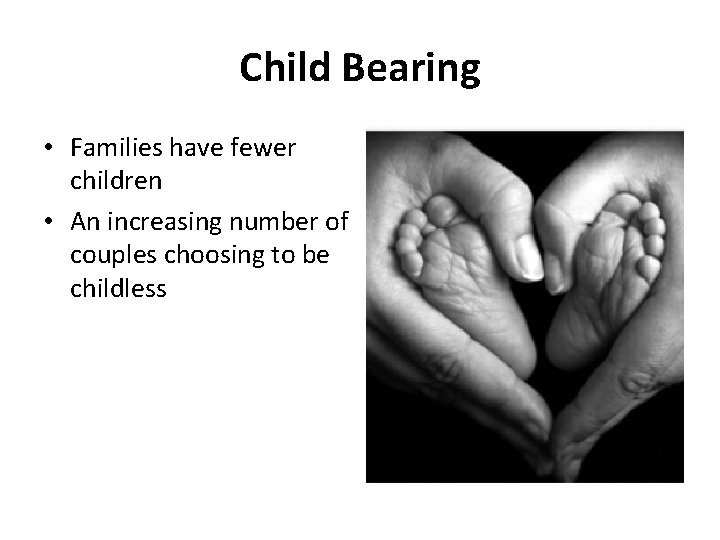
Child Bearing • Families have fewer children • An increasing number of couples choosing to be childless
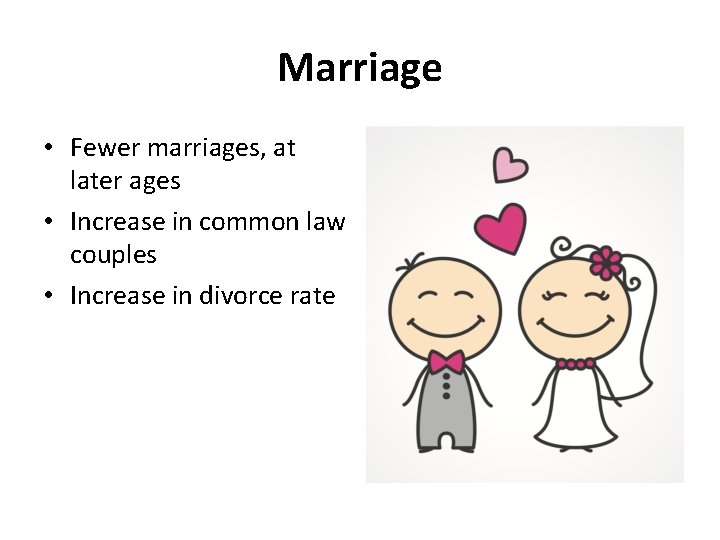
Marriage • Fewer marriages, at later ages • Increase in common law couples • Increase in divorce rate
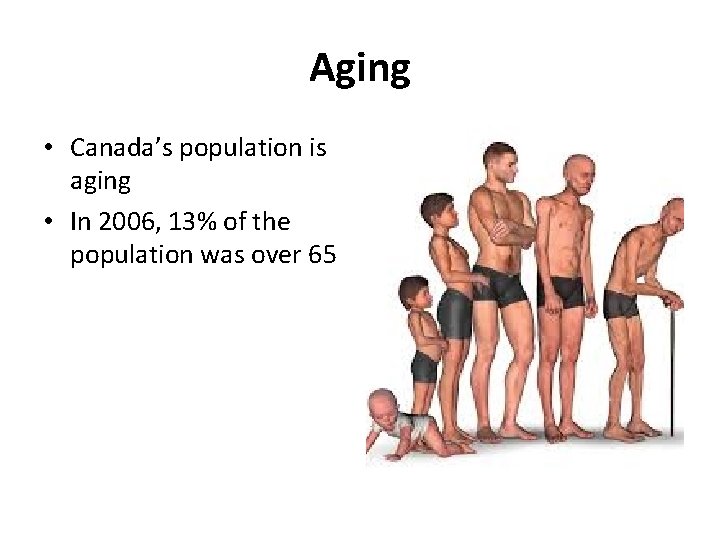
Aging • Canada’s population is aging • In 2006, 13% of the population was over 65
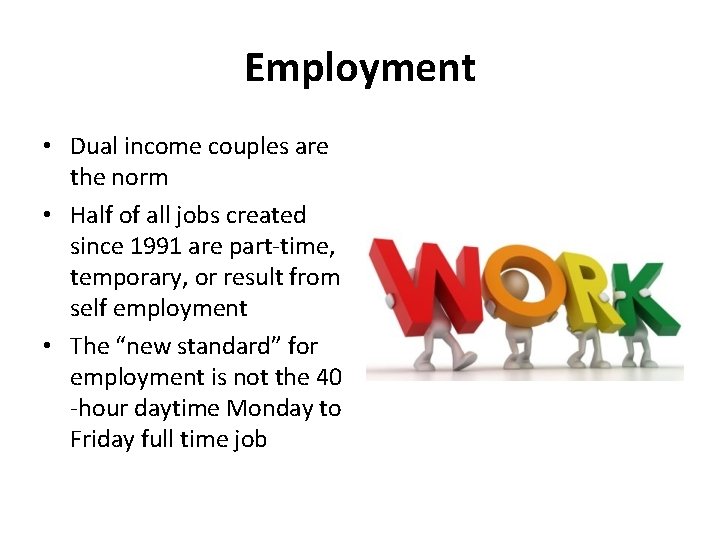
Employment • Dual income couples are the norm • Half of all jobs created since 1991 are part-time, temporary, or result from self employment • The “new standard” for employment is not the 40 -hour daytime Monday to Friday full time job