
Introduction to Experience Rating Waterside Re Joy Takahashi

- Slides: 19
Introduction to Experience Rating Waterside Re Joy Takahashi - American Re Broker Market CAS Ratemaking Seminar Session REI-39 March 7, 2002 Tampa, FL 1
Introduction to Experience Rating Waterside Re Classical Burning Cost Method l Frequency Based Method l 2
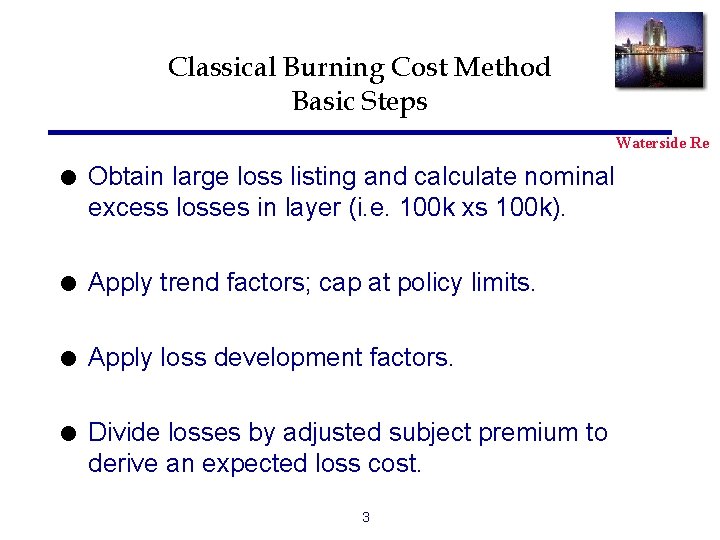
Classical Burning Cost Method Basic Steps Waterside Re l Obtain large loss listing and calculate nominal excess losses in layer (i. e. 100 k xs 100 k). l Apply trend factors; cap at policy limits. l Apply loss development factors. l Divide losses by adjusted subject premium to derive an expected loss cost. 3
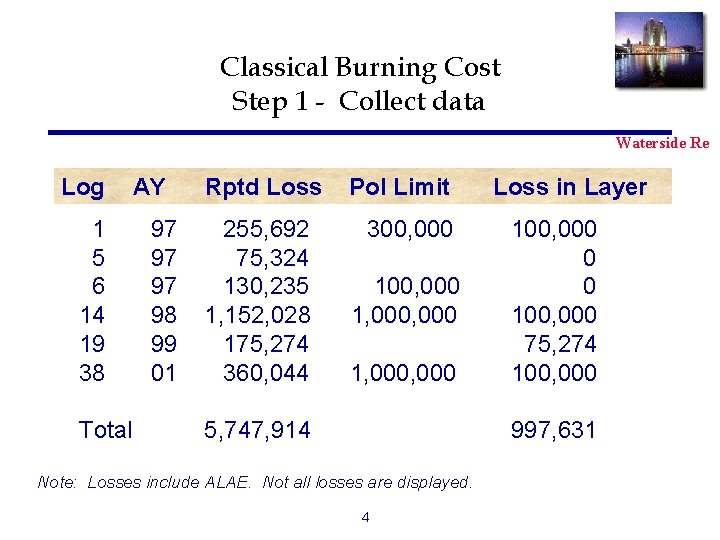
Classical Burning Cost Step 1 - Collect data Waterside Re Log 1 5 6 14 19 38 Total AY 97 97 97 98 99 01 Rptd Loss 255, 692 75, 324 130, 235 1, 152, 028 175, 274 360, 044 Pol Limit 300, 000 1, 000 5, 747, 914 Loss in Layer 100, 000 0 0 100, 000 75, 274 100, 000 997, 631 Note: Losses include ALAE. Not all losses are displayed. 4
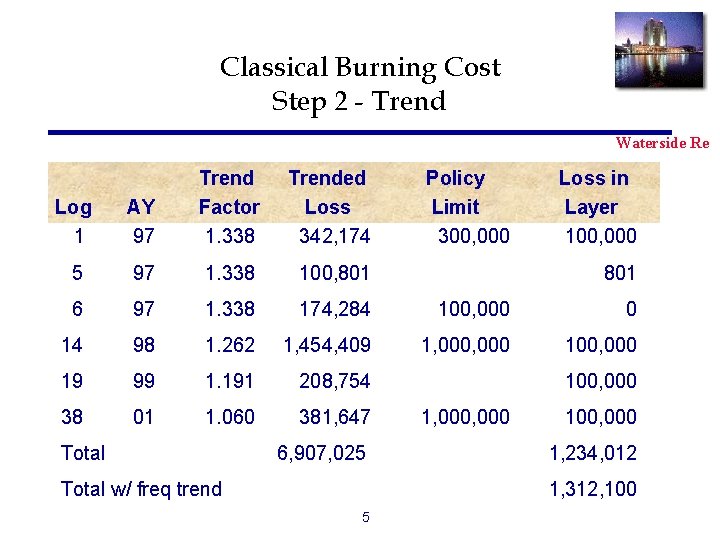
Classical Burning Cost Step 2 - Trend Waterside Re Log 1 AY 97 Trend Factor 1. 338 5 97 1. 338 100, 801 6 97 1. 338 174, 284 100, 000 0 14 98 1. 262 1, 454, 409 1, 000 100, 000 19 99 1. 191 208, 754 38 01 1. 060 381, 647 Total Trended Loss 342, 174 6, 907, 025 Total w/ freq trend Policy Limit 300, 000 Loss in Layer 100, 000 801 100, 000 1, 000 100, 000 1, 234, 012 1, 312, 100 5
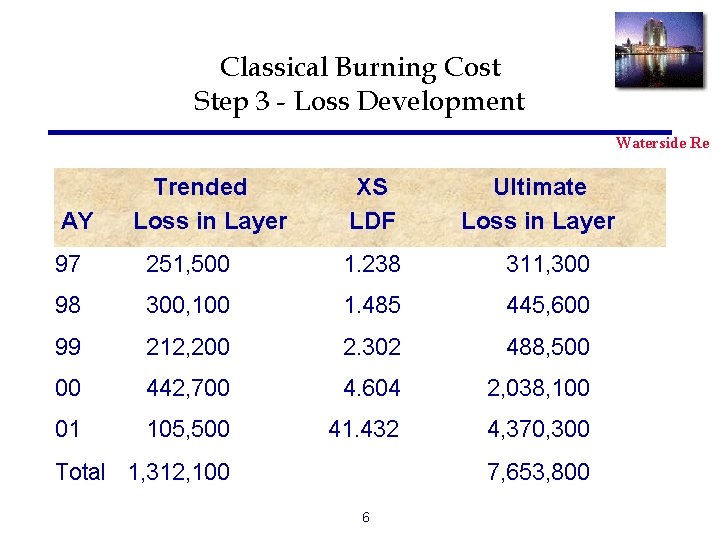
Classical Burning Cost Step 3 - Loss Development Waterside Re AY Trended Loss in Layer XS LDF Ultimate Loss in Layer 97 251, 500 1. 238 311, 300 98 300, 100 1. 485 445, 600 99 212, 200 2. 302 488, 500 00 442, 700 4. 604 2, 038, 100 01 105, 500 41. 432 4, 370, 300 Total 1, 312, 100 7, 653, 800 6
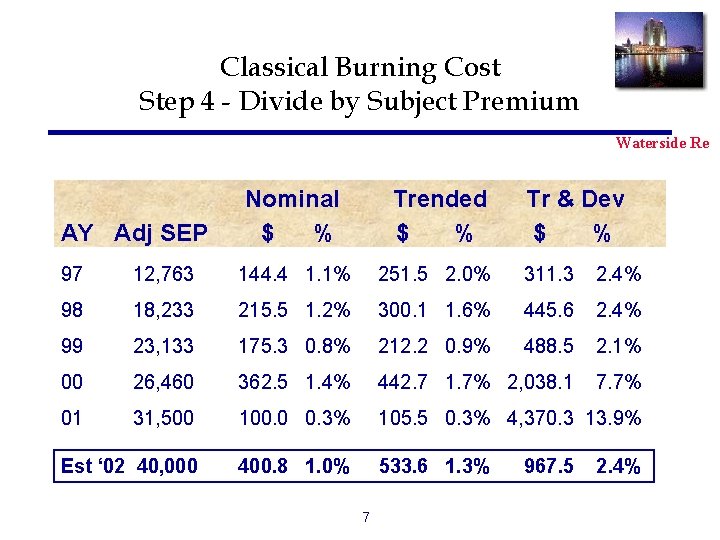
Classical Burning Cost Step 4 - Divide by Subject Premium Waterside Re AY Adj SEP Nominal $ % Trended $ % Tr & Dev $ % 97 12, 763 144. 4 1. 1% 251. 5 2. 0% 311. 3 2. 4% 98 18, 233 215. 5 1. 2% 300. 1 1. 6% 445. 6 2. 4% 99 23, 133 175. 3 0. 8% 212. 2 0. 9% 488. 5 2. 1% 00 26, 460 362. 5 1. 4% 442. 7 1. 7% 2, 038. 1 7. 7% 01 31, 500 100. 0 0. 3% 105. 5 0. 3% 4, 370. 3 13. 9% Est ‘ 02 40, 000 400. 8 1. 0% 533. 6 1. 3% 7 967. 5 2. 4%
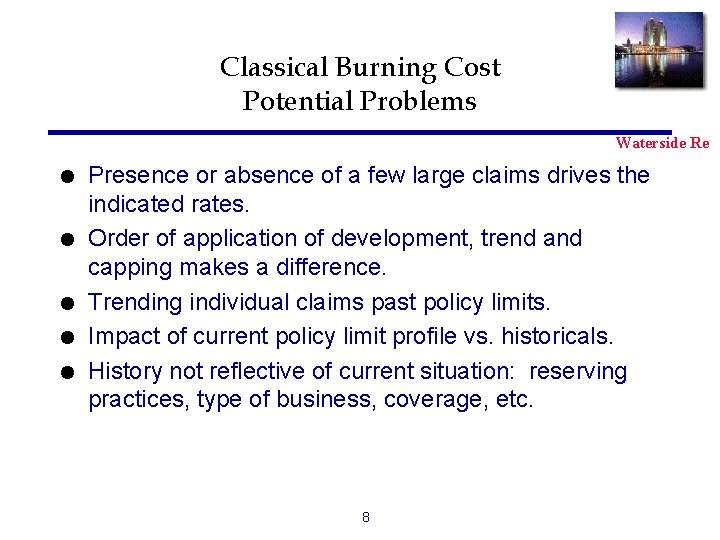
Classical Burning Cost Potential Problems Waterside Re l l l Presence or absence of a few large claims drives the indicated rates. Order of application of development, trend and capping makes a difference. Trending individual claims past policy limits. Impact of current policy limit profile vs. historicals. History not reflective of current situation: reserving practices, type of business, coverage, etc. 8
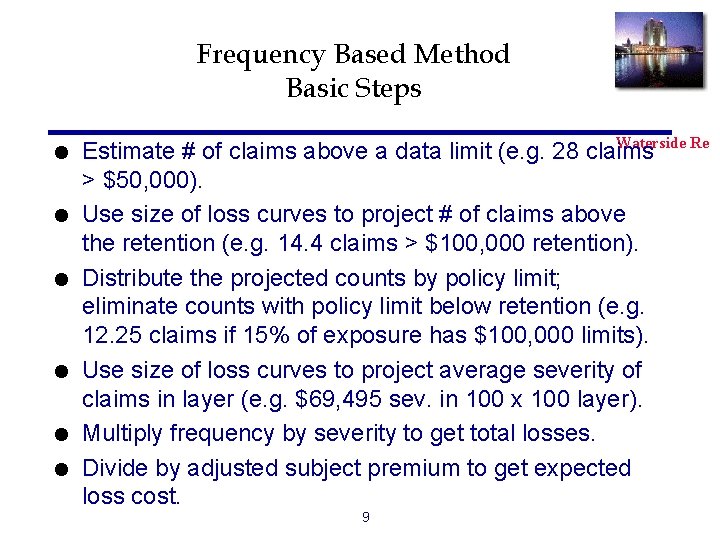
Frequency Based Method Basic Steps l l l Waterside Re Estimate # of claims above a data limit (e. g. 28 claims > $50, 000). Use size of loss curves to project # of claims above the retention (e. g. 14. 4 claims > $100, 000 retention). Distribute the projected counts by policy limit; eliminate counts with policy limit below retention (e. g. 12. 25 claims if 15% of exposure has $100, 000 limits). Use size of loss curves to project average severity of claims in layer (e. g. $69, 495 sev. in 100 x 100 layer). Multiply frequency by severity to get total losses. Divide by adjusted subject premium to get expected loss cost. 9
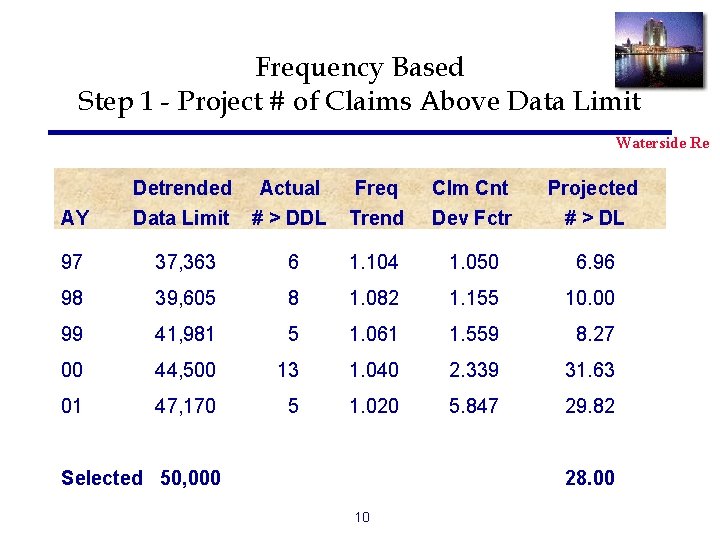
Frequency Based Step 1 - Project # of Claims Above Data Limit Waterside Re AY Detrended Actual Data Limit # > DDL Freq Trend Clm Cnt Dev Fctr Projected # > DL 97 37, 363 6 1. 104 1. 050 6. 96 98 39, 605 8 1. 082 1. 155 10. 00 99 41, 981 5 1. 061 1. 559 8. 27 00 44, 500 13 1. 040 2. 339 31. 63 01 47, 170 5 1. 020 5. 847 29. 82 Selected 50, 000 28. 00 10
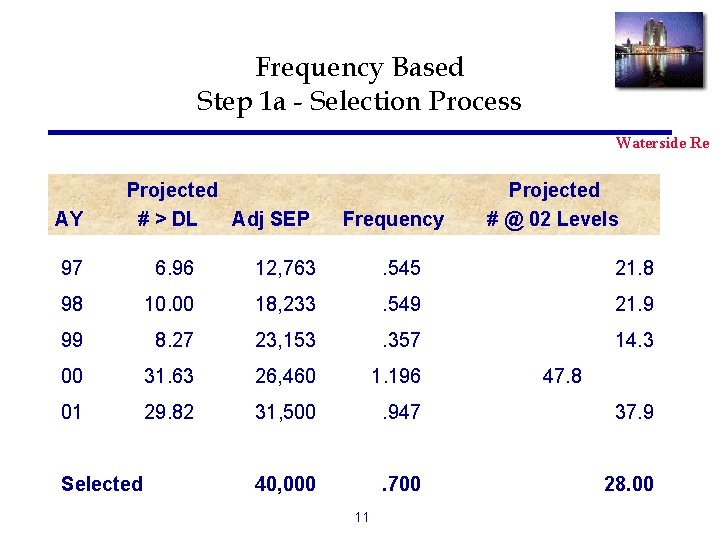
Frequency Based Step 1 a - Selection Process Waterside Re AY Projected # > DL Adj SEP Frequency Projected # @ 02 Levels 97 6. 96 12, 763 . 545 21. 8 98 10. 00 18, 233 . 549 21. 9 99 8. 27 23, 153 . 357 14. 3 00 31. 63 26, 460 1. 196 01 29. 82 31, 500 . 947 37. 9 40, 000 . 700 28. 00 Selected 11 47. 8
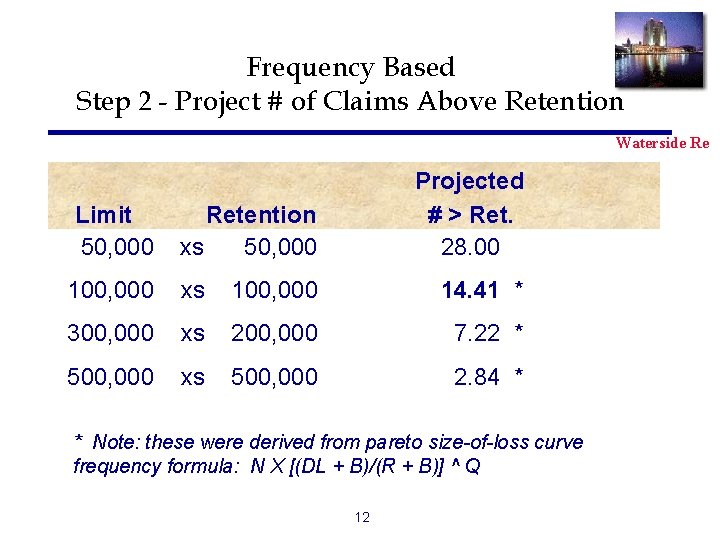
Frequency Based Step 2 - Project # of Claims Above Retention Waterside Re Limit 50, 000 Projected # > Ret. 28. 00 Retention xs 50, 000 100, 000 xs 100, 000 14. 41 * 300, 000 xs 200, 000 7. 22 * 500, 000 xs 500, 000 2. 84 * * Note: these were derived from pareto size-of-loss curve frequency formula: N X [(DL + B)/(R + B)] ^ Q 12
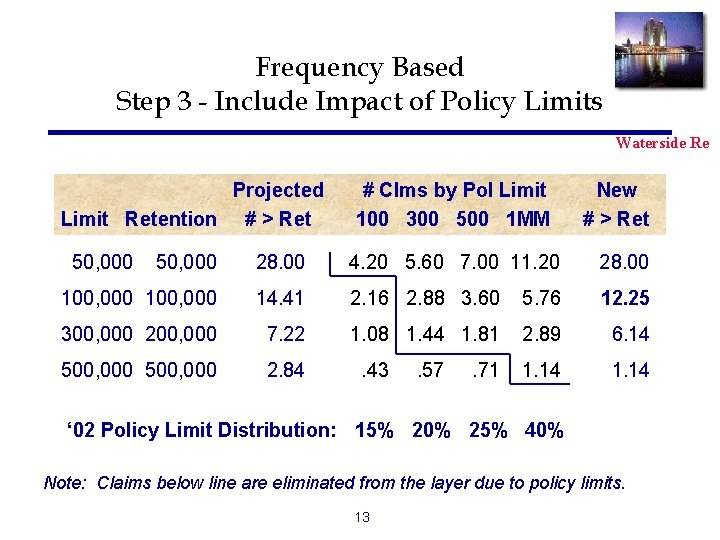
Frequency Based Step 3 - Include Impact of Policy Limits Waterside Re Projected Limit Retention # > Ret 50, 000 # Clms by Pol Limit 100 300 500 1 MM New # > Ret 50, 000 28. 00 4. 20 5. 60 7. 00 11. 20 28. 00 100, 000 14. 41 2. 16 2. 88 3. 60 5. 76 12. 25 300, 000 200, 000 7. 22 1. 08 1. 44 1. 81 2. 89 6. 14 500, 000 2. 84 1. 14 . 43 . 57 . 71 ‘ 02 Policy Limit Distribution: 15% 20% 25% 40% Note: Claims below line are eliminated from the layer due to policy limits. 13
Frequency Based Step 4 - Estimate Loss $ in Layer Waterside Re Limit Retention Projected # > Ret. Avg Sev. in Layer Loss Cost in Layer 100, 000 14. 41 69, 495 1, 001, 423 100, 000 12. 25 69, 495 851, 210 Note: Average severities are from pareto size-of-loss curve severity formula: [(R+B)/(Q-1)] X {1 - [(R+B)/(R+L+B)]^(Q-1)} 14
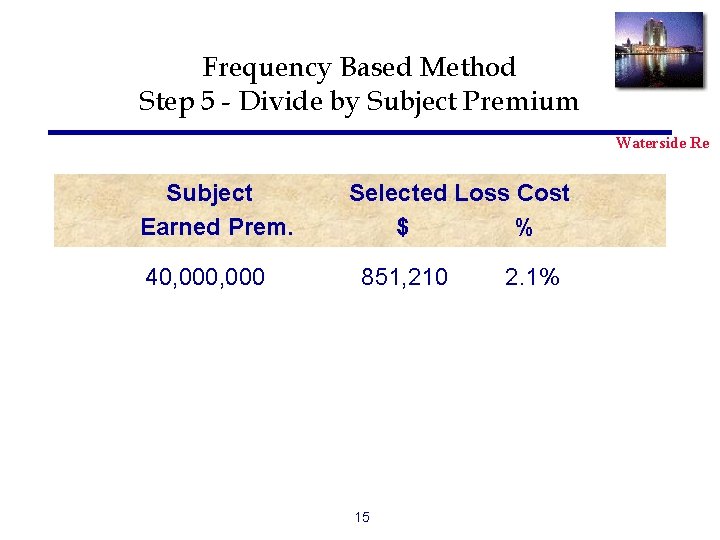
Frequency Based Method Step 5 - Divide by Subject Premium Waterside Re Subject Earned Prem. 40, 000 Selected Loss Cost $ % 851, 210 15 2. 1%
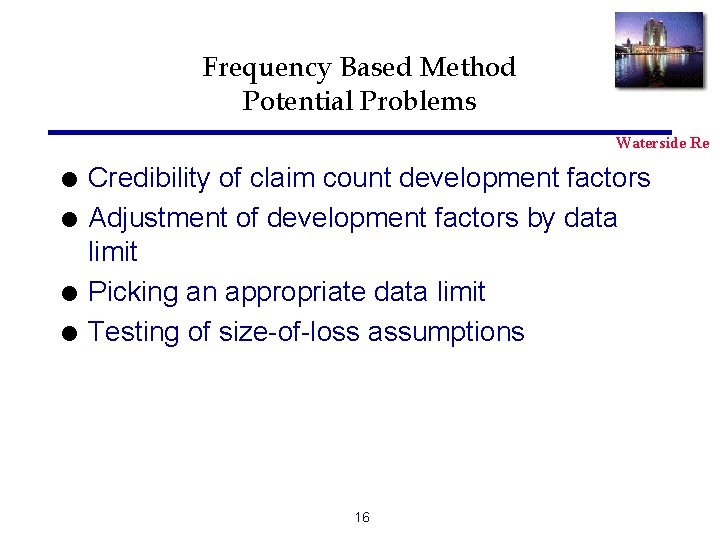
Frequency Based Method Potential Problems Waterside Re l l Credibility of claim count development factors Adjustment of development factors by data limit Picking an appropriate data limit Testing of size-of-loss assumptions 16
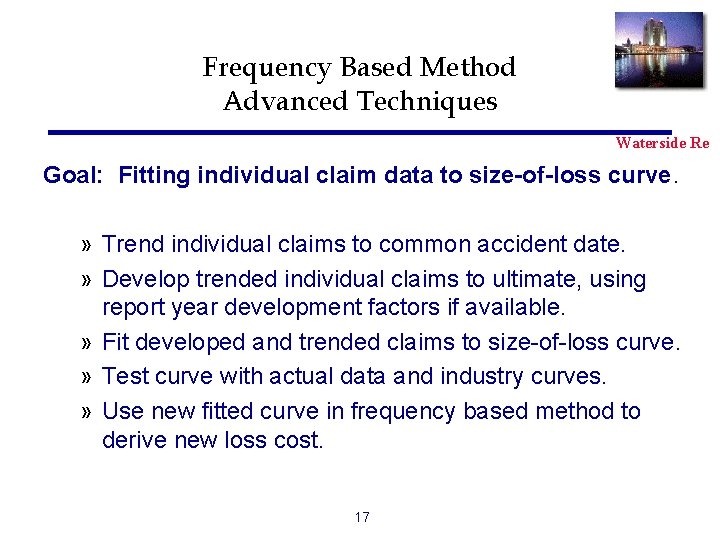
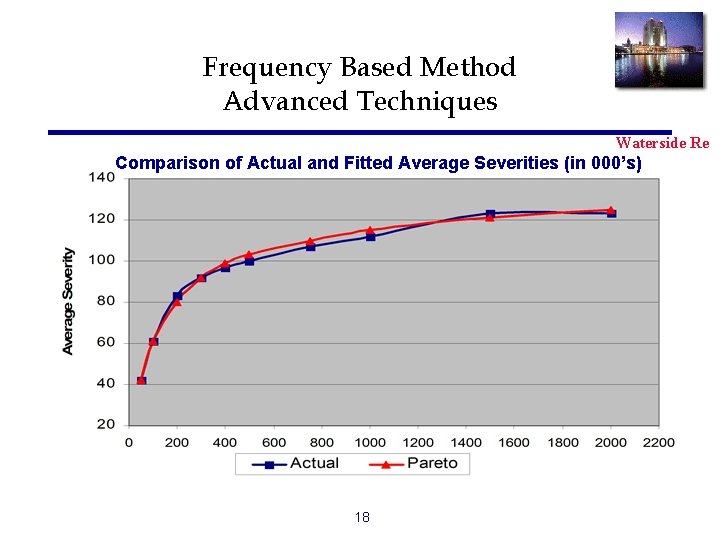
Frequency Based Method Advanced Techniques Waterside Re Goal: Fitting individual claim data to size-of-loss curve. » Trend individual claims to common accident date. » Develop trended individual claims to ultimate, using report year development factors if available. » Fit developed and trended claims to size-of-loss curve. » Test curve with actual data and industry curves. » Use new fitted curve in frequency based method to derive new loss cost. 17
Frequency Based Method Advanced Techniques Waterside Re Comparison of Actual and Fitted Average Severities (in 000’s) 18
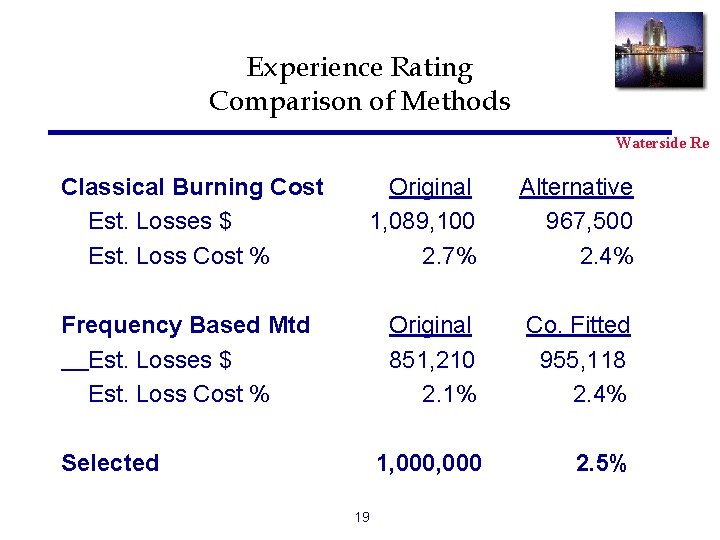
Experience Rating Comparison of Methods Waterside Re Classical Burning Cost Est. Losses $ Est. Loss Cost % Original 1, 089, 100 2. 7% Alternative 967, 500 2. 4% Original 851, 210 2. 1% Co. Fitted 955, 118 2. 4% 1, 000 2. 5% Frequency Based Mtd Est. Losses $ Est. Loss Cost % Selected 19