
Introduction to Exotic Phenomena in New Organicbased Magnetic
Introduction to Exotic Phenomena in New Organicbased Magnetic Materials Arthur J. Epstein The Ohio State University Tutorial, The American Physical Society March 2, 2003 N N -TCNE- TCNETCNE N N V 2+
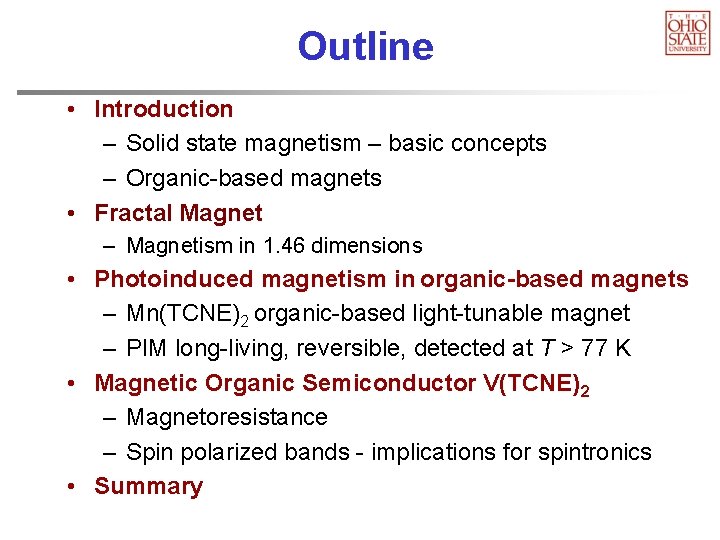
Outline • Introduction – Solid state magnetism – basic concepts – Organic-based magnets • Fractal Magnet – Magnetism in 1. 46 dimensions • Photoinduced magnetism in organic-based magnets – Mn(TCNE)2 organic-based light-tunable magnet – PIM long-living, reversible, detected at T > 77 K • Magnetic Organic Semiconductor V(TCNE)2 – Magnetoresistance – Spin polarized bands - implications for spintronics • Summary
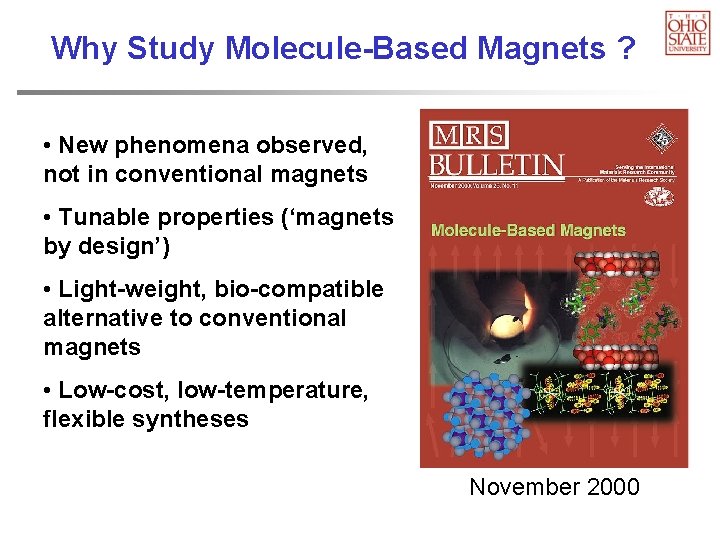
Why Study Molecule-Based Magnets ? • New phenomena observed, not in conventional magnets • Tunable properties (‘magnets by design’) • Light-weight, bio-compatible alternative to conventional magnets • Low-cost, low-temperature, flexible syntheses November 2000
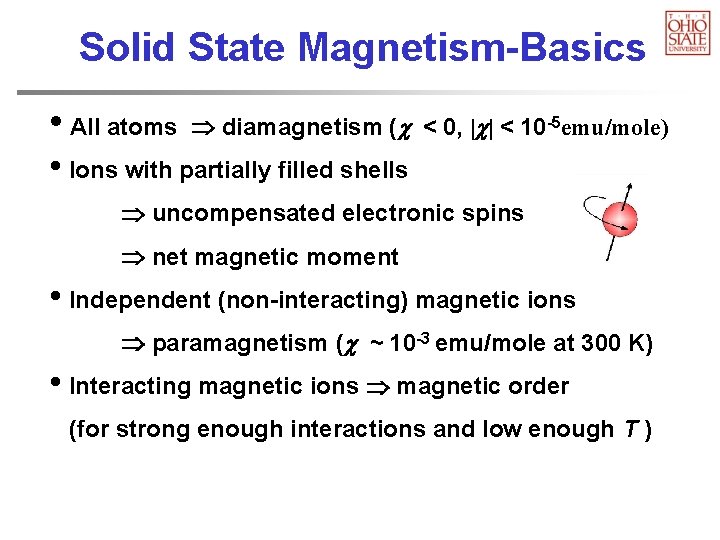
Solid State Magnetism-Basics • All atoms diamagnetism ( < 0, | | < 10 -5 emu/mole) • Ions with partially filled shells uncompensated electronic spins net magnetic moment • Independent (non-interacting) magnetic ions paramagnetism ( ~ 10 -3 emu/mole at 300 K) • Interacting magnetic ions magnetic order (for strong enough interactions and low enough T )
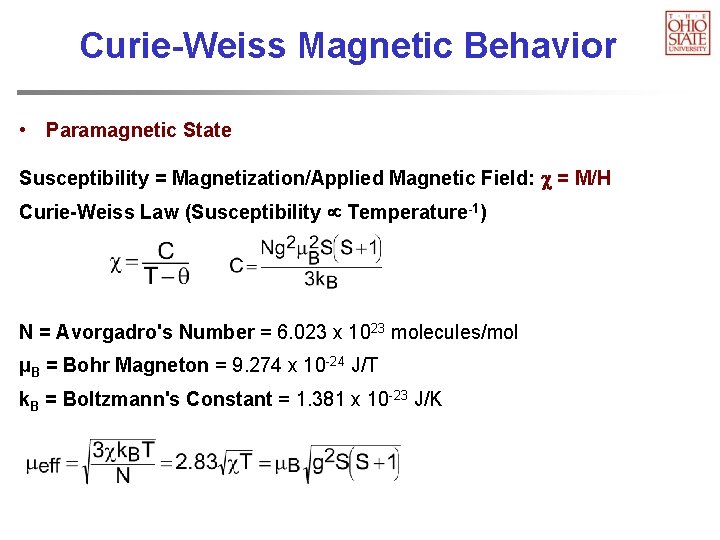
Curie-Weiss Magnetic Behavior • Paramagnetic State Susceptibility = Magnetization/Applied Magnetic Field: = M/H Curie-Weiss Law (Susceptibility Temperature-1) N = Avorgadro's Number = 6. 023 x 1023 molecules/mol µB = Bohr Magneton = 9. 274 x 10 -24 J/T k. B = Boltzmann's Constant = 1. 381 x 10 -23 J/K
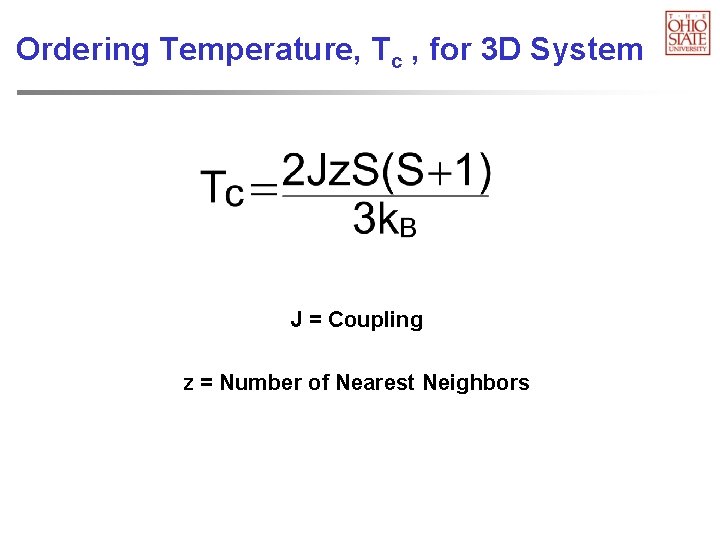
Ordering Temperature, Tc , for 3 D System J = Coupling z = Number of Nearest Neighbors
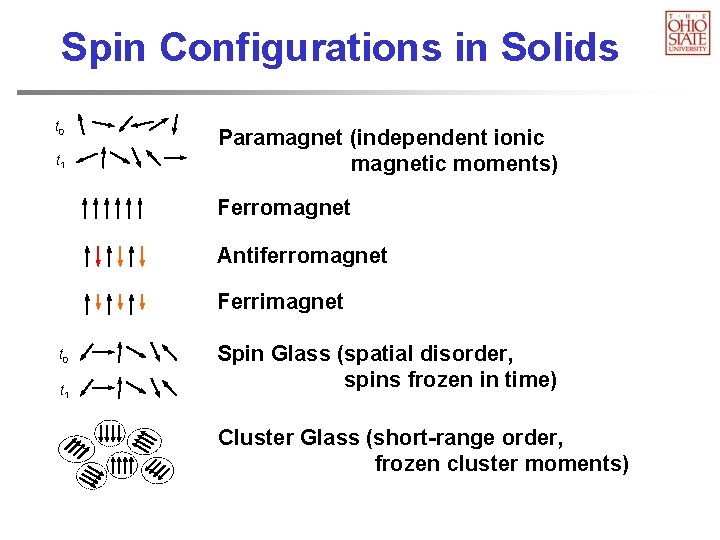
Spin Configurations in Solids t 0 t 1 Paramagnet (independent ionic magnetic moments) Ferromagnet Antiferromagnet Ferrimagnet t 0 t 1 Spin Glass (spatial disorder, spins frozen in time) Cluster Glass (short-range order, frozen cluster moments)

What Are Organic-Based Magnets ? • Molecular units play crucial role in magnetic ordering by: – providing unpaired electronic spins – mediating exchange interaction • Spins supplied by electrons in p or s orbitals A building block for molecule-based magnets: Tetracyanoethylene (TCNE) anion with spin 1/2 in * molecular orbital N N Tetracyanoethylene (TCNE) [TCNE]– spin density distribution Schweizer, et al, JACS 116, 7243 (1994)
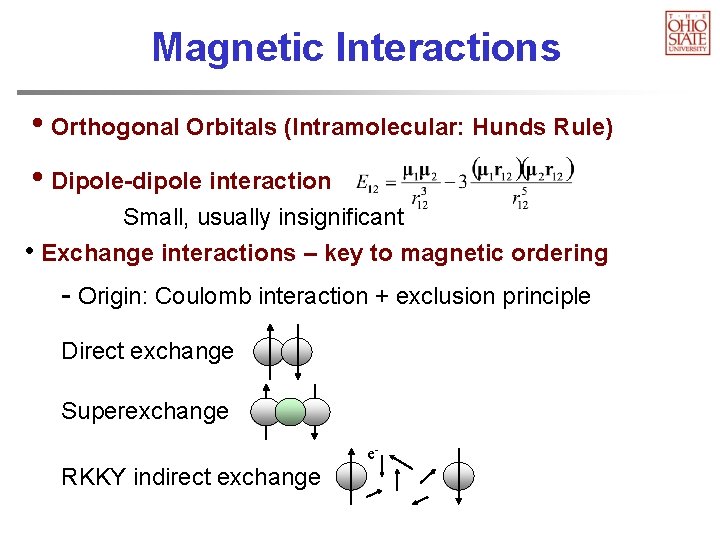
Magnetic Interactions • Orthogonal Orbitals (Intramolecular: Hunds Rule) • Dipole-dipole interaction Small, usually insignificant • Exchange interactions – key to magnetic ordering - Origin: Coulomb interaction + exclusion principle Direct exchange Superexchange e- RKKY indirect exchange
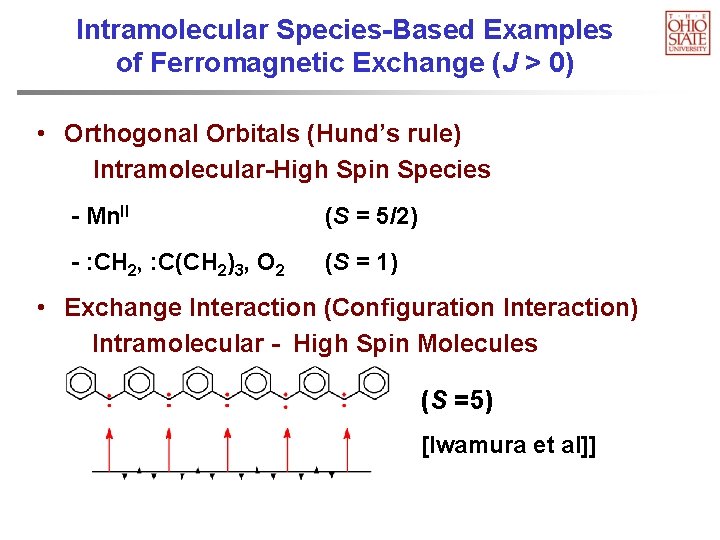
Intramolecular Species-Based Examples of Ferromagnetic Exchange (J > 0) • Orthogonal Orbitals (Hund’s rule) Intramolecular-High Spin Species - Mn. II (S = 5/2) - : CH 2, : C(CH 2)3, O 2 (S = 1) • Exchange Interaction (Configuration Interaction) Intramolecular - High Spin Molecules (S =5) [Iwamura et al]]
![First Organic-based Magnet: [Fe(C 5 Me 5)2] • +[TCNE] • - • • •](http://slidetodoc.com/presentation_image_h2/83f12e5f57b3b15f59d3716c8bc8c6ae/image-11.jpg "First Organic-based Magnet: [Fe(C 5 Me 5)2] • +[TCNE] • - • • •")
First Organic-based Magnet: [Fe(C 5 Me 5)2] • +[TCNE] • - • • • T >> , = C/(T- ) = + 30 K Jintra = 27 K T > 16 K 1 -D Heisenberg JCS 1986, PRL 1987
![[Fe(C 5 Me 5)2] • +[TCNE] • Specific Heat • Jinter = 27 K](http://slidetodoc.com/presentation_image_h2/83f12e5f57b3b15f59d3716c8bc8c6ae/image-12.jpg "[Fe(C 5 Me 5)2] • +[TCNE] • Specific Heat • Jinter = 27 K")
[Fe(C 5 Me 5)2] • +[TCNE] • Specific Heat • Jinter = 27 K • Jinter/ Jintra = 0. 013 • Tc ~ 1. 5(J J )1/2 • Very anisotropic • Specific heat: 4% entropy, T < Tc = 4. 8 K • 1 -D Correlations important, T > Tc
![[Fe(C 5 Me 5)2] • +[TCNE] • Neutron Diffraction Ferromagnetic Order](http://slidetodoc.com/presentation_image_h2/83f12e5f57b3b15f59d3716c8bc8c6ae/image-13.jpg "[Fe(C 5 Me 5)2] • +[TCNE] • Neutron Diffraction Ferromagnetic Order")
[Fe(C 5 Me 5)2] • +[TCNE] • Neutron Diffraction Ferromagnetic Order
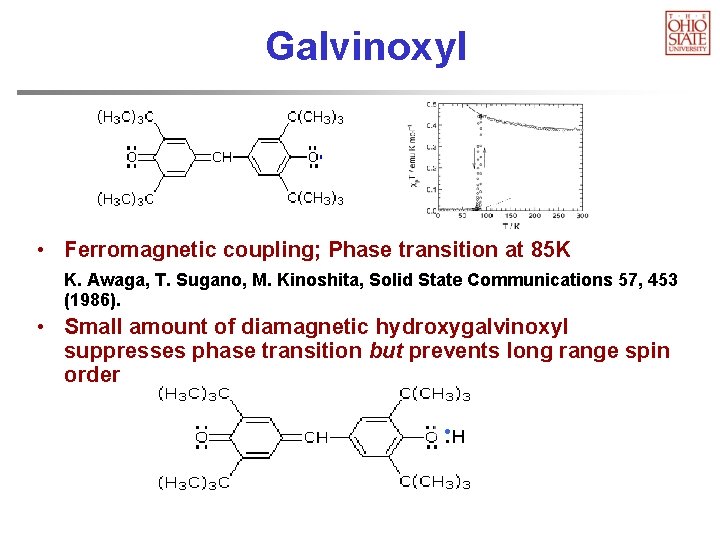
Galvinoxyl • Ferromagnetic coupling; Phase transition at 85 K K. Awaga, T. Sugano, M. Kinoshita, Solid State Communications 57, 453 (1986). • Small amount of diamagnetic hydroxygalvinoxyl suppresses phase transition but prevents long range spin order : . H
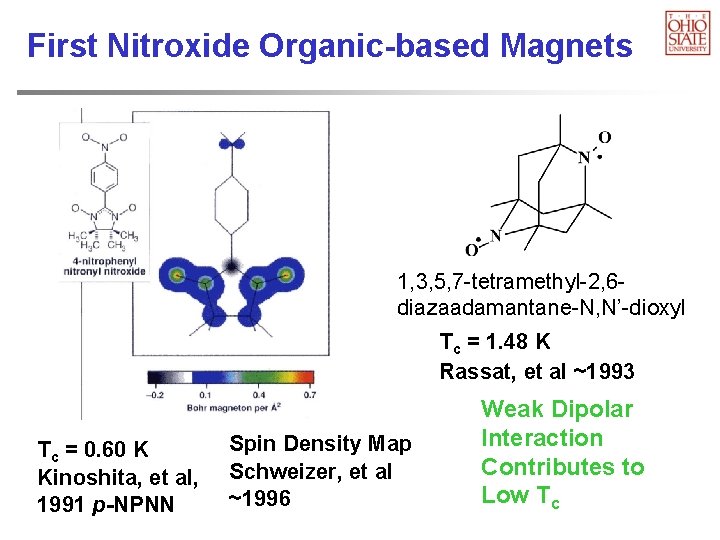
First Nitroxide Organic-based Magnets 1, 3, 5, 7 -tetramethyl-2, 6 diazaadamantane-N, N’-dioxyl Tc = 1. 48 K Rassat, et al ~1993 Tc = 0. 60 K Kinoshita, et al, 1991 p-NPNN Spin Density Map Schweizer, et al ~1996 Weak Dipolar Interaction Contributes to Low Tc
![Examples of Molecule-Based Magnets: [Mn. IIITPP]+[TCNE]- S=2 S=½ N Mn. TPP N • Quasi-1](http://slidetodoc.com/presentation_image_h2/83f12e5f57b3b15f59d3716c8bc8c6ae/image-16.jpg "Examples of Molecule-Based Magnets: [Mn. IIITPP]+[TCNE]- S=2 S=½ N Mn. TPP N • Quasi-1")
Examples of Molecule-Based Magnets: [Mn. IIITPP]+[TCNE]- S=2 S=½ N Mn. TPP N • Quasi-1 D ferrimagnetic order along chains (Adv. Mat. 1994) • Interchain coupling via magnetic dipolar interactions (Chem. of Mat. 1997) N N TCNE TPP = tetraphenylporphyrin
![Examples of Molecule-Based Magnets: [Mn. IIITPP]+[TCNE]- S=2 S=½ • Quasi-1 D ferrimagnetic order along](http://slidetodoc.com/presentation_image_h2/83f12e5f57b3b15f59d3716c8bc8c6ae/image-17.jpg "Examples of Molecule-Based Magnets: [Mn. IIITPP]+[TCNE]- S=2 S=½ • Quasi-1 D ferrimagnetic order along")
Examples of Molecule-Based Magnets: [Mn. IIITPP]+[TCNE]- S=2 S=½ • Quasi-1 D ferrimagnetic order along chains • Interchain coupling via magnetic dipolar interactions S=2 S=½ Mn. TPP • Vary interchain coupling by varying organic bridges TPP = tetraphenylporphyrin
![Examples of Molecule-Based Magnets: [Mn. IIITPP]+[TCNE]- S=2 S=½ • Quasi-1 D ferrimagnetic order along](http://slidetodoc.com/presentation_image_h2/83f12e5f57b3b15f59d3716c8bc8c6ae/image-18.jpg "Examples of Molecule-Based Magnets: [Mn. IIITPP]+[TCNE]- S=2 S=½ • Quasi-1 D ferrimagnetic order along")
Examples of Molecule-Based Magnets: [Mn. IIITPP]+[TCNE]- S=2 S=½ • Quasi-1 D ferrimagnetic order along chains • Interchain coupling via magnetic dipolar interactions S=2 S=½ Mn. TPP • Vary intrachain coupling by varying acceptor molecules TPP = tetraphenylporphyrin
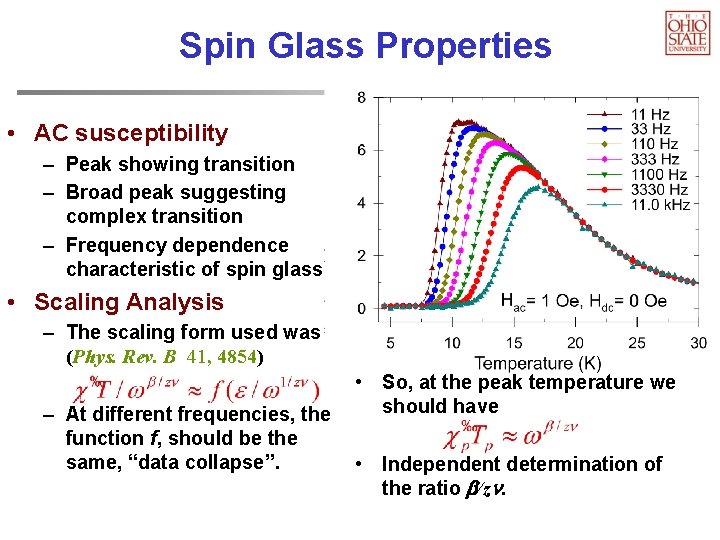
Spin Glass Properties • AC susceptibility – Peak showing transition – Broad peak suggesting complex transition – Frequency dependence characteristic of spin glass • Scaling Analysis – The scaling form used was (Phys. Rev. B 41, 4854) – At different frequencies, the function f, should be the same, “data collapse”. • So, at the peak temperature we should have • Independent determination of the ratio b/zn.
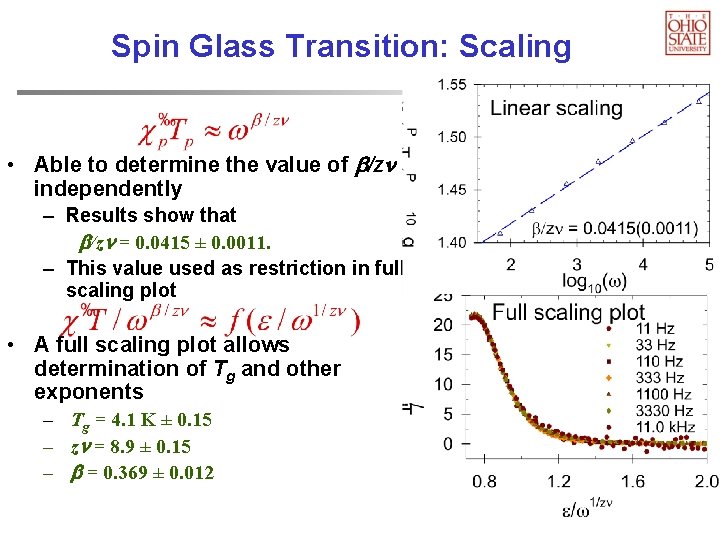
Spin Glass Transition: Scaling • Able to determine the value of b/zn independently – Results show that b/zn = 0. 0415 ± 0. 0011. – This value used as restriction in full scaling plot • A full scaling plot allows determination of Tg and other exponents – Tg = 4. 1 K ± 0. 15 – zn = 8. 9 ± 0. 15 – b = 0. 369 ± 0. 012
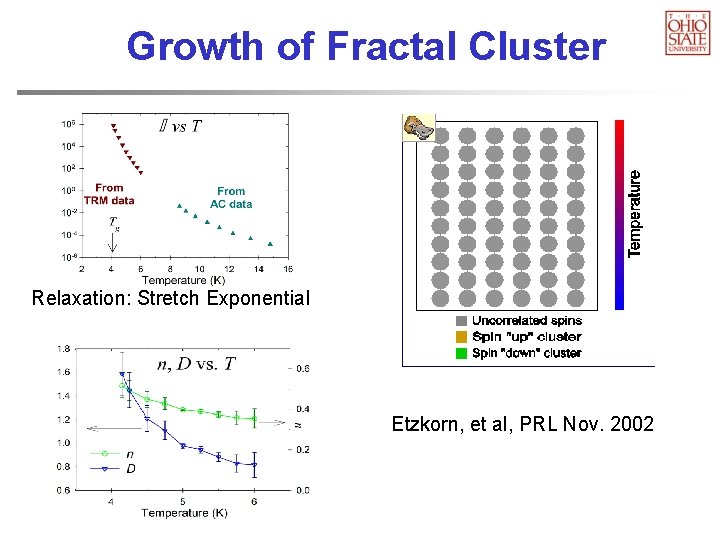
Growth of Fractal Cluster Relaxation: Stretch Exponential Etzkorn, et al, PRL Nov. 2002
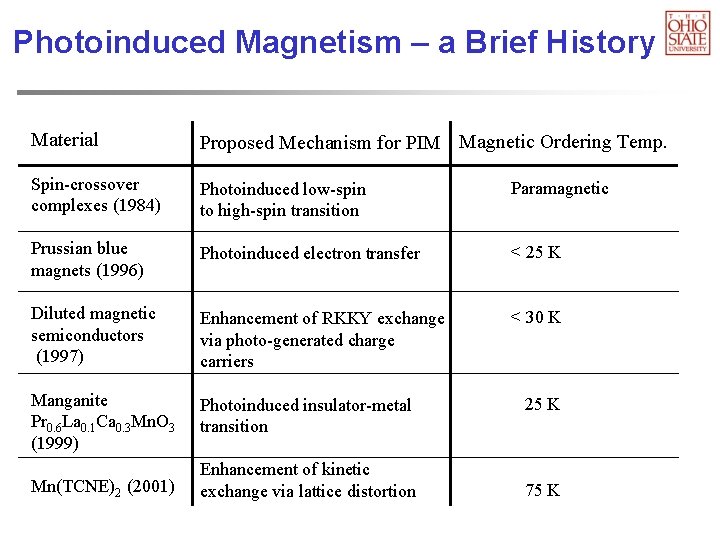
Photoinduced Magnetism – a Brief History Material Proposed Mechanism for PIM Magnetic Ordering Temp. Spin-crossover complexes (1984) Photoinduced low-spin to high-spin transition Paramagnetic Prussian blue magnets (1996) Photoinduced electron transfer < 25 K Diluted magnetic semiconductors (1997) Enhancement of RKKY exchange via photo-generated charge carriers < 30 K Manganite Pr 0. 6 La 0. 1 Ca 0. 3 Mn. O 3 (1999) Photoinduced insulator-metal transition Mn(TCNE)2 (2001) Enhancement of kinetic exchange via lattice distortion 25 K 75 K
![PIM in Co-Fe Prussian Blue Magnets Kx. Coy[Fe(CN)6]˙z. H 2 O • Structural disorder](http://slidetodoc.com/presentation_image_h2/83f12e5f57b3b15f59d3716c8bc8c6ae/image-23.jpg "PIM in Co-Fe Prussian Blue Magnets Kx. Coy[Fe(CN)6]˙z. H 2 O • Structural disorder")
PIM in Co-Fe Prussian Blue Magnets Kx. Coy[Fe(CN)6]˙z. H 2 O • Structural disorder dictated by composition/processing • PIM initially observed in K 0. 2 Co 1. 4[Fe(CN)6]· 6. 9 H 2 O O. Sato et al. , Science 272, 704 (1996) Defect (missing Fe) Fe Co C N K+ is interstitial - Ferrimagnetic ordering below ~16 K - Magnetization increase obtained by red light - Photoinduced state has lifetime >10 5 s at low T - Effect reversed by blue light, heating
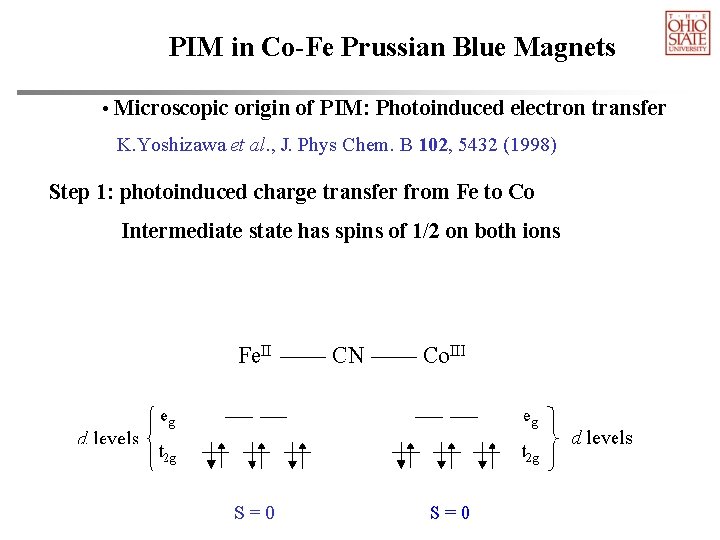
PIM in Co-Fe Prussian Blue Magnets • Microscopic origin of PIM: Photoinduced electron transfer K. Yoshizawa et al. , J. Phys Chem. B 102, 5432 (1998) Step 1: photoinduced charge transfer from Fe to Co Intermediate state has spins of 1/2 on both ions
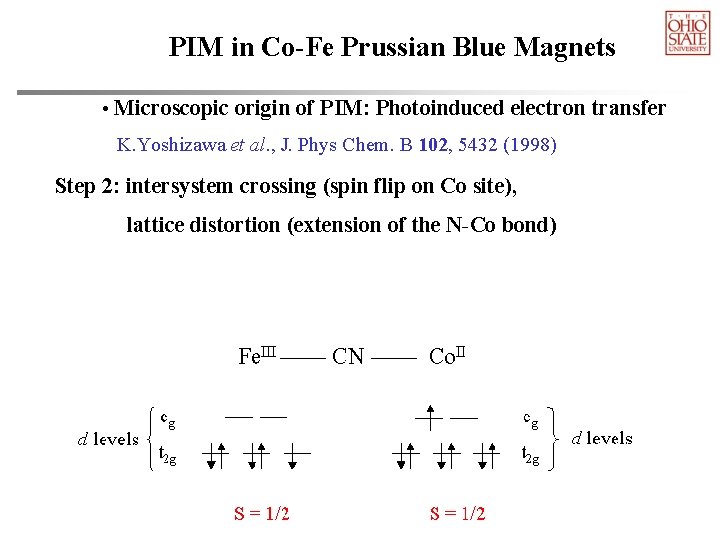
PIM in Co-Fe Prussian Blue Magnets • Microscopic origin of PIM: Photoinduced electron transfer K. Yoshizawa et al. , J. Phys Chem. B 102, 5432 (1998) Step 2: intersystem crossing (spin flip on Co site), lattice distortion (extension of the N-Co bond)
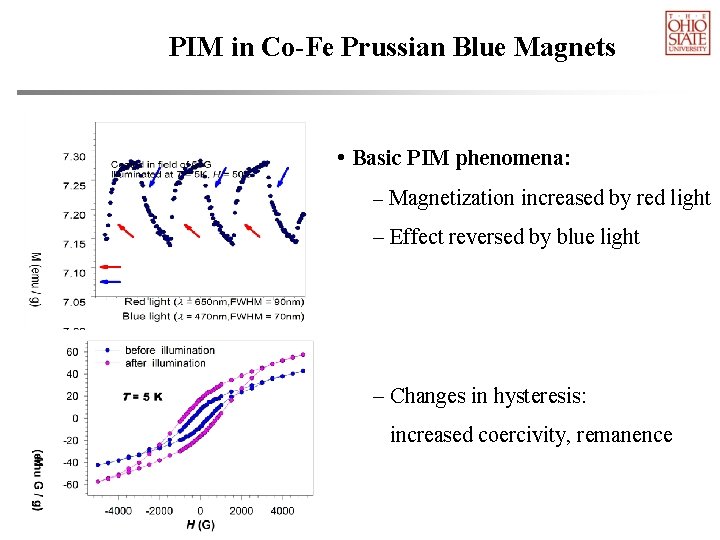
PIM in Co-Fe Prussian Blue Magnets • Basic PIM phenomena: – Magnetization increased by red light – Effect reversed by blue light – Changes in hysteresis: increased coercivity, remanence
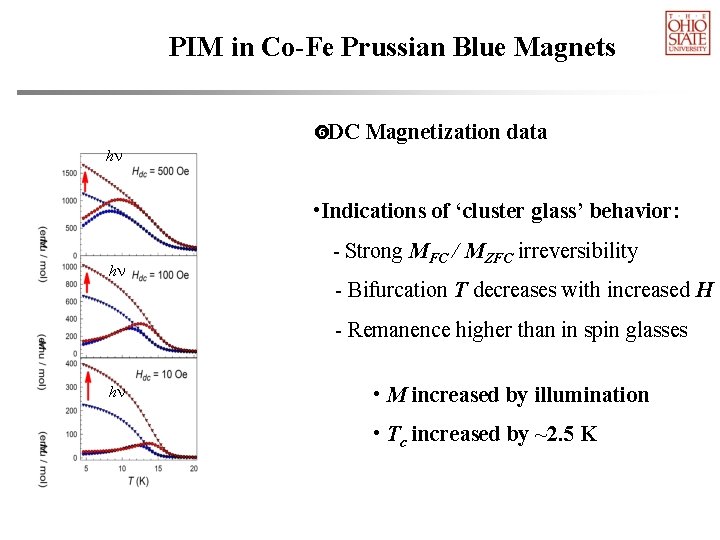
PIM in Co-Fe Prussian Blue Magnets DC Magnetization data h • Indications of ‘cluster glass’ behavior: h - Strong MFC / MZFC irreversibility - Bifurcation T decreases with increased H - Remanence higher than in spin glasses h • M increased by illumination • Tc increased by ~2. 5 K
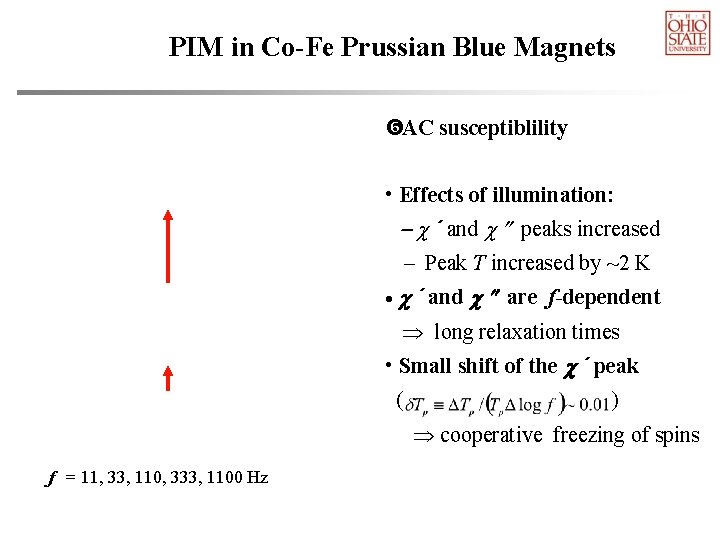
PIM in Co-Fe Prussian Blue Magnets AC susceptiblility • Effects of illumination: - c ´ and c peaks increased - Peak T increased by ~2 K · ´ and are f-dependent long relaxation times • Small shift of the ´ peak ( ) cooperative freezing of spins f = 11, 33, 110, 333, 1100 Hz
![PIM in Co-Fe Prussian Blue Magnets K 0. 6 Co 1. 2[Fe(CN)6]· 4. 9](http://slidetodoc.com/presentation_image_h2/83f12e5f57b3b15f59d3716c8bc8c6ae/image-29.jpg "PIM in Co-Fe Prussian Blue Magnets K 0. 6 Co 1. 2[Fe(CN)6]· 4. 9")
PIM in Co-Fe Prussian Blue Magnets K 0. 6 Co 1. 2[Fe(CN)6]· 4. 9 H 2 O • No frequency dependence before illumination rapid relaxation of spins h • Frequency-dependent response after illumination slow relaxation of spins h Direct observation of slowing down of spin dynamics D. A. Pejaković et al. , Phys. Rev. Lett. 85, 1994 (2000)
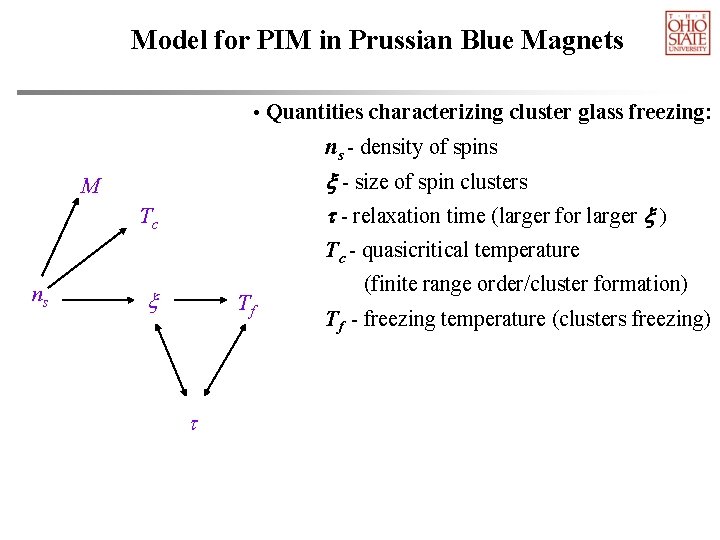
Model for PIM in Prussian Blue Magnets • Quantities characterizing cluster glass freezing: ns - density of spins Tc ns - size of spin clusters - relaxation time (larger for larger Tc - quasicritical temperature M Tf (finite range order/cluster formation) Tf - freezing temperature (clusters freezing)
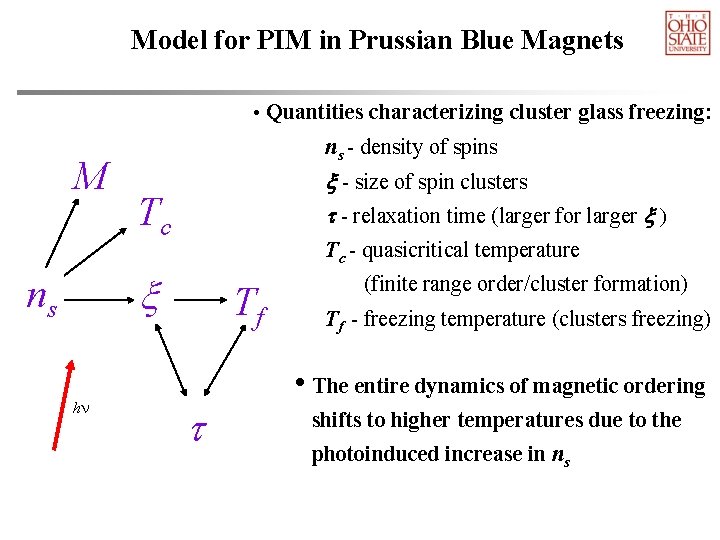
Model for PIM in Prussian Blue Magnets • Quantities characterizing cluster glass freezing: M M ns - density of spins T T c c ns ns h - size of spin clusters - relaxation time (larger for larger Tc - quasicritical temperature TT f f (finite range order/cluster formation) Tf - freezing temperature (clusters freezing) • • The • Due Spin Magnetization Sizes entire toconcentration of slower spin dynamics clusters dynamics, and of T increases magnetic increase freezing upon due ordering of cincrease, shifts clusters illumination to increased their torelaxation higher occurs via #temperatures at ofphotoinduced slows higher magnetic down temperature neighbors due to the photoinduced charge transfer increase in ns
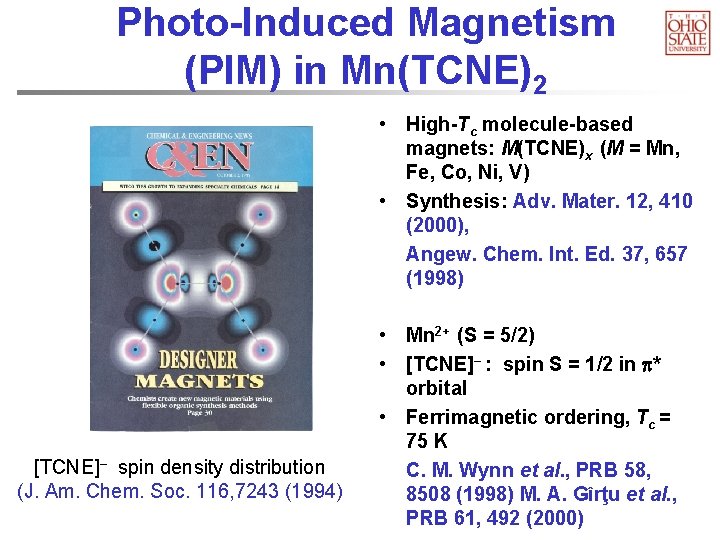
Photo-Induced Magnetism (PIM) in Mn(TCNE)2 • High-Tc molecule-based magnets: M(TCNE)x (M = Mn, Fe, Co, Ni, V) • Synthesis: Adv. Mater. 12, 410 (2000), Angew. Chem. Int. Ed. 37, 657 (1998) [TCNE]– spin density distribution (J. Am. Chem. Soc. 116, 7243 (1994) • Mn 2+ (S = 5/2) • [TCNE]– : spin S = 1/2 in * orbital • Ferrimagnetic ordering, Tc = 75 K C. M. Wynn et al. , PRB 58, 8508 (1998) M. A. Gîrţu et al. , PRB 61, 492 (2000)

Photoinduced Magnetization (PIM) in Mn(TCNE)2 • Effects of illumination on the magnetization: – Mfc increased by 25% – PIM persists for several days at T < 50 K – PIM partially reversed by lower energy light
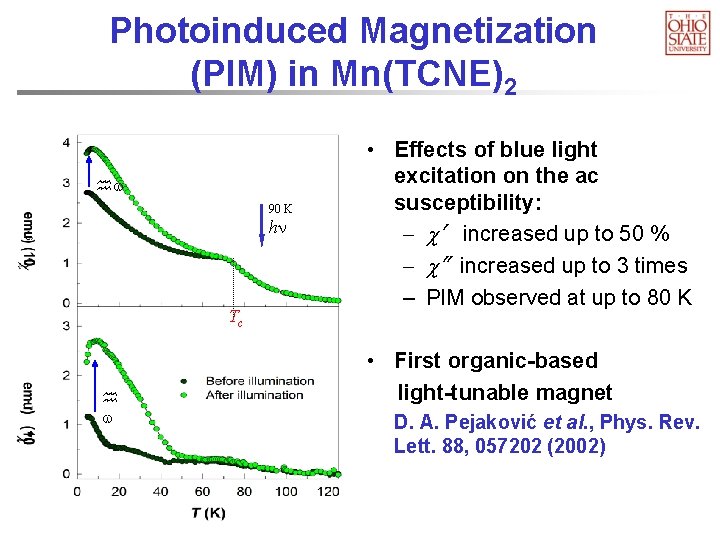
Photoinduced Magnetization (PIM) in Mn(TCNE)2 90 K h Tc • Effects of blue light excitation on the ac susceptibility: - c’ increased up to 50 % - c” increased up to 3 times – PIM observed at up to 80 K • First organic-based light-tunable magnet D. A. Pejaković et al. , Phys. Rev. Lett. 88, 057202 (2002)
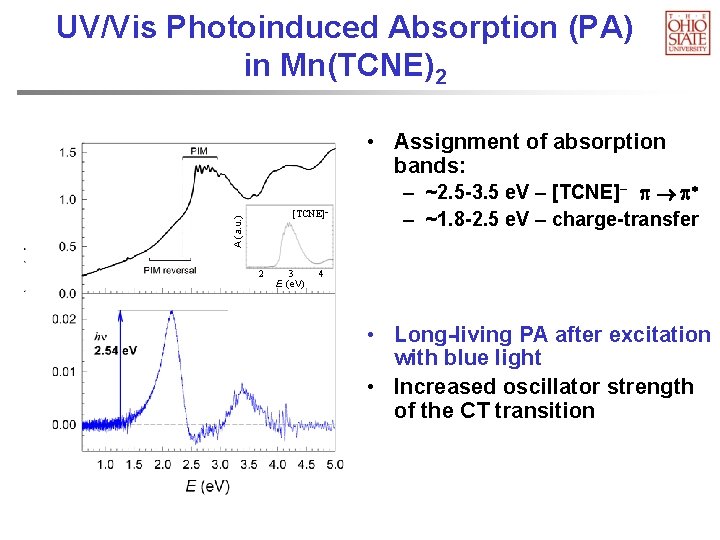
UV/Vis Photoinduced Absorption (PA) in Mn(TCNE)2 • Assignment of absorption bands: A (a. u. ) [TCNE]– 2 3 E (e. V) – ~2. 5 -3. 5 e. V – [TCNE]– * – ~1. 8 -2. 5 e. V – charge-transfer 4 • Long-living PA after excitation with blue light • Increased oscillator strength of the CT transition
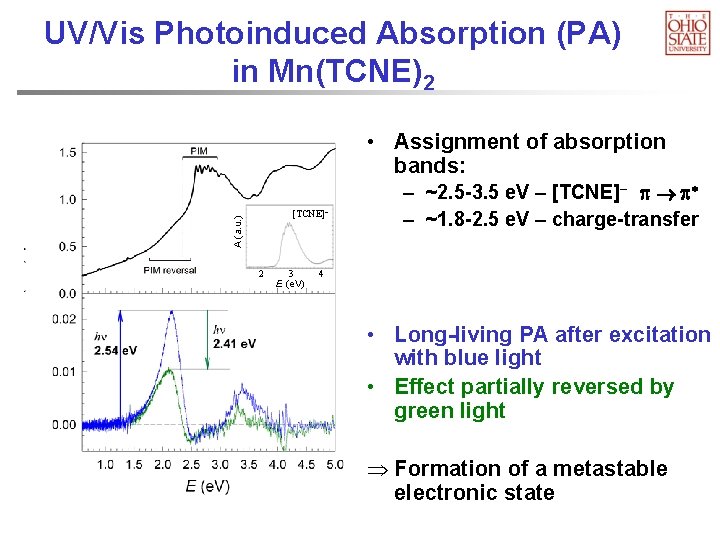
UV/Vis Photoinduced Absorption (PA) in Mn(TCNE)2 • Assignment of absorption bands: A (a. u. ) [TCNE]– 2 3 E (e. V) – ~2. 5 -3. 5 e. V – [TCNE]– * – ~1. 8 -2. 5 e. V – charge-transfer 4 • Long-living PA after excitation with blue light • Effect partially reversed by green light Formation of a metastable electronic state
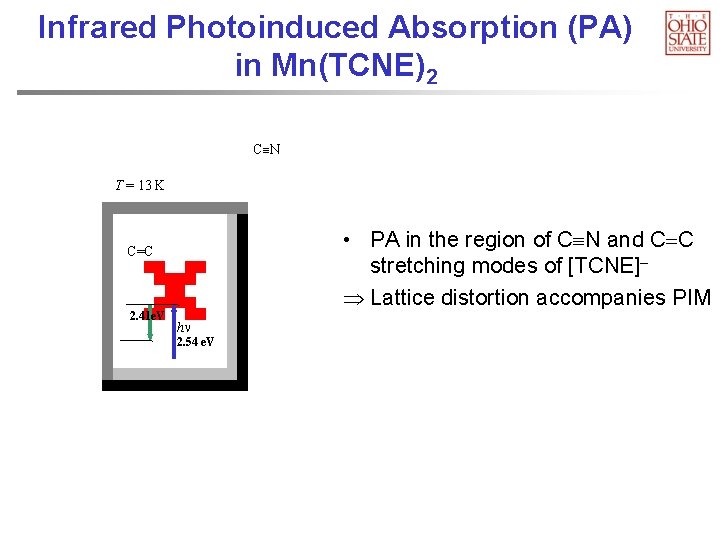
Infrared Photoinduced Absorption (PA) in Mn(TCNE)2 C N T = 13 K • PA in the region of C N and C C stretching modes of [TCNE]– Lattice distortion accompanies PIM C=C 2. 41 e. V h 2. 54 e. V
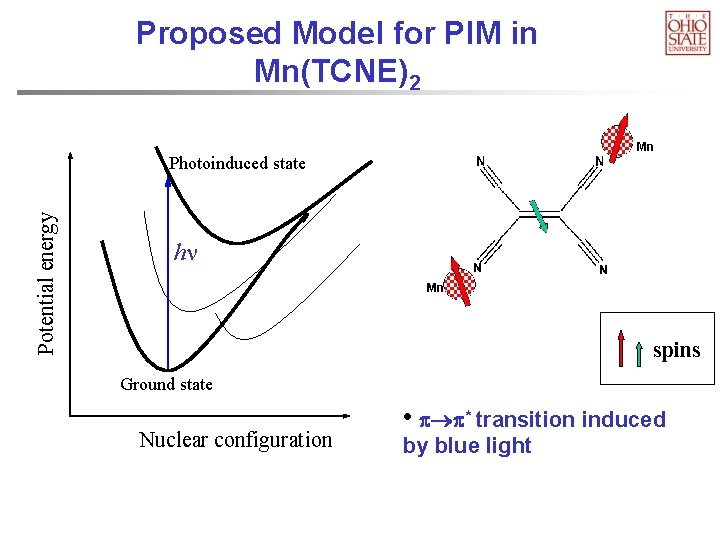
Proposed Model for PIM in Mn(TCNE)2 Potential energy Photoinduced state h spins Ground state Nuclear configuration • * transition induced by blue light
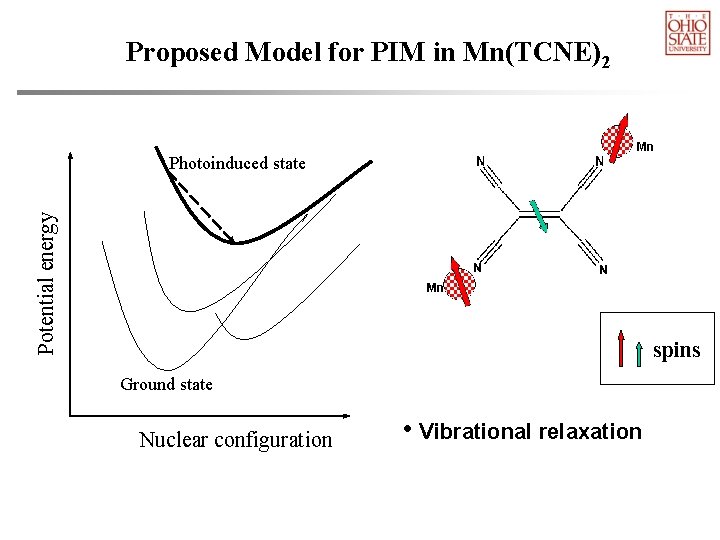
Proposed Model for PIM in Mn(TCNE)2 Potential energy Photoinduced state spins Ground state Nuclear configuration • Vibrational relaxation
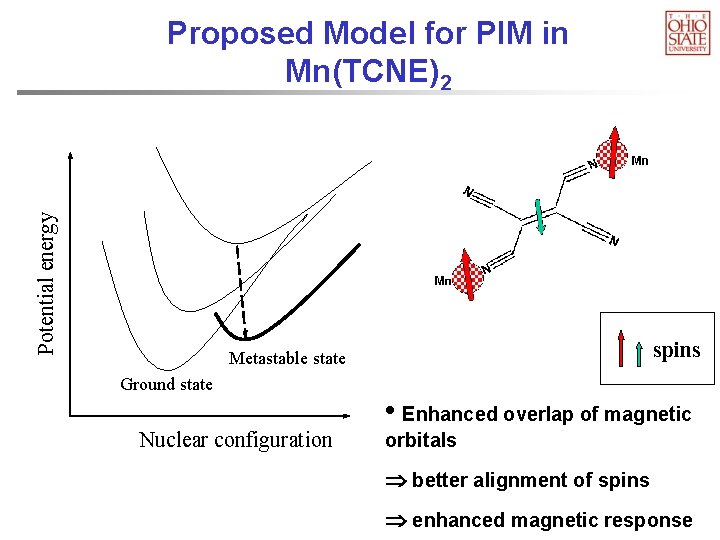
Potential energy Proposed Model for PIM in Mn(TCNE)2 Metastable state Ground state Nuclear configuration spins • Relaxation Enhanced overlap into metastable of magnetic state orbitals • Changed system geometry better alignment of spins Enhanced metal-ligand orbitals overlap enhanced magnetic response
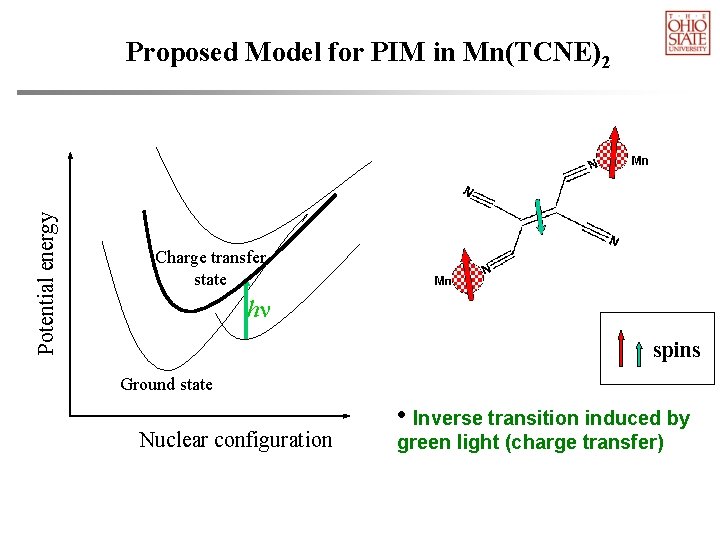
Potential energy Proposed Model for PIM in Mn(TCNE)2 Charge transfer state h spins Ground state Nuclear configuration • Inverse transition induced by green light (charge transfer)
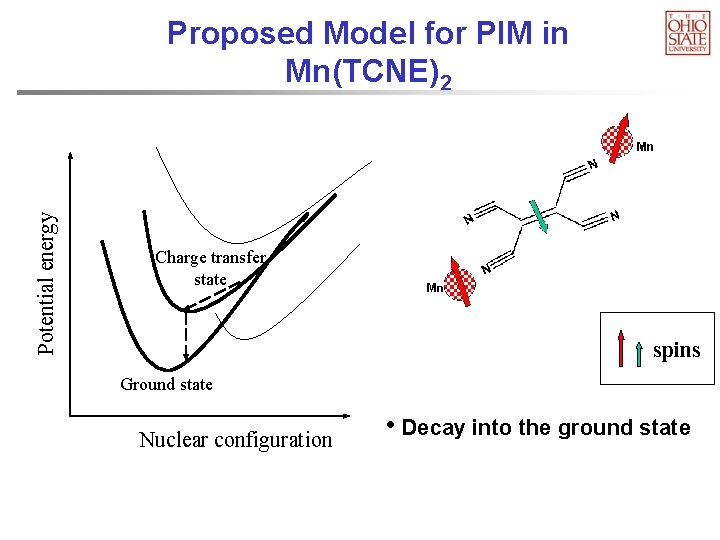
Potential energy Proposed Model for PIM in Mn(TCNE)2 Charge transfer state spins Ground state Nuclear configuration • • Decay into the ground state Vibrational relaxation
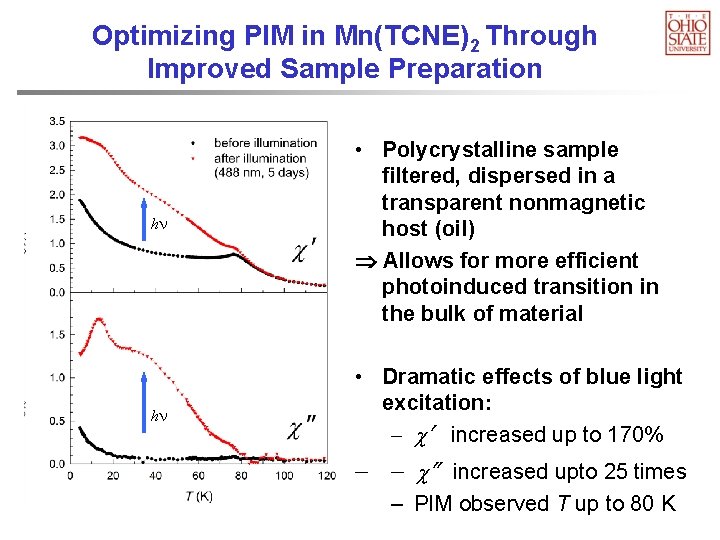
Optimizing PIM in Mn(TCNE)2 Through Improved Sample Preparation h h • Polycrystalline sample filtered, dispersed in a transparent nonmagnetic host (oil) Allows for more efficient photoinduced transition in the bulk of material • Dramatic effects of blue light excitation: - c’ increased up to 170% - - c” increased upto 25 times – PIM observed T up to 80 K
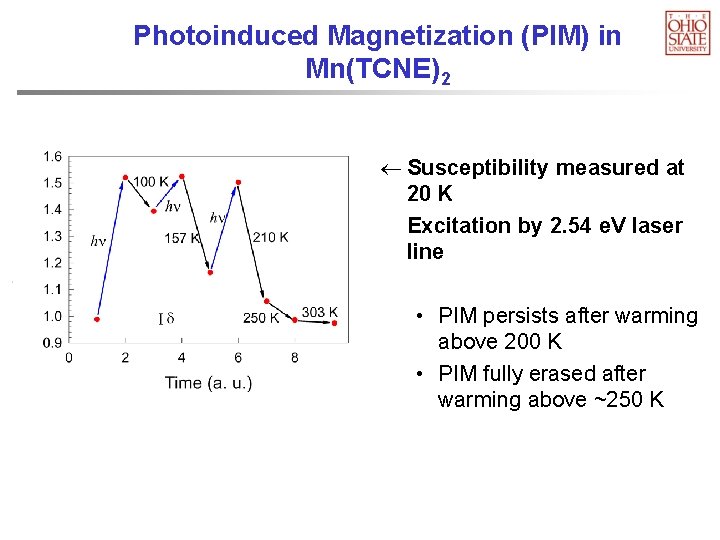
Photoinduced Magnetization (PIM) in Mn(TCNE)2 ¬ Susceptibility measured at 20 K Excitation by 2. 54 e. V laser line • PIM persists after warming above 200 K • PIM fully erased after warming above ~250 K
Photoinduced Magnetism Summary • • Mn(TCNE)2 - New class of light-tunable magnets PIM stabilized by metastable lattice distortion High operating temperature PIM in an organic-based material tuning of PIM by versatile organic chemistry methods Pejaković et al. , PRL 88, 057202 (2002) • Prussian blue magnets – coexistence of PIM and unusual “cluster glass” magnetic order • PIM due to photoinduced charge transfer between sites, stabilized by lattice distortion O. Sato et al. , Science 272, 704 (1996) Ohkoshi et al. , Phys. Rev. B 56, 11642 (1997) Pejaković et al. , PRL 85, 1994 (2000)
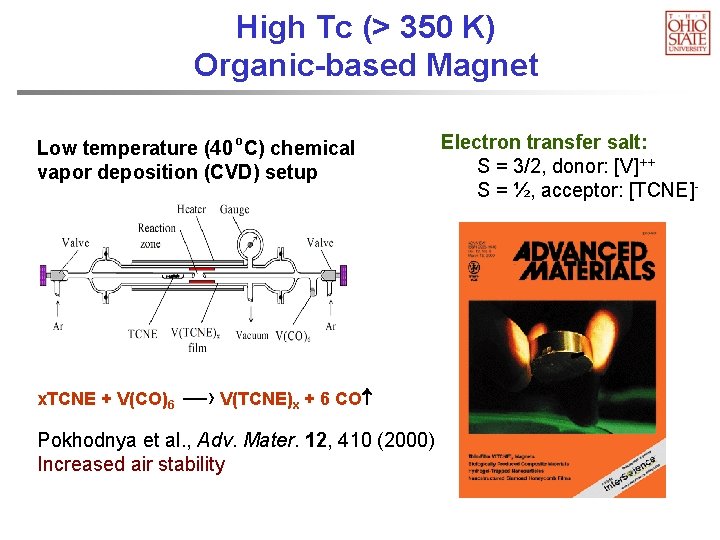
High Tc (> 350 K) Organic-based Magnet Low temperature (40 o. C) chemical vapor deposition (CVD) setup x. TCNE + V(CO)6 —› V(TCNE)x + 6 CO Pokhodnya et al. , Adv. Mater. 12, 410 (2000) Increased air stability Electron transfer salt: S = 3/2, donor: [V]++ S = ½, acceptor: [TCNE]-
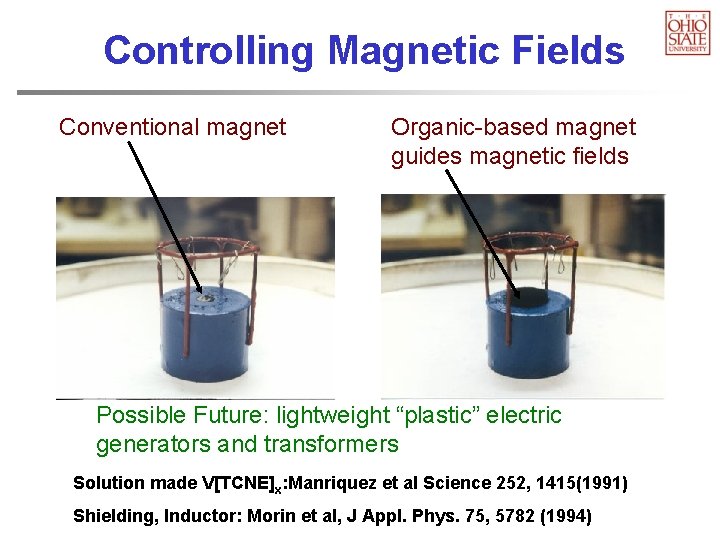
Controlling Magnetic Fields Conventional magnet Organic-based magnet guides magnetic fields Possible Future: lightweight “plastic” electric generators and transformers Solution made V[TCNE]x: Manriquez et al Science 252, 1415(1991) Shielding, Inductor: Morin et al, J Appl. Phys. 75, 5782 (1994)
![Spin States [TCNE]– Octahedral coordination of V with Ns splits 3 d-level of V](http://slidetodoc.com/presentation_image_h2/83f12e5f57b3b15f59d3716c8bc8c6ae/image-48.jpg "Spin States [TCNE]– Octahedral coordination of V with Ns splits 3 d-level of V")
Spin States [TCNE]– Octahedral coordination of V with Ns splits 3 d-level of V 2+ (EXAFS, ANL) : S = 1/2 unpaired electron in p* state 4. 426 Å 3. 959 Å eg 3 d t 2 g V 2+ Spin density distribution in [TCNE]– J. Am. Chem. Soc. 116, 7243 (1994) Large Hund’s pairing energy keeps all three spins parallel providing high spin state V 2+: S = 3/2
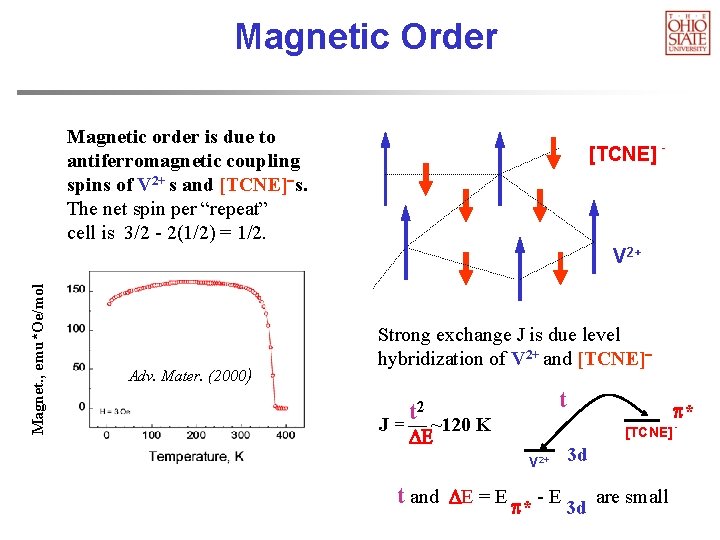
Magnetic Order Magnetic order is due to antiferromagnetic coupling spins of V 2+ s and [TCNE] s. The net spin per “repeat” cell is 3/2 - 2(1/2) = 1/2. [TCNE] - Magnet. , emu*Oe/mol V 2+ Adv. Mater. (2000) Strong exchange J is due level hybridization of V 2+ and [TCNE] J= t t 2 ~120 K DE * [TCNE] V 2+ 3 d t and DE = E * - E 3 d are small
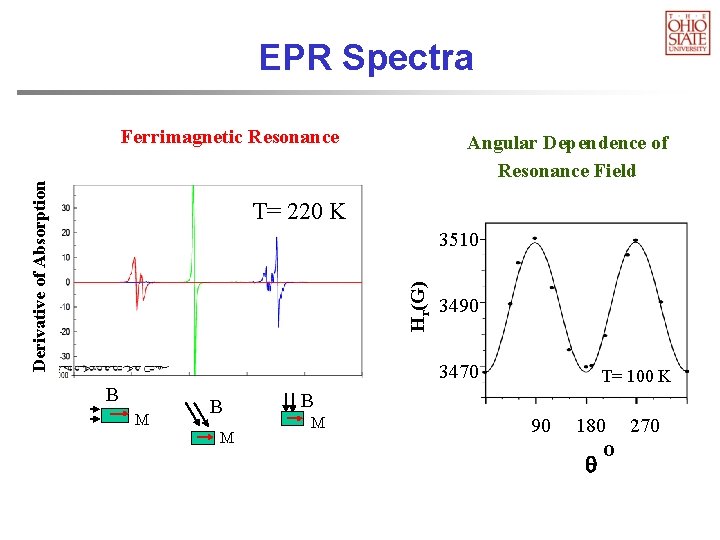
EPR Spectra Derivative of Absorption Ferrimagnetic Resonance Angular Dependence of Resonance Field T= 220 K Hr(G) 3510 3490 3470 B M T= 100 K B M 90 180 o 270
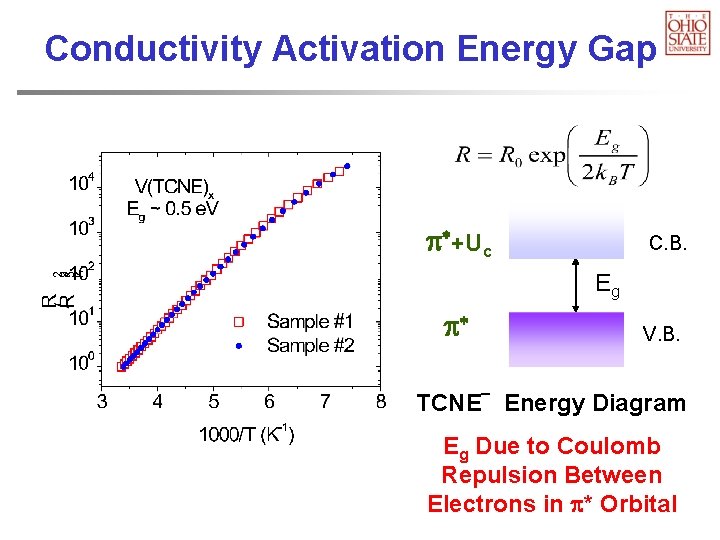
Conductivity Activation Energy Gap *+Uc C. B. Eg * V. B. TCNE Energy Diagram Eg Due to Coulomb Repulsion Between Electrons in * Orbital
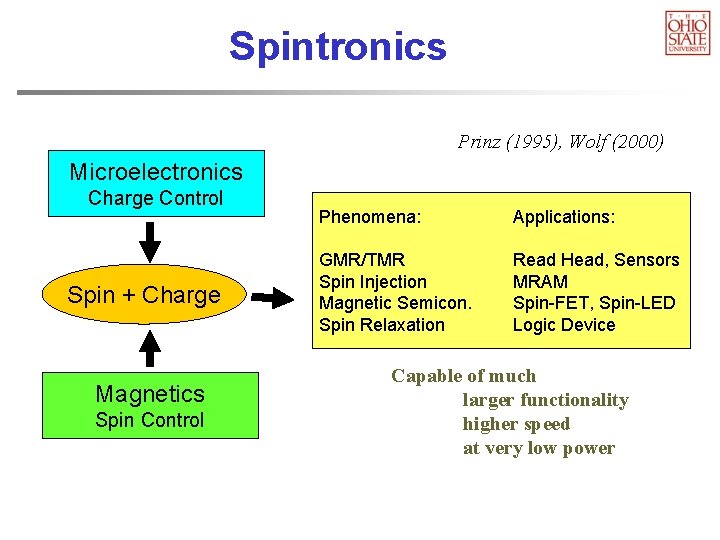
Spintronics Prinz (1995), Wolf (2000) Microelectronics Charge Control Spin + Charge Magnetics Spin Control Phenomena: Applications: GMR/TMR Spin Injection Magnetic Semicon. Spin Relaxation Read Head, Sensors MRAM Spin-FET, Spin-LED Logic Device Capable of much larger functionality higher speed at very low power
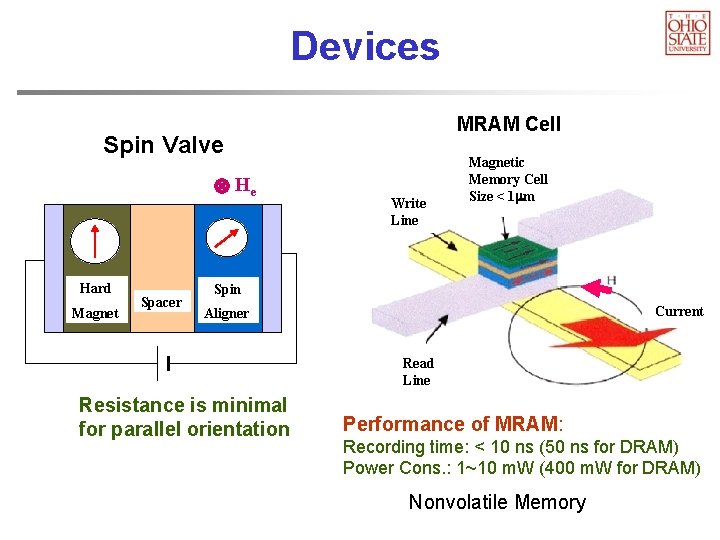
Devices MRAM Cell Spin Valve He Hard Magnet Spacer Write Line Magnetic Memory Cell Size < 1 mm Spin Current Aligner Read Line Resistance is minimal for parallel orientation Performance of MRAM: Recording time: < 10 ns (50 ns for DRAM) Power Cons. : 1~10 m. W (400 m. W for DRAM) Nonvolatile Memory
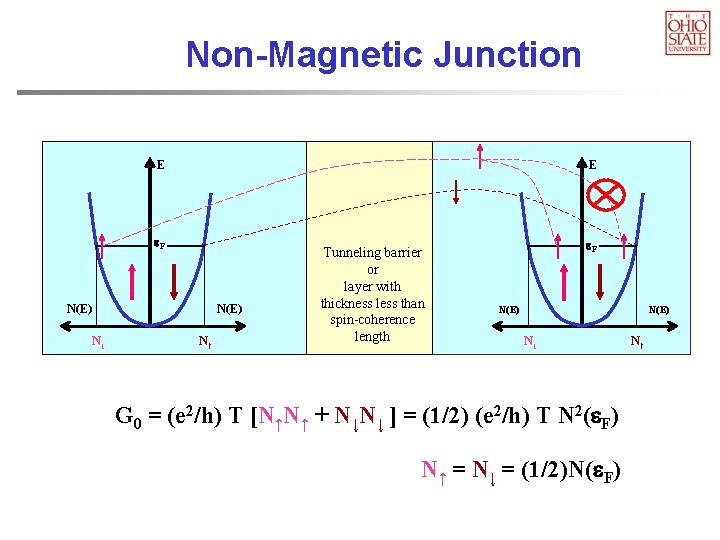
Non-Magnetic Junction E E e. F N(E) N↓ N↑ Tunneling barrier or layer with thickness less than spin-coherence length e. F N(E) N↓ G 0 = (e 2/h) T [N↑N↑ + N↓N↓ ] = (1/2) (e 2/h) T N 2(e. F) N↑ = N↓ = (1/2)N(e. F) N↑
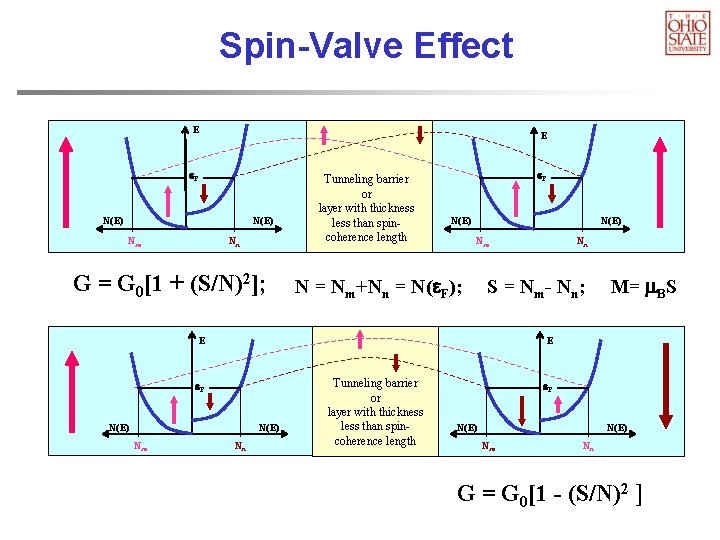
Spin-Valve Effect E E e. F N(E) Nm Nn G = G 0[1 + (S/N)2]; Tunneling barrier or layer with thickness less than spincoherence length e e. F N(E) Nm N = Nm+Nn = N(e. F); S = N m - Nn ; E M= m. BS E e. F N(E) Nm Nn Nn Tunneling barrier or layer with thickness less than spincoherence length e e. F N(E) Nm Nn G = G 0[1 - (S/N)2 ]
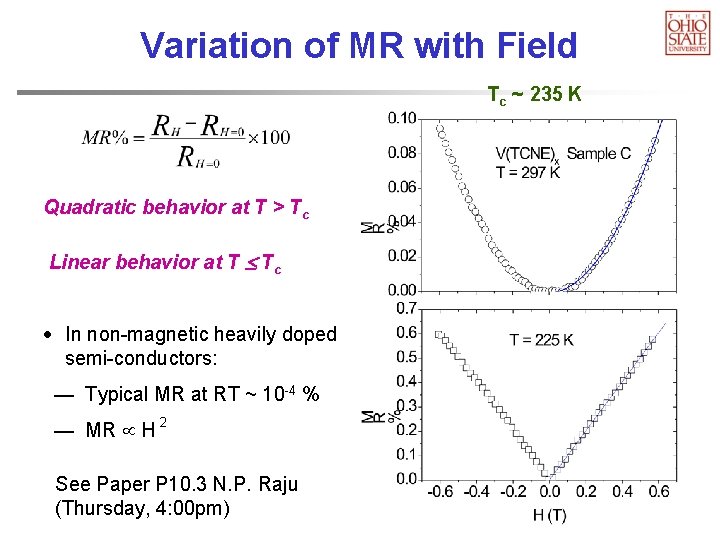
Variation of MR with Field Tc ~ 235 K Quadratic behavior at T > Tc Linear behavior at T Tc · In non-magnetic heavily doped semi-conductors: — Typical MR at RT ~ 10 -4 % — MR H 2 See Paper P 10. 3 N. P. Raju (Thursday, 4: 00 pm)
Linear MR vs Field up to 32 T • MR Linear to 0. 32 Megagauss, T < Tc
Non-linear MR for T >> Tc • MR ~ H 2 observed for samples for T >> Tc
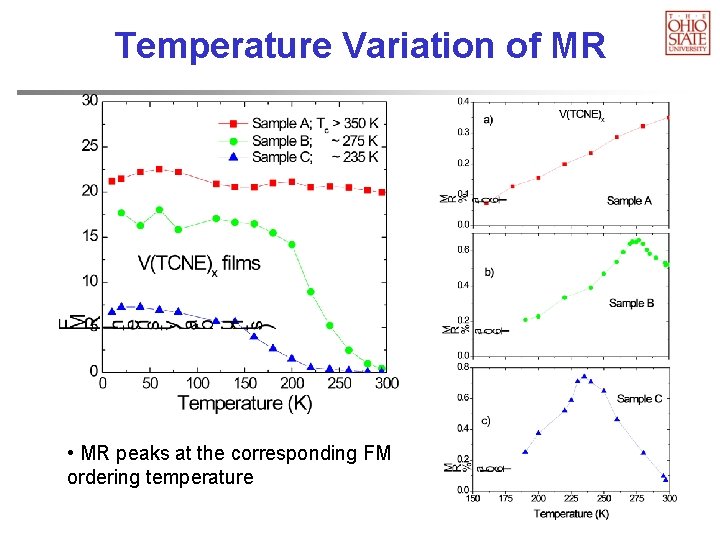
Temperature Variation of MR • MR peaks at the corresponding FM ordering temperature
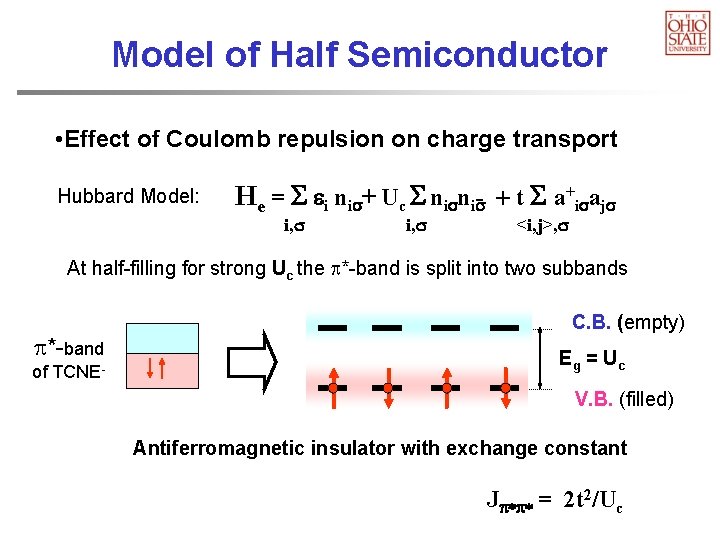
Model of Half Semiconductor • Effect of Coulomb repulsion on charge transport Hubbard Model: He = ei nis+ Uc nisnis- + t a+isajs i, s <i, j>, s At half-filling for strong Uc the p*-band is split into two subbands p*-band of TCNE- C. B. (empty) Eg = U c V. B. (filled) Antiferromagnetic insulator with exchange constant J * * = 2 t 2/Uc
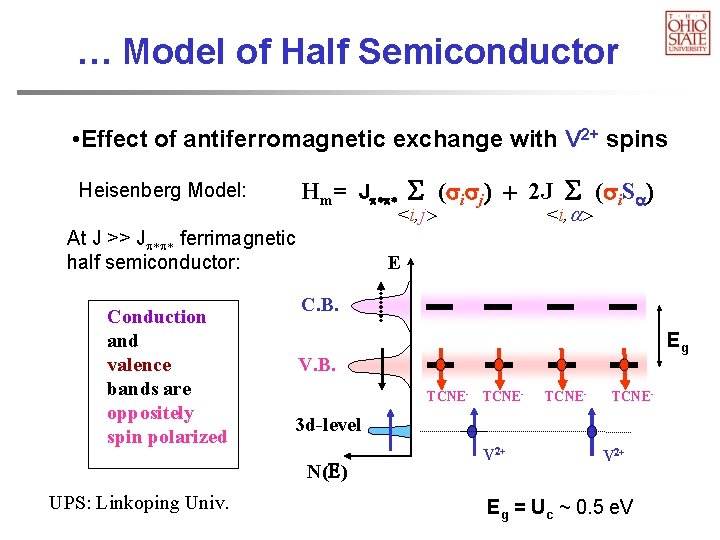
… Model of Half Semiconductor • Effect of antiferromagnetic exchange with V 2+ spins Hm= J * * (sisj) + 2 J (si. Sa) Heisenberg Model: <i, a> <i, j> At J >> Jp*p* ferrimagnetic half semiconductor: Conduction and valence bands are oppositely spin polarized E C. B. V. B. TCNE- 3 d-level N(E) UPS: Linkoping Univ. Eg V 2+ Eg = Uc ~ 0. 5 e. V
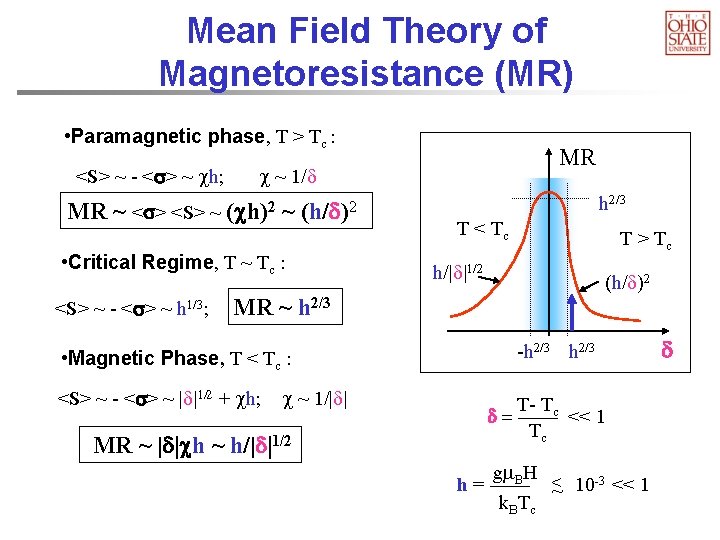
Mean Field Theory of Magnetoresistance (MR) • Paramagnetic phase, T > Tc : <S> ~ - <s> ~ h; ~ 1/d MR ~ <s> <S> ~ ( h)2 ~ (h/d)2 • Critical Regime, T ~ Tc : <S> ~ - <s> ~ h 1/3; MR h 2/3 T < Tc T > Tc h/|d|1/2 (h/d)2 MR ~ h 2/3 • Magnetic Phase, T < Tc : <S> ~ - <s> ~ |d|1/2 + h; ~ 1/|d| MR ~ |d h ~ h/|d 1/2 -h 2/3 T- T d ——c << 1 Tc gm. BH -3 < h = —— ~ 10 << 1 k. BTc d
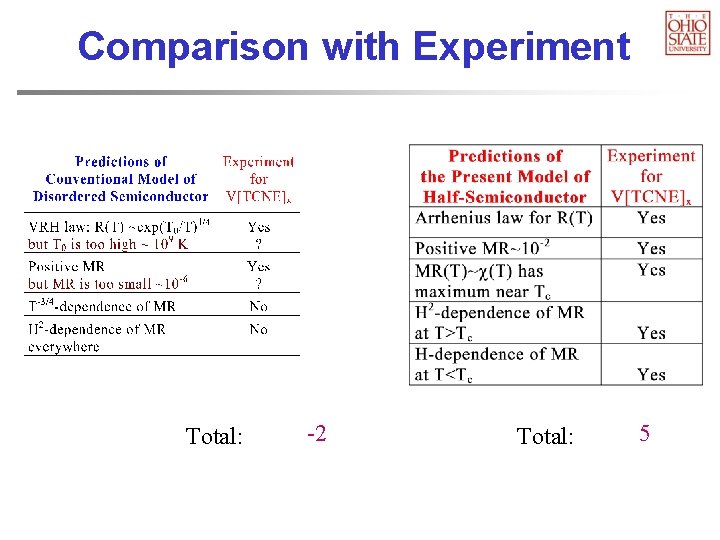
Comparison with Experiment Total: -2 Total: 5
Summary • Organic-based Magnets – Magnets from unpaired s and p electrons – Magnets with ‘conventional’ phenomena typical of ‘conventional’ magnets and • New Phenomena such as – – – – – Dipole-dipole interaction controlled magnets Fractal magnets 2 D Triangular spin glass Photoinduced magnetism Light weight magnets for shielding and induction Magnetic organic semiconductors Spin tunneling (M. Sarachik) Spin ladders (C. Landee) …
Acknowledgments Yurii Bataiev, Will Brinckerhoff, Animesh Chakraborty, Sailesh Chittipeddi, Gang Du, Stephen Etzkorn, Mihai Girtu, Carmen Kmety, Steven Long, Brian Morin, Raju Nandyala, K. S. Narayan, Dušan A. Pejaković, Kostia Pokhodnya Vladimir Prigodin, Chuck Wynn, Ping Zhou, Fulin Zuo Additional Graduate Students, Postdocs The Ohio State University Joel S. Miller Many Graduate Students, Postdocs University of Utah Many, Many More ANL, NHMFL, Linkoping U. , Grenoble, Columbia U. , NIST, BNL, Du. Pont, … Supported by DOE, AFOSR, ARO, DARPA, NSF
- Slides: 65