
Introduction to Evaluation Part One Overview of feedback
Introduction to Evaluation Part One: Overview of feedback and evaluation and their crucial impact
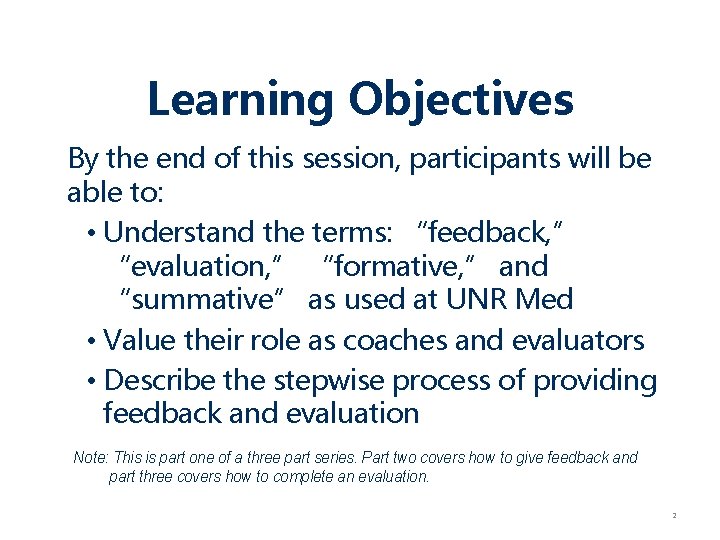
Learning Objectives By the end of this session, participants will be able to: • Understand the terms: “feedback, ” “evaluation, ” “formative, ” and “summative” as used at UNR Med • Value their role as coaches and evaluators • Describe the stepwise process of providing feedback and evaluation Note: This is part one of a three part series. Part two covers how to give feedback and part three covers how to complete an evaluation. 2
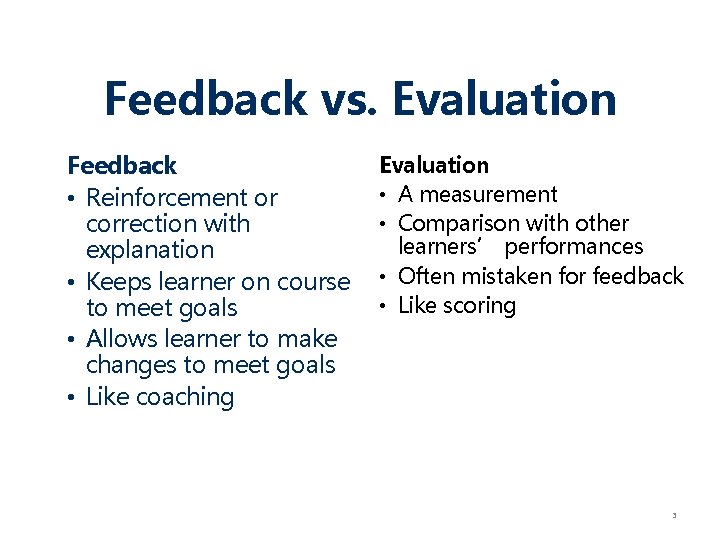
Feedback vs. Evaluation Feedback • Reinforcement or correction with explanation • Keeps learner on course to meet goals • Allows learner to make changes to meet goals • Like coaching Evaluation • A measurement • Comparison with other learners’ performances • Often mistaken for feedback • Like scoring 3
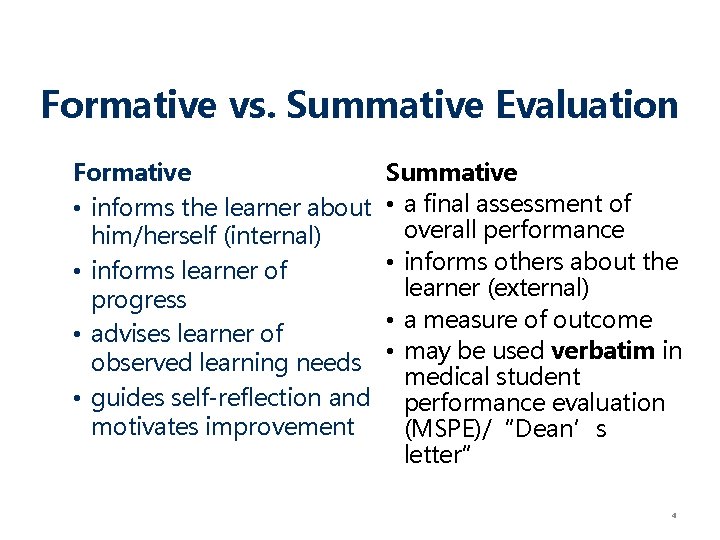
Formative vs. Summative Evaluation Formative • informs the learner about him/herself (internal) • informs learner of progress • advises learner of observed learning needs • guides self-reflection and motivates improvement Summative • a final assessment of overall performance • informs others about the learner (external) • a measure of outcome • may be used verbatim in medical student performance evaluation (MSPE)/“Dean’s letter” 4

Your Impact “A preceptor can exert significant influence on the student’s maturation from novice toward clinician. ” 5
As a Preceptor • You are a longitudinal firsthand observer • You shape the learner’s professional development • Your comments are critical to a trainees’ assessment • Your comments may be part of the MSPE (Dean’s letter) for residency application 6
Exercise One Using the Exercise One handout, imagine that you are selecting candidates to interview for a residency program. The evaluative comments for two interview candidates are included. If you only had one interview slot left, which student would you choose? 7
How should I approach feedback and evaluation? • Day One: Discuss learning objectives • Daily: Give feedback and note whether learner incorporates feedback effectively • End: Evaluate learner Watch this video [link] to see a colleague setting the stage for evaluation and feedback on day one. 8
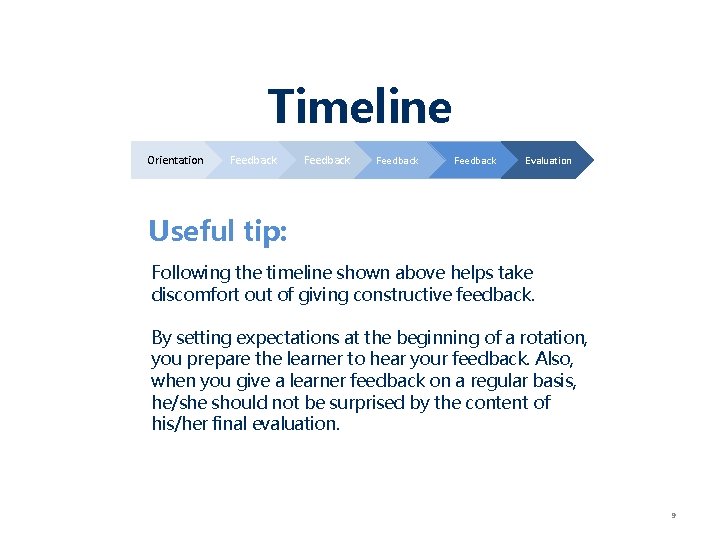
Timeline Orientation Feedback Evaluation Useful tip: Following the timeline shown above helps take discomfort out of giving constructive feedback. By setting expectations at the beginning of a rotation, you prepare the learner to hear your feedback. Also, when you give a learner feedback on a regular basis, he/she should not be surprised by the content of his/her final evaluation. 9
Exercise Two 1. Take the quiz on overview of feedback and evaluation. 2. Consider how you will set expectations for your next students and/or residents. 3. Has the School of Medicine provided you with the learning objectives for the rotation in which you teach? 4. Are there skills you need to build? (Please review parts two and three) 10
References 1. Ferenchick, G. , Kern, D. E. , Babbott, S. Evaluation and Program Enhancement. Chapter 5 Community-Based Teaching. Pgs. 89 -96. 1997. ACP. 2. Mink O. , Owen K. , Mink B. Developing High Performance People (Perseus Books 1993). 3. Whitman, N. Schwenk, T. The Physician as Teacher, 2 nd Ed. (Whitman Associates, 1997). 11

Questions? Contact: Jennifer Hagen, MD Office of Faculty Development jmhagen@med. unr. edu April Heiselt, Ph. D Office for Community Faculty aheiselt@med. unr. edu
- Slides: 12