
Introduction to EU Law European Labour Law Spring
Introduction to EU Law European Labour Law Spring 2015 1

Outline • How did it all start and why? • The institutions • What gives the institutions power to act – the doctrine on competences • The legislative process • The impact of EU law • Fundamental Rights in the EU 2

How did it all start and why? • The WR II ended in 1945 – 60 million people died, genocide, nuclear bombs • How to ensure that this would never happened again? • International collaboration – 1949 Council of Europe – promote Human Rights and democracy – intra national – 1952 A common market for coal and steel (BE, FR, BRD, NL, Lux, IT) - supranational – 1957/1958 Treaty of Rome – A common market for all goods and eventually also for services, capital and people EEC + Euroatom = EC 3
The members • 1952 – BE, BRD, FR, IT, LU, NL • 1973 – DK, IR, UK • 1981 – GR • 1986 – PT, SP • 1995 – AT, FI, SE • 2004 – CY, CZ, EST, HU, LT, LU, PL, SK, SL, MT, • 2007 – BU, RU • 2013 – CR 4
Treaty of Rome • Starting point – Economic integration-removal of obstacles to the free movement of labour, goods and capital – would in time ensure the optimum allocation of resources →optimum rate of economic growth→optimum social system and ”constant improvement of the living and working conditions of their peoples”. • Had a title on social policy – several articles but only one with substance – art 119 • On equal pay for men and women 5
The development of the Treaties • Intergovernmental conferences have been revising and developing the Treaties over the years – New competences have been added – The organization of the EU has changed considerably • But - It took many years before social issues made its way into the treaties 6

1970 -1986 • 1974 Social Action Plan – No direct social competence – Unanimous decision making • 1980: ies UK veto 7

• 1986 – Single European Act – Means to realise the internal market – more decisions could be taken through qualified majority – health and safety • 1989 Community Social Charter and Action Programme • 1993 Maastricht European Union – Social policy Agreement and Social Policy Protocol – Economic and monetary union, Foreign och security policy, Justice and Home affairs, European citizenship • 1997 Amsterdam Treaty – the Social Policy competence included in the Treaty • 2000 Nice Treaty /EU Charter of Fundamental Rights • 2007/09 Lisbon Treaty – The EU Charter of Fundamental Rights is given the same status as the Treaty 8
The treaties – The treaty of the European Union (TEU) – The treaty of the functioning of the European Union (TFEU) – The EU charter on fundamental rights 9
Subject areas • Agriculture, rural development; climate action; competition; economic and financial affairs; education and culture; EMPLOYMENT, SOCIAL AFFAIRS AND EQUAL OPPORTUNITIES; enterprise and industry; environment, executive agencies, health and consumers; home affairs, information society and media, internal market and services, justice, maritime affairs and fisheries, mobility and transport, regional policy, research, taxation and customs union, external relations including development, enlargement, Europe aidcooperation, external relations, humanitarian aid and trade. 10
The institutions • Art 13 TEU – – – The European Parliament The European Council The Commission The Court of Justice of the European Union – The European Central Bank – Court of Auditors 11
The European Parliament • Art 14 TEU • Composition – Each MS has a kind of proportional number of seats – The disposal of those seats are elected on a national basis. Last election 22 -25 May 2014. – The EP elected MEP are divided into seven EP political groupings – 766 MEP – Term 5 years – 20 standing committees 12

EP • Tasks – Dismissal and Appointment power • Important role in relation to the President of the Commission – Legislative • (co-legislator with the Council) exercise legislative powers • Bring annulment proceedings – Supervisory powers • Ombudsman-maladministration of the union institutions – Budget 13
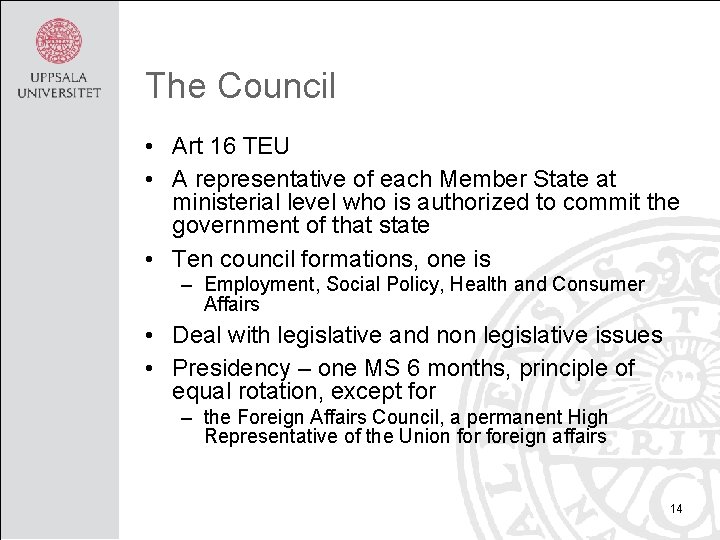
The Council • Art 16 TEU • A representative of each Member State at ministerial level who is authorized to commit the government of that state • Ten council formations, one is – Employment, Social Policy, Health and Consumer Affairs • Deal with legislative and non legislative issues • Presidency – one MS 6 months, principle of equal rotation, except for – the Foreign Affairs Council, a permanent High Representative of the Union foreign affairs 14

• Powers – Legislative – • has to vote its approval of virtually all Commission legislative initiatives before they become law • Ask the Commission to conduct studies and proposals • Delegate powers to the commission - Budget - Conclude agreements with third states or international organisation 15
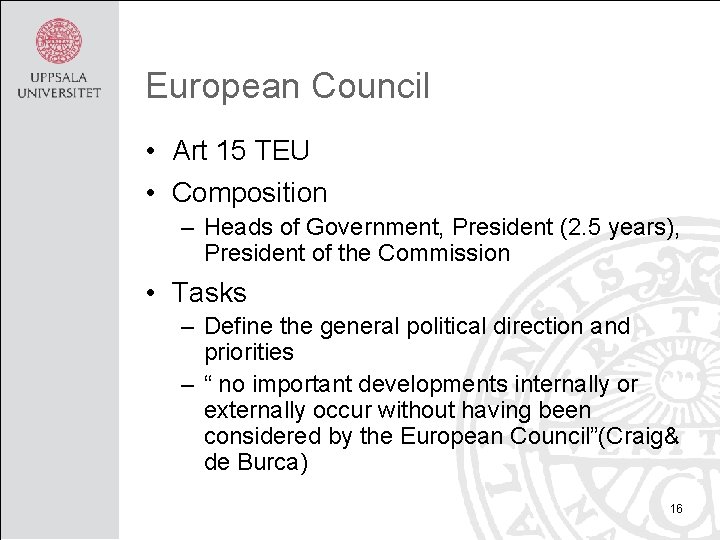
European Council • Art 15 TEU • Composition – Heads of Government, President (2. 5 years), President of the Commission • Tasks – Define the general political direction and priorities – “ no important developments internally or externally occur without having been considered by the European Council”(Craig& de Burca) 16
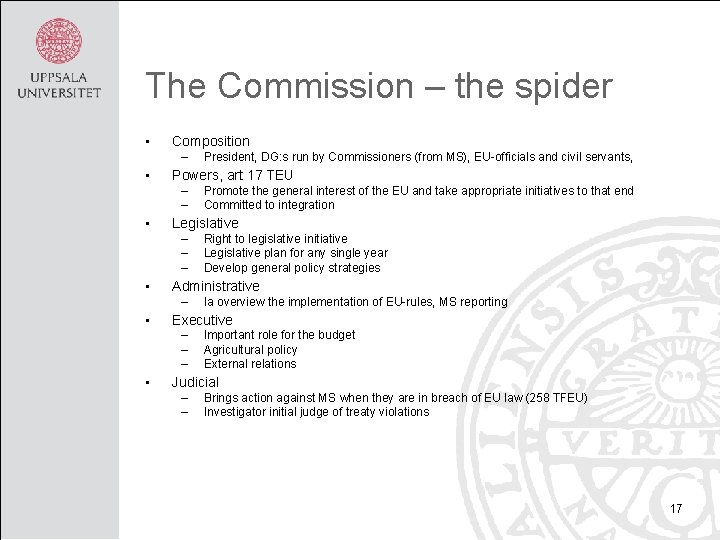
The Commission – the spider • Composition – • Powers, art 17 TEU – – • Ia overview the implementation of EU-rules, MS reporting Executive – – – • Right to legislative initiative Legislative plan for any single year Develop general policy strategies Administrative – • Promote the general interest of the EU and take appropriate initiatives to that end Committed to integration Legislative – – – • President, DG: s run by Commissioners (from MS), EU-officials and civil servants, Important role for the budget Agricultural policy External relations Judicial – – Brings action against MS when they are in breach of EU law (258 TFEU) Investigator initial judge of treaty violations 17
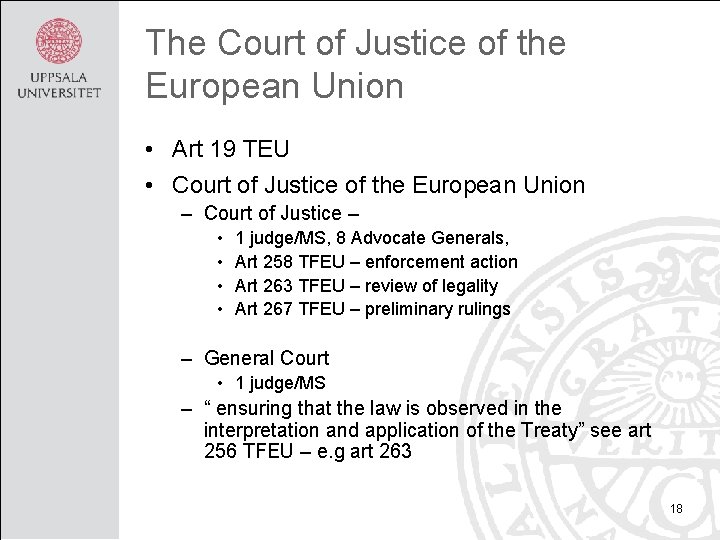
The Court of Justice of the European Union • Art 19 TEU • Court of Justice of the European Union – Court of Justice – • • 1 judge/MS, 8 Advocate Generals, Art 258 TFEU – enforcement action Art 263 TFEU – review of legality Art 267 TFEU – preliminary rulings – General Court • 1 judge/MS – “ ensuring that the law is observed in the interpretation and application of the Treaty” see art 256 TFEU – e. g art 263 18
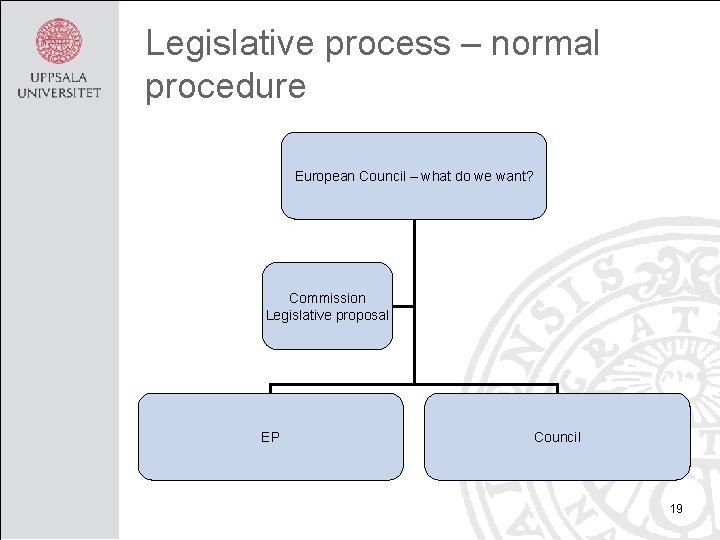
Legislative process – normal procedure European Council – what do we want? Commission Legislative proposal EP Council 19

What gives the EU competence to act? The EU can only act within the limits of the powers conferred to it! • The competence must be conferred to it by the Treaties, art 5. 2 TEU • Otherwise it remains with the MS, art 4 TEU • See for example – art 153 TFEU – specific – art 114 -115 TFEU – promote the internal market – art 352 – the flexibility clause /rest competence/promote a community objective • Sometimes difficult to read out the scope of the competence – the case law of the CJEU must be taken into account 20

Different kind of competences • Art 2 TEU • Exclusive competence – Only the EU can legislate • Shared competence – Both the EU and the MS may legislate – But the MS shall exercise their competence to the extent that the Union has not exercised it • Supportive/coordinate competence • Special coordinative competences for economic and employment policies and foreign and security policy 21

Exclusive competence • Art 3 TFEU • e. g customs union, trade policy, competition rules necessary for the completion of the internal market 22

Shared competence • Art 4 TFEU • i. a internal market, SOCIAL POLICY, agriculture and fisheries, environment, consumer protection, area of freedom, security and justice • EU can consume the competence through for example – uniform regulation, – harmonize national laws – minimum harmonization 23

Principles governing EU action • Subsidiarity principle, art 5. 3 TEU – If the MS can’t achieve the objectives themselves – National parliaments – alarm function, 1/3 in violation of subsidiarity – review proposal • Proportionality principle, art 5. 4 TEU – The EU action shall not exceed what is necessary to achieve the objectives 24

The legislative process • The ordinary legislative process, arts 289 and 294 TFEU – The COM submits a proposal – First reading • The EP adopts a position and the Council shall decide by qualified majority whether it can approve it • If not its divergent position is adopted and send to EP. COM comments. – Second reading • EP can within three months approve the Council position →adoption or • reject →not adopted or • propose amendments – council can approve all or if that is not the case convene a meeting of a conciliation committee – Conciliation • Reach agreement on a new text or • The act can not be adopted 25
The special legislative processes • Art 289. 2 • The special procedure is described in the specific treaty provisions related to this specific topic • Often - the Council decides by unanimity in consultation with/ or of consent of the EP • Applicable in some areas within the SOCIAL POLICY CHAPTER – Social security and social protection of workers – Protection of workers when their employment contract is terminated – Representation and collective defense of the interests of workers and employers 26

Specificities in the social chapter • Art 154 -155 TFEU • COM must consult the social partners on the direction of a initiative before submitting it to the Council and the EP • The social partners can ask to take over the initiative and solve it in an EU collective agreement 27

The legislative acts • Art 288 TFEU • Regulations – directly applicable in the MS • Directives – binding as to the results to be achieved – MS can choose form and method • Decisions- binding in its entirety on those who it affects • Recommendation - no binding force 28
Hierarchy of norms • Treaties and the EU Charter of Fundamental Rights • General principles of Law – Proportionality, fundamental rights, legal certainty, legitimate expectations • Legislative acts • Delegated acts • Implementing acts 29
Principle of sincere cooperation • Art 4. 3 TEU • “Pursuant to the principle of sincere cooperation, the Union and the Member States shall, in full mutual respect, assist each other in carrying out tasks which flow from the Treaties. • The Member States shall take any appropriate measure, general or particular, to ensure fulfillment of the obligations arising out of the Treaties or resulting from the acts of the institutions of the Union. • The Member States shall facilitate the achievement of the Union's tasks and refrain from any measure which could jeopardise the attainment of the Union's objectives. ” 30

Member State responsibility • Art 291 TFEU • MS shall adopt all measures necessary to implement legally binding Union acts • And if a Member State fail…. • The Member State can violate its obligations towards – the EU and – towards a citizen if he or she is deprived of rights he or she is supposed to be granted 31
If the MS fails • The COM or a MS can initiate an enforcement action art 258 -259 TFEU • The CJEU can then conclude whether the MS has fulfilled their obligations or not • Pecuniary penalty payment can be imposed, art 260 TFEU • Failure to transpose or to implement Union legislation – often inadequate implementation • The CJEU can review the adequacy of the chosen method of implementation – also concerning directives 32
What effect can EU-law have for individuals? • Direct effect – Developed by the ECJ, e. g. van Gend en Loos C 26/62, van Duyn C-41/74 – individuals can derive rights from EU provisions • Treaty articles, regulations , directives, decisions • If a provision is clear, precise and unconditional – Justiciable – can be invoked and relied on by individuals before national courts 33
Directives • Only vertical direct effect – can only be raised against a state or a state entity • No horizontal direct effect – can not impose obligations on a private party- Marshall C 152/84 • But national courts must interpret national law in conformity with directives – Indirect effect – von Colson C-14/83 • And general principles of law can bind private parties and the content of the general principle can be drawn from a directive – Mangold C 144/04 34
State liability for breach of EU-law • But if an individual suffers losses from nonimplementation of a directive • The individual can bring proceeding for damages against the state – Irrespective of if the provision has direct effect – BUT • the directive must confer a specific right upon the individual, • the content must be identifiable under the directive and • there must be a casual link between the state’s breach and damage to the individual • Francovich C-6 and 9/90, Brasserie de Pecheur C-46 and 48/93 35
If the impact of a directive is unclear? • • Art 267 TFEU Preliminary rulings When a national court has to deal with the interpretation of EU law – Courts against whose decisions there is no judicial remedy • and is uncertain of the meaning of the EU law – A decision on the question is necessary to enable judgment to be given • It then turns to the CJEU and asks for a preliminary ruling, e. g. – advice on how to solve the issue, – what circumstances that must be taken into account – the national court uses the reply from the CJEU to solve the national dispute – The CJEU is interpreting the treaties and is not supposed to make any judgment on the validity of national law – But it can give an interpretation of the compatibility of national law with EU law 36
Review of legality • Art 263 TFEU • Regulations, decisions and directives • Who can bring action – EP, COM, Council – Natural and legal persons - e. g • Individual concern • legal acts directly affects them and is directly applicable and does not need any implementation measures – A time limit – two months 37
Fundamental rights • From the beginning - nothing • ECJ decided to include the protection of fundamental rights within the general principles of law which the ECJ protects, Stauder C-29/69 • Which fundamental rights? – Inspired by the constitutional traditions common to the MS, Internationale Handelsgesellshaft, C- 11/70 – And international treaties for the protection of human rights on which the MS have collaborated or of which they are signatories, Nold C 4/73 – European Convention on Human Rights – a special source of inspiration- Rutili C-36/75 38
Treaty based protection of Fundamental rights • Maastricht and Amsterdam Treaties, • In Nice 2000 A non binding EU Charter on Fundamental rights was adopted • Through Lisbon the EU Charter becomes binding and is given the same status as the Treaties, art 6. 1 TEU 39
Article 6 TEU • 1. The Union recognises the rights, freedoms and principles set out in the Charter of Fundamental Rights of the European Union…. , which shall have the same legal value as the Treaties • The provisions of the Charter shall not extend in any way the competences of the Union as defined in the Treaties………. . • 2. The Union shall accede to the European Convention for the Protection of Human Rights and Fundamental Freedoms. …. • 3. Fundamental rights, as guaranteed by the European Convention for the Protection of Human Rights and Fundamental Freedoms and as they result from the constitutional traditions common to the Member States, shall constitute general principles of the Union's law 40
The EU Charter of Fundamental Rights • Includes 50 substantial articles, – i. a the right to dignity, right to life, prohibitition of slavery, right to asylum, freedom of expression, right to strike, right to a fair trial, right to good administration • Field of application – Directed towards EU institutions and MS when implementing EU law – Respect the rights, observe the principles and promote the application thereof 41

Thank you! 42
- Slides: 42