
Introduction to Ethics Sessions 16 and 17 I
- Slides: 48
Introduction to Ethics Sessions 16 and 17
I. Introduction: Ethics is the discipline that studies the moral life. If morality refers primarily to behavior and character, ethics is the discipline that tries to provide guidance and perspective in making decisions and forming character. [It is] the systematic study of standards of right and wrong, justice and injustice, virtue and vice, with a view to applying those standards in the realities of our lives. Dennis P. Hollinger, Choosing the Good, 14
II. Understanding How Moral Decisions Work: The “Ipsative” Factor A. Everything is understood in context
II. Understanding How Moral Decisions Work: The “Ipsative” Factor A. Everything is understood in context B. Values exist in hierarchy
II. Understanding How Moral Decisions Work: The “Ipsative” Factor A. Everything is understood in context B. Values exist in hierarchy C. People hold similar values
II. Understanding How Moral Decisions Work: The “Ipsative” Factor D. The most important factor is the way similar are values are ranked For example: Place the following values in rank order Equality Freedom Responsibility Tolerance Self-control
II. Understanding How Moral Decisions Work: The “Ipsative” Factor E. Any two values are potentially contradictory
II. Understanding How Moral Decisions Work: The “Ipsative” Factor E. Any two values are potentially contradictory F. There are no value-free statements
II. Understanding How Moral Decisions Work: The “Ipsative” Factor E. Any two values are potentially contradictory F. There are no value-free statements G. There is a limited and distinct number of value systems
II. Understanding How Moral Decisions Work: The “Ipsative” Factor H. Everyone orders their values, but not always in a consistent way
II. Understanding How Moral Decisions Work: The “Ipsative” Factor H. Everyone orders their values, but not always in a consistent way I. It is all but impossible to add or subtract values, but they can be reordered
III. Types of Ethics A. Descriptive versus Prescriptive 1. Descriptive Ethics
III. Types of Ethics A. Descriptive versus Prescriptive 1. Descriptive Ethics 2. Prescriptive Ethics
III. Types of Ethics A. Descriptive versus Prescriptive 1. Descriptive Ethics 2. Prescriptive Ethics B. Philosophical
III. Types of Ethics C. Professional/Specialized 1. Business
III. Types of Ethics C. Professional/Specialized 1. Business 2. Biomedical
III. Types of Ethics C. Professional/Specialized 1. Business 2. Biomedical 3. Legal
III. Types of Ethics C. Professional/Specialized 1. Business 2. Biomedical 3. Legal 4. Etc.
III. Types of Ethics D. Religious 1. As a Feature of a Distinctive Religious Commitment and Way of Life
III. Types of Ethics D. Religious 1. As a Feature of a Distinctive Religious Commitment and Way of Life 2. Potential Touch-points and Tensions within the Universal and the Particular Nature of Religious Ethics
III. Types of Ethics The great challenge for Christian ethics today is to find ways of relating a moral framework rooted in a particularistic worldview to a larger society and culture that have been secularized in terms of the role religion plays within them. Dennis Hollinger, Choosing the Good, 102
IV. The Distinctive Nature of Christian Ethics A. The Triune God of Love as the Ultimate and Definitive Foundation for Christian Ethics (1 Corinthians 13: 1 -3; 1 John 4: 7 -8)
IV. The Distinctive Nature of Christian Ethics B. The Centrality of Jesus Christ 1. As a Living Ethical Model (Hebrews 12: 1 -2)
IV. The Distinctive Nature of Christian Ethics B. The Centrality of Jesus Christ 1. As a Living Ethical Model (Hebrews 12: 1 -2) 2. As the Embodiment of God’s Perfect Love (John 13: 34 -35)
IV. The Distinctive Nature of Christian Ethics B. The Centrality of Jesus Christ 1. As a Living Ethical Model (Hebrews 12: 1 -2) 2. As the Embodiment of God’s Perfect Love (John 13: 34 -35) 3. As the Redemptive Source of Transformative Power (Galatians 2: 20 -21)
IV. The Distinctive Nature of Christian Ethics B. The Centrality of Jesus Christ 1. As a Living Ethical Model (Hebrews 12: 1 -2) 2. As the Embodiment of God’s Perfect Love (John 13: 34 -35) 3. As the Redemptive Source of Transformative Power (Galatians 2: 20 -21) 4. As the Goal of Christian Living (Romans 8: 29; Philippians 3: 7 -14)
IV. The Distinctive Nature of Christian Ethics C. The Absolute Authority of Scripture (2 Timothy 3: 16 -17)
IV. The Distinctive Nature of Christian Ethics C. The Absolute Authority of Scripture (2 Timothy 3: 16 -17) C. The Recognition of Both Human Finitude and Sin (Ephesians 2: 1)
IV. The Distinctive Nature of Christian Ethics C. The Absolute Authority of Scripture (2 Timothy 3: 16 -17) C. The Recognition of Both Human Finitude and Sin (Ephesians 2: 1) D. Positive versus Merely Negative (Philippians 2: 15 -16)
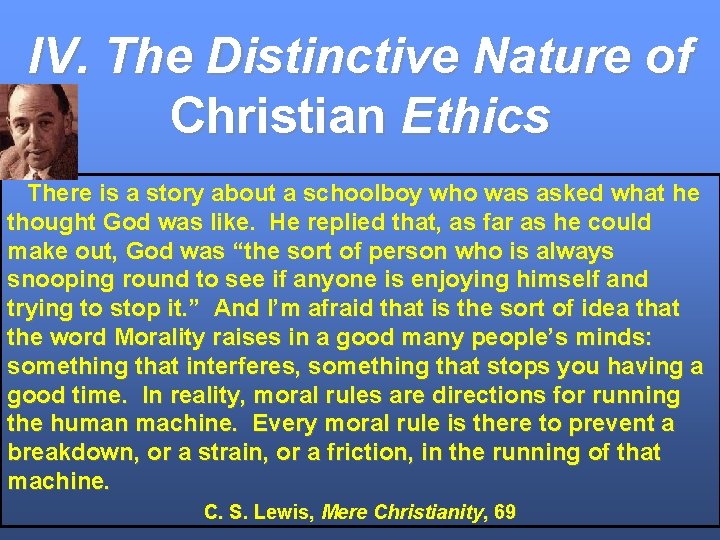
IV. The Distinctive Nature of Christian Ethics There is a story about a schoolboy who was asked what he thought God was like. He replied that, as far as he could make out, God was “the sort of person who is always snooping round to see if anyone is enjoying himself and trying to stop it. ” And I’m afraid that is the sort of idea that the word Morality raises in a good many people’s minds: something that interferes, something that stops you having a good time. In reality, moral rules are directions for running the human machine. Every moral rule is there to prevent a breakdown, or a strain, or a friction, in the running of that machine. C. S. Lewis, Mere Christianity, 69
V. The Importance and Difficulty of The Ethical Enterprise A. The Importance of the Ethical Enterprise 1. Everyone and every society must live by some code of ethics
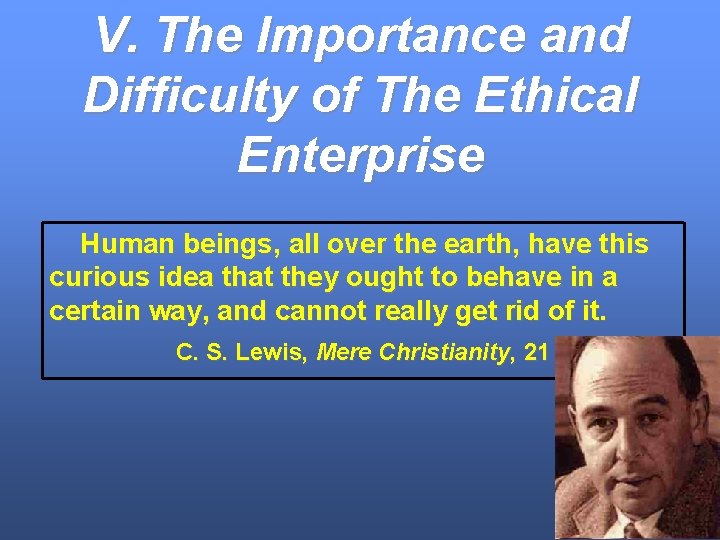
V. The Importance and Difficulty of The Ethical Enterprise Human beings, all over the earth, have this curious idea that they ought to behave in a certain way, and cannot really get rid of it. C. S. Lewis, Mere Christianity, 21
V. The Importance and Difficulty of The Ethical Enterprise A. The Importance of the Ethical Enterprise 2. From a Christian perspective, unethical living compromises and limits our ability to think and act in ways that honor God (Romans 1: 18 -32)
V. The Importance and Difficulty of The Ethical Enterprise Sin corrupts cognition, which leads to more sin, which brings about a further corruption of the mind and so on. The overarching point [of Romans 1] is clear: immoral behavior undermines one’s ability to think straight, at least about certain issues. From these passages, it appears the key subjects about which the depraved mind is blinded are God, ethics, and certain aspects of human nature. James S. Spiegel, The Making of an Atheist, 54
V. The Importance and Difficulty of The Ethical Enterprise A. The Importance of the Ethical Enterprise 3. Ethics provide hope and direction for the good life in the midst of our aimless, despairing, and sin-damaged world (John 10: 10; 1 Peter 3: 15)
V. The Importance and Difficulty of The Ethical Enterprise Such is the tragi-comedy of our situation— we continue to clamour for those very qualities we are rendering impossible. . We laugh at honour and are shocked to find traitors in our midst. We castrate and bid the geldings be fruitful. C. S. Lewis, The Abolition of Man, 35
V. The Importance and Difficulty of The Ethical Enterprise B. The Difficulty of the Ethical Enterprise 1. The Problem of Corruption a. The Corruption of Human Sin (Romans 1: 18 -32)
V. The Importance and Difficulty of The Ethical Enterprise B. The Difficulty of the Ethical Enterprise 1. The Problem of Corruption a. The Corruption of Human Sin (Romans 1: 18 -32) b. The Corruption of the World (1 John 2: 15 -17)
V. The Importance and Difficulty of The Ethical Enterprise B. The Difficulty of the Ethical Enterprise 1. The Problem of Corruption a. The Corruption of Human Sin (Romans 1: 18 -32) b. The Corruption of the World (1 John 2: 15 -17) c. The Corruption of the Devil (2 Corinthians 4: 3 -4, 11: 3)
V. The Importance and Difficulty of The Ethical Enterprise B. The Difficulty of the Ethical Enterprise 2. The Problem of Complexity a. Some contemporary ethical problems are not directly addressed in scripture
V. The Importance and Difficulty of The Ethical Enterprise B. The Difficulty of the Ethical Enterprise 2. The Problem of Complexity a. Some contemporary ethical problems are not directly addressed in scripture b. In some ethical situations, there appear to be competing ethical values
V. The Importance and Difficulty of The Ethical Enterprise B. The Difficulty of the Ethical Enterprise 2. The Problem of Complexity a. Some contemporary ethical problems are not directly addressed in scripture b. In some ethical situations, there appear to be competing ethical values c. In some ethical situations, there appear to be competing ethical responsibilities
V. The Importance and Difficulty of The Ethical Enterprise B. The Difficulty of the Ethical Enterprise 2. The Problem of Complexity d. Our human finitude limits our ability to know all the pertinent factors in making the right ethical decision, especially in large and complex systems
V. The Importance and Difficulty of The Ethical Enterprise B. The Difficulty of the Ethical Enterprise 2. The Problem of Complexity d. Our human finitude limits our ability to know all the pertinent factors in making the right ethical decision, especially in large and complex systems e. There is always a concrete cultural component (i. e. , a context) that both complicates as well as confers important resources for ethical living
VI. Conclusion: The Perennial Promise, Power, and Presence of God and His Word in Pursuing the Ethical Life (Hebrews 4: 12; 13: 5) 1. God as the Ground of Ethics (1 John 4: 7 -8):
VI. Conclusion: The Perennial Promise, Power, and Presence of God and His Word in Pursuing the Ethical Life (Hebrews 4: 12; 13: 5) 1. God as the Ground of Ethics (1 John 4: 7 -8): 2. God as the Norm of Ethics (Matthew 5 -7):
VI. Conclusion: The Perennial Promise, Power, and Presence of God and His Word in Pursuing the Ethical Life (Hebrews 4: 12; 13: 5) 1. God as the Ground of Ethics (1 John 4: 7 -8): 2. God as the Norm of Ethics (Matthew 5 -7): 3. God as the Power for Ethics (John 15):
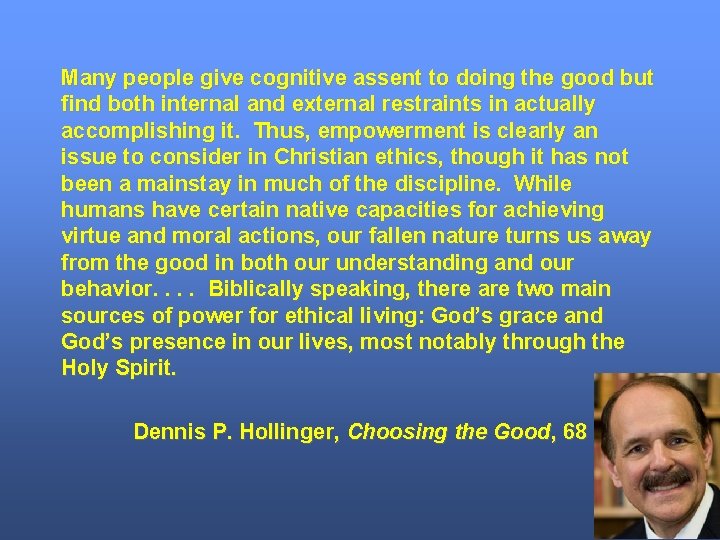
Many people give cognitive assent to doing the good but find both internal and external restraints in actually accomplishing it. Thus, empowerment is clearly an issue to consider in Christian ethics, though it has not been a mainstay in much of the discipline. While humans have certain native capacities for achieving virtue and moral actions, our fallen nature turns us away from the good in both our understanding and our behavior. . Biblically speaking, there are two main sources of power for ethical living: God’s grace and God’s presence in our lives, most notably through the Holy Spirit. Dennis P. Hollinger, Choosing the Good, 68