
Introduction to EPC 201920 Dr Meera Sood m
- Slides: 13
Introduction to EPC 2019/20 Dr Meera Sood m. sood@qmul. ac. uk
Learning Outcomes • Explain the background to EPC • List the Aims and Objectives of EPC • Know how to undertake a Learning Needs Assessment • Discuss the structure for the EPC morning • Discussion about lesson planning • Awareness of the assessment criteria for this unit
Background to EPC • 4 students per group • Split into Group AB and CD • Alternate Tuesday mornings (9 am-12 am) • Students need to continue to meet patients, building on their experiences in Medicine in Society in Year 1 and continue their professional development with the benefit of authentic clinical experiences. • GP will work as a setting which will bring to life the PBL scenarios, contextualising and broadening learning • The opportunity to actively engage with patients in a safe, yet authentic, clinical environment will allow students to reflect on communication skills and attitudes to patients and illness, forming an important aspect of their professional development.
Module Aims and Outcomes Module Aims: • To build on the general practice experience and patient contact in Medicine in Society in Year 1, bring to life the ‘core’ conditions covered in the PBL sessions with clinical experience. Learning Outcomes: • Apply their theoretical knowledge to clinical situations • Talk appropriately with patients • Identify the variety of patients’ concerns, the patients perspective of illness treatment and its impact on them and their families • Perform appropriate clinical examinations such as blood pressure and other basic examinations under adequate supervision • Use their observation of senior colleagues in clinical practice to reflect on the attributes required of them as professionals
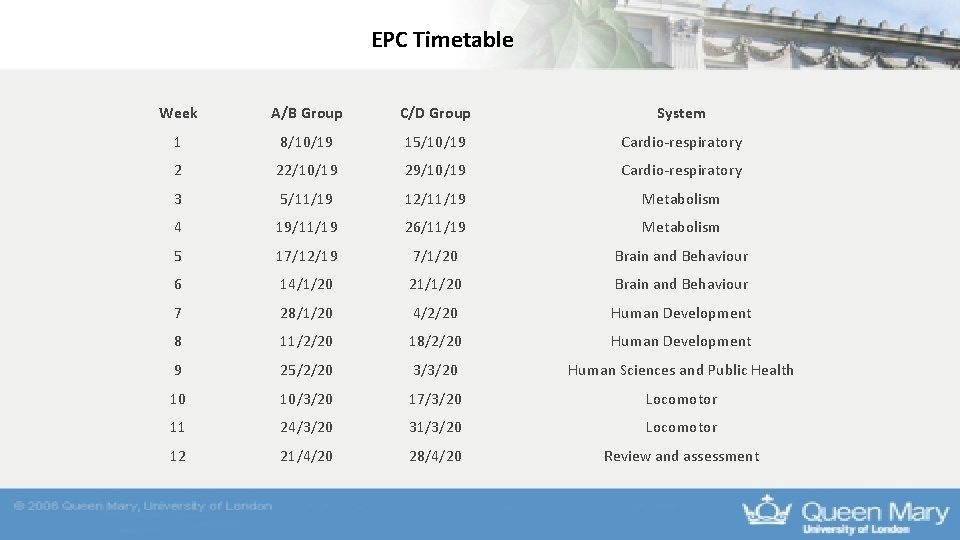
EPC Timetable Week A/B Group C/D Group System 1 8/10/19 15/10/19 Cardio-respiratory 2 22/10/19 29/10/19 Cardio-respiratory 3 5/11/19 12/11/19 Metabolism 4 19/11/19 26/11/19 Metabolism 5 17/12/19 7/1/20 Brain and Behaviour 6 14/1/20 21/1/20 Brain and Behaviour 7 28/1/20 4/2/20 Human Development 8 11/2/20 18/2/20 Human Development 9 25/2/20 3/3/20 Human Sciences and Public Health 10 10/3/20 17/3/20 Locomotor 11 24/3/20 31/3/20 Locomotor 12 21/4/20 28/4/20 Review and assessment
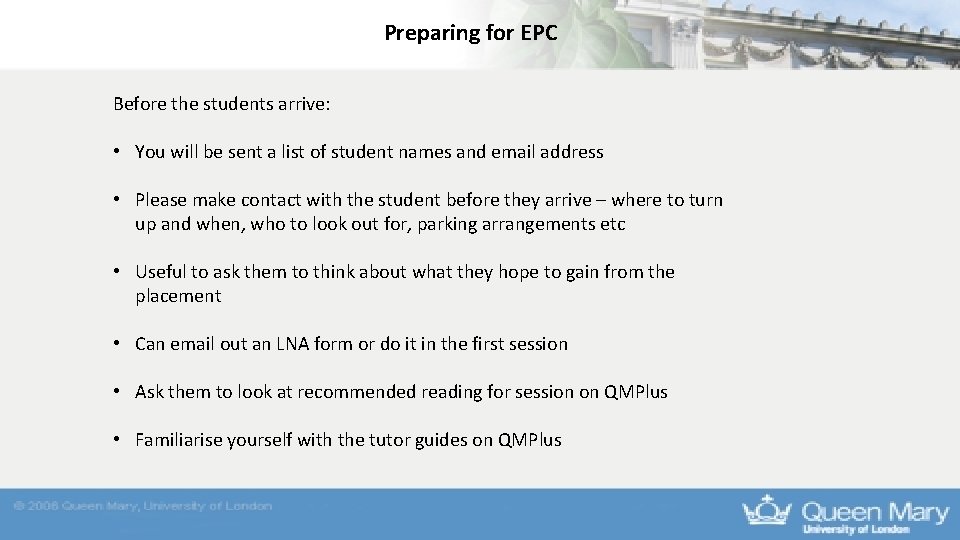
Preparing for EPC Before the students arrive: • You will be sent a list of student names and email address • Please make contact with the student before they arrive – where to turn up and when, who to look out for, parking arrangements etc • Useful to ask them to think about what they hope to gain from the placement • Can email out an LNA form or do it in the first session • Ask them to look at recommended reading for session on QMPlus • Familiarise yourself with the tutor guides on QMPlus
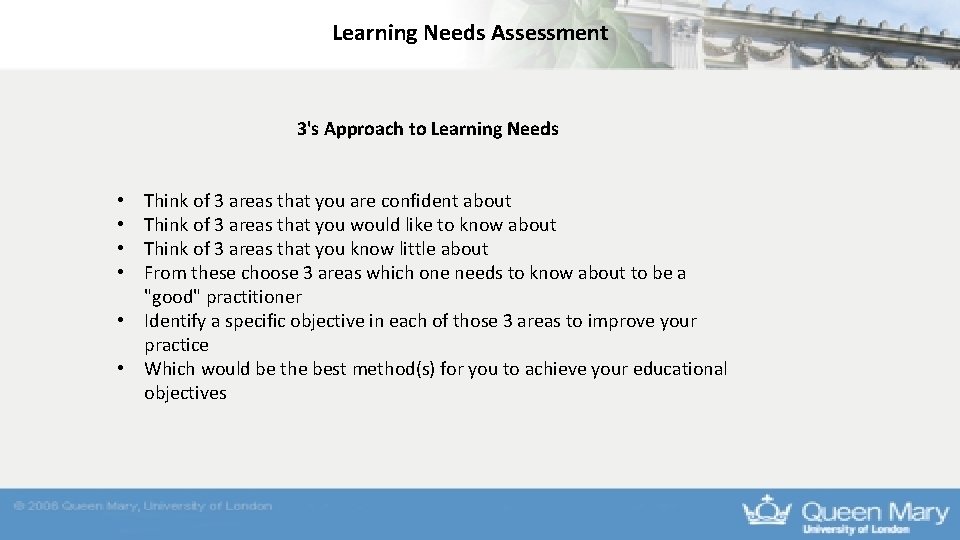
Learning Needs Assessment 3's Approach to Learning Needs Think of 3 areas that you are confident about Think of 3 areas that you would like to know about Think of 3 areas that you know little about From these choose 3 areas which one needs to know about to be a "good" practitioner • Identify a specific objective in each of those 3 areas to improve your practice • Which would be the best method(s) for you to achieve your educational objectives • •
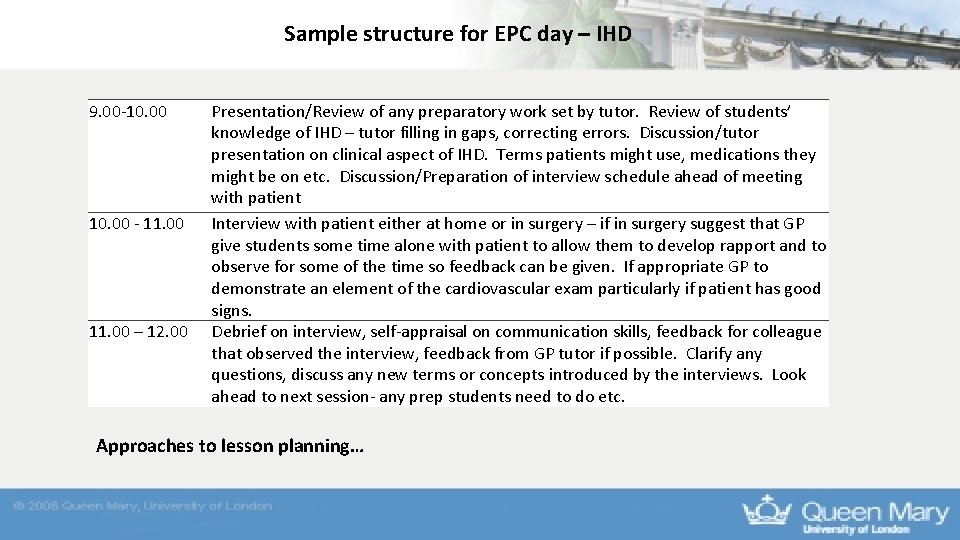
Sample structure for EPC day – IHD 9. 00 -10. 00 Presentation/Review of any preparatory work set by tutor. Review of students’ knowledge of IHD – tutor filling in gaps, correcting errors. Discussion/tutor presentation on clinical aspect of IHD. Terms patients might use, medications they might be on etc. Discussion/Preparation of interview schedule ahead of meeting Typical with. Morning: patient 10. 00 - 11. 00 Interview with patient either at home or in surgery – if in surgery suggest that GP 9 -10 Group tutorial and prepare for patient meeting give students some time alone with patient to allow them to develop rapport and to 10 -11 Students chat to patient observe for some of the time so feedback can be given. If appropriate GP to 11 -12 Debrief and reflection. Prep work for next session. demonstrate an element of the cardiovascular exam particularly if patient has good signs. 11. 00 – 12. 00 Debrief on interview, self-appraisal on communication skills, feedback for colleague that observed the interview, feedback from GP tutor if possible. Clarify any questions, discuss any new terms or concepts introduced by the interviews. Look ahead to next session- any prep students need to do etc. Approaches to lesson planning…
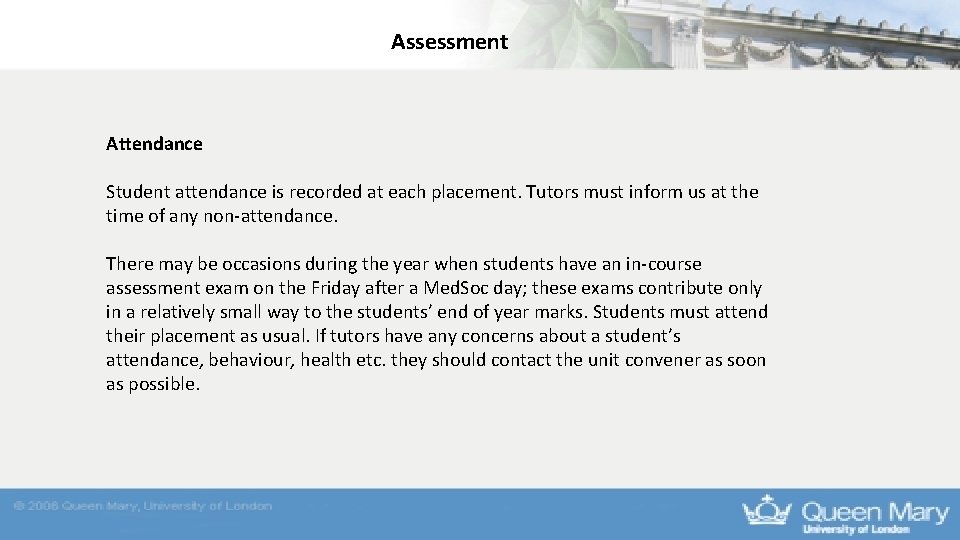
Assessment Attendance Student attendance is recorded at each placement. Tutors must inform us at the time of any non-attendance. There may be occasions during the year when students have an in-course assessment exam on the Friday after a Med. Soc day; these exams contribute only in a relatively small way to the students’ end of year marks. Students must attend their placement as usual. If tutors have any concerns about a student’s attendance, behaviour, health etc. they should contact the unit convener as soon as possible.
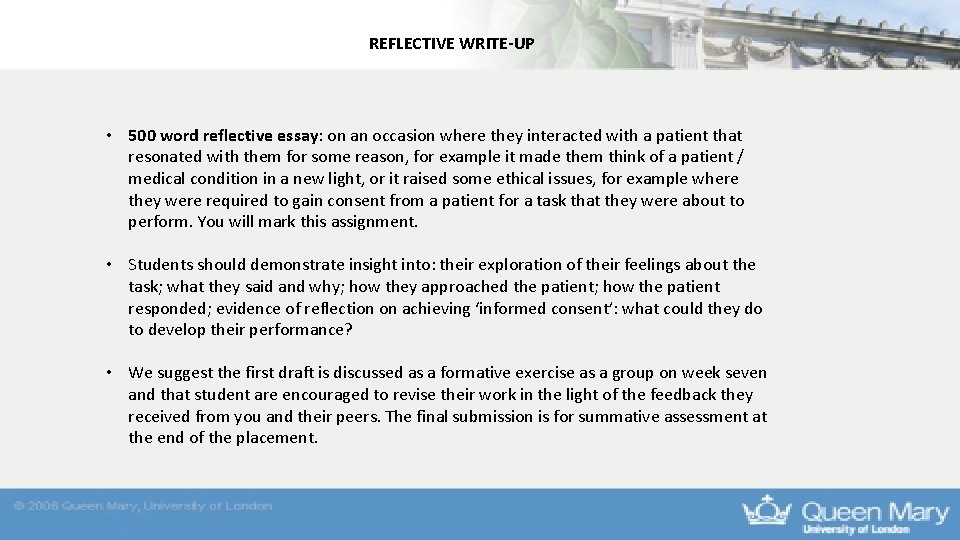
REFLECTIVE WRITE-UP • 500 word reflective essay: on an occasion where they interacted with a patient that resonated with them for some reason, for example it made them think of a patient / medical condition in a new light, or it raised some ethical issues, for example where they were required to gain consent from a patient for a task that they were about to perform. You will mark this assignment. • Students should demonstrate insight into: their exploration of their feelings about the task; what they said and why; how they approached the patient; how the patient responded; evidence of reflection on achieving ‘informed consent’: what could they do to develop their performance? • We suggest the first draft is discussed as a formative exercise as a group on week seven and that student are encouraged to revise their work in the light of the feedback they received from you and their peers. The final submission is for summative assessment at the end of the placement.
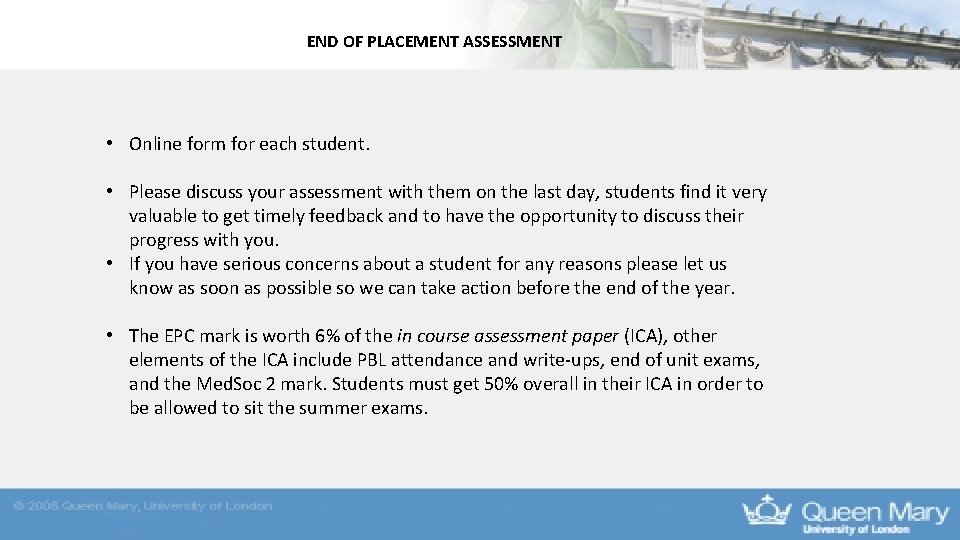
END OF PLACEMENT ASSESSMENT • Online form for each student. • Please discuss your assessment with them on the last day, students find it very valuable to get timely feedback and to have the opportunity to discuss their progress with you. • If you have serious concerns about a student for any reasons please let us know as soon as possible so we can take action before the end of the year. • The EPC mark is worth 6% of the in course assessment paper (ICA), other elements of the ICA include PBL attendance and write-ups, end of unit exams, and the Med. Soc 2 mark. Students must get 50% overall in their ICA in order to be allowed to sit the summer exams.
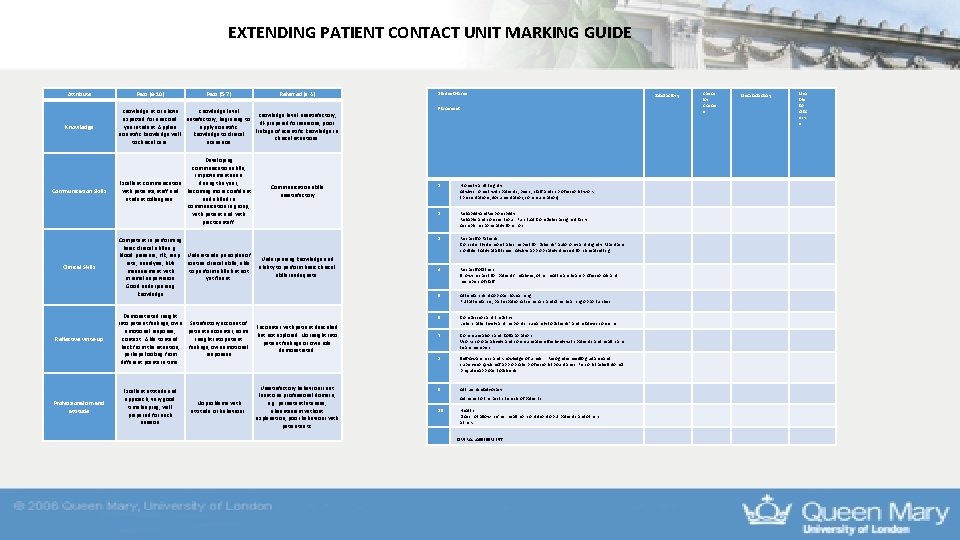
EXTENDING PATIENT CONTACT UNIT MARKING GUIDE Attribute Pass (8 -10) Pass (5 -7) Referred (≤ 4) Knowledge at or above expected for a second year student. Applies scientific knowledge well to clinical care. Knowledge level satisfactory, beginning to apply scientific knowledge to clinical scenarios Knowledge level unsatisfactory, ill-prepared for sessions, poor linkage of scientific knowledge in clinical situations. Communication Skills Clinical Skills Reflective write-up Professionalism and attitude Developing communication skills, improvement seen during the year, Excellent communication with patients, staff and becoming more confident student colleagues. and skilled in communication in group, with patient and with practice staff. Competent in performing basic clinical skills e. g. blood pressure, HR, resp. Understands principles of rate, urinalysis, BMI routine clinical skills, able measurement with to perform skills but not minimal supervision. yet fluent. Good underpinning knowledge Demonstrated insight into patient feelings, own emotional response, context. Able to stand back from the situation, perhaps looking from different points in time. Excellent attitude and approach, very good timekeeping, well prepared for each session Communication skills unsatisfactory Underpinning knowledge and ability to perform basic clinical skills inadequate. Satisfactory account of patient encounter, some insight into patient feelings, own emotional responses Encounter with patient described but not explored. No insight into patient feelings or own role demonstrated. No problems with attitude or behaviour. Unsatisfactory behaviour in at least one professional domain, e. g. persistent lateness, absenteeism without explanation, poor behaviour with patients etc. Student Name: Placement: 1 Honesty and. Integrity Always honest with patients, peers, staff and in professional work (presentations, documentation, communication) 2 Reliabilityand. Responsibility: Reliable and conscientious. Punctual. Completes assigned tasks. Accepts responsibility for errors. 3 Respectfor. Patients: Consistently demonstrates respect for patients’ autonomy and dignity. Maintains confidentiality at all times. Always appropriately dressed for clinical setting. 4 Respectfor. Others: Shows respect for patients’ relatives, other healthcare team professionals and members of staff 5 Attendanceand. Approachto. Learning: Full attendance, participation at seminars andother learning opportunities 6 Compassion and Empathy: Listens attentively and responds humanely to patients’ and relatives concerns 7 Communication and Collaboration: Works co-operatively and communicates effectively with patients and healthcare team members 8 Self-Awareness and Knowledge of Limits: Recognizesneedforguidanceand supervision, awareof appropriate professional boundaries. Personal beliefs do not prejudiceapproachtopatients 9 Altruismand. Advocacy: Adheres to the best interests of patients 10 Health: Does not allow his/her health or condition to put patients and others at risk OVERALLASSESSMENT Satisfactory Cause for Concer n Unsatisfactory Una ble to Obs erv e
Contact Details Maria Hayfron-Benjamin Unit Lead m. j. hayfron-benjamin@qmul. ac. uk Dr Meera Sood m. sood@qmul. ac. uk