
INTRODUCTION TO ENVIRONMENTAL MONITORING Introduction to Environmental Science
- Slides: 36
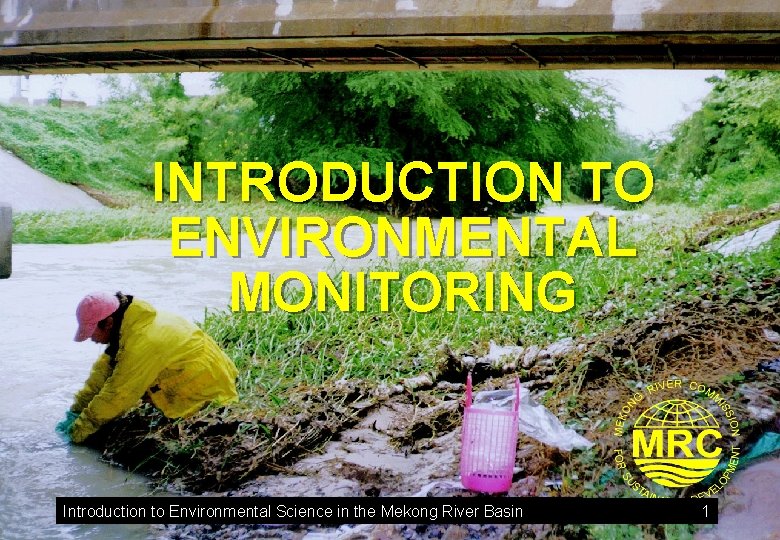
INTRODUCTION TO ENVIRONMENTAL MONITORING Introduction to Environmental Science in the Mekong River Basin 1
Lesson Learning Goals At the end of this lesson you should be able to: è Discuss the application of monitoring in assessing ecosystem health è Differentiate among monitoring program types and objectives è Describe a generic monitoring framework è Explain the different investigative tools available in undertaking a monitoring program Introduction to Environmental Science in the Mekong River Basin 2
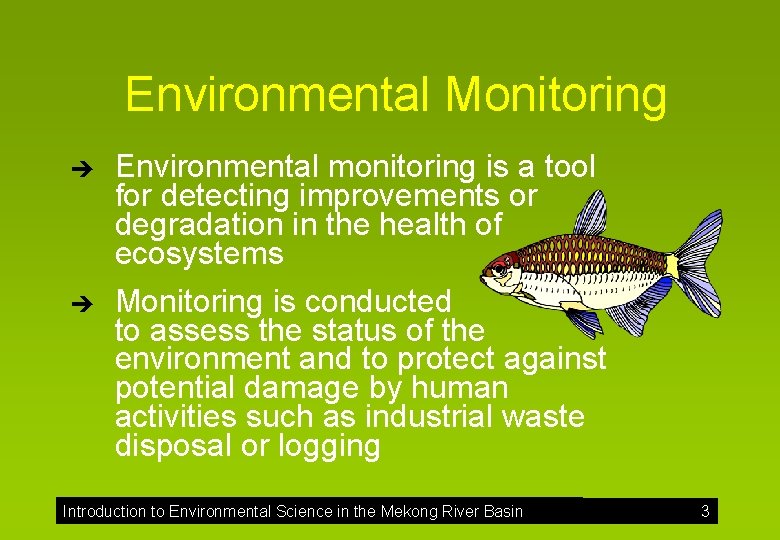
Environmental Monitoring è è Environmental monitoring is a tool for detecting improvements or degradation in the health of ecosystems Monitoring is conducted to assess the status of the environment and to protect against potential damage by human activities such as industrial waste disposal or logging Introduction to Environmental Science in the Mekong River Basin 3
Environmental Monitoring Defined EIA monitoring is the planned, systematic collection of environmental data to meet specific objectives and environmental needs Introduction to Environmental Science in the Mekong River Basin 4
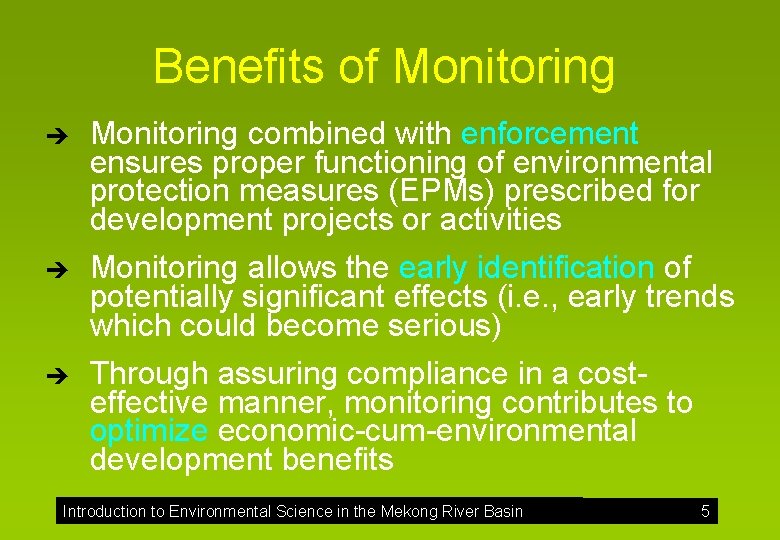
Benefits of Monitoring è è è Monitoring combined with enforcement ensures proper functioning of environmental protection measures (EPMs) prescribed for development projects or activities Monitoring allows the early identification of potentially significant effects (i. e. , early trends which could become serious) Through assuring compliance in a costeffective manner, monitoring contributes to optimize economic-cum-environmental development benefits Introduction to Environmental Science in the Mekong River Basin 5
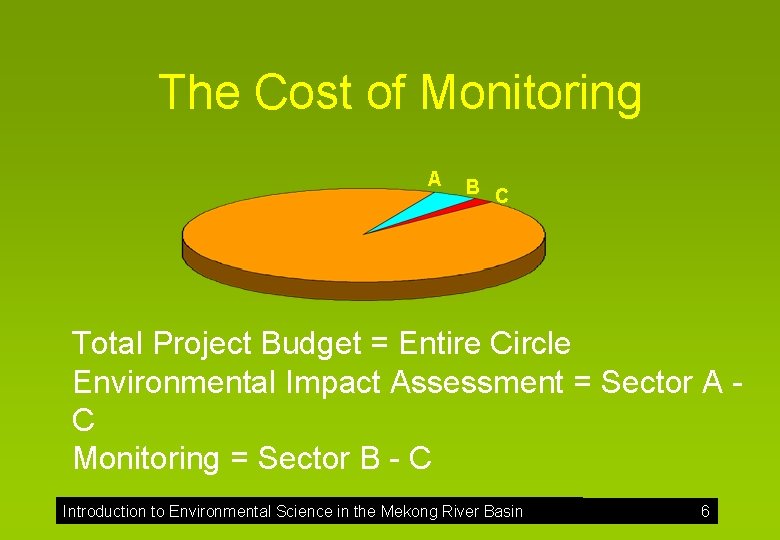
The Cost of Monitoring A B C Total Project Budget = Entire Circle Environmental Impact Assessment = Sector A C Monitoring = Sector B - C Introduction to Environmental Science in the Mekong River Basin 6
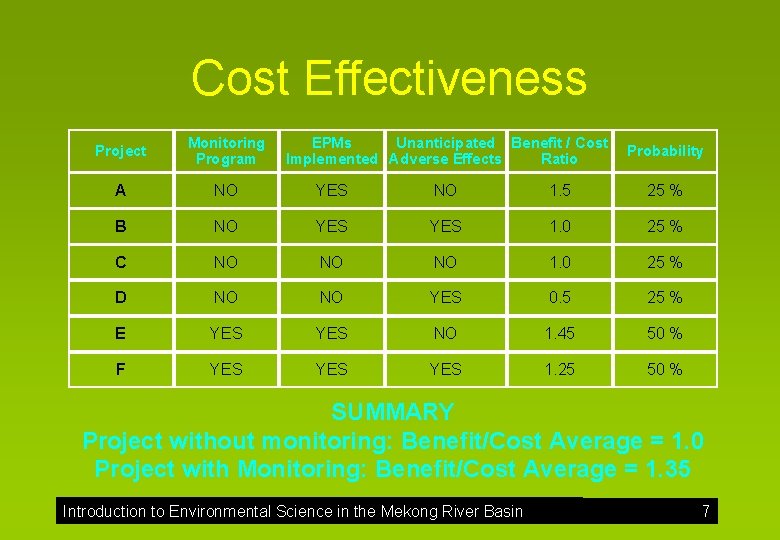
Cost Effectiveness Project Monitoring Program EPMs Unanticipated Benefit / Cost Implemented Adverse Effects Ratio A NO YES NO 1. 5 25 % B NO YES 1. 0 25 % C NO NO NO 1. 0 25 % D NO NO YES 0. 5 25 % E YES NO 1. 45 50 % F YES YES 1. 25 50 % Probability SUMMARY Project without monitoring: Benefit/Cost Average = 1. 0 Project with Monitoring: Benefit/Cost Average = 1. 35 Introduction to Environmental Science in the Mekong River Basin 7
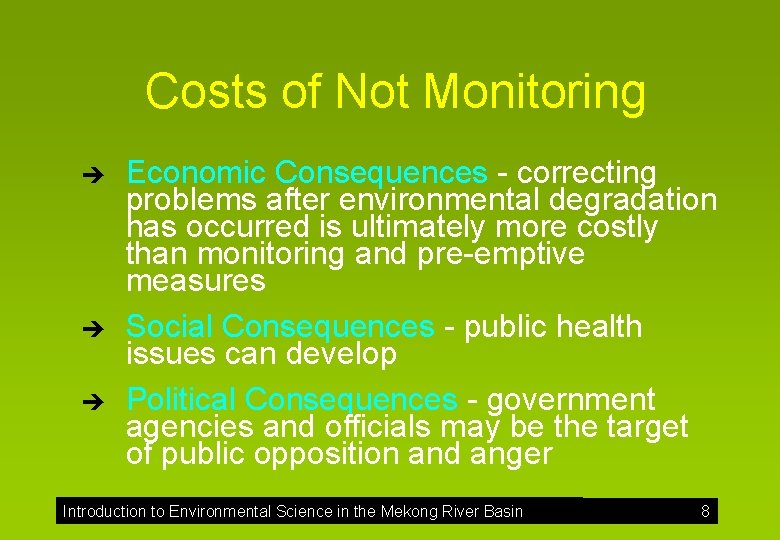
Costs of Not Monitoring è è è Economic Consequences - correcting problems after environmental degradation has occurred is ultimately more costly than monitoring and pre-emptive measures Social Consequences - public health issues can develop Political Consequences - government agencies and officials may be the target of public opposition and anger Introduction to Environmental Science in the Mekong River Basin 8
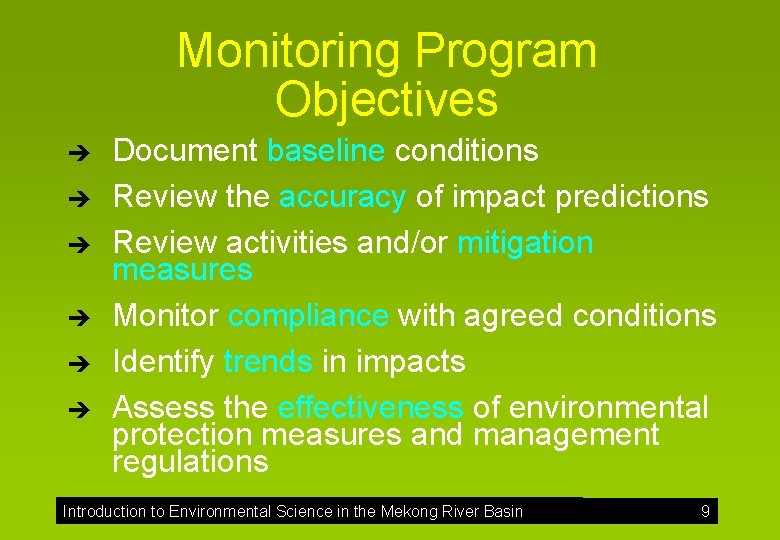
Monitoring Program Objectives è è è Document baseline conditions Review the accuracy of impact predictions Review activities and/or mitigation measures Monitor compliance with agreed conditions Identify trends in impacts Assess the effectiveness of environmental protection measures and management regulations Introduction to Environmental Science in the Mekong River Basin 9
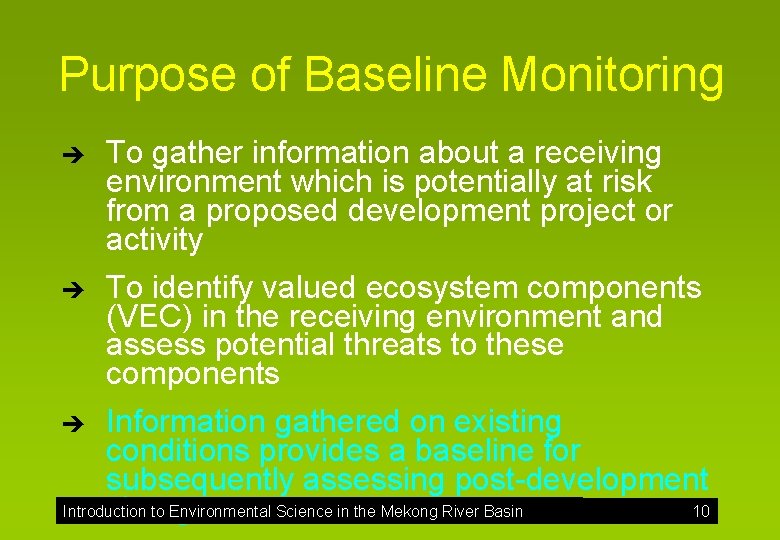
Purpose of Baseline Monitoring è è To gather information about a receiving environment which is potentially at risk from a proposed development project or activity To identify valued ecosystem components (VEC) in the receiving environment and assess potential threats to these components Information gathered on existing conditions provides a baseline for subsequently assessing post-development Introduction to Environmental Science in the Mekong River Basin 10 changes è
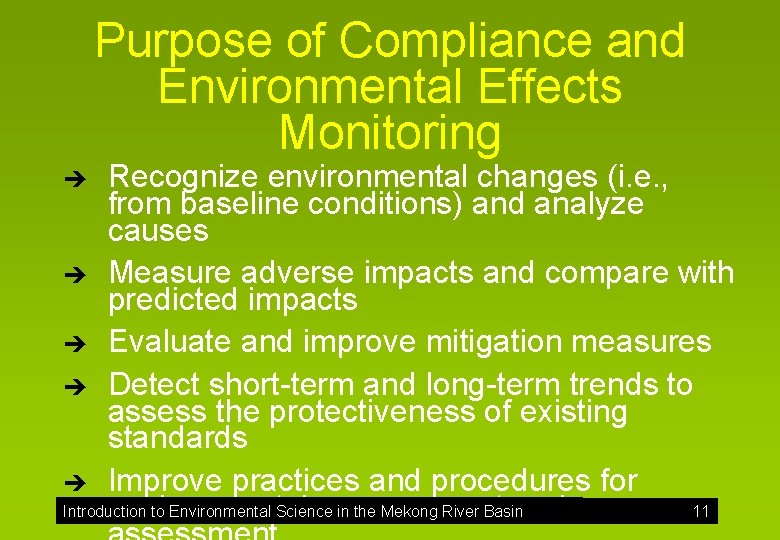
Purpose of Compliance and Environmental Effects Monitoring Recognize environmental changes (i. e. , from baseline conditions) and analyze causes è Measure adverse impacts and compare with predicted impacts è Evaluate and improve mitigation measures è Detect short-term and long-term trends to assess the protectiveness of existing standards è Improve practices and procedures for Introduction to Environmental Science in the Mekong River Basin 11 environmental management and è
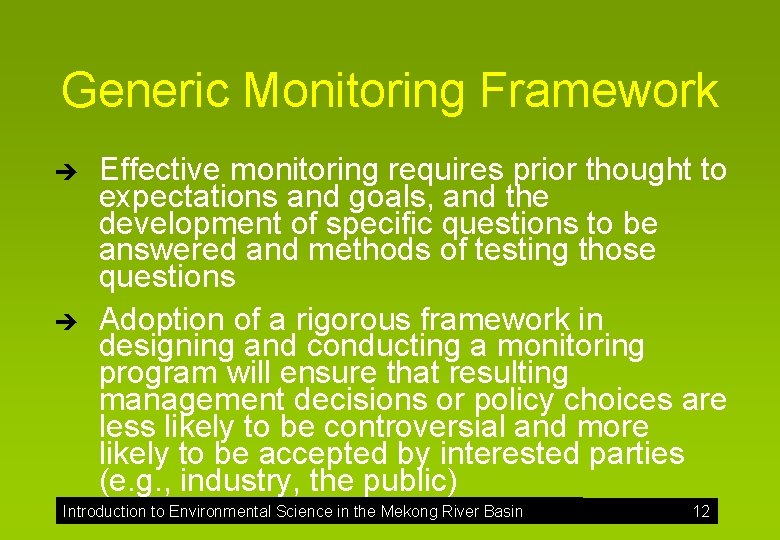
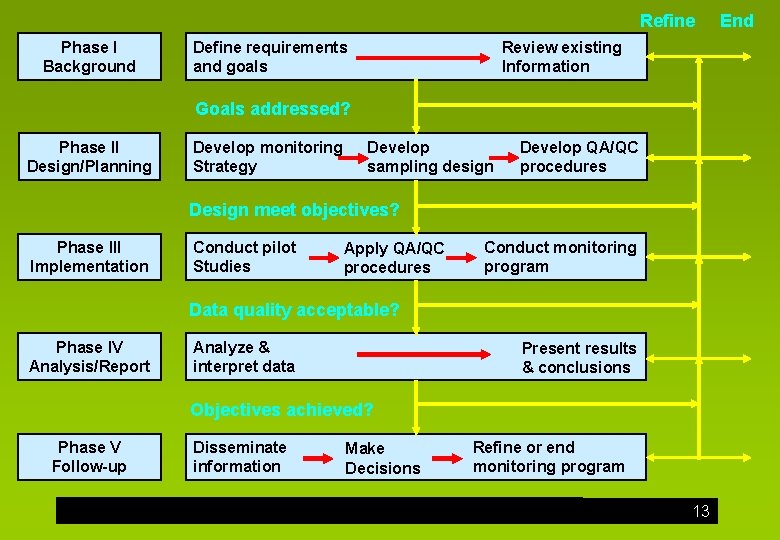
Generic Monitoring Framework è è Effective monitoring requires prior thought to expectations and goals, and the development of specific questions to be answered and methods of testing those questions Adoption of a rigorous framework in designing and conducting a monitoring program will ensure that resulting management decisions or policy choices are less likely to be controversial and more likely to be accepted by interested parties (e. g. , industry, the public) Introduction to Environmental Science in the Mekong River Basin 12
Refine Phase I Background Define requirements and goals Review existing Information Goals addressed? Phase II Design/Planning Develop monitoring Strategy Develop sampling design Develop QA/QC procedures Design meet objectives? Phase III Implementation Conduct pilot Studies Apply QA/QC procedures Conduct monitoring program Data quality acceptable? Phase IV Analysis/Report Analyze & interpret data Present results & conclusions Objectives achieved? Phase V Follow-up Disseminate information Make Decisions Refine or end monitoring program 13 End
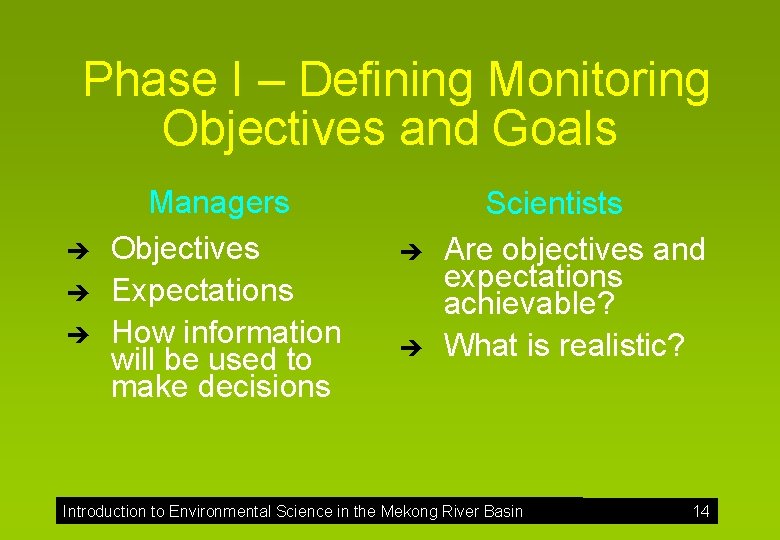
Phase I – Defining Monitoring Objectives and Goals è è è Managers Objectives Expectations How information will be used to make decisions è è Scientists Are objectives and expectations achievable? What is realistic? Introduction to Environmental Science in the Mekong River Basin 14
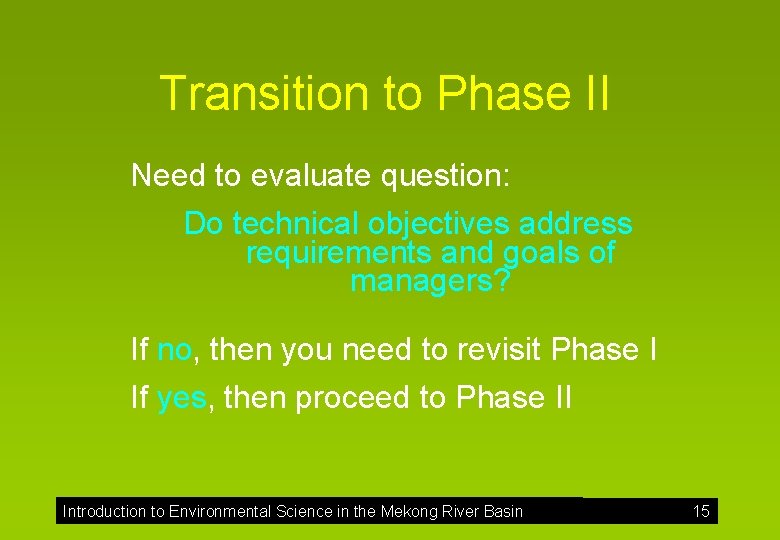
Transition to Phase II Need to evaluate question: Do technical objectives address requirements and goals of managers? If no, then you need to revisit Phase I If yes, then proceed to Phase II Introduction to Environmental Science in the Mekong River Basin 15
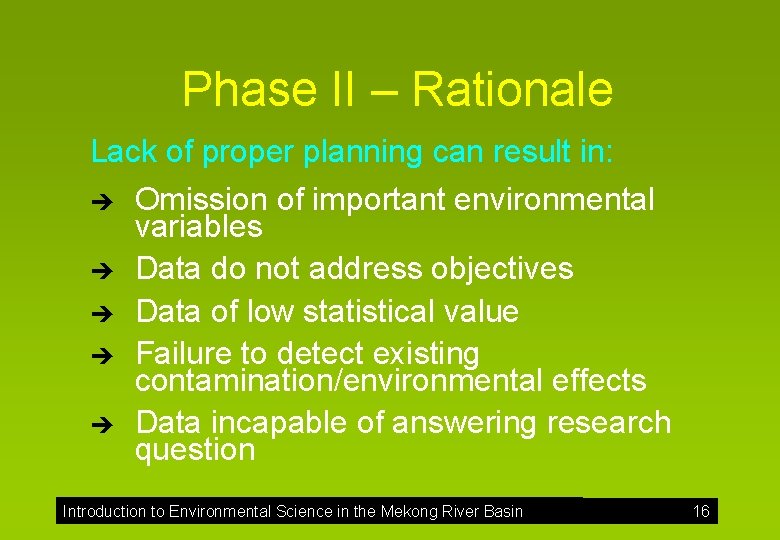
Phase II – Rationale Lack of proper planning can result in: è è è Omission of important environmental variables Data do not address objectives Data of low statistical value Failure to detect existing contamination/environmental effects Data incapable of answering research question Introduction to Environmental Science in the Mekong River Basin 16
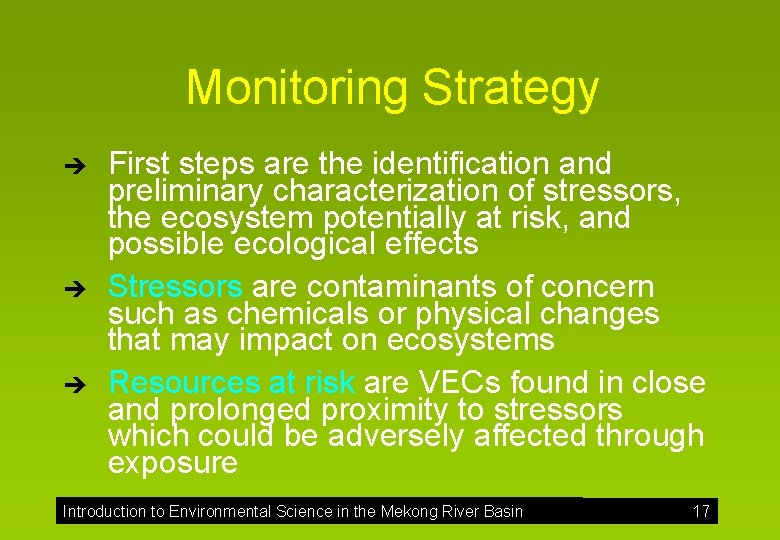
Monitoring Strategy è è è First steps are the identification and preliminary characterization of stressors, the ecosystem potentially at risk, and possible ecological effects Stressors are contaminants of concern such as chemicals or physical changes that may impact on ecosystems Resources at risk are VECs found in close and prolonged proximity to stressors which could be adversely affected through exposure Introduction to Environmental Science in the Mekong River Basin 17
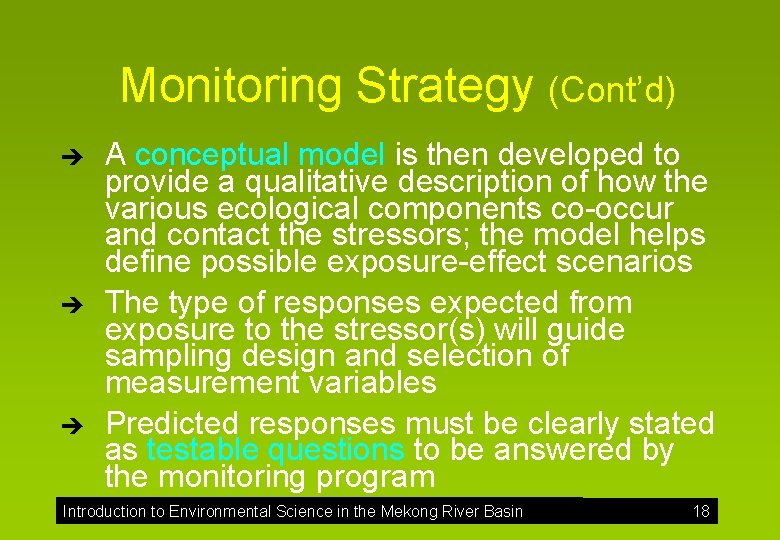
Monitoring Strategy (Cont’d) è è è A conceptual model is then developed to provide a qualitative description of how the various ecological components co-occur and contact the stressors; the model helps define possible exposure-effect scenarios The type of responses expected from exposure to the stressor(s) will guide sampling design and selection of measurement variables Predicted responses must be clearly stated as testable questions to be answered by the monitoring program Introduction to Environmental Science in the Mekong River Basin 18
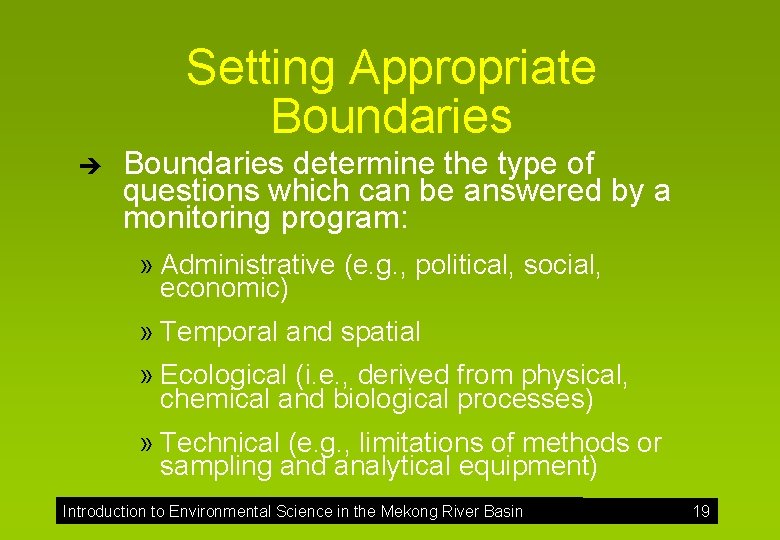
Setting Appropriate Boundaries è Boundaries determine the type of questions which can be answered by a monitoring program: » Administrative (e. g. , political, social, economic) » Temporal and spatial » Ecological (i. e. , derived from physical, chemical and biological processes) » Technical (e. g. , limitations of methods or sampling and analytical equipment) Introduction to Environmental Science in the Mekong River Basin 19
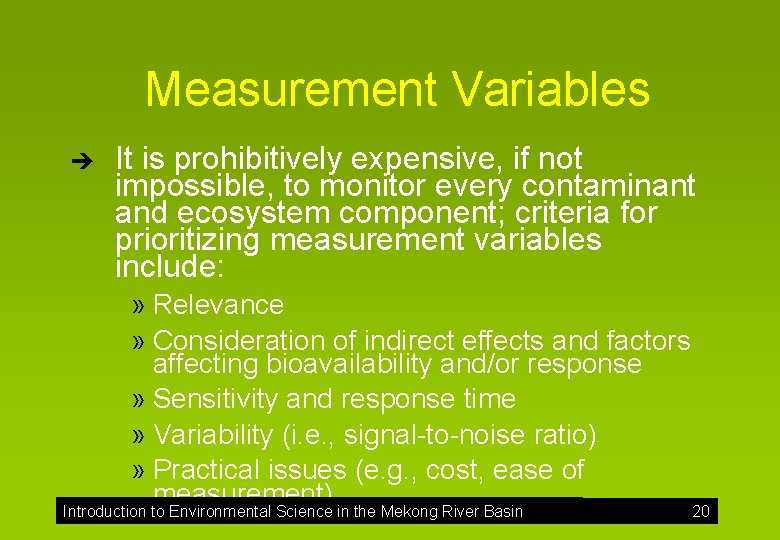
Measurement Variables è It is prohibitively expensive, if not impossible, to monitor every contaminant and ecosystem component; criteria for prioritizing measurement variables include: » Relevance » Consideration of indirect effects and factors affecting bioavailability and/or response » Sensitivity and response time » Variability (i. e. , signal-to-noise ratio) » Practical issues (e. g. , cost, ease of measurement) Introduction to Environmental Science in the Mekong River Basin 20
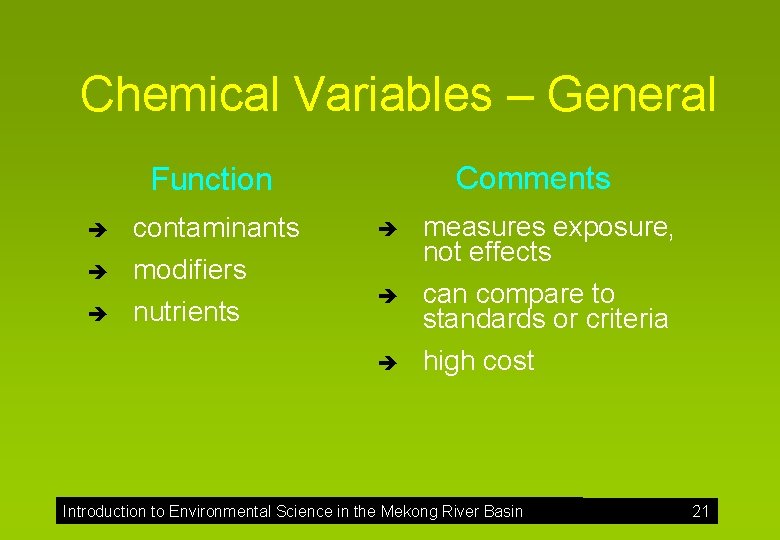
Chemical Variables – General Comments Function è è è contaminants modifiers nutrients è è è measures exposure, not effects can compare to standards or criteria high cost Introduction to Environmental Science in the Mekong River Basin 21
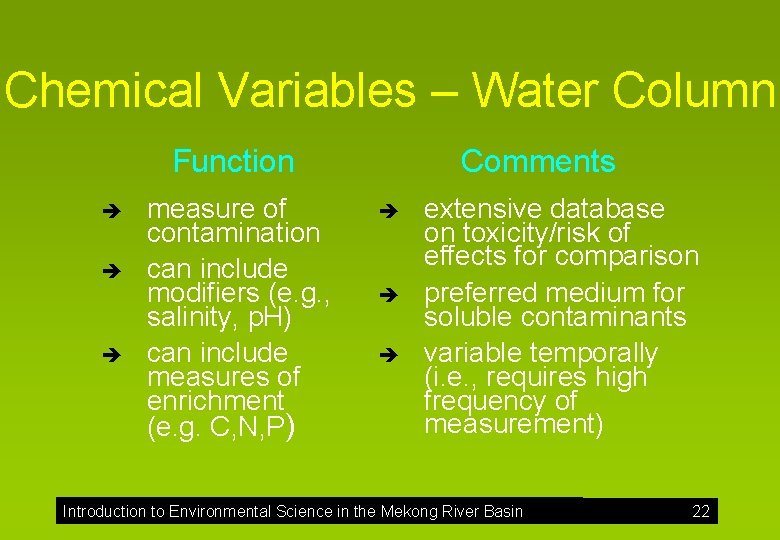
Chemical Variables – Water Column Function è è è measure of contamination can include modifiers (e. g. , salinity, p. H) can include measures of enrichment (e. g. C, N, P) Comments è è è extensive database on toxicity/risk of effects for comparison preferred medium for soluble contaminants variable temporally (i. e. , requires high frequency of measurement) Introduction to Environmental Science in the Mekong River Basin 22
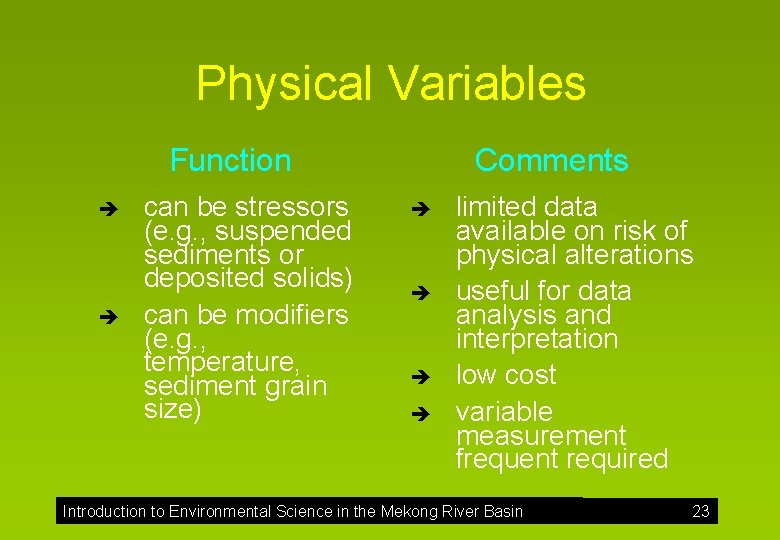
Physical Variables Function è è can be stressors (e. g. , suspended sediments or deposited solids) can be modifiers (e. g. , temperature, sediment grain size) Comments è è limited data available on risk of physical alterations useful for data analysis and interpretation low cost variable measurement frequent required Introduction to Environmental Science in the Mekong River Basin 23
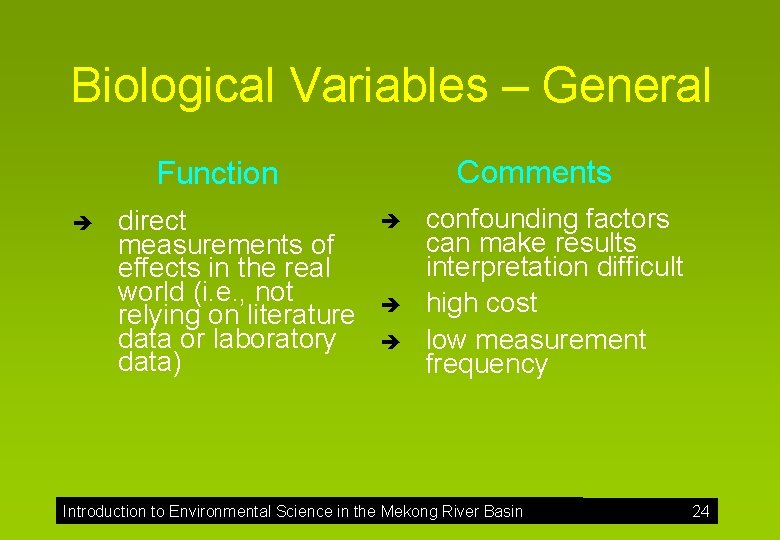
Biological Variables – General Comments Function è direct measurements of effects in the real world (i. e. , not relying on literature data or laboratory data) è è è confounding factors can make results interpretation difficult high cost low measurement frequency Introduction to Environmental Science in the Mekong River Basin 24
Biological Variables – Fish Function è è measure effects at many levels (i. e. , community, population, organism, tissue, cellular) important socially Comments è è long history in monitoring scale may be too broad depending on species of concern generally sensitive to enrichment, contaminants and physical alteration high cost; low frequency Introduction to Environmental Science in the Mekong River Basin 25
Types of Sampling è Haphazard = è Judgement = place in specific locations Probability = place randomly for statistical reasons Systematic = place evenly over area of concern è è place stations anywhere Introduction to Environmental Science in the Mekong River Basin 26
Units of Replication Consider: » Site selection method (e. g, . haphazard) » Sub-sampling occur within sites? » Composite versus replication General rules for selection choice: » Judgement to address specific sites when not extrapolating to other areas » Systematic to detect patterns » Random to generalize to larger population Introduction to Environmental Science in the Mekong River Basin 27
Monitoring Study Design Types è Spatial or Control-Impact (CI) » Potential impact area compared to one or more reference (control) areas è Temporal or Before-After (BA) » Potential impact area compared before and after event of interest (e. g. , effluent discharge) è Spatial-temporal or Before-After-Control. Impact (BACI) » Combines BA and CI designs; most powerful Introduction to Environmental Science in the Mekong River Basin 28
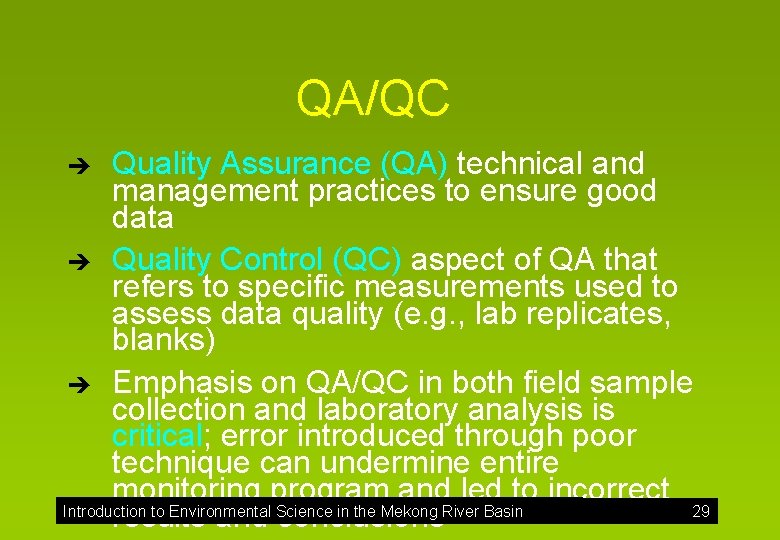
QA/QC Quality Assurance (QA) technical and management practices to ensure good data è Quality Control (QC) aspect of QA that refers to specific measurements used to assess data quality (e. g. , lab replicates, blanks) è Emphasis on QA/QC in both field sample collection and laboratory analysis is critical; error introduced through poor technique can undermine entire monitoring program and led to incorrect Introduction to Environmental Science in the Mekong River Basin 29 results and conclusions è
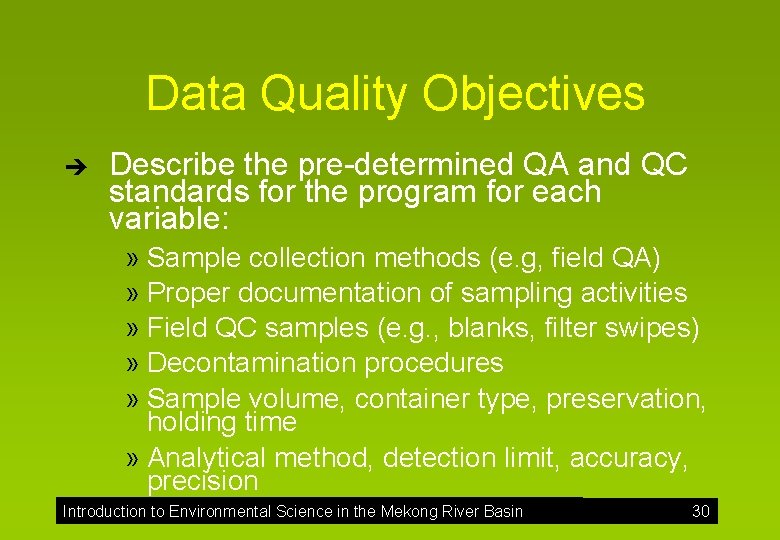
Data Quality Objectives è Describe the pre-determined QA and QC standards for the program for each variable: » Sample collection methods (e. g, field QA) » Proper documentation of sampling activities » Field QC samples (e. g. , blanks, filter swipes) » Decontamination procedures » Sample volume, container type, preservation, holding time » Analytical method, detection limit, accuracy, precision Introduction to Environmental Science in the Mekong River Basin 30
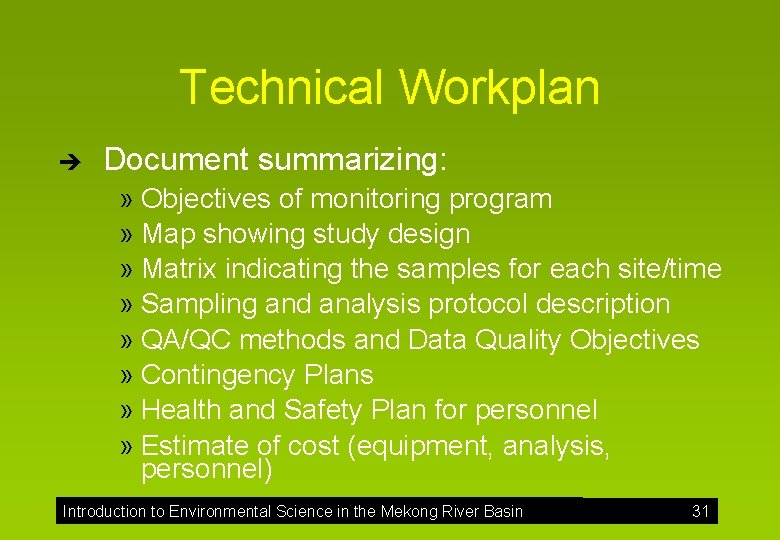
Technical Workplan è Document summarizing: » Objectives of monitoring program » Map showing study design » Matrix indicating the samples for each site/time » Sampling and analysis protocol description » QA/QC methods and Data Quality Objectives » Contingency Plans » Health and Safety Plan for personnel » Estimate of cost (equipment, analysis, personnel) Introduction to Environmental Science in the Mekong River Basin 31
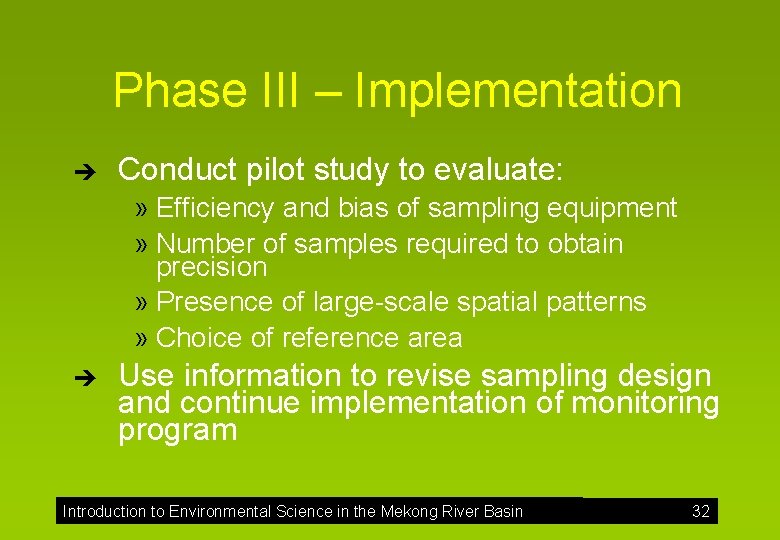
Phase III – Implementation è Conduct pilot study to evaluate: » Efficiency and bias of sampling equipment » Number of samples required to obtain precision » Presence of large-scale spatial patterns » Choice of reference area è Use information to revise sampling design and continue implementation of monitoring program Introduction to Environmental Science in the Mekong River Basin 32
Phase IV – Data Analysis Considerations è è è Screen data for errors or outliers Reduce or summarize data as needed Transform data as needed Evaluate testable hypotheses using statistical tests selected in Phase II Screen results/residuals; check robustness; power analysis USE A STATISTICIAN!!! Introduction to Environmental Science in the Mekong River Basin 33
Data Analyses è è The monitoring program design and statistical model chosen in Phase II will determine the type of analysis possible (e. g. , summary and descriptive statistics, analysis of variance or covariance, regression or correlation) Correctly done statistical analysis is critical to the clear presentation of monitoring program results; must convey key findings to managers and decision makers and importance of any uncertainty associated with the results Introduction to Environmental Science in the Mekong River Basin 34
Phase V – Follow-Up è è è Communicate monitoring program results to managers and decision makers; figures and tables are best way to summarize results for non-technical audiences Implement corrective management actions where required (e. g. , require industry to adopt additional mitigative measures) Identify data gaps and unresolved issues for further investigation Introduction to Environmental Science in the Mekong River Basin 35
Concluding Thoughts Important points to remember are: è Well-designed monitoring programs can provide important feedback on the actual environment impacts of development projects or activities è Baseline monitoring is essential to provide a understanding of existing environmental conditions and VECs at risk è Follow-up monitoring programs assess the effectiveness of management responses to development (e. g. , EIA requirements for large projects) and the overall protectiveness of environmental protection regulations Introduction to Environmental Science in the Mekong River Basin 36