
Introduction to Entropy by Mike Roller THIS MEANS

Introduction to Entropy by Mike Roller
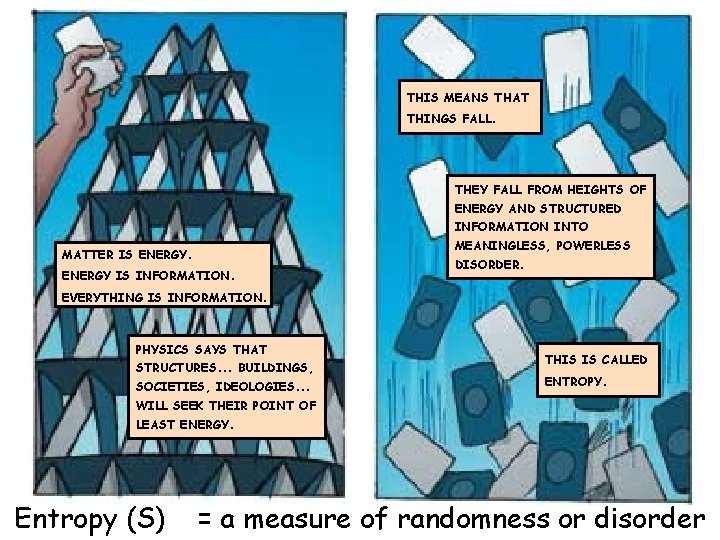
THIS MEANS THAT THINGS FALL. THEY FALL FROM HEIGHTS OF ENERGY AND STRUCTURED INFORMATION INTO MEANINGLESS, POWERLESS MATTER IS ENERGY IS INFORMATION. DISORDER. EVERYTHING IS INFORMATION. PHYSICS SAYS THAT STRUCTURES. . . BUILDINGS, SOCIETIES, IDEOLOGIES. . . THIS IS CALLED ENTROPY. WILL SEEK THEIR POINT OF LEAST ENERGY. Entropy (S) = a measure of randomness or disorder

Entropy: Time’s Arrow
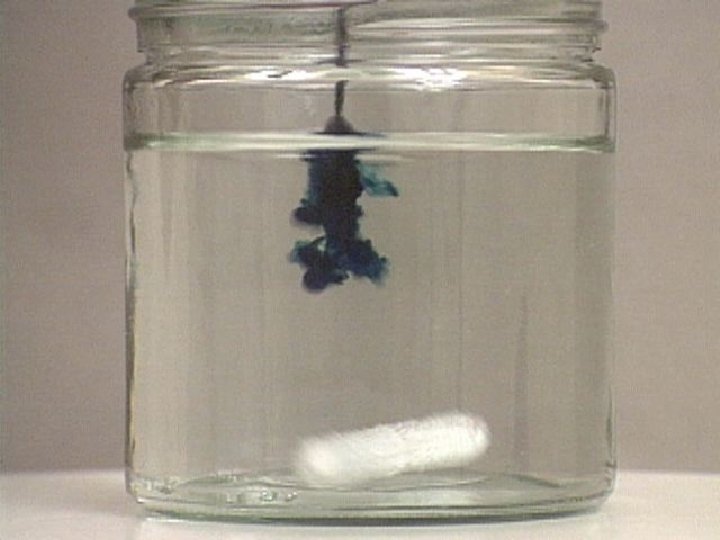

Second Law of Thermodynamics occurs without outside intervention In any spontaneous process, the entropy of the universe increases. ΔSuniverse > 0 Another version of the 2 nd Law: Energy spontaneously spreads out if it has no outside resistance Entropy measures the spontaneous dispersal of energy as a function of temperature How much energy is spread out How widely spread out it becomes Entropy change = “energy dispersed”/T
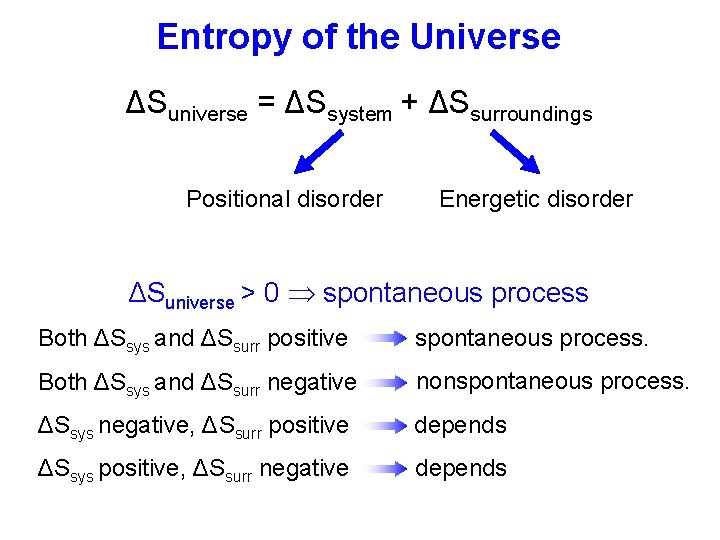
Entropy of the Universe ΔSuniverse = ΔSsystem + ΔSsurroundings Positional disorder Energetic disorder ΔSuniverse > 0 spontaneous process Both ΔSsys and ΔSsurr positive spontaneous process. Both ΔSsys and ΔSsurr negative nonspontaneous process. ΔSsys negative, ΔSsurr positive depends ΔSsys positive, ΔSsurr negative depends
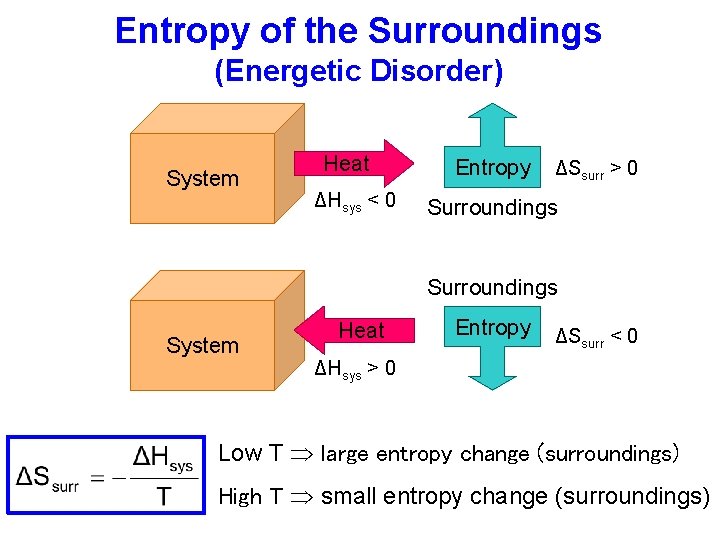
Entropy of the Surroundings (Energetic Disorder) System Heat ΔHsys < 0 Entropy ΔSsurr > 0 Surroundings System Heat Entropy ΔSsurr < 0 ΔHsys > 0 Low T large entropy change (surroundings) High T small entropy change (surroundings)
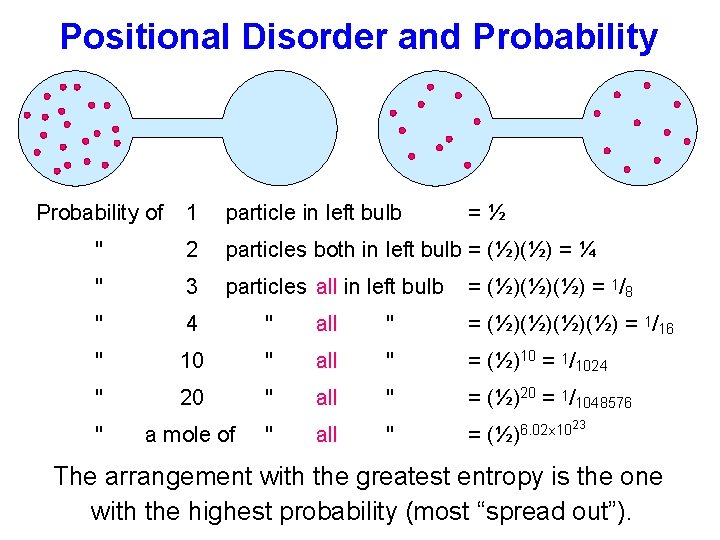
Positional Disorder and Probability of 1 particle in left bulb =½ " 2 particles both in left bulb = (½)(½) = ¼ " 3 particles all in left bulb " 4 " all " = (½)(½) = 1/16 " 10 " all " = (½)10 = 1/1024 " 20 " all " = (½)20 = 1/1048576 " a mole of " all " = (½)6. 02 10 = (½)(½)(½) = 1/8 23 The arrangement with the greatest entropy is the one with the highest probability (most “spread out”).
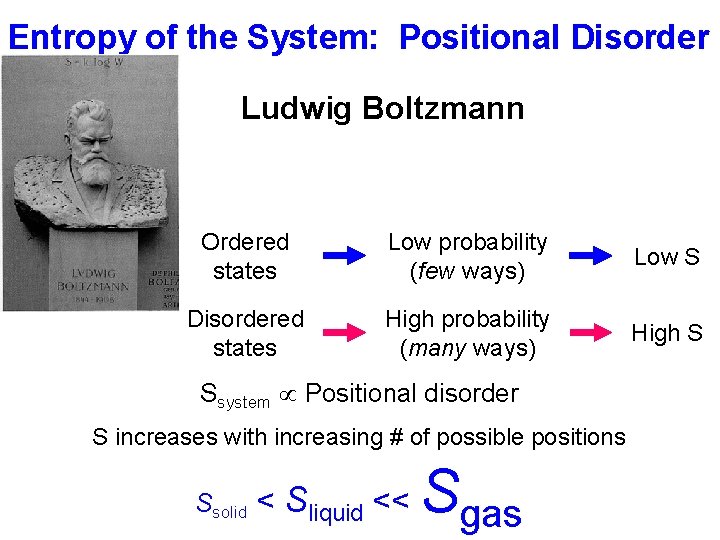
Entropy of the System: Positional Disorder Ludwig Boltzmann Ordered states Low probability (few ways) Low S Disordered states High probability (many ways) High S Ssystem Positional disorder S increases with increasing # of possible positions Ssolid < Sliquid << Sgas
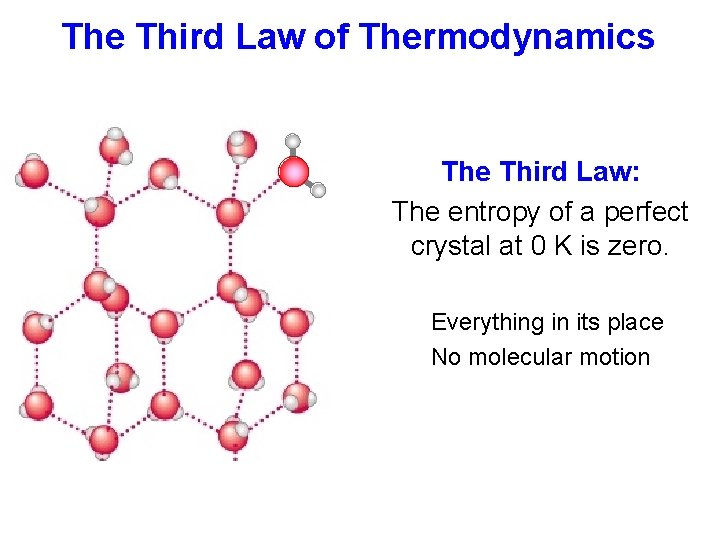
The Third Law of Thermodynamics The Third Law: The entropy of a perfect crystal at 0 K is zero. Everything in its place No molecular motion

Entropy Curve Solid Liquid Gas vaporization S (qrev/T) (J/K) fusion 0 0 Temperature (K) S° (absolute entropy) can be calculated for any substance
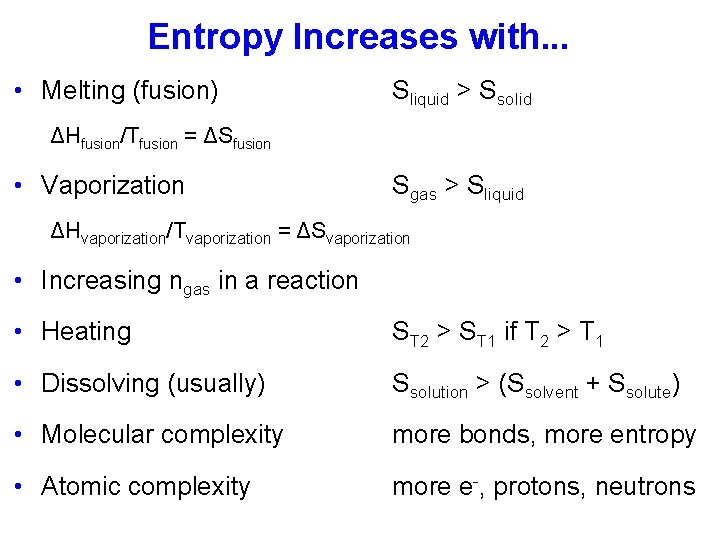
Entropy Increases with. . . • Melting (fusion) Sliquid > Ssolid ΔHfusion/Tfusion = ΔSfusion • Vaporization Sgas > Sliquid ΔHvaporization/Tvaporization = ΔSvaporization • Increasing ngas in a reaction • Heating ST 2 > ST 1 if T 2 > T 1 • Dissolving (usually) Ssolution > (Ssolvent + Ssolute) • Molecular complexity more bonds, more entropy • Atomic complexity more e-, protons, neutrons
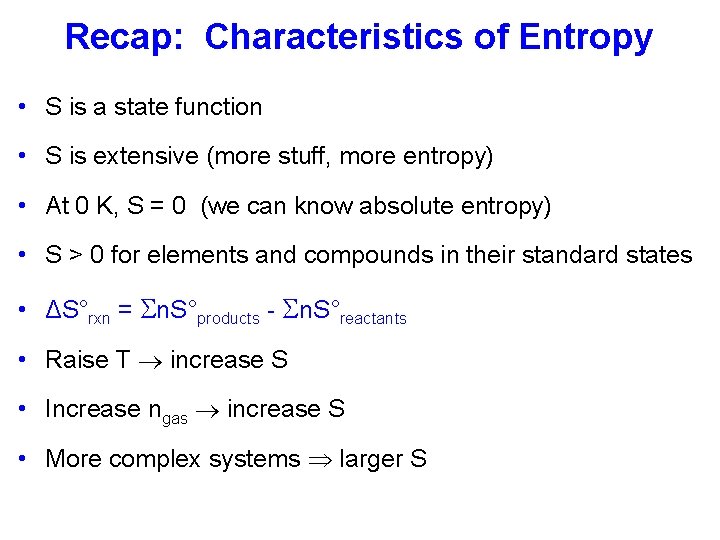
Recap: Characteristics of Entropy • S is a state function • S is extensive (more stuff, more entropy) • At 0 K, S = 0 (we can know absolute entropy) • S > 0 for elements and compounds in their standard states • ΔS°rxn = n. S°products - n. S°reactants • Raise T increase S • Increase ngas increase S • More complex systems larger S

Entropy and Gibbs Free Energy by Mike Roller
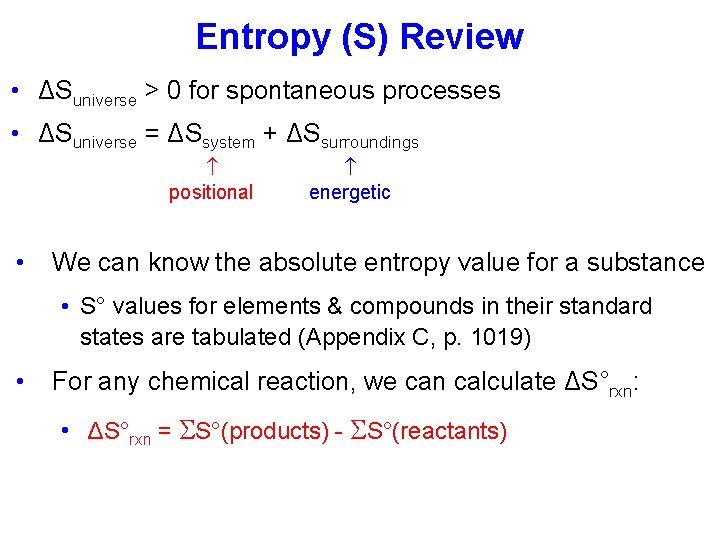
Entropy (S) Review • ΔSuniverse > 0 for spontaneous processes • ΔSuniverse = ΔSsystem + ΔSsurroundings positional • energetic We can know the absolute entropy value for a substance • S° values for elements & compounds in their standard states are tabulated (Appendix C, p. 1019) • For any chemical reaction, we can calculate ΔS°rxn: • ΔS°rxn = S°(products) - S°(reactants)
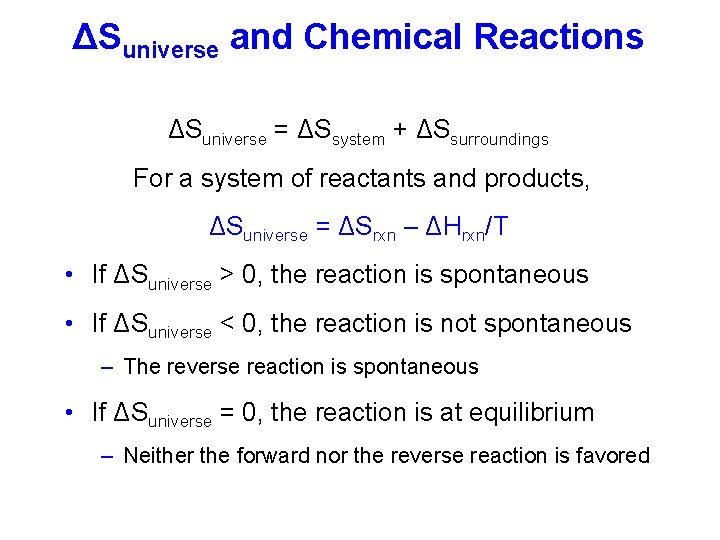
ΔSuniverse and Chemical Reactions ΔSuniverse = ΔSsystem + ΔSsurroundings For a system of reactants and products, ΔSuniverse = ΔSrxn – ΔHrxn/T • If ΔSuniverse > 0, the reaction is spontaneous • If ΔSuniverse < 0, the reaction is not spontaneous – The reverse reaction is spontaneous • If ΔSuniverse = 0, the reaction is at equilibrium – Neither the forward nor the reverse reaction is favored
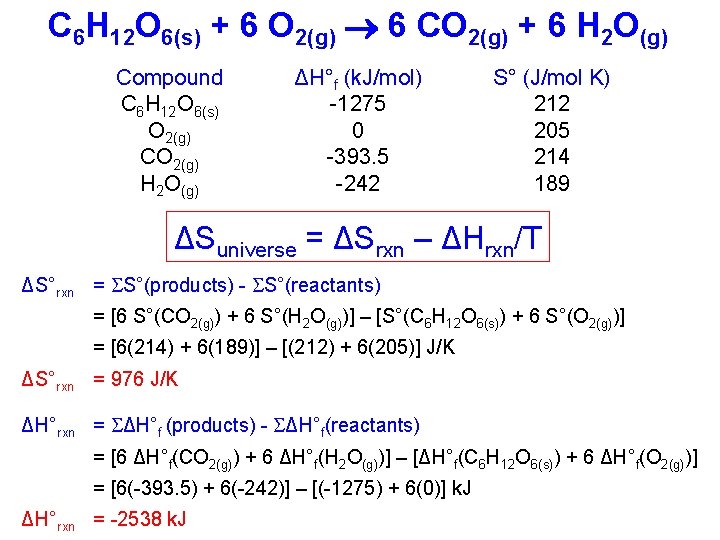
C 6 H 12 O 6(s) + 6 O 2(g) 6 CO 2(g) + 6 H 2 O(g) Compound C 6 H 12 O 6(s) O 2(g) CO 2(g) H 2 O(g) ΔH°f (k. J/mol) -1275 0 -393. 5 -242 S° (J/mol K) 212 205 214 189 ΔSuniverse = ΔSrxn – ΔHrxn/T ΔS°rxn = S°(products) - S°(reactants) = [6 S°(CO 2(g)) + 6 S°(H 2 O(g))] – [S°(C 6 H 12 O 6(s)) + 6 S°(O 2(g))] = [6(214) + 6(189)] – [(212) + 6(205)] J/K ΔS°rxn = 976 J/K ΔH°rxn = ΔH°f (products) - ΔH°f(reactants) = [6 ΔH°f(CO 2(g)) + 6 ΔH°f(H 2 O(g))] – [ΔH°f(C 6 H 12 O 6(s)) + 6 ΔH°f(O 2(g))] = [6(-393. 5) + 6(-242)] – [(-1275) + 6(0)] k. J ΔH°rxn = -2538 k. J
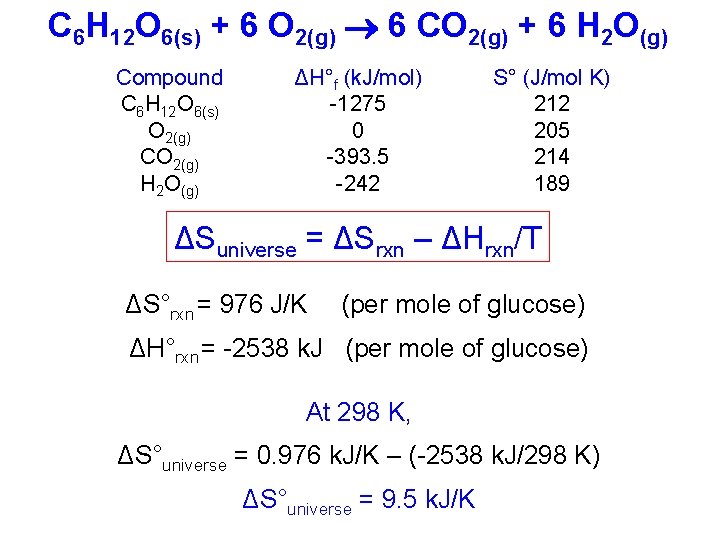
C 6 H 12 O 6(s) + 6 O 2(g) 6 CO 2(g) + 6 H 2 O(g) Compound C 6 H 12 O 6(s) O 2(g) CO 2(g) H 2 O(g) ΔH°f (k. J/mol) -1275 0 -393. 5 -242 S° (J/mol K) 212 205 214 189 ΔSuniverse = ΔSrxn – ΔHrxn/T ΔS°rxn = 976 J/K (per mole of glucose) ΔH°rxn = -2538 k. J (per mole of glucose) At 298 K, ΔS°universe = 0. 976 k. J/K – (-2538 k. J/298 K) ΔS°universe = 9. 5 k. J/K
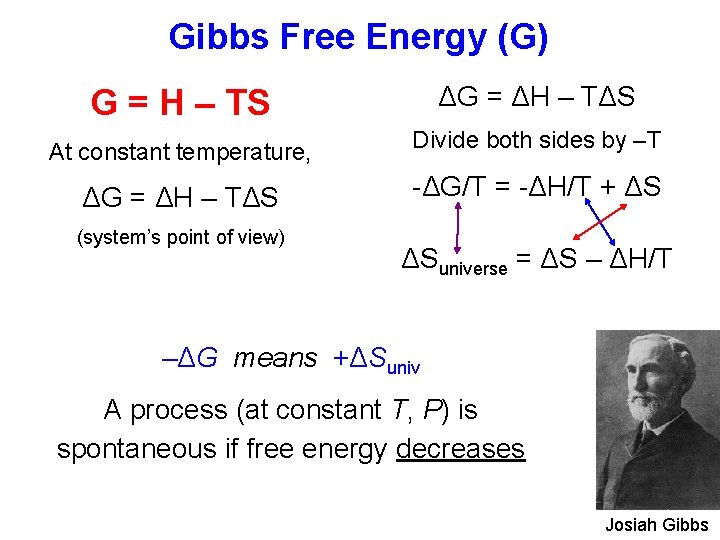
Gibbs Free Energy (G) G = H – TS ΔG = ΔH – TΔS At constant temperature, Divide both sides by –T ΔG = ΔH – TΔS -ΔG/T = -ΔH/T + ΔS (system’s point of view) ΔSuniverse = ΔS – ΔH/T –ΔG means +ΔSuniv A process (at constant T, P) is spontaneous if free energy decreases Josiah Gibbs
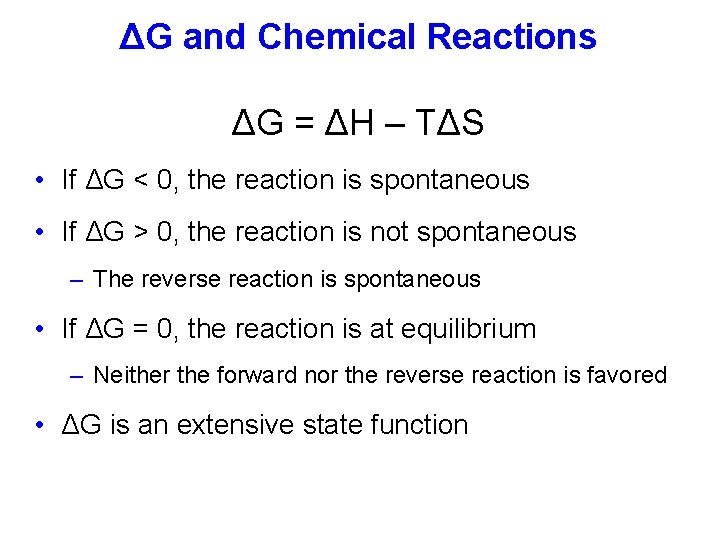
ΔG and Chemical Reactions ΔG = ΔH – TΔS • If ΔG < 0, the reaction is spontaneous • If ΔG > 0, the reaction is not spontaneous – The reverse reaction is spontaneous • If ΔG = 0, the reaction is at equilibrium – Neither the forward nor the reverse reaction is favored • ΔG is an extensive state function
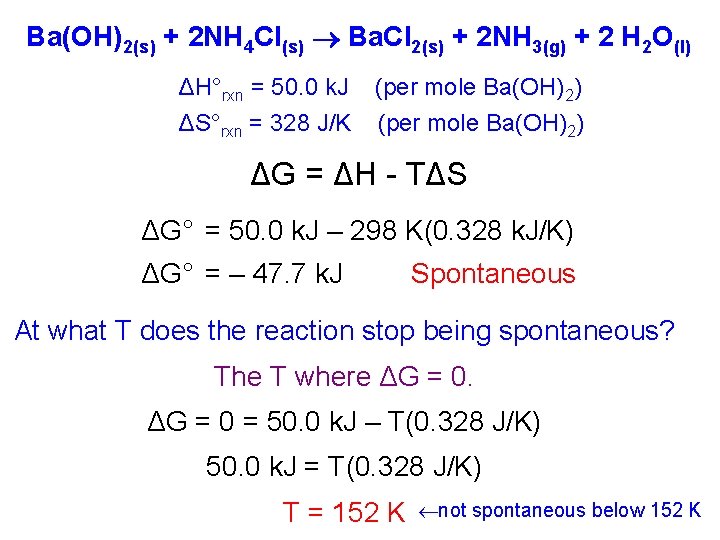
Ba(OH)2(s) + 2 NH 4 Cl(s) Ba. Cl 2(s) + 2 NH 3(g) + 2 H 2 O(l) ΔH°rxn = 50. 0 k. J (per mole Ba(OH)2) ΔS°rxn = 328 J/K (per mole Ba(OH)2) ΔG = ΔH - TΔS ΔG° = 50. 0 k. J – 298 K(0. 328 k. J/K) ΔG° = – 47. 7 k. J Spontaneous At what T does the reaction stop being spontaneous? The T where ΔG = 0 = 50. 0 k. J – T(0. 328 J/K) 50. 0 k. J = T(0. 328 J/K) T = 152 K not spontaneous below 152 K
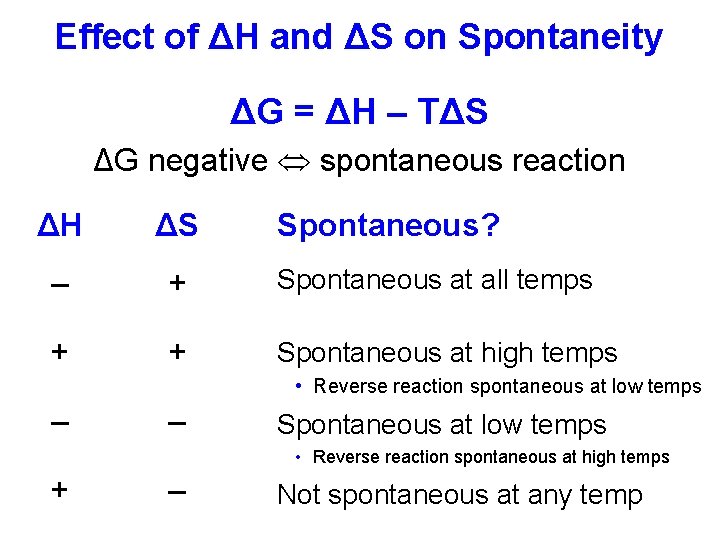
Effect of ΔH and ΔS on Spontaneity ΔG = ΔH – TΔS ΔG negative spontaneous reaction ΔH ΔS – + Spontaneous at all temps + + Spontaneous at high temps Spontaneous? • Reverse reaction spontaneous at low temps – – Spontaneous at low temps • Reverse reaction spontaneous at high temps + – Not spontaneous at any temp
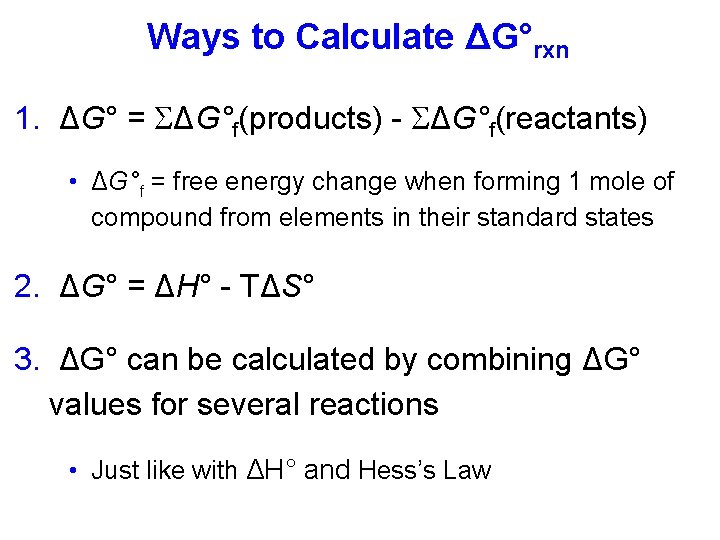
Ways to Calculate ΔG°rxn 1. ΔG° = ΔG°f(products) - ΔG°f(reactants) • ΔG°f = free energy change when forming 1 mole of compound from elements in their standard states 2. ΔG° = ΔH° - TΔS° 3. ΔG° can be calculated by combining ΔG° values for several reactions • Just like with ΔH° and Hess’s Law
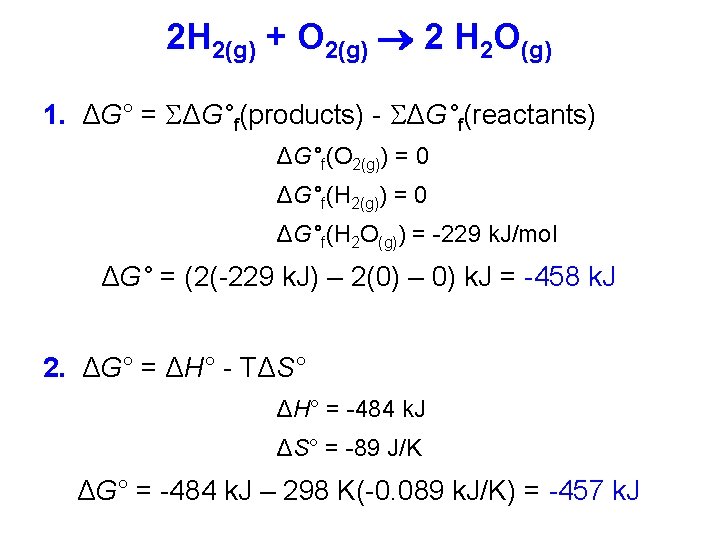
2 H 2(g) + O 2(g) 2 H 2 O(g) 1. ΔG° = ΔG°f(products) - ΔG°f(reactants) ΔG°f(O 2(g)) = 0 ΔG°f(H 2 O(g)) = -229 k. J/mol ΔG° = (2(-229 k. J) – 2(0) – 0) k. J = -458 k. J 2. ΔG° = ΔH° - TΔS° ΔH° = -484 k. J ΔS° = -89 J/K ΔG° = -484 k. J – 298 K(-0. 089 k. J/K) = -457 k. J
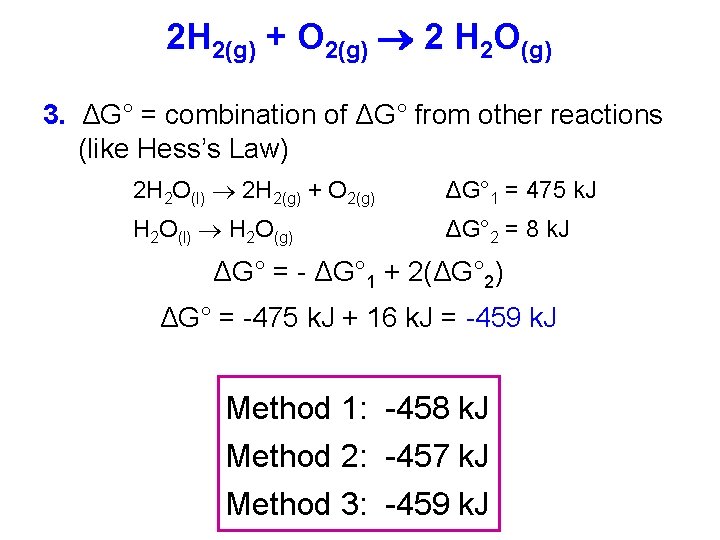
2 H 2(g) + O 2(g) 2 H 2 O(g) 3. ΔG° = combination of ΔG° from other reactions (like Hess’s Law) 2 H 2 O(l) 2 H 2(g) + O 2(g) ΔG° 1 = 475 k. J H 2 O(l) H 2 O(g) ΔG° 2 = 8 k. J ΔG° = - ΔG° 1 + 2(ΔG° 2) ΔG° = -475 k. J + 16 k. J = -459 k. J Method 1: -458 k. J Method 2: -457 k. J Method 3: -459 k. J
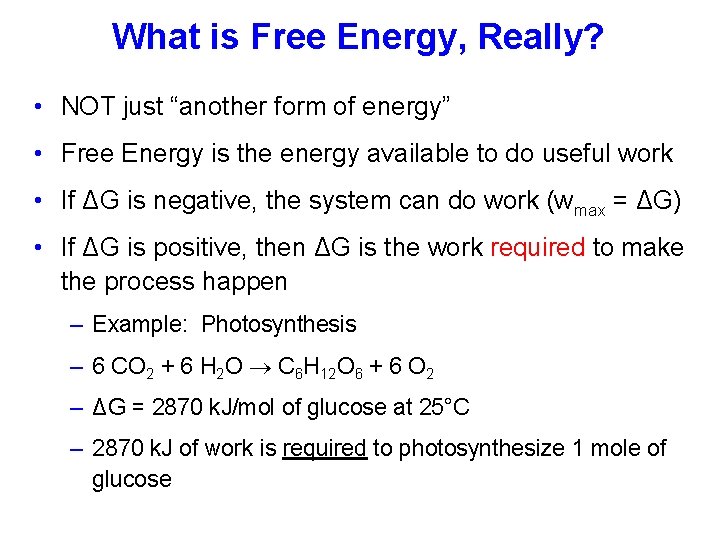
What is Free Energy, Really? • NOT just “another form of energy” • Free Energy is the energy available to do useful work • If ΔG is negative, the system can do work (wmax = ΔG) • If ΔG is positive, then ΔG is the work required to make the process happen – Example: Photosynthesis – 6 CO 2 + 6 H 2 O C 6 H 12 O 6 + 6 O 2 – ΔG = 2870 k. J/mol of glucose at 25°C – 2870 k. J of work is required to photosynthesize 1 mole of glucose
- Slides: 26