
Introduction to Energy Management WeekLesson 7 HVAC System
- Slides: 46
Introduction to Energy Management
Week/Lesson 7 HVAC System Types
HVAC System Types After completing this chapter, you will be able to: ± Recognize air conditioning system components ± List ASHRAE descriptions HVAC systems ± Identify components of the basic central system ± Distinguish between zones and rooms ± Understand the operation of an all-air system
HVAC System Types Understand the operation of an all-water system ± List advantages/disadvantages of all-water systems ± Explain the operation of various terminal units ± Understand how an air-water system operates ± List advantages/disadvantages of air-water systems ±
HVAC System Types Components of Air Conditioning Systems ± Heating device – adds heat ± Cooling device – removes heat ± Distribution system – ducts and/or pipes ± Equipment – Fans and/or pumps
HVAC System Types Heat transfer devices • Diffusion devices • Terminal units ± Operational equipment – valves, dampers, etc. ± Specialty devices – humidification, filtration ±
HVAC System Types Classifying HVAC systems ± ASHRAE classifications – by cooling medium • All-air systems • All-water systems • Air-water systems
HVAC System Types The basic central system (all-air) ± Primary system – source of hot/chilled water ± Secondary system – delivers heating/cooling throughout the building ± Portion of return air is exhausted ± Outside air is introduced ± Mixed air is filtered and conditioned
HVAC System Types Packaged and unitary HVAC systems ± Self-contained ± Window and through-the-wall ± Air-to-air and water source heat pumps ± Rooftop systems ± Predesigned configurations
HVAC System Types HVAC zones and rooms ± Zone • Requires separate thermostatic control • Usually comprises several rooms ± Room • Separate partitioned area • May require separate thermostatic control
HVAC System Types The all-air system ± Supplies cooling (heating) capacity to the zones ± Advantages • Adaptable to multiple zoning needs • Adaptable to seasonal changeover • Easily accepts heat recovery equipment • Provides year-round ventilation
HVAC System Types Disadvantages ± Larger distribution systems than all-water systems ± Operate longer than all-water systems to maintain temperatures ± Air distribution and performance are difficult to balance
HVAC System Types Introduction to single-path and dual-path all-air systems ± Single-path, all-air systems • Supply air flows directly from one conditioning device into the next • Single duct system
HVAC System Types ± Dual-path, all-air systems • Splits supply air into two streams • One stream is chilled, the other is heated • Dual duct layout • Heated and cooled air is mixed together • Air is brought to the zone via mixing boxes
HVAC System Types Variations of the single-path, all-air system ± Constant volume variable temperature ± Zone reheat systems ± Design options • Single zone, constant volume • Multiple zone, constant volume, zone reheat • Multiple zone, variable volume
HVAC System Types Single-duct, single-zone, constant volume ± Delivers constant volume of air ± Air is the same temperature in all zones Single-duct, Single zone, constant volume, zone reheat ± Reheat coil located at supply to each zone ± Air is heated as it enters the zone
HVAC System Types Single-duct, multiple zone, variable volume ± The volume of the air supplied is varied ± The occupied space is used as a mixing box ± The thermostat controls the volume damper ± Variable air volume, VAV, system
HVAC System Types Variations of the dual-path all-air system ± Dual-path, multi-zone, constant volume ± Dual-path, multi-zone, variable volume ± Dual-path, dual duct, multiple zone, constant volume ± Dual-path, dual duct, multiple zone, variable air volume
HVAC System Types Multi-zone systems ± Air streams are mixed centrally ± The mixed air flows to the individual zones Multiple zone systems ± Both hot and cold air streams are distributed throughout the facility ± The streams are mixed at the individual zones
HVAC System Types Dual path, multi-zone, constant volume ± Hot and cold air is mixed centrally ± Air is distributed to the zone via a single duct Dual path, multi-zone, variable volume ± Hot and cold air is mixed centrally ± Each duct is equipped with a volume damper
HVAC System Types Dual path, dual-duct, multiple zone, constant volume ± Separate hot and cold air ducts ± Air is mixed at each zone, constant volume Dual path, dual-duct, multiple zone, variable volume ± Separate hot and cold air ducts ± Air is mixed in variable volume mixing boxes
HVAC System Types The 100% outdoor, all-air system ± 100% of the return air is exhausted ± System requires pre-heating equipment ± Air must be properly filtered
HVAC System Types The all-water system ± Steam, hot water or chilled water ± Hydronic systems ± Terminal units provide heat transfer ± All-water system advantages • Smaller distribution systems • Less expensive distribution systems
HVAC System Types ± All-water system disadvantages • Do not filter or ventilate effectively • Lack humidity control • Must be switched over for seasonal operation • Require a great deal of maintenance
HVAC System Types Variations of the all-water system ± Series loop ± One-pipe main ± Two-pipe direct return ± Two-pipe reverse return ± Three-pipe system ± Four-pipe system
HVAC System Types Series loop ± All water flows through all terminal units ± Individual temperature control is impossible ± Distant units are not as effective ± System must be shut down for service
HVAC System Types One-pipe ± Each unit can be valved off from the system ± Individual control and service is possible ± Distant terminal units are less effective ± In the heating mode, the water gets cooler as it flows through the loop
HVAC System Types Two-pipe direct return ± Separate supply and return lines ± All units receive water at the same temperature ± Balancing valves are needed Two-pipe reverse return ± Supply and return lines are the same length ± System balancing and operation are easier
HVAC System Types Three-pipe system ± Hot and cold supply pipes plus a return ± Units are equipped with three-way valves Four-pipe system ± Units have separate heating and cooling coils ± Each coil is independent of the other
HVAC System Types Terminal units ± Facilitate heat transfer between the conditioned water and the occupied space ± Heating or heating/cooling ± Do not filter the air effectively ± Does not humidify the air effectively
HVAC System Types Radiators ± Heat primarily by convection ± Natural airflow pattern is created Convectors ± Finned tube or cast iron heat exchanger ± Baseboard convectors – residential use ± Fin-tube convectors – commercial applications
HVAC System Types Unit heaters ± Cabinet unit heaters • Internal centrifugal fans • Able to filter the air ± Propeller unit heaters • Physically large in size • Noisy operation
HVAC System Types Radiant panels ± Tubing grids installed within the structure ± Located in the floors, walls or ceiling ± Heat is transferred by radiation ± Tubes are imbedded in the concrete
HVAC System Types Unit ventilators ± Coil can carry hot or cold water ± Can introduce outside air to the space Induction units ± Used in air-water systems ± Require high velocity primary air ± Do not use a fan or blower
HVAC System Types The air-water system ± Heat transfer rate of the all-water system ± Filtration capability of the all-air system ± Water system provides heating/cooling ± Air system provides ventilation ± Can provide heating/cooling to different zones
HVAC System Types Advantages of air-water systems ± Water distribution system is smaller ± Smaller air distribution system ± Lower energy costs ± Provides ventilation and humidity control ± Individual temperature control
HVAC System Types Disadvantages of air-water systems ± Require a trained and qualified staff ± Between-the-season operation is difficult to manage ± Normally limited to exterior zones ± Do not satisfy high exhaust rate needs
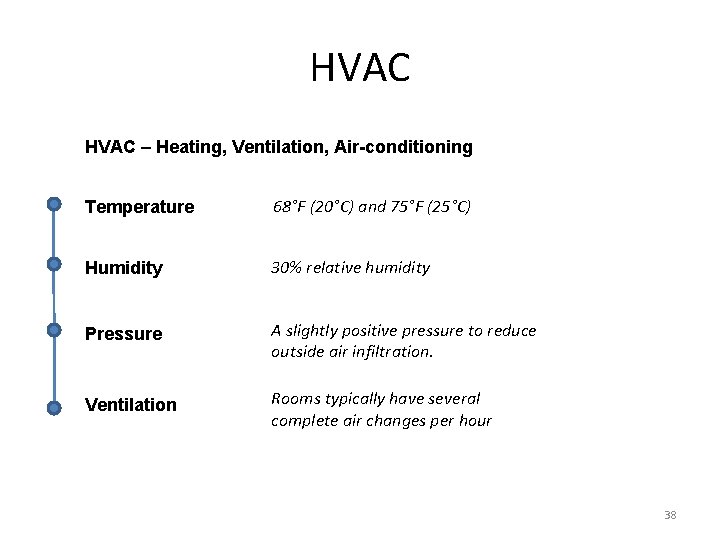
HVAC – Heating, Ventilation, Air-conditioning Temperature 68°F (20°C) and 75°F (25°C) Humidity 30% relative humidity Pressure A slightly positive pressure to reduce outside air infiltration. Ventilation Rooms typically have several complete air changes per hour 38
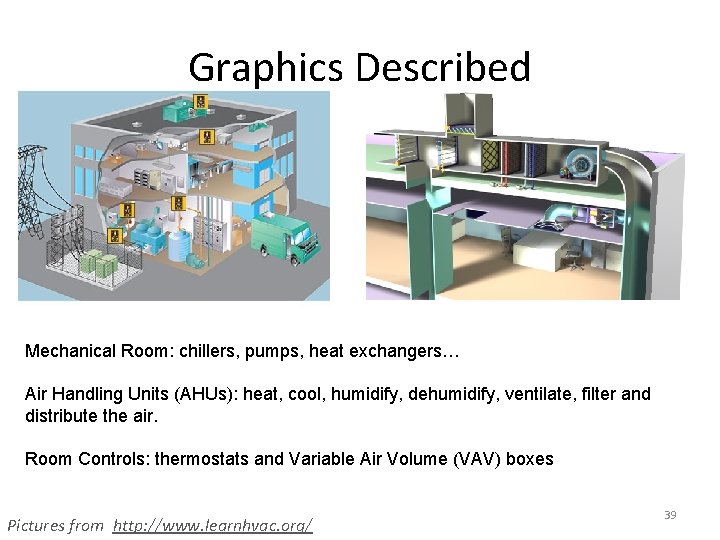
Graphics Described Mechanical Room: chillers, pumps, heat exchangers… Air Handling Units (AHUs): heat, cool, humidify, dehumidify, ventilate, filter and distribute the air. Room Controls: thermostats and Variable Air Volume (VAV) boxes Pictures from http: //www. learnhvac. org/ 39
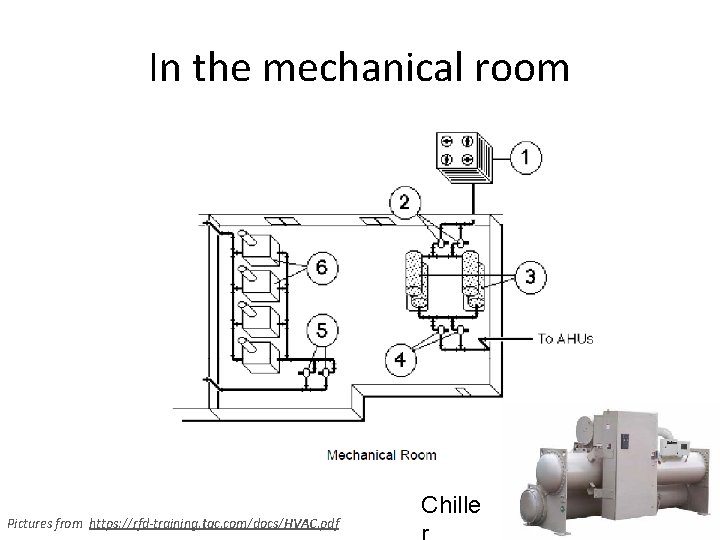
In the mechanical room Pictures from https: //rfd-training. tac. com/docs/HVAC. pdf Chille 40
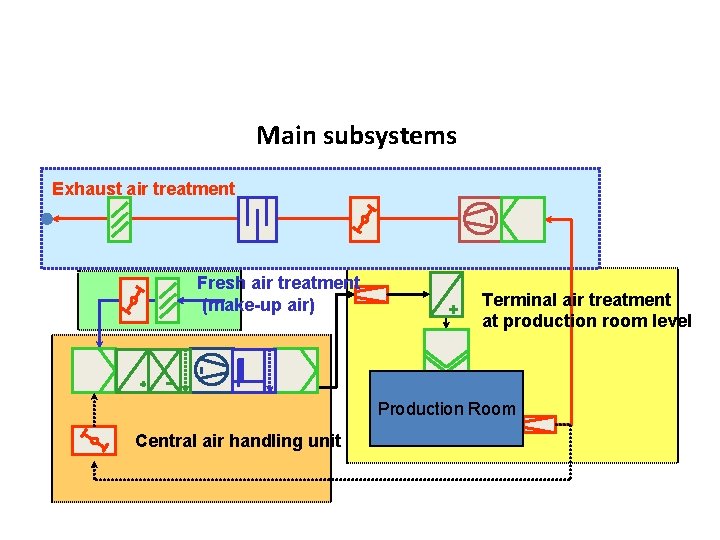
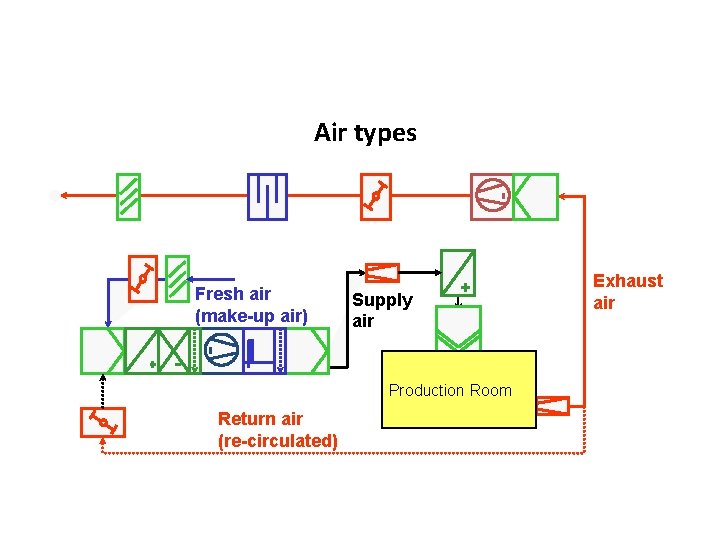
Main subsystems Exhaust air treatment Fresh air treatment (make-up air) + Terminal air treatment at production room level Production Room Central air handling unit
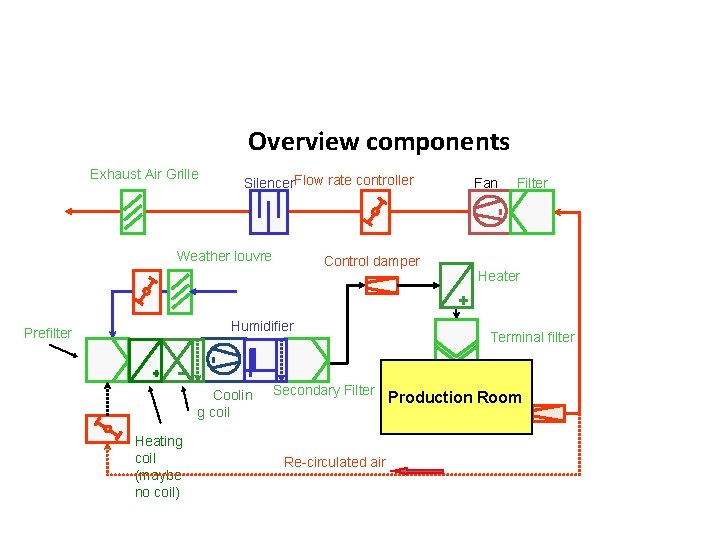
Overview components Exhaust Air Grille Silencer. Flow rate controller Weather louvre Fan Control damper Filter Heater + Humidifier Prefilter Coolin g coil Heating coil (maybe no coil) Secondary Filter Re-circulated air Terminal filter Production Room
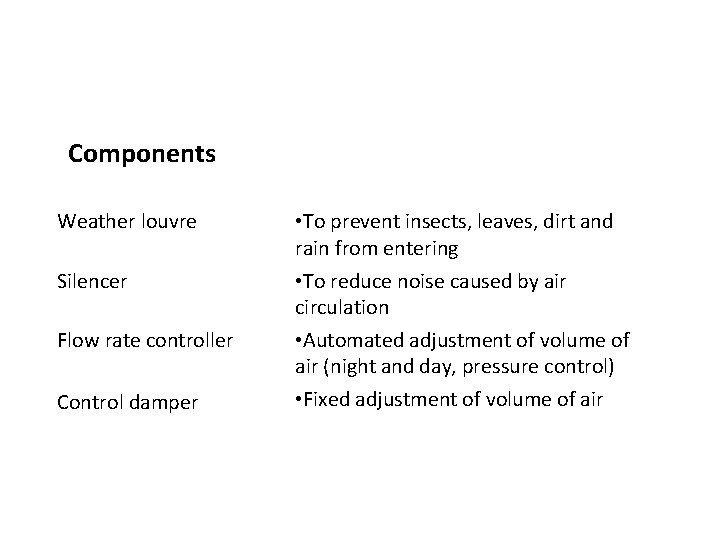
Components Weather louvre Silencer Flow rate controller Control damper • To prevent insects, leaves, dirt and rain from entering • To reduce noise caused by air circulation • Automated adjustment of volume of air (night and day, pressure control) • Fixed adjustment of volume of air
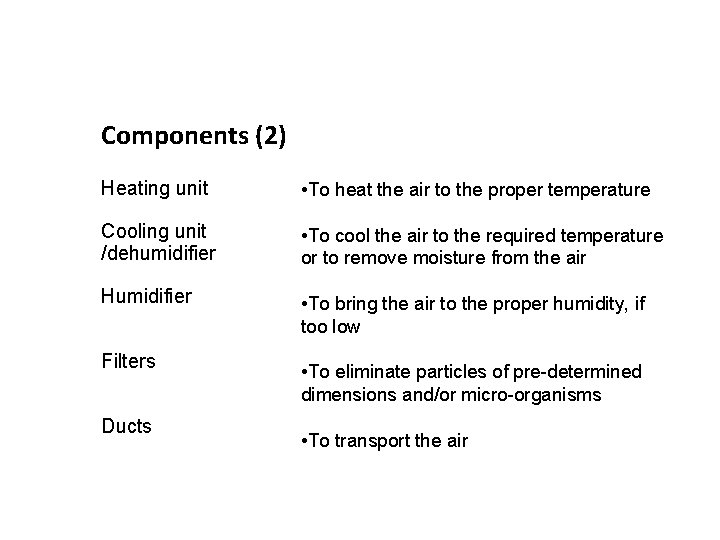
Components (2) Heating unit • To heat the air to the proper temperature Cooling unit /dehumidifier • To cool the air to the required temperature or to remove moisture from the air Humidifier • To bring the air to the proper humidity, if too low Filters Ducts • To eliminate particles of pre-determined dimensions and/or micro-organisms • To transport the air
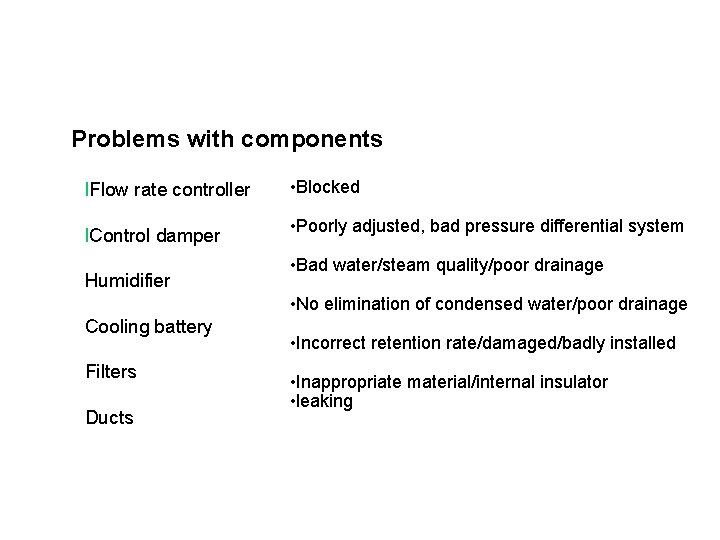
Problems with components l. Flow rate controller • Blocked l. Control damper • Poorly adjusted, bad pressure differential system Humidifier • Bad water/steam quality/poor drainage • No elimination of condensed water/poor drainage Cooling battery Filters Ducts • Incorrect retention rate/damaged/badly installed • Inappropriate material/internal insulator • leaking
Air types Fresh air (make-up air) Supply air + Production Room Return air (re-circulated) Exhaust air