
Introduction to Energy Engineering Lecture 3 Energy Consumption

- Slides: 42
Introduction to Energy Engineering Lecture 3 Energy Consumption and Future Energy Challenges Dr Mike Spann School of EECE m. spann@bham. ac. uk
Part I Energy Consumption
Energy Consumption � Energy consumption facts and figures can be presented in many ways � However, it boils down to the amount of energy consumed on the planet � Which depends on global population � And the economic growth � First a few numbers …. � 2. 5 � At this level of average annual growth rate (2. 5%) world electricity demand will double in the next 30 years � 75 � Forecasts of the % increase in carbon dioxide emissions in the next 30 years � 2 billion � The UN forecasts population will by 2 billion over the next 30 years. That’s another 2 billion people who will need fuel for their cars and electricity 80% of global energy consumption is based on fossil fuels 31. 6 Gt of global energy-related CO 2 emissions in 2012, a historic high
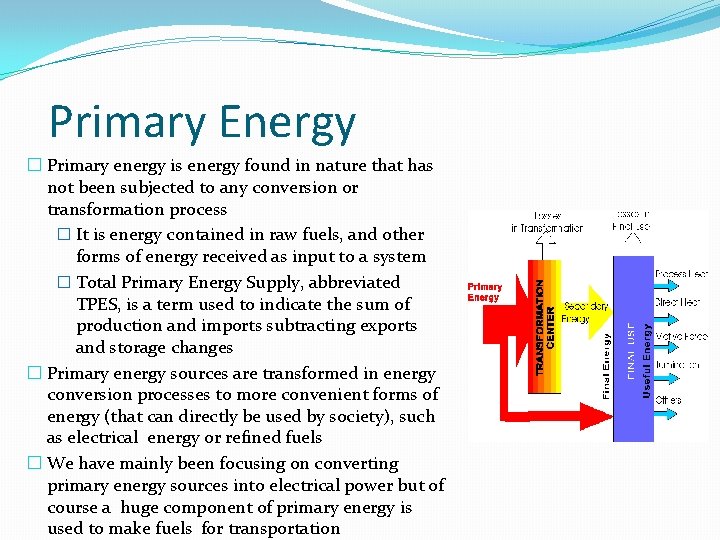
Primary Energy � Primary energy is energy found in nature that has not been subjected to any conversion or transformation process � It is energy contained in raw fuels, and other forms of energy received as input to a system � Total Primary Energy Supply, abbreviated TPES, is a term used to indicate the sum of production and imports subtracting exports and storage changes � Primary energy sources are transformed in energy conversion processes to more convenient forms of energy (that can directly be used by society), such as electrical energy or refined fuels � We have mainly been focusing on converting primary energy sources into electrical power but of course a huge component of primary energy is used to make fuels for transportation
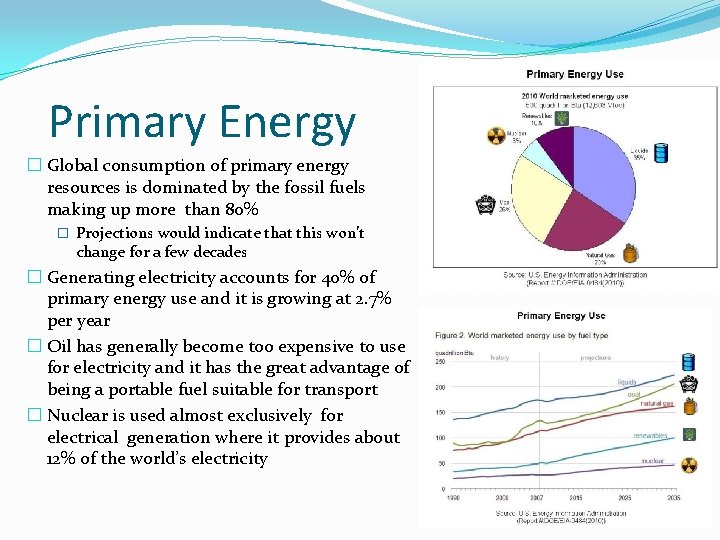
Primary Energy � Global consumption of primary energy resources is dominated by the fossil fuels making up more than 80% � Projections would indicate that this won’t change for a few decades � Generating electricity accounts for 40% of primary energy use and it is growing at 2. 7% per year � Oil has generally become too expensive to use for electricity and it has the great advantage of being a portable fuel suitable for transport � Nuclear is used almost exclusively for electrical generation where it provides about 12% of the world’s electricity
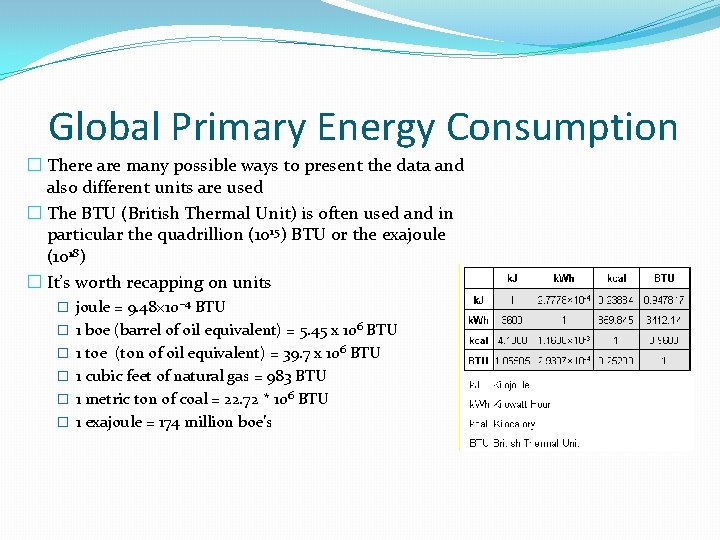
Global Primary Energy Consumption � There are many possible ways to present the data and also different units are used � The BTU (British Thermal Unit) is often used and in particular the quadrillion (1015) BTU or the exajoule (1018) � It’s worth recapping on units � joule = 9. 48× 10− 4 BTU � 1 boe (barrel of oil equivalent) = 5. 45 x 106 BTU � 1 toe (ton of oil equivalent) = 39. 7 x 10⁶ BTU � 1 cubic feet of natural gas = 983 BTU � 1 metric ton of coal = 22. 72 * 106 BTU � 1 exajoule = 174 million boe’s
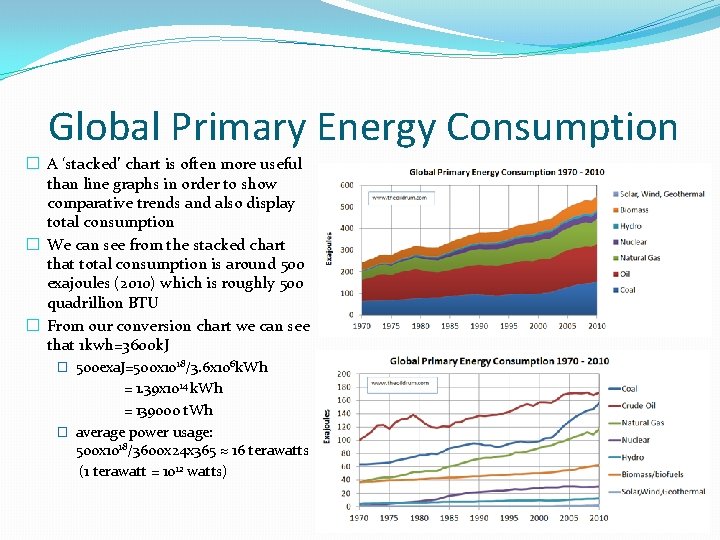
Global Primary Energy Consumption � A ‘stacked’ chart is often more useful than line graphs in order to show comparative trends and also display total consumption � We can see from the stacked chart that total consumption is around 500 exajoules (2010) which is roughly 500 quadrillion BTU � From our conversion chart we can see that 1 kwh=3600 k. J � 500 exa. J=500 x 1018/3. 6 x 10⁶ k. Wh = 1. 39 x 1014 k. Wh = 139000 t. Wh � average power usage: 500 x 1018/3600 x 24 x 365 ≈ 16 terawatts (1 terawatt = 1012 watts)
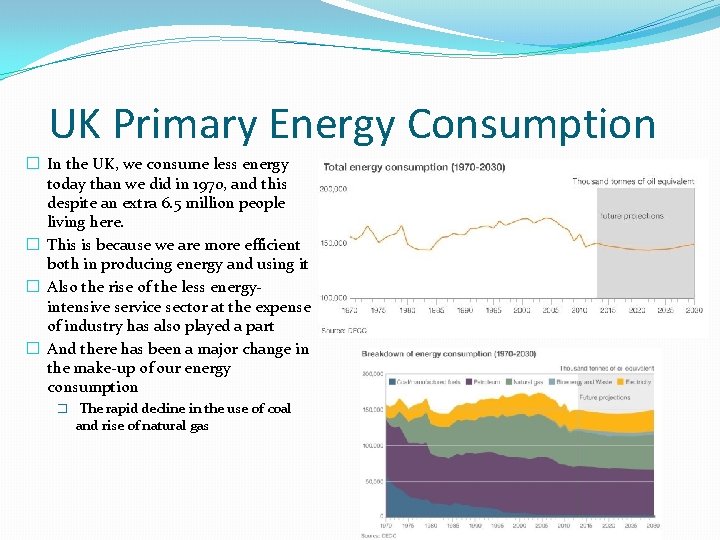
UK Primary Energy Consumption � In the UK, we consume less energy today than we did in 1970, and this despite an extra 6. 5 million people living here. � This is because we are more efficient both in producing energy and using it � Also the rise of the less energyintensive service sector at the expense of industry has also played a part � And there has been a major change in the make-up of our energy consumption � The rapid decline in the use of coal and rise of natural gas
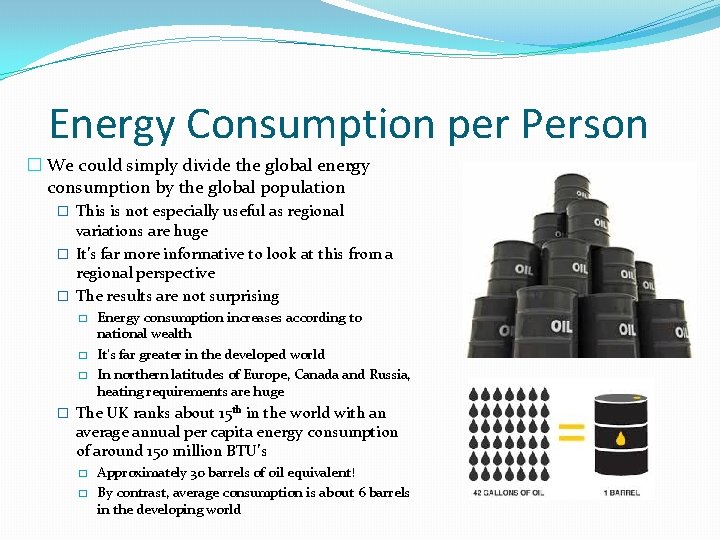
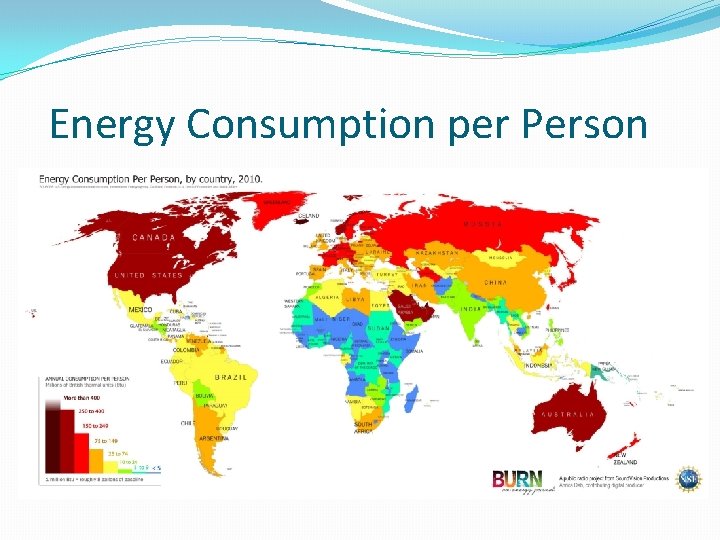
Energy Consumption per Person � We could simply divide the global energy consumption by the global population � This is not especially useful as regional variations are huge � It’s far more informative to look at this from a regional perspective � The results are not surprising � � � Energy consumption increases according to national wealth It’s far greater in the developed world In northern latitudes of Europe, Canada and Russia, heating requirements are huge � The UK ranks about 15 th in the world with an average annual per capita energy consumption of around 150 million BTU’s � � Approximately 30 barrels of oil equivalent! By contrast, average consumption is about 6 barrels in the developing world
Energy Consumption per Person
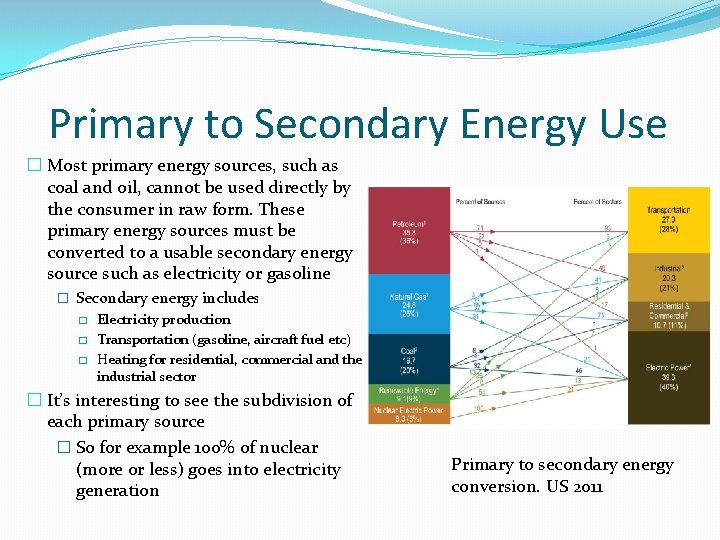
Primary to Secondary Energy Use � Most primary energy sources, such as coal and oil, cannot be used directly by the consumer in raw form. These primary energy sources must be converted to a usable secondary energy source such as electricity or gasoline � Secondary energy includes � Electricity production � Transportation (gasoline, aircraft fuel etc) � Heating for residential, commercial and the industrial sector � It’s interesting to see the subdivision of each primary source � So for example 100% of nuclear (more or less) goes into electricity generation Primary to secondary energy conversion. US 2011
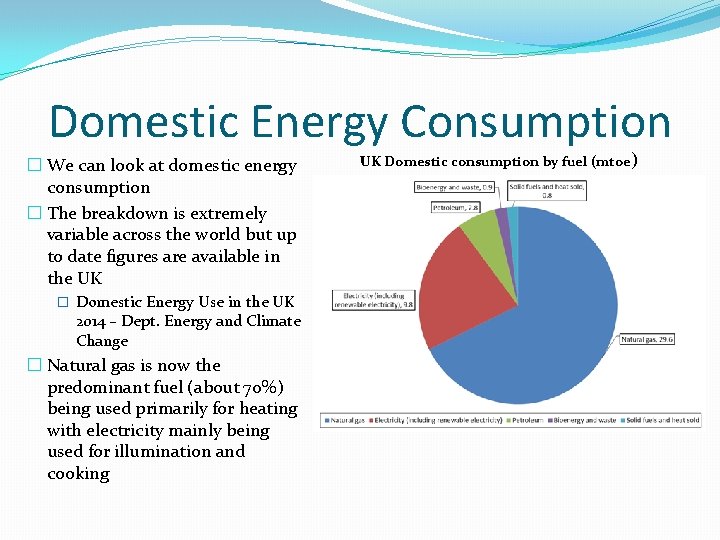
Domestic Energy Consumption � We can look at domestic energy consumption � The breakdown is extremely variable across the world but up to date figures are available in the UK � Domestic Energy Use in the UK 2014 – Dept. Energy and Climate Change � Natural gas is now the predominant fuel (about 70%) being used primarily for heating with electricity mainly being used for illumination and cooking UK Domestic consumption by fuel (mtoe)
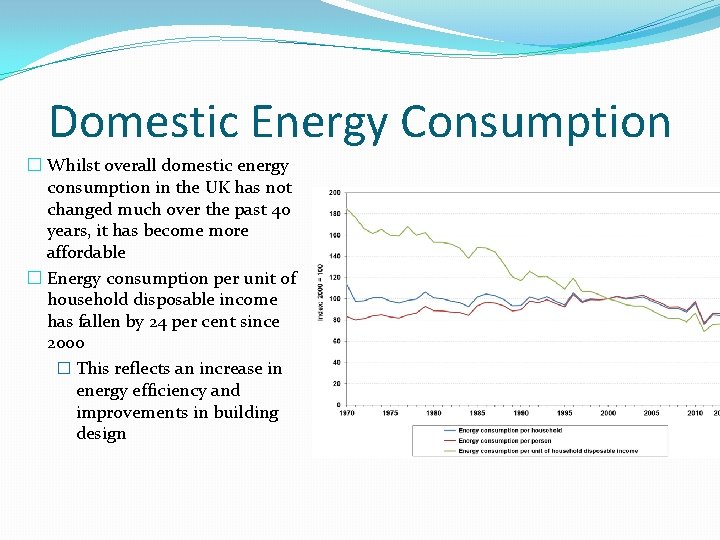
Domestic Energy Consumption � Whilst overall domestic energy consumption in the UK has not changed much over the past 40 years, it has become more affordable � Energy consumption per unit of household disposable income has fallen by 24 per cent since 2000 � This reflects an increase in energy efficiency and improvements in building design
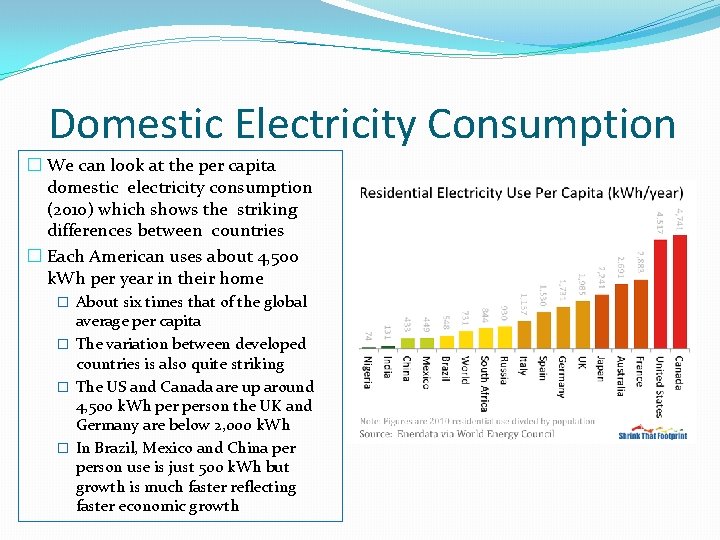
Domestic Electricity Consumption � We can look at the per capita domestic electricity consumption (2010) which shows the striking differences between countries � Each American uses about 4, 500 k. Wh per year in their home � About six times that of the global average per capita � The variation between developed countries is also quite striking � The US and Canada are up around 4, 500 k. Wh person the UK and Germany are below 2, 000 k. Wh � In Brazil, Mexico and China person use is just 500 k. Wh but growth is much faster reflecting faster economic growth
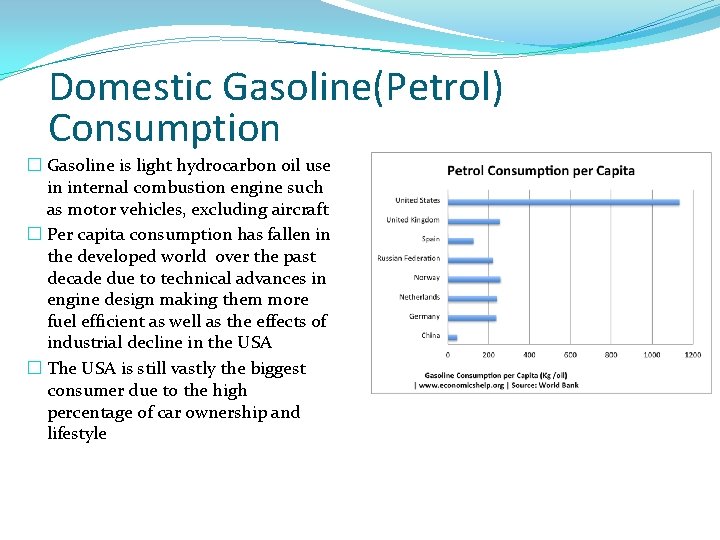
Domestic Gasoline(Petrol) Consumption � Gasoline is light hydrocarbon oil use in internal combustion engine such as motor vehicles, excluding aircraft � Per capita consumption has fallen in the developed world over the past decade due to technical advances in engine design making them more fuel efficient as well as the effects of industrial decline in the USA � The USA is still vastly the biggest consumer due to the high percentage of car ownership and lifestyle
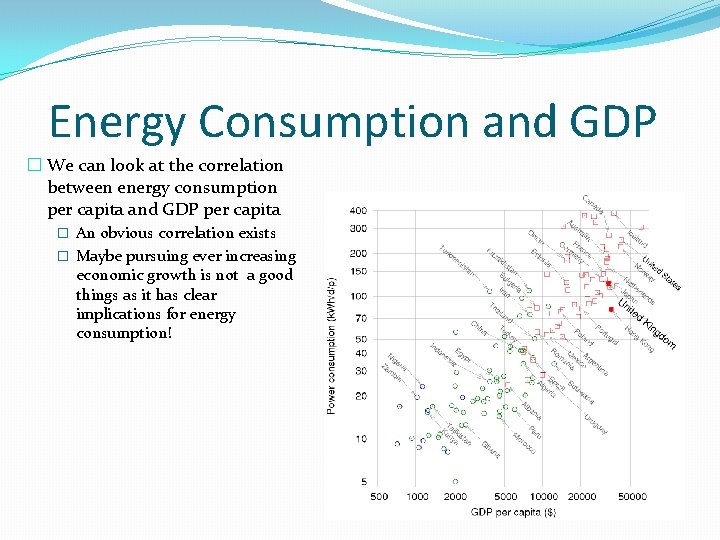
Energy Consumption and GDP � We can look at the correlation between energy consumption per capita and GDP per capita � An obvious correlation exists � Maybe pursuing ever increasing economic growth is not a good things as it has clear implications for energy consumption!
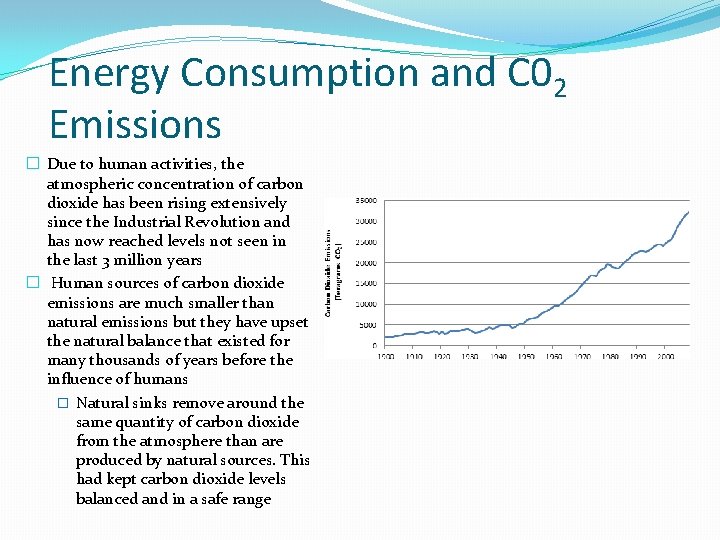
Energy Consumption and C 02 Emissions � Due to human activities, the atmospheric concentration of carbon dioxide has been rising extensively since the Industrial Revolution and has now reached levels not seen in the last 3 million years � Human sources of carbon dioxide emissions are much smaller than natural emissions but they have upset the natural balance that existed for many thousands of years before the influence of humans � Natural sinks remove around the same quantity of carbon dioxide from the atmosphere than are produced by natural sources. This had kept carbon dioxide levels balanced and in a safe range
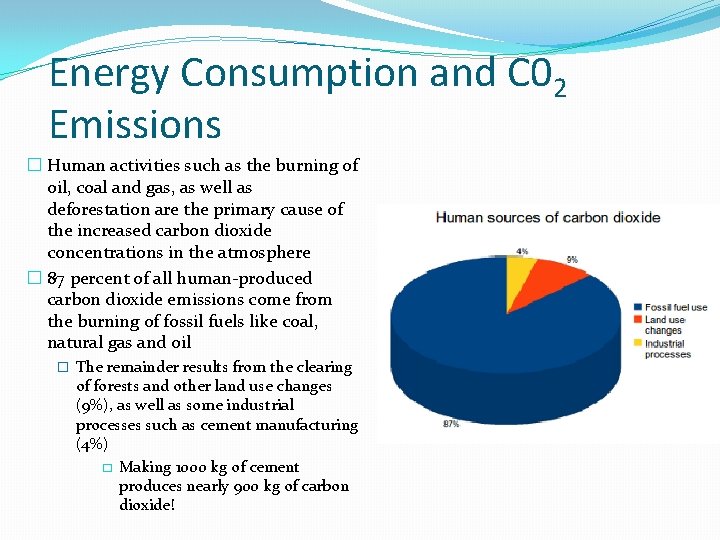
Energy Consumption and C 02 Emissions � Human activities such as the burning of oil, coal and gas, as well as deforestation are the primary cause of the increased carbon dioxide concentrations in the atmosphere � 87 percent of all human-produced carbon dioxide emissions come from the burning of fossil fuels like coal, natural gas and oil � The remainder results from the clearing of forests and other land use changes (9%), as well as some industrial processes such as cement manufacturing (4%) � Making 1000 kg of cement produces nearly 900 kg of carbon dioxide!
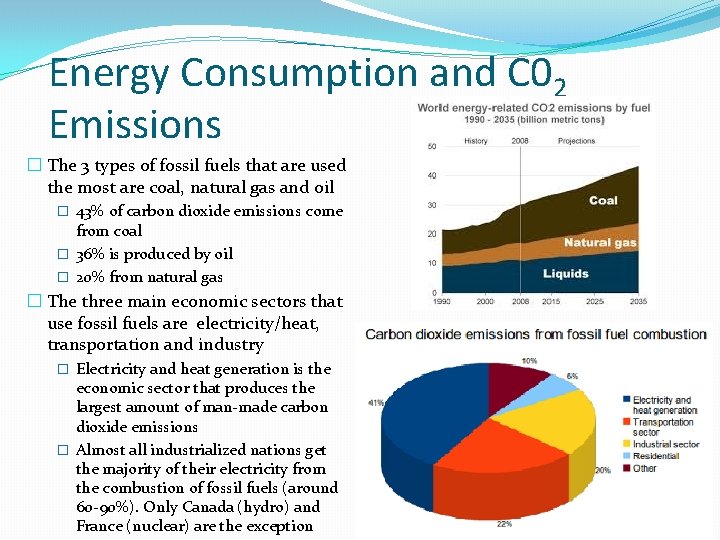
Energy Consumption and C 02 Emissions � The 3 types of fossil fuels that are used the most are coal, natural gas and oil � 43% of carbon dioxide emissions come from coal � 36% is produced by oil � 20% from natural gas � The three main economic sectors that use fossil fuels are electricity/heat, transportation and industry � Electricity and heat generation is the economic sector that produces the largest amount of man-made carbon dioxide emissions � Almost all industrialized nations get the majority of their electricity from the combustion of fossil fuels (around 60 -90%). Only Canada (hydro) and France (nuclear) are the exception
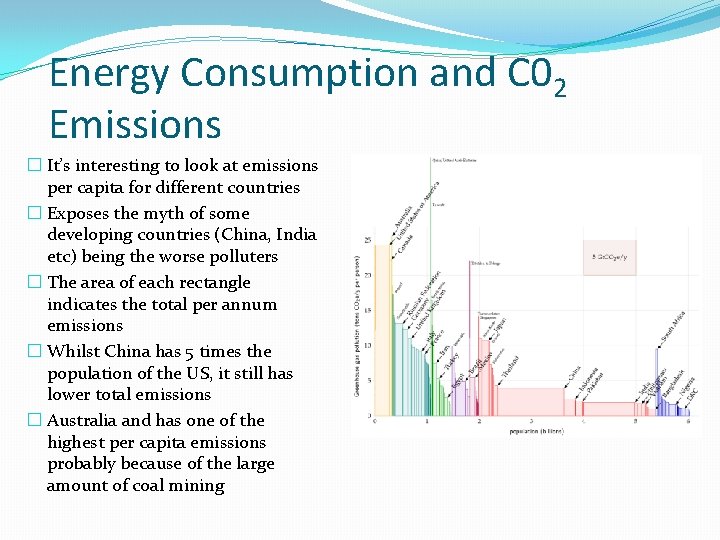
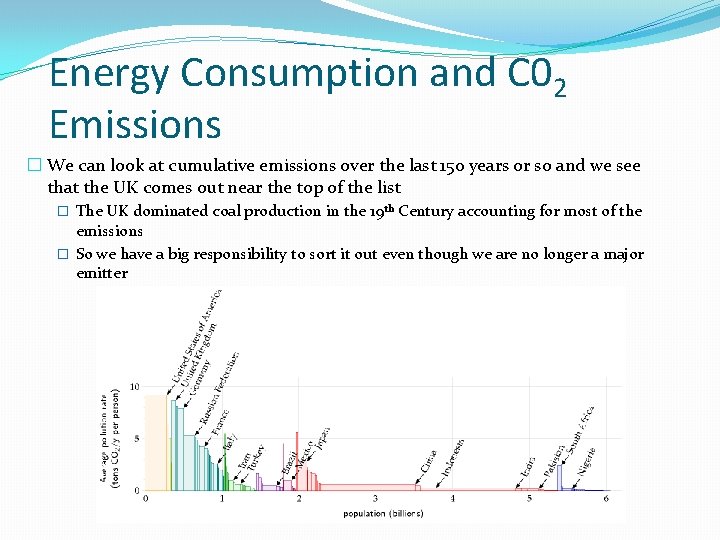
Energy Consumption and C 02 Emissions � It’s interesting to look at emissions per capita for different countries � Exposes the myth of some developing countries (China, India etc) being the worse polluters � The area of each rectangle indicates the total per annum emissions � Whilst China has 5 times the population of the US, it still has lower total emissions � Australia and has one of the highest per capita emissions probably because of the large amount of coal mining
Energy Consumption and C 02 Emissions � We can look at cumulative emissions over the last 150 years or so and we see that the UK comes out near the top of the list � The UK dominated coal production in the 19 th Century accounting for most of the emissions � So we have a big responsibility to sort it out even though we are no longer a major emitter
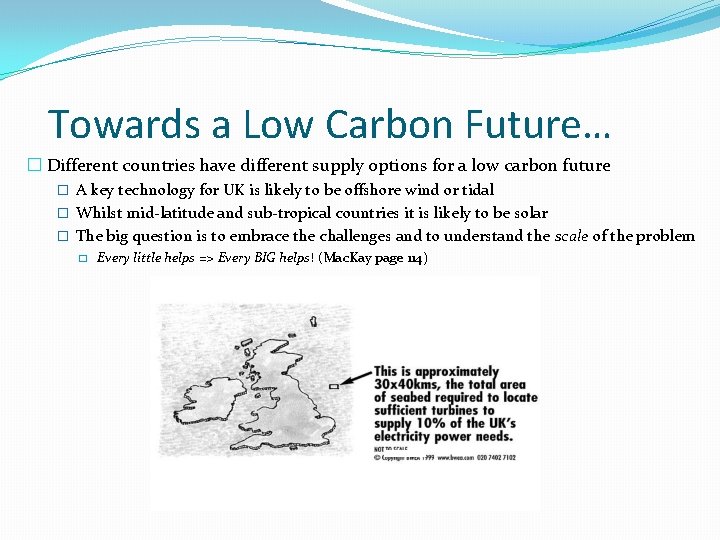
Towards a Low Carbon Future… � Different countries have different supply options for a low carbon future � A key technology for UK is likely to be offshore wind or tidal � Whilst mid-latitude and sub-tropical countries it is likely to be solar � The big question is to embrace the challenges and to understand the scale of the problem � Every little helps => Every BIG helps! (Mac. Kay page 114)
Part II Future Energy Challenges
Future Energy Challenges � We can identify the main energy challenges for the next several decades � These are UK specific but apply to a greater or lesser extent globally � Supply – demand gap Energy Challenges Introduction � A number of power stations are due to be decommissioned over the next decade � CO 2 emissions � We are obliged to drastically cut our emissions over the next few decades to conform to international agreements � Supply security � We currently import oil and gas from areas with significant political unrest https: //www. youtube. com/watch? v=U 7 Bsvht 2 I 7 c&feature=player_embedded
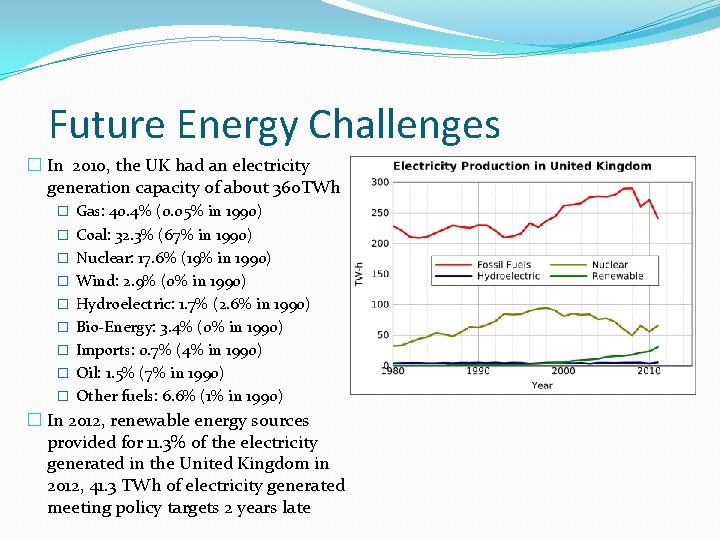
Future Energy Challenges � In 2010, the UK had an electricity generation capacity of about 360 TWh � Gas: 40. 4% (0. 05% in 1990) � Coal: 32. 3% (67% in 1990) � Nuclear: 17. 6% (19% in 1990) � Wind: 2. 9% (0% in 1990) � Hydroelectric: 1. 7% (2. 6% in 1990) � Bio-Energy: 3. 4% (0% in 1990) � Imports: 0. 7% (4% in 1990) � Oil: 1. 5% (7% in 1990) � Other fuels: 6. 6% (1% in 1990) � In 2012, renewable energy sources provided for 11. 3% of the electricity generated in the United Kingdom in 2012, 41. 3 TWh of electricity generated meeting policy targets 2 years late
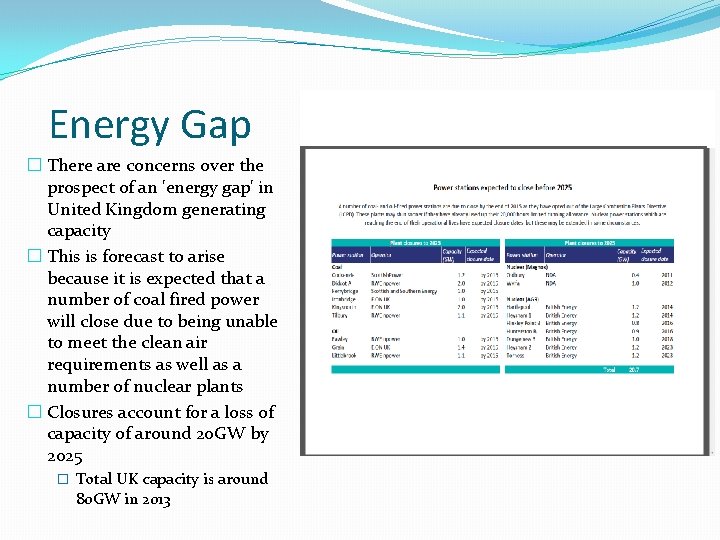
Energy Gap � There are concerns over the prospect of an 'energy gap' in United Kingdom generating capacity � This is forecast to arise because it is expected that a number of coal fired power will close due to being unable to meet the clean air requirements as well as a number of nuclear plants � Closures account for a loss of capacity of around 20 GW by 2025 � Total UK capacity is around 80 GW in 2013
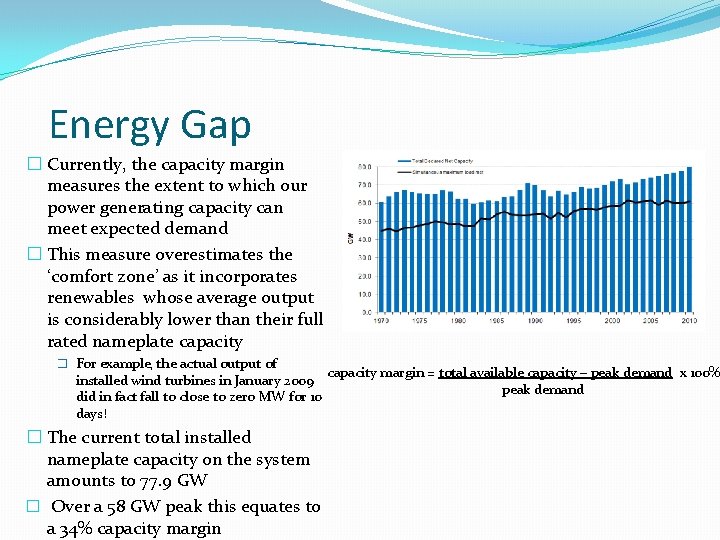
Energy Gap � Currently, the capacity margin measures the extent to which our power generating capacity can meet expected demand � This measure overestimates the ‘comfort zone’ as it incorporates renewables whose average output is considerably lower than their full rated nameplate capacity � For example, the actual output of capacity margin = total available capacity – peak demand x 100% installed wind turbines in January 2009 peak demand did in fact fall to close to zero MW for 10 days! � The current total installed nameplate capacity on the system amounts to 77. 9 GW � Over a 58 GW peak this equates to a 34% capacity margin
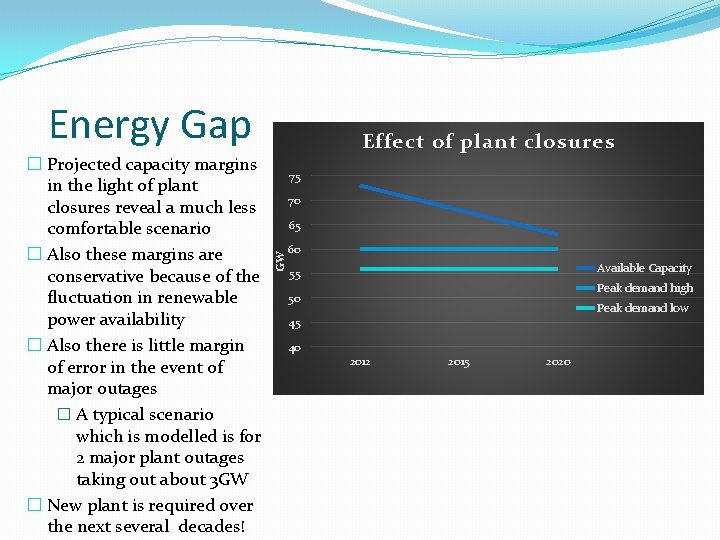
Energy Gap 75 70 65 GW � Projected capacity margins in the light of plant closures reveal a much less comfortable scenario � Also these margins are conservative because of the fluctuation in renewable power availability � Also there is little margin of error in the event of major outages � A typical scenario which is modelled is for 2 major plant outages taking out about 3 GW � New plant is required over the next several decades! Effect of plant closures 60 Available Capacity 55 Peak demand high 50 Peak demand low 45 40 2012 2015 2020
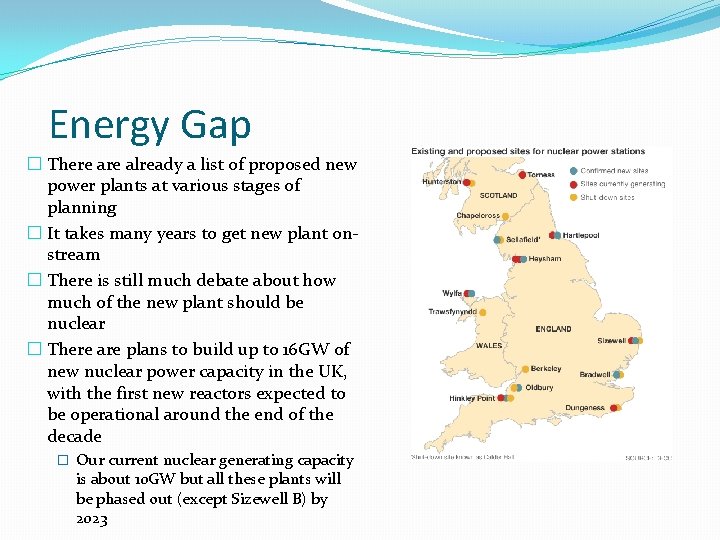
Energy Gap � There already a list of proposed new power plants at various stages of planning � It takes many years to get new plant onstream � There is still much debate about how much of the new plant should be nuclear � There are plans to build up to 16 GW of new nuclear power capacity in the UK, with the first new reactors expected to be operational around the end of the decade � Our current nuclear generating capacity is about 10 GW but all these plants will be phased out (except Sizewell B) by 2023
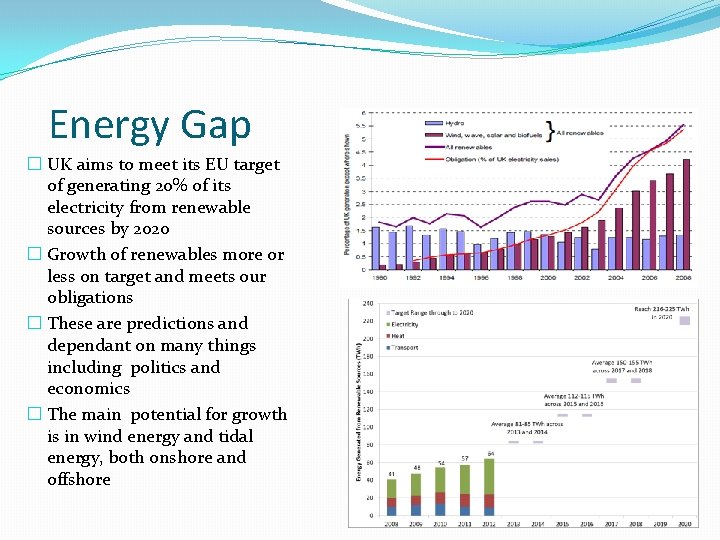
Energy Gap � UK aims to meet its EU target of generating 20% of its electricity from renewable sources by 2020 � Growth of renewables more or less on target and meets our obligations � These are predictions and dependant on many things including politics and economics � The main potential for growth is in wind energy and tidal energy, both onshore and offshore
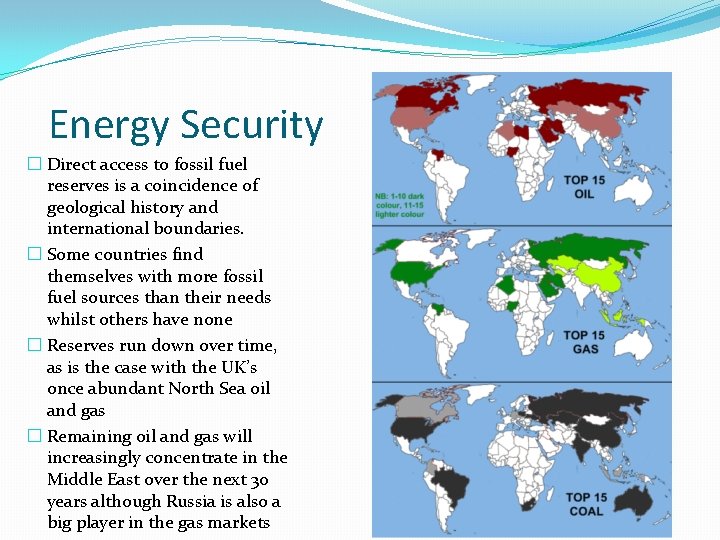
Energy Security � Direct access to fossil fuel reserves is a coincidence of geological history and international boundaries. � Some countries find themselves with more fossil fuel sources than their needs whilst others have none � Reserves run down over time, as is the case with the UK’s once abundant North Sea oil and gas � Remaining oil and gas will increasingly concentrate in the Middle East over the next 30 years although Russia is also a big player in the gas markets
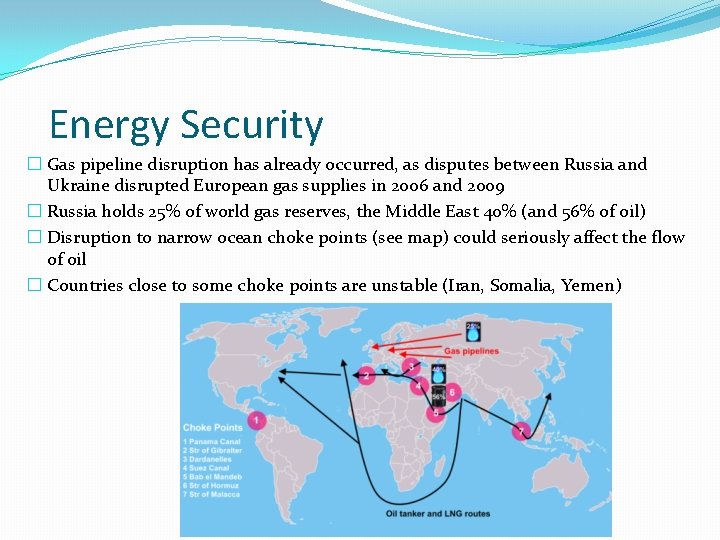
Energy Security � Gas pipeline disruption has already occurred, as disputes between Russia and Ukraine disrupted European gas supplies in 2006 and 2009 � Russia holds 25% of world gas reserves, the Middle East 40% (and 56% of oil) � Disruption to narrow ocean choke points (see map) could seriously affect the flow of oil � Countries close to some choke points are unstable (Iran, Somalia, Yemen)
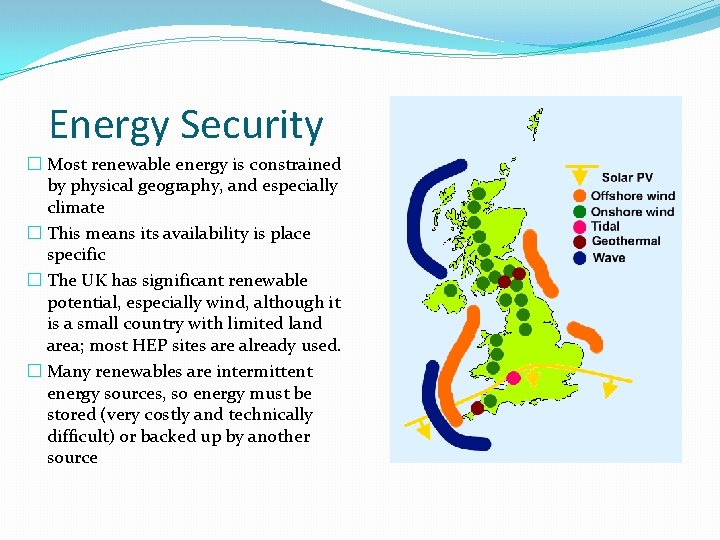
Energy Security � Most renewable energy is constrained by physical geography, and especially climate � This means its availability is place specific � The UK has significant renewable potential, especially wind, although it is a small country with limited land area; most HEP sites are already used. � Many renewables are intermittent energy sources, so energy must be stored (very costly and technically difficult) or backed up by another source
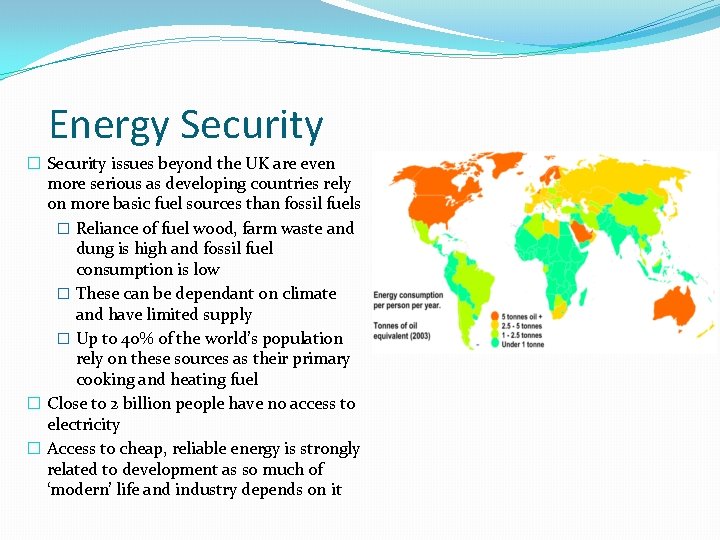
Energy Security � Security issues beyond the UK are even more serious as developing countries rely on more basic fuel sources than fossil fuels � Reliance of fuel wood, farm waste and dung is high and fossil fuel consumption is low � These can be dependant on climate and have limited supply � Up to 40% of the world’s population rely on these sources as their primary cooking and heating fuel � Close to 2 billion people have no access to electricity � Access to cheap, reliable energy is strongly related to development as so much of ‘modern’ life and industry depends on it
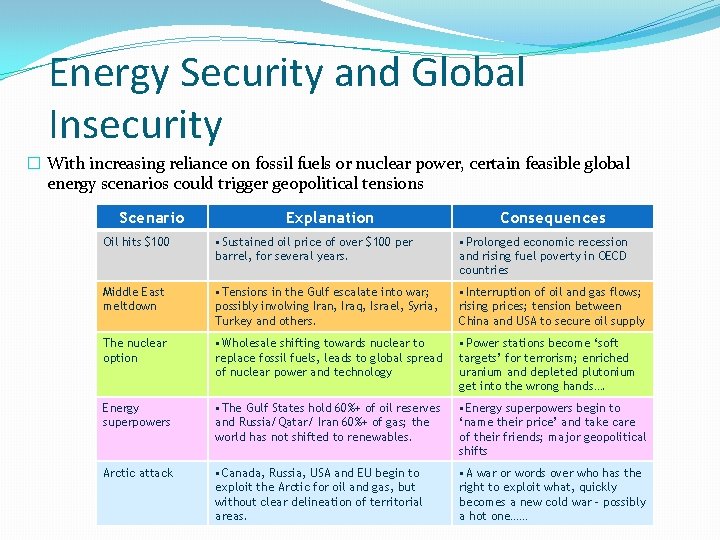
Energy Security and Global Insecurity � With increasing reliance on fossil fuels or nuclear power, certain feasible global energy scenarios could trigger geopolitical tensions Scenario Explanation Consequences Oil hits $100 • Sustained oil price of over $100 per barrel, for several years. • Prolonged economic recession and rising fuel poverty in OECD countries Middle East meltdown • Tensions in the Gulf escalate into war; possibly involving Iran, Iraq, Israel, Syria, Turkey and others. • Interruption of oil and gas flows; rising prices; tension between China and USA to secure oil supply The nuclear option • Wholesale shifting towards nuclear to replace fossil fuels, leads to global spread of nuclear power and technology • Power stations become ‘soft targets’ for terrorism; enriched uranium and depleted plutonium get into the wrong hands…. Energy superpowers • The Gulf States hold 60%+ of oil reserves and Russia/Qatar/ Iran 60%+ of gas; the world has not shifted to renewables. • Energy superpowers begin to ‘name their price’ and take care of their friends; major geopolitical shifts Arctic attack • Canada, Russia, USA and EU begin to exploit the Arctic for oil and gas, but without clear delineation of territorial areas. • A war or words over who has the right to exploit what, quickly becomes a new cold war – possibly a hot one……
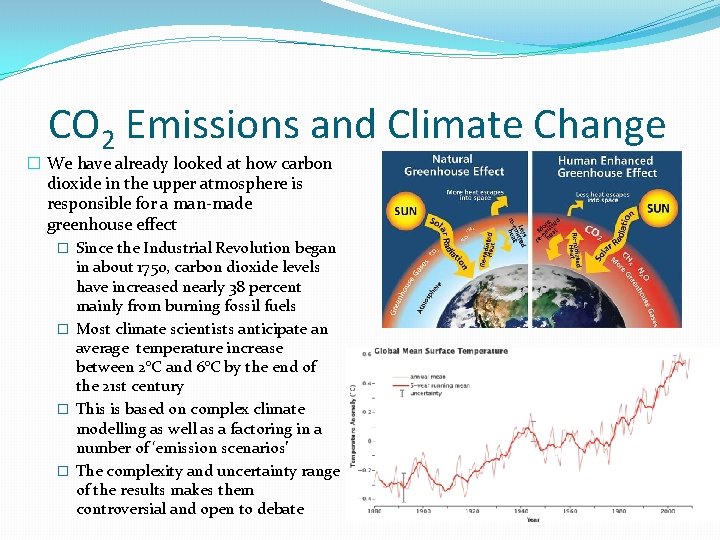
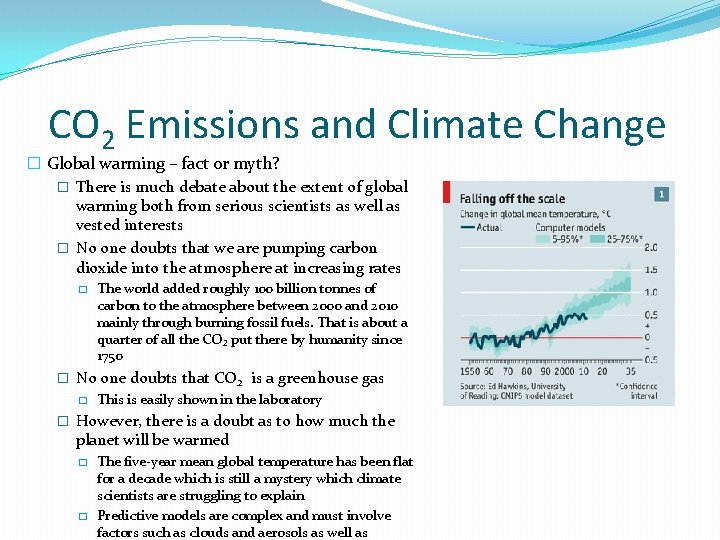
CO 2 Emissions and Climate Change � We have already looked at how carbon dioxide in the upper atmosphere is responsible for a man-made greenhouse effect � Since the Industrial Revolution began in about 1750, carbon dioxide levels have increased nearly 38 percent mainly from burning fossil fuels � Most climate scientists anticipate an average temperature increase between 2°C and 6°C by the end of the 21 st century � This is based on complex climate modelling as well as a factoring in a number of ‘emission scenarios’ � The complexity and uncertainty range of the results makes them controversial and open to debate
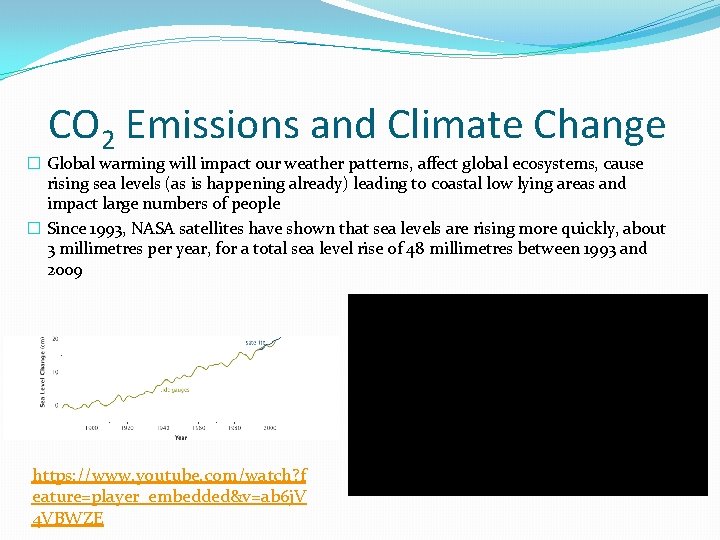
CO 2 Emissions and Climate Change � Global warming will impact our weather patterns, affect global ecosystems, cause rising sea levels (as is happening already) leading to coastal low lying areas and impact large numbers of people � Since 1993, NASA satellites have shown that sea levels are rising more quickly, about 3 millimetres per year, for a total sea level rise of 48 millimetres between 1993 and 2009 https: //www. youtube. com/watch? f eature=player_embedded&v=ab 6 j. V 4 VBWZE
CO 2 Emissions and Climate Change � Global warming – fact or myth? � There is much debate about the extent of global warming both from serious scientists as well as vested interests � No one doubts that we are pumping carbon dioxide into the atmosphere at increasing rates � The world added roughly 100 billion tonnes of carbon to the atmosphere between 2000 and 2010 mainly through burning fossil fuels. That is about a quarter of all the CO₂ put there by humanity since 1750 � No one doubts that CO₂ is a greenhouse gas � This is easily shown in the laboratory � However, there is a doubt as to how much the planet will be warmed � � The five-year mean global temperature has been flat for a decade which is still a mystery which climate scientists are struggling to explain Predictive models are complex and must involve factors such as clouds and aerosols as well as
CO 2 Emissions and Climate Change � There are ‘myth-mongerers’ and ‘myth-debunkers’ amongst both amateur scientists, commentators and serious scientists alike � The main battleground is that the effect of ‘man’ on climate change is insignificant compared to the huge natural effects of the oceans, polar regions and the atmosphere � Things are not helped by the fact that the IPCC (Inter-governmental panel on climate change) is a political and not a scientific organisation � Here is an alternative view from the Friends of Science which is a nonprofit organization based in Canada https: //www. youtube. com/watch? v=Knip. KZ Ahg. W 4&feature=player_embedded
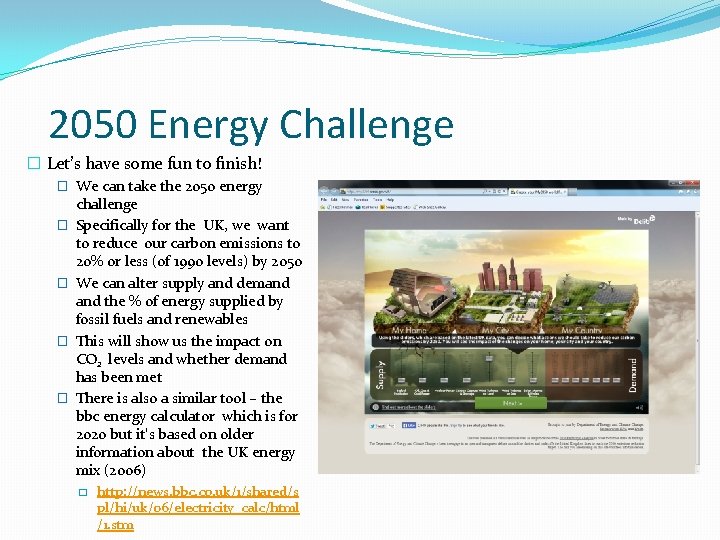
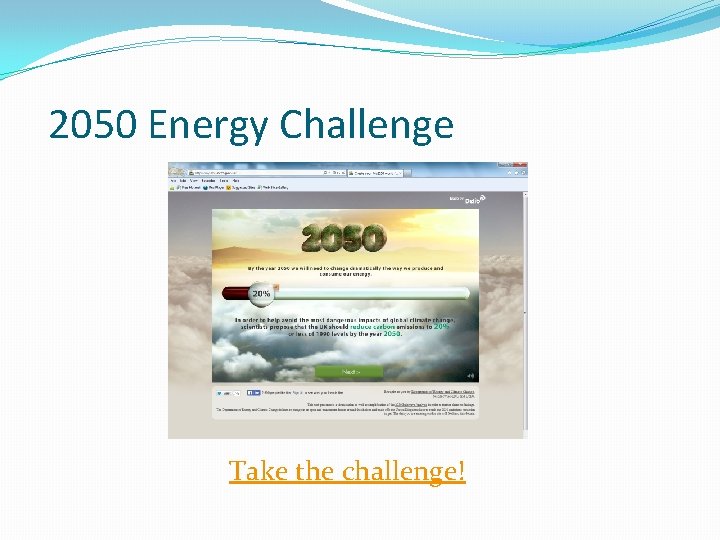
2050 Energy Challenge � Let’s have some fun to finish! � We can take the 2050 energy � � challenge Specifically for the UK, we want to reduce our carbon emissions to 20% or less (of 1990 levels) by 2050 We can alter supply and demand the % of energy supplied by fossil fuels and renewables This will show us the impact on CO 2 levels and whether demand has been met There is also a similar tool – the bbc energy calculator which is for 2020 but it’s based on older information about the UK energy mix (2006) � http: //news. bbc. co. uk/1/shared/s pl/hi/uk/06/electricity_calc/html /1. stm
2050 Energy Challenge Take the challenge!
Summary � This completes my series of lectures � Today we looked at energy consumption and future energy challenges � UK supply-demand energy gap � Energy security � Carbon emissions � We have looked at primary energy consumption from a range of viewpoints � By fuel type � By country and per capita