
Introduction to Energy and Metabolism Chapter 8 Energy
Introduction to Energy and Metabolism Chapter 8
Energy • Energy- The ability to do work o Move matter against opposing forces (ex. Gravity, friction) • 1 st law of thermodynamics o Energy cannot be created nor destroyed, it can only be transferred or transformed o Energy may be transformed into different types of energy • Mechanical, light, sound, thermal, electrical, and chemical • 2 basic categories of energy 1. Kinetic energy of motion 2. Potential energy stored in material based on its arrangement or location. • Example: Boulder on a cliff o Potential energy due to position converts to kinetic energy as it falls • Example: Gasoline o Potential energy due to arrangement of atoms converts to kinetic energy when it reacts with oxygen.
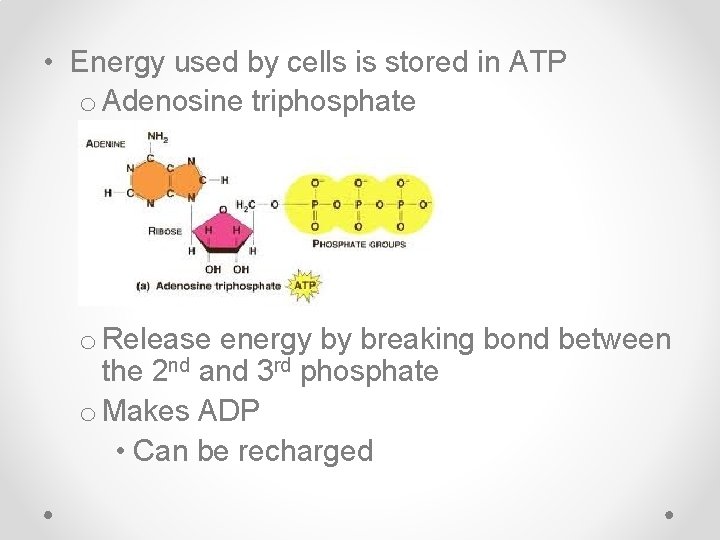
• Energy used by cells is stored in ATP o Adenosine triphosphate o Release energy by breaking bond between the 2 nd and 3 rd phosphate o Makes ADP • Can be recharged
Obtaining ATP • Organisms have different ways of obtaining ATP o Autotrophs • Produce their own food • Photosynthesis use of sunlight to produce high energy carbohydrates (sugars and starches) o Heterotrophs • Gain energy by consuming other organisms

Autotroph or heterotroph
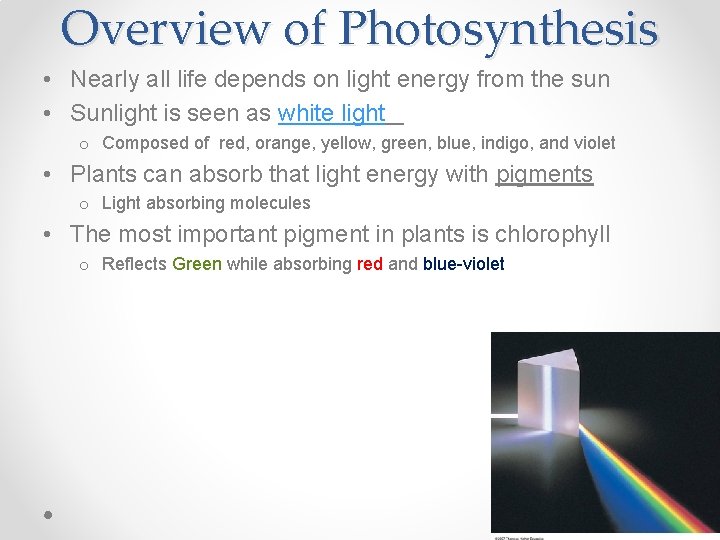
Overview of Photosynthesis • Nearly all life depends on light energy from the sun • Sunlight is seen as white light o Composed of red, orange, yellow, green, blue, indigo, and violet • Plants can absorb that light energy with pigments o Light absorbing molecules • The most important pigment in plants is chlorophyll o Reflects Green while absorbing red and blue-violet
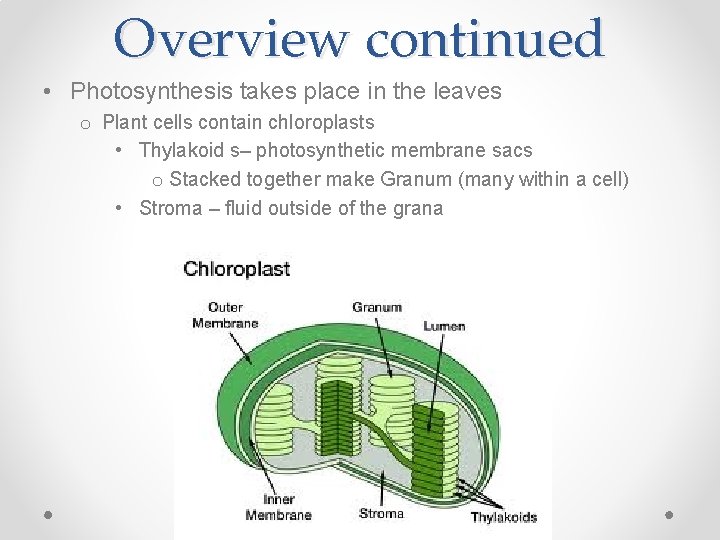
Overview continued • Photosynthesis takes place in the leaves o Plant cells contain chloroplasts • Thylakoid s– photosynthetic membrane sacs o Stacked together make Granum (many within a cell) • Stroma – fluid outside of the grana
Energy collection • Chlorophyll collects light energy • Transfer energy to electrons makes high energy electrons (HEE) • HEE power photosynthesis o Most be transported by carrier molecules o NADP+ is one such carrier molecule o NADP+ holds 2 HEE and 1 hydrogen ion • Becomes NADPH • HEE are transported to the site of reactions and used to build carbohydrates
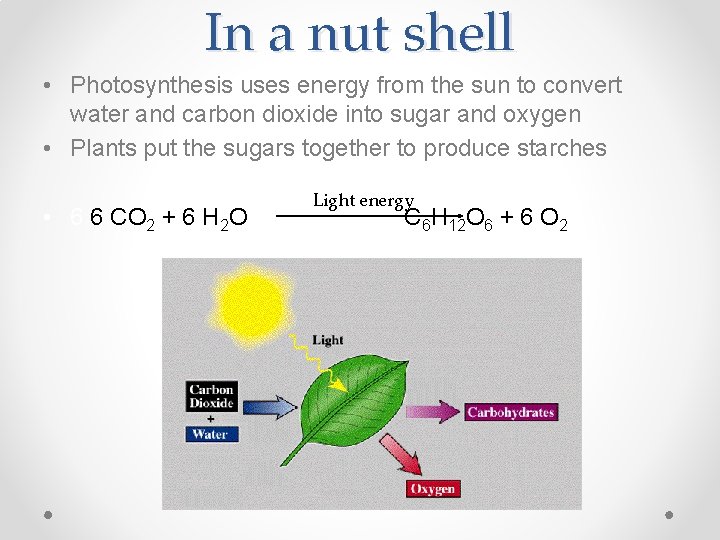
In a nut shell • Photosynthesis uses energy from the sun to convert water and carbon dioxide into sugar and oxygen • Plants put the sugars together to produce starches • 6 6 CO 2 + 6 H 2 O Light energy C 6 H 12 O 6 + 6 O 2
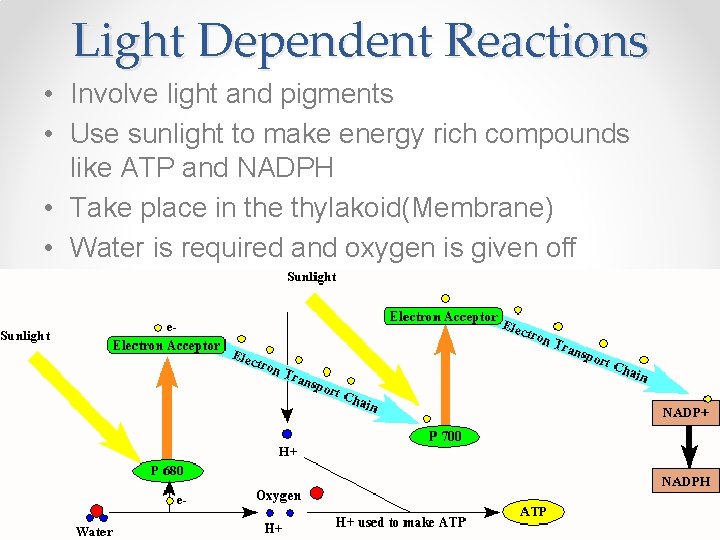
Light Dependent Reactions • Involve light and pigments • Use sunlight to make energy rich compounds like ATP and NADPH • Take place in the thylakoid(Membrane) • Water is required and oxygen is given off
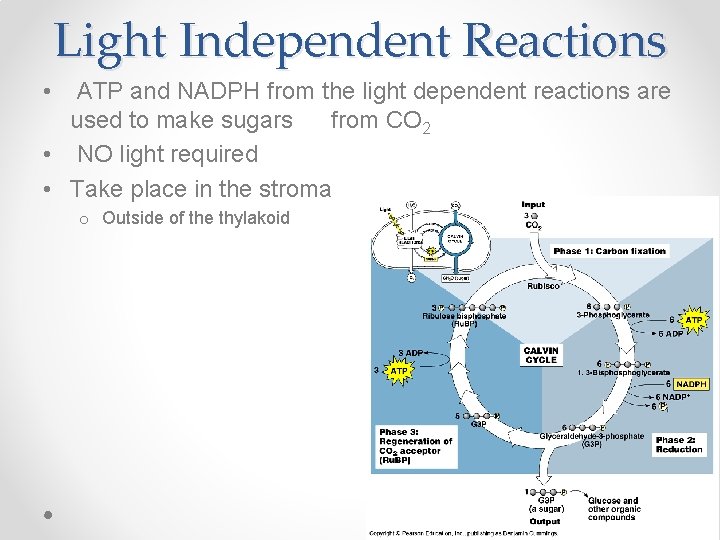
Light Independent Reactions • ATP and NADPH from the light dependent reactions are used to make sugars from CO 2 • NO light required • Take place in the stroma o Outside of the thylakoid
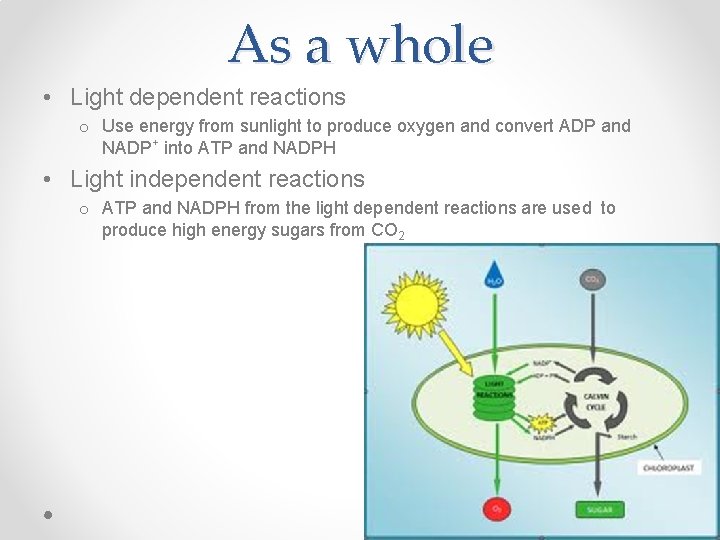
As a whole • Light dependent reactions o Use energy from sunlight to produce oxygen and convert ADP and NADP+ into ATP and NADPH • Light independent reactions o ATP and NADPH from the light dependent reactions are used to produce high energy sugars from CO 2
Light Dependent Reactions • Take place in the thylakoids of the chloroplasts o Thylakoids have groups of chlorophyll and proteins called photosystems(PS) o PS absorb light energy • Photosystem II (PS II) o Light energy raises e- to a high energy state • Water is split to replace e- in PS II • Oxygen is produced o e- are passed to the electron transport chain (ETC) • As e- lose energy, it is used to pump H+ ions into the thylakoid o e- are then passed to PS I
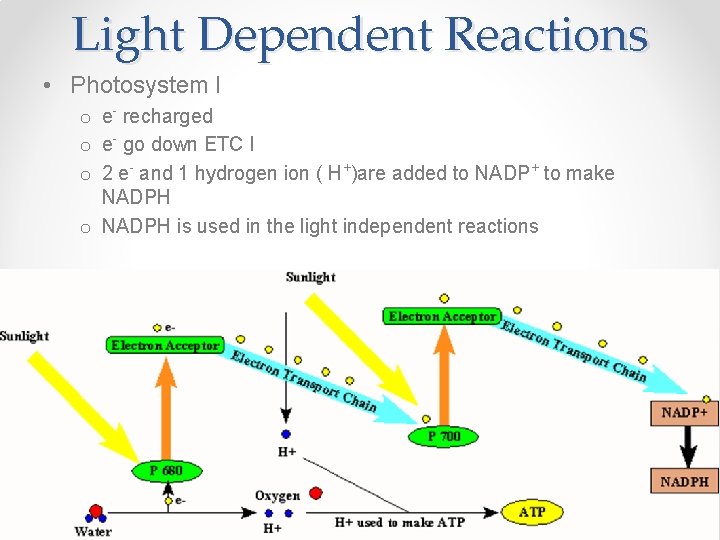
Light Dependent Reactions • Photosystem I o e- recharged o e- go down ETC I o 2 e- and 1 hydrogen ion ( H+)are added to NADP+ to make NADPH o NADPH is used in the light independent reactions
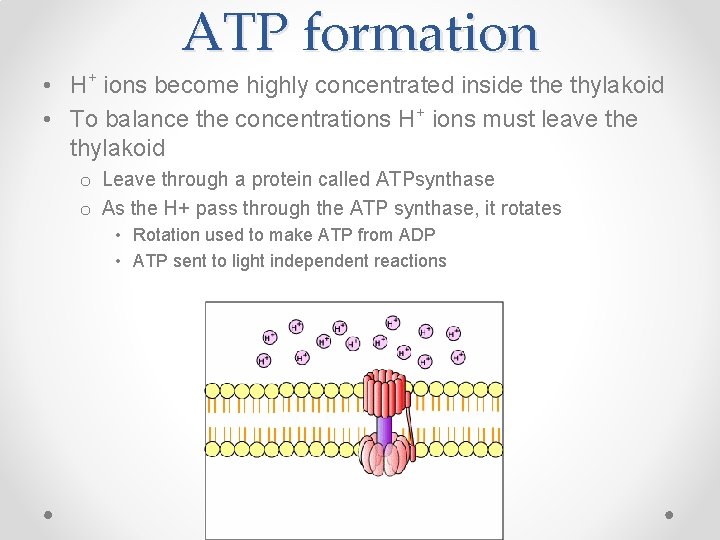
ATP formation • H+ ions become highly concentrated inside thylakoid • To balance the concentrations H+ ions must leave thylakoid o Leave through a protein called ATPsynthase o As the H+ pass through the ATP synthase, it rotates • Rotation used to make ATP from ADP • ATP sent to light independent reactions
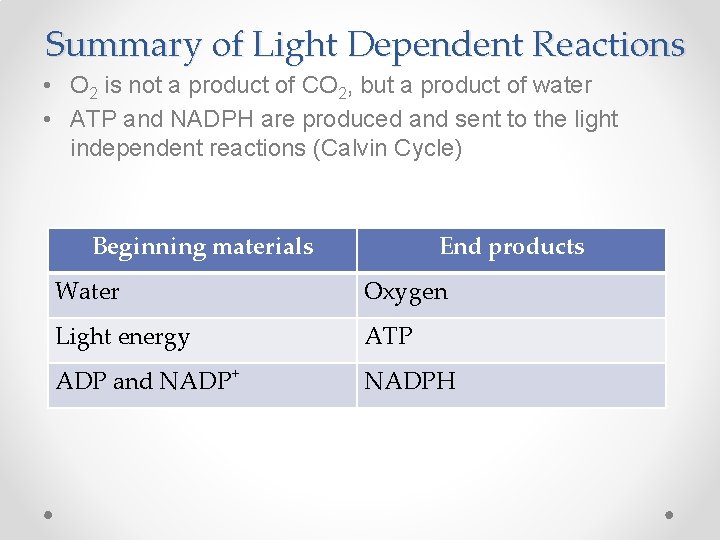
Summary of Light Dependent Reactions • O 2 is not a product of CO 2, but a product of water • ATP and NADPH are produced and sent to the light independent reactions (Calvin Cycle) Beginning materials End products Water Oxygen Light energy ATP ADP and NADP+ NADPH
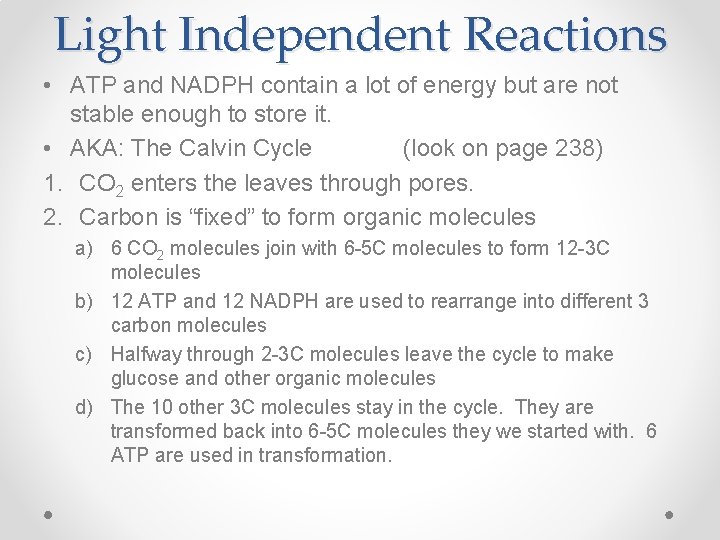
Light Independent Reactions • ATP and NADPH contain a lot of energy but are not stable enough to store it. • AKA: The Calvin Cycle (look on page 238) 1. CO 2 enters the leaves through pores. 2. Carbon is “fixed” to form organic molecules a) 6 CO 2 molecules join with 6 -5 C molecules to form 12 -3 C molecules b) 12 ATP and 12 NADPH are used to rearrange into different 3 carbon molecules c) Halfway through 2 -3 C molecules leave the cycle to make glucose and other organic molecules d) The 10 other 3 C molecules stay in the cycle. They are transformed back into 6 -5 C molecules they we started with. 6 ATP are used in transformation.
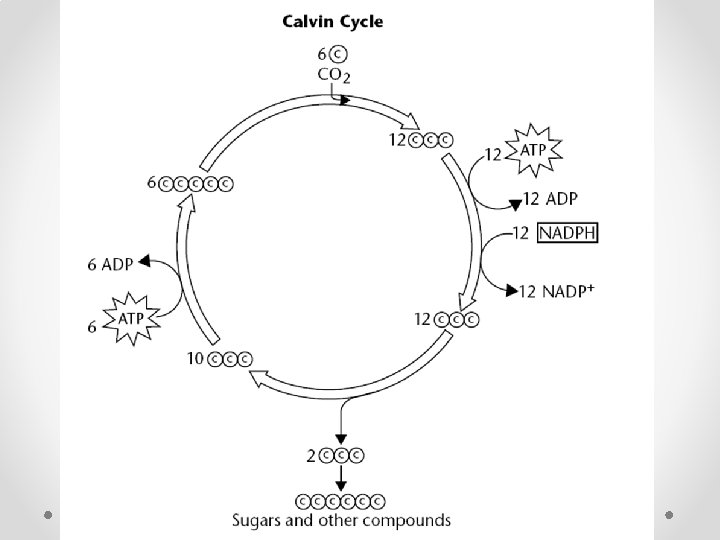
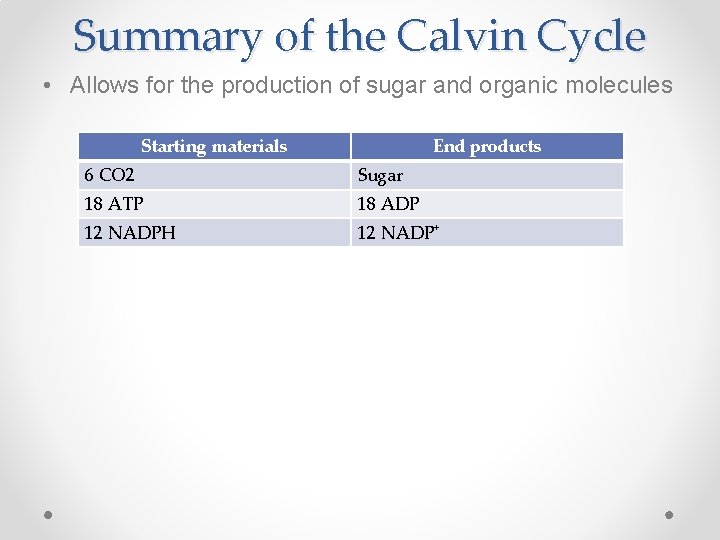
Summary of the Calvin Cycle • Allows for the production of sugar and organic molecules Starting materials End products 6 CO 2 Sugar 18 ATP 18 ADP 12 NADPH 12 NADP+
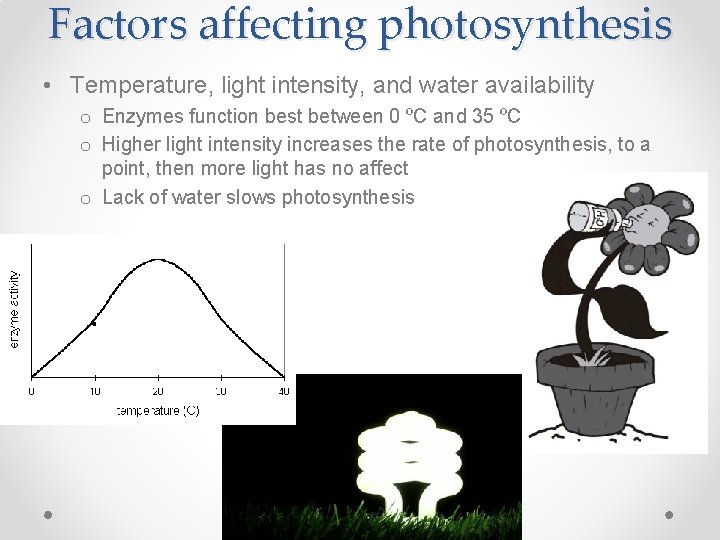
Factors affecting photosynthesis • Temperature, light intensity, and water availability o Enzymes function best between 0 ºC and 35 ºC o Higher light intensity increases the rate of photosynthesis, to a point, then more light has no affect o Lack of water slows photosynthesis
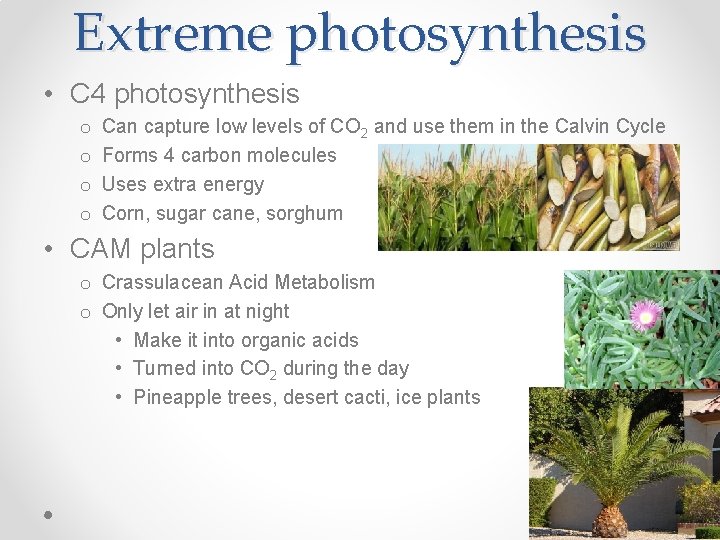
Extreme photosynthesis • C 4 photosynthesis o o Can capture low levels of CO 2 and use them in the Calvin Cycle Forms 4 carbon molecules Uses extra energy Corn, sugar cane, sorghum • CAM plants o Crassulacean Acid Metabolism o Only let air in at night • Make it into organic acids • Turned into CO 2 during the day • Pineapple trees, desert cacti, ice plants
- Slides: 21