
Introduction to EMBOK The Event Management Body of
Introduction to EMBOK The Event Management Body of Knowledge By Julia Rutherford Silvers, CSEP Originator of The EMBOK Project Charter member of the International EMBOK Executive* *Glenn AJ Bowdin, Joe Goldblatt, Matthew D. Gonzalez, Janet Landey, Philip Mondor, Kathy Nelson, William J. O'Toole, and Julia Rutherford Silvers © 2007, Julia Rutherford Silvers, CSEP, All Rights Reserved
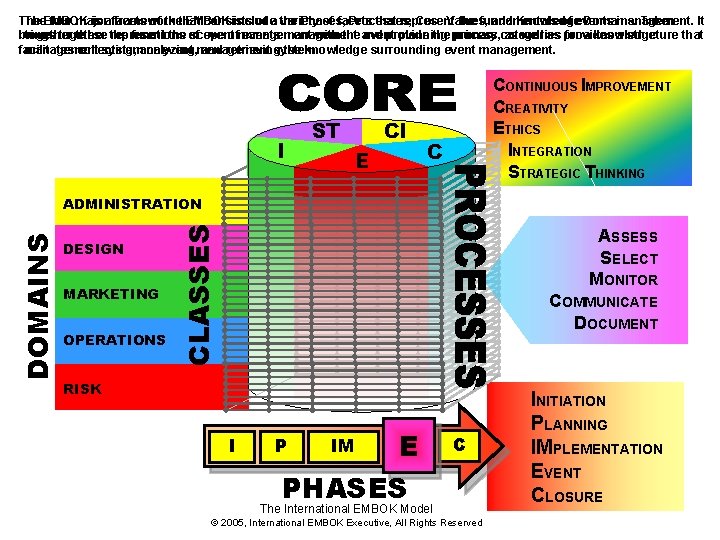
The. EMBOK four major of thethat EMBOK include Phases, Processes, Core Values, and Knowledge Domains. Taken The is a facets framework consists of a the variety of facets that represent the fundamentals of events management. It together these the represent the of scope ofmanagement events management provide the process, primary categories for a knowledge brings together functions event with the and event planning as well as provides a structure that management systemanalyzing, or event management system. facilitates collecting, and retrieving the knowledge surrounding event management. I ST CI E CONTINUOUS IMPROVEMENT CREATIVITY ETHICS INTEGRATION STRATEGIC THINKING C DESIGN MARKETING OPERATIONS CLASSES DOMAINS ADMINISTRATION ASSESS SELECT MONITOR COMMUNICATE DOCUMENT RISK I P IM E C PHASES The International EMBOK Model © 2005, International EMBOK Executive, All Rights Reserved INITIATION PLANNING IMPLEMENTATION EVENT CLOSURE
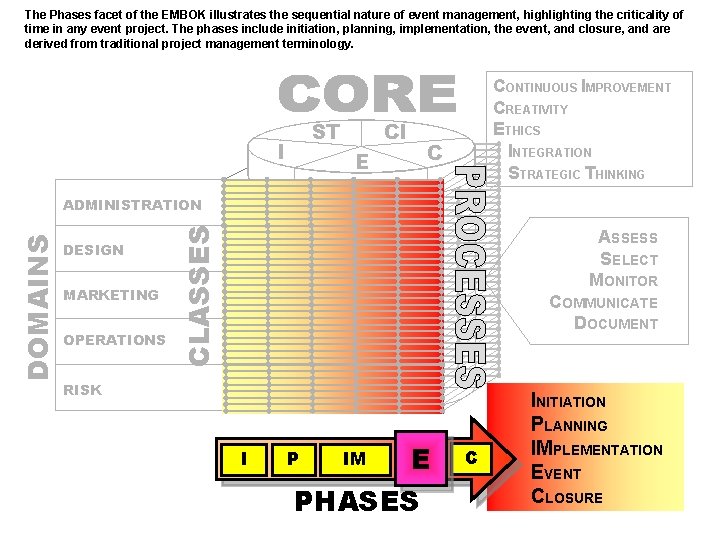
The Phases facet of the EMBOK illustrates the sequential nature of event management, highlighting the criticality of time in any event project. The phases include initiation, planning, implementation, the event, and closure, and are derived from traditional project management terminology. ST I CI CONTINUOUS IMPROVEMENT CREATIVITY ETHICS INTEGRATION STRATEGIC THINKING C E DESIGN MARKETING OPERATIONS CLASSES DOMAINS ADMINISTRATION ASSESS SELECT MONITOR COMMUNICATE DOCUMENT RISK I P IM E PHASES C INITIATION PLANNING IMPLEMENTATION EVENT CLOSURE
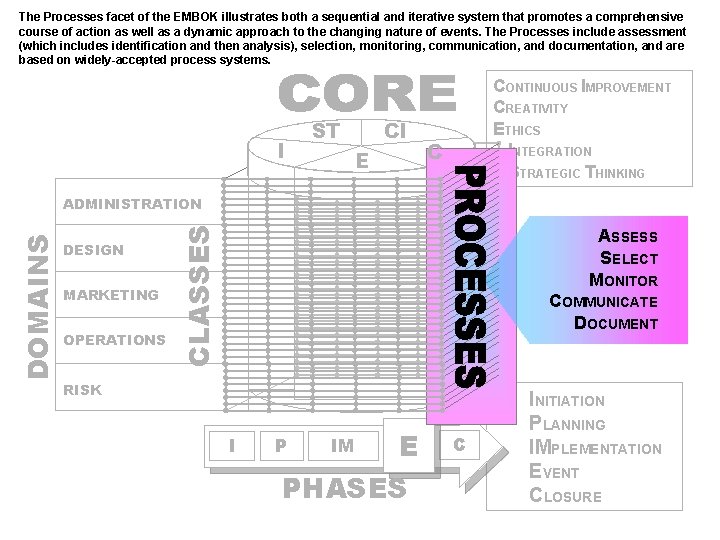
The Processes facet of the EMBOK illustrates both a sequential and iterative system that promotes a comprehensive course of action as well as a dynamic approach to the changing nature of events. The Processes include assessment (which includes identification and then analysis), selection, monitoring, communication, and documentation, and are based on widely-accepted process systems. I ST CI E CONTINUOUS IMPROVEMENT CREATIVITY ETHICS INTEGRATION STRATEGIC THINKING C DESIGN MARKETING OPERATIONS CLASSES DOMAINS ADMINISTRATION ASSESS SELECT MONITOR COMMUNICATE DOCUMENT RISK I P IM E PHASES C INITIATION PLANNING IMPLEMENTATION EVENT CLOSURE
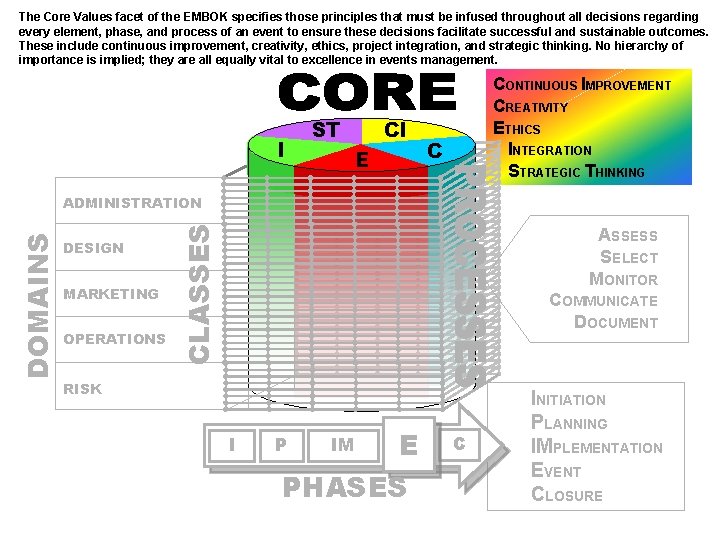
The Core Values facet of the EMBOK specifies those principles that must be infused throughout all decisions regarding every element, phase, and process of an event to ensure these decisions facilitate successful and sustainable outcomes. These include continuous improvement, creativity, ethics, project integration, and strategic thinking. No hierarchy of importance is implied; they are all equally vital to excellence in events management. I ST CI E CONTINUOUS IMPROVEMENT CREATIVITY ETHICS INTEGRATION STRATEGIC THINKING C DESIGN MARKETING OPERATIONS CLASSES DOMAINS ADMINISTRATION ASSESS SELECT MONITOR COMMUNICATE DOCUMENT RISK I P IM E PHASES C INITIATION PLANNING IMPLEMENTATION EVENT CLOSURE
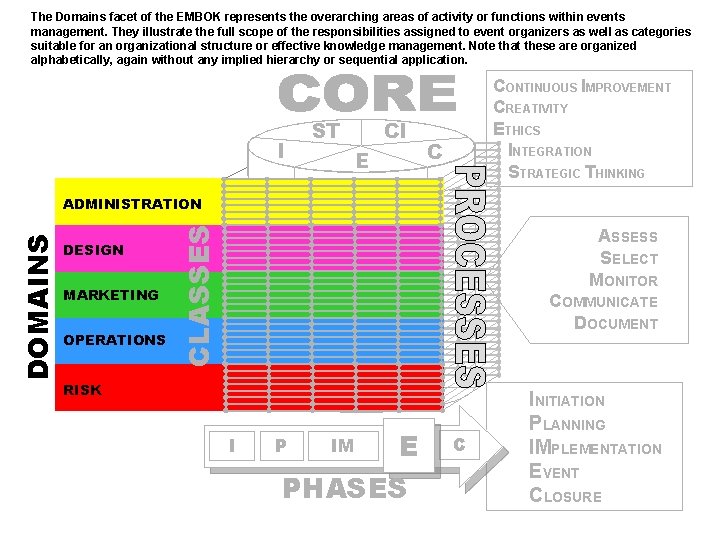
The Domains facet of the EMBOK represents the overarching areas of activity or functions within events management. They illustrate the full scope of the responsibilities assigned to event organizers as well as categories suitable for an organizational structure or effective knowledge management. Note that these are organized alphabetically, again without any implied hierarchy or sequential application. I ST CI E CONTINUOUS IMPROVEMENT CREATIVITY ETHICS INTEGRATION STRATEGIC THINKING C DESIGN MARKETING OPERATIONS CLASSES DOMAINS ADMINISTRATION ASSESS SELECT MONITOR COMMUNICATE DOCUMENT RISK I P IM E PHASES C INITIATION PLANNING IMPLEMENTATION EVENT CLOSURE
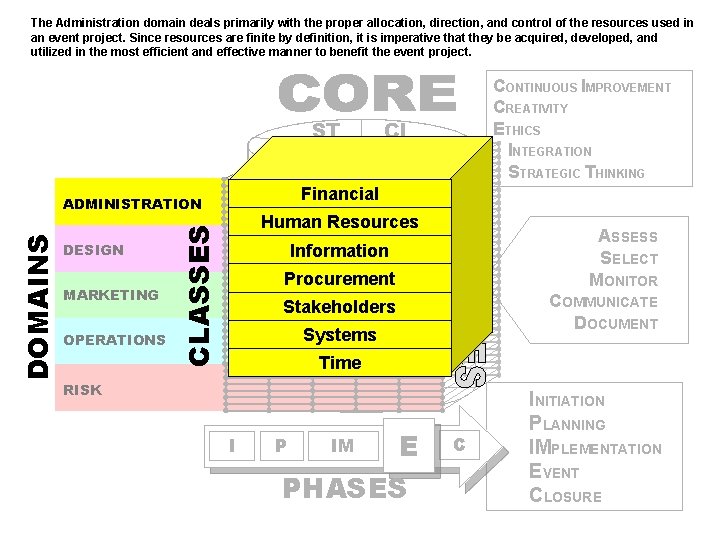
The Administration domain deals primarily with the proper allocation, direction, and control of the resources used in an event project. Since resources are finite by definition, it is imperative that they be acquired, developed, and utilized in the most efficient and effective manner to benefit the event project. I OPERATIONS E C Human Resources CLASSES DOMAINS MARKETING CI Financial ADMINISTRATION DESIGN ST CONTINUOUS IMPROVEMENT CREATIVITY ETHICS INTEGRATION STRATEGIC THINKING ASSESS SELECT MONITOR Information Procurement COMMUNICATE DOCUMENT Stakeholders Systems Time RISK I P IM E PHASES C INITIATION PLANNING IMPLEMENTATION EVENT CLOSURE
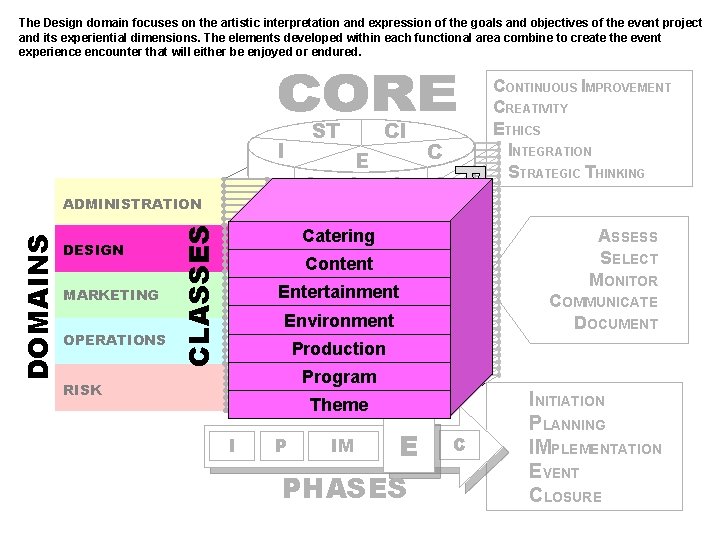
The Design domain focuses on the artistic interpretation and expression of the goals and objectives of the event project and its experiential dimensions. The elements developed within each functional area combine to create the event experience encounter that will either be enjoyed or endured. I ST CI E CONTINUOUS IMPROVEMENT CREATIVITY ETHICS INTEGRATION STRATEGIC THINKING C DESIGN MARKETING OPERATIONS CLASSES DOMAINS ADMINISTRATION Catering ASSESS SELECT MONITOR Content Entertainment COMMUNICATE DOCUMENT Environment Production Program RISK Theme I P IM E PHASES C INITIATION PLANNING IMPLEMENTATION EVENT CLOSURE
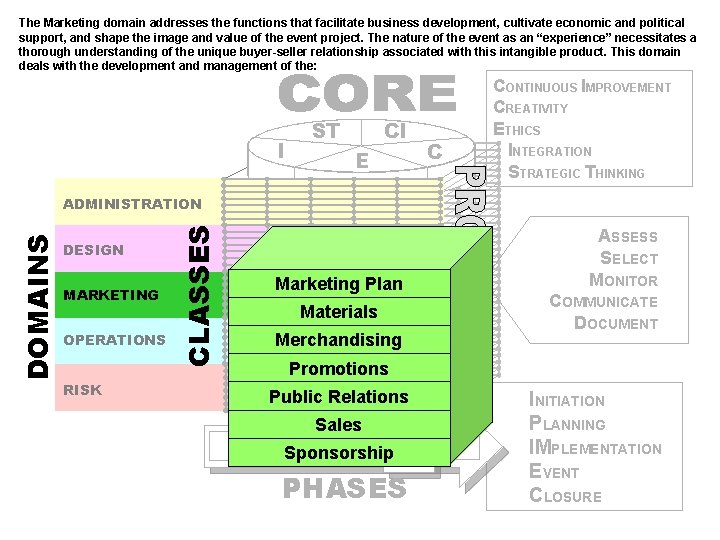
The Marketing domain addresses the functions that facilitate business development, cultivate economic and political support, and shape the image and value of the event project. The nature of the event as an “experience” necessitates a thorough understanding of the unique buyer-seller relationship associated with this intangible product. This domain deals with the development and management of the: I ST CI E CONTINUOUS IMPROVEMENT CREATIVITY ETHICS INTEGRATION STRATEGIC THINKING C DESIGN MARKETING OPERATIONS CLASSES DOMAINS ADMINISTRATION ASSESS SELECT MONITOR Marketing Plan COMMUNICATE DOCUMENT Materials Merchandising Promotions RISK Public Relations I Sales PSponsorship IM E PHASES C INITIATION PLANNING IMPLEMENTATION EVENT CLOSURE
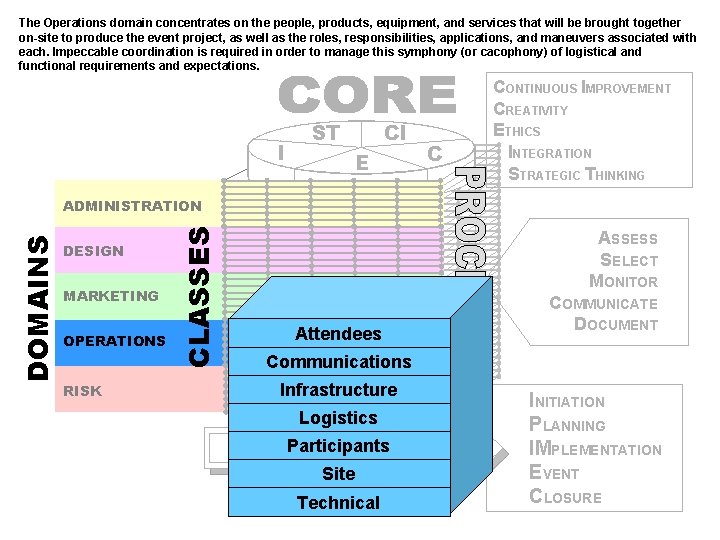
The Operations domain concentrates on the people, products, equipment, and services that will be brought together on-site to produce the event project, as well as the roles, responsibilities, applications, and maneuvers associated with each. Impeccable coordination is required in order to manage this symphony (or cacophony) of logistical and functional requirements and expectations. I ST CI E CONTINUOUS IMPROVEMENT CREATIVITY ETHICS INTEGRATION STRATEGIC THINKING C DESIGN MARKETING OPERATIONS CLASSES DOMAINS ADMINISTRATION ASSESS SELECT MONITOR COMMUNICATE DOCUMENT Attendees Communications Infrastructure RISK Logistics I PParticipants IM Site E PHASES Technical C INITIATION PLANNING IMPLEMENTATION EVENT CLOSURE
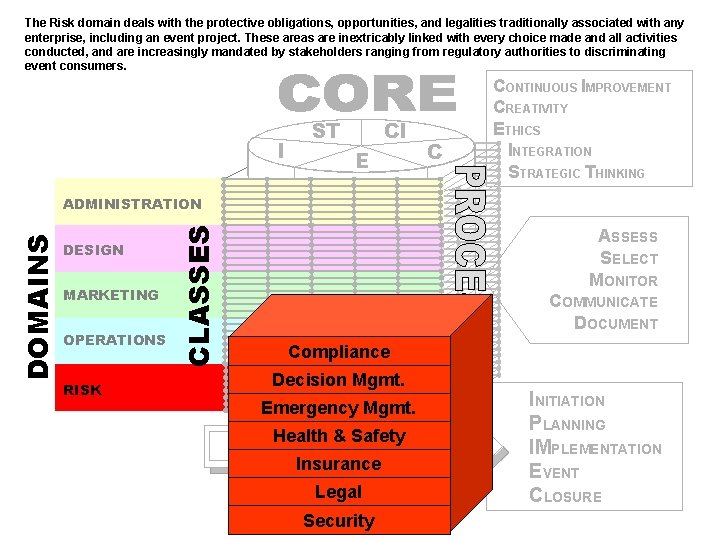
The Risk domain deals with the protective obligations, opportunities, and legalities traditionally associated with any enterprise, including an event project. These areas are inextricably linked with every choice made and all activities conducted, and are increasingly mandated by stakeholders ranging from regulatory authorities to discriminating event consumers. I ST CI E CONTINUOUS IMPROVEMENT CREATIVITY ETHICS INTEGRATION STRATEGIC THINKING C DESIGN MARKETING OPERATIONS CLASSES DOMAINS ADMINISTRATION ASSESS SELECT MONITOR COMMUNICATE DOCUMENT Compliance Decision Mgmt. RISK Emergency Mgmt. I Health & Safety P IM E Insurance PHASES Legal Security C INITIATION PLANNING IMPLEMENTATION EVENT CLOSURE
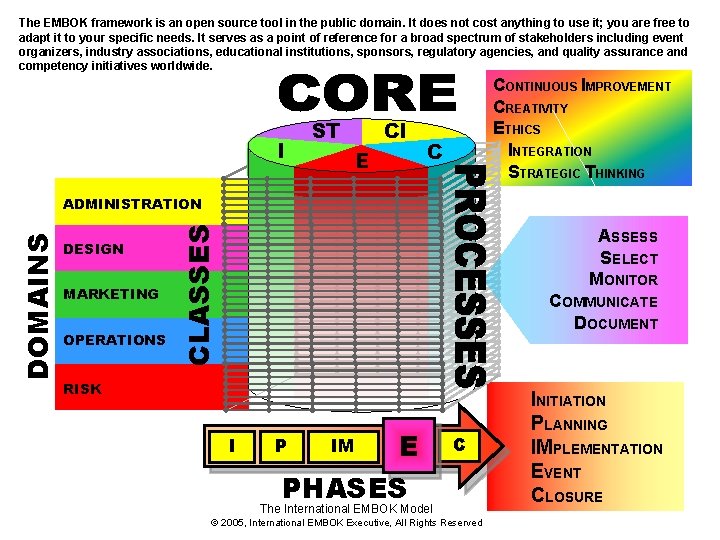
The EMBOK framework is an open source tool in the public domain. It does not cost anything to use it; you are free to adapt it to your specific needs. It serves as a point of reference for a broad spectrum of stakeholders including event organizers, industry associations, educational institutions, sponsors, regulatory agencies, and quality assurance and competency initiatives worldwide. I ST CI E CONTINUOUS IMPROVEMENT CREATIVITY ETHICS INTEGRATION STRATEGIC THINKING C DESIGN MARKETING OPERATIONS CLASSES DOMAINS ADMINISTRATION ASSESS SELECT MONITOR COMMUNICATE DOCUMENT RISK I P IM E C PHASES The International EMBOK Model © 2005, International EMBOK Executive, All Rights Reserved INITIATION PLANNING IMPLEMENTATION EVENT CLOSURE
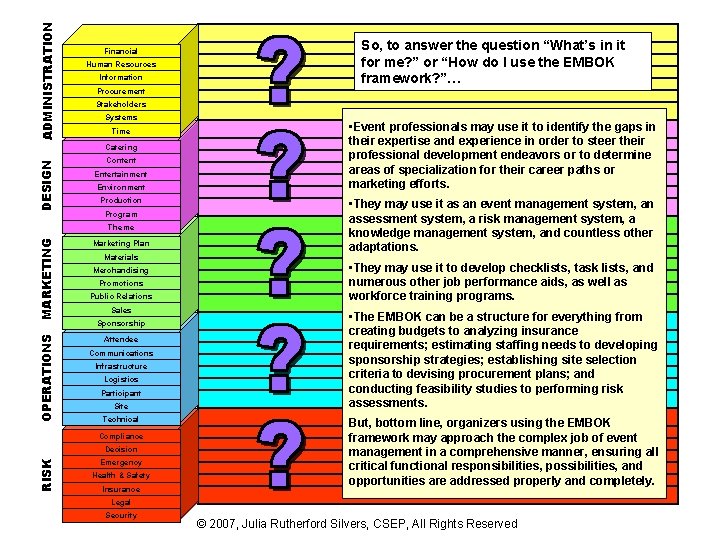
ADMINISTRATION Financial Human Resources Information Procurement Stakeholders Systems Time DESIGN Catering Content Entertainment Environment Production Program OPERATIONS MARKETING Theme Marketing Plan Materials Merchandising Promotions Public Relations Sales Sponsorship Attendee Communications Infrastructure Logistics Participant Site Technical Compliance Decision RISK So, to answer the question “What’s in it for me? ” or “How do I use the EMBOK framework? ”… Emergency Health & Safety Insurance • Event professionals may use it to identify the gaps in their expertise and experience in order to steer their professional development endeavors or to determine areas of specialization for their career paths or marketing efforts. • They may use it as an event management system, an assessment system, a risk management system, a knowledge management system, and countless other adaptations. • They may use it to develop checklists, task lists, and numerous other job performance aids, as well as workforce training programs. • The EMBOK can be a structure for everything from creating budgets to analyzing insurance requirements; estimating staffing needs to developing sponsorship strategies; establishing site selection criteria to devising procurement plans; and conducting feasibility studies to performing risk assessments. But, bottom line, organizers using the EMBOK framework may approach the complex job of event management in a comprehensive manner, ensuring all critical functional responsibilities, possibilities, and opportunities are addressed properly and completely. Legal Security © 2007, Julia Rutherford Silvers, CSEP, All Rights Reserved
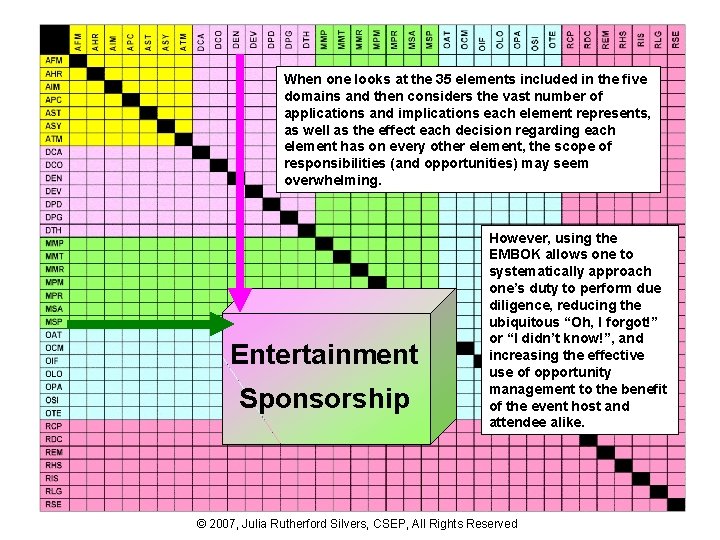
When one looks at the 35 elements included in the five domains and then considers the vast number of applications and implications each element represents, as well as the effect each decision regarding each element has on every other element, the scope of responsibilities (and opportunities) may seem overwhelming. Entertainment Sponsorship However, using the EMBOK allows one to systematically approach one’s duty to perform due diligence, reducing the ubiquitous “Oh, I forgot!” or “I didn’t know!”, and increasing the effective use of opportunity management to the benefit of the event host and attendee alike. © 2007, Julia Rutherford Silvers, CSEP, All Rights Reserved
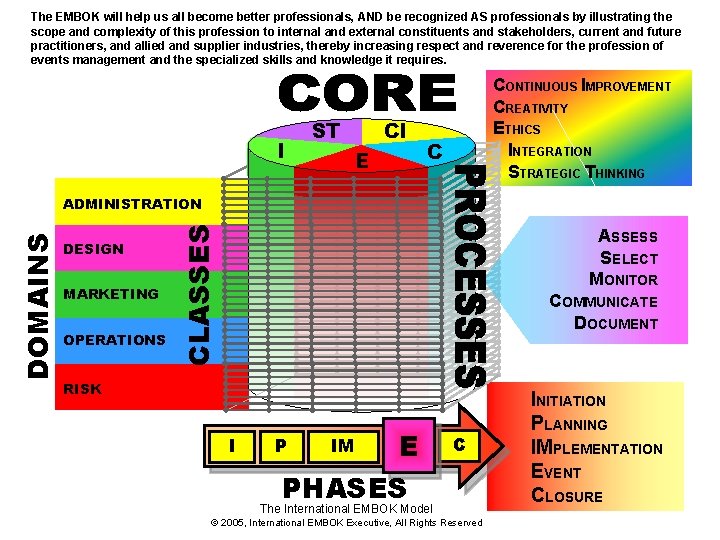
The EMBOK will help us all become better professionals, AND be recognized AS professionals by illustrating the scope and complexity of this profession to internal and external constituents and stakeholders, current and future practitioners, and allied and supplier industries, thereby increasing respect and reverence for the profession of events management and the specialized skills and knowledge it requires. I ST CI E CONTINUOUS IMPROVEMENT CREATIVITY ETHICS INTEGRATION STRATEGIC THINKING C DESIGN MARKETING OPERATIONS CLASSES DOMAINS ADMINISTRATION ASSESS SELECT MONITOR COMMUNICATE DOCUMENT RISK I P IM E C PHASES The International EMBOK Model © 2005, International EMBOK Executive, All Rights Reserved INITIATION PLANNING IMPLEMENTATION EVENT CLOSURE
- Slides: 15