
Introduction to Embedded Systems Edward A Lee UC
Introduction to Embedded Systems Edward A. Lee UC Berkeley EECS 149/249 A Fall 2016 © 2008 -2016: E. A. Lee, A. L. Sangiovanni-Vincentelli, S. A. Seshia. All rights reserved. Chapter 3: Discrete Dynamics, State Machines
Discrete Systems Discrete = “individually separate / distinct” A discrete system is one that operates in a sequence of discrete steps or has signals taking discrete values. It is said to have discrete dynamics. EECS 149/249 A, UC Berkeley: 2
Concepts covered in Today’s Lecture Models = Programs Actor Models of Discrete Systems: Types and Interfaces States, Transitions, Guards Determinism and Receptiveness EECS 149/249 A, UC Berkeley: 3
Discrete Systems: Example Design Problem Count the number of cars that are present in a parking garage by sensing cars enter and leave the garage. Show this count on a display. EECS 149/249 A, UC Berkeley: 4
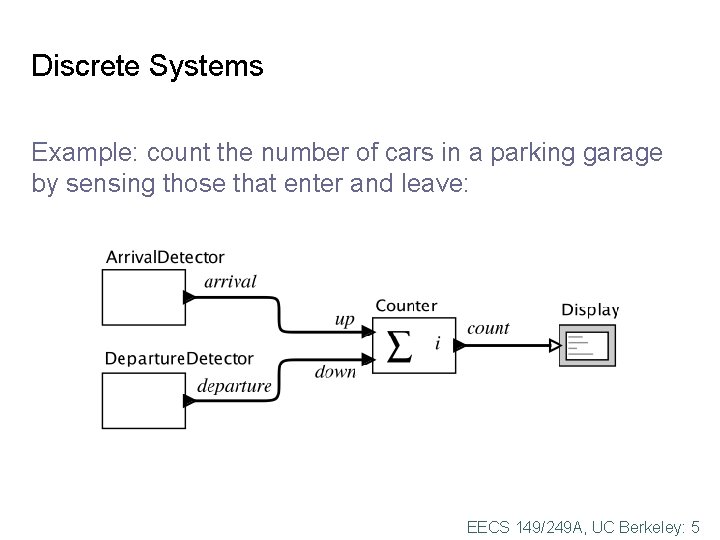
Discrete Systems Example: count the number of cars in a parking garage by sensing those that enter and leave: EECS 149/249 A, UC Berkeley: 5
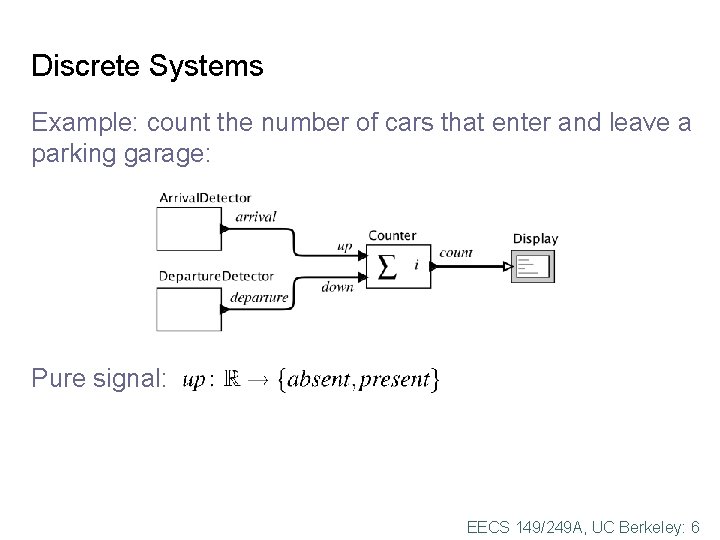
Discrete Systems Example: count the number of cars that enter and leave a parking garage: Pure signal: EECS 149/249 A, UC Berkeley: 6
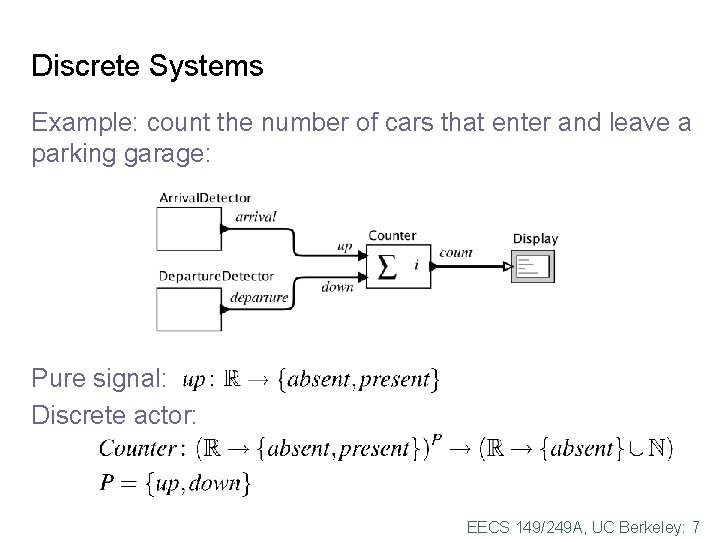
Discrete Systems Example: count the number of cars that enter and leave a parking garage: Pure signal: Discrete actor: EECS 149/249 A, UC Berkeley: 7
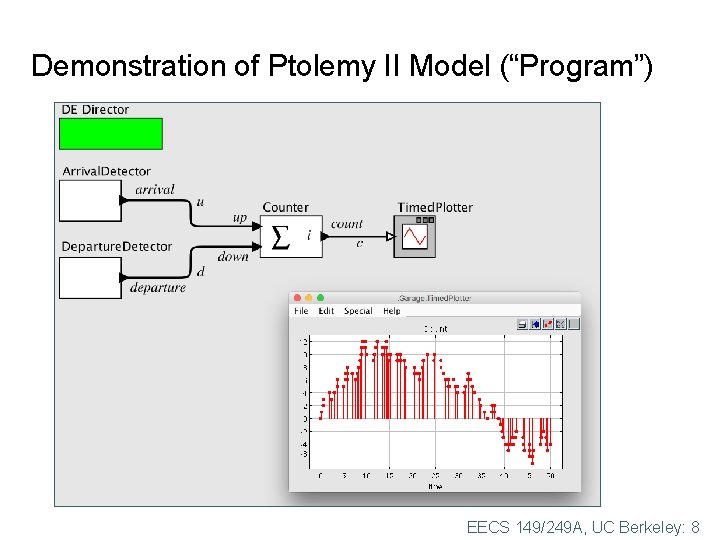
Demonstration of Ptolemy II Model (“Program”) EECS 149/249 A, UC Berkeley: 8
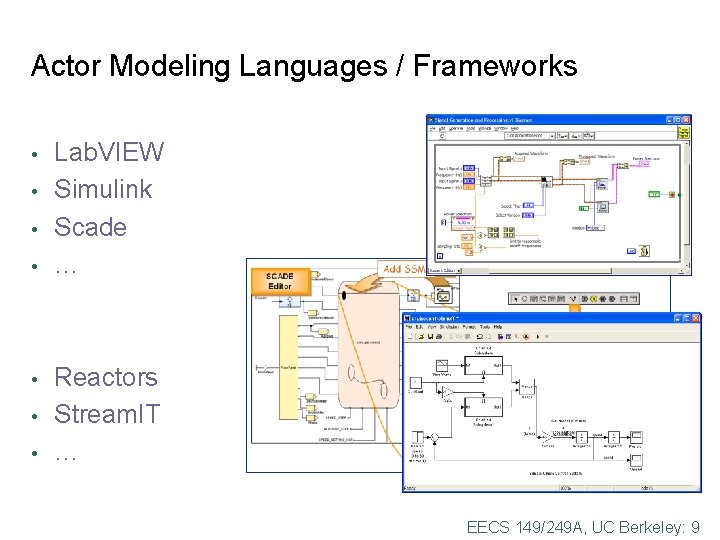
Actor Modeling Languages / Frameworks • • Lab. VIEW Simulink Scade … Reactors Stream. IT … EECS 149/249 A, UC Berkeley: 9
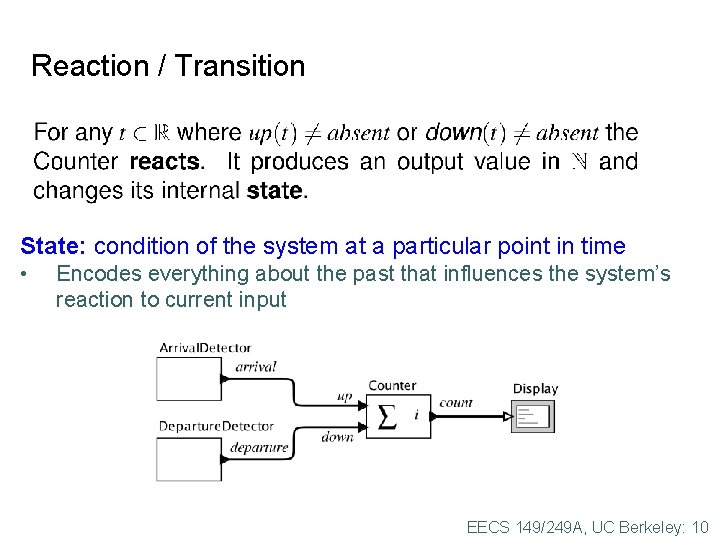
Reaction / Transition State: condition of the system at a particular point in time • Encodes everything about the past that influences the system’s reaction to current input EECS 149/249 A, UC Berkeley: 10
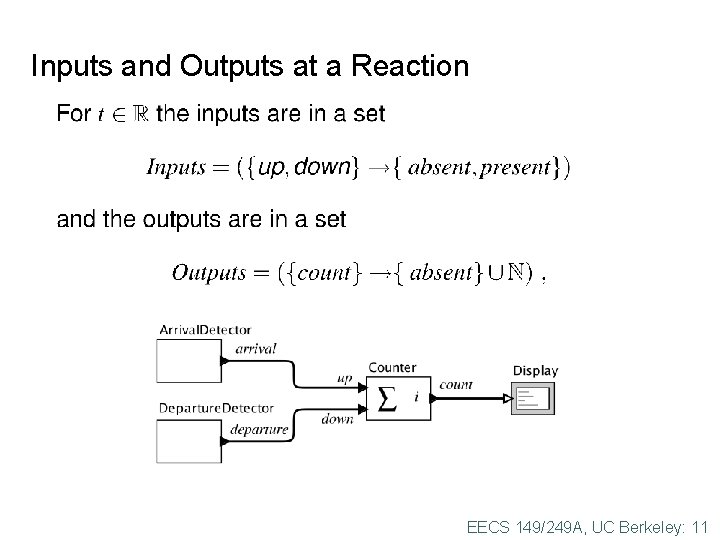
Inputs and Outputs at a Reaction EECS 149/249 A, UC Berkeley: 11
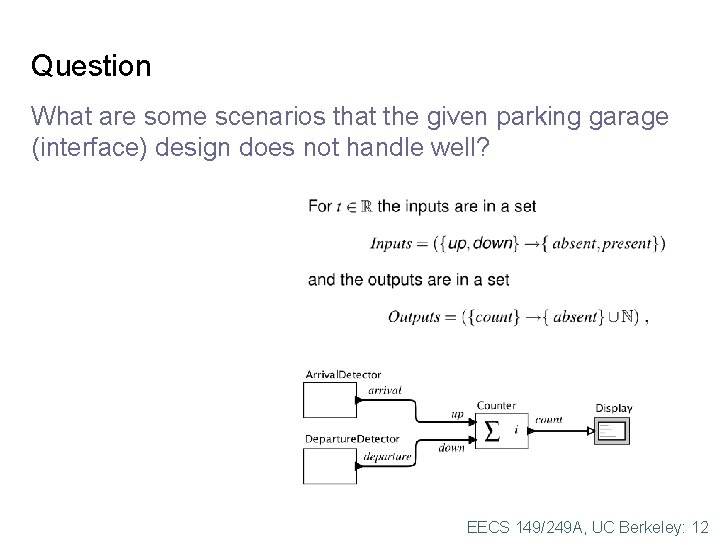
Question What are some scenarios that the given parking garage (interface) design does not handle well? EECS 149/249 A, UC Berkeley: 12
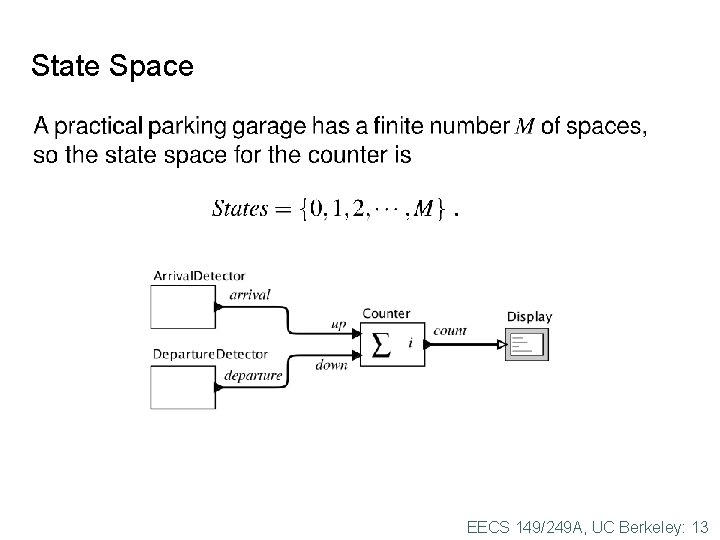
State Space EECS 149/249 A, UC Berkeley: 13
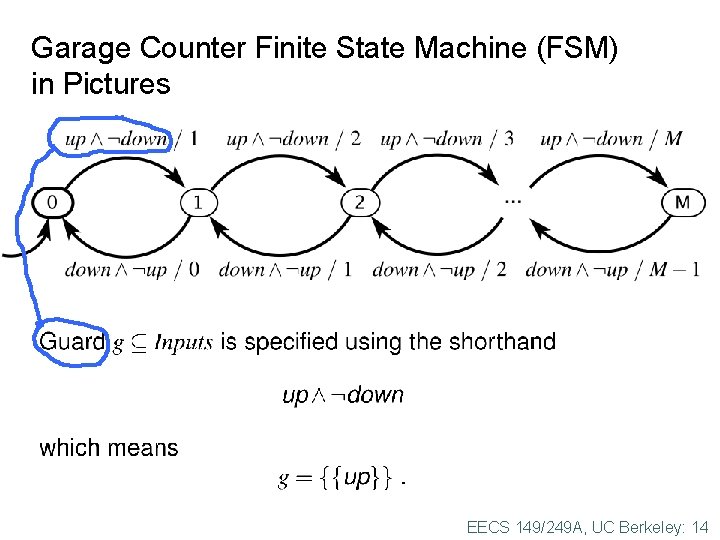
Garage Counter Finite State Machine (FSM) in Pictures EECS 149/249 A, UC Berkeley: 14
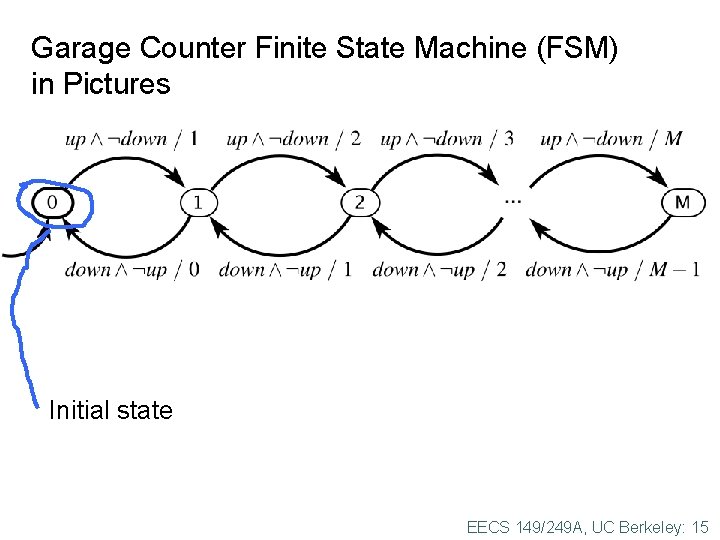
Garage Counter Finite State Machine (FSM) in Pictures Initial state EECS 149/249 A, UC Berkeley: 15
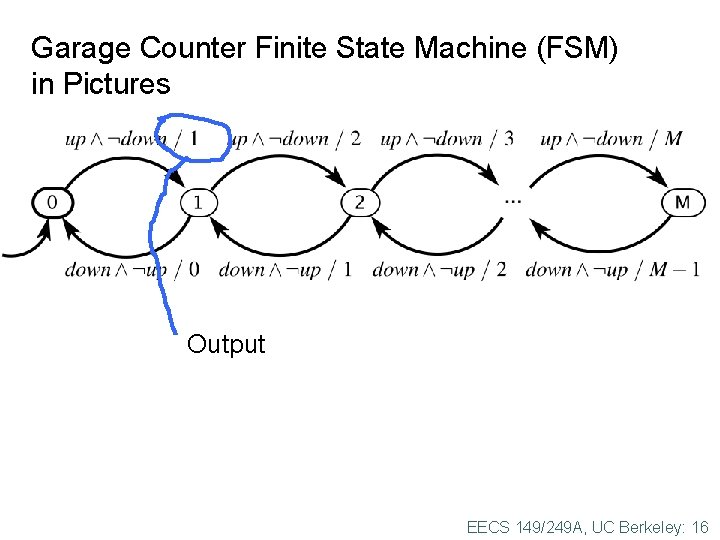
Garage Counter Finite State Machine (FSM) in Pictures Output EECS 149/249 A, UC Berkeley: 16
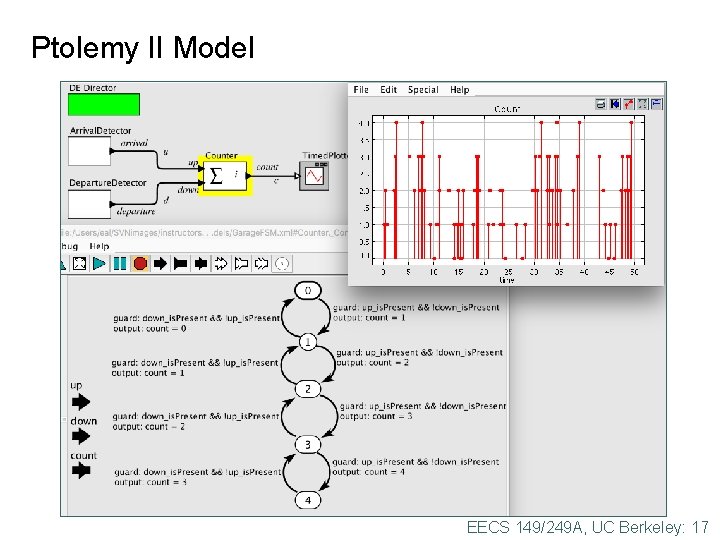
Ptolemy II Model EECS 149/249 A, UC Berkeley: 17
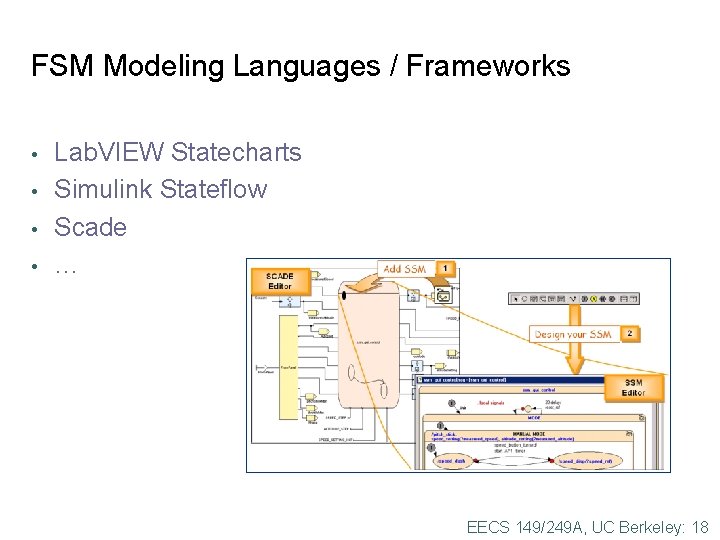
FSM Modeling Languages / Frameworks • • Lab. VIEW Statecharts Simulink Stateflow Scade … EECS 149/249 A, UC Berkeley: 18
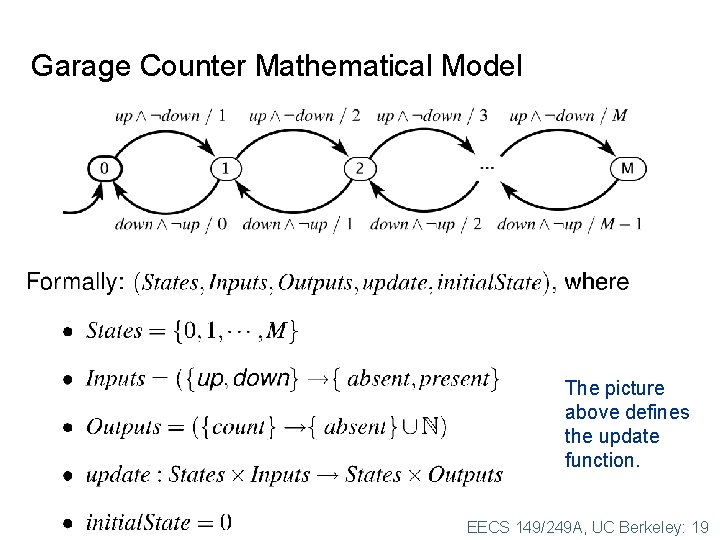
Garage Counter Mathematical Model The picture above defines the update function. EECS 149/249 A, UC Berkeley: 19
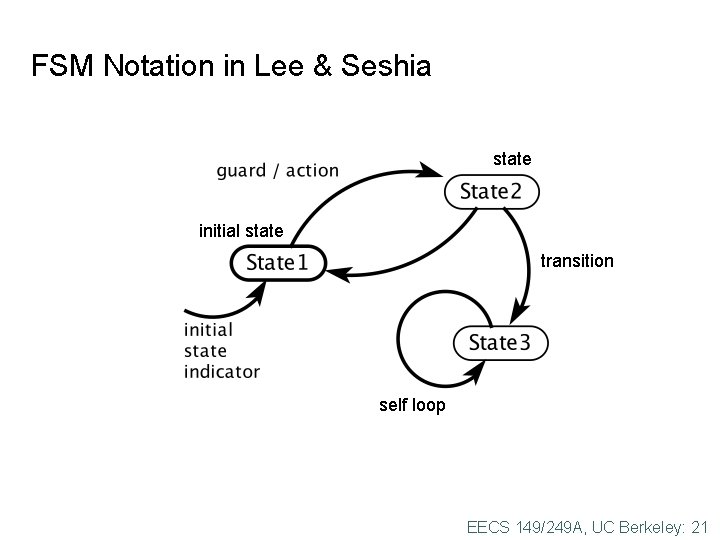
FSM Notation in Lee & Seshia state initial state transition self loop EECS 149/249 A, UC Berkeley: 21
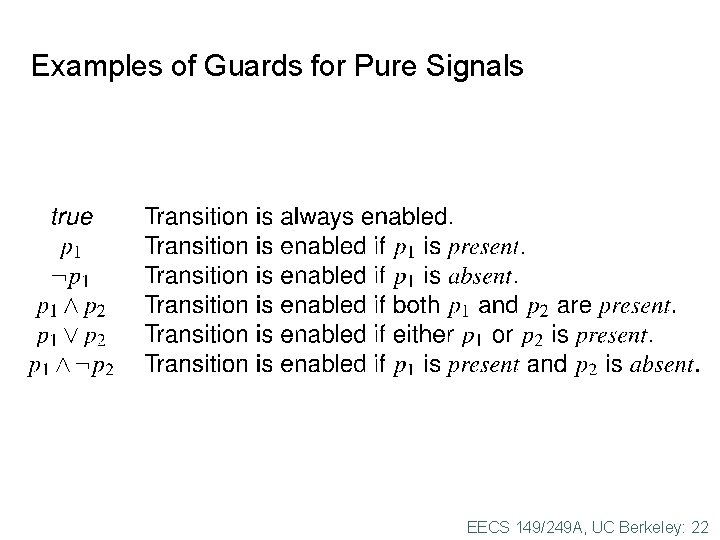
Examples of Guards for Pure Signals EECS 149/249 A, UC Berkeley: 22
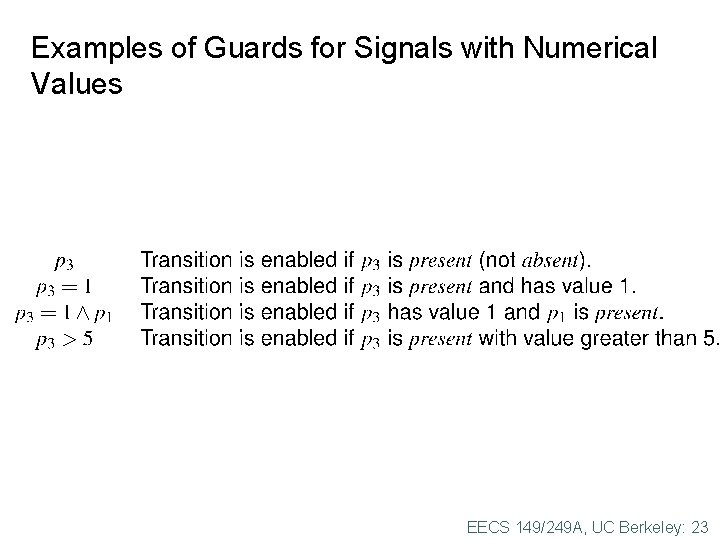
Examples of Guards for Signals with Numerical Values EECS 149/249 A, UC Berkeley: 23
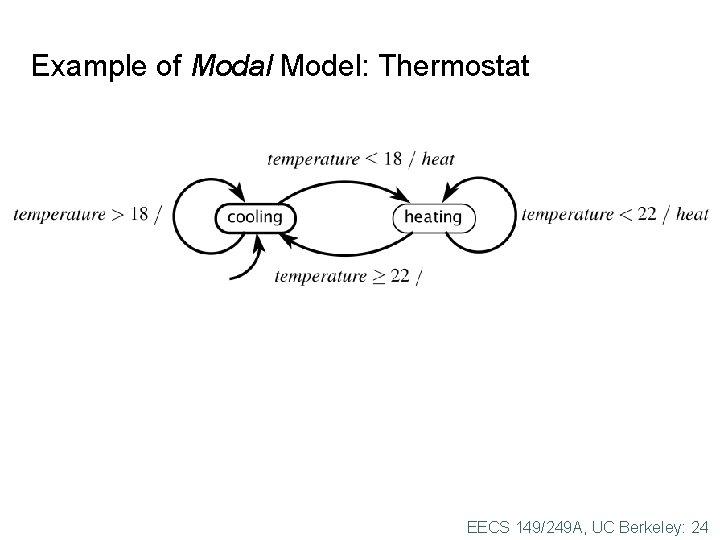
Example of Modal Model: Thermostat EECS 149/249 A, UC Berkeley: 24
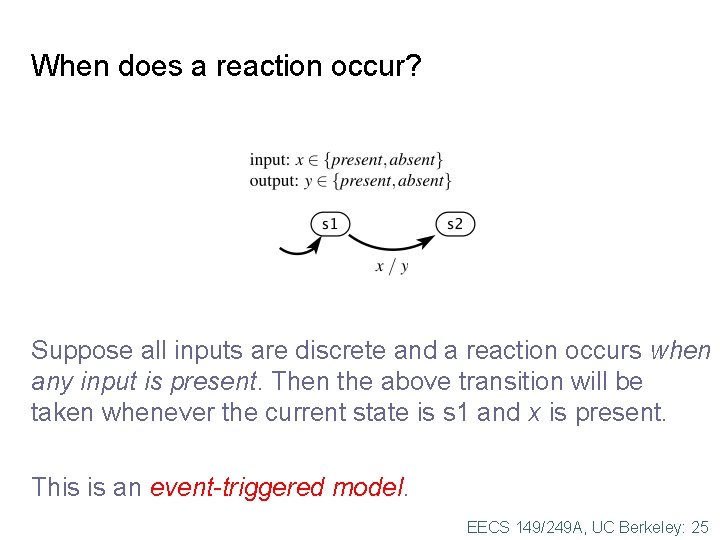
When does a reaction occur? Suppose all inputs are discrete and a reaction occurs when any input is present. Then the above transition will be taken whenever the current state is s 1 and x is present. This is an event-triggered model. EECS 149/249 A, UC Berkeley: 25
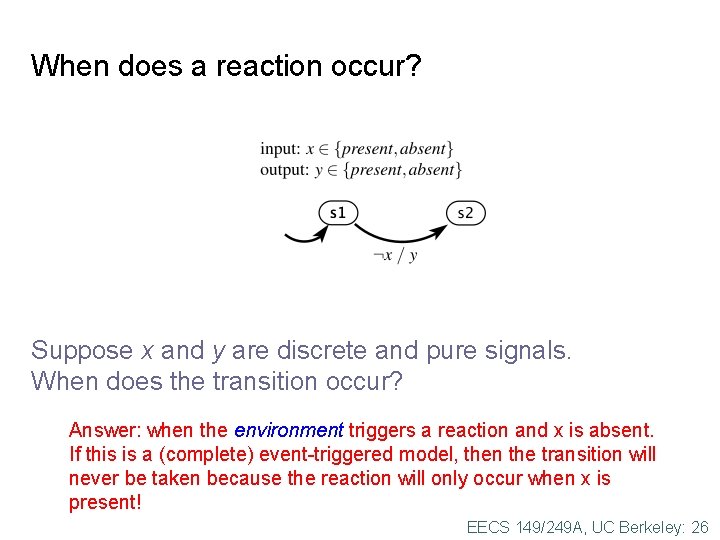
When does a reaction occur? Suppose x and y are discrete and pure signals. When does the transition occur? Answer: when the environment triggers a reaction and x is absent. If this is a (complete) event-triggered model, then the transition will never be taken because the reaction will only occur when x is present! EECS 149/249 A, UC Berkeley: 26
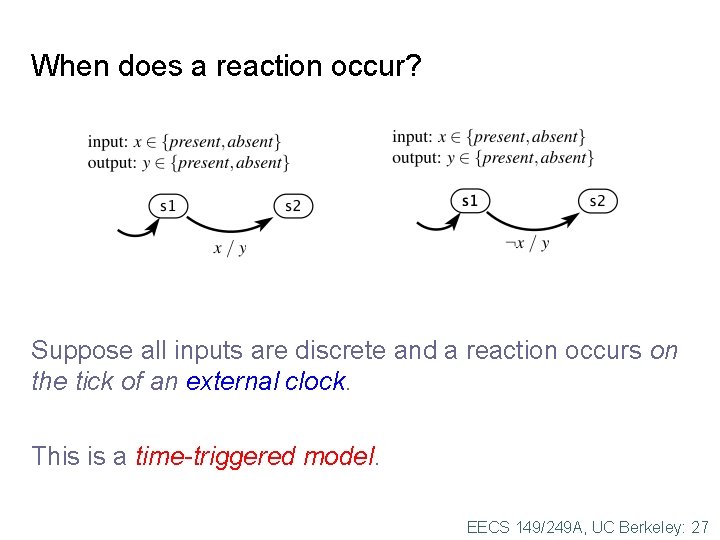
When does a reaction occur? Suppose all inputs are discrete and a reaction occurs on the tick of an external clock. This is a time-triggered model. EECS 149/249 A, UC Berkeley: 27
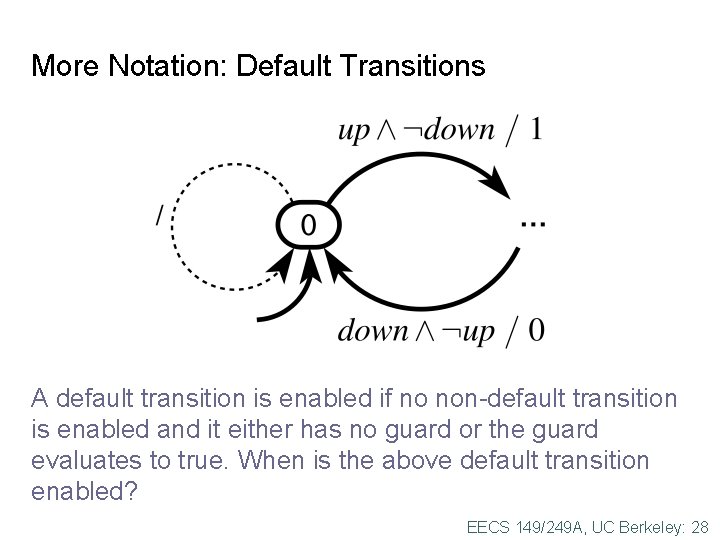
More Notation: Default Transitions A default transition is enabled if no non-default transition is enabled and it either has no guard or the guard evaluates to true. When is the above default transition enabled? EECS 149/249 A, UC Berkeley: 28
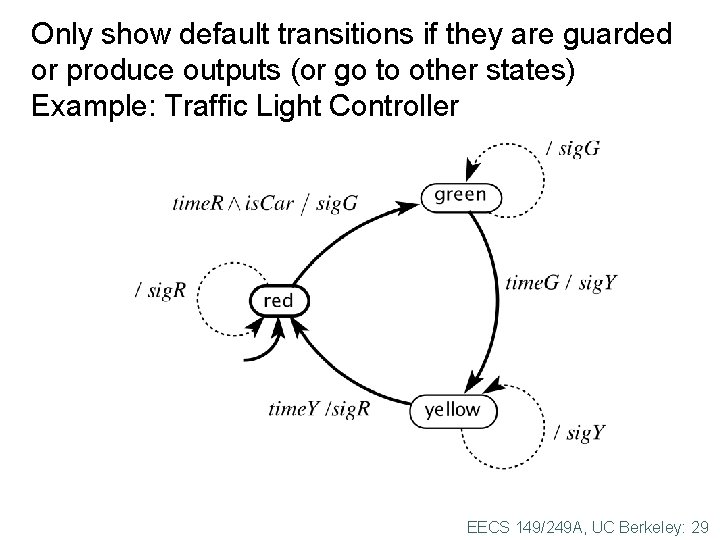
Only show default transitions if they are guarded or produce outputs (or go to other states) Example: Traffic Light Controller EECS 149/249 A, UC Berkeley: 29
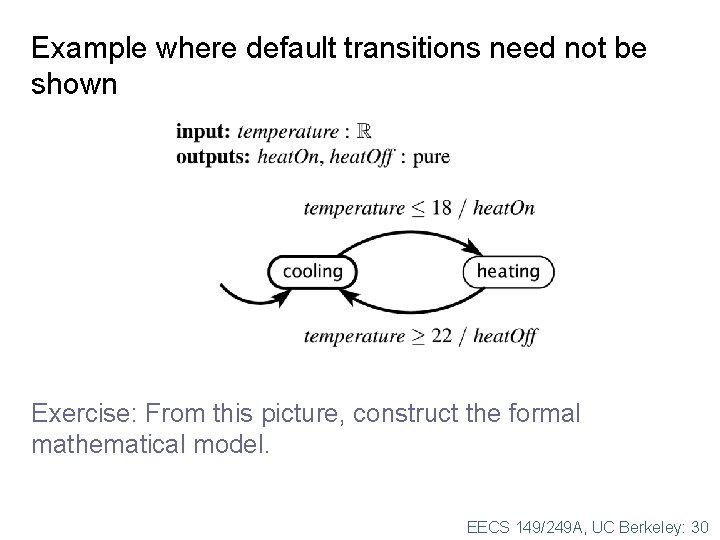
Example where default transitions need not be shown Exercise: From this picture, construct the formal mathematical model. EECS 149/249 A, UC Berkeley: 30
Some Definitions • Stuttering transition: (possibly implicit) default transition that is enabled when inputs are absent, that does not change state, and that produces absent outputs. • Receptiveness: For any input values, some transition is enabled. Our structure together with the implicit default transition ensures that our FSMs are receptive. • Determinism: In every state, for all input values, exactly one (possibly implicit) transition is enabled. EECS 149/249 A, UC Berkeley: 31
Test Your Understanding: Three Kinds of Transitions Self-Loop Default Transition Stuttering Transition 1. 2. 3. Is a default transition always a self-loop? Is a stuttering transition always a self-loop? Is a self-loop always stuttering? EECS 149/249 A, UC Berkeley: 32
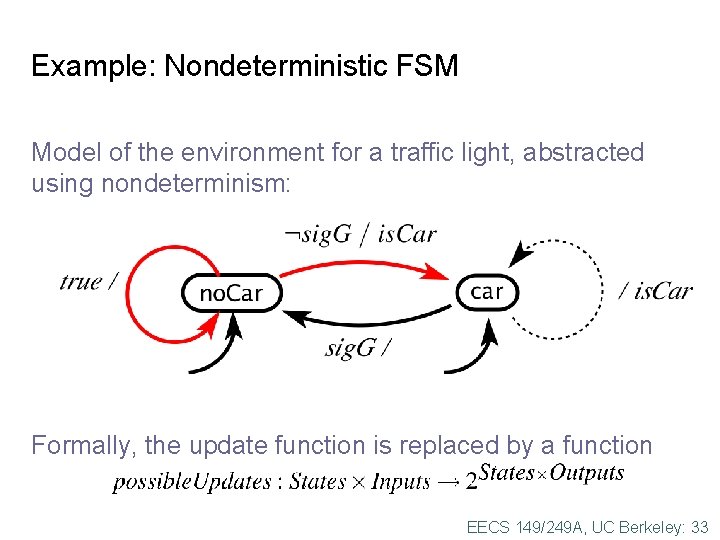
Example: Nondeterministic FSM Model of the environment for a traffic light, abstracted using nondeterminism: Formally, the update function is replaced by a function EECS 149/249 A, UC Berkeley: 33
EECS 149/249 A, UC Berkeley: 34
Uses of Nondeterminism 1. Modeling unknown aspects of the environment or system ¢ Such as: how the environment changes a robot’s orientation 2. Hiding detail in a specification of the system ¢ We will see an example of this later (see the text) Any other reasons why nondeterministic FSMs might be preferred over deterministic FSMs? EECS 149/249 A, UC Berkeley: 35
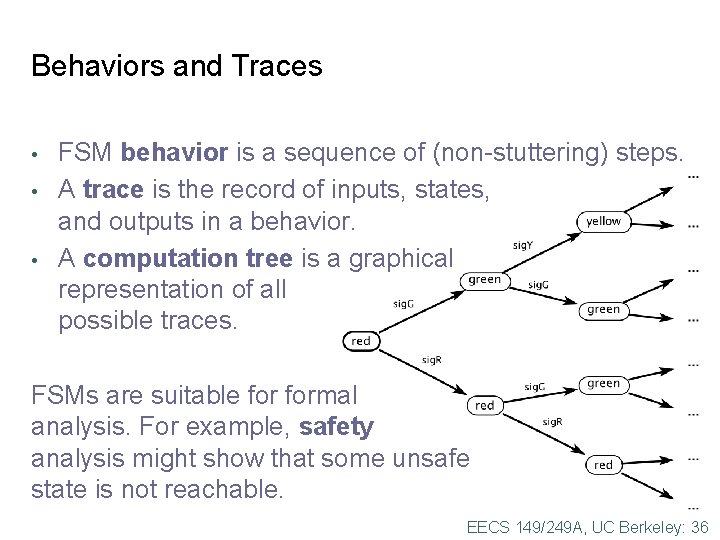
Behaviors and Traces • • • FSM behavior is a sequence of (non-stuttering) steps. A trace is the record of inputs, states, and outputs in a behavior. A computation tree is a graphical representation of all possible traces. FSMs are suitable formal analysis. For example, safety analysis might show that some unsafe state is not reachable. EECS 149/249 A, UC Berkeley: 36
Size Matters Non-deterministic FSMs are more compact than deterministic FSMs l l A classic result in automata theory shows that a nondeterministic FSM has a related deterministic FSM that is equivalent in a technical sense (language equivalence, covered in Chapter 13, for FSMs with finite-length executions). But the deterministic machine has, in the worst case, many more states (exponential in the number of states of the nondeterministic machine, see Appendix B). EECS 149/249 A, UC Berkeley: 37
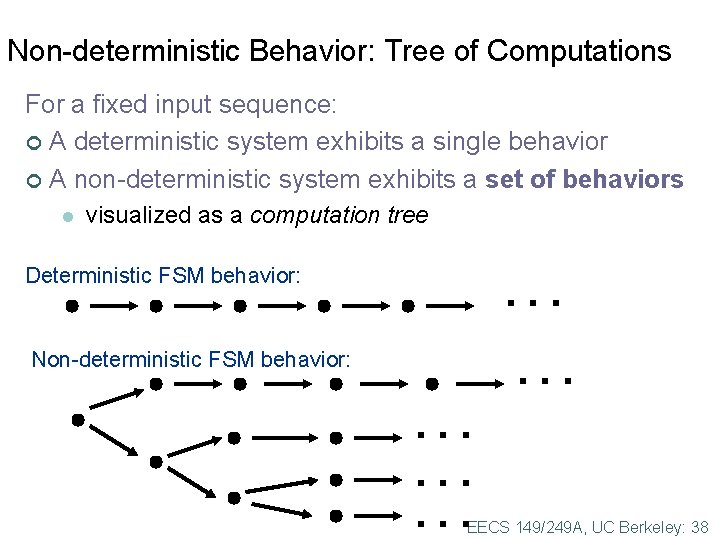
Non-deterministic Behavior: Tree of Computations For a fixed input sequence: ¢ A deterministic system exhibits a single behavior ¢ A non-deterministic system exhibits a set of behaviors l visualized as a computation tree Deterministic FSM behavior: . . . Non-deterministic FSM behavior: . . . EECS 149/249 A, UC Berkeley: 38
Non-deterministic Probabilistic (Stochastic) In a probabilistic FSM, each transition has an associated probability with which it is taken. In a non-deterministic FSM, no such probability is known. We just know that any of the enabled transitions from a state can be taken. EECS 149/249 A, UC Berkeley: 39
Review: Concepts covered Models = Programs Actor Models of Discrete Systems: Types and Interfaces States, Transitions, Guards Determinism, Receptiveness, etc. EECS 149/249 A, UC Berkeley: 40
- Slides: 39