
Introduction to Embedded Systems Chapter 14 Reachability Analysis

Introduction to Embedded Systems Chapter 14 Reachability Analysis (14. 1, 14. 2. 1 – 14. 2 -2) Hao Zheng U of South Florida
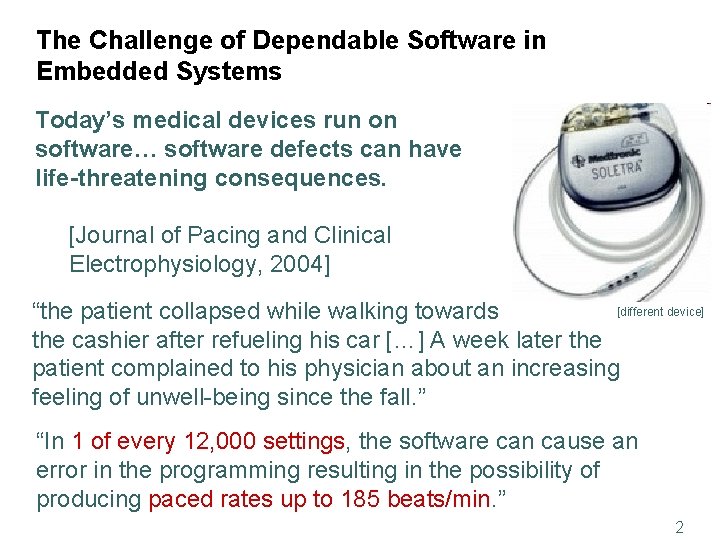
The Challenge of Dependable Software in Embedded Systems Today’s medical devices run on software… software defects can have life-threatening consequences. [Journal of Pacing and Clinical Electrophysiology, 2004] [different device] “the patient collapsed while walking towards the cashier after refueling his car […] A week later the patient complained to his physician about an increasing feeling of unwell-being since the fall. ” “In 1 of every 12, 000 settings, the software can cause an error in the programming resulting in the possibility of producing paced rates up to 185 beats/min. ” 2
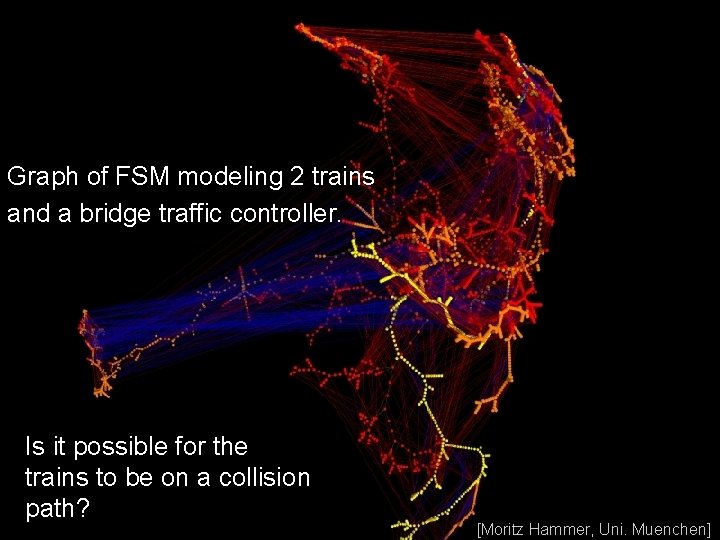
Graph of FSM modeling 2 trains and a bridge traffic controller. Is it possible for the trains to be on a collision path? 3 [Moritz Hammer, Uni. Muenchen]
Reachability Analysis and Model Checking Reachability analysis is the process of computing the set of reachable states for a system. l all three problems can be solved using reachability analysis Model checking is an algorithmic method for determining if a system satisfies a formal specification expressed in temporal logic. Model checking typically performs reachability analysis. 4
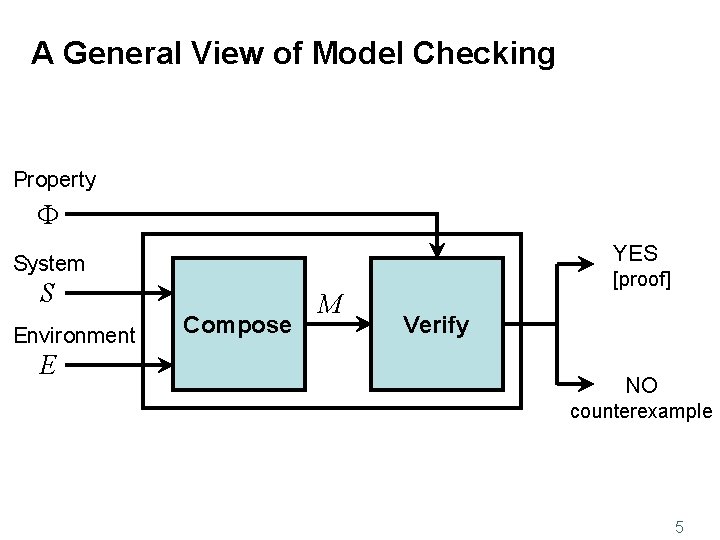
A General View of Model Checking Property YES System S Environment E Compose M [proof] Verify NO counterexample 5
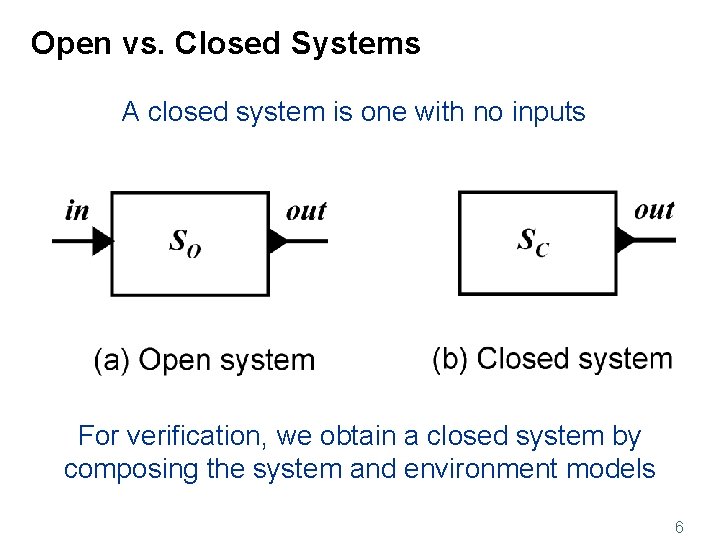
Open vs. Closed Systems A closed system is one with no inputs For verification, we obtain a closed system by composing the system and environment models 6
Model Checking G p Consider an LTL formula of the form Gp where p is a proposition (p is a property on a single state) To verify Gp on a system M, one simply needs to enumerate all the reachable states and check that they all satisfy p. The state space found is typically represented as a directed graph called a state graph. When M is a finite-state machine, this reachability analysis will terminate (in theory). In practice, though, the number of states may be prohibitively large consuming too much run-time or memory (the state explosion problem). 7
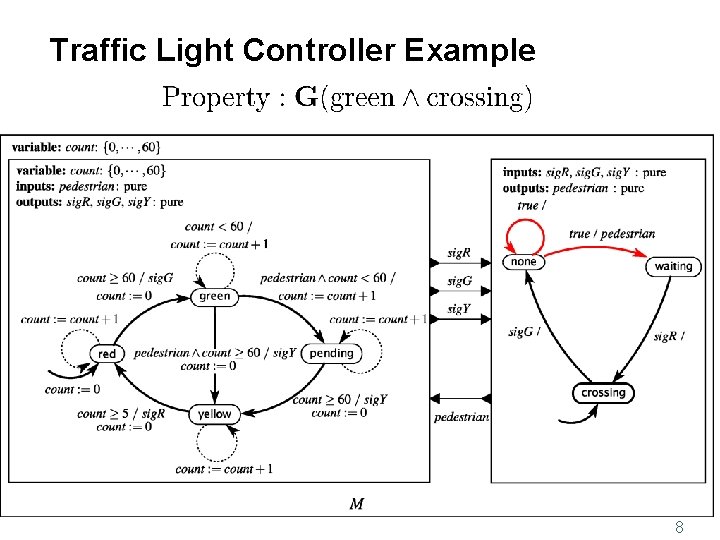
Traffic Light Controller Example 8
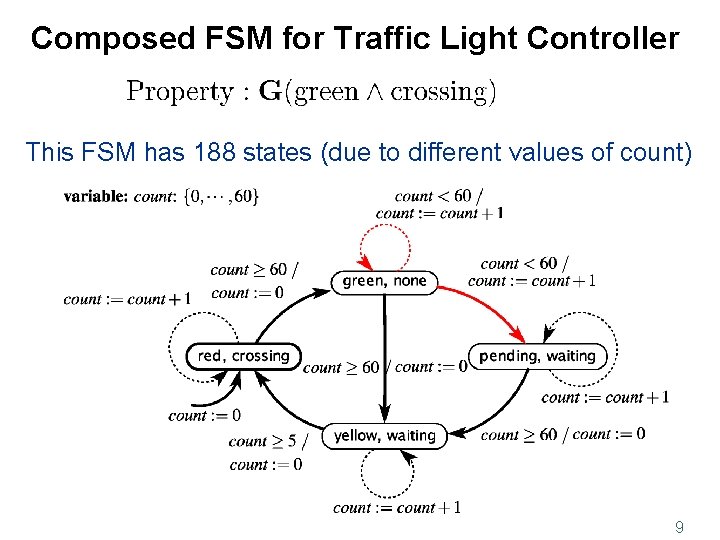
Composed FSM for Traffic Light Controller This FSM has 188 states (due to different values of count) 9

Reachability Analysis Through Graph Traversal Construct the state graph on the fly Start with initial state, and explore next states using a suitable graph-traversal strategy. A state is a collection of a FSM state and values of all variables. initial state: (red, crossing, count==0) A successor: (red, crossing, count==1 10
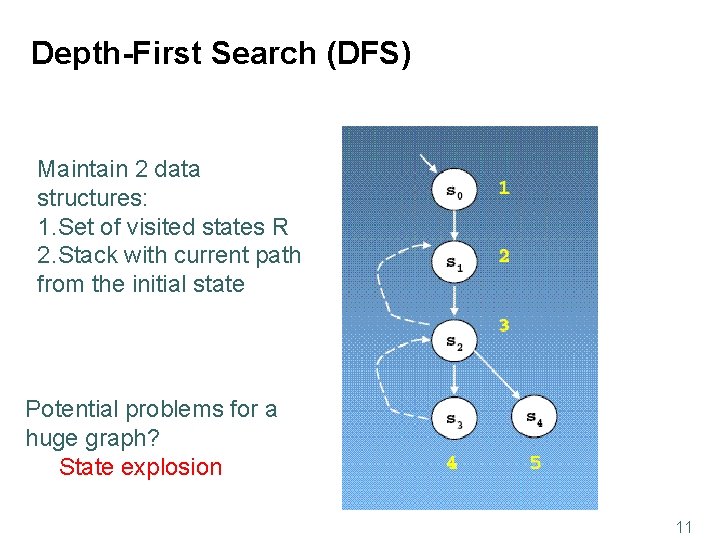
Depth-First Search (DFS) Maintain 2 data structures: 1. Set of visited states R 2. Stack with current path from the initial state Potential problems for a huge graph? State explosion 11
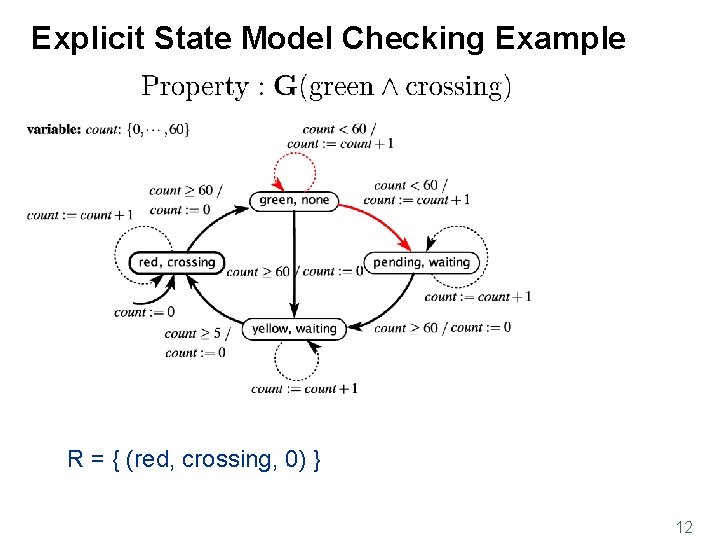
Explicit State Model Checking Example R = { (red, crossing, 0) } 12
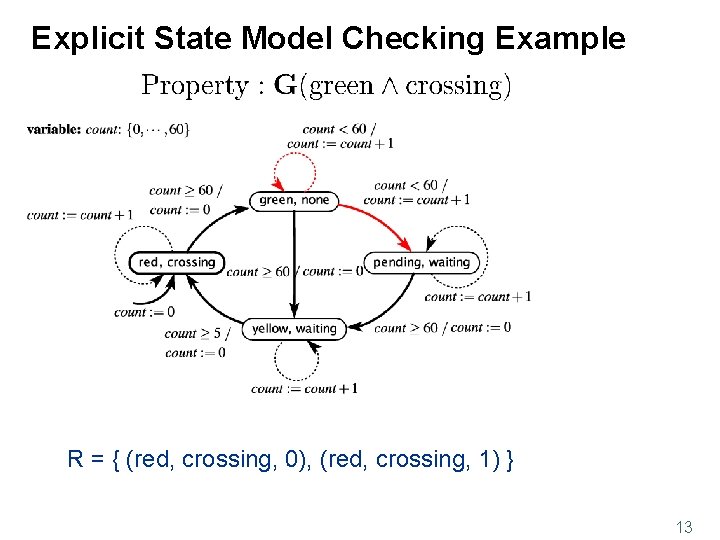
Explicit State Model Checking Example R = { (red, crossing, 0), (red, crossing, 1) } 13
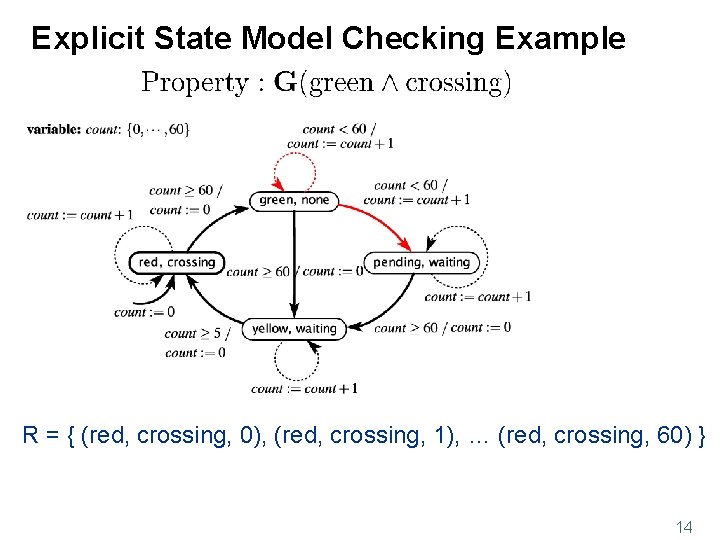
Explicit State Model Checking Example R = { (red, crossing, 0), (red, crossing, 1), … (red, crossing, 60) } 14
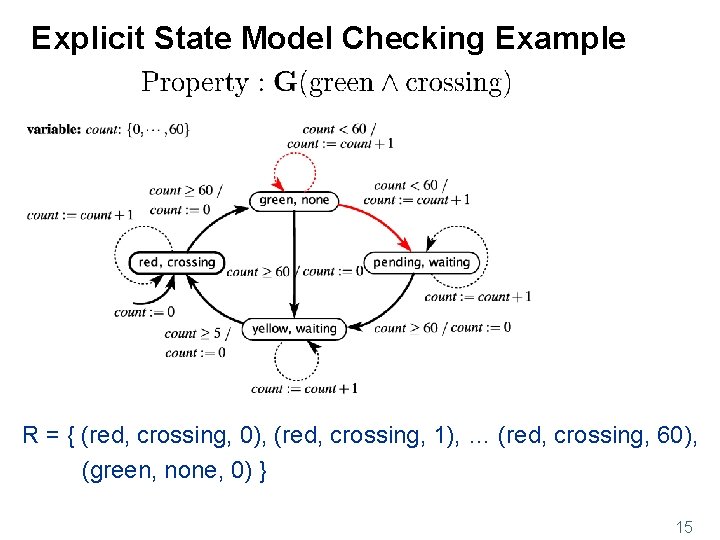
Explicit State Model Checking Example R = { (red, crossing, 0), (red, crossing, 1), … (red, crossing, 60), (green, none, 0) } 15
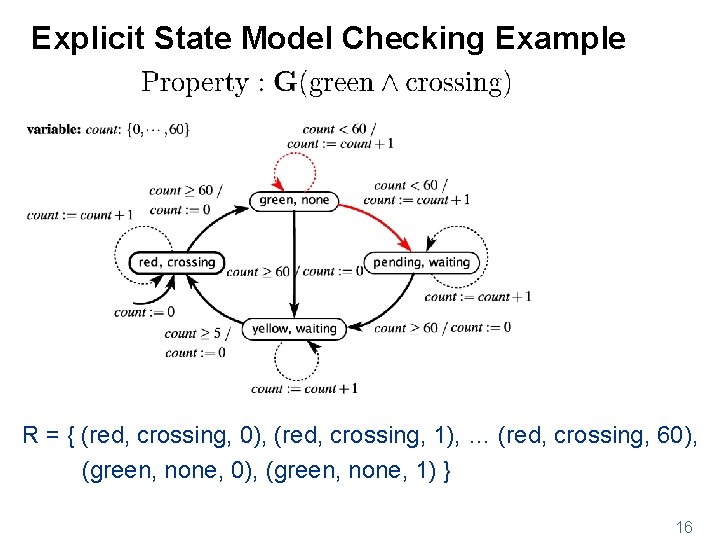
Explicit State Model Checking Example R = { (red, crossing, 0), (red, crossing, 1), … (red, crossing, 60), (green, none, 1) } 16
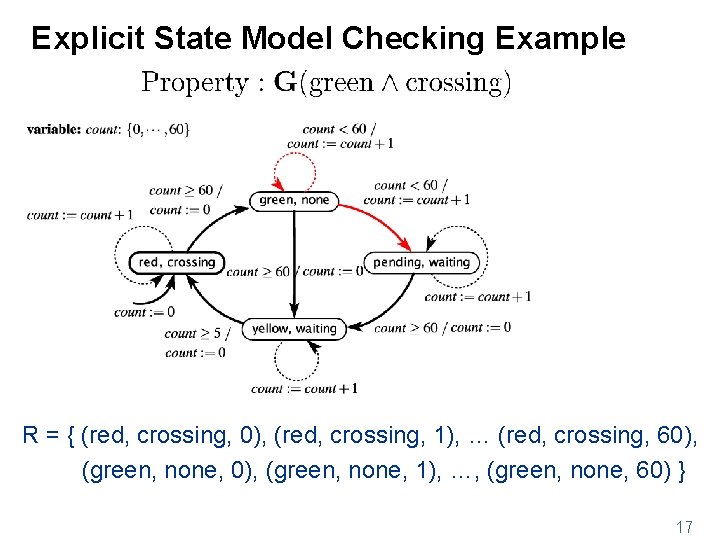
Explicit State Model Checking Example R = { (red, crossing, 0), (red, crossing, 1), … (red, crossing, 60), (green, none, 1), …, (green, none, 60) } 17
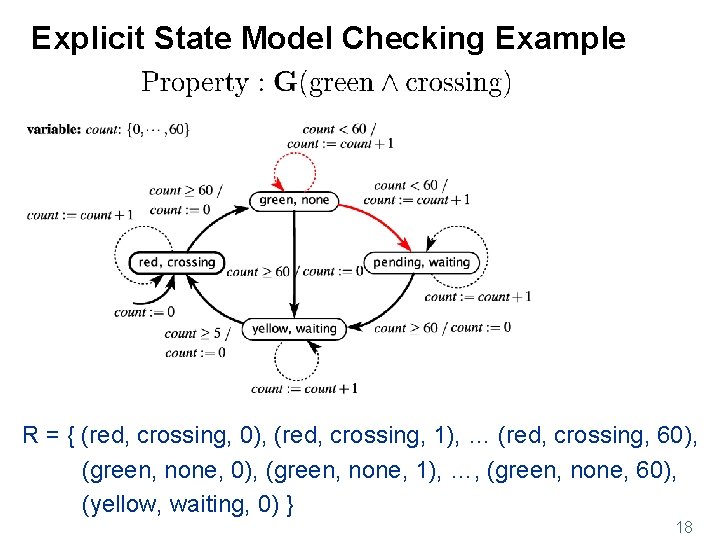
Explicit State Model Checking Example R = { (red, crossing, 0), (red, crossing, 1), … (red, crossing, 60), (green, none, 1), …, (green, none, 60), (yellow, waiting, 0) } 18
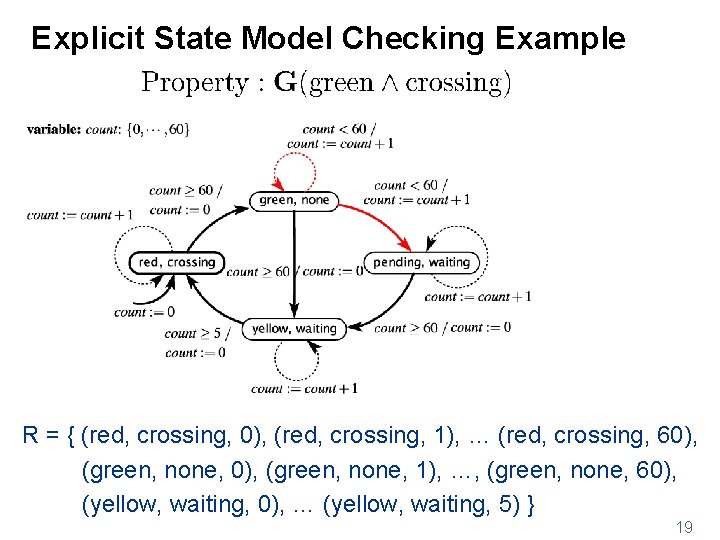
Explicit State Model Checking Example R = { (red, crossing, 0), (red, crossing, 1), … (red, crossing, 60), (green, none, 1), …, (green, none, 60), (yellow, waiting, 0), … (yellow, waiting, 5) } 19
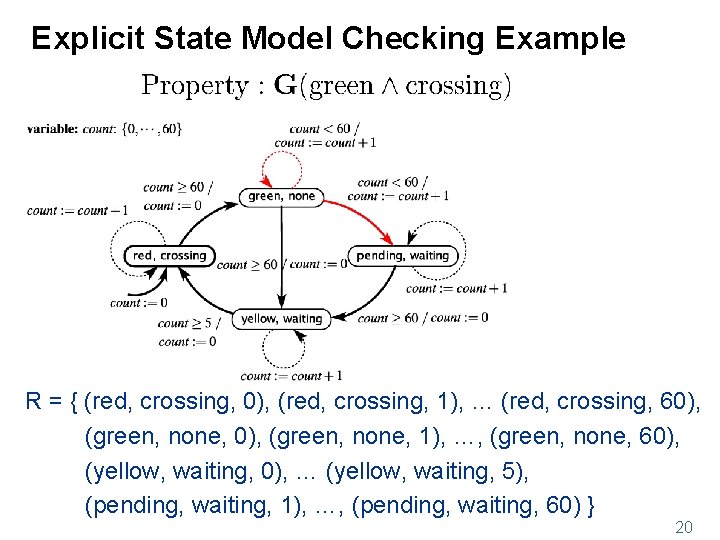
Explicit State Model Checking Example R = { (red, crossing, 0), (red, crossing, 1), … (red, crossing, 60), (green, none, 1), …, (green, none, 60), (yellow, waiting, 0), … (yellow, waiting, 5), (pending, waiting, 1), …, (pending, waiting, 60) } 20
- Slides: 20