
Introduction to Elliptic Curves What is an Elliptic

- Slides: 25
Introduction to Elliptic Curves
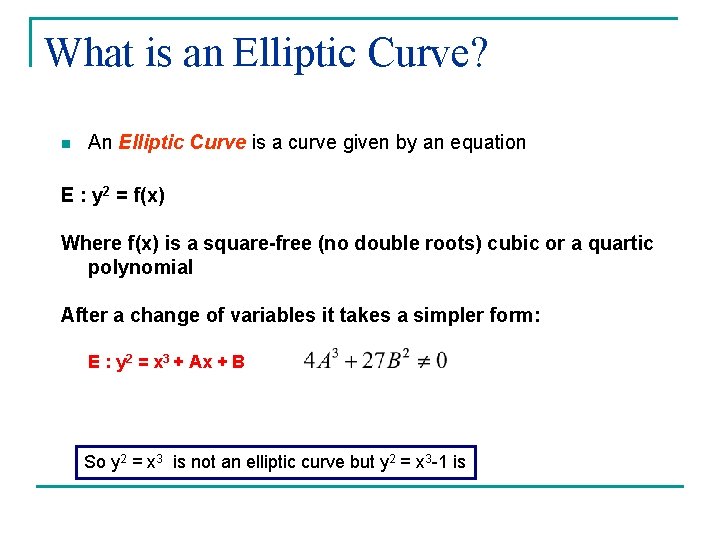
What is an Elliptic Curve? n An Elliptic Curve is a curve given by an equation E : y 2 = f(x) Where f(x) is a square-free (no double roots) cubic or a quartic polynomial After a change of variables it takes a simpler form: E : y 2 = x 3 + Ax + B So y 2 = x 3 is not an elliptic curve but y 2 = x 3 -1 is
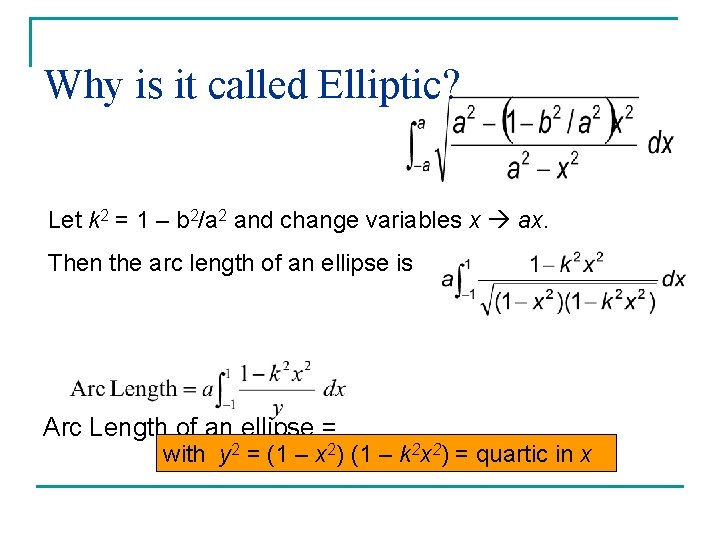
Why is it called Elliptic? Let k 2 = 1 – b 2/a 2 and change variables x ax. Then the arc length of an ellipse is Arc Length of an ellipse = with y 2 = (1 – x 2) (1 – k 2 x 2) = quartic in x
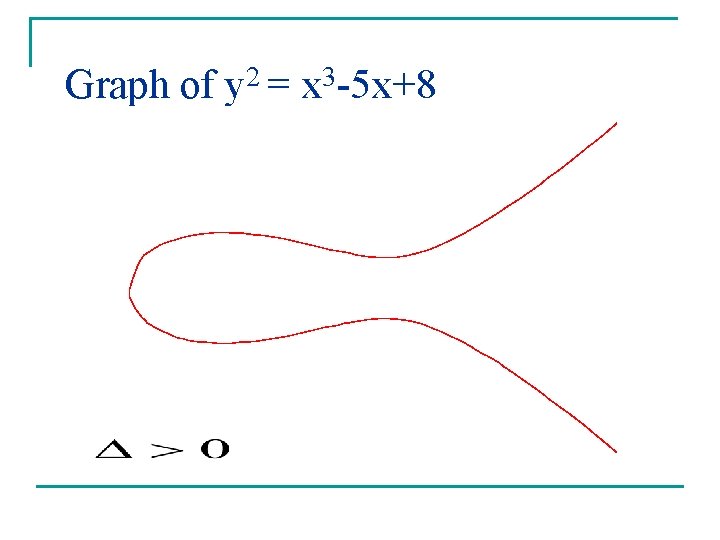
Graph of y 2 = x 3 -5 x+8
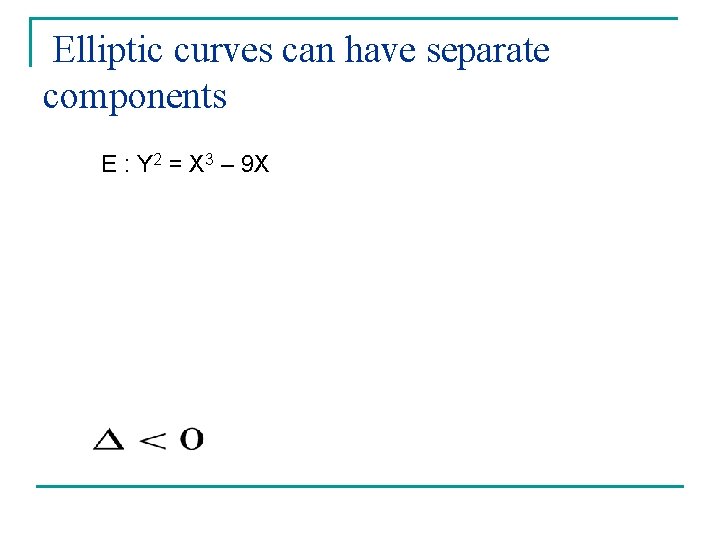
Elliptic curves can have separate components E : Y 2 = X 3 – 9 X
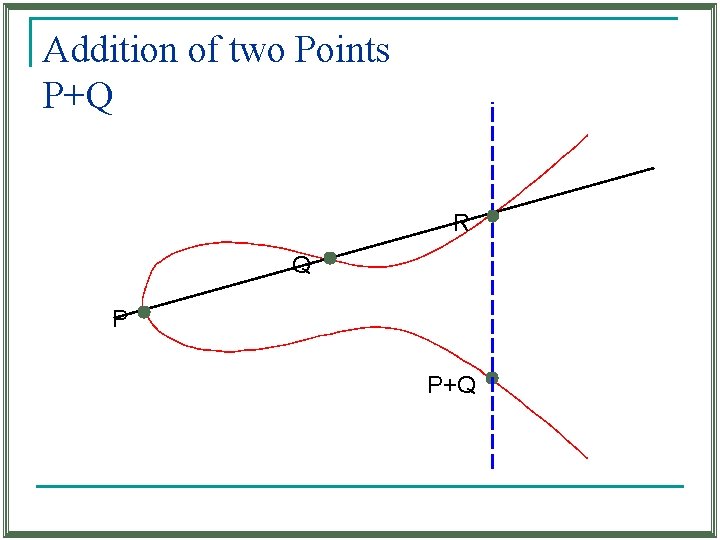
Addition of two Points P+Q R Q P P+Q
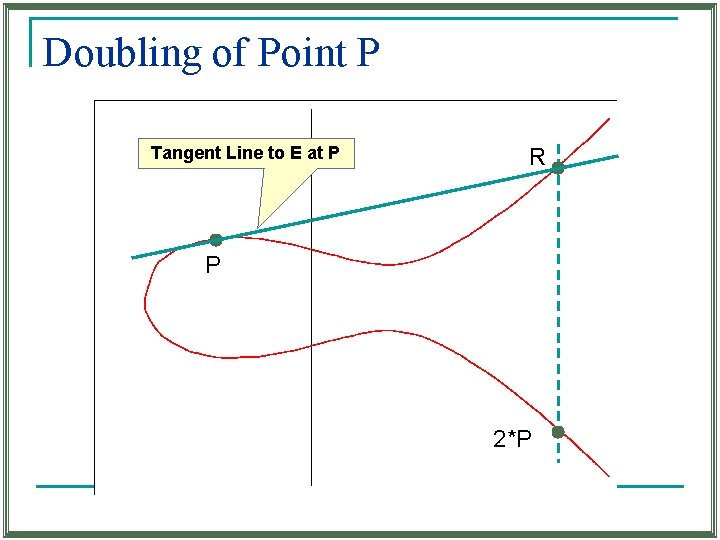
Doubling of Point P Tangent Line to E at P R P 2*P
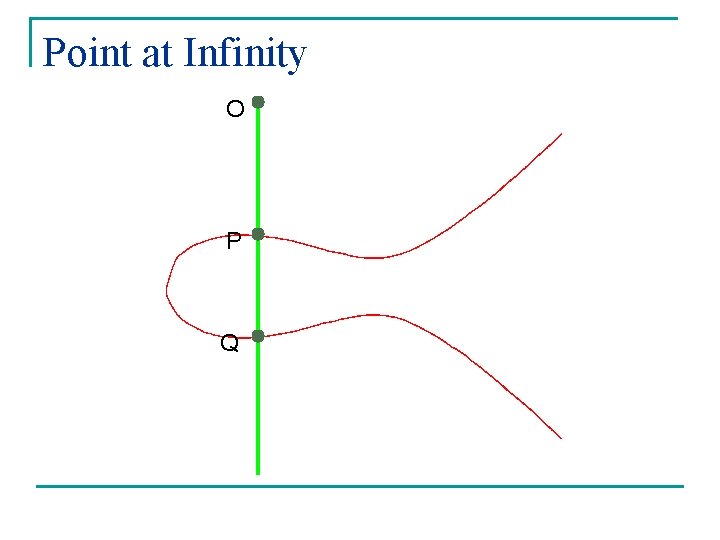
Point at Infinity O P Q
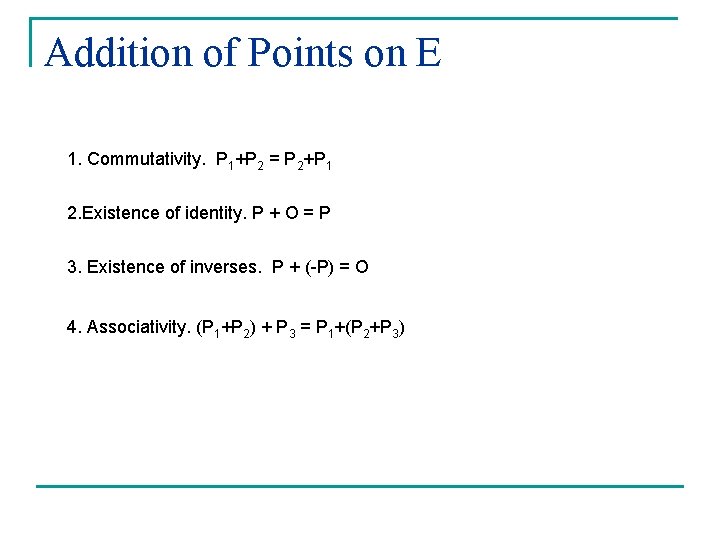
Addition of Points on E 1. Commutativity. P 1+P 2 = P 2+P 1 2. Existence of identity. P + O = P 3. Existence of inverses. P + (-P) = O 4. Associativity. (P 1+P 2) + P 3 = P 1+(P 2+P 3)
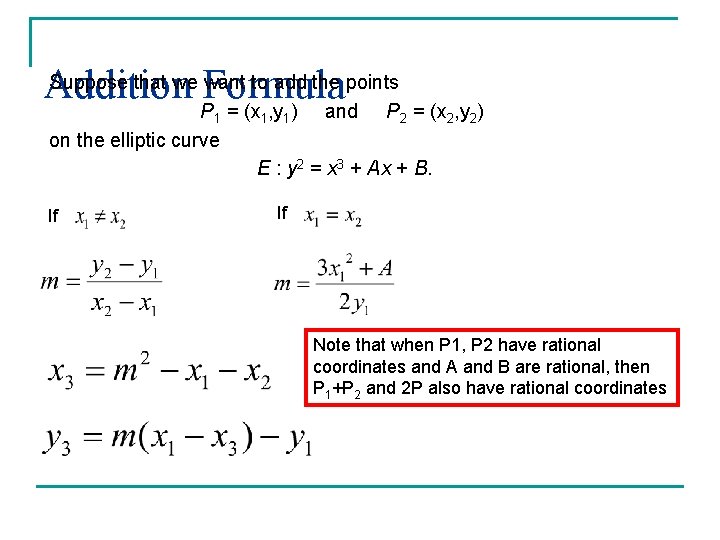
Suppose that we Formula want to add the points Addition P = (x , y ) and P 1 1 1 2 = (x 2, y 2) on the elliptic curve E : y 2 = x 3 + Ax + B. If If Note that when P 1, P 2 have rational coordinates and A and B are rational, then P 1+P 2 and 2 P also have rational coordinates
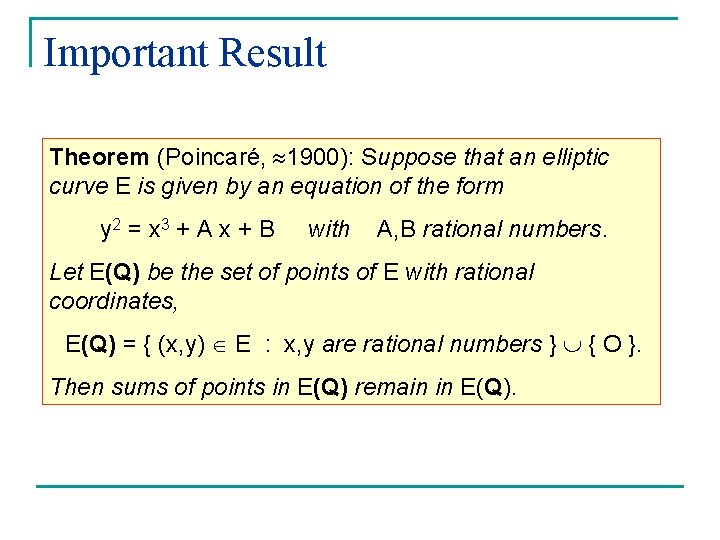
Important Result Theorem (Poincaré, 1900): Suppose that an elliptic curve E is given by an equation of the form y 2 = x 3 + A x + B with A, B rational numbers. Let E(Q) be the set of points of E with rational coordinates, E(Q) = { (x, y) E : x, y are rational numbers } { O }. Then sums of points in E(Q) remain in E(Q).
The many uses of elliptic curves.
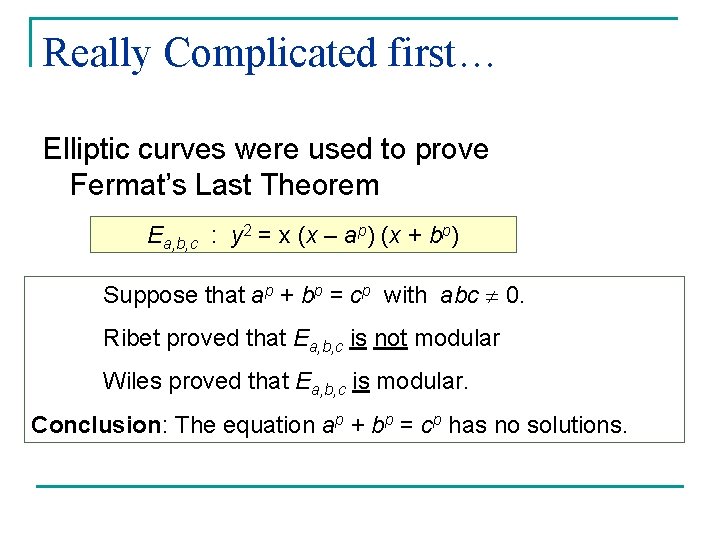
Really Complicated first… Elliptic curves were used to prove Fermat’s Last Theorem Ea, b, c : y 2 = x (x – ap) (x + bp) Suppose that ap + bp = cp with abc 0. Ribet proved that Ea, b, c is not modular Wiles proved that Ea, b, c is modular. Conclusion: The equation ap + bp = cp has no solutions.
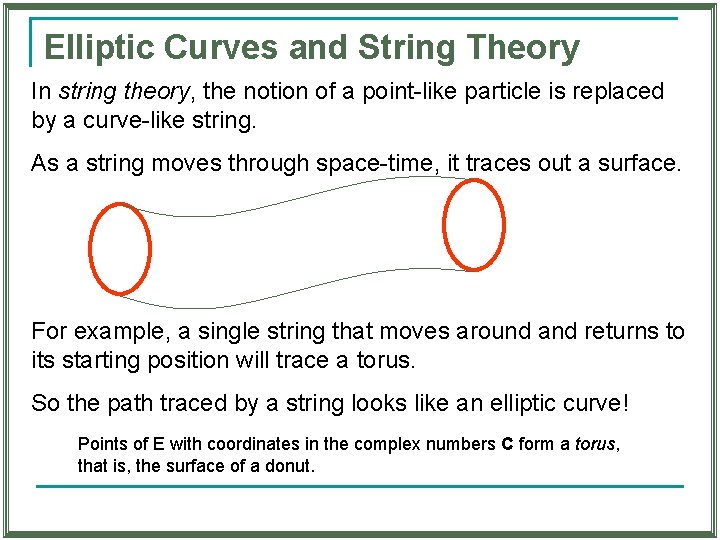
Elliptic Curves and String Theory In string theory, the notion of a point-like particle is replaced by a curve-like string. As a string moves through space-time, it traces out a surface. For example, a single string that moves around and returns to its starting position will trace a torus. So the path traced by a string looks like an elliptic curve! Points of E with coordinates in the complex numbers C form a torus, that is, the surface of a donut.
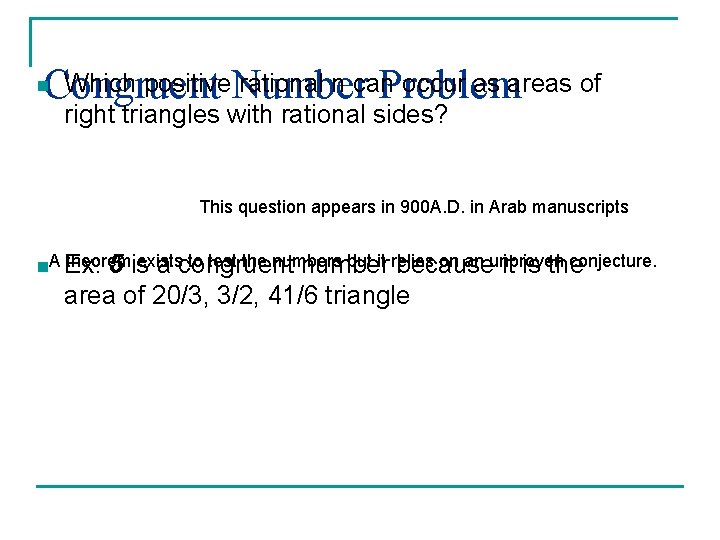
Which positive. Number rational n can occur as areas of Congruent Problem n right triangles with rational sides? This question appears in 900 A. D. in Arab manuscripts theorem to test the numbers but it relies on an unproven conjecture. n. A Ex: 5 isexists a congruent number because it is the area of 20/3, 3/2, 41/6 triangle
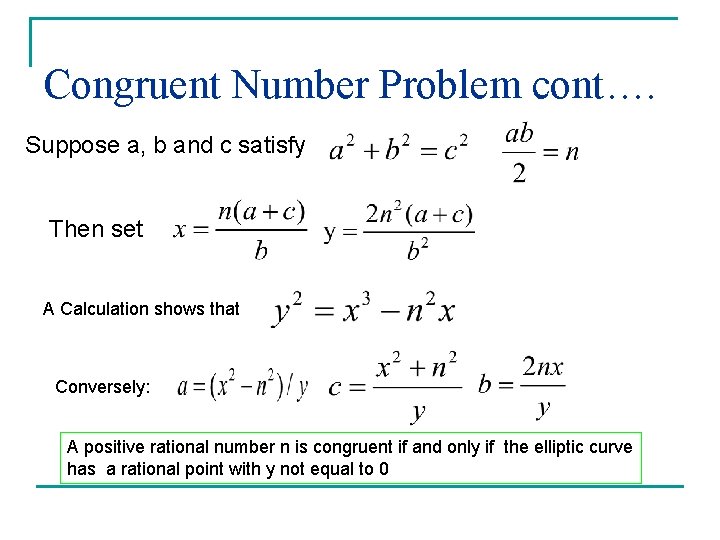
Congruent Number Problem cont…. Suppose a, b and c satisfy Then set A Calculation shows that Conversely: A positive rational number n is congruent if and only if the elliptic curve has a rational point with y not equal to 0
Congruent Number Problem cont… Continuing with n = 5 We have Point (-4, 6) on the curve We can now find a, b and c
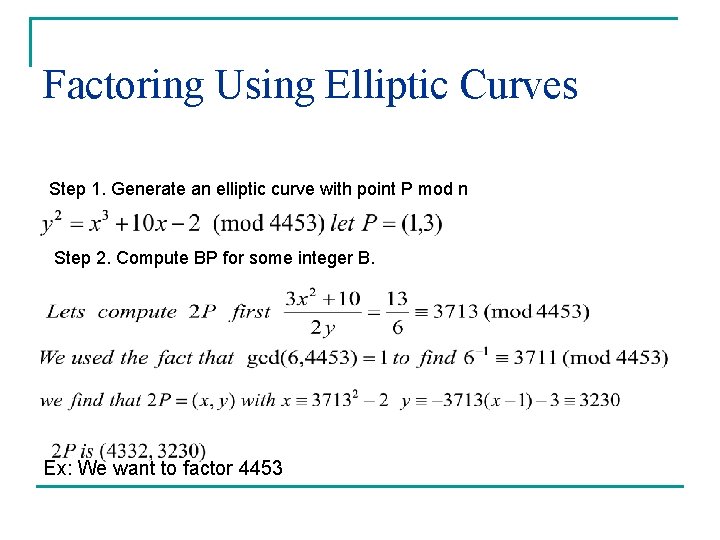
Factoring Using Elliptic Curves Step 1. Generate an elliptic curve with point P mod n Step 2. Compute BP for some integer B. Ex: We want to factor 4453
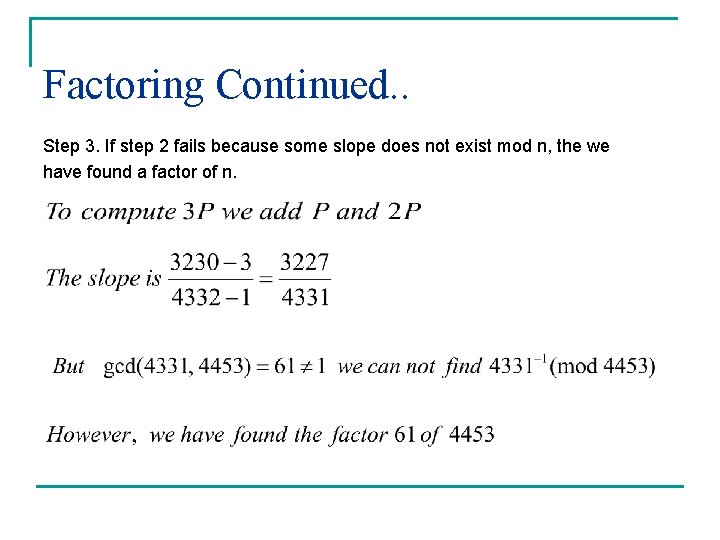
Factoring Continued. . Step 3. If step 2 fails because some slope does not exist mod n, the we have found a factor of n.
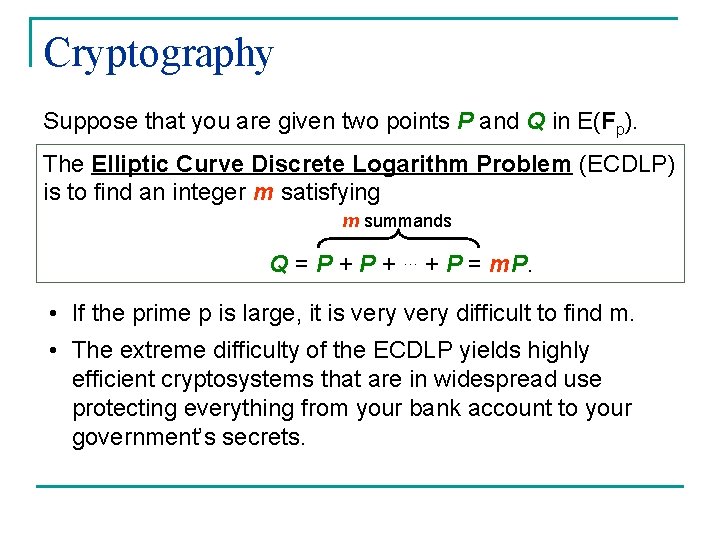
Cryptography Suppose that you are given two points P and Q in E(Fp). The Elliptic Curve Discrete Logarithm Problem (ECDLP) is to find an integer m satisfying m summands Q = P + … + P = m. P. • If the prime p is large, it is very difficult to find m. • The extreme difficulty of the ECDLP yields highly efficient cryptosystems that are in widespread use protecting everything from your bank account to your government’s secrets.
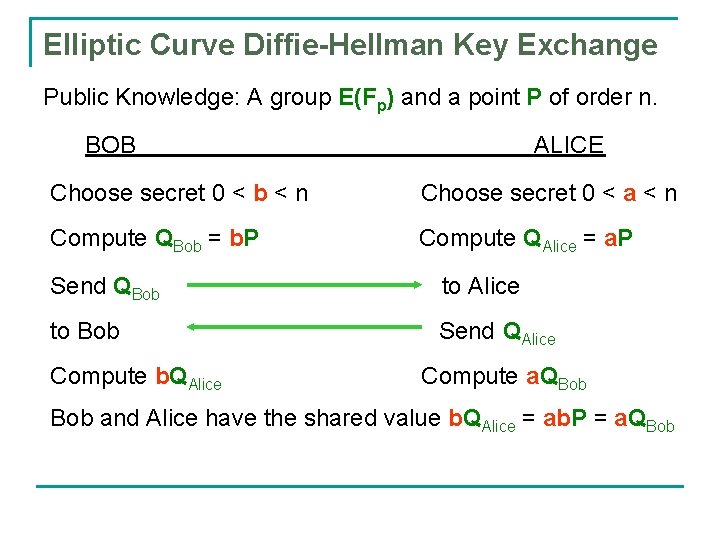
Elliptic Curve Diffie-Hellman Key Exchange Public Knowledge: A group E(Fp) and a point P of order n. BOB ALICE Choose secret 0 < b < n Choose secret 0 < a < n Compute QBob = b. P Compute QAlice = a. P Send QBob to Alice to Bob Send QAlice Compute b. QAlice Compute a. QBob and Alice have the shared value b. QAlice = ab. P = a. QBob
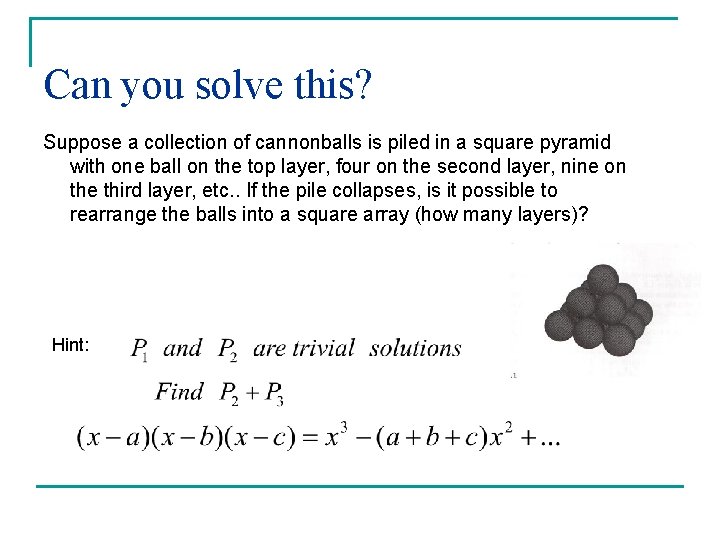
Can you solve this? Suppose a collection of cannonballs is piled in a square pyramid with one ball on the top layer, four on the second layer, nine on the third layer, etc. . If the pile collapses, is it possible to rearrange the balls into a square array (how many layers)? Hint:
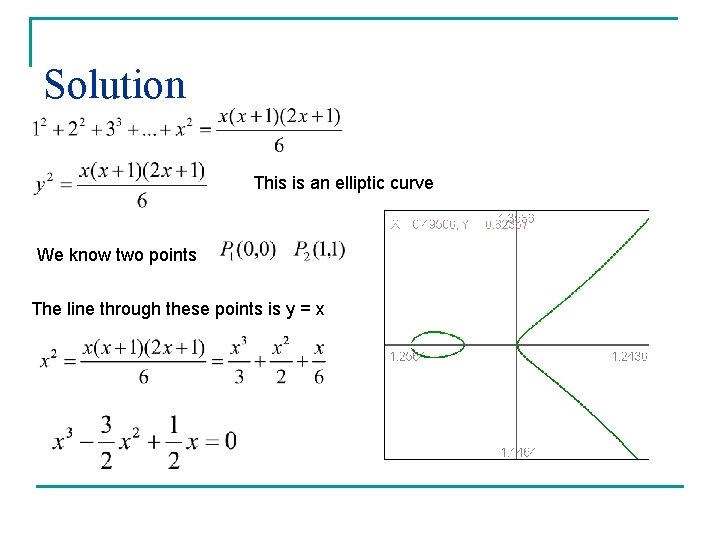
Solution This is an elliptic curve We know two points The line through these points is y = x
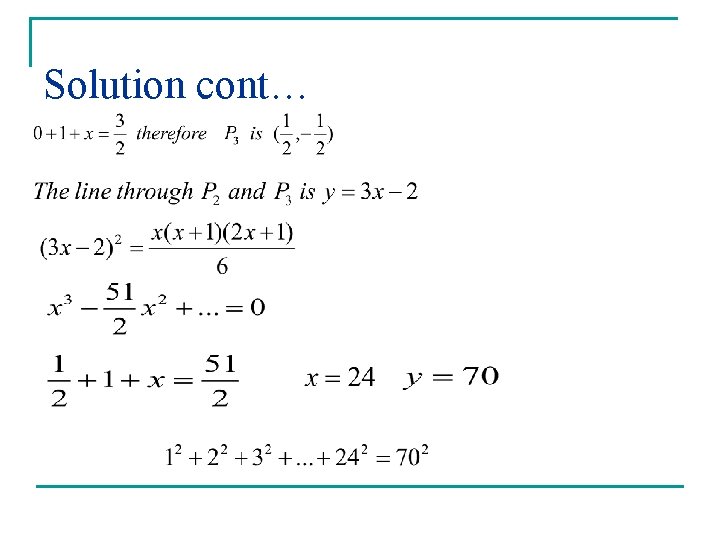
Solution cont…
References Elliptic Curves Number Theory and Cryptography Lawrence C. Washington n http: //www. math. vt. edu/people/brown/doc. html n http: //www. math. brown. edu/~jhs/ n