
Introduction to Electricity PART 1 May 11 30
- Slides: 48
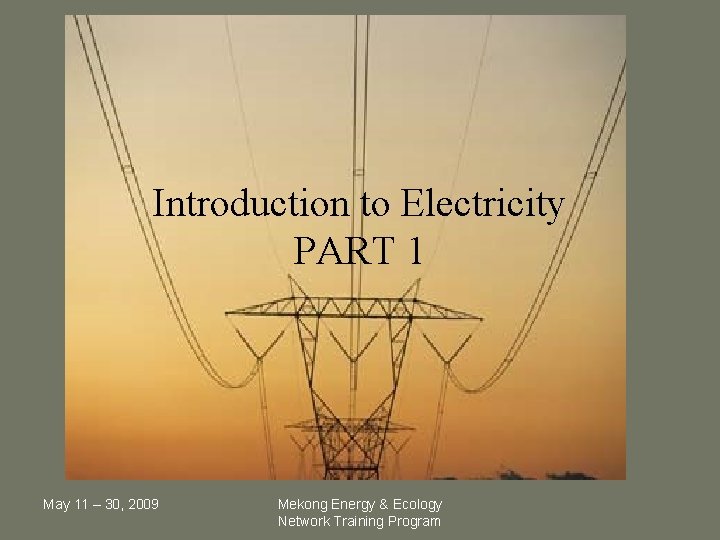
Introduction to Electricity PART 1 May 11 – 30, 2009 Mekong Energy & Ecology Network Training Program
Part 1: Introduction to Electricity Basic Electricity How Central Power Grids Work Electricity Generation STOP FOR TRANSLATION ASK QUESTIONS ANY TIME May 11 – 30, 2009 Mekong Energy & Ecology Network Training Program
Part 1: Electricity Concepts What is Electricity? Electrons, atoms, negative charge Conductors (example? ) Insulators (example? ) Electrical energy Magnet May 11 – 30, 2009 Mekong Energy & Ecology Network Training Program
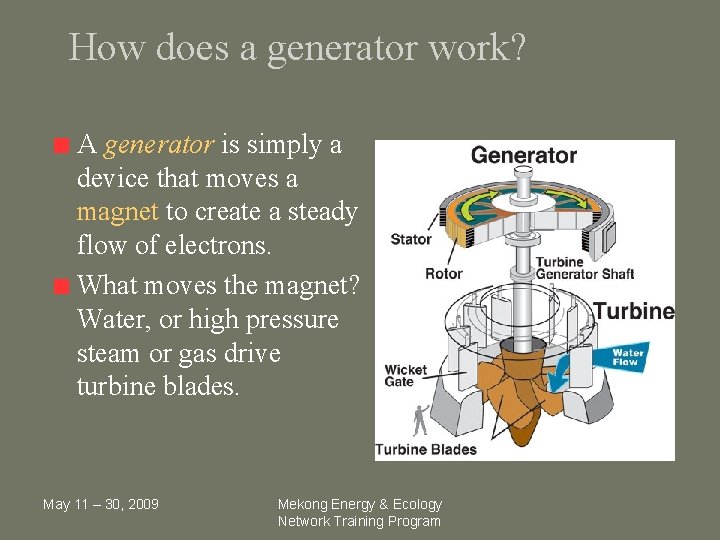
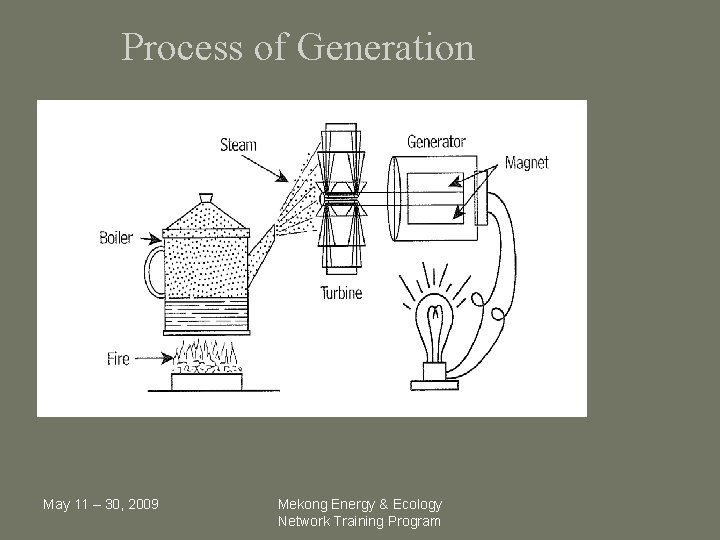
How does a generator work? A generator is simply a device that moves a magnet to create a steady flow of electrons. What moves the magnet? Water, or high pressure steam or gas drive turbine blades. May 11 – 30, 2009 Mekong Energy & Ecology Network Training Program
Process of Generation May 11 – 30, 2009 Mekong Energy & Ecology Network Training Program
Electrical Units Three basic units of measurement: Voltage (volts) Current (amps) Resistance (ohms) May 11 – 30, 2009 Mekong Energy & Ecology Network Training Program
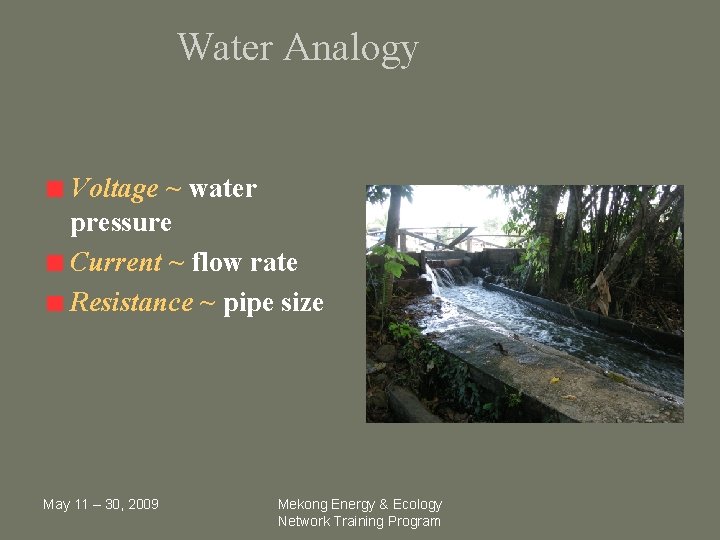
Water Analogy Voltage ~ water pressure Current ~ flow rate Resistance ~ pipe size May 11 – 30, 2009 Mekong Energy & Ecology Network Training Program
Key Concept Let’s say you have a tank of pressurized water connected to a hose that you use to water your vegetable garden. If you increase the pressure in the tank, more water comes out of the hose. Same for electrical systems: increase the voltage: you get a higher current of electrons. OR if you increase the size of the hose more water can flow out. This is like reducing resistance in an electrical system, so you get more current. May 11 – 30, 2009 Mekong Energy & Ecology Network Training Program
Basic Electrical Circuit All circuits have basic components: a source of electricity (such as a battery), a load (a light or motor) and two wires to carry electricity between the two. Electrons move from the source, through the load, and back to the source. These moving electrons have what we call energy. As they move they can do work. May 11 – 30, 2009 Mekong Energy & Ecology Network Training Program
Key Concept In an electrical system, increasing either the current (i) or the voltage (V) will increase power output (P). Increase resistance in the wires, voltage drops, current drops > power output drops. May 11 – 30, 2009 Mekong Energy & Ecology Network Training Program
Electrical Circuits Battery is a simple electrical circuit and source When you load a battery into an electronic device, the negatively charged electrons will travel to the portion of the battery with a positive charge - much like water flowing down a stream and being forced to turn a water wheel. May 11 – 30, 2009 Mekong Energy & Ecology Network Training Program
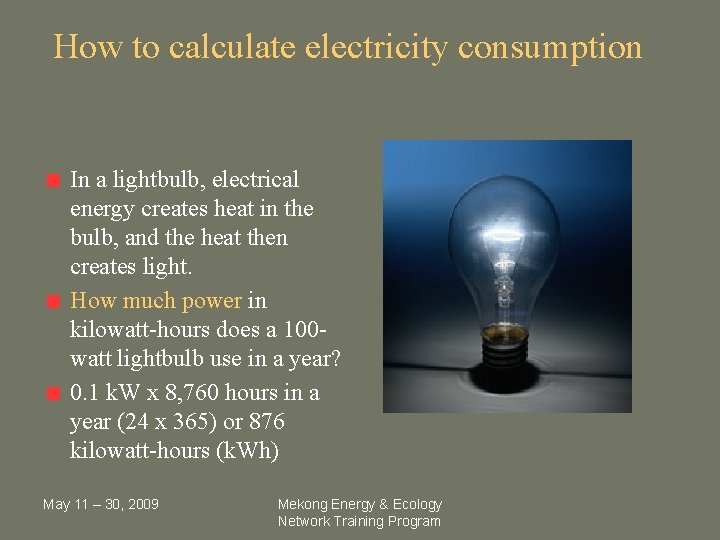
How to calculate electricity consumption In a lightbulb, electrical energy creates heat in the bulb, and the heat then creates light. How much power in kilowatt-hours does a 100 watt lightbulb use in a year? 0. 1 k. W x 8, 760 hours in a year (24 x 365) or 876 kilowatt-hours (k. Wh) May 11 – 30, 2009 Mekong Energy & Ecology Network Training Program
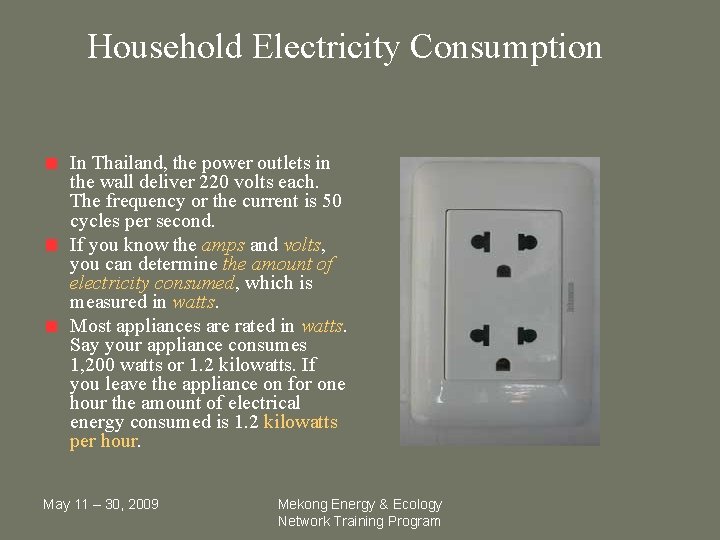
Household Electricity Consumption In Thailand, the power outlets in the wall deliver 220 volts each. The frequency or the current is 50 cycles per second. If you know the amps and volts, you can determine the amount of electricity consumed, which is measured in watts. Most appliances are rated in watts. Say your appliance consumes 1, 200 watts or 1. 2 kilowatts. If you leave the appliance on for one hour the amount of electrical energy consumed is 1. 2 kilowatts per hour. May 11 – 30, 2009 Mekong Energy & Ecology Network Training Program
Your Electricity Bill Power is measured in watts (voltage x current) Consumption is measured in kilowatt-hours How much does the power company charge you for electricity? May 11 – 30, 2009 Mekong Energy & Ecology Network Training Program
Electrical Current Direct Current (DC) Batteries (and solar cells) produce DC. The positive and negative terminals of a battery are always positive and negative. Current always flows in the same direction between the two terminals. May 11 – 30, 2009 Mekong Energy & Ecology Network Training Program
Electrical Current Alternating Current (AC) Power from a power plant is AC. The direction of the current reverses or alternates. In Thailand, AC moves at 50 cycles per second. Power from a wall socket is 220 volts, 50 cycle single-phase AC power. May 11 – 30, 2009 Mekong Energy & Ecology Network Training Program
Key Concept There is an advantage in using less current to make the same amount of power. The resistance in electrical wires consumes power; as current increases, more power consumed. Using a higher voltage to reduce the current makes electrical system more efficient. May 11 – 30, 2009 Mekong Energy & Ecology Network Training Program
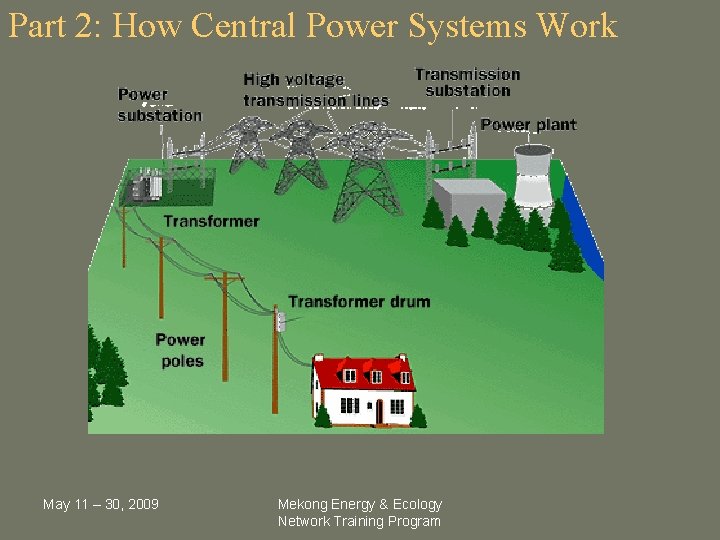
Part 2: How Central Power Systems Work May 11 – 30, 2009 Mekong Energy & Ecology Network Training Program
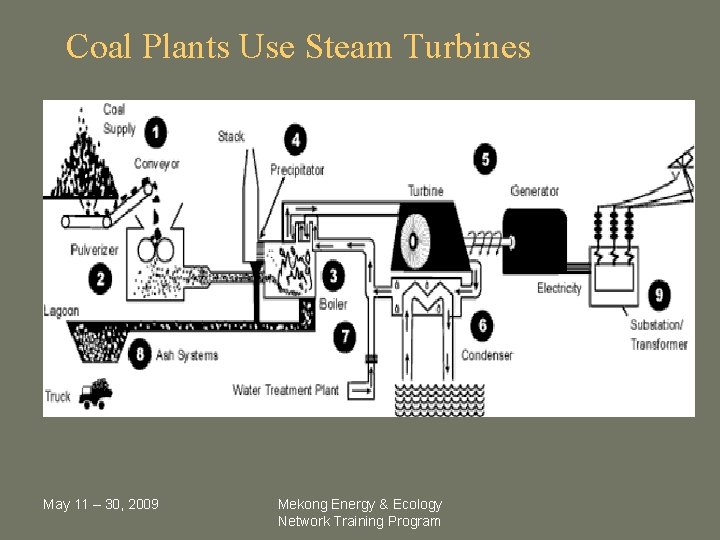
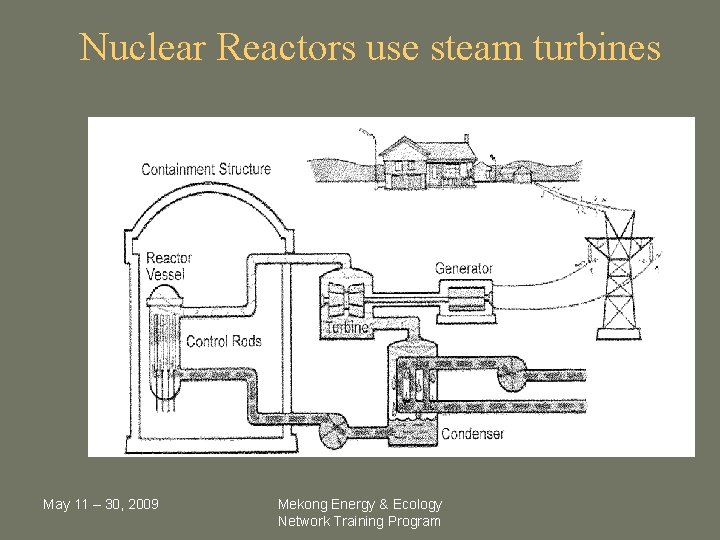
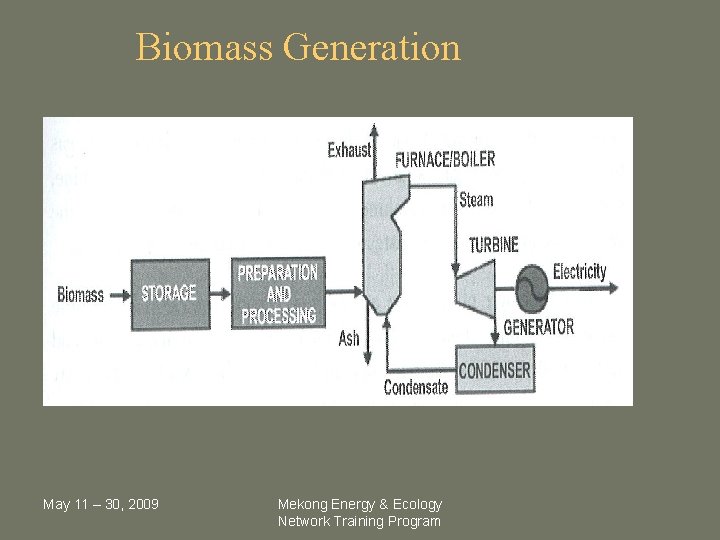
The Power Plant This is where electrical power begins. In most cases, the plant consists of a spinning electrical generator. Something – some kind of force or pressure - has to make the generator spin. It might be a turbine in a hydroelectric dam, a large diesel engine, or a gas turbine. Often a steam turbine is used to spin the generator. The steam is created by burning coal, oil or natural gas. Or the steam may be generated in a nuclear station. May 11 – 30, 2009 Mekong Energy & Ecology Network Training Program
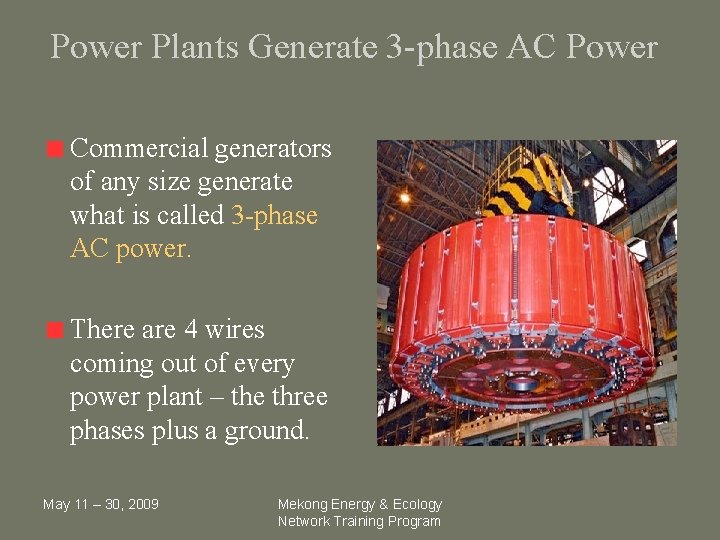
Power Plants Generate 3 -phase AC Power Commercial generators of any size generate what is called 3 -phase AC power. There are 4 wires coming out of every power plant – the three phases plus a ground. May 11 – 30, 2009 Mekong Energy & Ecology Network Training Program
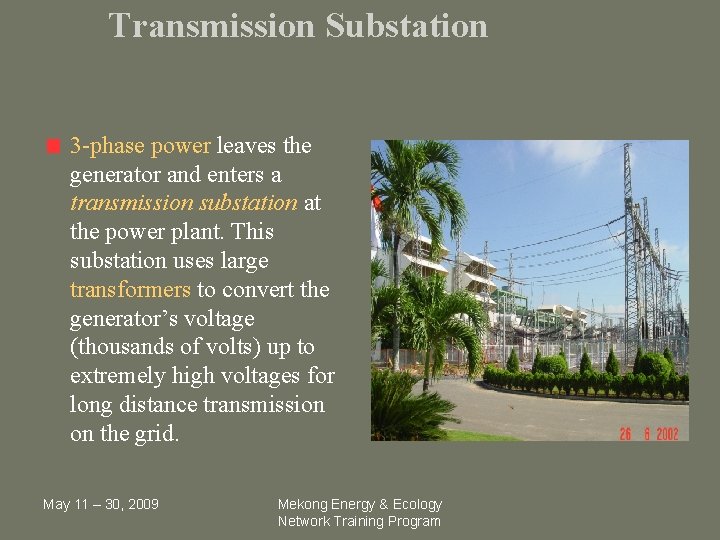
Transmission Substation 3 -phase power leaves the generator and enters a transmission substation at the power plant. This substation uses large transformers to convert the generator’s voltage (thousands of volts) up to extremely high voltages for long distance transmission on the grid. May 11 – 30, 2009 Mekong Energy & Ecology Network Training Program
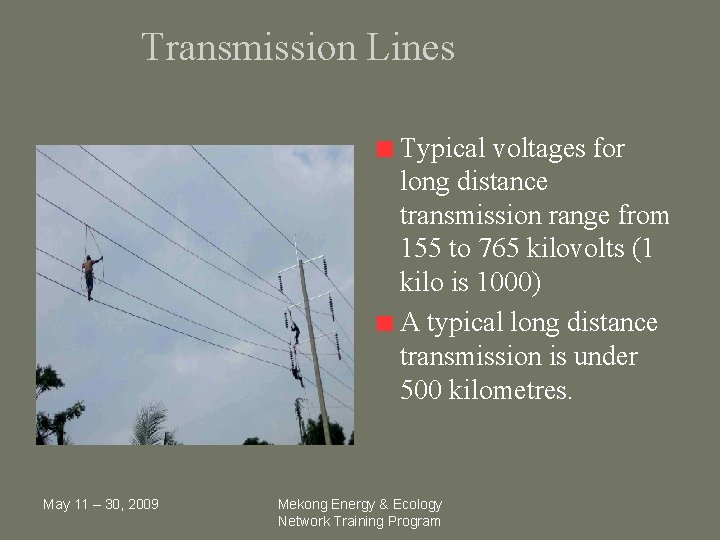
Transmission Lines Typical voltages for long distance transmission range from 155 to 765 kilovolts (1 kilo is 1000) A typical long distance transmission is under 500 kilometres. May 11 – 30, 2009 Mekong Energy & Ecology Network Training Program
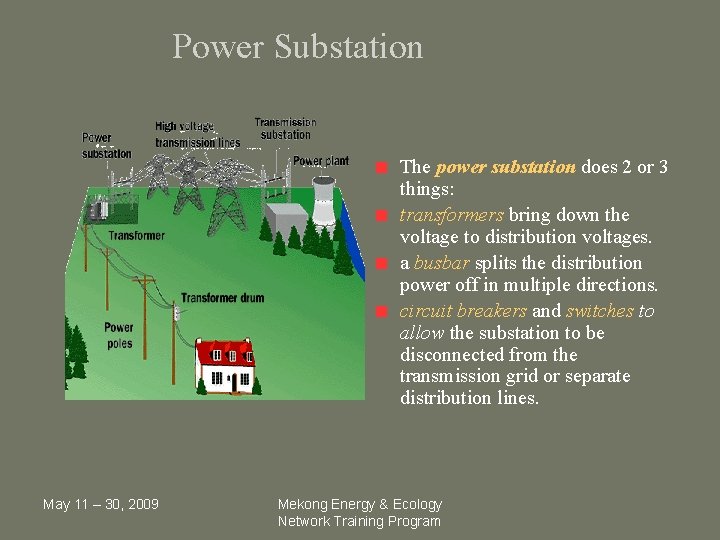
Power Substation The power substation does 2 or 3 things: transformers bring down the voltage to distribution voltages. a busbar splits the distribution power off in multiple directions. circuit breakers and switches to allow the substation to be disconnected from the transmission grid or separate distribution lines. May 11 – 30, 2009 Mekong Energy & Ecology Network Training Program
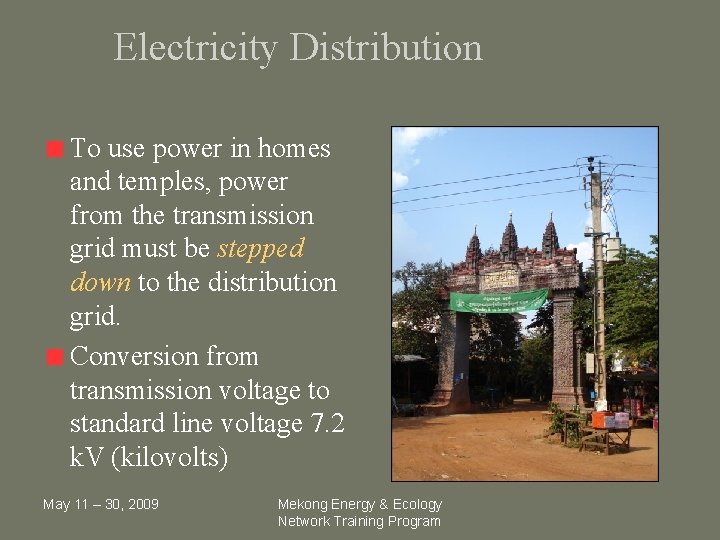
Electricity Distribution To use power in homes and temples, power from the transmission grid must be stepped down to the distribution grid. Conversion from transmission voltage to standard line voltage 7. 2 k. V (kilovolts) May 11 – 30, 2009 Mekong Energy & Ecology Network Training Program
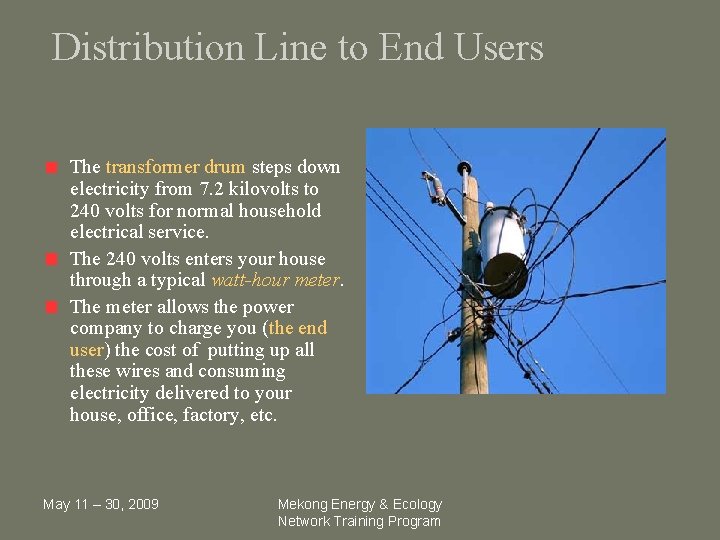
Distribution Line to End Users The transformer drum steps down electricity from 7. 2 kilovolts to 240 volts for normal household electrical service. The 240 volts enters your house through a typical watt-hour meter. The meter allows the power company to charge you (the end user) the cost of putting up all these wires and consuming electricity delivered to your house, office, factory, etc. May 11 – 30, 2009 Mekong Energy & Ecology Network Training Program
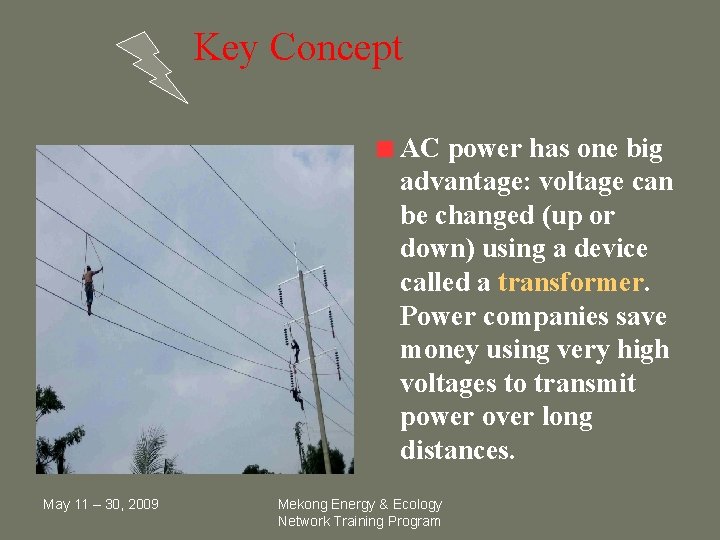
Key Concept AC power has one big advantage: voltage can be changed (up or down) using a device called a transformer. Power companies save money using very high voltages to transmit power over long distances. May 11 – 30, 2009 Mekong Energy & Ecology Network Training Program
Part 3: Electricity Generation Technologies Steam turbines Gas turbines Wind turbines Hydro/hydraulic turbines Combined cycle plants Cogeneration Microturbines Solar photovoltaics (DC power) May 11 – 30, 2009 Mekong Energy & Ecology Network Training Program
Coal Plants Use Steam Turbines May 11 – 30, 2009 Mekong Energy & Ecology Network Training Program
Nuclear Reactors use steam turbines May 11 – 30, 2009 Mekong Energy & Ecology Network Training Program
Biomass Generation May 11 – 30, 2009 Mekong Energy & Ecology Network Training Program
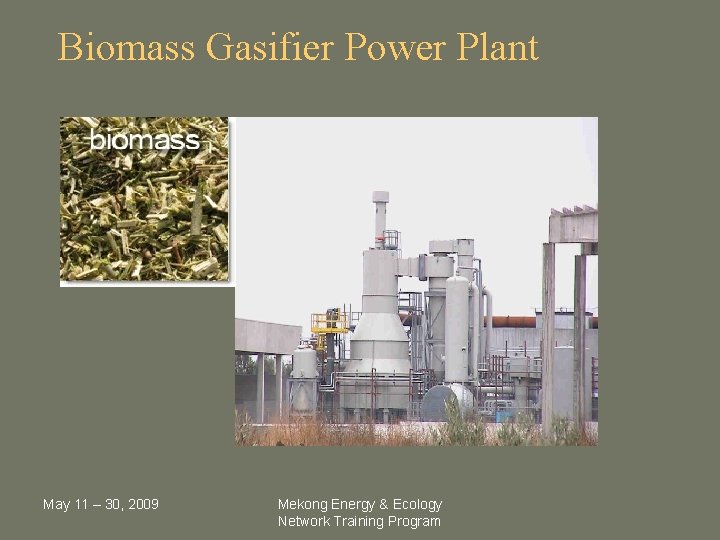
Biomass Gasifier Power Plant May 11 – 30, 2009 Mekong Energy & Ecology Network Training Program
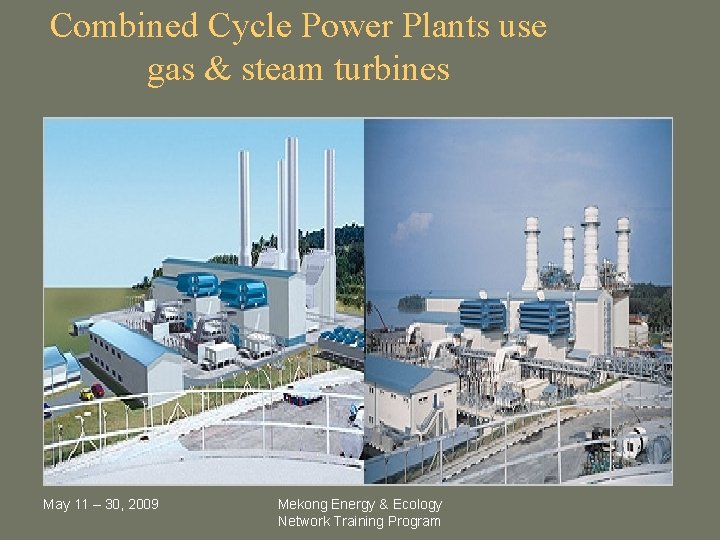
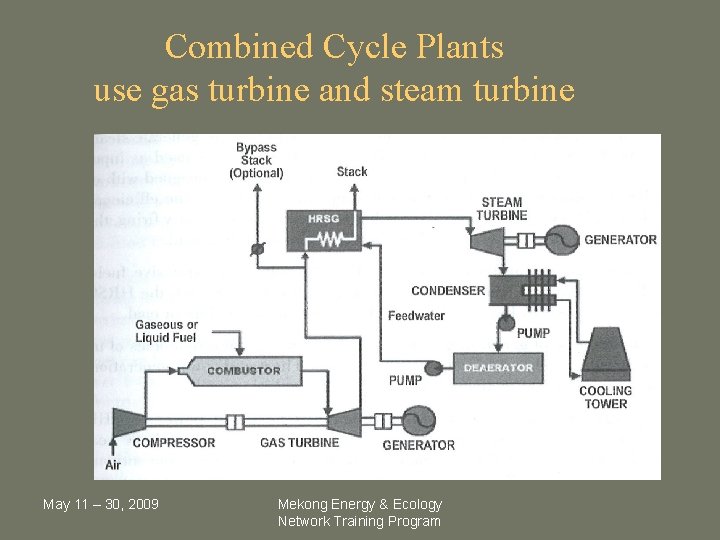
Combined Cycle Power Plants use gas & steam turbines May 11 – 30, 2009 Mekong Energy & Ecology Network Training Program
Combined Cycle Plants use gas turbine and steam turbine May 11 – 30, 2009 Mekong Energy & Ecology Network Training Program
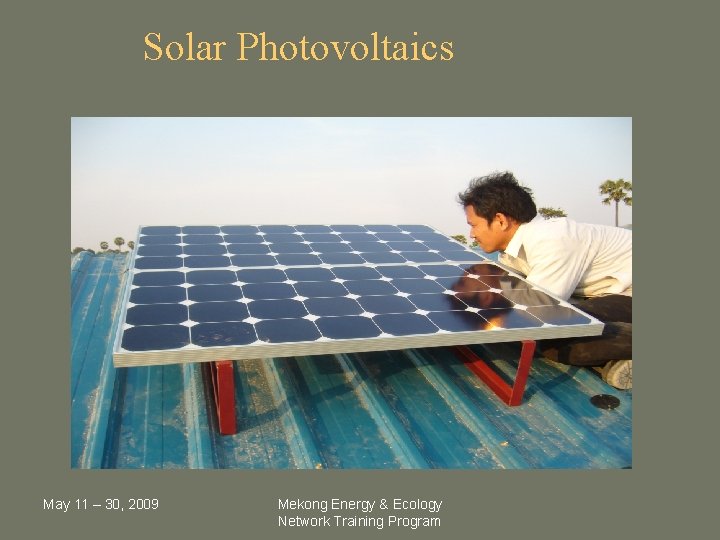
Solar Photovoltaics May 11 – 30, 2009 Mekong Energy & Ecology Network Training Program
Solar: On-Grid/Off-Grid Technology May 11 – 30, 2009 Mekong Energy & Ecology Network Training Program
Characteristics of Generating Plants Size, generating capacity Energy/fuel source Efficiency – conversion to electrical energy Type of use Availability May 11 – 30, 2009 Mekong Energy & Ecology Network Training Program
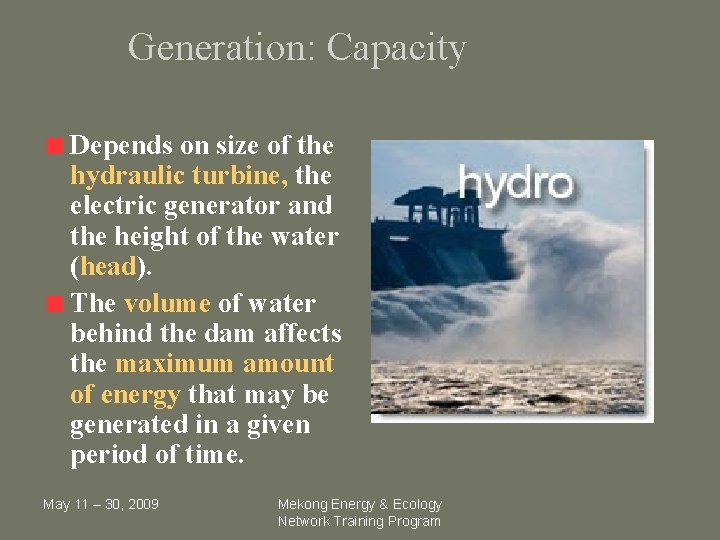
Generation: Capacity Depends on size of the hydraulic turbine, the electric generator and the height of the water (head). The volume of water behind the dam affects the maximum amount of energy that may be generated in a given period of time. May 11 – 30, 2009 Mekong Energy & Ecology Network Training Program
Power Plant – Size (Capacity) Range from a few kilowatts to >1, 000 MW Microturbines are the smallest (see Capstone video for a tour of a microturbine cogeneration facility) May 11 – 30, 2009 Mekong Energy & Ecology Network Training Program
Generation: Efficiency The efficiency of a generating unit is a measure of the amount of electrical energy produced per unit of energy input. For thermal plants (plants burning fuel), the energy input is fuel and the way efficiency is measured is called the heat rate. The more fuel that has to be burned to produce electricity, the lower thermal efficiency. May 11 – 30, 2009 Mekong Energy & Ecology Network Training Program
Comparing Plant Efficiency Newer combined cycle plants have near 50 percent thermal efficiency compared to coal or nuclear plants which can only convert 30 percent of their fuel into electrical energy (the rest is released into the atmosphere as waste heat). May 11 – 30, 2009 Mekong Energy & Ecology Network Training Program
Type of Use: Base, Intermediate, Peak Load In a central power system, power plants are designed and operated for: base load, intermediate load, and peak load. Base load – usually large units with low operating costs. Usually operated at full capacity during most of the hours they are available. Designed to operate for long periods of time at or near maximum dependable capacity. Low operating costs refer to low cost of the fuel they use. May 11 – 30, 2009 Mekong Energy & Ecology Network Training Program
Intermediate Load Power plants used to respond to variations in customer demand which occur during the day. Plants designed for change in output levels. May 11 – 30, 2009 Mekong Energy & Ecology Network Training Program
Type of Use: Peak Load Peak load – power plant is called upon to supply customer demand during peak (= highest) load hours of a given day, month, season or year. Combustion turbines and small hydro units – usually less than 150 MW, capable of achieving full load operation within 10 minutes. They may also be used to replace capacity of other units that have suddenly been taken off the system due to forced outages. May 11 – 30, 2009 Mekong Energy & Ecology Network Training Program
Plant Availability & Dispatch System operators are concerned about availability of each power plant to supply the grid. System operators dispatch power plants according to their availability (and operating cost). On a day to day and hour to hour basis there must sufficient generation synchronized to the grid to meet all load requirements and respond to shortterm variations in customer load, as well as cover for the loss of another generator. May 11 – 30, 2009 Mekong Energy & Ecology Network Training Program
Availability vs Outages Unavailability of a generating unit due to component failure is called a forced outage. Various components of generating units must be removed from service on a regular basis for preventive maintenance or to replace components before a forced outage results – this is called a planned outage. May 11 – 30, 2009 Mekong Energy & Ecology Network Training Program
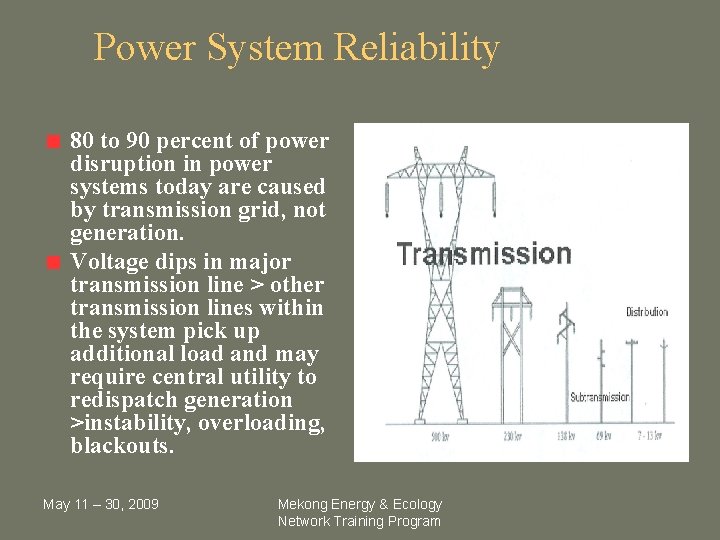
Power System Reliability 80 to 90 percent of power disruption in power systems today are caused by transmission grid, not generation. Voltage dips in major transmission line > other transmission lines within the system pick up additional load and may require central utility to redispatch generation >instability, overloading, blackouts. May 11 – 30, 2009 Mekong Energy & Ecology Network Training Program
Reserve Capacity Central power systems designed to meet demand plus a reserve capacity, over and above the expected peak load obligation of the power plant (15 to 45 %). Today big questions within the industry: should the amount of installed generating capacity should be a design requirement (set by government) or should be determined by the market; who should pay for transmission? [MORE TOMORROW]. May 11 – 30, 2009 Mekong Energy & Ecology Network Training Program
END: Introduction to Electricity NEXT: The Electricity Industry May 11 – 30, 2009 Mekong Energy & Ecology Network Training Program