
Introduction to Earthquake Geotechnical Engineering and Its Practices
- Slides: 51
Introduction to Earthquake Geotechnical Engineering and It’s Practices by Dr. Deepankar Choudhury Assistant Professor, Department of Civil Engineering, IIT Bombay, Powai, Mumbai 400 076, India. URL: http: //www. civil. iitb. ac. in/~dc/ 1
Earthquake Hazards related to Geotechnical Engineering D. Choudhury, IIT Bombay, India 2
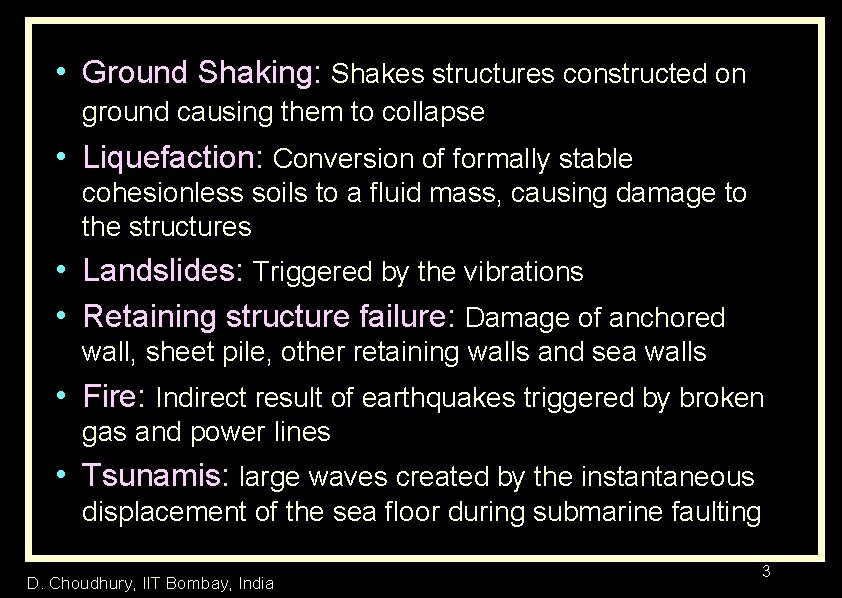
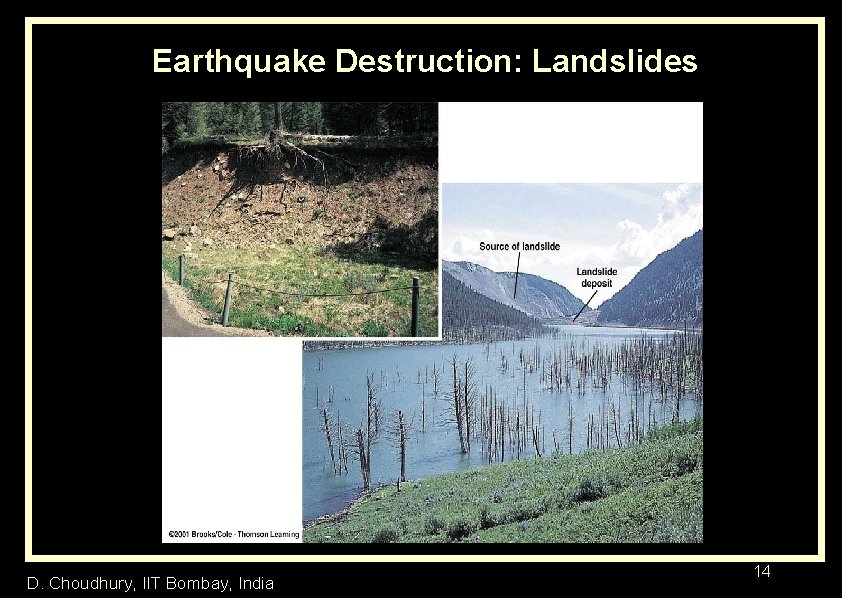
• Ground Shaking: Shakes structures constructed on ground causing them to collapse • Liquefaction: Conversion of formally stable cohesionless soils to a fluid mass, causing damage to the structures • Landslides: Triggered by the vibrations • Retaining structure failure: Damage of anchored wall, sheet pile, other retaining walls and sea walls • Fire: Indirect result of earthquakes triggered by broken gas and power lines • Tsunamis: large waves created by the instantaneous displacement of the sea floor during submarine faulting D. Choudhury, IIT Bombay, India 3
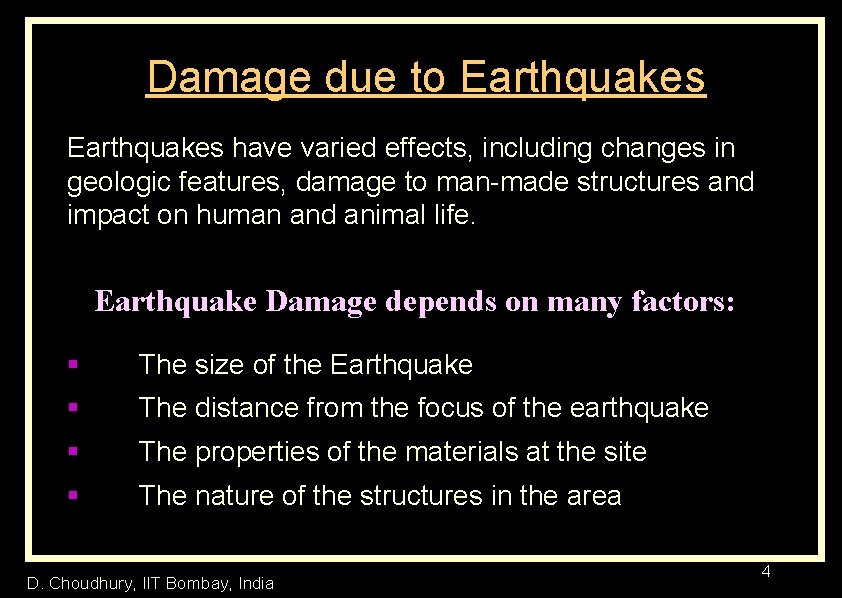
Damage due to Earthquakes have varied effects, including changes in geologic features, damage to man-made structures and impact on human and animal life. Earthquake Damage depends on many factors: § The size of the Earthquake § The distance from the focus of the earthquake § The properties of the materials at the site § The nature of the structures in the area D. Choudhury, IIT Bombay, India 4
Ground Shaking Frequency of shaking differs for different seismic waves. High frequency body waves shake low buildings more. Low frequency surface waves shake high buildings more. Intensity of shaking also depends on type of subsurface material. Unconsolidated materials amplify shaking more than rocks do. Buildings respond differently to shaking depending on construction styles, materials Wood -- more flexible, holds up well Earthen materials, unreinforced concrete -- very vulnerable to shaking. D. Choudhury, IIT Bombay, India 5
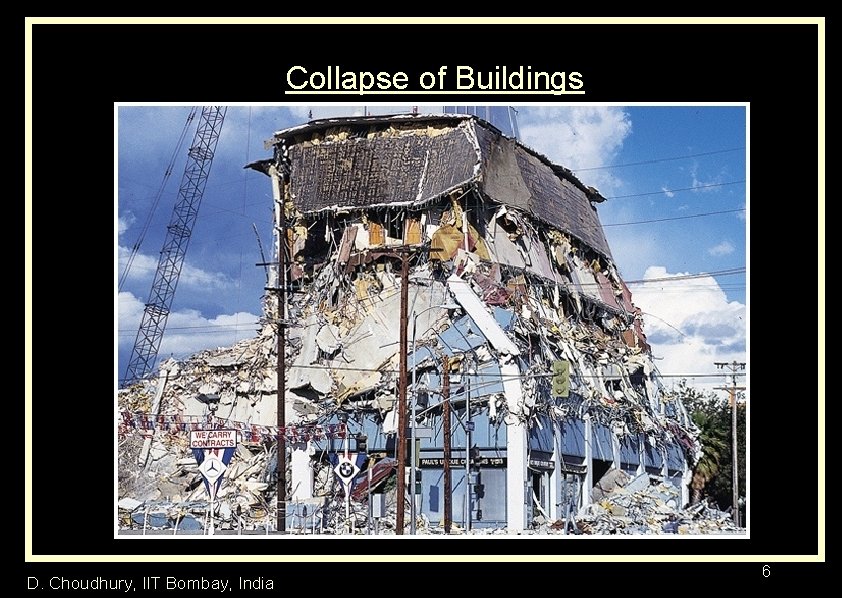
Collapse of Buildings D. Choudhury, IIT Bombay, India 6
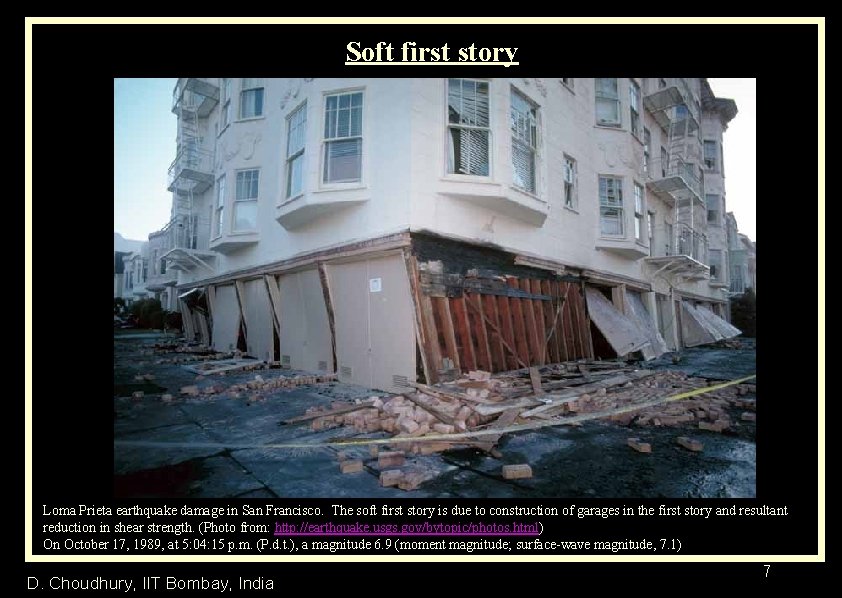
Soft first story Loma Prieta earthquake damage in San Francisco. The soft first story is due to construction of garages in the first story and resultant reduction in shear strength. (Photo from: http: //earthquake. usgs. gov/bytopic/photos. html) On October 17, 1989, at 5: 04: 15 p. m. (P. d. t. ), a magnitude 6. 9 (moment magnitude; surface-wave magnitude, 7. 1) D. Choudhury, IIT Bombay, India 7
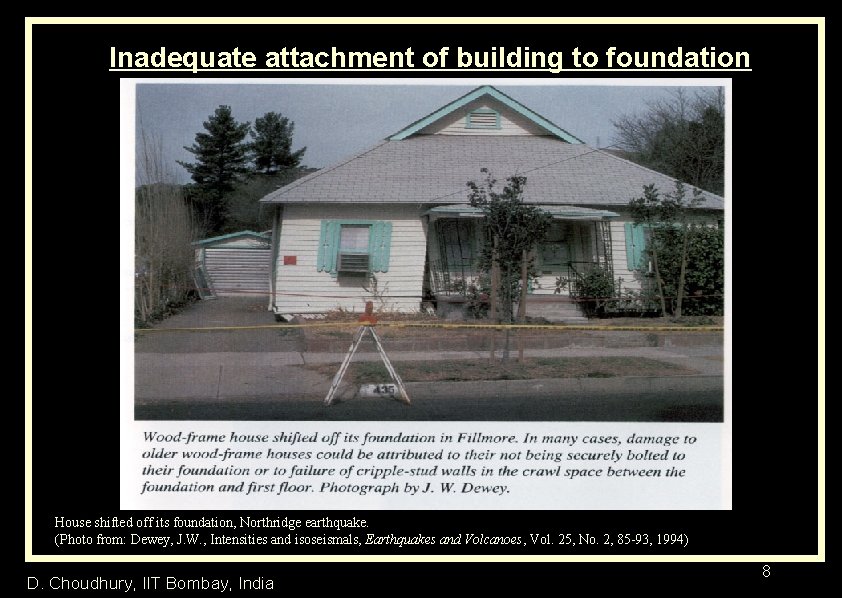
Inadequate attachment of building to foundation House shifted off its foundation, Northridge earthquake. (Photo from: Dewey, J. W. , Intensities and isoseismals, Earthquakes and Volcanoes, Vol. 25, No. 2, 85 -93, 1994) D. Choudhury, IIT Bombay, India 8
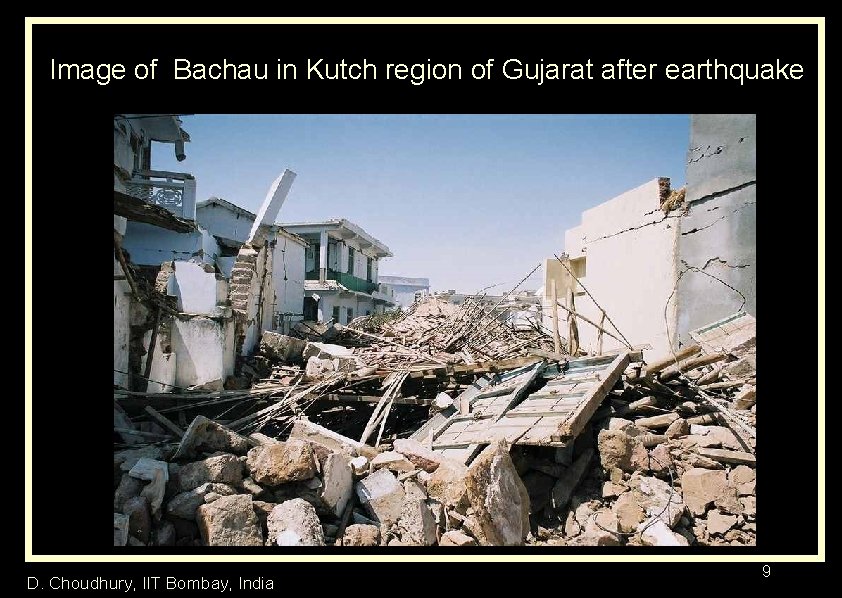
Image of Bachau in Kutch region of Gujarat after earthquake D. Choudhury, IIT Bombay, India 9
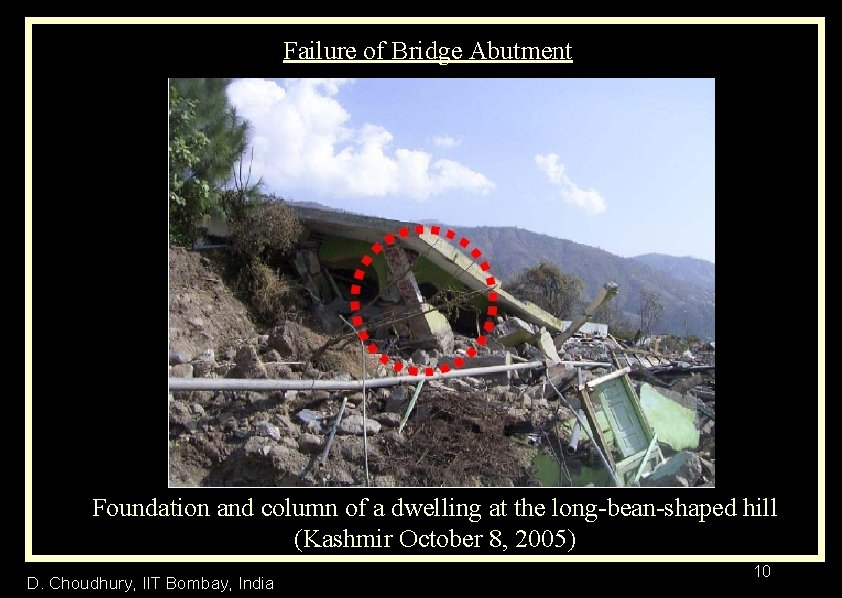
Failure of Bridge Abutment Foundation and column of a dwelling at the long-bean-shaped hill (Kashmir October 8, 2005) D. Choudhury, IIT Bombay, India 10
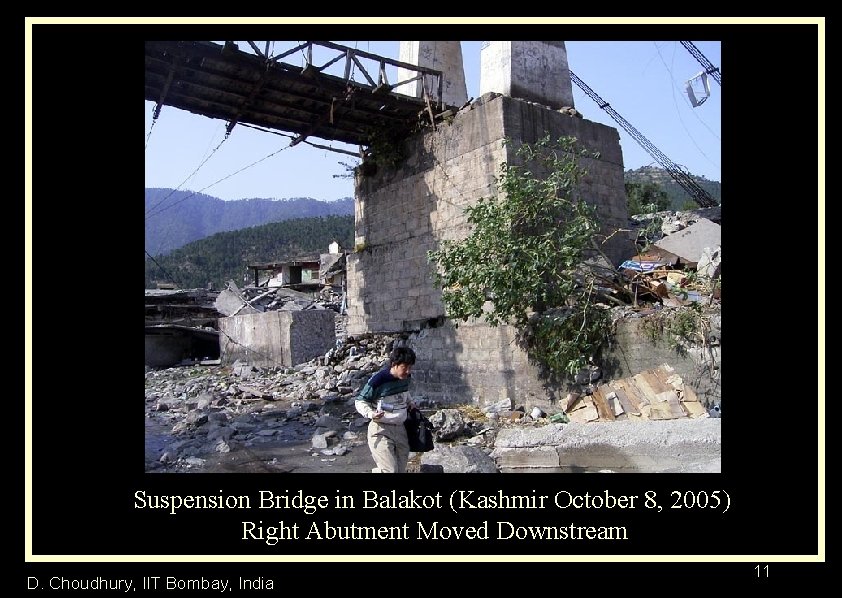
Suspension Bridge in Balakot (Kashmir October 8, 2005) Right Abutment Moved Downstream D. Choudhury, IIT Bombay, India 11
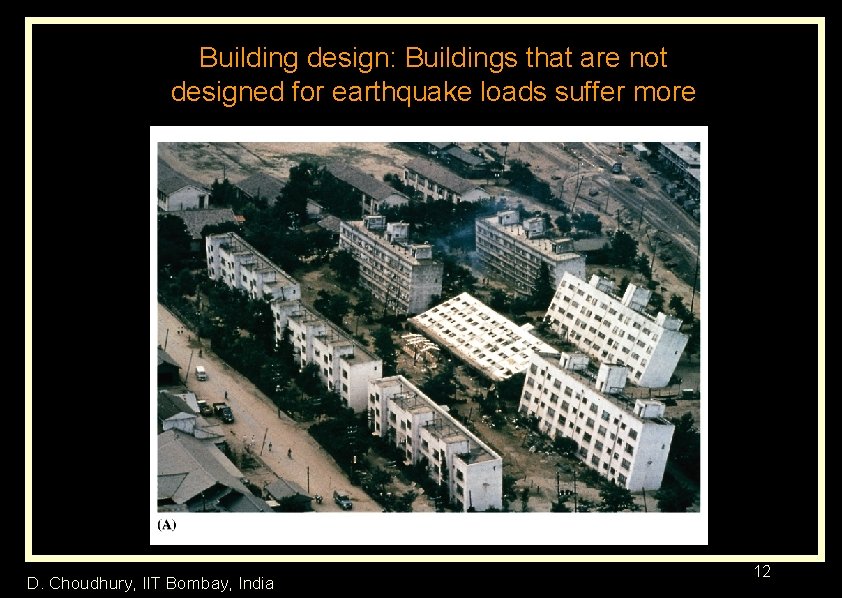
Building design: Buildings that are not designed for earthquake loads suffer more D. Choudhury, IIT Bombay, India 12
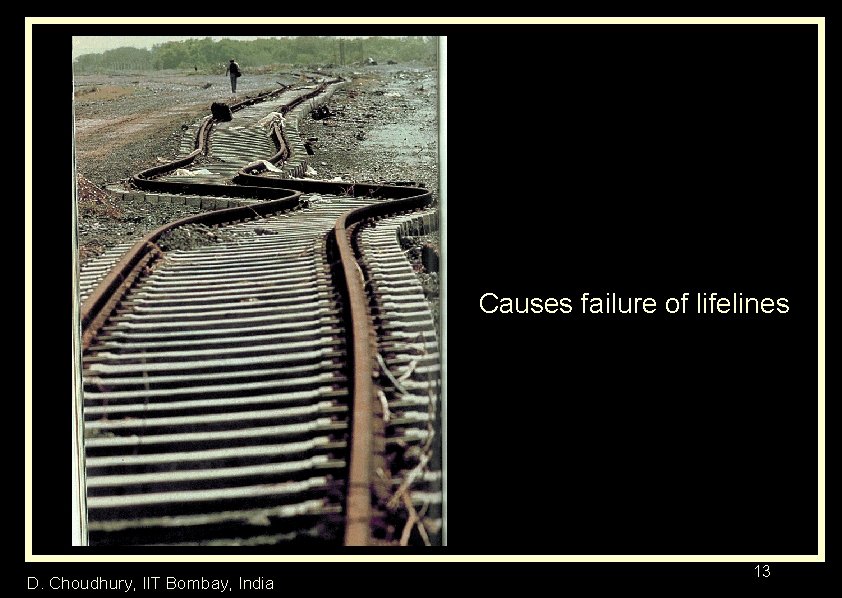
Causes failure of lifelines D. Choudhury, IIT Bombay, India 13
Earthquake Destruction: Landslides D. Choudhury, IIT Bombay, India 14
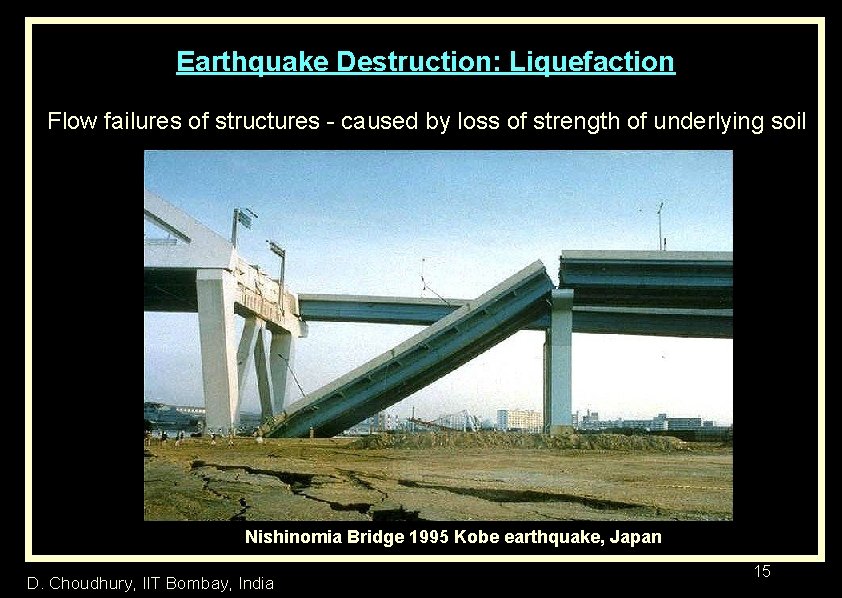
Earthquake Destruction: Liquefaction Flow failures of structures - caused by loss of strength of underlying soil Nishinomia Bridge 1995 Kobe earthquake, Japan D. Choudhury, IIT Bombay, India 15
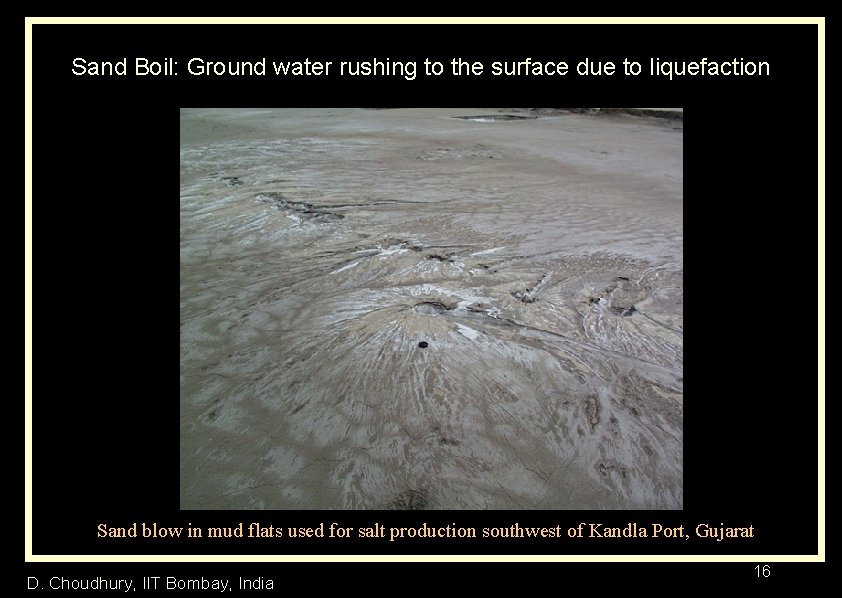
Sand Boil: Ground water rushing to the surface due to liquefaction Sand blow in mud flats used for salt production southwest of Kandla Port, Gujarat D. Choudhury, IIT Bombay, India 16
Lateral Deformation and Spreading D. Choudhury, IIT Bombay, India 17
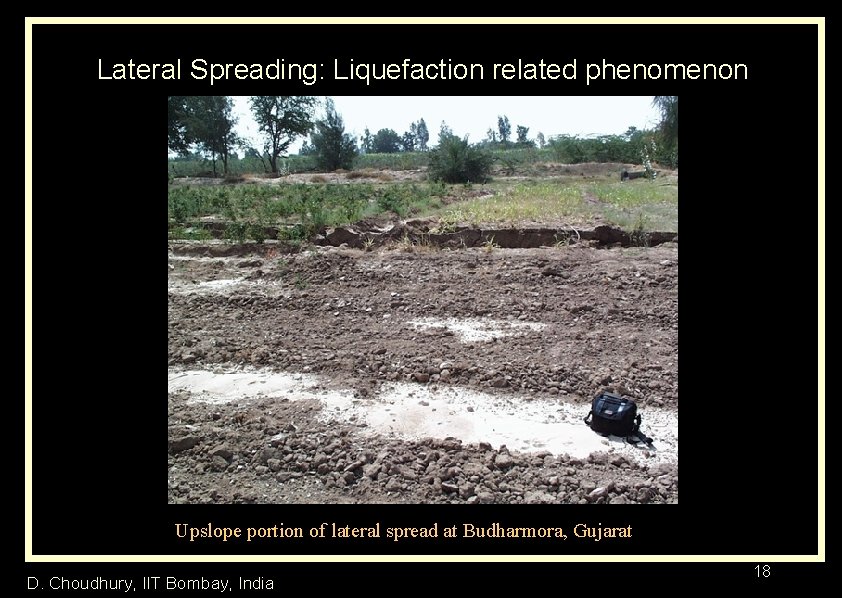
Lateral Spreading: Liquefaction related phenomenon Upslope portion of lateral spread at Budharmora, Gujarat D. Choudhury, IIT Bombay, India 18
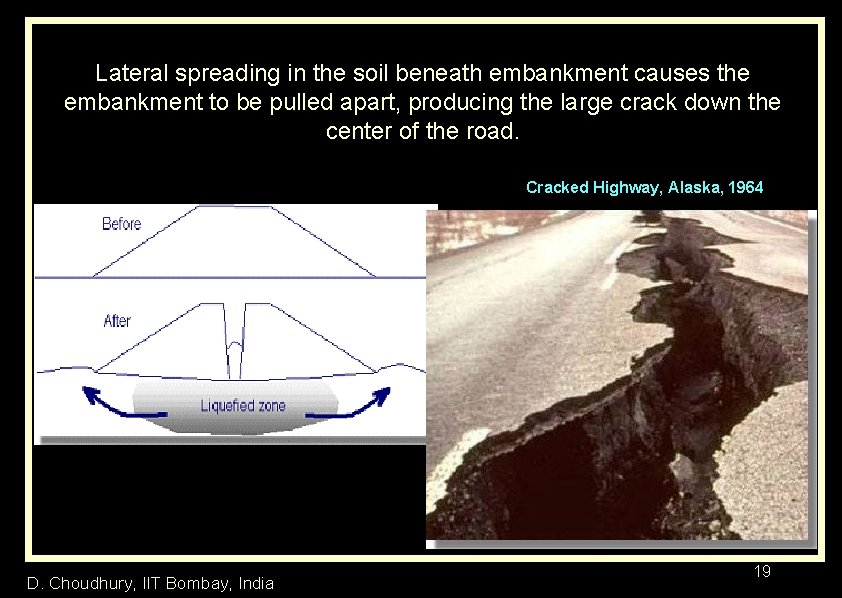
Lateral spreading in the soil beneath embankment causes the embankment to be pulled apart, producing the large crack down the center of the road. Cracked Highway, Alaska, 1964 D. Choudhury, IIT Bombay, India 19
Lateral Deformation and Spreading Ø Down slope movement of soil, when loose sandy (liquefiable) soil is present, at slopes as gentle as 0. 50 Ø In situations where strengths (near or post liquefaction) are less than the driving static shear stresses, deformations can be large, and global instability often results D. Choudhury, IIT Bombay, India 20
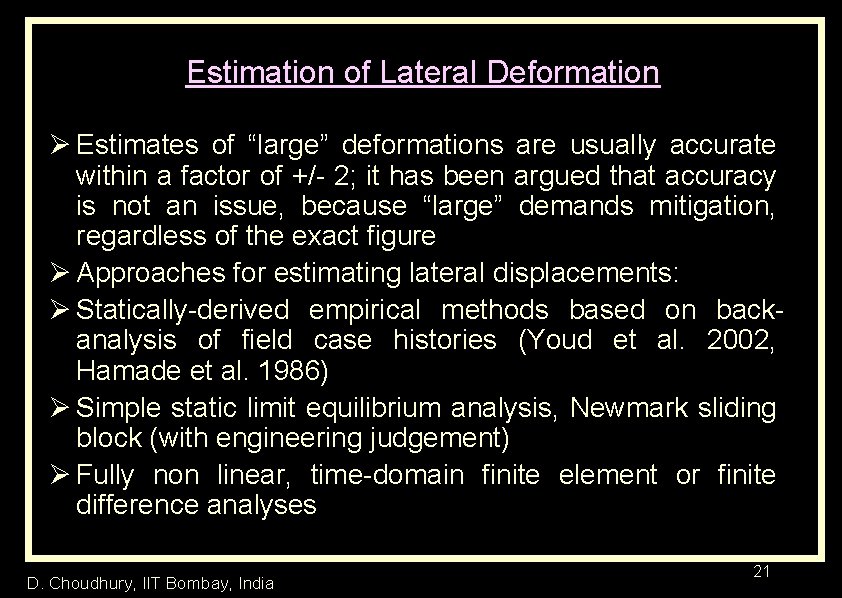
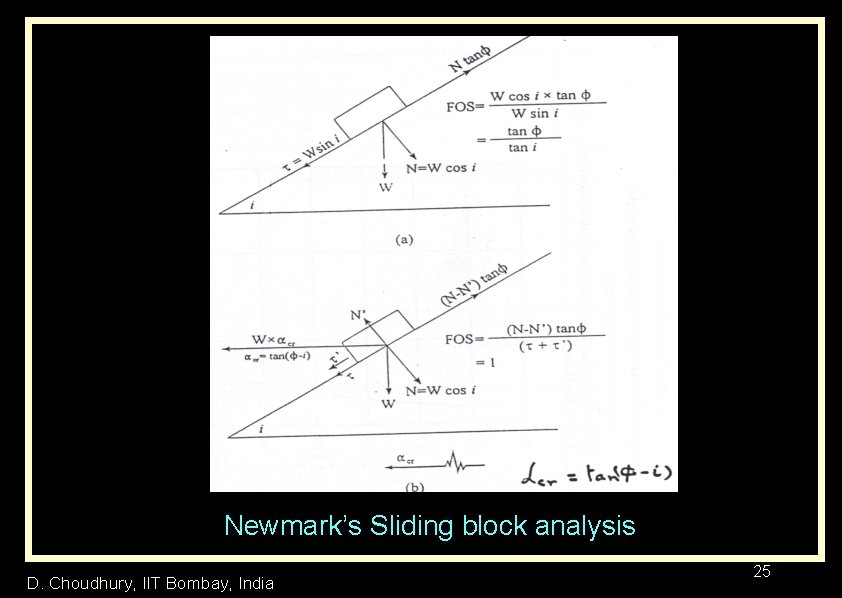
Estimation of Lateral Deformation Ø Estimates of “large” deformations are usually accurate within a factor of +/- 2; it has been argued that accuracy is not an issue, because “large” demands mitigation, regardless of the exact figure Ø Approaches for estimating lateral displacements: Ø Statically-derived empirical methods based on backanalysis of field case histories (Youd et al. 2002, Hamade et al. 1986) Ø Simple static limit equilibrium analysis, Newmark sliding block (with engineering judgement) Ø Fully non linear, time-domain finite element or finite difference analyses D. Choudhury, IIT Bombay, India 21
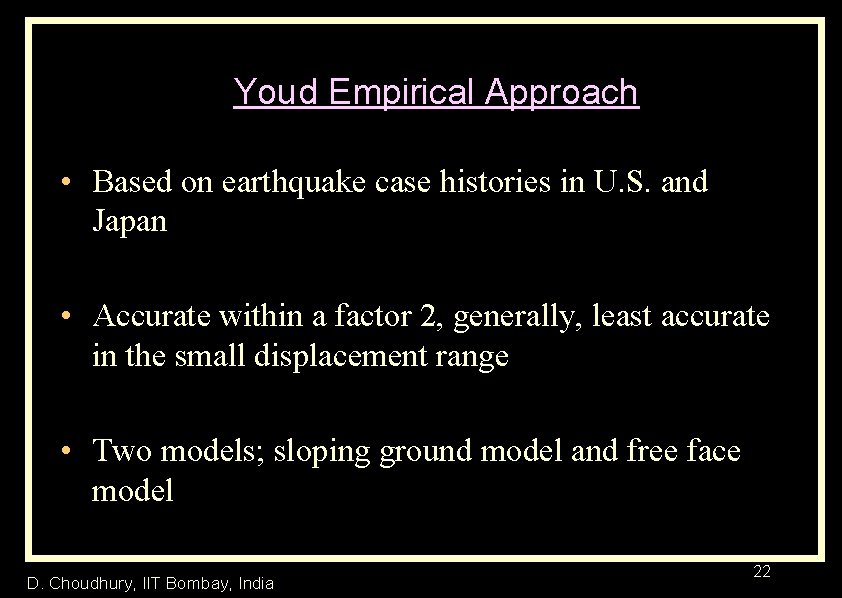
Youd Empirical Approach • Based on earthquake case histories in U. S. and Japan • Accurate within a factor 2, generally, least accurate in the small displacement range • Two models; sloping ground model and free face model D. Choudhury, IIT Bombay, India 22
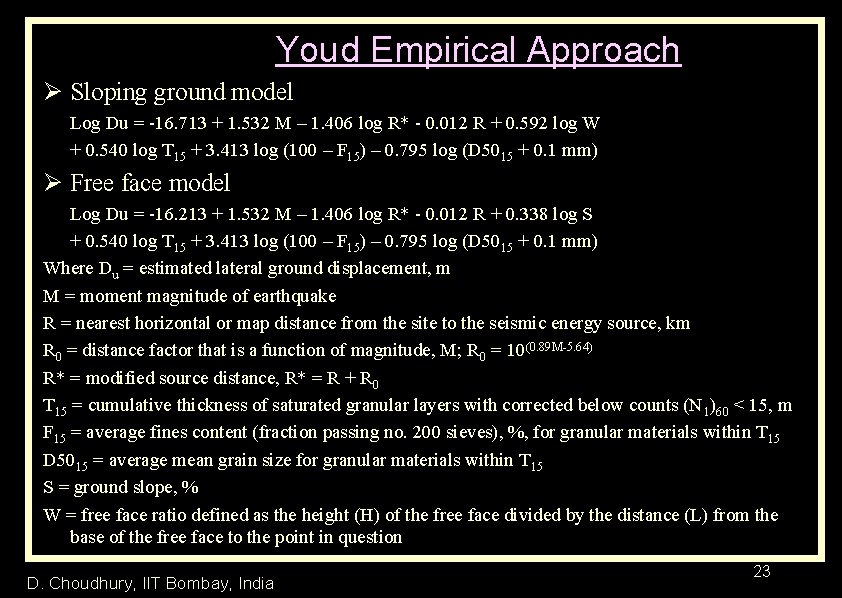
Youd Empirical Approach Ø Sloping ground model Log Du = -16. 713 + 1. 532 M – 1. 406 log R* - 0. 012 R + 0. 592 log W + 0. 540 log T 15 + 3. 413 log (100 – F 15) – 0. 795 log (D 5015 + 0. 1 mm) Ø Free face model Log Du = -16. 213 + 1. 532 M – 1. 406 log R* - 0. 012 R + 0. 338 log S + 0. 540 log T 15 + 3. 413 log (100 – F 15) – 0. 795 log (D 5015 + 0. 1 mm) Where Du = estimated lateral ground displacement, m M = moment magnitude of earthquake R = nearest horizontal or map distance from the site to the seismic energy source, km R 0 = distance factor that is a function of magnitude, M; R 0 = 10(0. 89 M-5. 64) R* = modified source distance, R* = R + R 0 T 15 = cumulative thickness of saturated granular layers with corrected below counts (N 1)60 < 15, m F 15 = average fines content (fraction passing no. 200 sieves), %, for granular materials within T 15 D 5015 = average mean grain size for granular materials within T 15 S = ground slope, % W = free face ratio defined as the height (H) of the free face divided by the distance (L) from the base of the free face to the point in question D. Choudhury, IIT Bombay, India 23
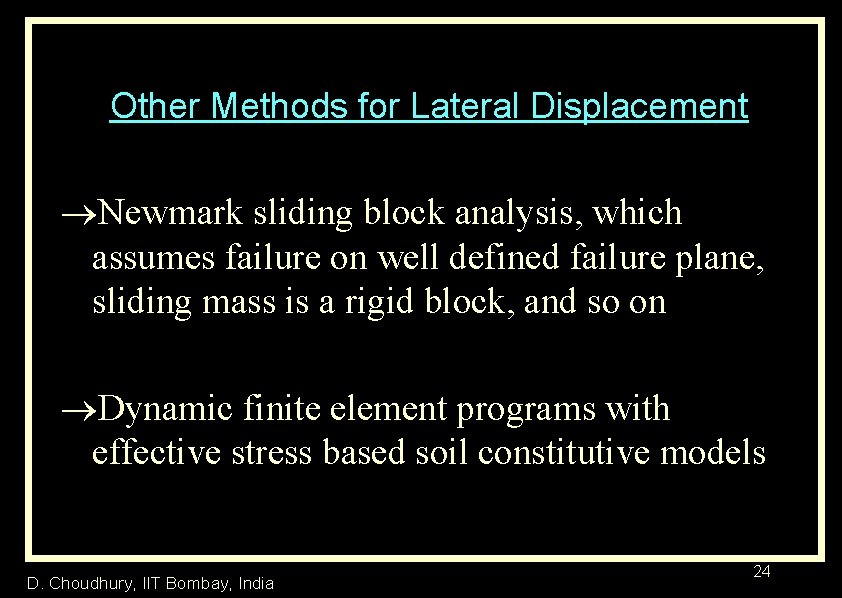
Other Methods for Lateral Displacement ®Newmark sliding block analysis, which assumes failure on well defined failure plane, sliding mass is a rigid block, and so on ®Dynamic finite element programs with effective stress based soil constitutive models D. Choudhury, IIT Bombay, India 24
Newmark’s Sliding block analysis D. Choudhury, IIT Bombay, India 25
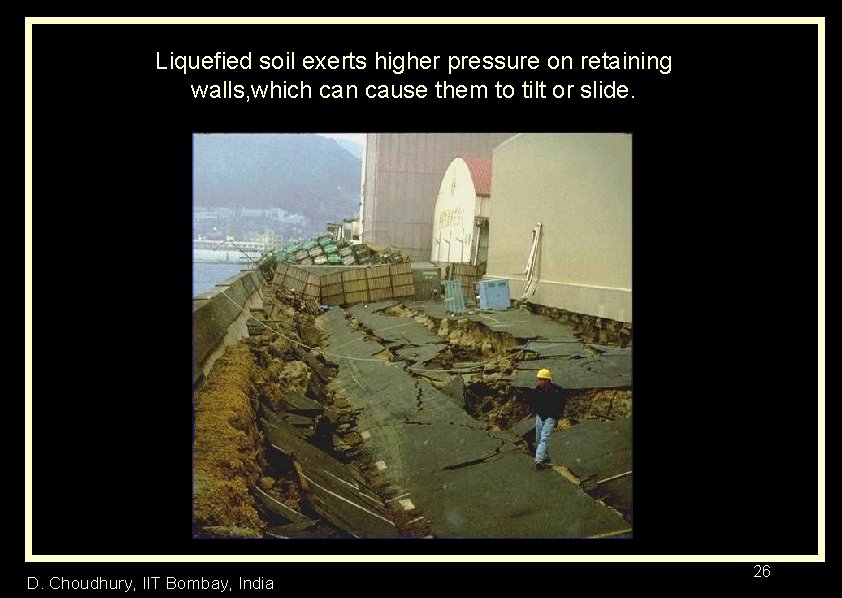
Liquefied soil exerts higher pressure on retaining walls, which can cause them to tilt or slide. D. Choudhury, IIT Bombay, India 26
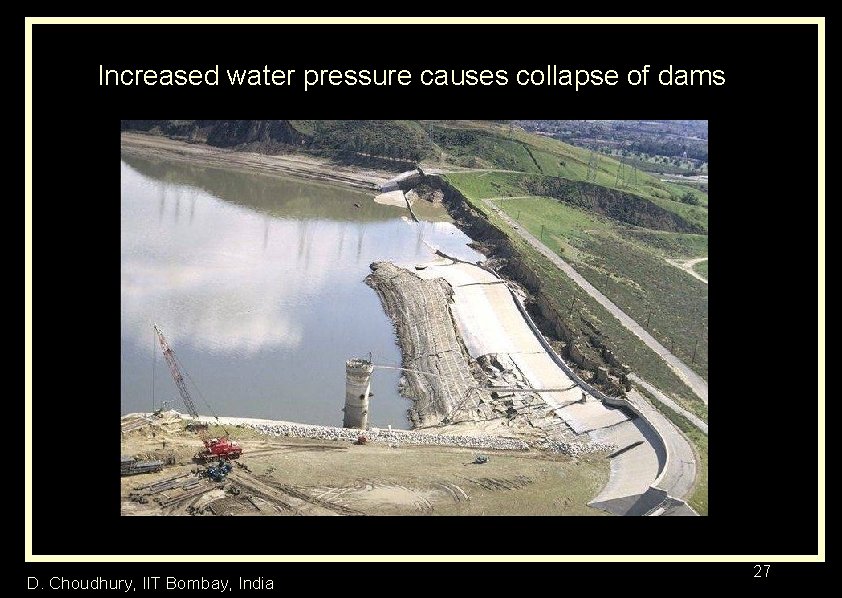
Increased water pressure causes collapse of dams D. Choudhury, IIT Bombay, India 27
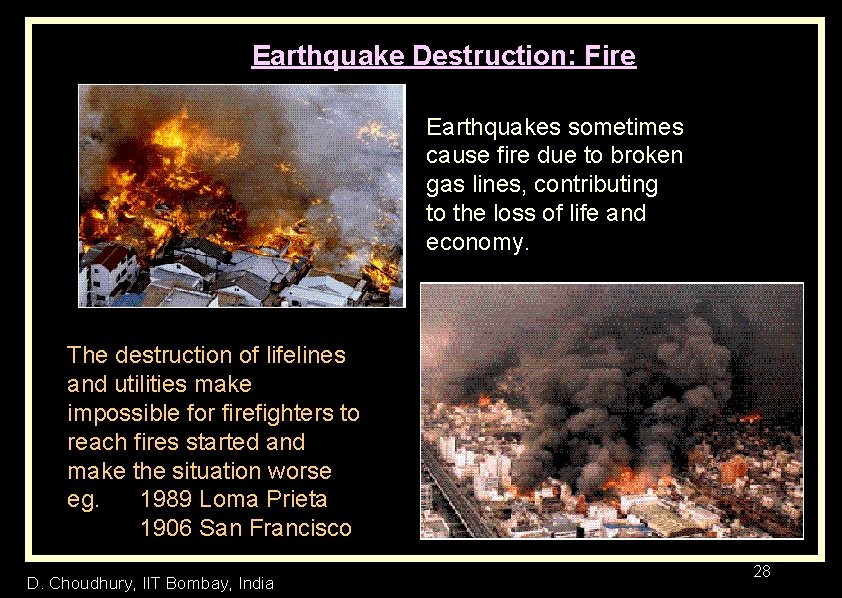
Earthquake Destruction: Fire Earthquakes sometimes cause fire due to broken gas lines, contributing to the loss of life and economy. The destruction of lifelines and utilities make impossible for firefighters to reach fires started and make the situation worse eg. 1989 Loma Prieta 1906 San Francisco D. Choudhury, IIT Bombay, India 28
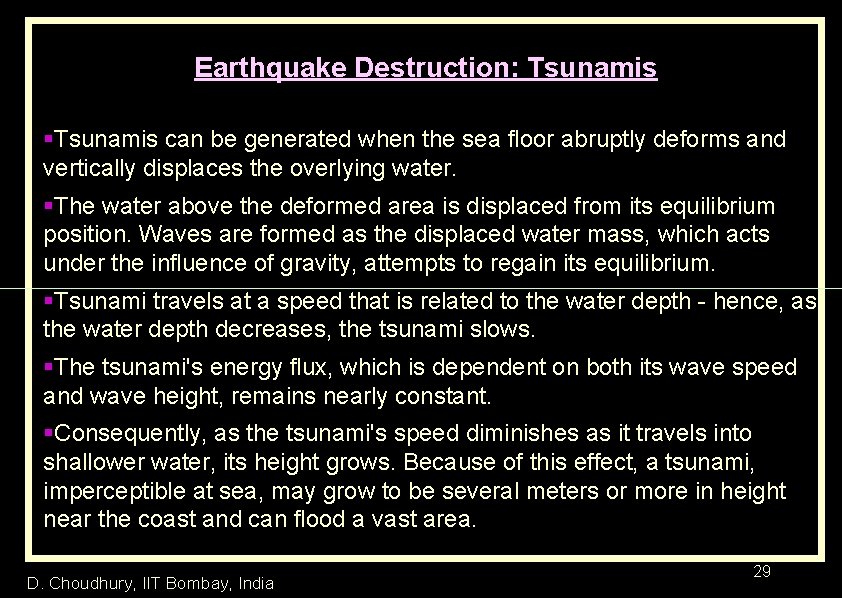
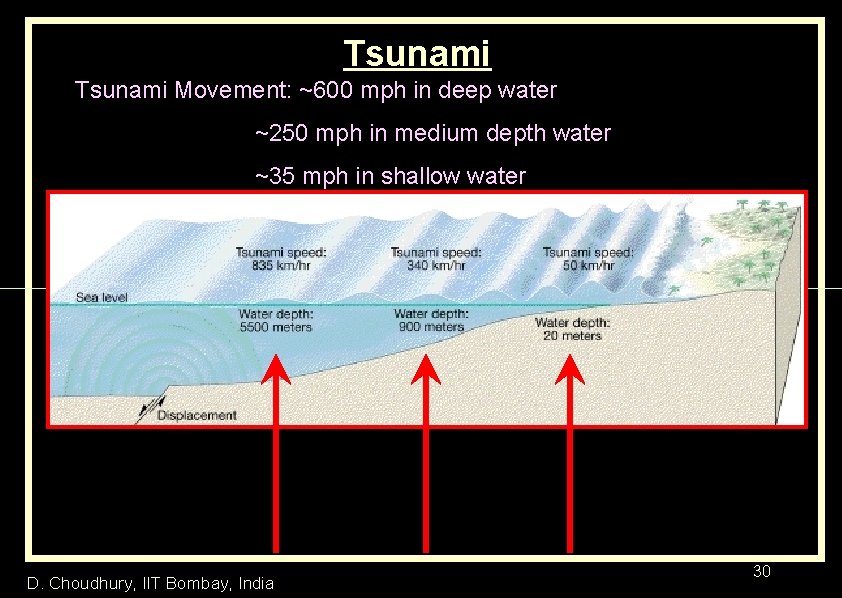
Earthquake Destruction: Tsunamis §Tsunamis can be generated when the sea floor abruptly deforms and vertically displaces the overlying water. §The water above the deformed area is displaced from its equilibrium position. Waves are formed as the displaced water mass, which acts under the influence of gravity, attempts to regain its equilibrium. §Tsunami travels at a speed that is related to the water depth - hence, as the water depth decreases, the tsunami slows. §The tsunami's energy flux, which is dependent on both its wave speed and wave height, remains nearly constant. §Consequently, as the tsunami's speed diminishes as it travels into shallower water, its height grows. Because of this effect, a tsunami, imperceptible at sea, may grow to be several meters or more in height near the coast and can flood a vast area. D. Choudhury, IIT Bombay, India 29
Tsunami Movement: ~600 mph in deep water ~250 mph in medium depth water ~35 mph in shallow water D. Choudhury, IIT Bombay, India 30
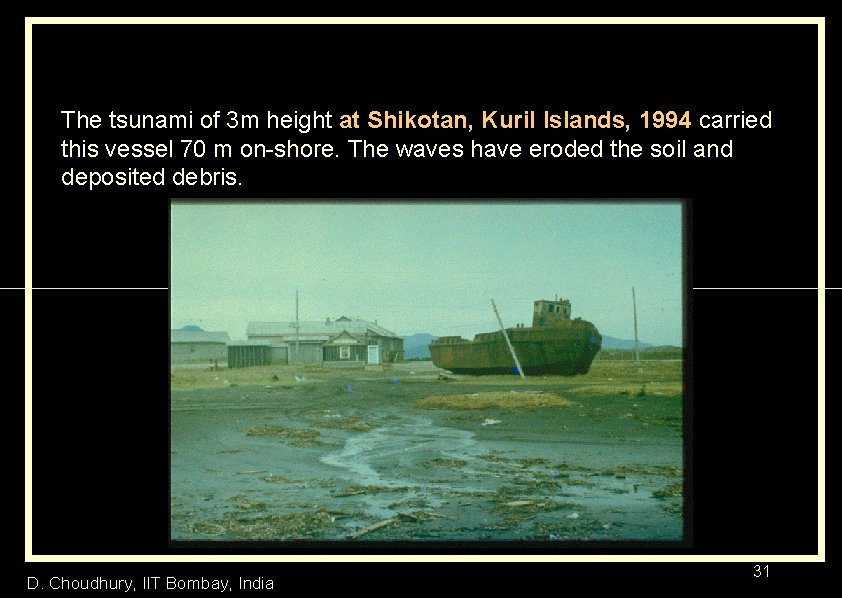
The tsunami of 3 m height at Shikotan, Kuril Islands, 1994 carried this vessel 70 m on-shore. The waves have eroded the soil and deposited debris. D. Choudhury, IIT Bombay, India 31
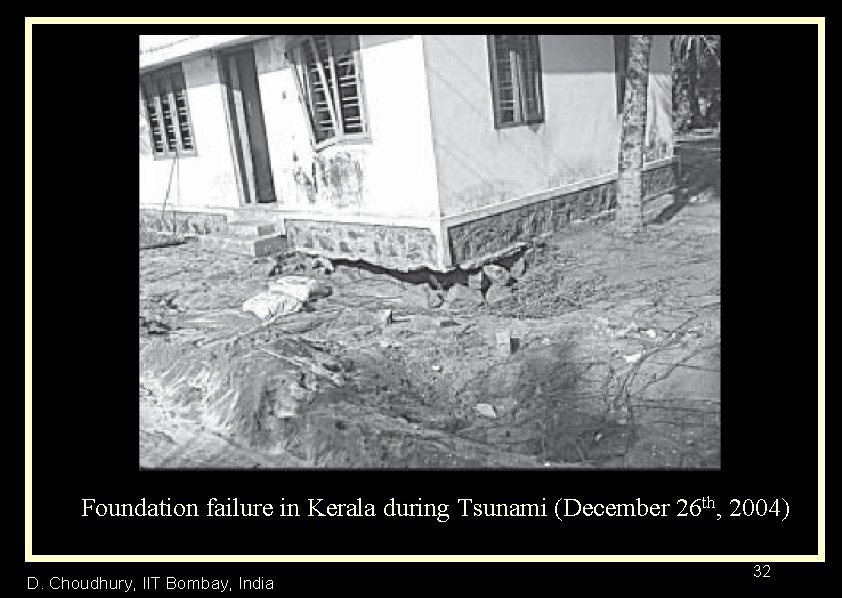
Foundation failure in Kerala during Tsunami (December 26 th, 2004) D. Choudhury, IIT Bombay, India 32
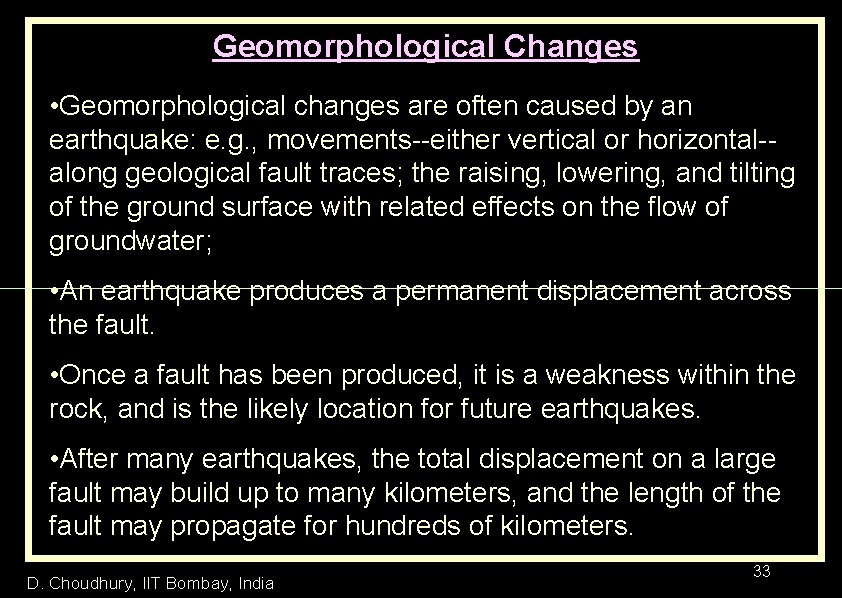
Geomorphological Changes • Geomorphological changes are often caused by an earthquake: e. g. , movements--either vertical or horizontal-along geological fault traces; the raising, lowering, and tilting of the ground surface with related effects on the flow of groundwater; • An earthquake produces a permanent displacement across the fault. • Once a fault has been produced, it is a weakness within the rock, and is the likely location for future earthquakes. • After many earthquakes, the total displacement on a large fault may build up to many kilometers, and the length of the fault may propagate for hundreds of kilometers. D. Choudhury, IIT Bombay, India 33
Ground Improvement for Liquefaction Hazard Mitigation D. Choudhury, IIT Bombay, India 34
Ground Improvement in IS Code “In poor and weak subsoils, the design of conventional shallow foundation for structures and equipment may present problems with respect to both sizing of foundations as well as control of foundation settlements. Traditionally, pile foundations have been employed often at enormous costs. A more viable alternative in certain solutions, developed over the recent years, is to improve the subsoil itself to an extent such that the subsoil improvement would have resultant settlements within acceptable limits. The techniques for ground improvement has developed rapidly and has found large scale application in industrial projects. ” IS 13094 : 1992 (Reaffirmed 1997) D. Choudhury, IIT Bombay, India 35
Ground Improvement in IS Code Ground improvement is indicated if →Net loading intensity of the foundation exceeds the allowable bearing pressure as per IS 6403: 1981 →Resultant settlement or differential settlement (per IS 8009 Part 1 or 2) exceeds acceptable limits for the structure →The subsoil is prone to liquefaction in seismic event D. Choudhury, IIT Bombay, India 36
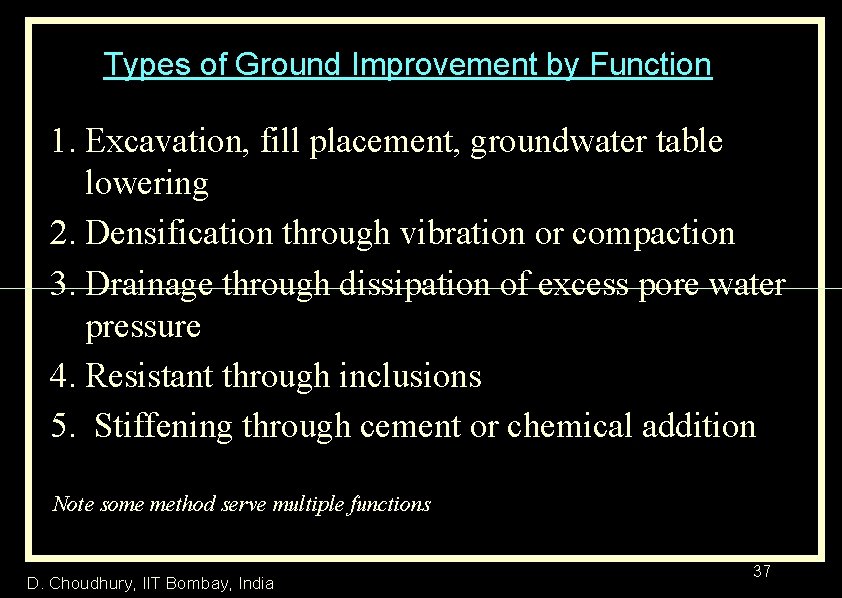
Types of Ground Improvement by Function 1. Excavation, fill placement, groundwater table lowering 2. Densification through vibration or compaction 3. Drainage through dissipation of excess pore water pressure 4. Resistant through inclusions 5. Stiffening through cement or chemical addition Note some method serve multiple functions D. Choudhury, IIT Bombay, India 37
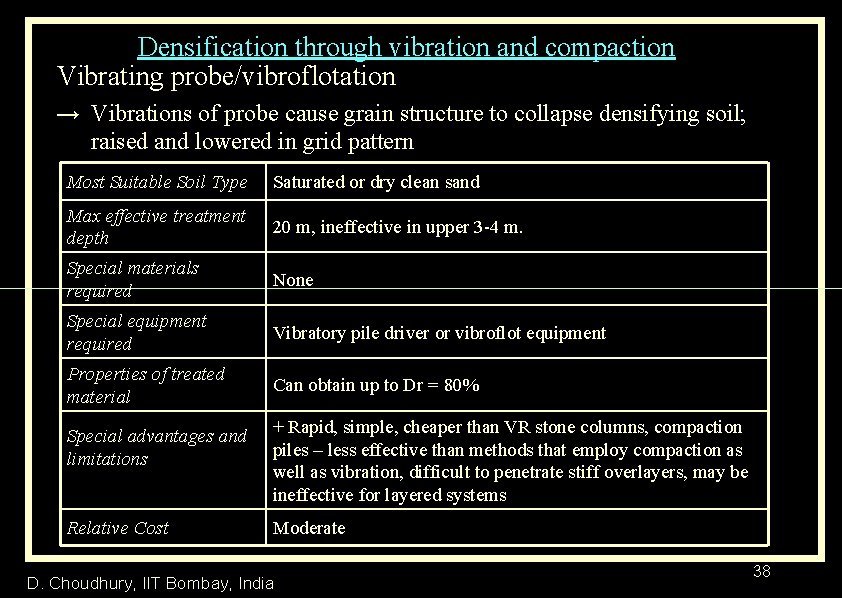
Densification through vibration and compaction Vibrating probe/vibroflotation → Vibrations of probe cause grain structure to collapse densifying soil; raised and lowered in grid pattern Most Suitable Soil Type Saturated or dry clean sand Max effective treatment depth 20 m, ineffective in upper 3 -4 m. Special materials required None Special equipment required Vibratory pile driver or vibroflot equipment Properties of treated material Can obtain up to Dr = 80% Special advantages and limitations + Rapid, simple, cheaper than VR stone columns, compaction piles – less effective than methods that employ compaction as well as vibration, difficult to penetrate stiff overlayers, may be ineffective for layered systems Relative Cost Moderate D. Choudhury, IIT Bombay, India 38
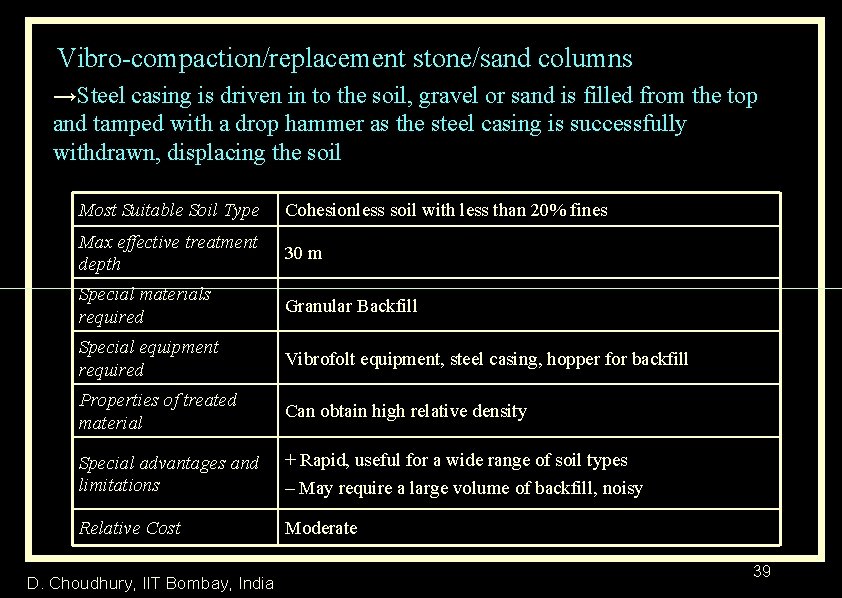
Vibro-compaction/replacement stone/sand columns →Steel casing is driven in to the soil, gravel or sand is filled from the top and tamped with a drop hammer as the steel casing is successfully withdrawn, displacing the soil Most Suitable Soil Type Cohesionless soil with less than 20% fines Max effective treatment depth 30 m Special materials required Granular Backfill Special equipment required Vibrofolt equipment, steel casing, hopper for backfill Properties of treated material Can obtain high relative density Special advantages and limitations + Rapid, useful for a wide range of soil types – May require a large volume of backfill, noisy Relative Cost Moderate D. Choudhury, IIT Bombay, India 39
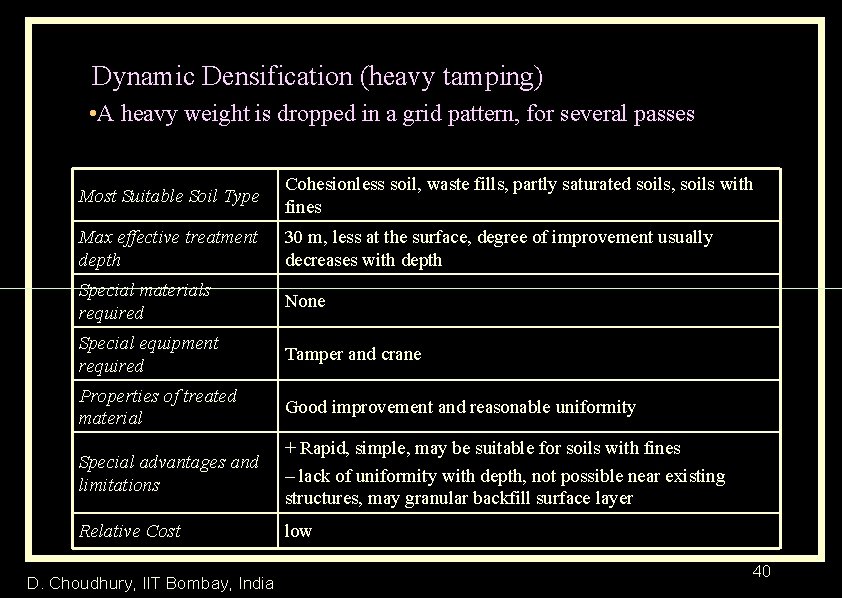
Dynamic Densification (heavy tamping) • A heavy weight is dropped in a grid pattern, for several passes Most Suitable Soil Type Cohesionless soil, waste fills, partly saturated soils, soils with fines Max effective treatment depth 30 m, less at the surface, degree of improvement usually decreases with depth Special materials required None Special equipment required Tamper and crane Properties of treated material Good improvement and reasonable uniformity Special advantages and limitations + Rapid, simple, may be suitable for soils with fines – lack of uniformity with depth, not possible near existing structures, may granular backfill surface layer Relative Cost low D. Choudhury, IIT Bombay, India 40
Other methods →Displacement piles: densification by displacement of pile volume, usually precast concrete or timber piles →Compaction grouting: densification by displacement of grout volume D. Choudhury, IIT Bombay, India 41
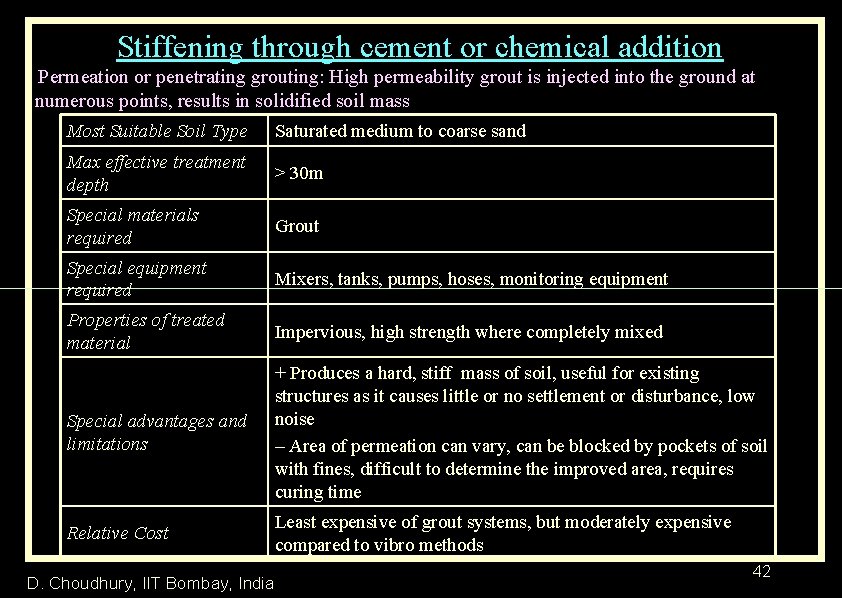
Stiffening through cement or chemical addition Permeation or penetrating grouting: High permeability grout is injected into the ground at numerous points, results in solidified soil mass Most Suitable Soil Type Saturated medium to coarse sand Max effective treatment depth > 30 m Special materials required Grout Special equipment required Mixers, tanks, pumps, hoses, monitoring equipment Properties of treated material Impervious, high strength where completely mixed Special advantages and limitations + Produces a hard, stiff mass of soil, useful for existing structures as it causes little or no settlement or disturbance, low noise – Area of permeation can vary, can be blocked by pockets of soil with fines, difficult to determine the improved area, requires curing time Relative Cost Least expensive of grout systems, but moderately expensive compared to vibro methods D. Choudhury, IIT Bombay, India 42
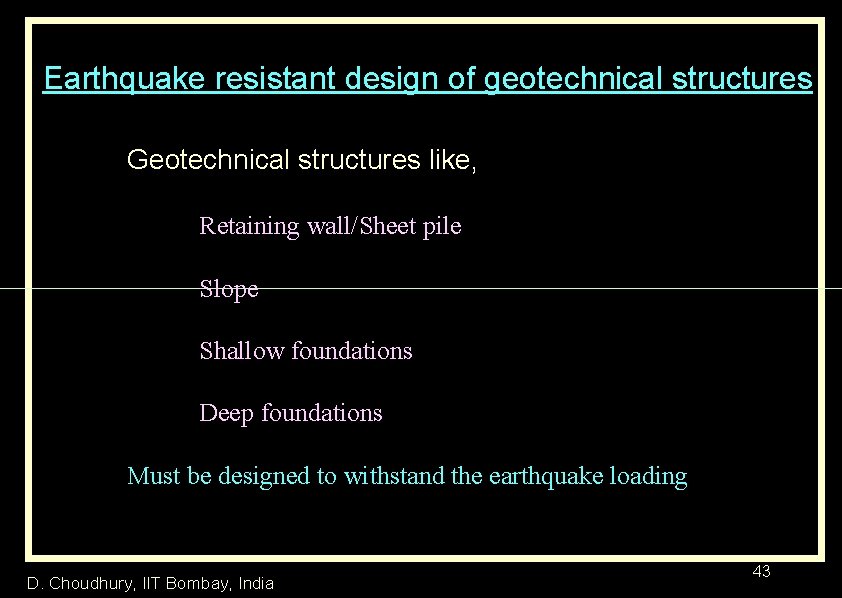
Earthquake resistant design of geotechnical structures Geotechnical structures like, Retaining wall/Sheet pile Slope Shallow foundations Deep foundations Must be designed to withstand the earthquake loading D. Choudhury, IIT Bombay, India 43
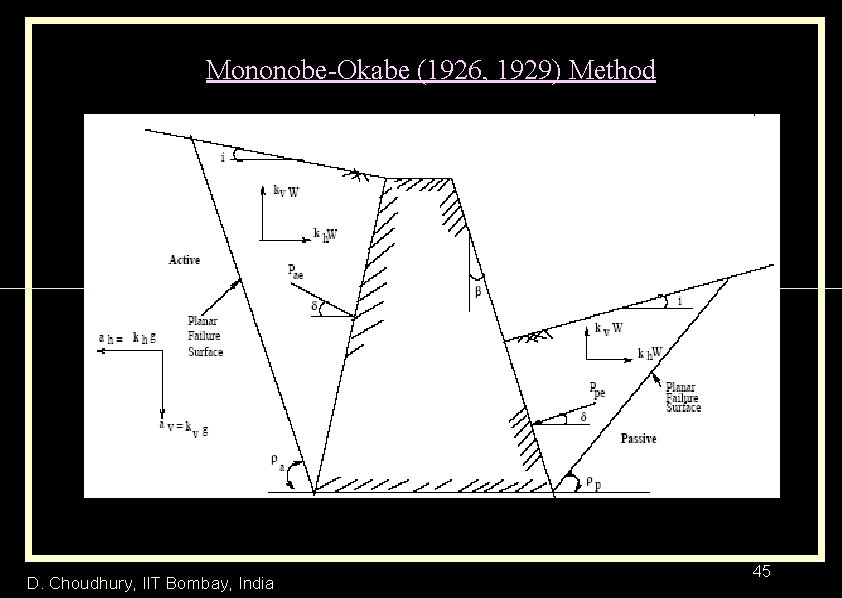
Seismic Design of Retaining Wall D. Choudhury, IIT Bombay, India 44
Mononobe-Okabe (1926, 1929) Method D. Choudhury, IIT Bombay, India 45
Seismic Slope Stability D. Choudhury, IIT Bombay, India 46
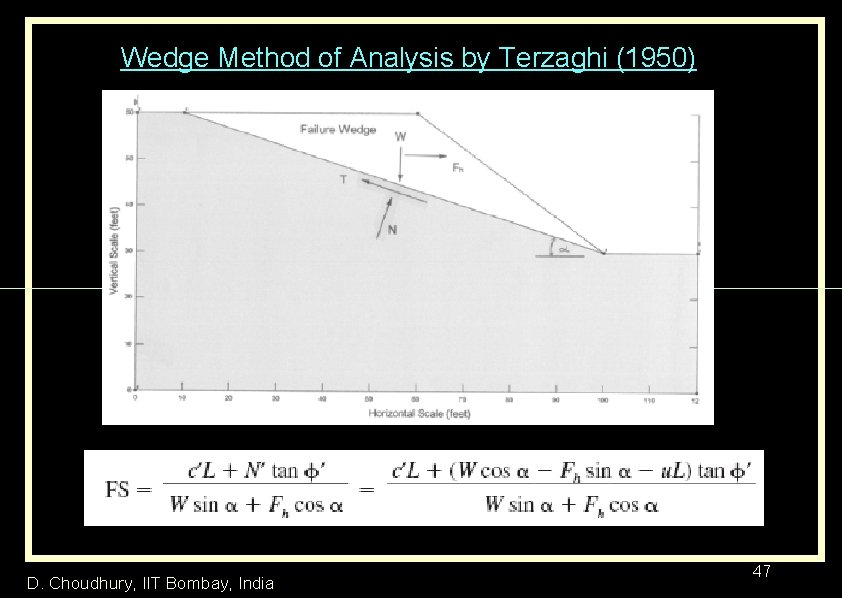
Wedge Method of Analysis by Terzaghi (1950) D. Choudhury, IIT Bombay, India 47
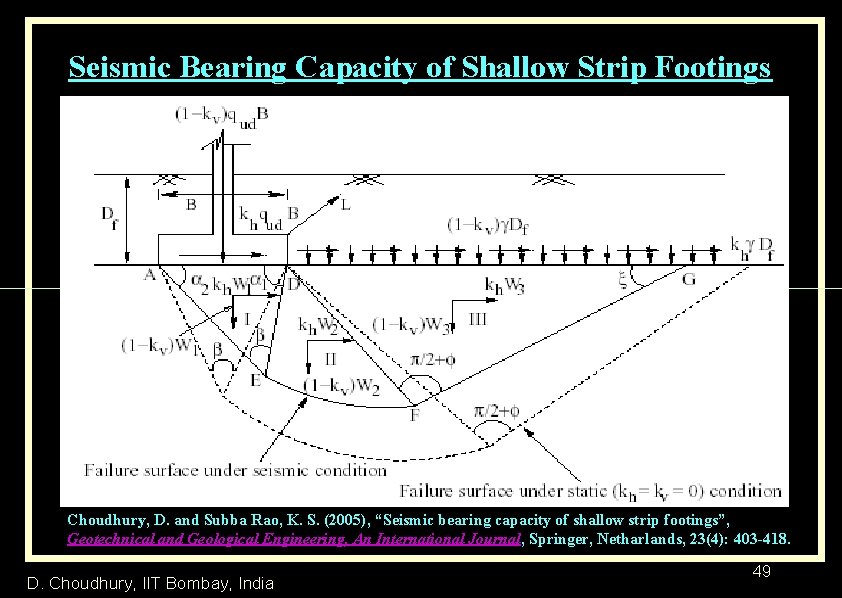
Seismic Bearing Capacity of Shallow Foundations D. Choudhury, IIT Bombay, India 48
Seismic Bearing Capacity of Shallow Strip Footings Choudhury, D. and Subba Rao, K. S. (2005), “Seismic bearing capacity of shallow strip footings”, Geotechnical and Geological Engineering, An International Journal, Springer, Netharlands, 23(4): 403 -418. D. Choudhury, IIT Bombay, India 49
Guideline as per Indian Code • According to IS 1893, isolated RCC footing without tie beams, or unreinforced strip foundation shall not be permitted in soft soils • Shallow foundation elements should be tied together so that they move uniformly, bridge over areas of local settlements, resist soil movements which ultimately reduces the level of shear forces induced in the elements resting on the foundation • Buried utilities, such as sewage and water pipes, should have ductile connections to the structure to accommodate the large movements and settlements that can occur under seismic loading D. Choudhury, IIT Bombay, India 50
Questions? D. Choudhury, IIT Bombay, India 51