
Introduction to EarthEnvironmental Science Topic 1 Science Lab
Introduction to Earth/Environmental Science
Topic 1 – Science Lab Safety + Standard 1. 1 – I can understand explain laboratory safety rules. + Question: Why is it important to know lab safety symbols? 2
Science Lab Safety + Act responsibly at all times in the laboratory. + Follow all instructions given – orally or written by my teacher. (MOST IMPORTANT) + Perform ONLY those activities assigned and approved by my teacher. + Protect my eyes, face, hands and body by wearing proper clothing and using protective equipment provided by my school. + Carry out good housekeeping practices as instructed by my teacher. + Know the location of safety and first aid equipment in the laboratory. 3
Science Lab Safety + Notify my teacher immediately of an emergency. + NEVER work alone in the laboratory. + NEVER eat or drink in the laboratory unless instructed to do so by my teacher. + Handle living organisms or preserved specimens only when authorized by my teacher, and then always carefully and with respect. + NEVER enter or work in a supply area unless instructed to do so and supervised by my teacher. 4
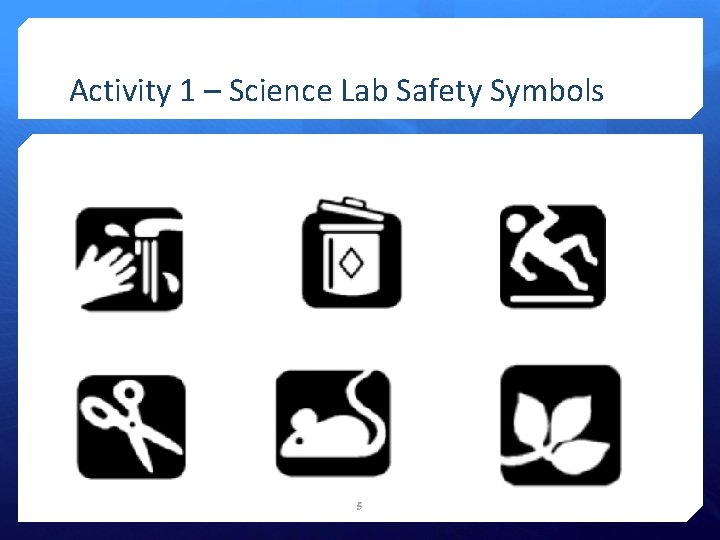
Activity 1 – Science Lab Safety Symbols 5
Topic 2 – Earth’s Systems + Standard 1. 2 – I can identify the branches of Earth Science and explain the interconnectedness of Earth’s systems. + QUESTION: What are Earth’s major systems and how do they interact? 6
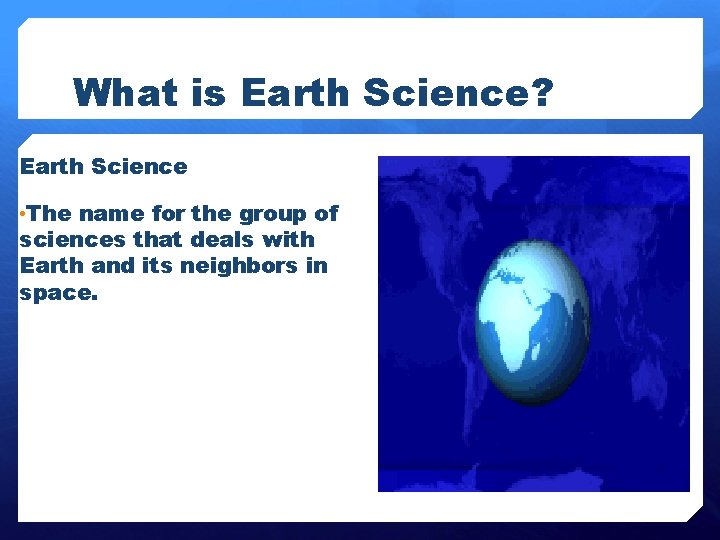
What is Earth Science? Earth Science • The name for the group of sciences that deals with Earth and its neighbors in space.
The Study of Earth Science + Earth scientist use several BIG IDEAS to guide them: + Structure of Earth’s systems + Earth’s history + Earth in the solar system + System – group of parts that work together as a whole + Matter and energy constantly move from one part of the Earth system to another 8
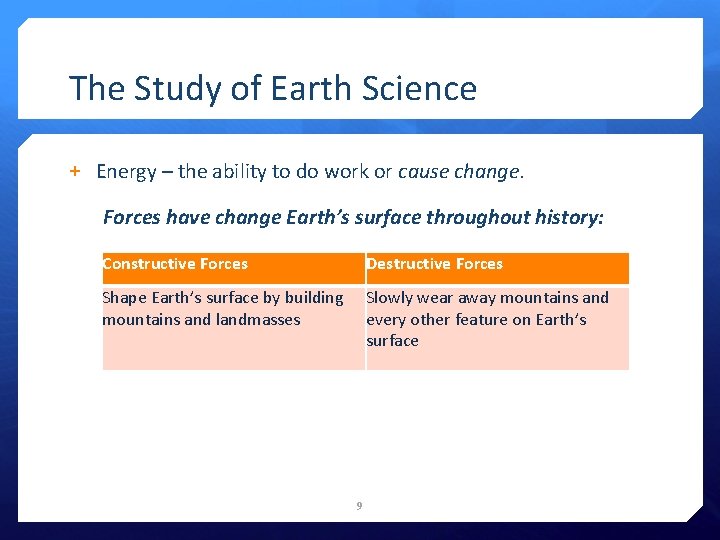
The Study of Earth Science + Energy – the ability to do work or cause change. Forces have change Earth’s surface throughout history: Constructive Forces Destructive Forces Shape Earth’s surface by building mountains and landmasses Slowly wear away mountains and every other feature on Earth’s surface 9
Earth science has several branches including: + Geology – study of the forces that have shaped Earth + Oceanography study of everything from chemistry of ocean water to ocean floor and marine organisms + Meteorology – study of conditions in the atmosphere, weather, climate + Astronomy – focus on solar systems, stars and galaxies 10
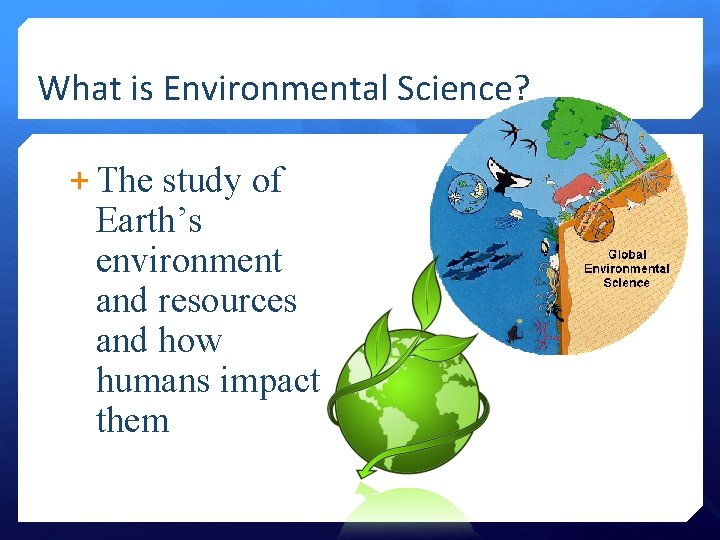
What is Environmental Science? + The study of Earth’s environment and resources and how humans impact them
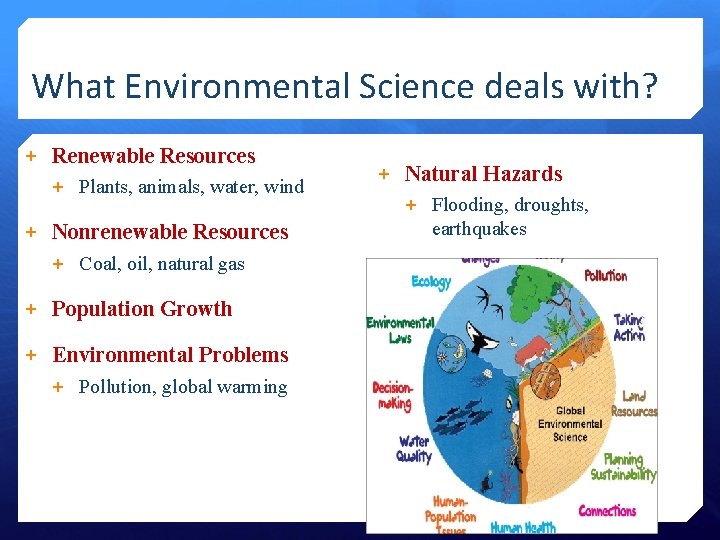
What Environmental Science deals with? + Renewable Resources + Plants, animals, water, wind + Nonrenewable Resources + Coal, oil, natural gas + Population Growth + Environmental Problems + Pollution, global warming + Natural Hazards + Flooding, droughts, earthquakes
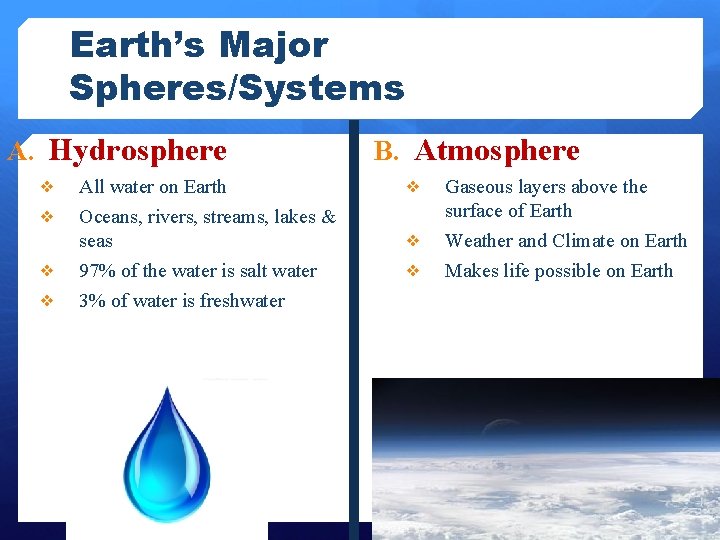
Earth’s Major Spheres/Systems A. Hydrosphere ❖ All water on Earth ❖ Oceans, rivers, streams, lakes & seas 97% of the water is salt water 3% of water is freshwater ❖ ❖ B. Atmosphere ❖ ❖ ❖ Gaseous layers above the surface of Earth Weather and Climate on Earth Makes life possible on Earth
C. Geosphere/Lithosphere ❖ Beneath both the Hydrosphere and Atmosphere ❖ Three Parts ▪ Core ▪ Mantle ▪ Crust D. Biosphere ❖ All organisms on Earth ❖ Environments where organisms live
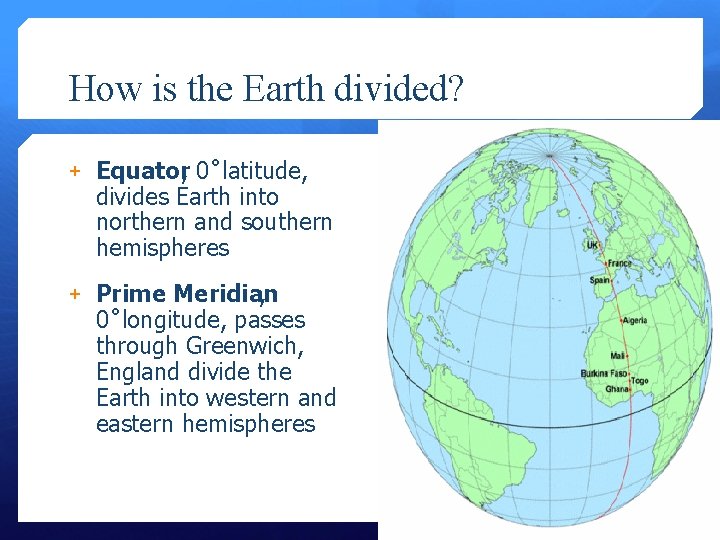
How is the Earth divided? + Equator, 0˚latitude, divides Earth into northern and southern hemispheres + Prime Meridian , 0˚longitude, passes through Greenwich, England divide the Earth into western and eastern hemispheres
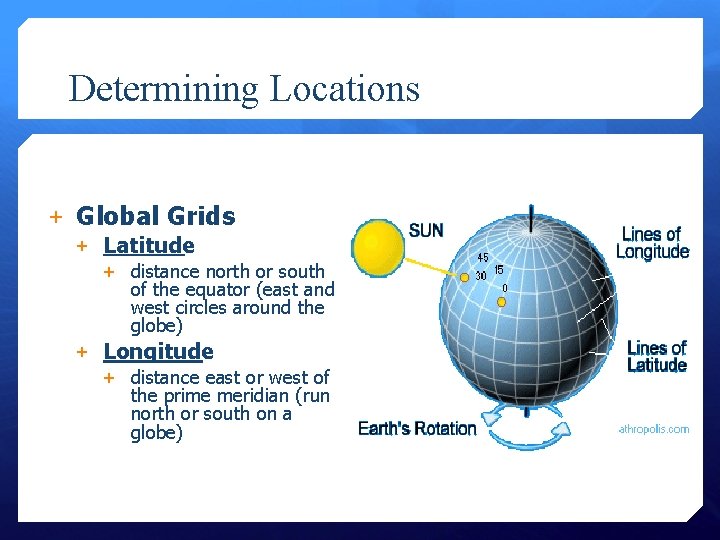
Determining Locations + Global Grids + Latitude + distance north or south of the equator (east and west circles around the globe) + Longitude + distance east or west of the prime meridian (run north or south on a globe)
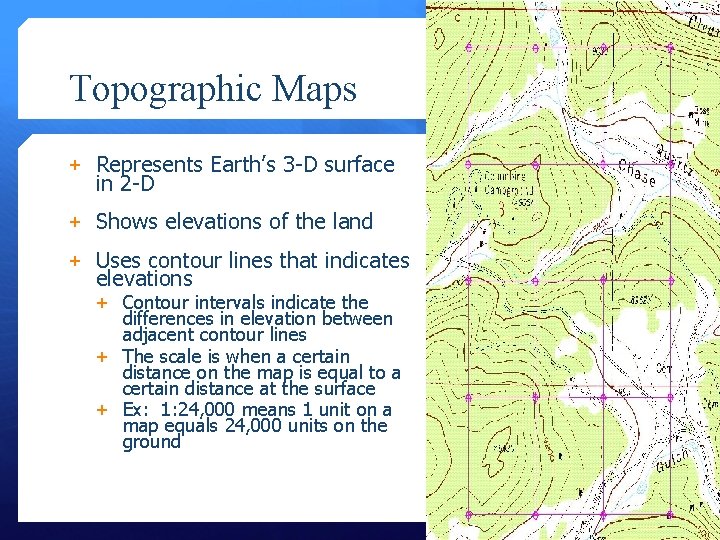
Topographic Maps + Represents Earth’s 3 -D surface in 2 -D + Shows elevations of the land + Uses contour lines that indicates elevations + Contour intervals indicate the differences in elevation between adjacent contour lines + The scale is when a certain distance on the map is equal to a certain distance at the surface + Ex: 1: 24, 000 means 1 unit on a map equals 24, 000 units on the ground
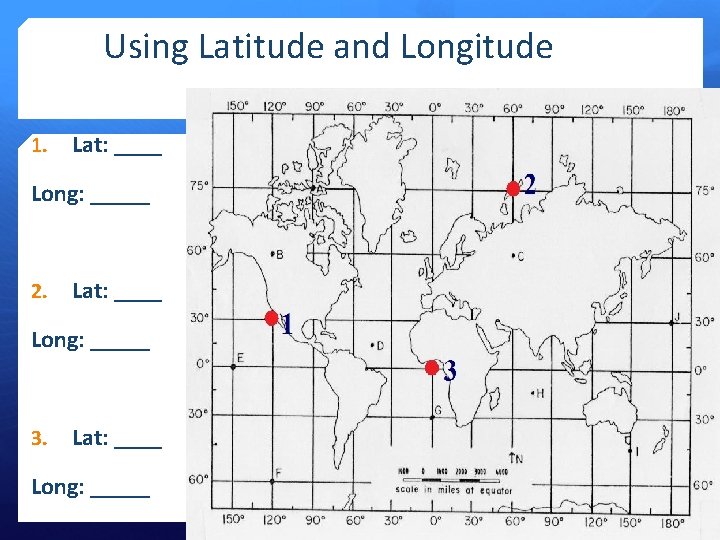
Using Latitude and Longitude 1. Lat: ____ Long: _____ 2. Lat: ____ Long: _____ 3. Lat: ____ Long: _____
Topic 3: Methods of Science + Standard 1. 3 – I can understand experimental design and methods in science. + Question: What do scientist use when they perform scientific investigations? 19
Experimental Design + Scientific Method – a organized plan for gathering, organizing and communication of information + Scientific Inquiry – a process that uses a set of skills to answer questions or to test ideas about the natural world. + GOAL + Solve a problem + Better understand something
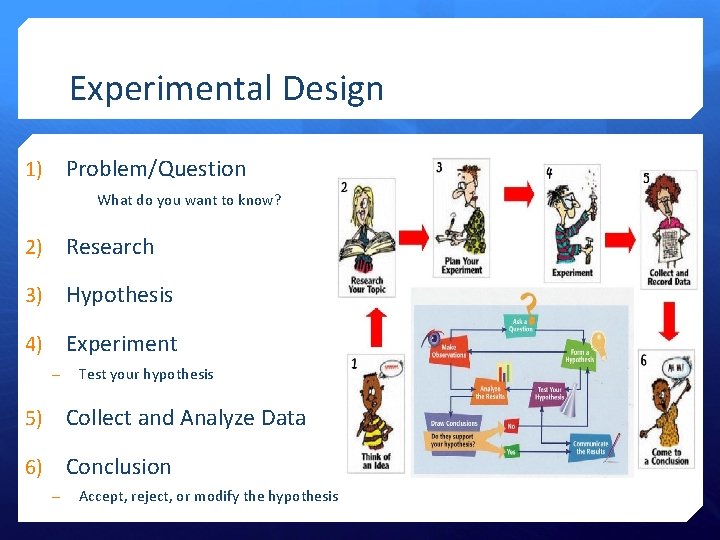
Experimental Design Problem/Question 1) What do you want to know? 2) Research 3) Hypothesis 4) Experiment – Test your hypothesis 5) Collect and Analyze Data 6) Conclusion – Accept, reject, or modify the hypothesis
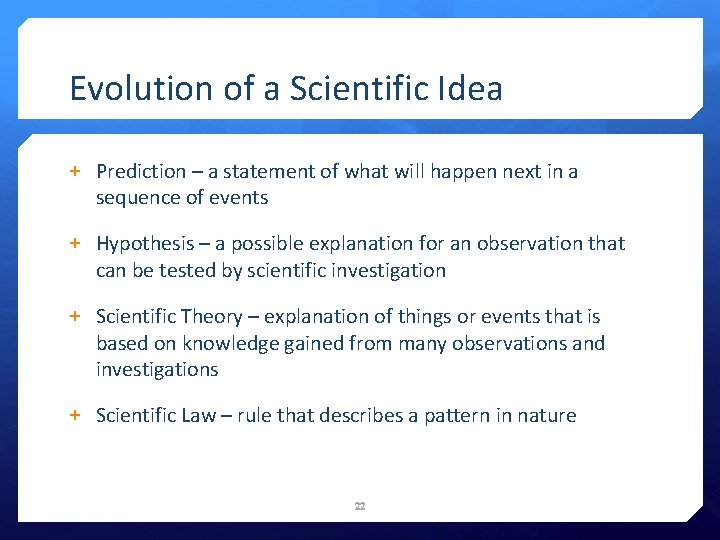
Evolution of a Scientific Idea + Prediction – a statement of what will happen next in a sequence of events + Hypothesis – a possible explanation for an observation that can be tested by scientific investigation + Scientific Theory – explanation of things or events that is based on knowledge gained from many observations and investigations + Scientific Law – rule that describes a pattern in nature 22
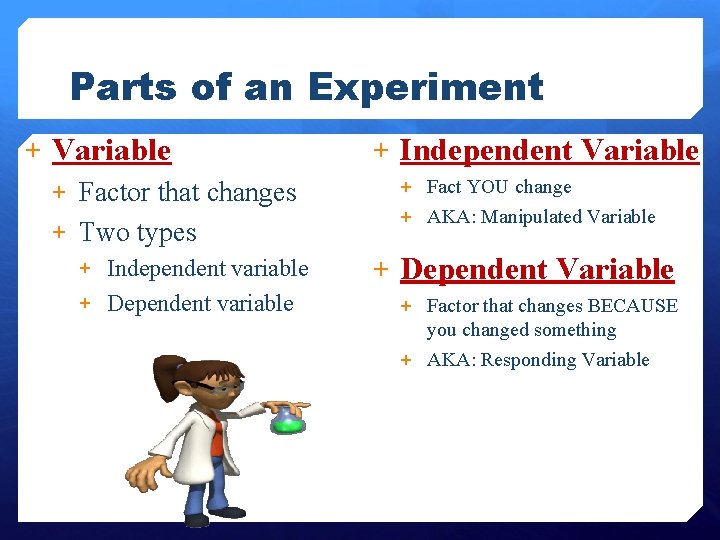
Parts of an Experiment + Variable + Factor that changes + Two types + Independent variable + Dependent variable + Independent Variable + Fact YOU change + AKA: Manipulated Variable + Dependent Variable + Factor that changes BECAUSE you changed something + AKA: Responding Variable
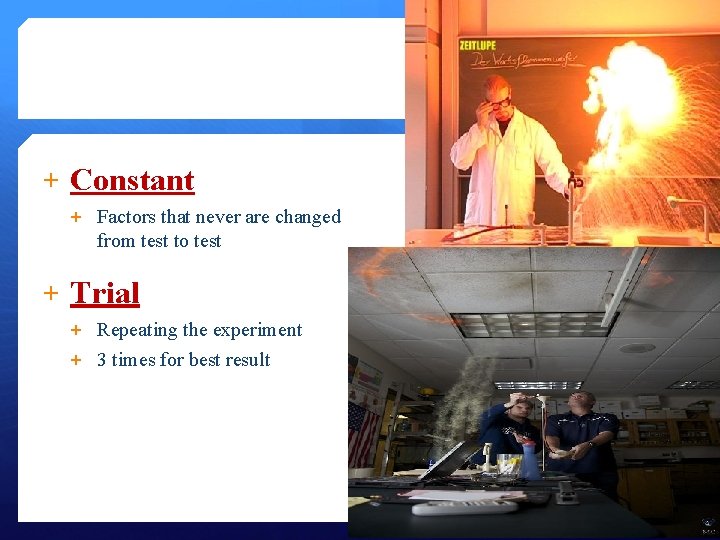
+ Constant + Factors that never are changed from test to test + Trial + Repeating the experiment + 3 times for best result
Topic 4 – Measurements in Science + Standard 1. 4 – I can explain how measurements are used in science and how to determine the density of an object. + Question: How do scientist determine the density of an object? 25
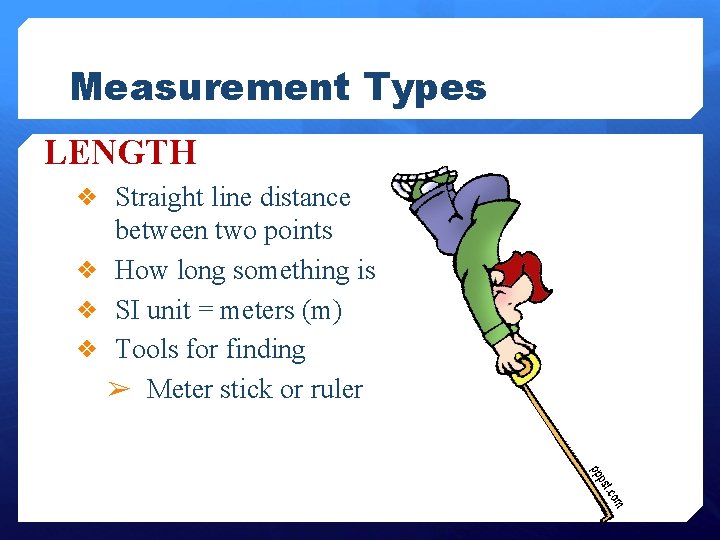
Measurement Types LENGTH ❖ Straight line distance between two points ❖ How long something is ❖ SI unit = meters (m) ❖ Tools for finding ➢ Meter stick or ruler
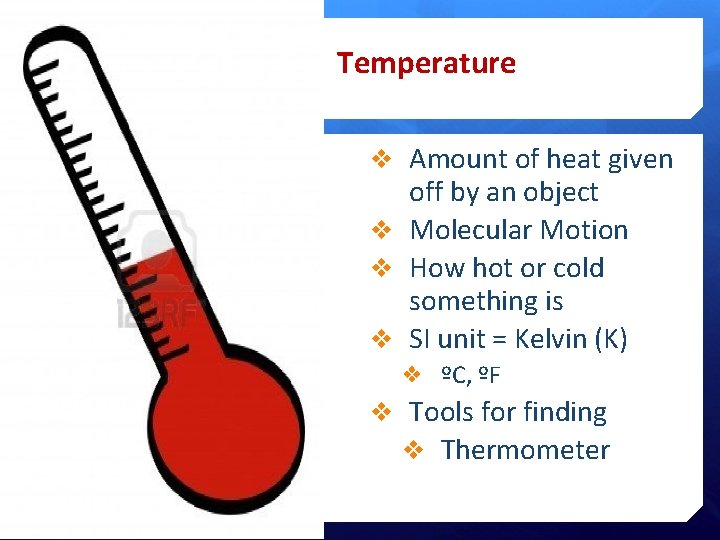
Temperature ❖ Amount of heat given off by an object ❖ Molecular Motion ❖ How hot or cold something is ❖ SI unit = Kelvin (K) ❖ ºC, ºF ❖ Tools for finding ❖ Thermometer
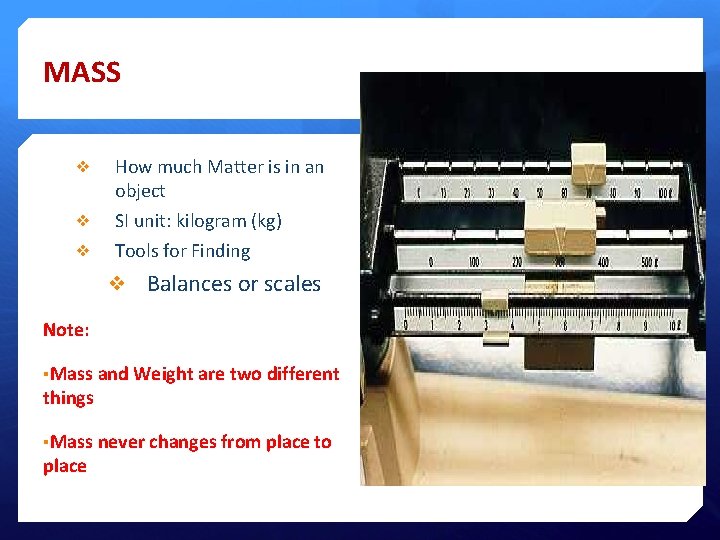
MASS ❖ ❖ ❖ How much Matter is in an object SI unit: kilogram (kg) Tools for Finding ❖ Balances or scales Note: ▪Mass and Weight are two different things ▪Mass never changes from place to place
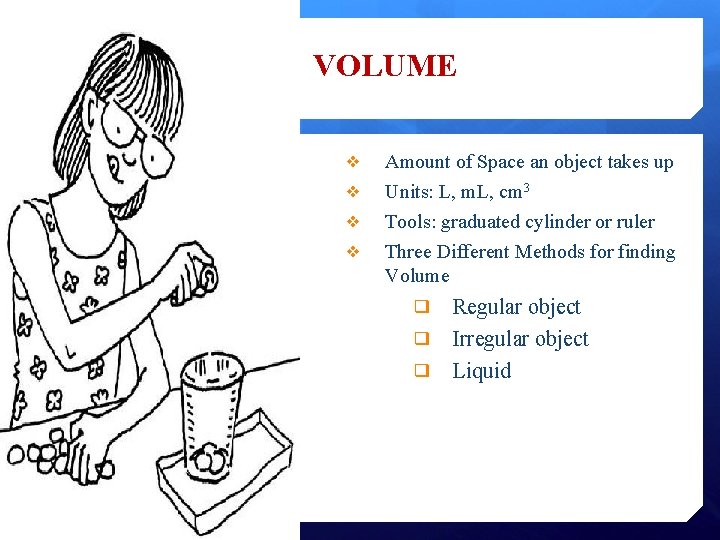
VOLUME ❖ ❖ Amount of Space an object takes up Units: L, m. L, cm 3 Tools: graduated cylinder or ruler Three Different Methods for finding Volume ❑ Regular object ❑ Irregular object ❑ Liquid
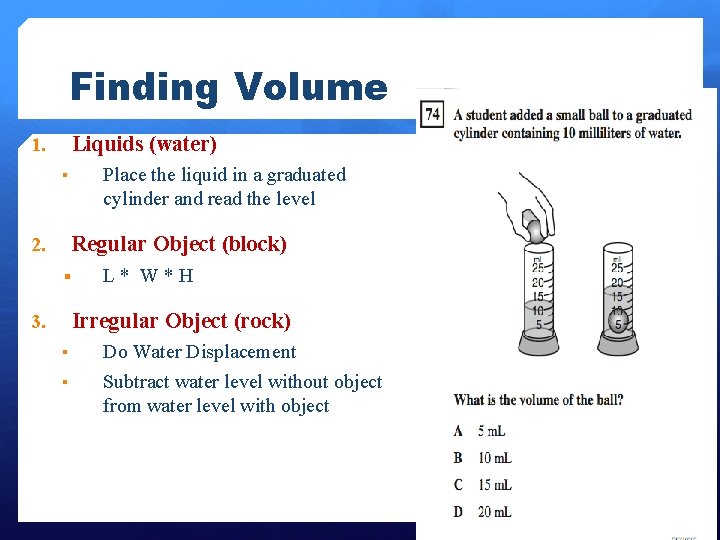
Finding Volume Liquids (water) 1. Place the liquid in a graduated cylinder and read the level ▪ Regular Object (block) 2. ▪ L* W*H Irregular Object (rock) 3. ▪ ▪ Do Water Displacement Subtract water level without object from water level with object
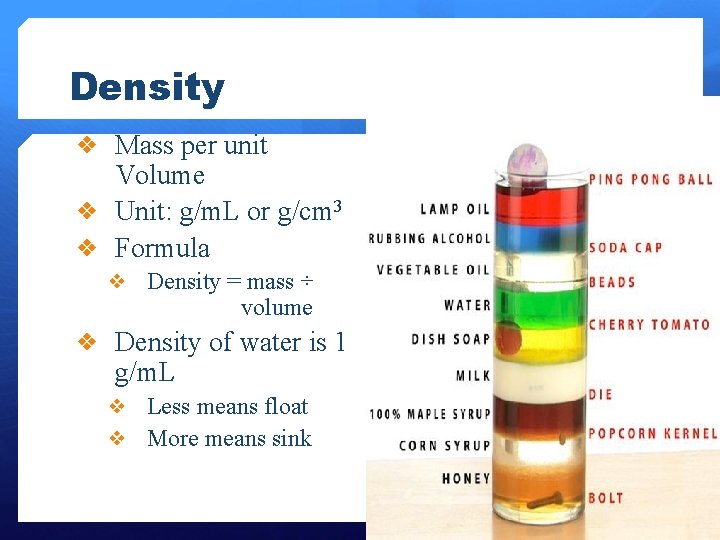
Density ❖ Mass per unit Volume ❖ Unit: g/m. L or g/cm 3 ❖ Formula ❖ Density = mass ÷ volume ❖ Density of water is 1 g/m. L ❖ Less means float ❖ More means sink
- Slides: 31