
INTRODUCTION TO EARLY CHILDHOOD EDUCATION ETECE11 Determine components
- Slides: 51
INTRODUCTION TO EARLY CHILDHOOD EDUCATION ET-ECE-11 Determine components of a well-organized, developmentally appropriate learning environment.
STANDARDS & ELEMENTS ET-ECE-11 Determine components of a well-organized, developmentally appropriate learning environment. • 11. 1 Identify ways that the activity/interest centers and learning stations enhance the development of children. • 11. 2 Describe and set up activity/interest centers and learning stations within the environment. • 11. 3 Describe the role of play as a basis for learning in infant, toddler, preschool, and elementary age children. • 11. 4 Examine the teacher’s role in play environments. • 11. 5 Evaluate appropriate indoor and outdoor play environments for various age groups. • 11. 6 Design an early childhood classroom that promotes a healthy and safe physical and psychological environment that promotes development and learning. • 11. 7 Evaluate strategies to adapt the learning environment for children with
GPS Academic Standards: ELACC 9 -10 SL 1: Initiate and participate effectively in a range of collaborative discussions (one-on-one, in groups, and teacher-led) with diverse partners on grades 9– 10 topics, texts, and issues, building on others’ ideas and expressing their own clearly and persuasively. ELACC 9 -10 SL 2: Integrate multiple sources of information presented in diverse media or formats (e. g. , visually, quantitatively, orally) evaluating the credibility and accuracy of each source. ELACC 9 -10 SL 4: Present information, findings, and supporting evidence clearly, concisely, and logically such that listeners can follow the line of reasoning and the organization, development, substance, and style are appropriate to purpose, audience, and task.
UNDERSTANDINGS & GOALS Enduring Understandings: Play provides many opportunities for children to practice skills, stretch thinking abilities, work through emotions, socialize, and be creative. Play can be categorized by its social (six stages) or its cognitive (four stages) characteristics. The environment created in a child care facility has a strong impact on the staff’s ability to meet program goals. When children work and play in interesting environments, they are more likely to behave well. Essential Questions: What are the various types of play? What is the relationship between age and type of play? How are learning centers set up in the classroom? What are the kinds of learning centers?
STANDARD 11 Stationary. VOCABULARY Equipment Projection Personification Play Role-playing Coaching Modeling Developmentally Delayed Self-Directed Learning Isolation area Staff room Audiovisual board Acoustic material Cubbies Cool colors Warm colors Traffic pattern Sensory table
VOCABULARY Stationary equipment-equipment that is set permanently in the ground for stability Projection- the child places feelings or emotions he or she feels onto a puppet Personification- giving human traits to nonliving objects Role-playing~ allows children to try out a variety of roles and engage in socio-dramatic play Coaching-provide children with ideas for difficult situations. Modeling- show children the appropriate behavior to use. Developmentally delayed- These types of children may exhibit play behaviors that are typical of much younger children. Self-directed learning-Autodidacticism; learning on your own" or "by yourself"
VOCABULARY Isolation area- a special room or space for children who become ill or show signs of a communicable disease Staff room- a room that adults have for their own use Audiovisual board-board that serves as a bulletin board, chalkboard and movie screen Acoustic material- used to deaden or absorb sounds Cubbies-storage for children’s items- clothing, artwork, library books, etc. Cool colors-colors that make a room feel spacious and look pleasant- blue, green, and purple Warm colors- colors that make a room seem smaller-red, yellow, and orange Traffic pattern- arrangement of classroom centers that instruct children on how to move through the classroom area Sensory table-water or sand table that gives children practice interacting with others
OPENINGBELL RINGER Please ensure that your sourcebook is organized properly: • Cover Page Name 2013 -2014 Intro to ECE • Table of Contents (2 pages- front only) • Section 1 - Bell Ringer (30 pages) • Section 2 - Notes (50 pages) • Section 3 - Observation Journal (20 pages) What is play? What type of play activities do you remember participating in when you were younger?
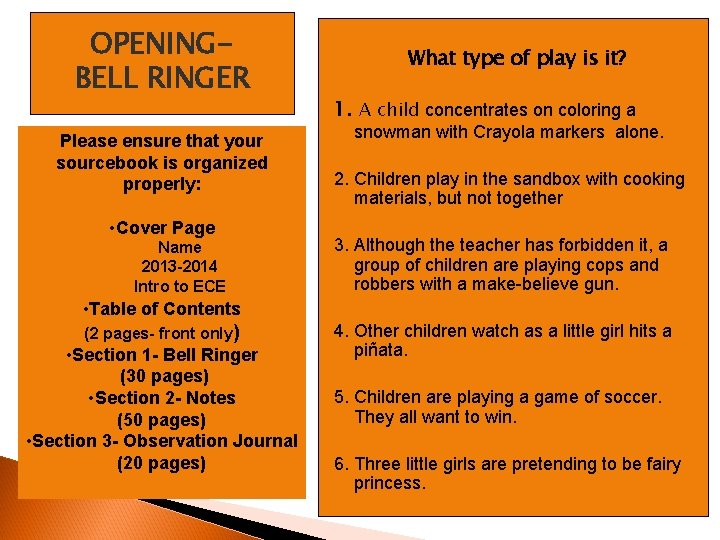
OPENINGBELL RINGER Please ensure that your sourcebook is organized properly: • Cover Page Name 2013 -2014 Intro to ECE What type of play is it? 1. A child concentrates on coloring a snowman with Crayola markers alone. 2. Children play in the sandbox with cooking materials, but not together 3. Although the teacher has forbidden it, a group of children are playing cops and robbers with a make-believe gun. • Table of Contents (2 pages- front only) • Section 1 - Bell Ringer (30 pages) • Section 2 - Notes (50 pages) • Section 3 - Observation Journal (20 pages) 4. Other children watch as a little girl hits a piñata. 5. Children are playing a game of soccer. They all want to win. 6. Three little girls are pretending to be fairy princess.
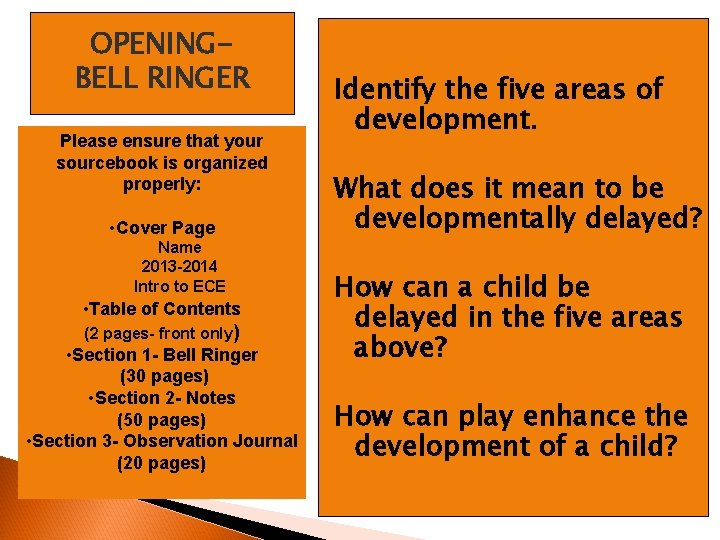
OPENINGBELL RINGER Please ensure that your sourcebook is organized properly: • Cover Page Name 2013 -2014 Intro to ECE • Table of Contents (2 pages- front only) • Section 1 - Bell Ringer (30 pages) • Section 2 - Notes (50 pages) • Section 3 - Observation Journal (20 pages) Identify the five areas of development. What does it mean to be developmentally delayed? How can a child be delayed in the five areas above? How can play enhance the development of a child?
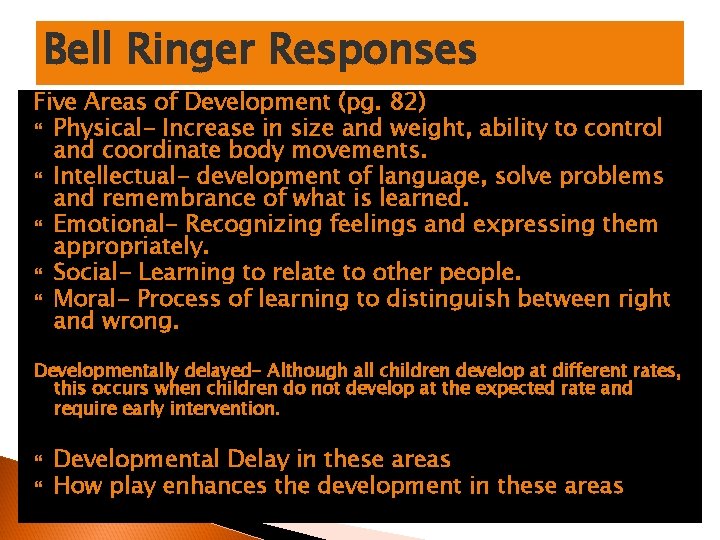
Bell Ringer Responses Five Areas of Development (pg. 82) Physical- Increase in size and weight, ability to control and coordinate body movements. Intellectual- development of language, solve problems and remembrance of what is learned. Emotional- Recognizing feelings and expressing them appropriately. Social- Learning to relate to other people. Moral- Process of learning to distinguish between right and wrong. Developmentally delayed- Although all children develop at different rates, this occurs when children do not develop at the expected rate and require early intervention. Developmental Delay in these areas How play enhances the development in these areas
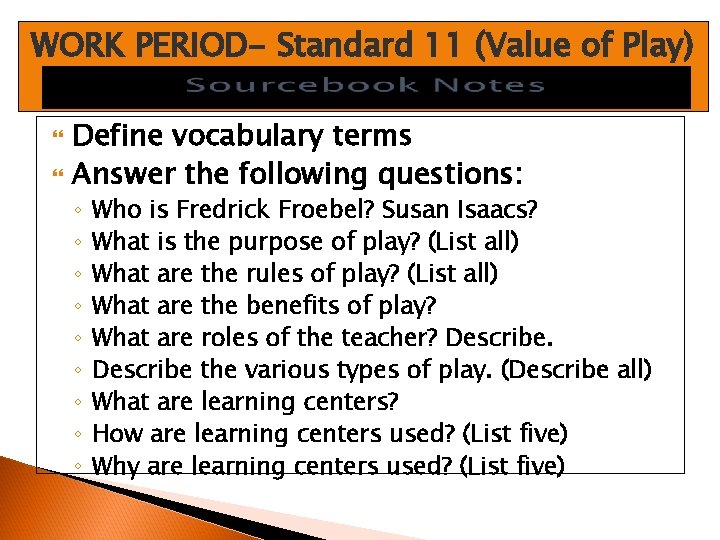
WORK PERIOD- Standard 11 (Value of Play) Define vocabulary terms Answer the following questions: ◦ ◦ ◦ ◦ ◦ Who is Fredrick Froebel? Susan Isaacs? What is the purpose of play? (List all) What are the rules of play? (List all) What are the benefits of play? What are roles of the teacher? Describe the various types of play. (Describe all) What are learning centers? How are learning centers used? (List five) Why are learning centers used? (List five)
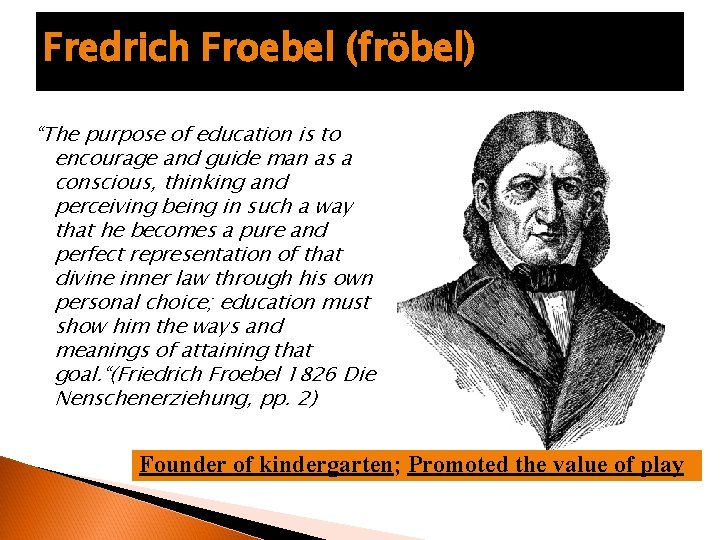
Fredrich Froebel (fröbel) “The purpose of education is to encourage and guide man as a conscious, thinking and perceiving being in such a way that he becomes a pure and perfect representation of that divine inner law through his own personal choice; education must show him the ways and meanings of attaining that goal. “(Friedrich Froebel 1826 Die Nenschenerziehung, pp. 2) Founder of kindergarten; Promoted the value of play
Fredrich Froebel (fröbel) His life and influence on education What was life like before kindergarten, before ‘childhood’ existed? Children worked in mines and factories; nobody celebrated birthdays, and by the age of seven, children were considered adults. Then along came Friedrich Froebel (1782 -1852), and invented the kindergarten…perhaps as a result of being raised by the proverbial ‘wicked’ stepmother of fairytales, who gave him little love or attention. “Play is the highest expression of human development in childhood, for it alone is the free expression of what is in a child's soul. ” Friedrich Froebel
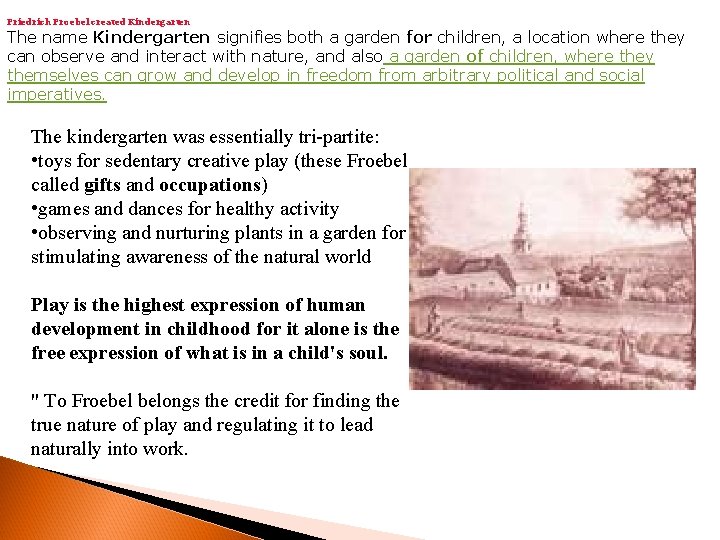
Friedrich Froebel created Kindergarten The name Kindergarten signifies both a garden for children, a location where they can observe and interact with nature, and also a garden of children, where they themselves can grow and develop in freedom from arbitrary political and social imperatives. The kindergarten was essentially tri-partite: • toys for sedentary creative play (these Froebel called gifts and occupations) • games and dances for healthy activity • observing and nurturing plants in a garden for stimulating awareness of the natural world Play is the highest expression of human development in childhood for it alone is the free expression of what is in a child's soul. " To Froebel belongs the credit for finding the true nature of play and regulating it to lead naturally into work.
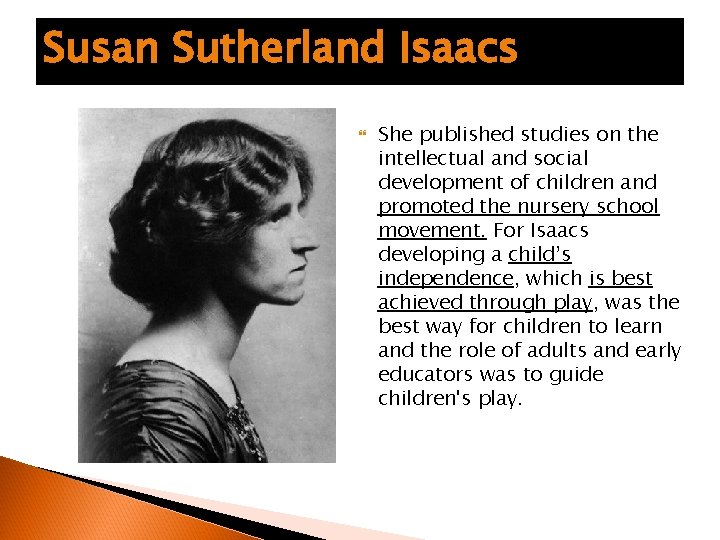
Susan Sutherland Isaacs She published studies on the intellectual and social development of children and promoted the nursery school movement. For Isaacs developing a child’s independence, which is best achieved through play, was the best way for children to learn and the role of adults and early educators was to guide children's play.
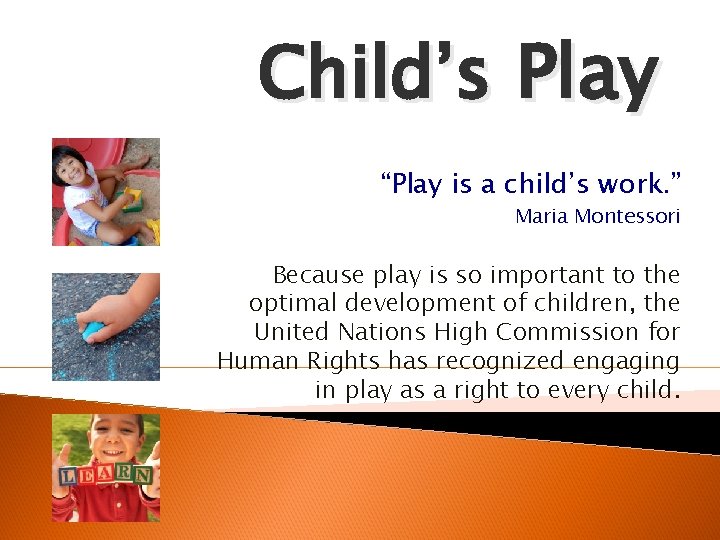
Child’s Play “Play is a child’s work. ” Maria Montessori Because play is so important to the optimal development of children, the United Nations High Commission for Human Rights has recognized engaging in play as a right to every child.
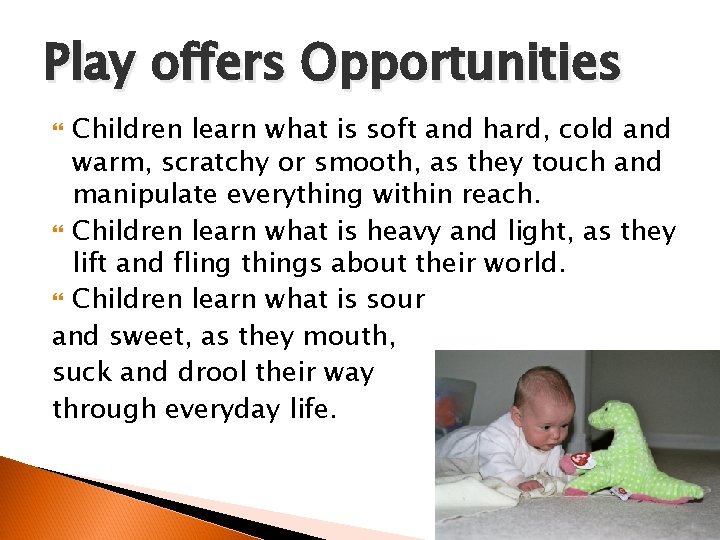
Play offers Opportunities Children learn what is soft and hard, cold and warm, scratchy or smooth, as they touch and manipulate everything within reach. Children learn what is heavy and light, as they lift and fling things about their world. Children learn what is sour and sweet, as they mouth, suck and drool their way through everyday life.
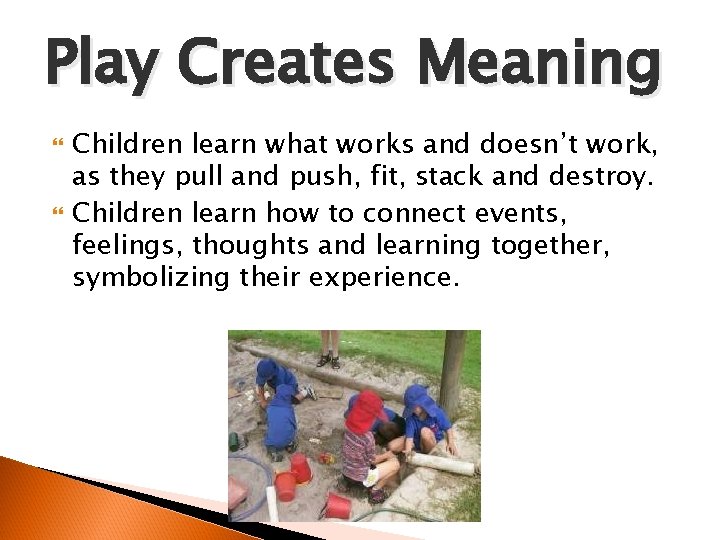
Play Creates Meaning Children learn what works and doesn’t work, as they pull and push, fit, stack and destroy. Children learn how to connect events, feelings, thoughts and learning together, symbolizing their experience.
What is play? Play is a child's natural way of learning. Children test and practice new physical, mental and social skills through play. It is the way a child learns to concentrate, to imagine things, to try new ideas and to practice grown-up behavior.
Purpose and Value of Play Play helps children develop and strengthen organizing and problem-solving abilities. Play helps children consider the viewpoints of their playmates. Play helps children achieve both fine and gross motor control. Play is an important part of a young child’s day. Play encourages experimentation and discovery. By observing children at play, you will gain insight into their cognitive, physical, social, and emotional development
Rules of Play In order for an activity to be called play, the player must choose to participate; a play activity is self-chosen. The child controls how long she will participate. The child defines the goals of the activity. Play is active, not passive. It is interactive. Play has no set rules. Children playing outdoors often have more freedom than is typical of indoor play.
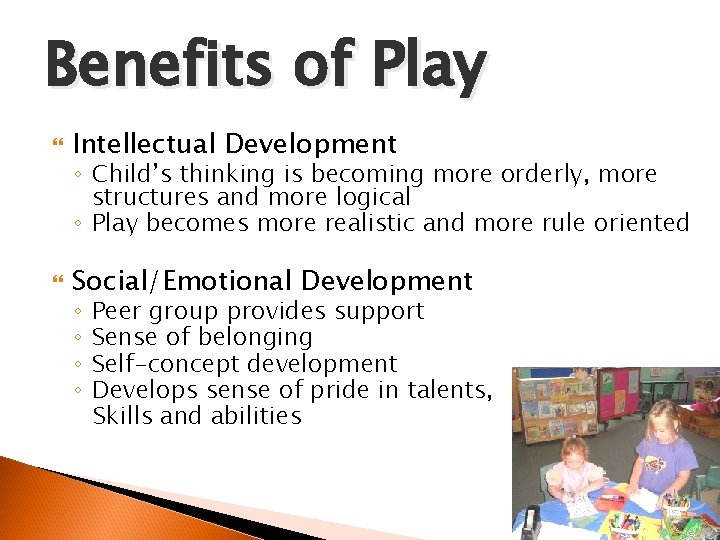
Benefits of Play Intellectual Development Social/Emotional Development ◦ Child’s thinking is becoming more orderly, more structures and more logical ◦ Play becomes more realistic and more rule oriented ◦ ◦ Peer group provides support Sense of belonging Self-concept development Develops sense of pride in talents, Skills and abilities
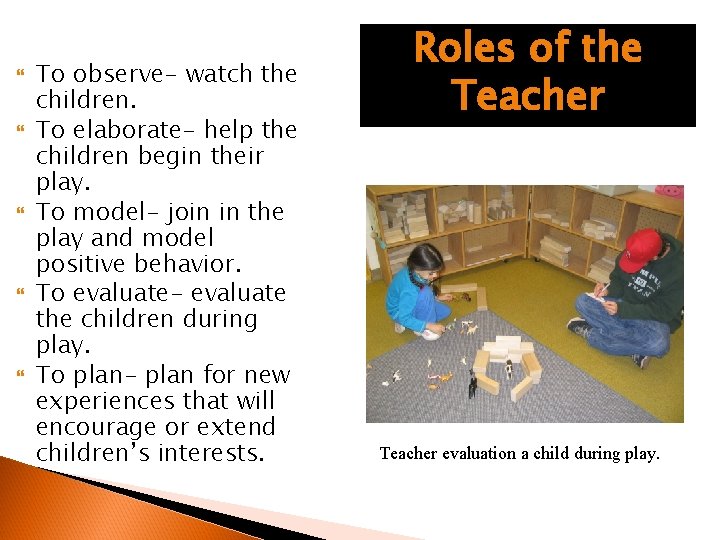
To observe- watch the children. To elaborate- help the children begin their play. To model- join in the play and model positive behavior. To evaluate- evaluate the children during play. To plan- plan for new experiences that will encourage or extend children’s interests. Roles of the Teacher evaluation a child during play.
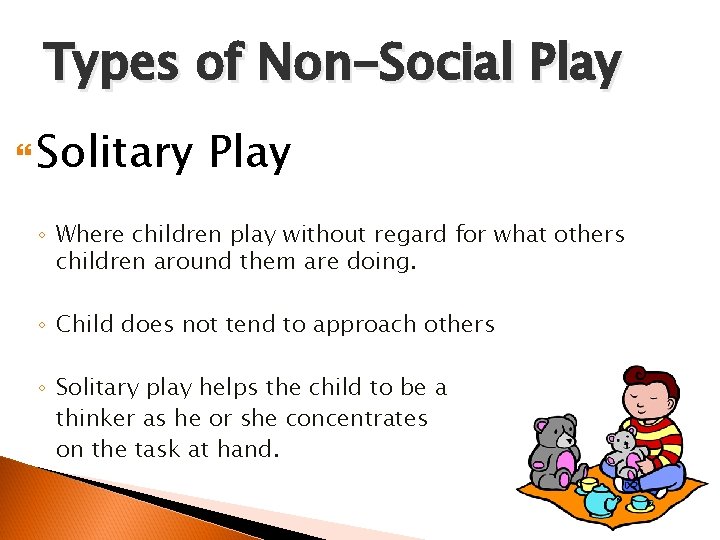
Types of Non-Social Play Solitary Play ◦ Where children play without regard for what others children around them are doing. ◦ Child does not tend to approach others ◦ Solitary play helps the child to be a thinker as he or she concentrates on the task at hand.
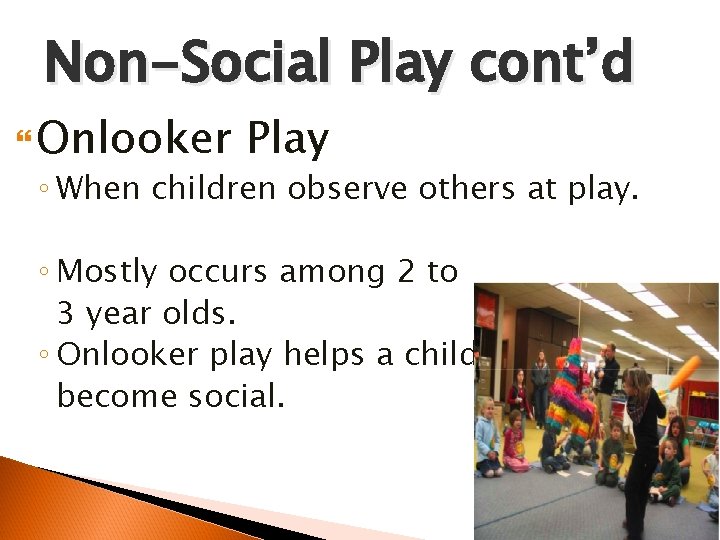
Non-Social Play cont’d Onlooker Play ◦ When children observe others at play. ◦ Mostly occurs among 2 to 3 year olds. ◦ Onlooker play helps a child to become social.
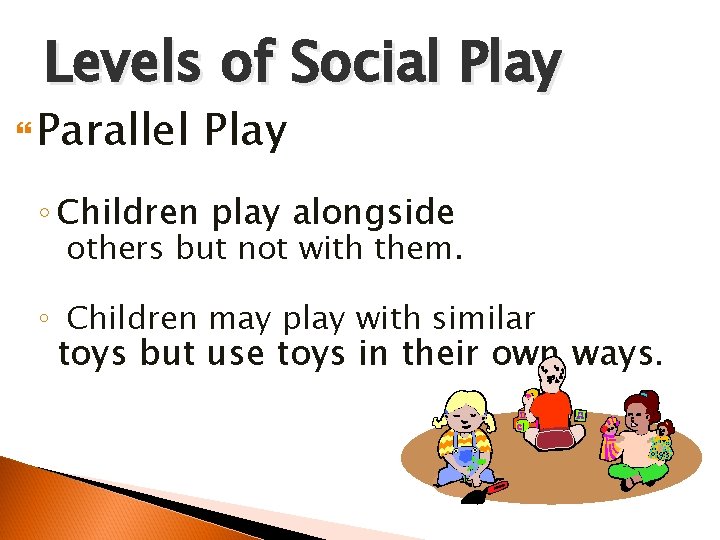
Levels of Social Play Parallel Play ◦ Children play alongside others but not with them. ◦ Children may play with similar toys but use toys in their own ways.
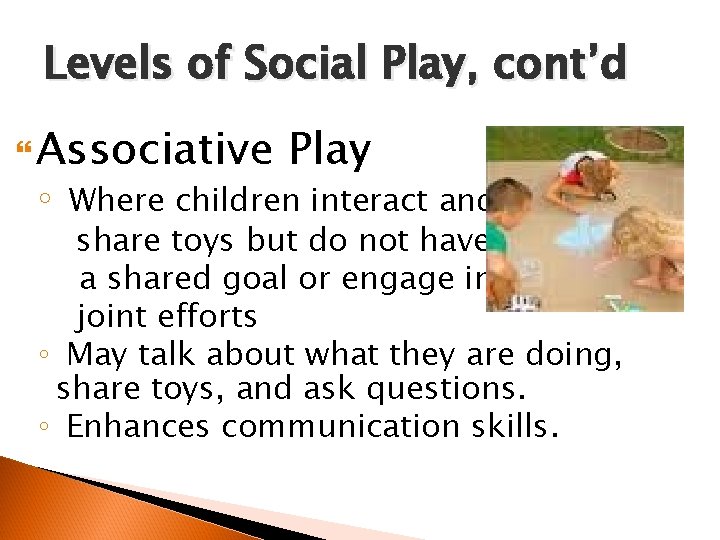
Levels of Social Play, cont’d Associative ◦ Play Where children interact and share toys but do not have a shared goal or engage in joint efforts ◦ May talk about what they are doing, share toys, and ask questions. ◦ Enhances communication skills.
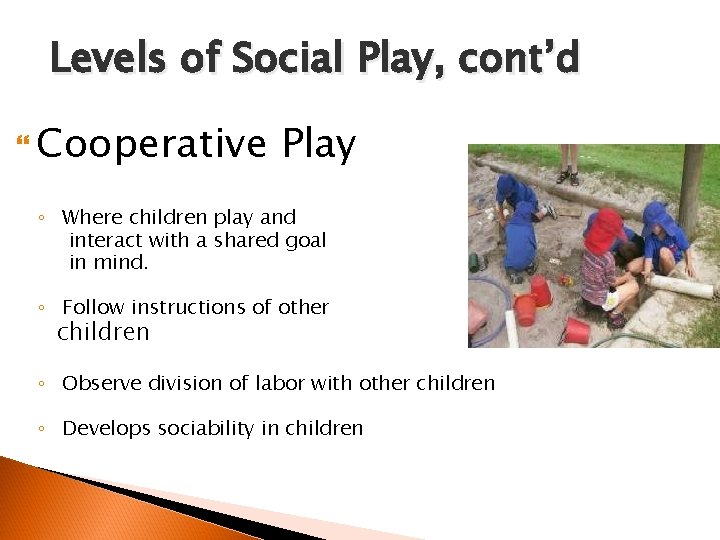
Levels of Social Play, cont’d Cooperative Play ◦ Where children play and interact with a shared goal in mind. ◦ Follow instructions of other children ◦ Observe division of labor with other children ◦ Develops sociability in children
Passive Play The child is not actively engaged in the act of play but rather being passively entertained by or minimally interacting with an electronic device. ◦ Examples: Television Videos Video & computer games
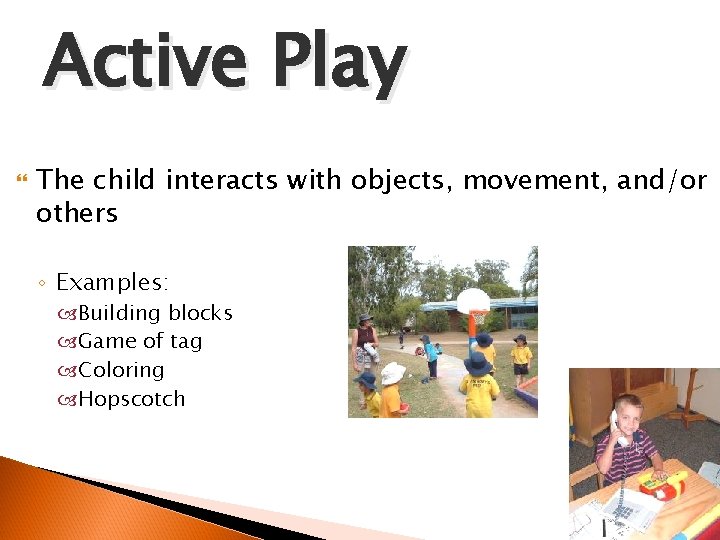
Active Play The child interacts with objects, movement, and/or others ◦ Examples: Building blocks Game of tag Coloring Hopscotch
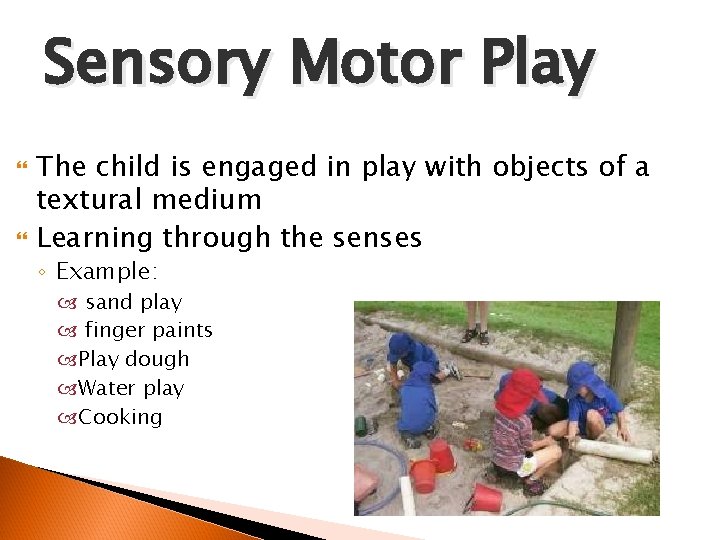
Sensory Motor Play The child is engaged in play with objects of a textural medium Learning through the senses ◦ Example: sand play finger paints Play dough Water play Cooking
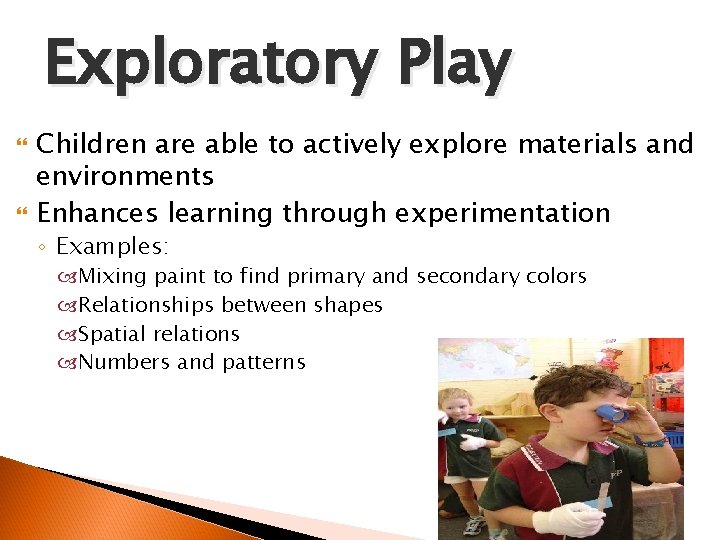
Exploratory Play Children are able to actively explore materials and environments Enhances learning through experimentation ◦ Examples: Mixing paint to find primary and secondary colors Relationships between shapes Spatial relations Numbers and patterns
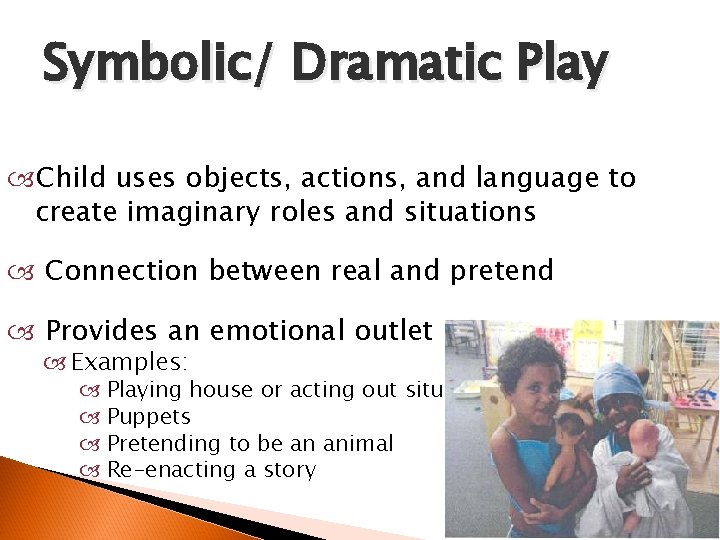
Symbolic/ Dramatic Play Child uses objects, actions, and language to create imaginary roles and situations Connection between real and pretend Provides an emotional outlet Examples: Playing house or acting out situations Puppets Pretending to be an animal Re-enacting a story
Skill Mastery Play Develop sense of accomplishment and independence Do something over and over until they have mastered it, feel good about their newly acquired skill ◦ Examples: Riding a bike Skating
Manipulative or Constructive Play Child uses objects or materials to create a representation of something Symbolic thinking and elements of pretend Hands on experiences ◦ Examples: Building a fort with blocks Building a sand castle Paper folding Provides a good outlet for emotional energy
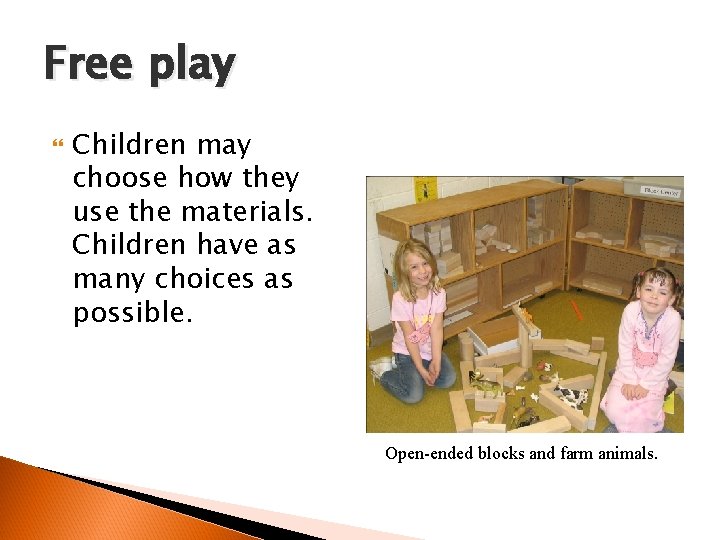
Free play Children may choose how they use the materials. Children have as many choices as possible. Open-ended blocks and farm animals.
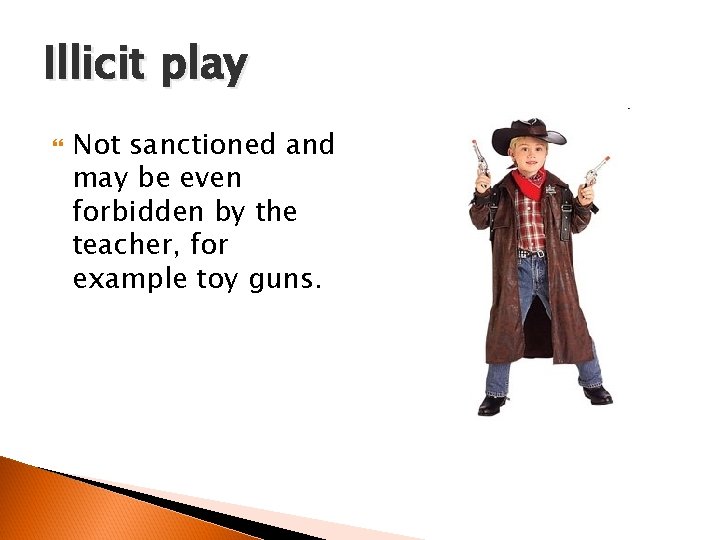
Illicit play Not sanctioned and may be even forbidden by the teacher, for example toy guns.
Types of Play Collage (Label Collage ~ Name, Date, Assignment) Using Word or Power. Point, create a collage that depicts at least the 12 types of play Each type of play should be labeled with the name and description of the play. Be Creative!! Idea-Turn images in different directions and with different borders. Submit/Save assignment as ~ Name-Assignment-Course/Block
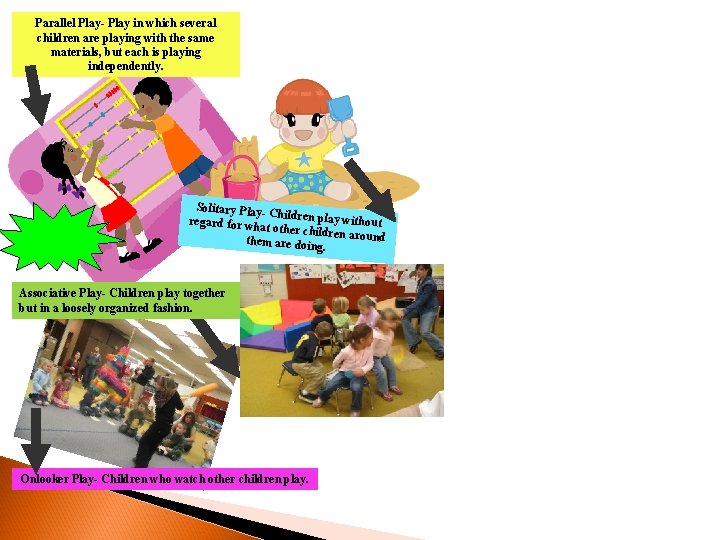
Parallel Play- Play in which several children are playing with the same materials, but each is playing independently. Solitary Play. Children play without regard for wh at other childre n around them are doin g. Associative Play- Children play together but in a loosely organized fashion. Onlooker Play- Children who watch other children play.
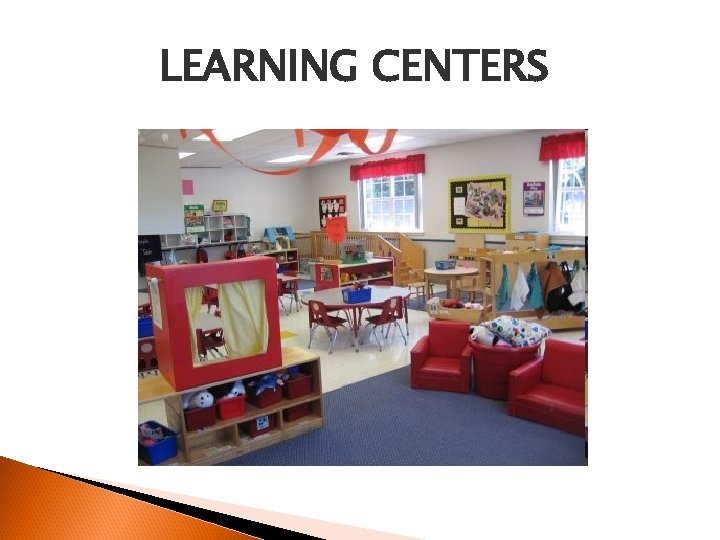
LEARNING CENTERS
WHAT ARE LEARNING CENTERS Developmentally appropriate A vital part of the early childhood classroom A means to facilitate a hands-on learning environment that achieves multiple learning objectives An effective way to enhance language development A way to achieve classroom objectives An effective way for children to learn in a fun, self-directed, appropriate manner
How are Learning Centers Used? To introduce new learning To allow repetition To stimulate and encourage creativity To extend learning through research and discovery To help children learn to function in a classroom To reinforce a particular skill or concept To encourage communication and language amongst the children
Why are Learning Centers Used? To allow child-directed learning To provide concrete experiences To promote creative thinking To allow children ample opportunities to communicate with each other To adapt for all ages and abilities To provide a variety of methods for learning To accommodate classroom modifications
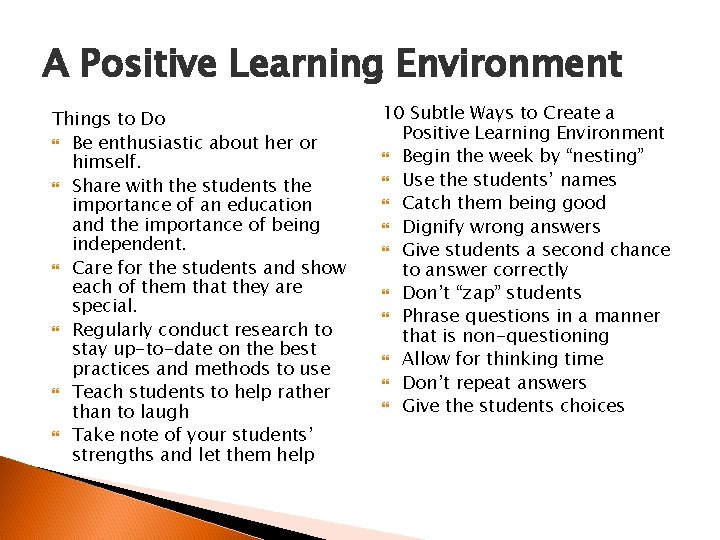
A Positive Learning Environment Things to Do Be enthusiastic about her or himself. Share with the students the importance of an education and the importance of being independent. Care for the students and show each of them that they are special. Regularly conduct research to stay up-to-date on the best practices and methods to use Teach students to help rather than to laugh Take note of your students’ strengths and let them help 10 Subtle Ways to Create a Positive Learning Environment Begin the week by “nesting” Use the students’ names Catch them being good Dignify wrong answers Give students a second chance to answer correctly Don’t “zap” students Phrase questions in a manner that is non-questioning Allow for thinking time Don’t repeat answers Give the students choices
Play Center Questions What is the center teaching? What activities are you doing that demonstrate the play concept? What can a child learn through play to help develop this skill? What other activities could you do to teach this concept?
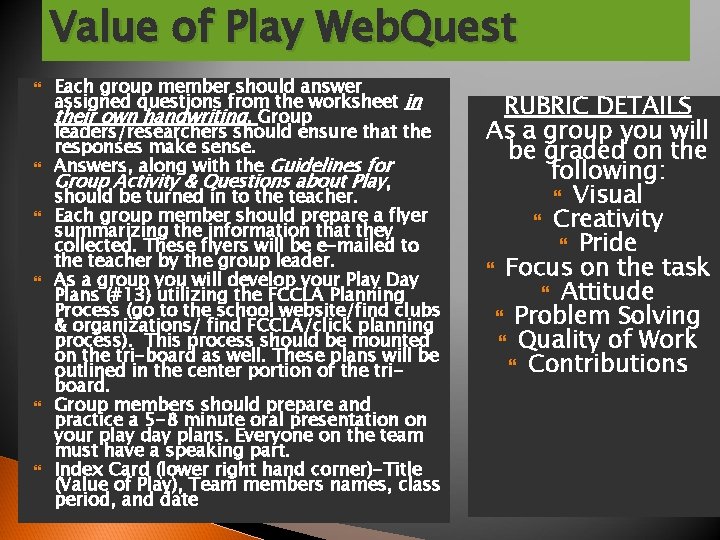
Value of Play Web. Quest Each group member should answer assigned questions from the worksheet in their own handwriting. Group leaders/researchers should ensure that the responses make sense. Answers, along with the Guidelines for Group Activity & Questions about Play, should be turned in to the teacher. Each group member should prepare a flyer summarizing the information that they collected. These flyers will be e-mailed to the teacher by the group leader. As a group you will develop your Play Day Plans (#13) utilizing the FCCLA Planning Process (go to the school website/find clubs & organizations/ find FCCLA/click planning process). This process should be mounted on the tri-board as well. These plans will be outlined in the center portion of the triboard. Group members should prepare and practice a 5 -8 minute oral presentation on your play day plans. Everyone on the team must have a speaking part. Index Card (lower right hand corner)-Title (Value of Play), Team members names, class period, and date RUBRIC DETAILS As a group you will be graded on the following: Visual Creativity Pride Focus on the task Attitude Problem Solving Quality of Work Contributions
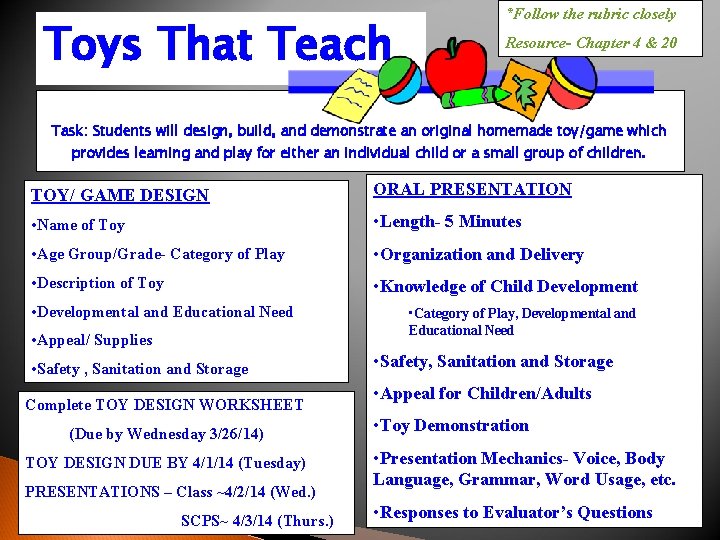
Toys That Teach *Follow the rubric closely Resource- Chapter 4 & 20 Task: Students will design, build, and demonstrate an original homemade toy/game which provides learning and play for either an individual child or a small group of children. TOY/ GAME DESIGN ORAL PRESENTATION • Name of Toy • Length- 5 Minutes • Age Group/Grade- Category of Play • Organization and Delivery • Description of Toy • Knowledge of Child Development • Developmental and Educational Need • Appeal/ Supplies • Safety , Sanitation and Storage Complete TOY DESIGN WORKSHEET (Due by Wednesday 3/26/14) TOY DESIGN DUE BY 4/1/14 (Tuesday) PRESENTATIONS – Class ~4/2/14 (Wed. ) SCPS~ 4/3/14 (Thurs. ) • Category of Play, Developmental and Educational Need • Safety, Sanitation and Storage • Appeal for Children/Adults • Toy Demonstration • Presentation Mechanics- Voice, Body Language, Grammar, Word Usage, etc. • Responses to Evaluator’s Questions
Preparation for the Presentation Identify the following on your index card: Name of Participants, Date, Assignment (Toys That Teach) Name of Toy, Child Age Group, Category of Play Explanation of how the toy addresses ALL five developmental, as well as educational, needs of the selected age group. Describe safety and sanitation considerations and explain how the toy should be maintained, cleaned, and stored (THERE IS NO SUCH THING AS NOT NEEDED OR NONE). Identify supplies used. Explain how the toy would appeal to children and adults. Demonstration should include: Usage, unique aspects and adaptive uses for special needs children
TOYS THAT TEACH DEMONSTRATION SCPS FIELD EXPERIENCE You will be expected to take the toy that you designed to SCPS. Allow your children an opportunity to interact with your toy or activity. Please respond to the following questions in your observation journal upon the completion of your activity: Was your toy or activity appropriate for the group that you specified? Explain. Was this activity appropriate for an indoor/outdoor play environment? Explain. As the children engaged in the activities, what areas of development did you notice were enhanced? Explain. What role did this activity or toy play in the child’s learning?