
INTRODUCTION TO EARLY CHILDHOOD AND PHYSICAL DEVELOPMENT OT
- Slides: 19
INTRODUCTION TO EARLY CHILDHOOD AND PHYSICAL DEVELOPMENT OT 500 Spring 2016
HIGHLIGHTS OF EARLY CHILDHOOD (2 -6 YEARS) I can talk now!!!! Me do it!!!!! Egocentrism Basic or personal activities of daily living are learned (washing, dressing, brushing, toileting), although still need some help and supervision Targeted motor skills are learned (skating, skiing, swimming, bike riding, ball play)…I take lessons now!!!! I go to preschool and then kindergarten I have friends and love to play with cool toys !!! I know best! Pushing limits; I am the boss and its all about ME…. but I still need you! Come tuck me in; I won’t admit it, but I love having boundaries
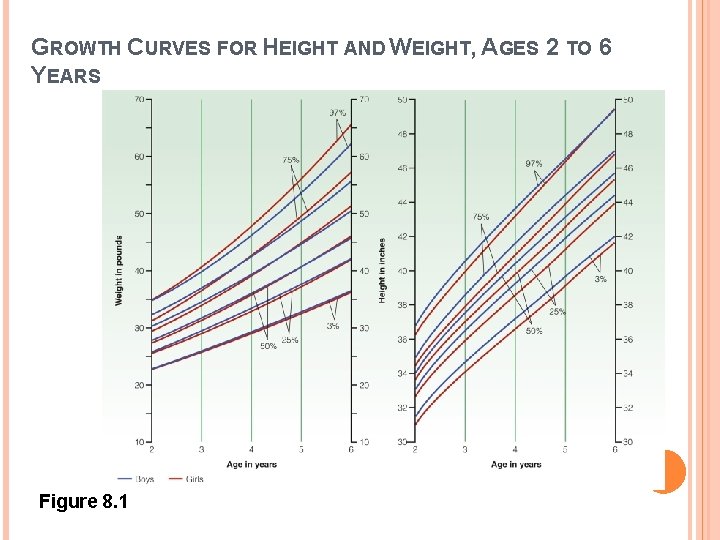
PHYSICAL GROWTH: HEIGHT AND WEIGHT, CNS Growth rate slows substantially (no wonder preschoolers are such picker eaters…they really aren’t very hungry) 2 to 3 inches per year � 4 to 6 pounds per year � Individual variation � As a group, boys are slightly taller and heavier The BRAIN develops more quickly than any other organ during early childhood; at 2 years the brain has 75% of its adult weight; by age 5, 90% of its adult weight (total body weight is only about 1/3 of what it will be as an adult); myelination of motor neural pathways The brain has PLASTICITY: due to sprouting of new dendrites. and redundancy of neural connections; Greatest plasticity at 1 to 2 years of age
GROWTH CURVES FOR HEIGHT AND WEIGHT, AGES 2 TO 6 YEARS Figure 8. 1
HOW DOES THE BRAIN DEVELOP DURING EARLY CHILDHOOD? Visual skills � Improved attention…selective and sustained attention � Visual processing skills, space awareness, discrimination (shapes, size, color, spatial orientation) � Early literacy skills Specialization of hemispheres � Left-hemisphere: more involved in logical, problem solving, language, and mathematical computations � Right-hemisphere: more involved in visual-spatial functions, recognition of faces, discrimination of color, aesthetic and emotional responses, understanding metaphors, and creative mathematical reasoning � Functions overlap: Myelination of corpus callosum
MOTOR SKILL DEVELOPMENT IN EARLY CHILDHOOD Gross motor skills � Involve large muscles used in locomotion; little gender differentiation but much individual differences (nature and nurture) 2 -yrs to 2 yrs -11 mos: walks up stairs 2 feet on each step; jumps clearing both feet about 6 inches, hops on one foot 13 x; pedals a trike; runs quickly, can change direction and stop without falling , although not a well-coordinated running gait (stiff); kicks a large ball; tosses a ball but with poor accuracy
GROSS MOTOR SKILL DEVELOPMENT 3 yrs to 3 years 11 months: kicks, tosses, catches medium-sized ball; walks up stairs alternate feet; uses playground slides safely, rides bike with training wheels, gallops, stands on one foot 2 -5 sec; descends stairs one foot on each step; hops on one foot 3 -6 x 4 to 6 years: Rides a bike first with and then without training wheels; turns a somersault, catches small ball; goes up and down stairs alternate feet; swims, pumps a swing, jumps forward 3 feet; hops on one foot 6 -10 x, skips, learns specific skills like using a skateboard, scooter, skiing, skating; loves playground equipment
FINE MOTOR SKILL DEVELOPMENT IN EARLY CHILDHOOD Fine motor skills � Involve small muscles used in manipulation and coordination; Proximodistal trend accounts for lag in fine motor skills � Fine motor skill development involves use of various grasp patterns, dexterity, in-hand manipulation, visual-motor skillsdrawing, using scissors, eye-hand coordination- ball play; bilateral hand use � 2 - years-2 yrs-11 months: does large insert puzzles, shape sorter; stacks 4 -6 one inch cubes, copies simple horizontal vertical and circular lines; scribbles; uses spoon and fork,
FINE MOTOR SKILLS 3 yrs to 3 years 11 months: builds tower of 6 -12 cubes; copies circle and cross and simple letters strings beads together, snips with scissors; puts toothpaste on tooth brush and brushes teeth; hand preference is usually clear; finger grasps, pincer grasp, but not a mature tripod grasp on a pencil 4 -6 years: prints name and simple short sentences; cuts out simple shapes, colors within the lines, laces and then ties shoes, folds paper, does buttons and zippers; uses a tripod grasp; builds simple models with legos
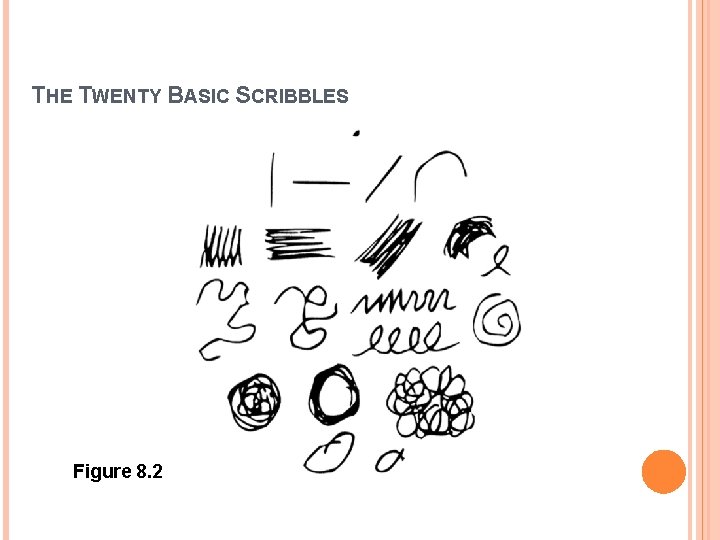
THE TWENTY BASIC SCRIBBLES Figure 8. 2
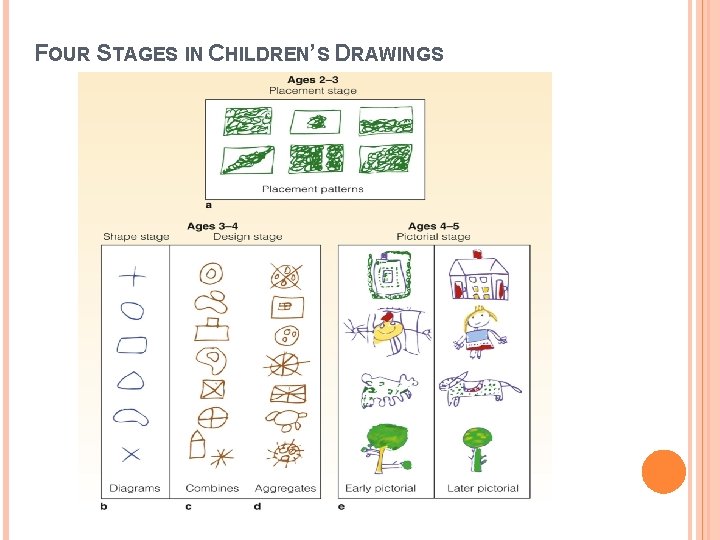
FOUR STAGES IN CHILDREN’S DRAWINGS
ARE THERE PROBLEMS CONNECTED WITH BEING LEFT-HANDED? Connections have been made with Language problems Dyslexia and stuttering � Health and Psychological problems; High blood pressure and epilepsy; Schizophrenia and depression � Higher frequencies of left-handers have Stronger Mathematical abilities � Stronger Athletic abilities � Artistic, musical, and architectural abilities Genetic component: L Handedness seems to run in families
NUTRITIONAL NEEDS AND EATING HABITS IN EARLY CHILDHOOD? Nutritional needs Need more overall calories than toddlers; about 1400 calories � Slower growth rate - less calories per pound � Patterns of eating Appetite decreases and becomes erratic; picky eaters � Preference for sugar and salt with exposure � Challenging part of parenting…meal times; ensuring a wellbalanced diet; develop healthy eating habits �
COMMON ILLNESSES AND ENVIRONMENTAL HAZARDS ENCOUNTERED DURING EARLY CHILDHOOD? Minor illnesses: Respiratory infections; Colds, sore throat; Gastrointestinal upsets- Nausea, vomiting, diarrhea; ear infections ** In developing countries, diarrheal illness is leading killer of children- malaria, dehydration Major illnesses � Immunizations, antibiotics reduced major illness in US � One-third of children in US under 18 years suffer from some type of chronic illness (asthma, diabetes, cystic fibrosis) � Globally 13 million children die each year Two-thirds die of pneumonia, diarrhea, measles, tetanus, whooping cough and TB Lead poisoning
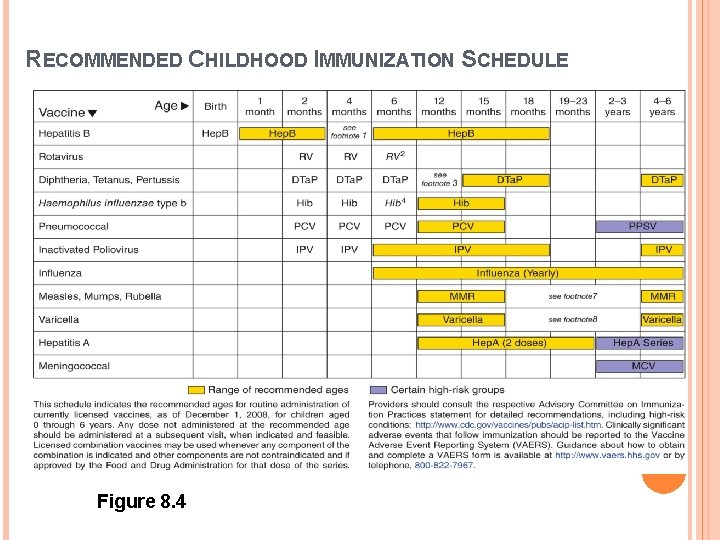
PREVENTION OF ILLNESS Vaccines, antibiotics, oral rehydration therapy Immunization in the US is not universal although recommended; mandated by public schools, child care facilities, summer camps, colleges…. 93 -95% are vaccinated against Polio, Diptheria, Tetanus, Pertussis, Measles, Mumps, Rubella, Hepatitis B, Varicella (chicken pox)
RECOMMENDED CHILDHOOD IMMUNIZATION SCHEDULE Figure 8. 4
ILLNESSES AND ENVIRONMENTAL HAZARDS ENCOUNTERED DURING EARLY CHILDHOOD Leading causes of death Ages 1 -4: Accidents, congenital malformations, homicide, cancer, heart disease, influenza/pneumonia Ages 5 -14: Accidents, cancer, congenital malformations, homicide, suicide, influenza/pneumonia Motor vehicle accidents, drowning and fires Legislation to prevent accidents � � � Child safety seats in cars Window guards in apartment buildings Toy and clothing safety standards
SLEEP NEEDED DURING EARLY CHILDHOOD Preschoolers average 10 to 11 hours per 24 hour period � � 9 to 10 hours at night 1 to 2 hour nap Bedtime routine � � In U. S. often includes transitional object “special blankie” Often a parenting challenge
WHEN ARE CHILDREN CONSIDERED TO BE GAINING CONTROL OVER ELIMINATION TOO SLOWLY? Maturation plays a critical role in toilet training � � � Enuresis � � Most US children are toilet trained between 3 and 4; often start training after the second birthday Usually control over urinating before bowel movements Day time success first; then night time Based on age of child and frequency of “accident”; Bedwetting is more frequent in boys than girls, and occurs most often during deep sleep (10% of children) Numerous causes: physical, psychological, stress, sleep disorder Encopresis � � � More common in boys than girls Less common than enuresis, more common in daytime Causes may be physical or psychological