
INTRODUCTION TO DRAMA Presented by Dr Nouf Alkhattabi
INTRODUCTION TO DRAMA Presented by Dr. Nouf Alkhattabi
Drama v v Drama is different from fiction and poetry in one essential way: it is meant to be performed. Some theorists argue that a play is incomplete until it is performed. The term drama comes from a Greek word meaning ‘action, ’ which is derived from ‘to do. ’
Poetry, Drama and Fiction Drama contains many of the elements of fiction. Like fiction, drama contains plot, characters, theme, and setting. Like fiction drama uses irony and symbolism. And indeed you could read a play as you would a short novel, using your imagination to fill in all the missing material you typically find in fiction – character description, background information, vivid action scenes. Similarly drama contains many of the elements of poetry, and you can read the poetic passages in plays just as you read any poetry.
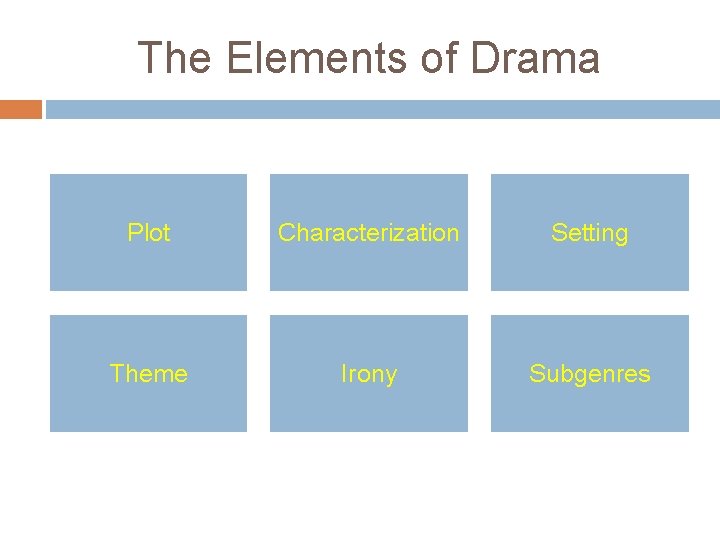
The Elements of Drama Plot Characterization Setting Theme Irony Subgenres

Plot Some critics define plot as what occurs during the play and story as what occurs before, during and after the play. The playwright must keep the plot simple and clear enough for the audience to grasp during the short time of the performance. Therefore, playwrights limit the number of characters in a play and emphasize conflict to keep the audience involved in the action. Because the time and place for a presentation is limited, certain kinds of actions such as battles and sport activities, for example, cannot be presented fully on the stage. These activates must be concentrated or symbolized. Also a character might describe events that have taken place, but the audience have not seen them.
Characterization As with plot, the playwright must keep character portrayal simple for the audience to understand during the course of a single performance. Therefore, the playwright must rely on flat characters, especially stereotyped ones, whose moralities and traits are easily remembered by the audience. The playwright must also rely on static characters more than dynamic characters. The playwright’s most important device for character development is dialogue- what the characters say and what they say about one another.
Setting in drama is the same as in fiction: the social mores, values and customs of the world in which the characters live; the physical world; the time of the action, including historical circumstances. There are three main ways of communicating setting for the audience. 1. Through the characters’ dialogue, dress and behavior. 2. Through the sets produced by the set designer. 3. Through the knowledge we bring to the
Setting Because of the limited time and place of dramatic productions, a play cannot create a world in the same detail and breadth a novel can.
Theme Playwrights build themes into their plays through the development and interrelationship of all elements of drama, most of which are the same as for fiction. There are three methods for developing dramatic themes. 1. Repetition can take many forms – a character performing the same gesture or repeating the same phrase. But for repetition to relate to theme they must develop ideas. 2. Symbolism bears on both characterization and theme as well. 3. Contrast is a device for developing plot, characterization and theme. For example, the romantic love in Romeo and Juliet versus social requirements.
Irony Dramatic irony acknowledges the presence of the audience because it gives them the privilege of knowing things the characters do not know but will certainly soon know. Dramatic irony occurs when characters say or do something that has meaning the audience recognize but the characters do not.
Subgenres The best-known subgenres of drama are tragedy and comedy, but there are many others: melodrama, allegory, comedy of manners, the spectacle, the masque, modern drama, farce and tragicomedy.
Tragedy In tragedy the hero inspires ‘pity’ and ‘fear’ in the audience: Pity because the hero does not deserve his fate, fear because the hero’s fate can be anyone’s. The audience identify deeply with the tragic hero, who is noble but flawed. He has one principle flaw such as pride and anger. Because of the hero’s flaw, he suffers emotionally and experiences reversal of fortune, moving from a high place to a low place. Before this reversal occurs the hero understands for the first time his flawed state and error ways. This moment is the recognition and usually occurs at the climax of the play.
Comedy is the deception of the ludicrous, and the ludicrous is a gross departure from the serious. Hence, the comedy in a play is closely related to what the community thinks is serious. Comedy must cause no pain for the audience. This means that the audience cannot identify as deeply with comic figures as they do with tragic heroes.
- Slides: 13