
Introduction to DNA and RNA Biology Standards B4
Introduction to DNA and RNA Biology Standards B-4. 1: Compare DNA and RNA in terms of structure, nucleotides, and base pairs. B-4. 2: Summarize the relationship among DNA, genes, and chromosomes.
Nucleic Acids § Remember, there are 4 major Organic Compounds 1. Carbohydrates 2. Lipids 3. Proteins 4. Nucleic Acids
Nucleic Acids §Nucleic acids are organic molecules that serve as the blueprint for proteins § These proteins give organisms their unique traits § Example: hair color, eye color, blood type, height, digestive enzymes, skin color, etc.
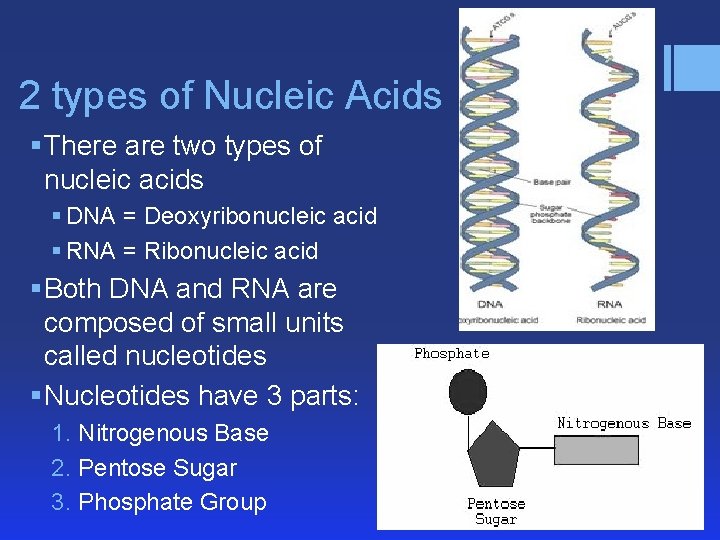
2 types of Nucleic Acids § There are two types of nucleic acids § DNA = Deoxyribonucleic acid § RNA = Ribonucleic acid § Both DNA and RNA are composed of small units called nucleotides § Nucleotides have 3 parts: 1. Nitrogenous Base 2. Pentose Sugar 3. Phosphate Group
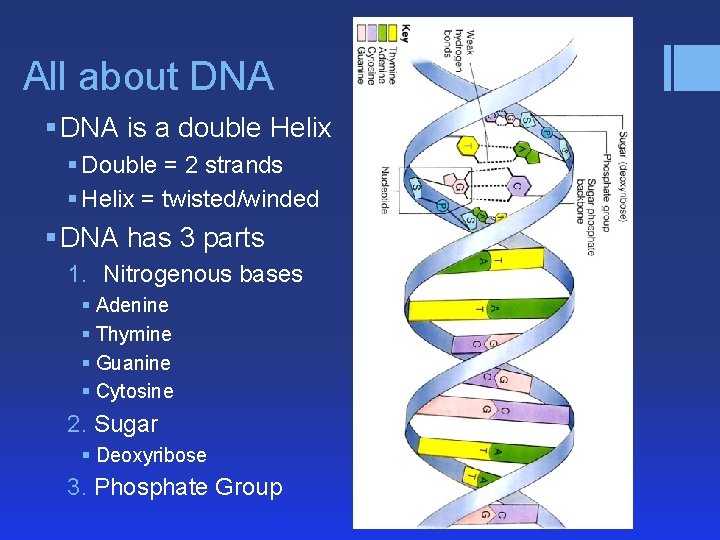
All about DNA § DNA is a double Helix § Double = 2 strands § Helix = twisted/winded § DNA has 3 parts 1. Nitrogenous bases § Adenine § Thymine § Guanine § Cytosine 2. Sugar § Deoxyribose 3. Phosphate Group
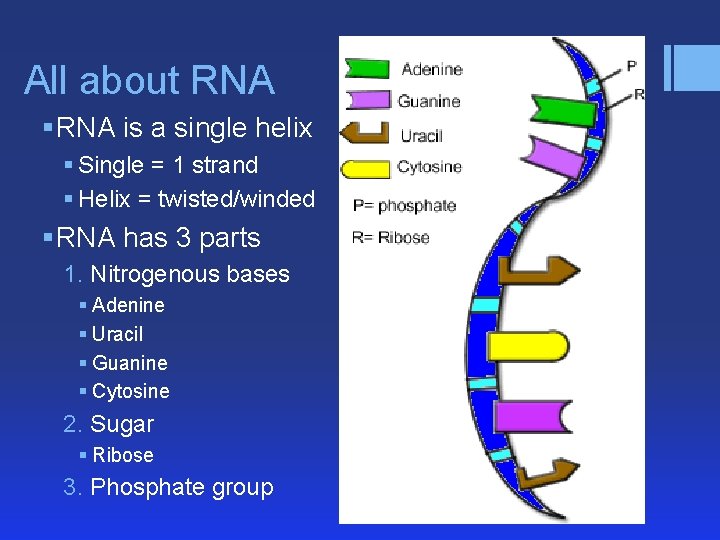
All about RNA § RNA is a single helix § Single = 1 strand § Helix = twisted/winded § RNA has 3 parts 1. Nitrogenous bases § Adenine § Uracil § Guanine § Cytosine 2. Sugar § Ribose 3. Phosphate group
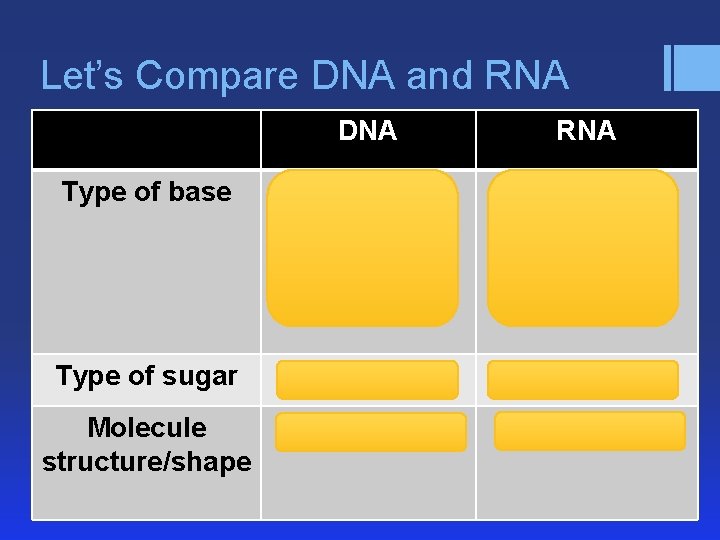
Let’s Compare DNA and RNA DNA RNA Type of base Cytosine (C) Adenine (A) Guanine (G) Thymine (T) Cytosine (C) Adenine (A) Guanine (G) Uracil (U) Type of sugar Deoxyribose Ribose Molecule structure/shape Double Helix Single Helix
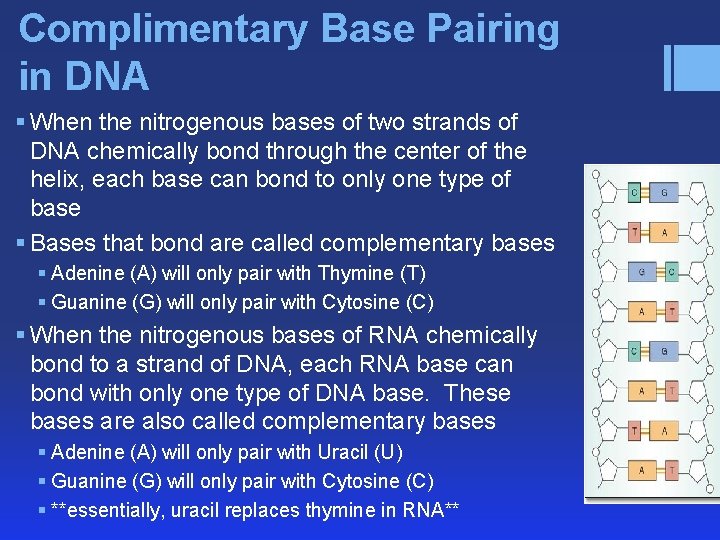
Complimentary Base Pairing in DNA § When the nitrogenous bases of two strands of DNA chemically bond through the center of the helix, each base can bond to only one type of base § Bases that bond are called complementary bases § Adenine (A) will only pair with Thymine (T) § Guanine (G) will only pair with Cytosine (C) § When the nitrogenous bases of RNA chemically bond to a strand of DNA, each RNA base can bond with only one type of DNA base. These bases are also called complementary bases § Adenine (A) will only pair with Uracil (U) § Guanine (G) will only pair with Cytosine (C) § **essentially, uracil replaces thymine in RNA**
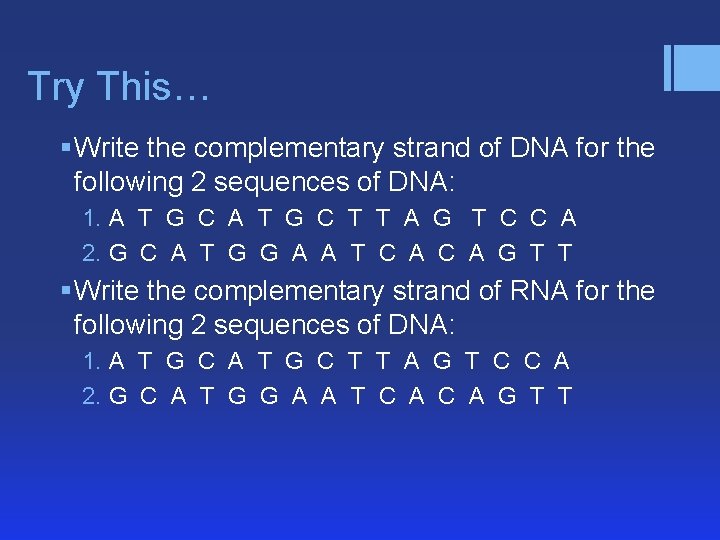
Try This… § Write the complementary strand of DNA for the following 2 sequences of DNA: 1. A T G C T T A G T C C A 2. G C A T G G A A T C A G T T § Write the complementary strand of RNA for the following 2 sequences of DNA: 1. A T G C T T A G T C C A 2. G C A T G G A A T C A G T T
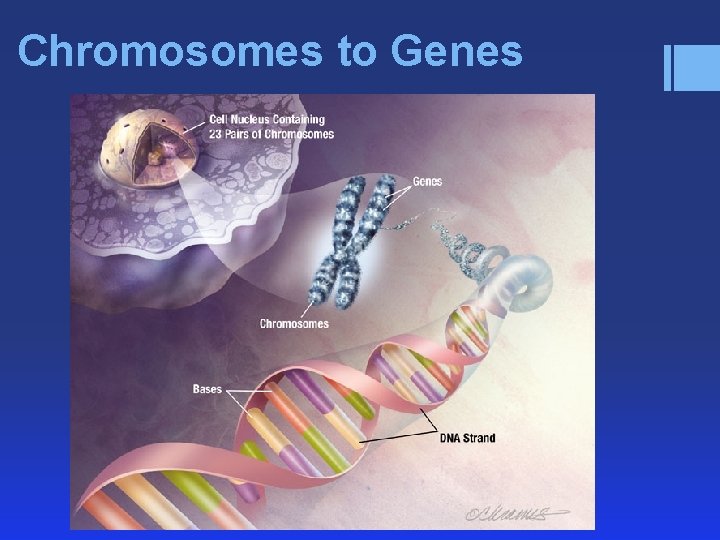
Chromosomes to Genes
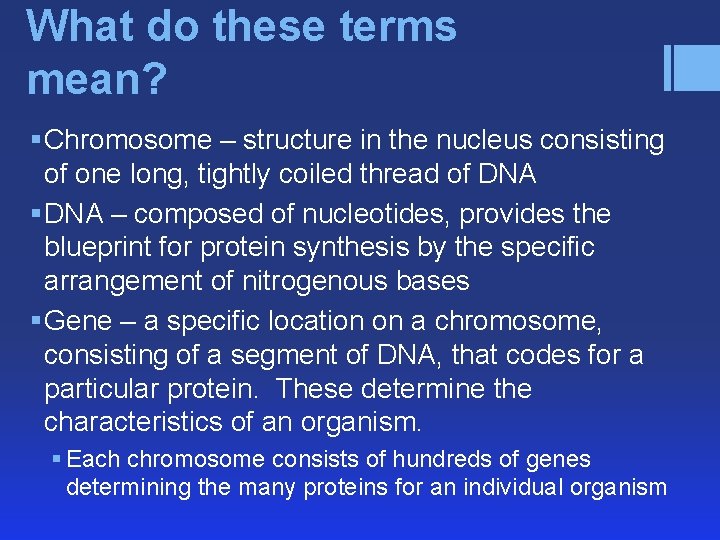
What do these terms mean? § Chromosome – structure in the nucleus consisting of one long, tightly coiled thread of DNA § DNA – composed of nucleotides, provides the blueprint for protein synthesis by the specific arrangement of nitrogenous bases § Gene – a specific location on a chromosome, consisting of a segment of DNA, that codes for a particular protein. These determine the characteristics of an organism. § Each chromosome consists of hundreds of genes determining the many proteins for an individual organism
- Slides: 11