
Introduction to Distributed Systems INF 50409040 Autumn 2017
Introduction to Distributed Systems INF 5040/9040 Autumn 2017 Lecturer: Eli Gjørven (ifi/Ui. O) August 22, 2017
Outline § Definition of a distributed system § Goals of a distributed system § Implications of distributed systems § Pitfalls in developing distributed systems § Types of distributed systems INF 5040, ifi/Ui. O 2
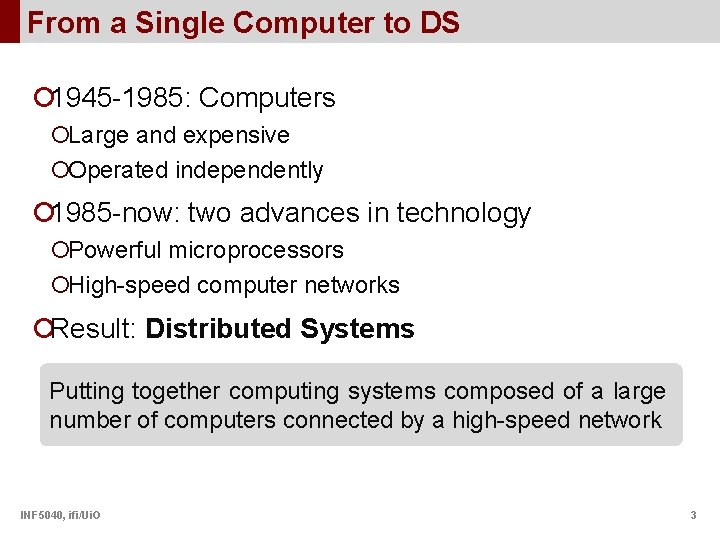
From a Single Computer to DS ¡ 1945 -1985: Computers ¡Large and expensive ¡Operated independently ¡ 1985 -now: two advances in technology ¡Powerful microprocessors ¡High-speed computer networks ¡Result: Distributed Systems Putting together computing systems composed of a large number of computers connected by a high-speed network INF 5040, ifi/Ui. O 3

What Is a Distributed System? ¡Definition Operational perspective: A distributed system is one in which hardware or software components, located at networked computers, communicate and coordinate their actions only by passing messages. [Coulouris] User perspective: A distributed system is a collection of independent computers that appears to its users as a single coherent system. [Tanenbaum] INF 5040, ifi/Ui. O 4

What Is a Distributed System? ¡A DS organized as middleware ¡extending over multiple machines ¡offering each application the same interface INF 5040, ifi/Ui. O 5
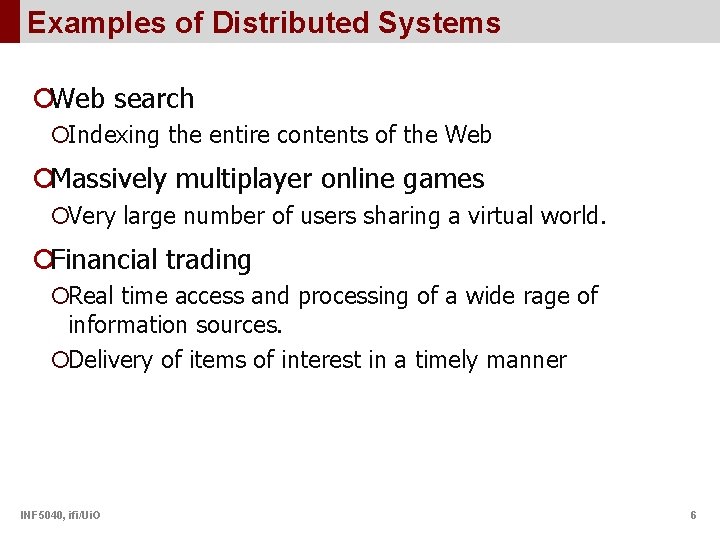
Examples of Distributed Systems ¡Web search ¡Indexing the entire contents of the Web ¡Massively multiplayer online games ¡Very large number of users sharing a virtual world. ¡Financial trading ¡Real time access and processing of a wide rage of information sources. ¡Delivery of items of interest in a timely manner INF 5040, ifi/Ui. O 6

Outline § Definition of a distributed system § Goals of a distributed system § Implications of distributed systems § Pitfalls in developing distributed systems § Types of distributed systems INF 5040, ifi/Ui. O 7

Goals of Distributed Systems ¡Resource sharing ¡Distribution transparency ¡Openness ¡Scalability ¡Fault tolerance ¡Allowing heterogeneity INF 5040, ifi/Ui. O 8
Resource Sharing ¡Making resources accessible: ¡accessing remote resources ¡sharing them in a controlled and efficient way ¡Examples: printers, storages, files, etc. ¡One reason to share: economics ¡e. g. , 1 -to-many printer access, rather than 1 -to-1 ¡Resource managers control access, offer a scheme for naming, and control concurrency ¡A resource sharing model describes how ¡resources are made available ¡resources can be used ¡service provider and user interact with each other INF 5040, ifi/Ui. O 9
Models for Resource Sharing ¡Client-server resource model ¡Server processes act as resource managers, and offer services (collection of procedures) ¡Client processes send requests to servers ¡HTTP implements a client-server resource model ¡Object-based resource model ¡Any entity in a process is modeled as an object with a message based interface that provides access to its operations ¡Any shared resource is modeled as an object ¡Object-based middleware (CORBA, Java RMI) defines object-based resource models INF 5040, ifi/Ui. O 10
Distribution Transparency ¡An important goal of a DS: ¡hiding the fact that its processes and resources are physically distributed across multiple computers ¡Definition: A distributed system that is able to present itself to its users and applications as if it were only a single computer system is said to be transparent. ¡What kind of transparency? INF 5040, ifi/Ui. O 11
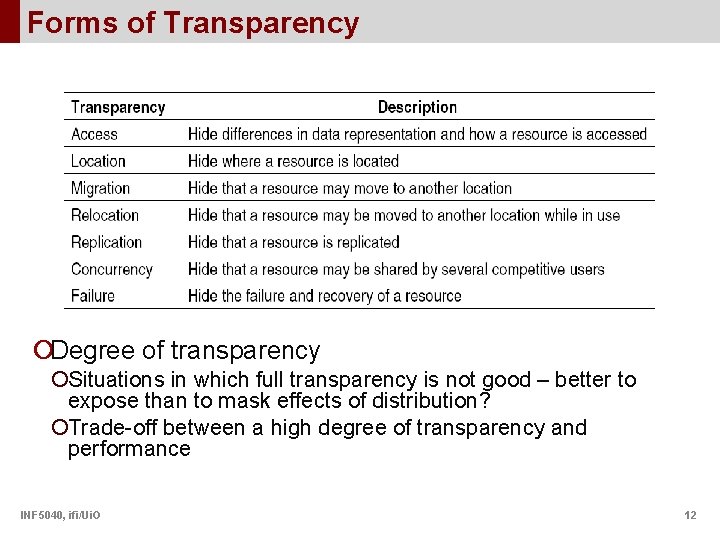
Forms of Transparency ¡Degree of transparency ¡Situations in which full transparency is not good – better to expose than to mask effects of distribution? ¡Trade-off between a high degree of transparency and performance INF 5040, ifi/Ui. O 12
Openness ¡Definition: An open distributed system is a system that offers services according to standard rules that describe syntax and semantics of those services. ¡E. g. , in computer networks: format, content, and meaning of messages ¡In DS: services specified through interfaces ¡Interface Definition Language (IDL): syntax ¡Web Service Definition Language (WSDL): syntax ¡Semantics? the hard part to specify ¡Extensibility: an open DS can be extended and improved incrementally ¡add or replace components INF 5040, ifi/Ui. O 13
Scalability ¡Scalability in three dimensions: ¡ Scalable in size: Users and resources can easily be added ¡ Geographically scalable: Users and resources may lie far apart ¡ Administratively scalable: The system spans many administrative organizations ¡Scaling up along these dimensions often come with a performance cost ¡Scalability denotes the ability of a system to handle future scaling up ¡Examples: ¡ Internet: Size, geography and number of administrative organizations has grown enormously ¡ Google: scaled over the years to handle O(100) billion queries a month, expected query time 0. 2 secs. INF 5040, ifi/Ui. O 14
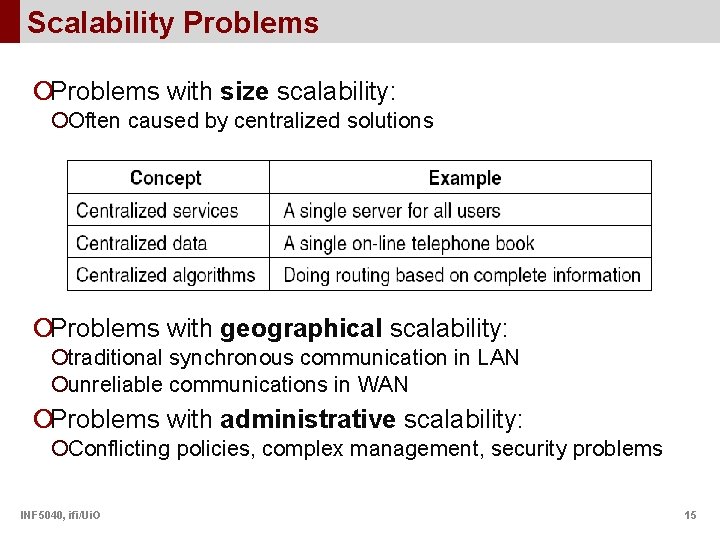
Scalability Problems ¡Problems with size scalability: ¡Often caused by centralized solutions ¡Problems with geographical scalability: ¡traditional synchronous communication in LAN ¡unreliable communications in WAN ¡Problems with administrative scalability: ¡Conflicting policies, complex management, security problems INF 5040, ifi/Ui. O 15
Scaling Techniques ¡Distribution ¡splitting a resource (such as data) into smaller parts, and spreading the parts across the system (cf DNS) ¡Replication ¡replicate resources (services, data) across the system ¡increases availability, helps to balance load ¡caching (special form of replication) ¡Hiding communication latencies ¡avoid waiting for responses to remote service requests (use asynchronous communication or design to reduce the amount of remote requests) INF 5040, ifi/Ui. O 16
Fault Tolerance ¡Hardware, software and network fail!! ¡DS must maintain availability even in cases where hardware/software/network have low reliability ¡Failures in distributed systems are partial ¡makes error handling particularly difficult ¡Many techniques for handling failures ¡Detecting failures (checksum) ¡Masking failures (retransmission in protocols) ¡Tolerating failures (as in web-browsers) ¡Recovery from failures (roll back) ¡Redundancy (replicate servers in failure-independent ways) INF 5040, ifi/Ui. O 17
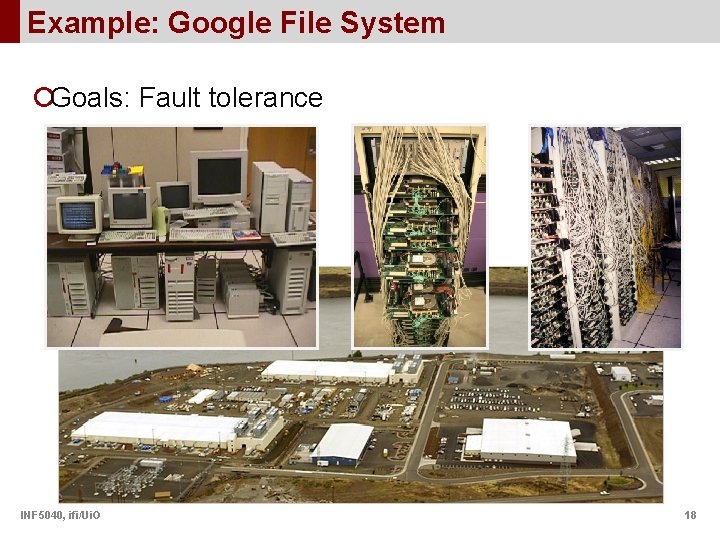
Example: Google File System ¡Goals: Fault tolerance INF 5040, ifi/Ui. O 18

Outline § Definition of a distributed system § Goals of a distributed system § Implications of distributed systems § Pitfalls in developing distributed systems § Types of distributed systems INF 5040, ifi/Ui. O 19
Implications of Distributed Systems ¡Concurrency ¡components execute in concurrent processes that read and update shared resources. Requires coordination ¡No global clock ¡makes coordination difficult (ordering of events) ¡Independent failure of components ¡“partial failure” & incomplete information ¡Unreliable communication ¡Loss of connection and messages. Message bit errors ¡Unsecure communication ¡Possibility of unauthorised recording and modification of messages ¡Expensive communication ¡Communication between computers usually has less bandwidth, longer latency, and costs more, than between independent processes on the same computer INF 5040, ifi/Ui. O 20
Pitfalls When Developing DS ¡False assumptions made by first time developer: ¡The network is reliable. ¡The network is secure. ¡The network is homogeneous. ¡The topology does not change. ¡Latency is zero. ¡Bandwidth is infinite. ¡Transport cost is zero. ¡There is one administrator. INF 5040, ifi/Ui. O 21
Outline § Definition of a distributed system § Goals of a distributed system § Implications of distributed systems § Pitfalls in developing distributed systems § Types of distributed systems INF 5040, ifi/Ui. O 22
Types of Distributed Systems ¡Type 1: Distributed Computing Systems ¡Used for high performance computing tasks ¡Cluster and Cloud computing systems ¡Grid computing systems ¡Type 2: Distributed Information Systems ¡Systems mainly for management and integration of business functions ¡Transaction processing systems ¡Enterprise application integration ¡Type 3: Distributed Pervasive (or Ubiquitous) Systems ¡Mobile and embedded systems ¡Home systems ¡Sensor networks INF 5040, ifi/Ui. O 23

Type 1: Cluster Computing Systems ¡Collection of similar PCs, closely connected, all run same OS, e. g. : ¡A collection of computing nodes + master node ¡Master runs middleware: parallel execution and management INF 5040, ifi/Ui. O 24
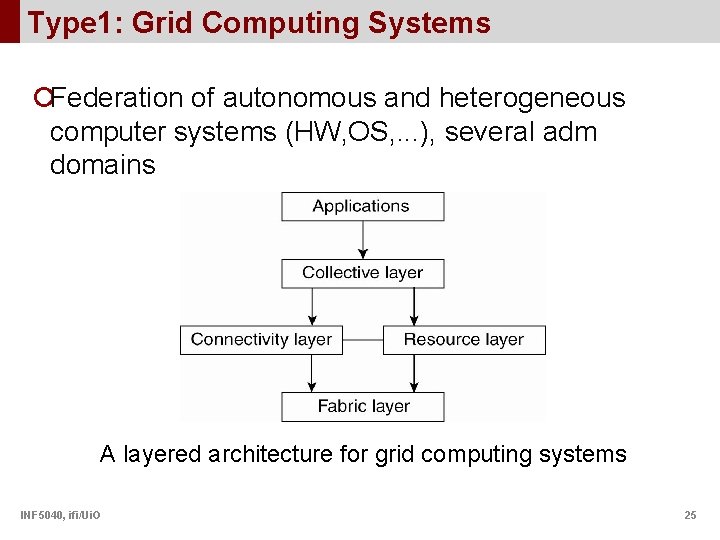
Type 1: Grid Computing Systems ¡Federation of autonomous and heterogeneous computer systems (HW, OS, . . . ), several adm domains A layered architecture for grid computing systems INF 5040, ifi/Ui. O 25
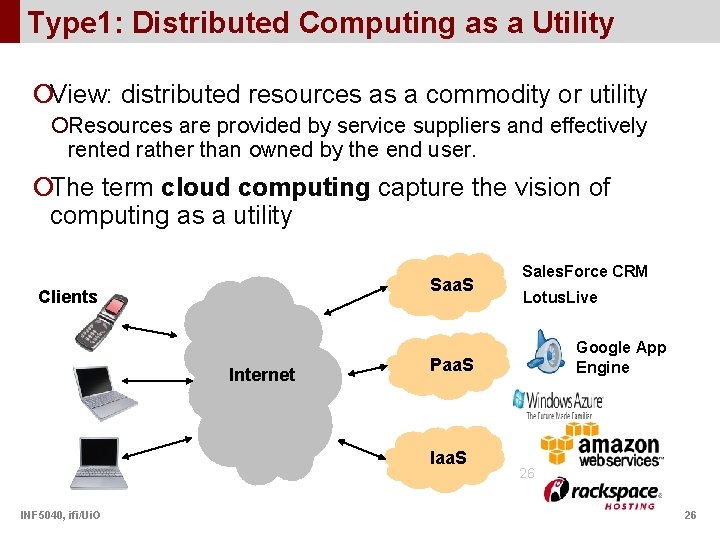
Type 1: Distributed Computing as a Utility ¡View: distributed resources as a commodity or utility ¡Resources are provided by service suppliers and effectively rented rather than owned by the end user. ¡The term cloud computing capture the vision of computing as a utility Saa. S Clients Internet Lotus. Live Google App Engine Paa. S INF 5040, ifi/Ui. O Sales. Force CRM 26 26
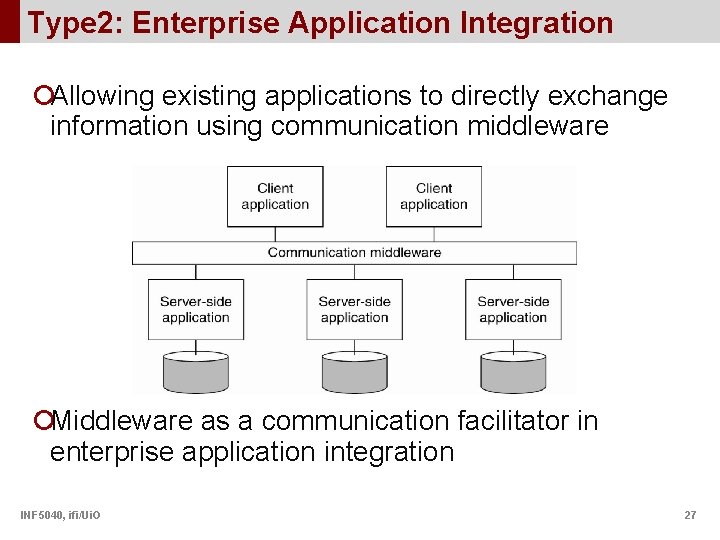
Type 2: Enterprise Application Integration ¡Allowing existing applications to directly exchange information using communication middleware ¡Middleware as a communication facilitator in enterprise application integration INF 5040, ifi/Ui. O 27
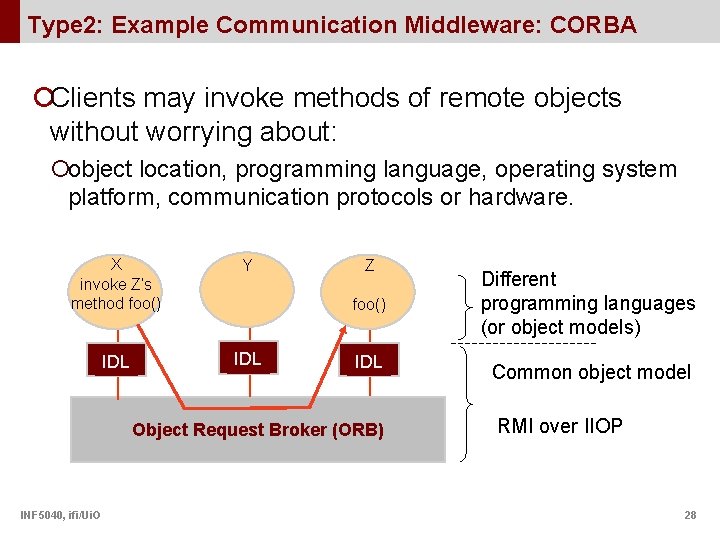
Type 2: Example Communication Middleware: CORBA ¡Clients may invoke methods of remote objects without worrying about: ¡object location, programming language, operating system platform, communication protocols or hardware. X invoke Z’s method foo() Y IDL Z foo() IDL Object Request Broker (ORB) INF 5040, ifi/Ui. O Different programming languages (or object models) Common object model RMI over IIOP 28
Type 3: Distributed Pervasive Systems ¡Pervasive systems: exploiting the increasing integration of services and (small/tiny) computing devices in our everyday physical world ¡(Mobile) Devices: discover the environment (its services) and establish themselves in this environment as best as possible. ¡Requirements for pervasive applications ¡Embrace contextual changes ¡Encourage ad hoc and dynamic composition ¡Recognize sharing as the default INF 5040, ifi/Ui. O 29
Type 3: Example: Smart Home System ¡Integrates personal devices (mobile, wearables, . . ) ¡Integrates home apparatus (light, alarms, entertainment systems, termostat control. . ) ¡Self-configuring and self-managing ¡Takes care of your information (music, photo, video, calendar, health information…) ¡Protects your personal space from others! ¡Exampe: Google home INF 5040, ifi/Ui. O 31
Summary ¡Distributed systems: ¡components located in a network that communicates and coordinates their actions exclusively by sending messages. ¡Goals like resource sharing, distribution transparency, openness, scalability, fault tolerance and heterogeneity can be satisfied by distributed systems ¡Consequences of distributed systems ¡Independent failure of components ¡Unsecure communication ¡No global clock ¡Many pitfalls when developing distributed systems ¡Novel applications in pervasive systems: e. g. , smart homes INF 5040, ifi/Ui. O 32
- Slides: 31