
Introduction to Developmental Disabilities I am a Person
Introduction to Developmental Disabilities “I am a Person with Abilities”
Learning Objectives • Participants will understand the definition and criteria for intellectual disabilities • Participants will understand the definition and criteria for developmental disabilities • Participants will learn communication strategies and ethical work standards for DSPs. • Participants will learn about the life cycle
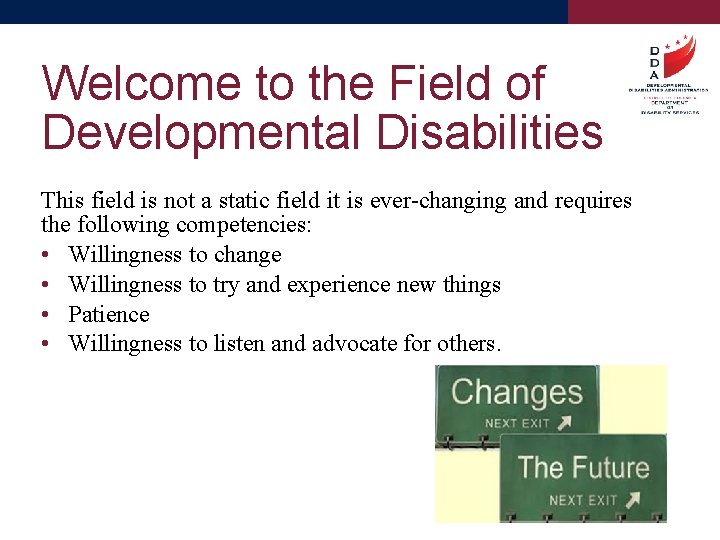
Welcome to the Field of Developmental Disabilities This field is not a static field it is ever-changing and requires the following competencies: • Willingness to change • Willingness to try and experience new things • Patience • Willingness to listen and advocate for others.

Welcome to the Field of Developmental Disabilities • As a Direct Support Professional (DSP), you are the major advocate for the people you are supporting. Words that are synonyms or mean the same as advocate include: supporter, backer, promoter, proponent and campaigner.
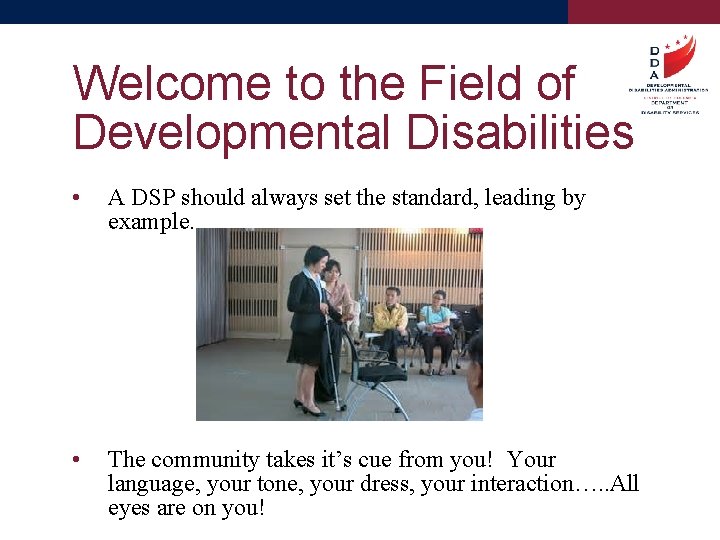
Welcome to the Field of Developmental Disabilities • A DSP should always set the standard, leading by example. • The community takes it’s cue from you! Your language, your tone, your dress, your interaction…. . All eyes are on you!
DSPs: Set a Good Example! • Be respectful to all people. • Remember you are working with adults. • The person is first. The disability is secondary. • Call people by their preferred name
What is the Difference between Intellectual Disabilities and Developmental Disabilities Diagnosed before age 22 and results in significant functional limitations in three or more major life activities Intellectual Disabilities Must be diagnosed before age 18 and an IQ score of less than 70.
FACTS: About Intellectual Disabilities (ID) • Intellectual disability (ID) means that a person mentally develops at a different rate. People with ID can have learning difficulties and trouble socially adjusting. • Intellectual disability (sometimes called cognitive disability) is not a disease or a contagious condition • People diagnosed with intellectual disabilities may develop slower than others in terms of speaking, walking, and taking care of themselves (showering, eating, dressing).
FACTS: About Intellectual Disabilities (ID) • 10 percent of Americans have a family member with some sort of intellectual disability • People with intellectual disabilities create one of America's largest disability groups • Every year, 125, 000 children are born with an intellectual disability • In the U. S. , roughly 6. 5 million people are identified as having an intellectual disability.
Causes of Intellectual Disabilities (ID) There are many causes of intellectual disability. A specific cause can be identified in approximately two thirds of cases. Known causes include: • Brain injury or infection before, during or after birth • Growth or nutrition problems • Chromosomal and genetic disorders • Babies born long before the expected birth date – also called extreme prematurity • Health problems during childhood • Drug use during pregnancy, including excessive alcohol intake and smoking • Environmental deprivation • Exposure to toxins • Unknown
Effective Communication Tips that may help when talking with someone who has an intellectual disability include: • Make sure you have the person’s attention. Use their name, gain eye contact or respectful tone and language. • Start by assuming a person can understand you, then adjust your level of communication according to their response. • Ask the person how they would like to communicate.
Effective Communication Tips that may help when talking with someone who has an intellectual disability include: • Use appropriate language for the person and the situation – for example, simple, clear words and short, uncomplicated sentences. If the person is an adult, do not speak as though they are a child. • Use visual information such as pictures, diagrams, signs, objects, or gestures to improve understanding.
Effective Communication Tips that may help when talking with someone who has an intellectual disability include: • Don’t rush. • Check if they have been able to understand what you have said by asking them to rephrase in their own words. Do not simply ask, ‘Do you understand? ’ because people will often say ‘yes’ to avoid embarrassment or because it is the answer they think you want to hear.
Effective Communication Tips that may help when talking with someone who has an intellectual disability include: • If you don’t understand the other person, do not pretend to understand. Be honest and take responsibility for any communication breakdowns. For example, say: ‘I’m sorry, I don’t understand what you’re telling me. Would you please tell me again? ’ • If you cannot understand or be understood, try another approach. Is there another way you can communicate what you want to say? Ask if it’s okay to involve someone who is familiar to the person (a family member or support worker).

Don’t be awkward!
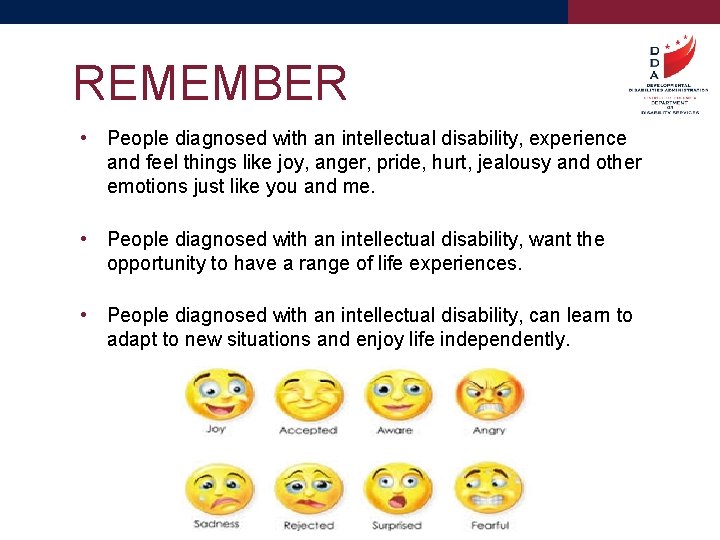
REMEMBER • People diagnosed with an intellectual disability, experience and feel things like joy, anger, pride, hurt, jealousy and other emotions just like you and me. • People diagnosed with an intellectual disability, want the opportunity to have a range of life experiences. • People diagnosed with an intellectual disability, can learn to adapt to new situations and enjoy life independently.
FACTS: About Developmental Disabilities • Developmental disabilities is an umbrella term that includes intellectual disabilities (ID) but also includes other disabilities that have effects on a person’s ability to independently complete major life activities in three or more areas. These conditions begin during the developmental period, but before age 22 and last throughout a person’s lifetime.
FACTS: About Developmental Disabilities Developmental disabilities occur among all racial, ethnic, and socioeconomic groups. Recent estimates in the United States show that about one in six, or about 15%, of children aged 3 through 21 years carry a diagnosis of developmental disability. • ADHD • autism spectrum disorders, • cerebral palsy, • hearing loss, • intellectual disability • learning disability, • vision impairment • Mental Health • other developmental delays.
FACTS: About Developmental Disabilities SOME MAJOR LIFE ACTIVITIES INCLUDE: • Self Care • Learning • Receptive and Expressive Communication • Mobility • Self-Direction • Capacity for Independent Living • Economic Self Sufficiency
Growth and Development LIFE CYCLE Infant (baby) (0 month - 12 months) Toddler (1 – 3 years) Play age (3 – 5 years) Primary school age (middle childhood also called prepubescence) (3 - 11) Elementary school age (5 - 11) Preadolescence (The child in this and the previous phase are called schoolchild (schoolboy or schoolgirl), when still of primary school age. ) (9 – 11 years) Adolescence (12 – 19 years) Per puberty (8[3]-10[4] until 15[4]-17[5]) Adulthood (20+ years) Young adulthood (20 – 39 years) Middle adulthood (40 – 60 years) Elder/Senior citizen (60+ years
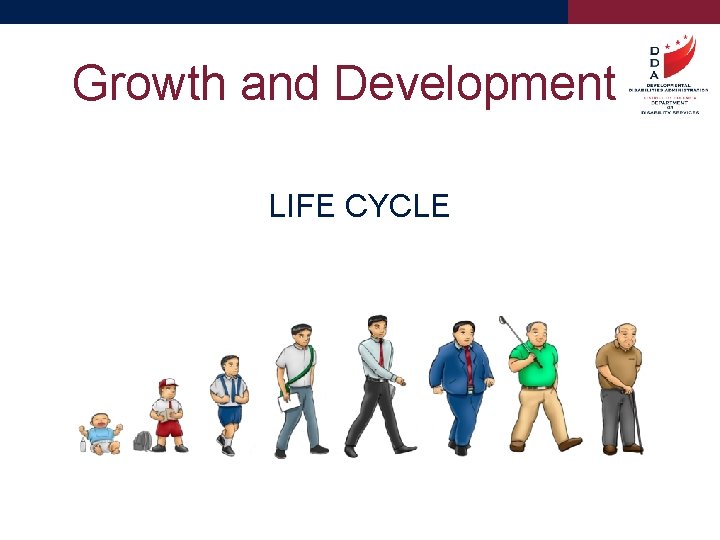
Growth and Development LIFE CYCLE
Growth and Development People go through a continuum of change during their lifetime As people grow older, these are basic human needs that must be met through the developmental stages: q Trust –Which leads to relationship building q Autonomy & Initiative –Which leads to self realization q Identity & Role-Understanding who you are and your importance q Intimacy-Feeling connected to someone other than self q Ego- Need to understand your purpose (Employment)
Growth and Development People go through a continuum of change during their lifetime Riddle Me This? ? What creature walks on four legs in the morning, two legs at noon and three legs in the afternoon?
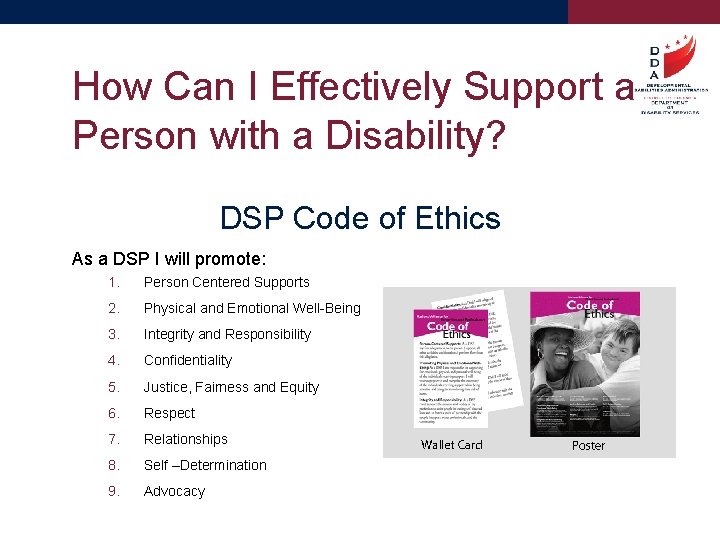
How Can I Effectively Support a Person with a Disability? DSP Code of Ethics As a DSP I will promote: 1. Person Centered Supports 2. Physical and Emotional Well-Being 3. Integrity and Responsibility 4. Confidentiality 5. Justice, Fairness and Equity 6. Respect 7. Relationships 8. Self –Determination 9. Advocacy
- Slides: 24