
Introduction to Design Thinking in Models Software systems
- Slides: 44
Introduction to Design Thinking in Models Software systems are becoming increasingly complex and difficult to develop Today even small systems tend to exhibit increasing amounts of complexity 15 September 2007 1 Copyright 2007 Oxford Consulting, Ltd
Introduction to Design Thinking in Models We are continually striving to devise ways to attack complexity One such method is to develop models…. …Using models · We try to abstract away inessential details · Focus on what's important 15 September 2007 2 Copyright 2007 Oxford Consulting, Ltd
Introduction to Design Thinking in Models are simplifications of a problem · Simulations and emulations model real world processes · Fantasy game program models an imaginary world 15 September 2007 3 Copyright 2007 Oxford Consulting, Ltd
Introduction to Design Tools for Modeling - Objects Revisited Objects are an abstraction … a model …. . they encapsulate · Data and functions · Functions operate on the data 15 September 2007 4 Copyright 2007 Oxford Consulting, Ltd
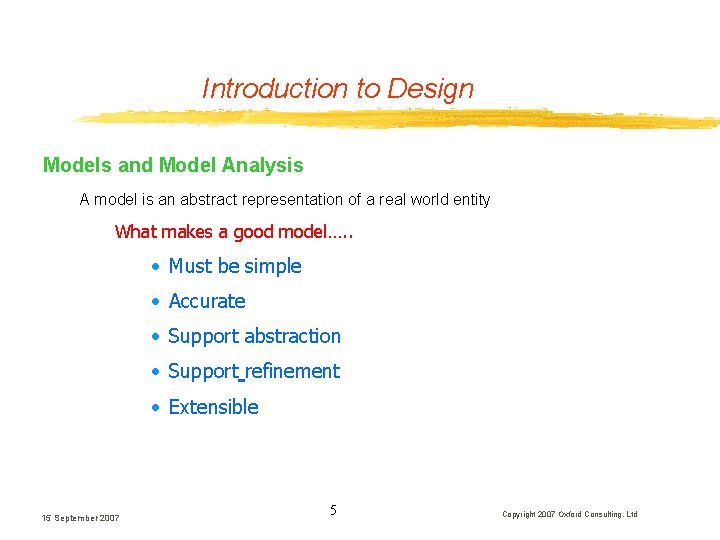
Introduction to Design Models and Model Analysis A model is an abstract representation of a real world entity What makes a good model…. . • Must be simple • Accurate • Support abstraction • Support refinement • Extensible 15 September 2007 5 Copyright 2007 Oxford Consulting, Ltd
System Design Problem Solving · Problem Statement · Goal 15 September 2007 6 Copyright 2007 Oxford Consulting, Ltd
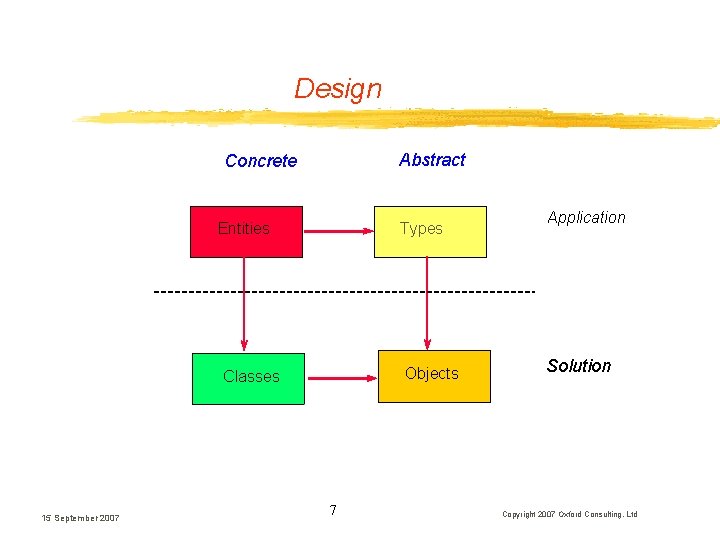
Design Abstract Concrete Entities Types Objects Classes 15 September 2007 7 Application Solution Copyright 2007 Oxford Consulting, Ltd
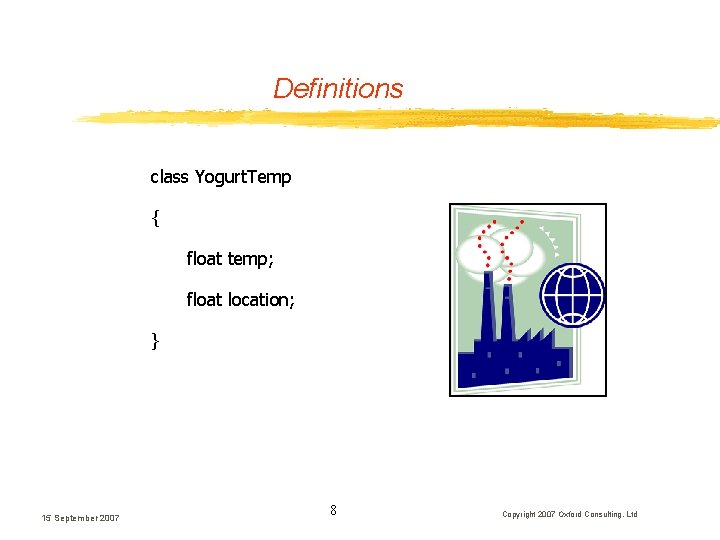
Definitions class Yogurt. Temp { float temp; float location; } 15 September 2007 8 Copyright 2007 Oxford Consulting, Ltd
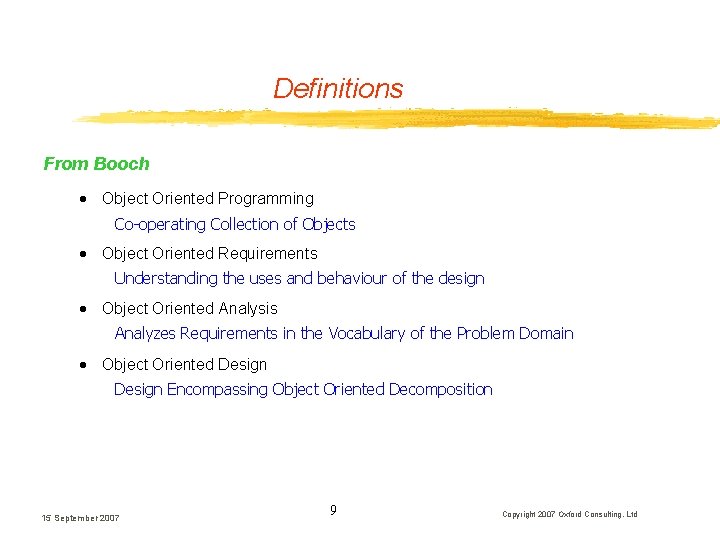
Definitions From Booch · Object Oriented Programming Co-operating Collection of Objects · Object Oriented Requirements Understanding the uses and behaviour of the design · Object Oriented Analysis Analyzes Requirements in the Vocabulary of the Problem Domain · Object Oriented Design Encompassing Object Oriented Decomposition 15 September 2007 9 Copyright 2007 Oxford Consulting, Ltd
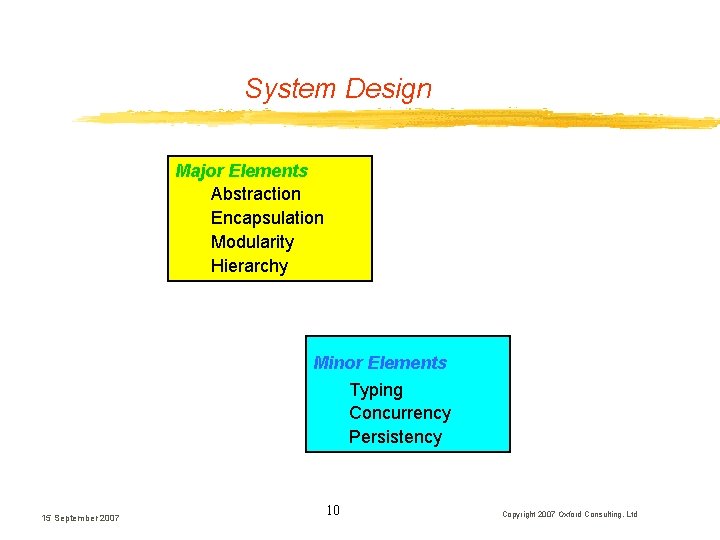
System Design Major Elements Abstraction Encapsulation Modularity Hierarchy Minor Elements Typing Concurrency Persistency 15 September 2007 10 Copyright 2007 Oxford Consulting, Ltd
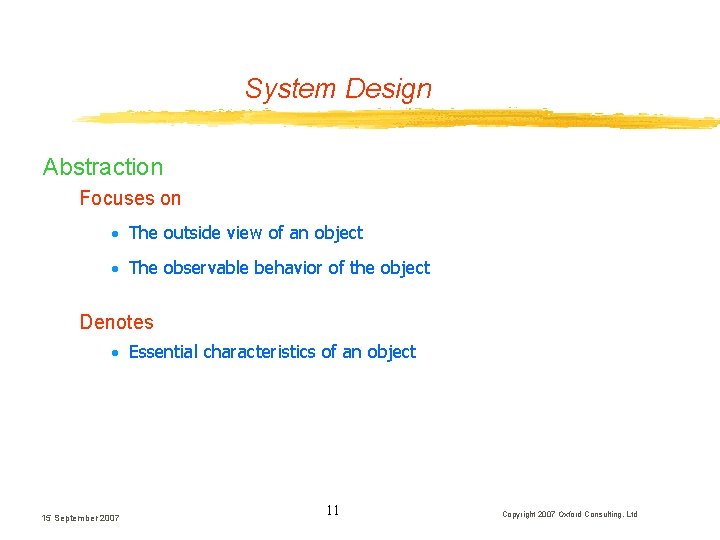
System Design Abstraction Focuses on · The outside view of an object · The observable behavior of the object Denotes · Essential characteristics of an object 15 September 2007 11 Copyright 2007 Oxford Consulting, Ltd
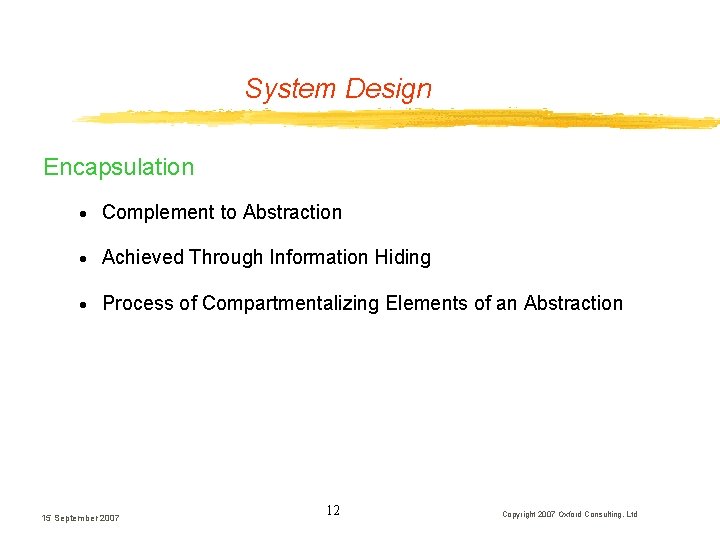
System Design Encapsulation · Complement to Abstraction · Achieved Through Information Hiding · Process of Compartmentalizing Elements of an Abstraction 15 September 2007 12 Copyright 2007 Oxford Consulting, Ltd
System Design Modularity · Act of Partitioning a Program into Individual Components · Modules Serve as Physical Containers · Property of a System Decomposed into Loosely Coupled Modules 15 September 2007 13 Copyright 2007 Oxford Consulting, Ltd
System Design Modularity Considerations · Modules Serve as Indivisible Units of Software · Many Compilers Generate Object Code in Segments · Work Assignments · Rapidly Stabilize Module Interfaces · Security 15 September 2007 14 Copyright 2007 Oxford Consulting, Ltd
System Design Hierarchy · A Set of Abstractions Forms a Hierarchy · Simplifies Understanding the Problem · Ranking or Ordering of Abstractions 15 September 2007 15 Copyright 2007 Oxford Consulting, Ltd
System Design Kinds of Hierarchies Most Important IS-A HAS-A Supporting CREATES-A USES-A 15 September 2007 16 Copyright 2007 Oxford Consulting, Ltd
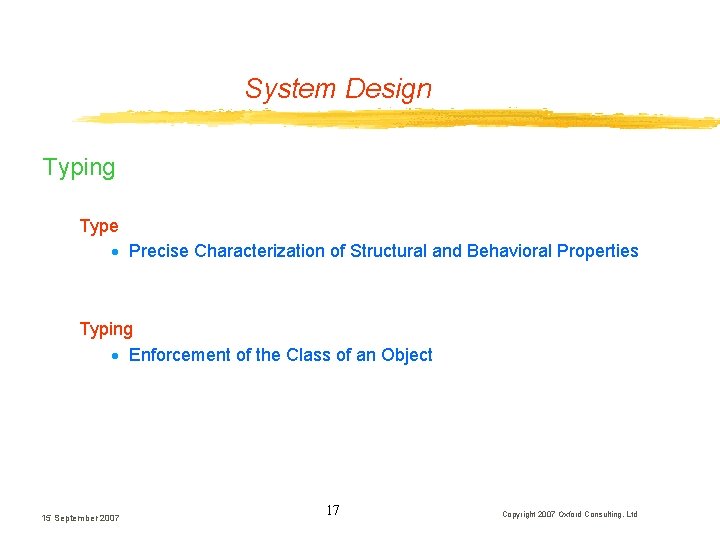
System Design Typing Type · Precise Characterization of Structural and Behavioral Properties Typing · Enforcement of the Class of an Object 15 September 2007 17 Copyright 2007 Oxford Consulting, Ltd
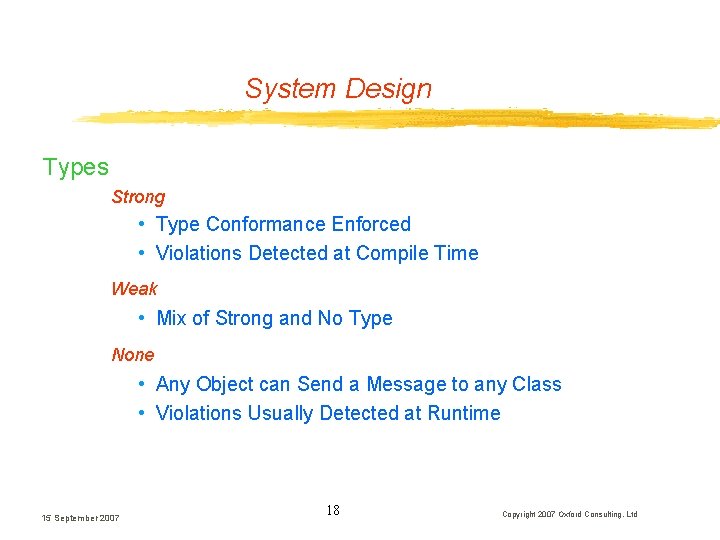
System Design Types Strong • Type Conformance Enforced • Violations Detected at Compile Time Weak • Mix of Strong and No Type None • Any Object can Send a Message to any Class • Violations Usually Detected at Runtime 15 September 2007 18 Copyright 2007 Oxford Consulting, Ltd
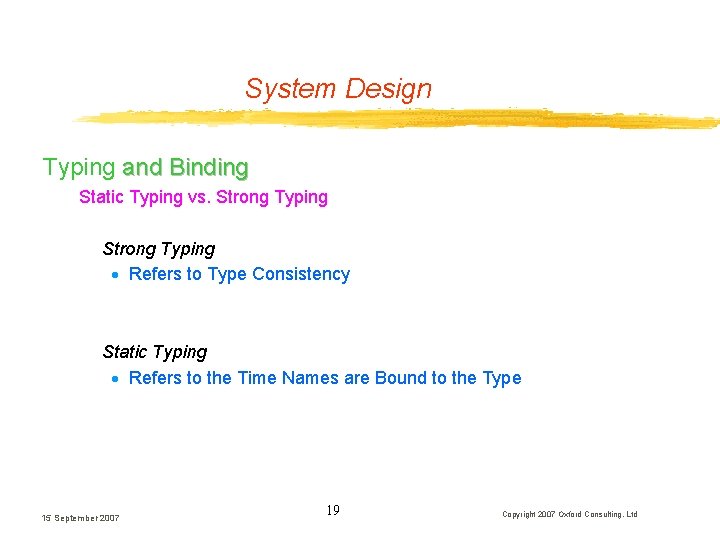
System Design Typing and Binding Static Typing vs. Strong Typing · Refers to Type Consistency Static Typing · Refers to the Time Names are Bound to the Type 15 September 2007 19 Copyright 2007 Oxford Consulting, Ltd
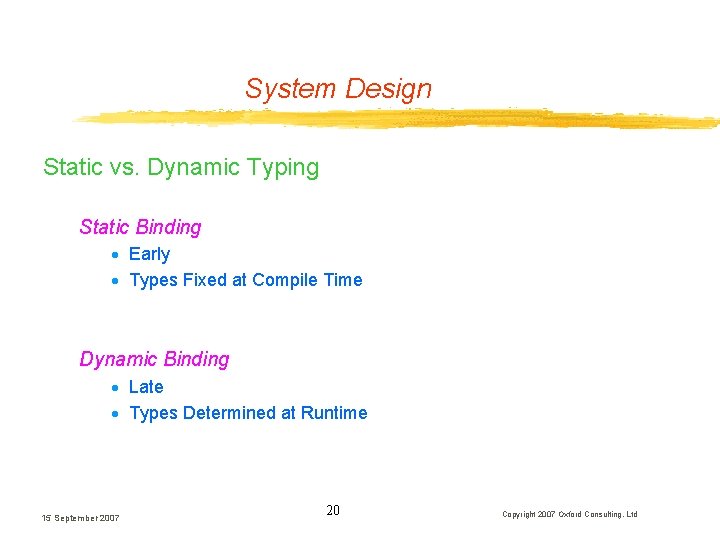
System Design Static vs. Dynamic Typing Static Binding · Early · Types Fixed at Compile Time Dynamic Binding · Late · Types Determined at Runtime 15 September 2007 20 Copyright 2007 Oxford Consulting, Ltd
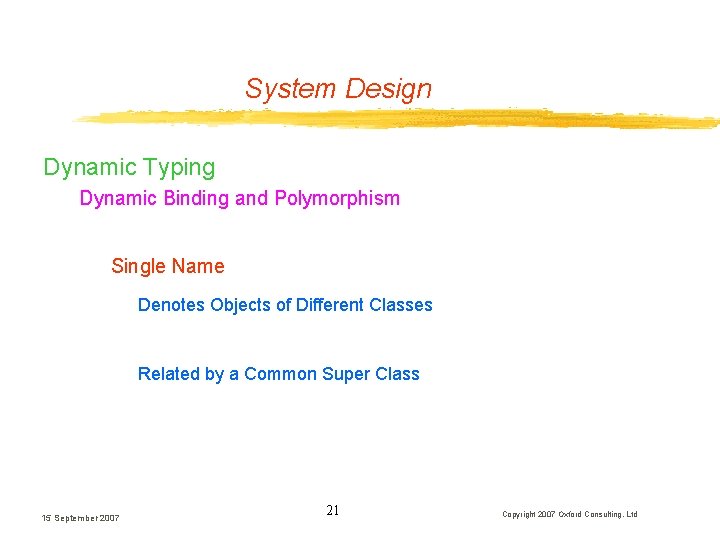
System Design Dynamic Typing Dynamic Binding and Polymorphism Single Name Denotes Objects of Different Classes Related by a Common Super Class 15 September 2007 21 Copyright 2007 Oxford Consulting, Ltd
System Design Concurrency Ability to Handle Different Events Simultaneously • Heavyweight Processes • Lightweight Processes Focuses on Process Abstraction and Synchronization 15 September 2007 22 Copyright 2007 Oxford Consulting, Ltd
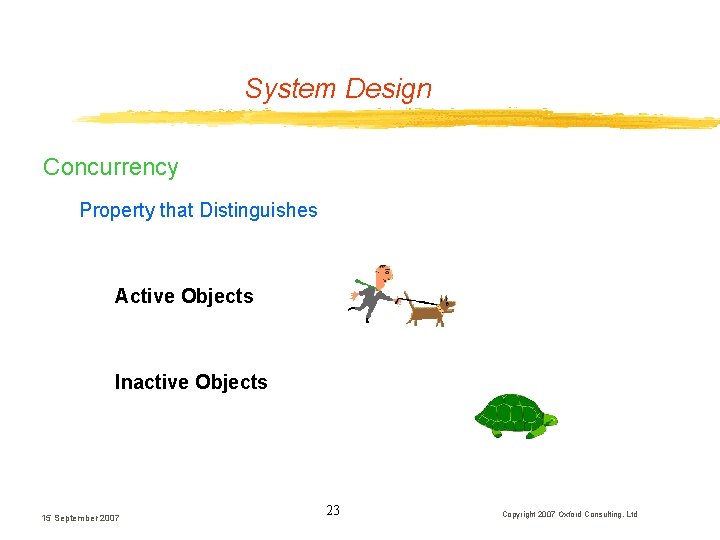
System Design Concurrency Property that Distinguishes Active Objects Inactive Objects 15 September 2007 23 Copyright 2007 Oxford Consulting, Ltd
System Design Persistence Range · Transient Appears in Expression Evaluation · Local Variables · Extent Different from Scope · Exists Between Executions of the Program · Exists Between Versions of the Program · Outlives the Program 15 September 2007 24 Copyright 2007 Oxford Consulting, Ltd
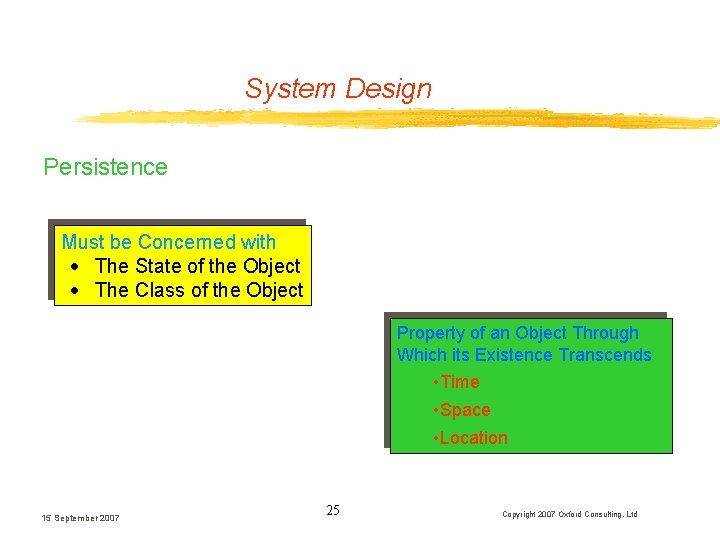
System Design Persistence Must be Concerned with · The State of the Object · The Class of the Object Property of an Object Through Which its Existence Transcends • Time • Space • Location 15 September 2007 25 Copyright 2007 Oxford Consulting, Ltd
System Design Getting Started Development of Systems Requires Knowledge About… • Problem • Tools and Techniques • Methods 15 September 2007 26 Copyright 2007 Oxford Consulting, Ltd
System Design Life Cycle Models Independent of design methodology we have what we call a product life cycle A life cycle comprises necessary steps or processes necessary to execute a design using the methodology 15 September 2007 27 Copyright 2007 Oxford Consulting, Ltd
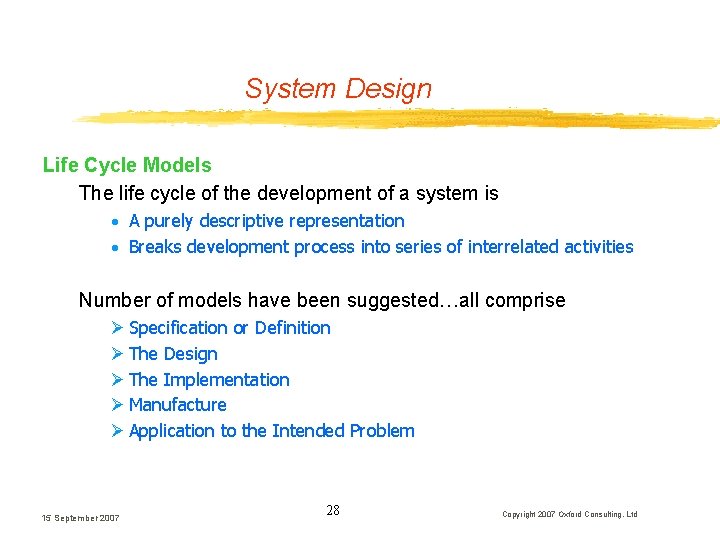
System Design Life Cycle Models The life cycle of the development of a system is · A purely descriptive representation · Breaks development process into series of interrelated activities Number of models have been suggested…all comprise Ø Specification or Definition Ø The Design Ø The Implementation Ø Manufacture Ø Application to the Intended Problem 15 September 2007 28 Copyright 2007 Oxford Consulting, Ltd
System Design Life Cycle Models Several of historically more common · Waterfall · Contractual · V cycle · Spiral · Rapid Prototype 15 September 2007 29 Copyright 2007 Oxford Consulting, Ltd
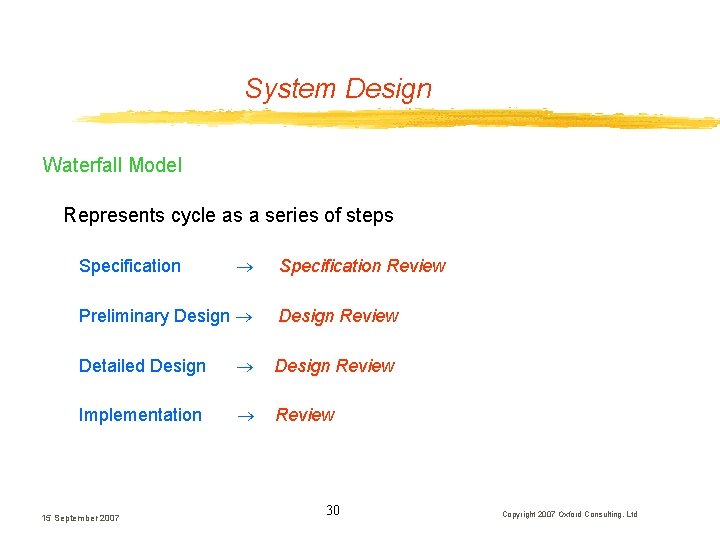
System Design Waterfall Model Represents cycle as a series of steps Specification Review Preliminary Design Review Detailed Design Review Implementation Review 15 September 2007 30 Copyright 2007 Oxford Consulting, Ltd
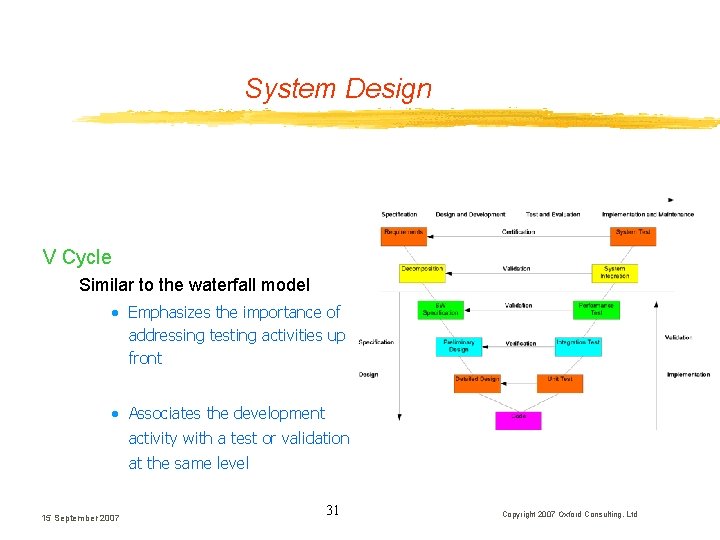
System Design V Cycle Similar to the waterfall model · Emphasizes the importance of addressing testing activities up front · Associates the development activity with a test or validation at the same level 15 September 2007 31 Copyright 2007 Oxford Consulting, Ltd
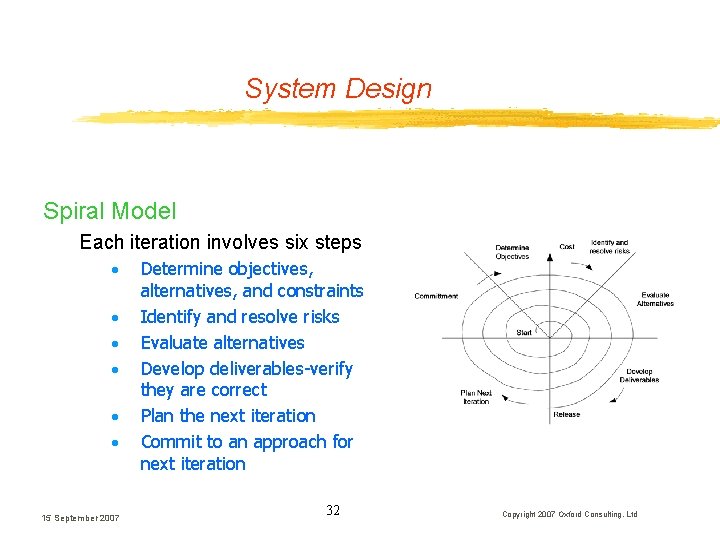
System Design Spiral Model Each iteration involves six steps · · · 15 September 2007 Determine objectives, alternatives, and constraints Identify and resolve risks Evaluate alternatives Develop deliverables-verify they are correct Plan the next iteration Commit to an approach for next iteration 32 Copyright 2007 Oxford Consulting, Ltd
System Design Rapid Prototyping – An Incremental Approach Used to develop a quick implementation of software and hardware Allows developers to construct hardware and software in incremental stages Each stage adds additional functionality Each stage consists of design, code and unit test, integration test and delivery 15 September 2007 33 Copyright 2007 Oxford Consulting, Ltd
System Design Rapid Prototyping – An Incremental Approach The prototype is used several ways Developer Enables rapid development of major functionality of system Establishes structural architecture and flow of control Permits one to identify major problems early Customer uses the prototype in a real world context Provides feedback to the Developers as to its strengths and weaknesses 15 September 2007 34 Copyright 2007 Oxford Consulting, Ltd
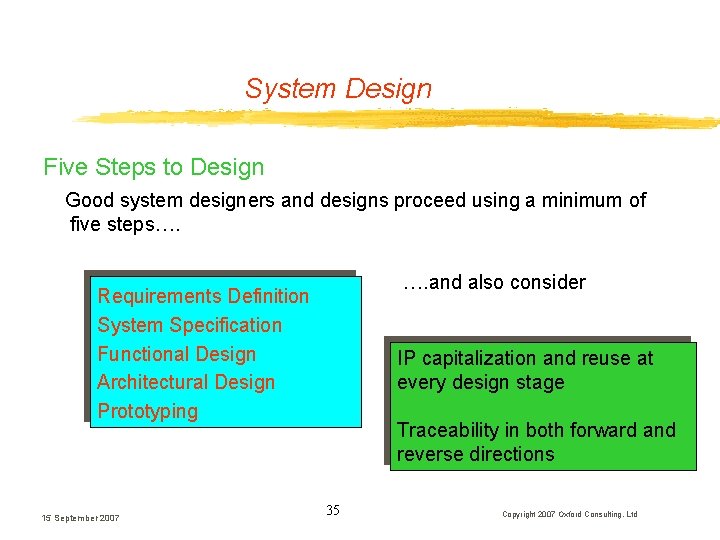
System Design Five Steps to Design Good system designers and designs proceed using a minimum of five steps…. …. and also consider Requirements Definition System Specification Functional Design Architectural Design Prototyping 15 September 2007 IP capitalization and reuse at every design stage Traceability in both forward and reverse directions 35 Copyright 2007 Oxford Consulting, Ltd
System Design Requirements Definition • Process of understanding what the needs of all interested parties are • Documenting these needs as written definitions and descriptions 15 September 2007 36 Copyright 2007 Oxford Consulting, Ltd
System Design Purpose of the Specification step is to • Capture and express a purely external view of the system • Identify WHAT needs to be done • Develop a complete modeling of the system behavior 15 September 2007 37 Copyright 2007 Oxford Consulting, Ltd
System Design Specification Based upon the System Requirements Specification Specifies the how of the design not the what Written in the designer’s language From the designer’s point of view Serves as bridge between the customer and designer 15 September 2007 38 Copyright 2007 Oxford Consulting, Ltd
System Design Specification Requirements Specification · Provides a view from the outside of the system looking in Design Specification · Provides a view from the inside looking out as well 15 September 2007 39 Copyright 2007 Oxford Consulting, Ltd
System Design Specification must · Formalize requirements in precise, unambiguous language · Should be clear, robust, and complete 15 September 2007 40 Copyright 2007 Oxford Consulting, Ltd
System Design Functional Design Purpose is to find an appropriate internal architecture for the system…. . …. that explains the HOW the identified requirements are implemented according to an application-oriented viewpoint 15 September 2007 41 Copyright 2007 Oxford Consulting, Ltd
System Design Functional Design A first functional decomposition is carried out based upon a search of essential internal variables and events in the system The design process then consists of successive refinements or decompositions for each function 15 September 2007 42 Copyright 2007 Oxford Consulting, Ltd
System Design Architectural Design In executing an architectural design our goal is to define or develop the detailed solution Consists of searching. . . ü Firstly for an architecture ü Secondly for the mapping of each functional module onto the physical software module(s) or blocks 15 September 2007 43 Copyright 2007 Oxford Consulting, Ltd
System Design Prototyping The prototype phase leads to an operational system prototype Prototype implementation includes. . . • Testing • Debugging • Validation 15 September 2007 44 Copyright 2007 Oxford Consulting, Ltd