
Introduction to Design Patterns What is Design Pattern
- Slides: 15
Introduction to Design Patterns • • What is Design Pattern? The Container Pattern. The Visitor Pattern. The Searchable. Container Pattern. The Iterator Pattern. The Association Pattern. Review Questions.
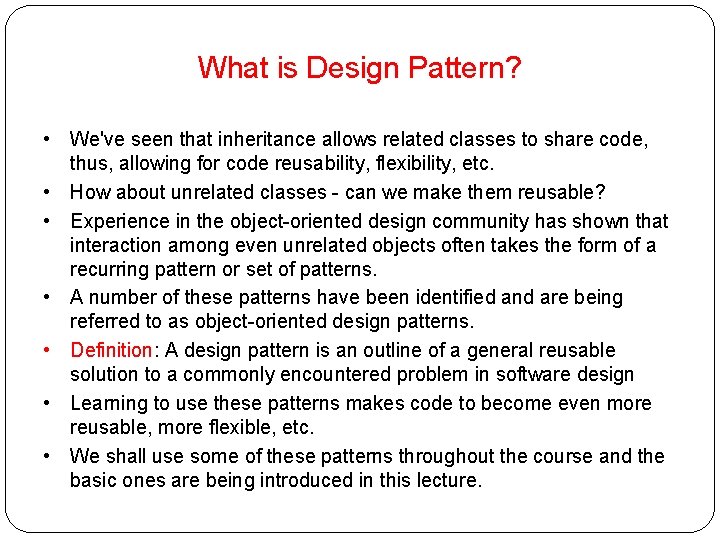
What is Design Pattern? • We've seen that inheritance allows related classes to share code, thus, allowing for code reusability, flexibility, etc. • How about unrelated classes - can we make them reusable? • Experience in the object-oriented design community has shown that interaction among even unrelated objects often takes the form of a recurring pattern or set of patterns. • A number of these patterns have been identified and are being referred to as object-oriented design patterns. • Definition: A design pattern is an outline of a general reusable solution to a commonly encountered problem in software design • Learning to use these patterns makes code to become even more reusable, more flexible, etc. • We shall use some of these patterns throughout the course and the basic ones are being introduced in this lecture.
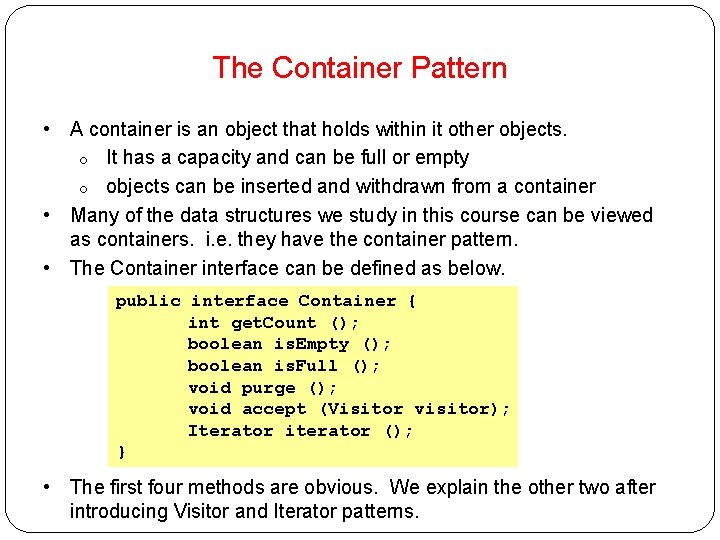
The Container Pattern • A container is an object that holds within it other objects. o It has a capacity and can be full or empty o objects can be inserted and withdrawn from a container • Many of the data structures we study in this course can be viewed as containers. i. e. they have the container pattern. • The Container interface can be defined as below. public interface Container { int get. Count (); boolean is. Empty (); boolean is. Full (); void purge (); void accept (Visitor visitor); Iterator iterator (); } • The first four methods are obvious. We explain the other two after introducing Visitor and Iterator patterns.
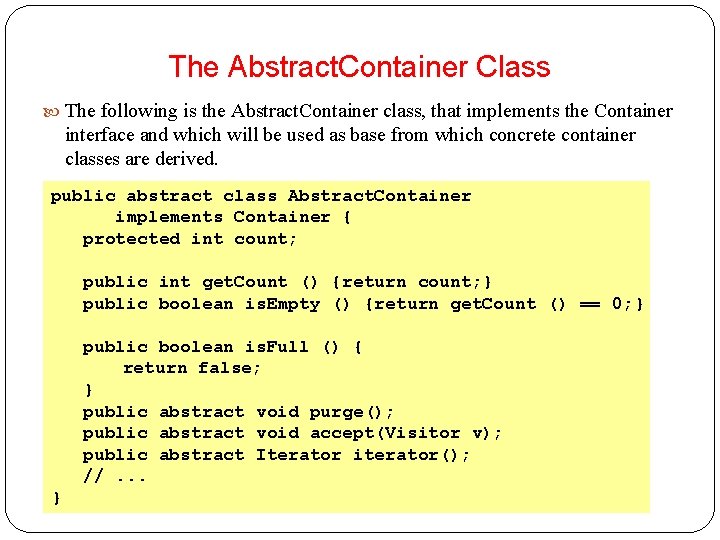
The Abstract. Container Class The following is the Abstract. Container class, that implements the Container interface and which will be used as base from which concrete container classes are derived. public abstract class Abstract. Container implements Container { protected int count; public int get. Count () {return count; } public boolean is. Empty () {return get. Count () == 0; } public boolean is. Full () { return false; } public abstract void purge(); public abstract void accept(Visitor v); public abstract Iterator iterator(); //. . . }
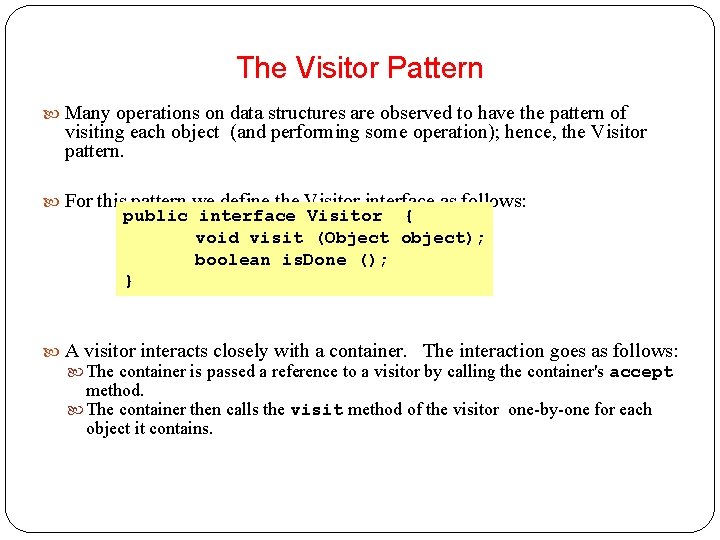
The Visitor Pattern Many operations on data structures are observed to have the pattern of visiting each object (and performing some operation); hence, the Visitor pattern. For this pattern we define the Visitor interface as follows: public interface Visitor { void visit (Object object); boolean is. Done (); } A visitor interacts closely with a container. The interaction goes as follows: The container is passed a reference to a visitor by calling the container's accept method. The container then calls the visit method of the visitor one-by-one for each object it contains.
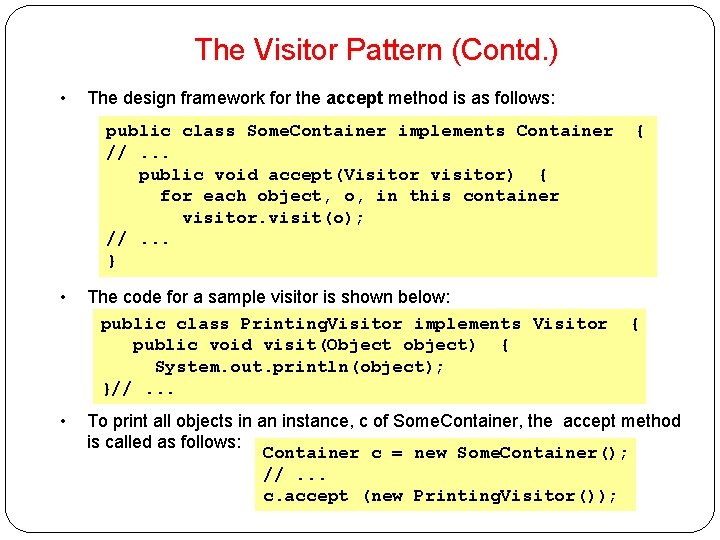
The Visitor Pattern (Contd. ) • The design framework for the accept method is as follows: public class Some. Container implements Container //. . . public void accept(Visitor visitor) { for each object, o, in this container visitor. visit(o); //. . . } • • The code for a sample visitor is shown below: public class Printing. Visitor implements Visitor public void visit(Object object) { System. out. println(object); }//. . . { { To print all objects in an instance, c of Some. Container, the accept method is called as follows: Container c = new Some. Container(); //. . . c. accept (new Printing. Visitor());
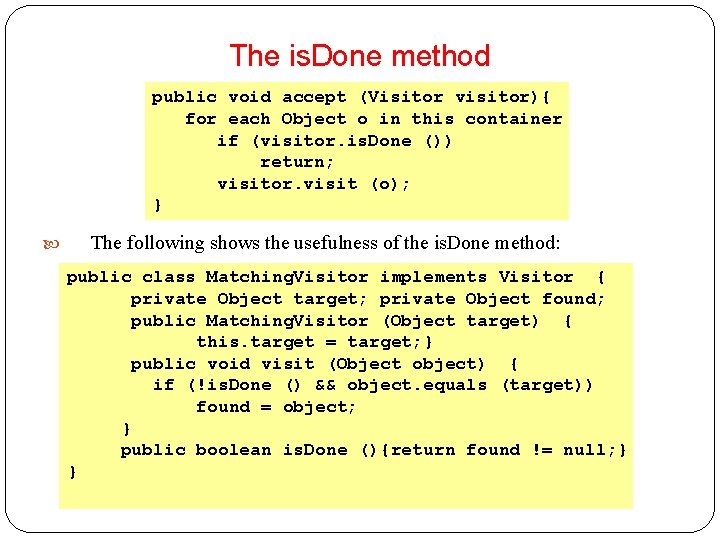
The is. Done method public void accept (Visitor visitor){ for each Object o in this container if (visitor. is. Done ()) return; visitor. visit (o); } The following shows the usefulness of the is. Done method: public class Matching. Visitor implements Visitor { private Object target; private Object found; public Matching. Visitor (Object target) { this. target = target; } public void visit (Object object) { if (!is. Done () && object. equals (target)) found = object; } public boolean is. Done (){return found != null; } }
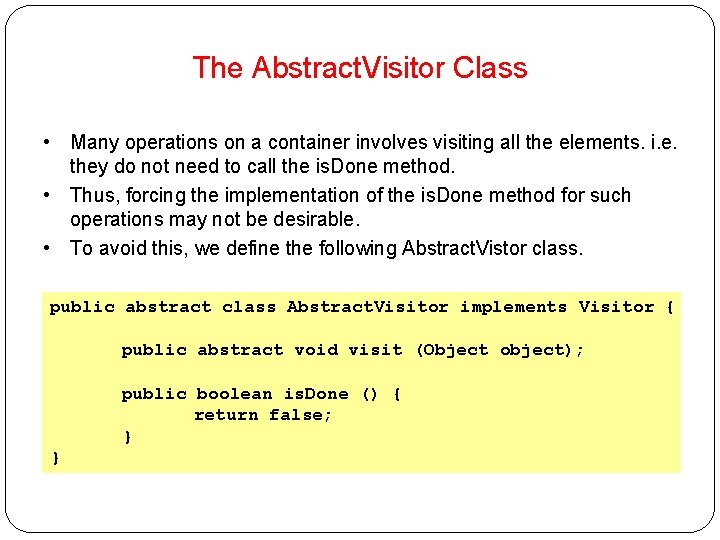
The Abstract. Visitor Class • Many operations on a container involves visiting all the elements. i. e. they do not need to call the is. Done method. • Thus, forcing the implementation of the is. Done method for such operations may not be desirable. • To avoid this, we define the following Abstract. Vistor class. public abstract class Abstract. Visitor implements Visitor { public abstract void visit (Object object); public boolean is. Done () { return false; } }
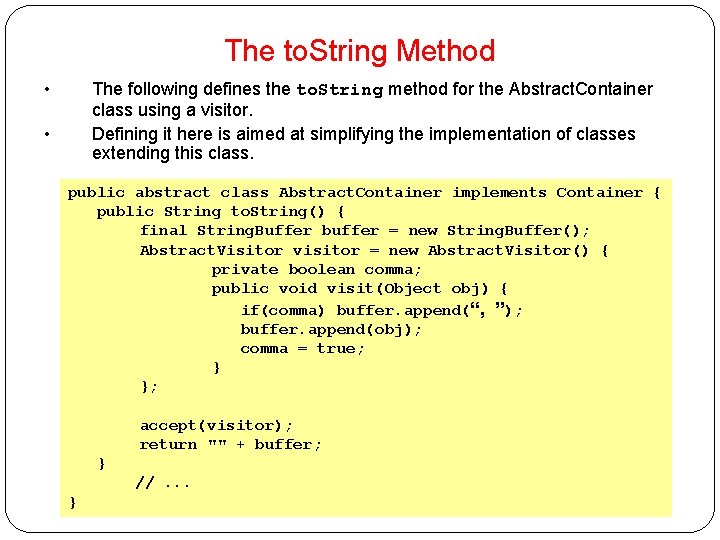
The to. String Method • The following defines the to. String method for the Abstract. Container class using a visitor. Defining it here is aimed at simplifying the implementation of classes extending this class. • public abstract class Abstract. Container implements Container { public String to. String() { final String. Buffer buffer = new String. Buffer(); Abstract. Visitor visitor = new Abstract. Visitor() { private boolean comma; public void visit(Object obj) { if(comma) buffer. append(“, ”); buffer. append(obj); comma = true; } }; accept(visitor); return "" + buffer; } //. . . }
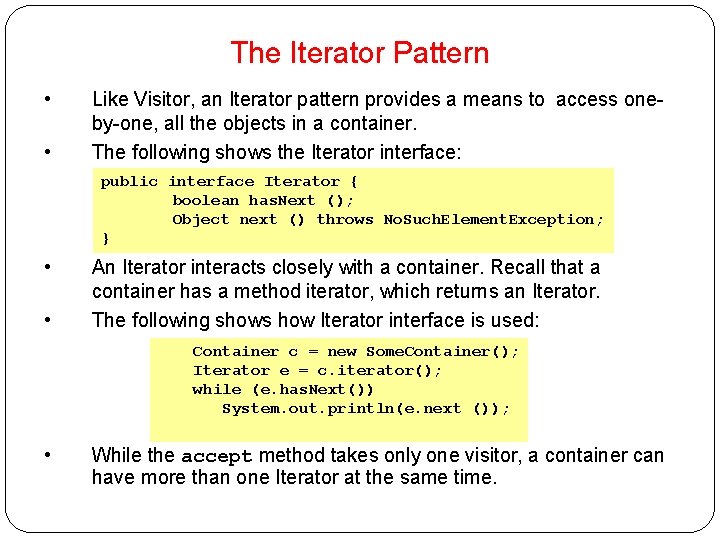
The Iterator Pattern • • Like Visitor, an Iterator pattern provides a means to access oneby-one, all the objects in a container. The following shows the Iterator interface: public interface Iterator { boolean has. Next (); Object next () throws No. Such. Element. Exception; } • • An Iterator interacts closely with a container. Recall that a container has a method iterator, which returns an Iterator. The following shows how Iterator interface is used: Container c = new Some. Container(); Iterator e = c. iterator(); while (e. has. Next()) System. out. println(e. next ()); • While the accept method takes only one visitor, a container can have more than one Iterator at the same time.
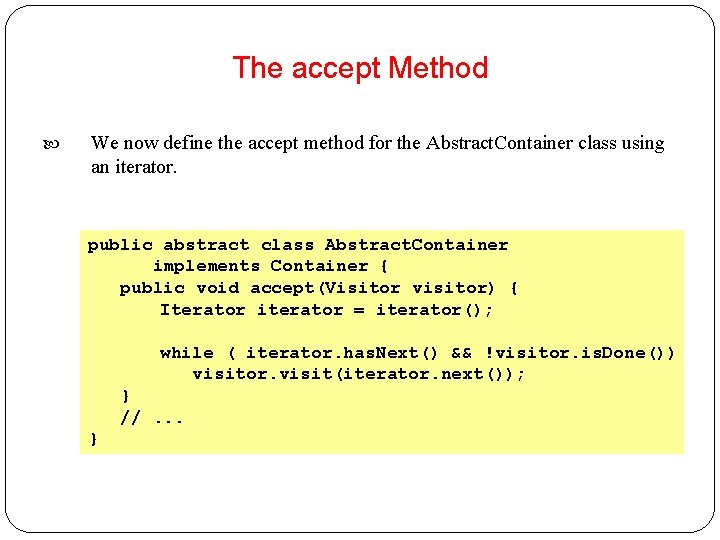
The accept Method We now define the accept method for the Abstract. Container class using an iterator. public abstract class Abstract. Container implements Container { public void accept(Visitor visitor) { Iterator iterator = iterator(); while ( iterator. has. Next() && !visitor. is. Done()) visitor. visit(iterator. next()); } //. . . }
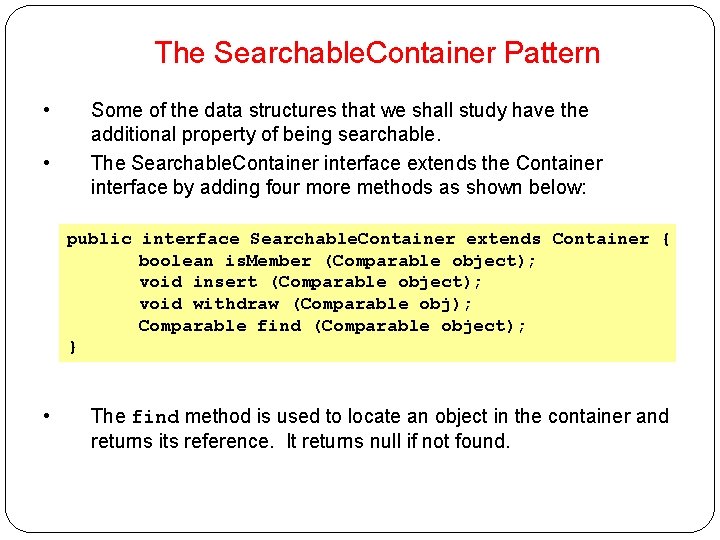
The Searchable. Container Pattern • • Some of the data structures that we shall study have the additional property of being searchable. The Searchable. Container interface extends the Container interface by adding four more methods as shown below: public interface Searchable. Container extends Container { boolean is. Member (Comparable object); void insert (Comparable object); void withdraw (Comparable obj); Comparable find (Comparable object); } • The find method is used to locate an object in the container and returns its reference. It returns null if not found.
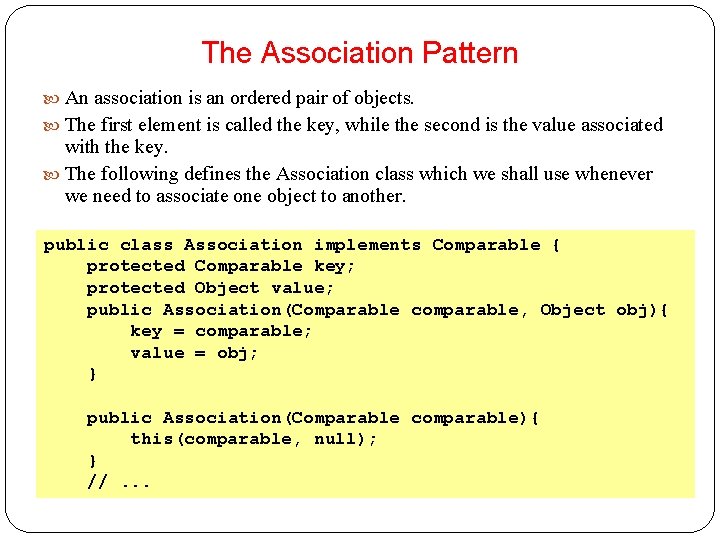
The Association Pattern An association is an ordered pair of objects. The first element is called the key, while the second is the value associated with the key. The following defines the Association class which we shall use whenever we need to associate one object to another. public class Association implements Comparable { protected Comparable key; protected Object value; public Association(Comparable comparable, Object obj){ key = comparable; value = obj; } public Association(Comparable comparable){ this(comparable, null); } //. . .
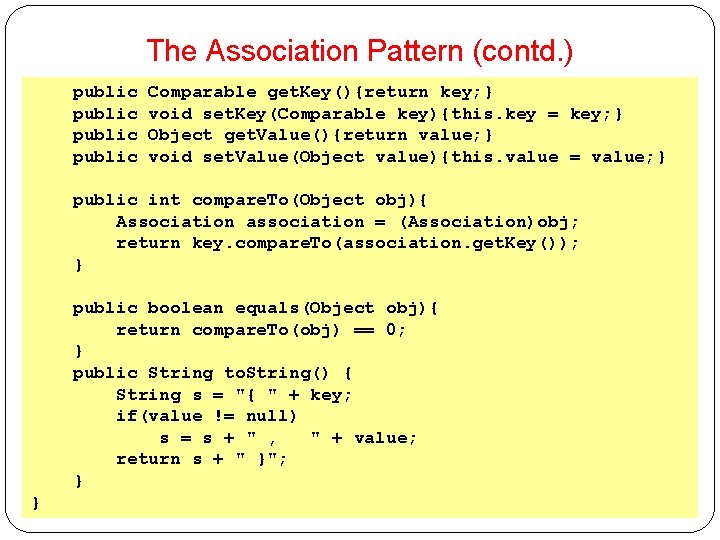
The Association Pattern (contd. ) public Comparable get. Key(){return key; } void set. Key(Comparable key){this. key = key; } Object get. Value(){return value; } void set. Value(Object value){this. value = value; } public int compare. To(Object obj){ Association association = (Association)obj; return key. compare. To(association. get. Key()); } public boolean equals(Object obj){ return compare. To(obj) == 0; } public String to. String() { String s = "{ " + key; if(value != null) s = s + " , " + value; return s + " }"; } }
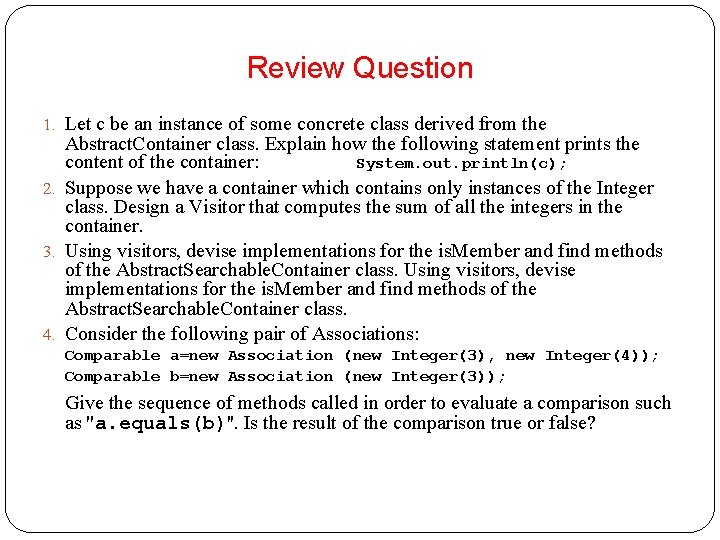
Review Question 1. Let c be an instance of some concrete class derived from the Abstract. Container class. Explain how the following statement prints the content of the container: System. out. println(c); 2. Suppose we have a container which contains only instances of the Integer class. Design a Visitor that computes the sum of all the integers in the container. 3. Using visitors, devise implementations for the is. Member and find methods of the Abstract. Searchable. Container class. 4. Consider the following pair of Associations: Comparable a=new Association (new Integer(3), new Integer(4)); Comparable b=new Association (new Integer(3)); Give the sequence of methods called in order to evaluate a comparison such as "a. equals(b)''. Is the result of the comparison true or false?