
Introduction to Design Patterns Slides adapted from Craig


![Table-based Solution private static final int [] scores. By. Char = {/* A */](https://slidetodoc.com/presentation_image_h/0a77f21988cab798a4f6907b9a707b1c/image-28.jpg "Table-based Solution private static final int [] scores. By. Char = {/* A */")
- Slides: 28
Introduction to Design Patterns Slides adapted from Craig Zilles 1
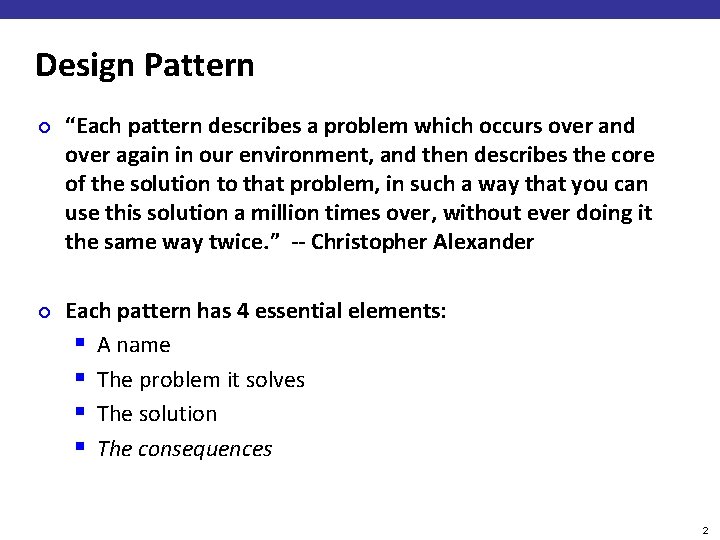
Design Pattern ¢ ¢ “Each pattern describes a problem which occurs over and over again in our environment, and then describes the core of the solution to that problem, in such a way that you can use this solution a million times over, without ever doing it the same way twice. ” -- Christopher Alexander Each pattern has 4 essential elements: § A name § The problem it solves § The solution § The consequences 2
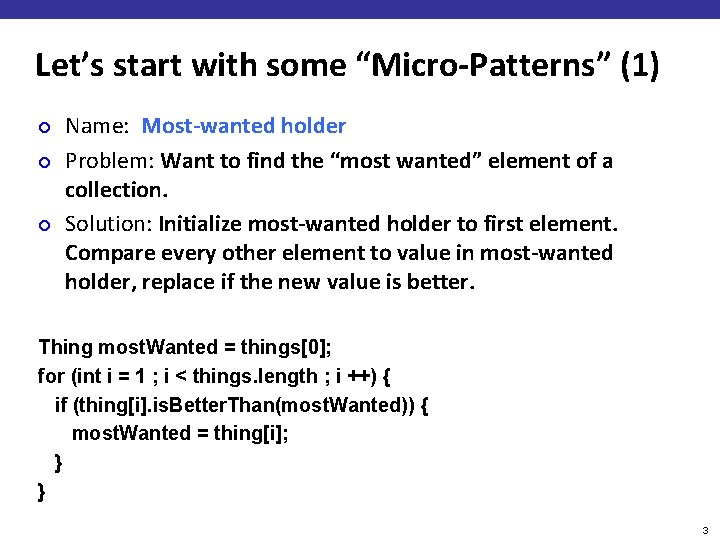
Let’s start with some “Micro-Patterns” (1) ¢ ¢ ¢ Name: Most-wanted holder Problem: Want to find the “most wanted” element of a collection. Solution: Initialize most-wanted holder to first element. Compare every other element to value in most-wanted holder, replace if the new value is better. Thing most. Wanted = things[0]; for (int i = 1 ; i < things. length ; i ++) { if (thing[i]. is. Better. Than(most. Wanted)) { most. Wanted = thing[i]; } } 3
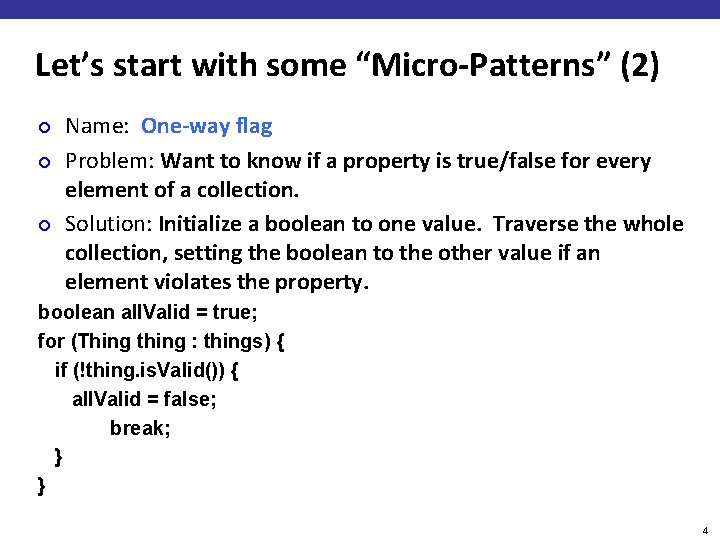
Let’s start with some “Micro-Patterns” (2) ¢ ¢ ¢ Name: One-way flag Problem: Want to know if a property is true/false for every element of a collection. Solution: Initialize a boolean to one value. Traverse the whole collection, setting the boolean to the other value if an element violates the property. boolean all. Valid = true; for (Thing thing : things) { if (!thing. is. Valid()) { all. Valid = false; break; } } 4
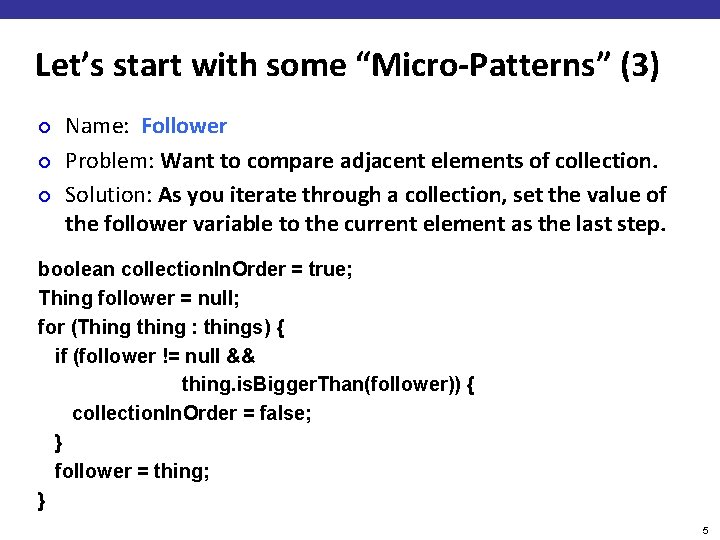
Let’s start with some “Micro-Patterns” (3) ¢ ¢ ¢ Name: Follower Problem: Want to compare adjacent elements of collection. Solution: As you iterate through a collection, set the value of the follower variable to the current element as the last step. boolean collection. In. Order = true; Thing follower = null; for (Thing thing : things) { if (follower != null && thing. is. Bigger. Than(follower)) { collection. In. Order = false; } follower = thing; } 5
Other ”Micro-Patterns” 6
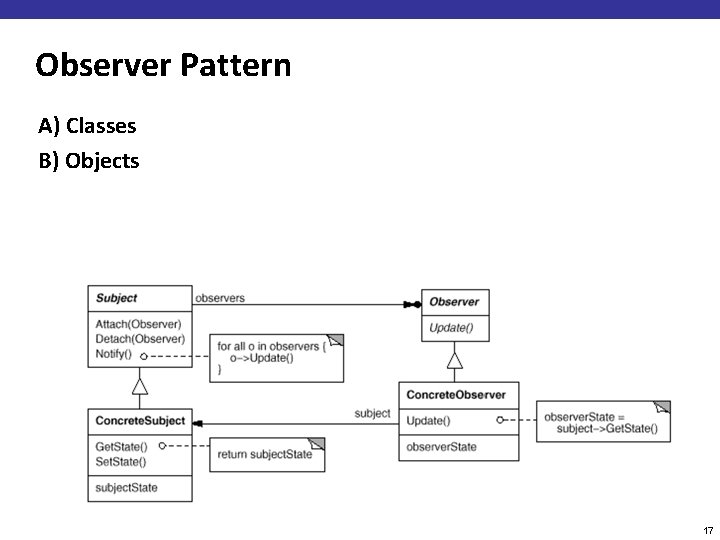
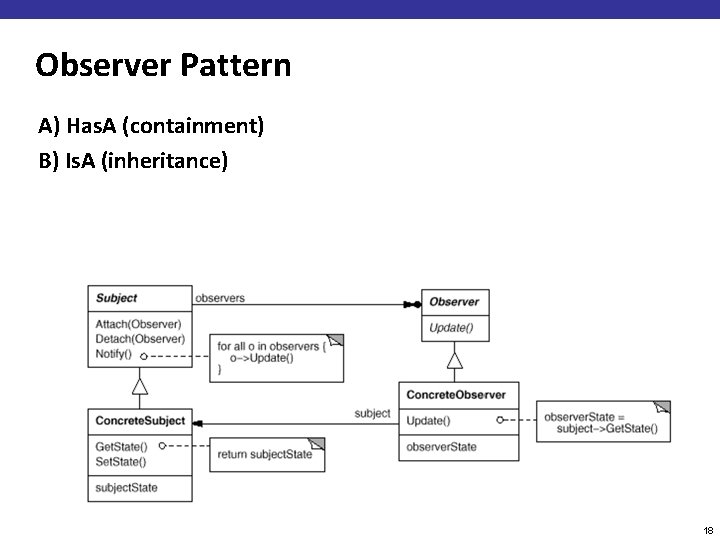
“Design Patterns” focus on object-level ¢ ¢ Relate to relationships between classes & objects § Is. A (inheritance) and Has. A (containment) relationships Many of these seem obvious (in hind sight) § The power is giving these names, codifying a best practice solution, and understanding their strengths/limitations. 7
UML Class Diagrams ¢ ¢ Unified Modeling Language (UML) § A standard for diagrammatic representations in software engineering. The Class Diagram is the main building block for objectoriented modeling; it shows: § the system's classes § their attributes and operations (or methods), and § the relationships among objects 8
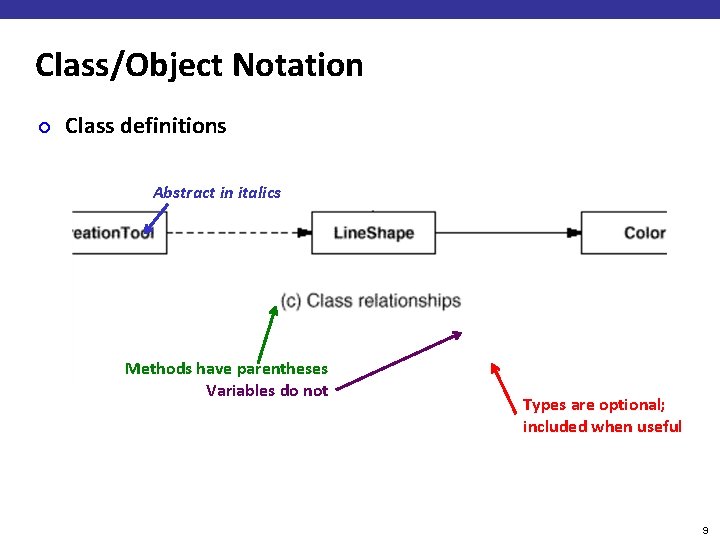
Class/Object Notation ¢ Class definitions Abstract in italics Methods have parentheses Variables do not Types are optional; included when useful 9
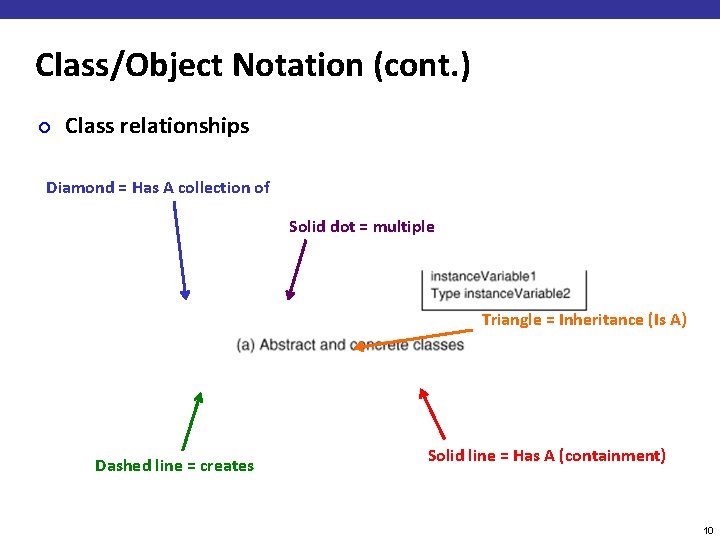
Class/Object Notation (cont. ) ¢ Class relationships Diamond = Has A collection of Solid dot = multiple Triangle = Inheritance (Is A) Dashed line = creates Solid line = Has A (containment) 10
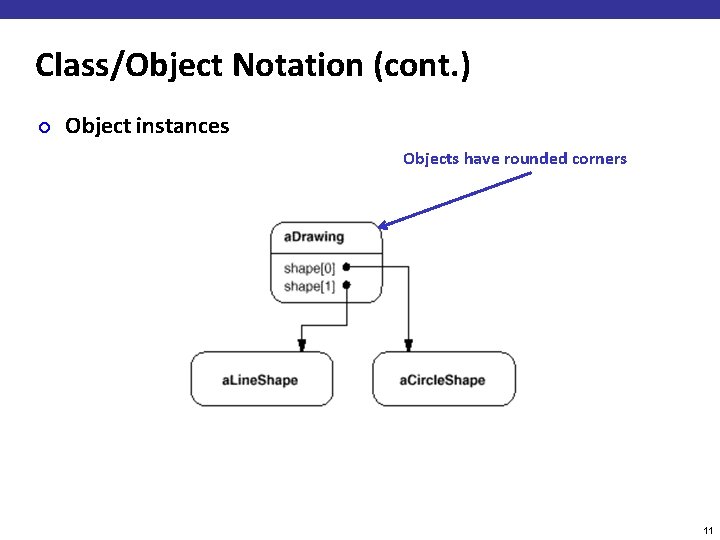
Class/Object Notation (cont. ) ¢ Object instances Objects have rounded corners 11
Strategy ¢ ¢ Intent: define a family of algorithms, encapsulate each one, and make them interchangable. Strategy lets the algorithm vary independently from clients that use it. Use the strategy pattern when: § Many related classes differ only in their behavior. § You need different variants of an algorithm (e. g. , trade-offs) § An algorithm uses data that clients shouldn’t know about § E. g. , encapsulate the algorithm data from client § A class defines multiple behaviors and these are implemented using conditionals. 13
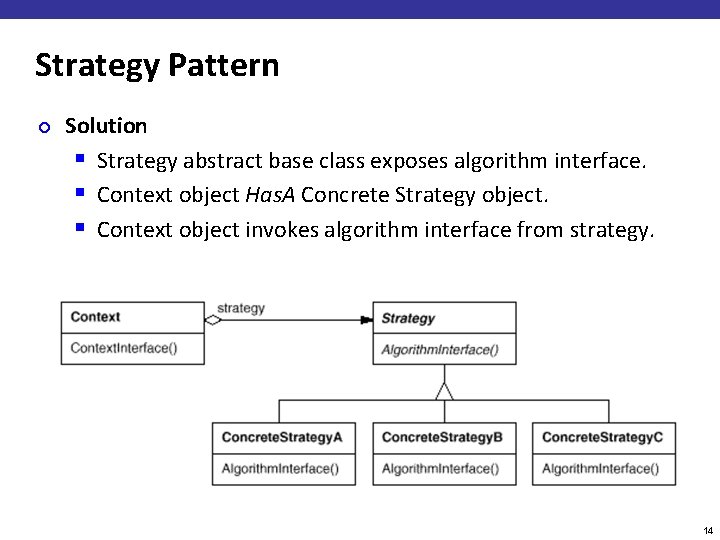
Strategy Pattern ¢ Solution § Strategy abstract base class exposes algorithm interface. § Context object Has. A Concrete Strategy object. § Context object invokes algorithm interface from strategy. 14
Problem: Social media updates ¢ You have your Insta. Twit. In. You. Face. Trest app open and a friend makes a post / updates their status. How do you get the info before the next time you (manually) refresh your app? 15
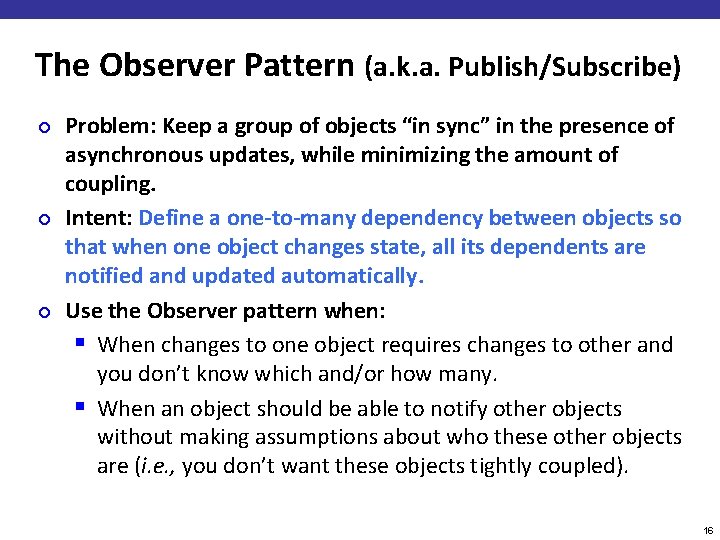
The Observer Pattern (a. k. a. Publish/Subscribe) ¢ ¢ ¢ Problem: Keep a group of objects “in sync” in the presence of asynchronous updates, while minimizing the amount of coupling. Intent: Define a one-to-many dependency between objects so that when one object changes state, all its dependents are notified and updated automatically. Use the Observer pattern when: § When changes to one object requires changes to other and you don’t know which and/or how many. § When an object should be able to notify other objects without making assumptions about who these other objects are (i. e. , you don’t want these objects tightly coupled). 16
Observer Pattern A) Classes B) Objects 17
Observer Pattern A) Has. A (containment) B) Is. A (inheritance) 18
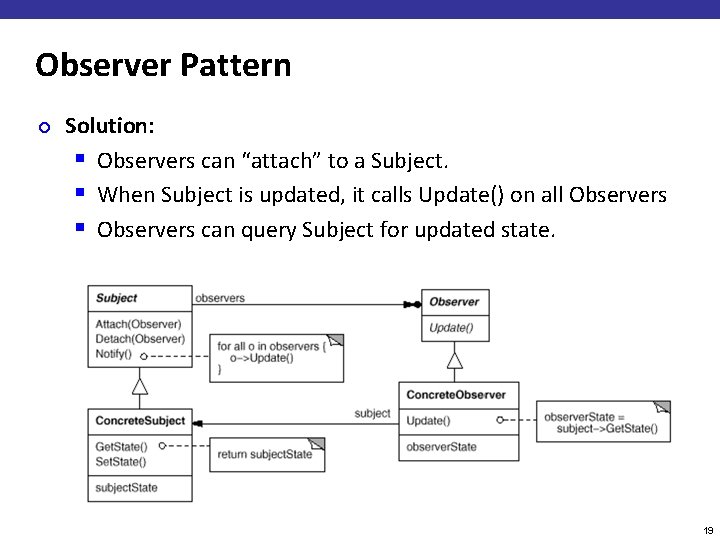
Observer Pattern ¢ Solution: § Observers can “attach” to a Subject. § When Subject is updated, it calls Update() on all Observers § Observers can query Subject for updated state. 19
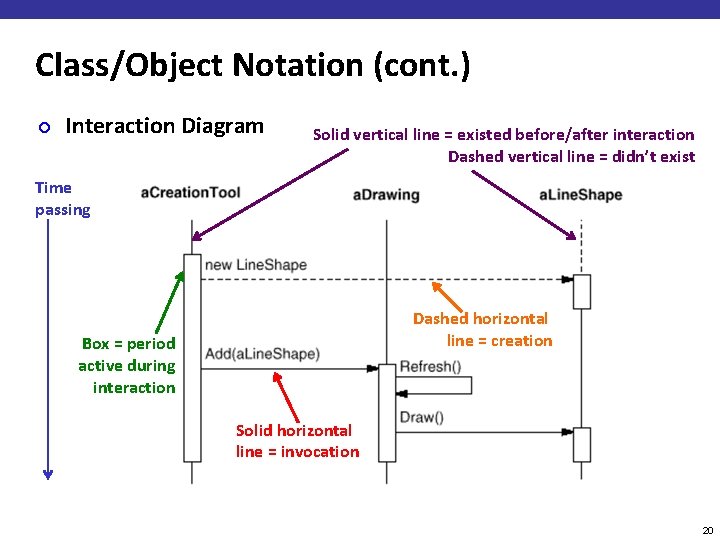
Class/Object Notation (cont. ) ¢ Interaction Diagram Solid vertical line = existed before/after interaction Dashed vertical line = didn’t exist Time passing Dashed horizontal line = creation Box = period active during interaction Solid horizontal line = invocation 20
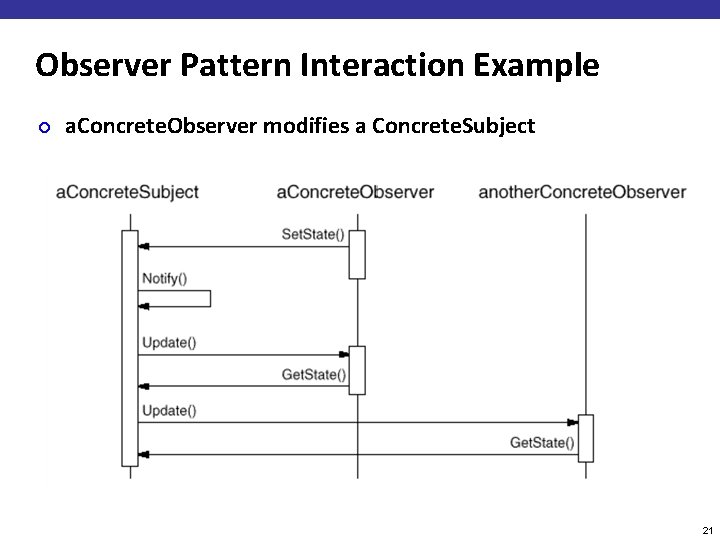
Observer Pattern Interaction Example ¢ a. Concrete. Observer modifies a Concrete. Subject 21
Adapter Pattern ¢ ¢ Intent: Convert the interface of a class into another interface that a client expects. Adapter lets classes work together that couldn’t otherwise because of incompatible interfaces. Use the Adapter pattern when: § You want to use an existing class and interface doesn’t match the one that you need § You want to create a reusable class that cooperates with unrelated and unforeseen classes (non-compatible interfaces) § You need to use several existing subclasses, but it’s impractical to adapt their interface by subclassing every one. 22
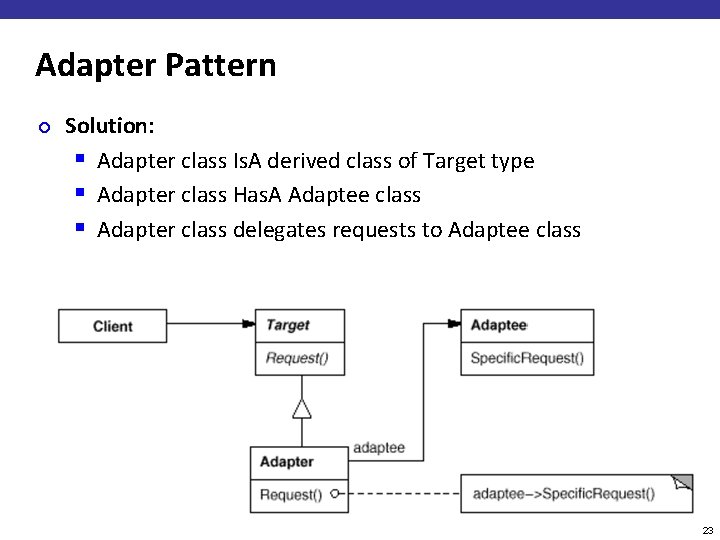
Adapter Pattern ¢ Solution: § Adapter class Is. A derived class of Target type § Adapter class Has. A Adaptee class § Adapter class delegates requests to Adaptee class 23
24
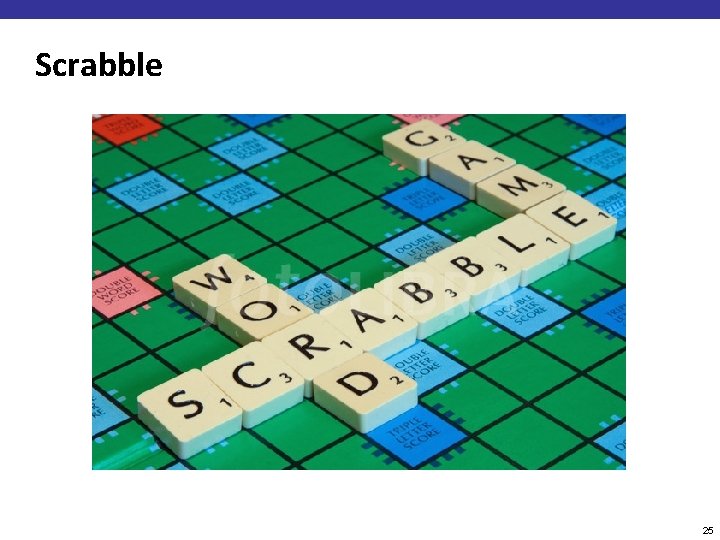
Scrabble 25
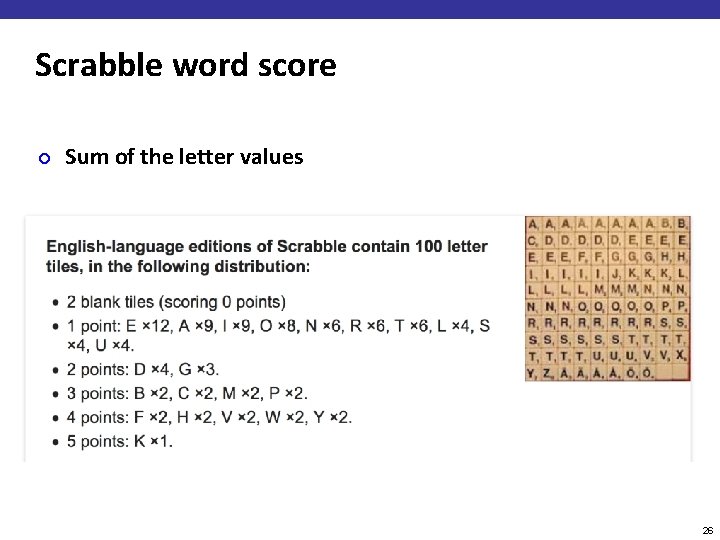
Scrabble word score ¢ Sum of the letter values 26
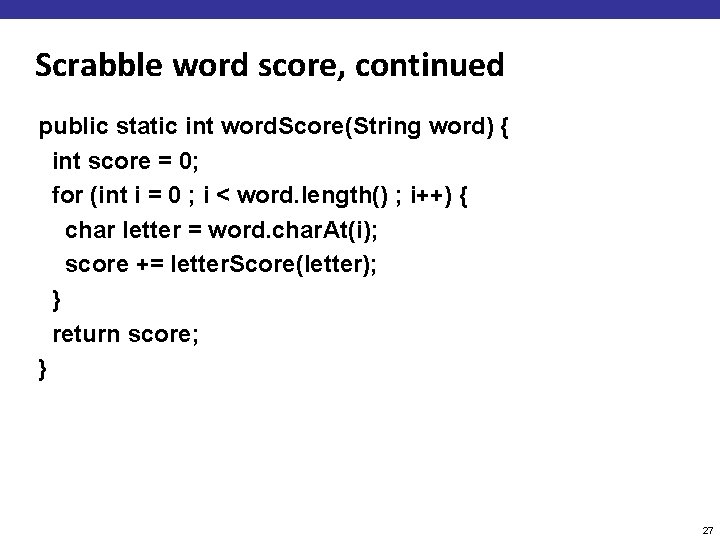
Scrabble word score, continued public static int word. Score(String word) { int score = 0; for (int i = 0 ; i < word. length() ; i++) { char letter = word. char. At(i); score += letter. Score(letter); } return score; } 27
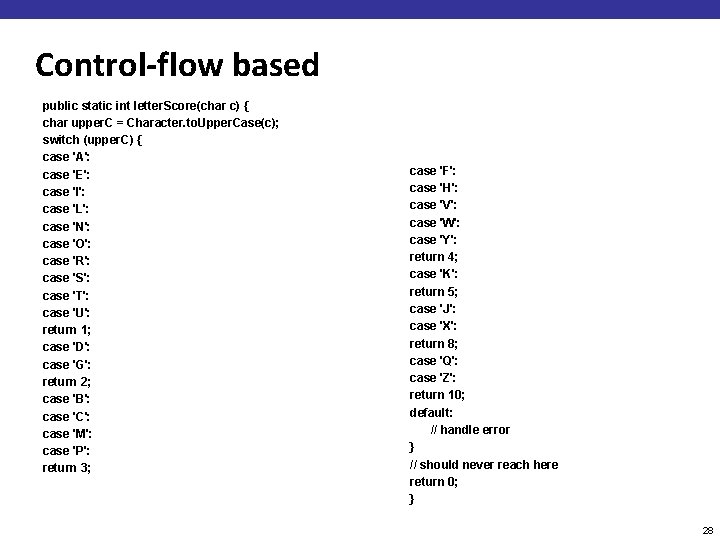
Control-flow based public static int letter. Score(char c) { char upper. C = Character. to. Upper. Case(c); switch (upper. C) { case 'A': case 'E': case 'I': case 'L': case 'N': case 'O': case 'R': case 'S': case 'T': case 'U': return 1; case 'D': case 'G': return 2; case 'B': case 'C': case 'M': case 'P': return 3; case 'F': case 'H': case 'V': case 'W': case 'Y': return 4; case 'K': return 5; case 'J': case 'X': return 8; case 'Q': case 'Z': return 10; default: // handle error } // should never reach here return 0; } 28
Table-based Solution private static final int [] scores. By. Char = {/* A */ 1, /* B */ 3, /* C */ 3, /* D */ 2, /* E */ 1, /* F */ 4, /* G */ 2, /* H */ 4, /* I */ 1, /* J */ 8, /* K */ 5, /* L */ 1, /* M */ 3, /* N */ 1, /* O */ 1, /* P */ 3, /* Q */ 10, /* R */ 1, /* S */ 1, /* T */ 1, /* U */ 1, /* V */ 4, /* W */ 4, /* X */ 8, /* Y */ 4, /* Z */ 10}; public static int letter. Score 2(char c) { char c. As. Uppercase = Character. to. Upper. Case(c); int index = c. As. Uppercase - 'A'; if (index < 0 || index >= 26) { // handle error } return scores. By. Char[index]; } 29