
Introduction to Decision Making Capacity Mental Health Act
- Slides: 12
Introduction to Decision Making Capacity Mental Health Act 2014 S
Acknowledgements S Thanks to Chief Psychiatrist in Tasmania, Dr Len Lambeth, for the use of the material on which this package is based S Mental Health Act Decision Making Capacity Training Package, Alcohol and Drug Directorate, Tasmanian Department of Health and Human Services
Purpose and contents This presentation is for audiences interested in the concept of assessment of decision making capacity relevant to MHA 2014. Medical Practitioners, Authorised Mental Health Practitioners and psychiatrists should access the CAPACITY Training Package or CAPACITY Face to Face training relevant to their professional group. Key Contents S What is capacity S General concepts S Capacity Assessment Principles S Capacity and the MHA 2014 S Capacity and adults S Capacity and children S Who can assess capacity?
What is Capacity? A person’s capacity is their mental ability (or competence) to make a decision for themselves. Generally speaking a person has capacity to make a decision if they can understand, retain and manipulate the relevant information rationally; reflect and make a judgement based on personal values and the situation and freely communicate a decision (see HDWA Consent Policy) For some types of decision there is a legal test for capacity
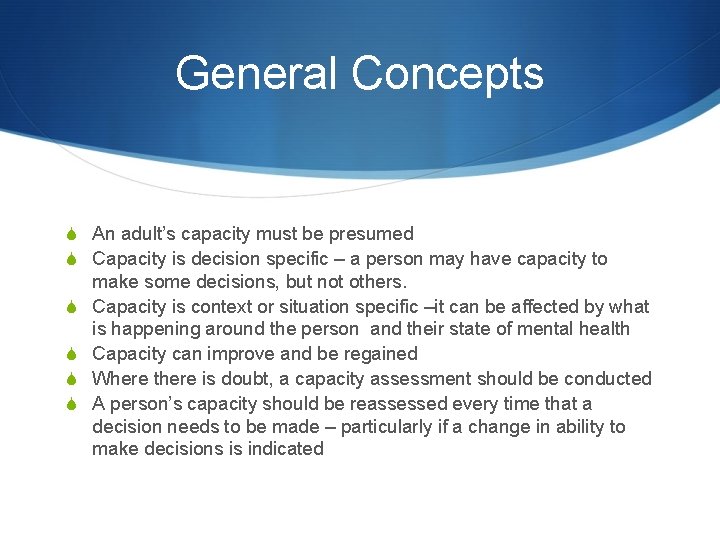
General Concepts S An adult’s capacity must be presumed S Capacity is decision specific – a person may have capacity to S S make some decisions, but not others. Capacity is context or situation specific –it can be affected by what is happening around the person and their state of mental health Capacity can improve and be regained Where there is doubt, a capacity assessment should be conducted A person’s capacity should be reassessed every time that a decision needs to be made – particularly if a change in ability to make decisions is indicated
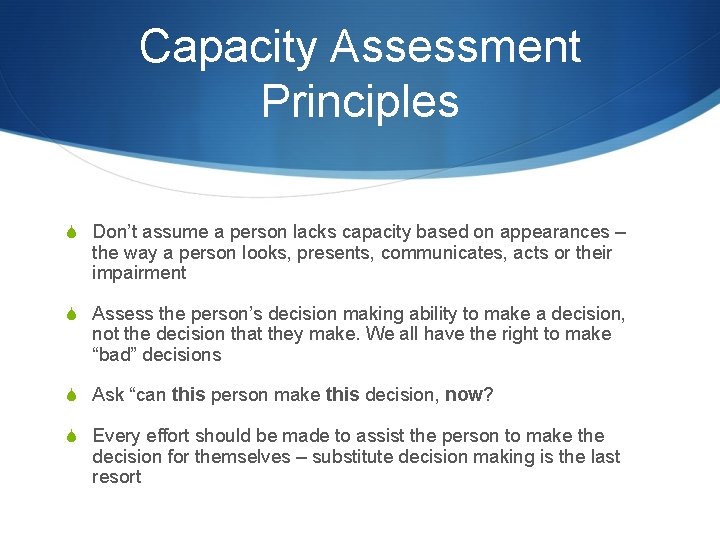
Capacity Assessment Principles S Don’t assume a person lacks capacity based on appearances – the way a person looks, presents, communicates, acts or their impairment S Assess the person’s decision making ability to make a decision, not the decision that they make. We all have the right to make “bad” decisions S Ask “can this person make this decision, now? S Every effort should be made to assist the person to make the decision for themselves – substitute decision making is the last resort
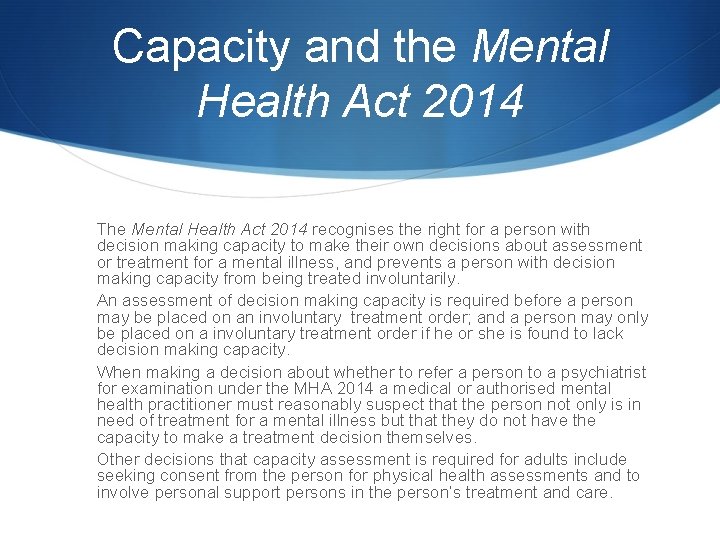
Capacity and the Mental Health Act 2014 The Mental Health Act 2014 recognises the right for a person with decision making capacity to make their own decisions about assessment or treatment for a mental illness, and prevents a person with decision making capacity from being treated involuntarily. An assessment of decision making capacity is required before a person may be placed on an involuntary treatment order; and a person may only be placed on a involuntary treatment order if he or she is found to lack decision making capacity. When making a decision about whether to refer a person to a psychiatrist for examination under the MHA 2014 a medical or authorised mental health practitioner must reasonably suspect that the person not only is in need of treatment for a mental illness but that they do not have the capacity to make a treatment decision themselves. Other decisions that capacity assessment is required for adults include seeking consent from the person for physical health assessments and to involve personal support persons in the person’s treatment and care.
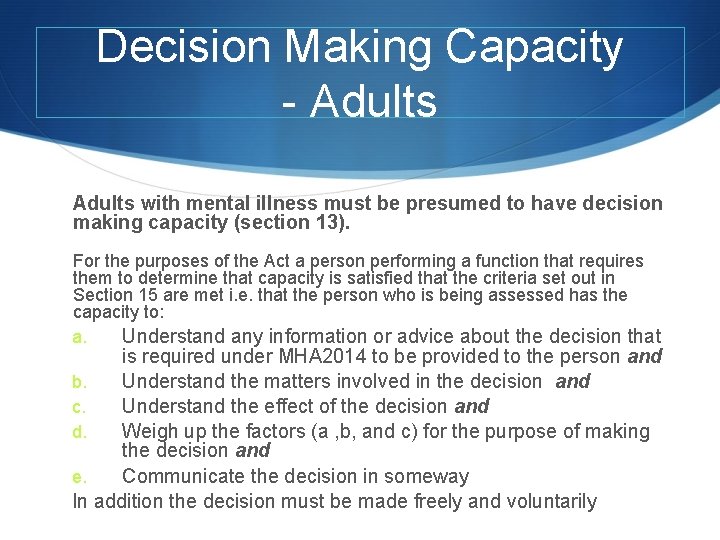
Decision Making Capacity - Adults with mental illness must be presumed to have decision making capacity (section 13). For the purposes of the Act a person performing a function that requires them to determine that capacity is satisfied that the criteria set out in Section 15 are met i. e. that the person who is being assessed has the capacity to: a. Understand any information or advice about the decision that is required under MHA 2014 to be provided to the person and b. Understand the matters involved in the decision and c. Understand the effect of the decision and d. Weigh up the factors (a , b, and c) for the purpose of making the decision and e. Communicate the decision in someway In addition the decision must be made freely and voluntarily
Decision Making Capacity - Children with mental illness are presumed to lack decision making capacity (s 14). Decision with regard to admission, discharge and treatment of voluntary children may be made by the child’s parent or guardian unless it is shown that the child has the capacity to make the decision his or herself (s 302). The determination as to the capacity of a child to make a decision is is based on criteria set out in section 15 (that is the criteria is the same as for adults). The person assessing decision making capacity must be satisfied that not only has the decision been made freely and voluntarily but the child has the capacity to a. b. c. d. e. Understand any information or advice about the decision that is required under MHA 2014 to be provided to the person and Understand the matters involved in the decision and Understand the effect of the decision and Weigh up the factors (a , b, and c) for the purpose of making the decision and Communicate the decision in someway
Decision Making Capacity - Children: Wishes and views Furthermore, regardless of capacity, a person or body performing a function under this Act in relation to a child must have regard to • Child’s wishes s 300 • Views of child’s parent/guardian s 301 In assessing decision making capacity in children there would usually be the additional requirement that the child be sufficiently mature. This would involve consideration of more general aspects of the presentation rather than just the criteria outlined in the MHA. The factors that would be considered would include age; apparent maturity, intelligence and attitude; family and sociocultural factors; the degree of social independence from parents,
Who can assess capacity? S Any member of the treating team can be involved in a capacity assessment S Assessment by a medical practitioner or authorised mental health practitioner is required for MHA 2014 Referral Orders S Assessment by a psychiatrist is required for MHA 2014 Involuntary Treatment Orders S The Mental Health Tribunal will consider capacity at reviews of treatment orders or application as well as considering if a child may represent themself at an appearance S Second or Expert involvement should be sought if needed
Resources • The MHA 14 can be accessed on website • The primary explanatory document for clinicians is the CPG which can be accessed on website • The main education tool for clinicians is the Clinicians ELearning Package (CELP). • The Mental Health Act Handbook is the primary explanatory document for consumers, carers and others which can be accessed on MHC website Although information related to Mental Health Acts and Guardianship may not be relevant to WA the NSW Capacity Toolkit is a useful resource http: //www. justice. nsw. gov. au/diversityservices/Documents/capacity_toolkit 06 09. pdf