
Introduction to DataMining Marko Grobelnik Institut Jozef Stefan
Introduction to Data-Mining Marko Grobelnik Institut Jozef Stefan
Outline • • • Motivation & Definition What are typical applications? How do we build solutions? Method & algorithms Tools & standards …conclusion
Motivation: “Necessity is the Mother of Invention” • Data explosion problem: • Automated data collection tools and mature database technology lead to tremendous amounts of data stored in databases, data warehouses and other information repositories • We are drowning in data, but starving for knowledge!
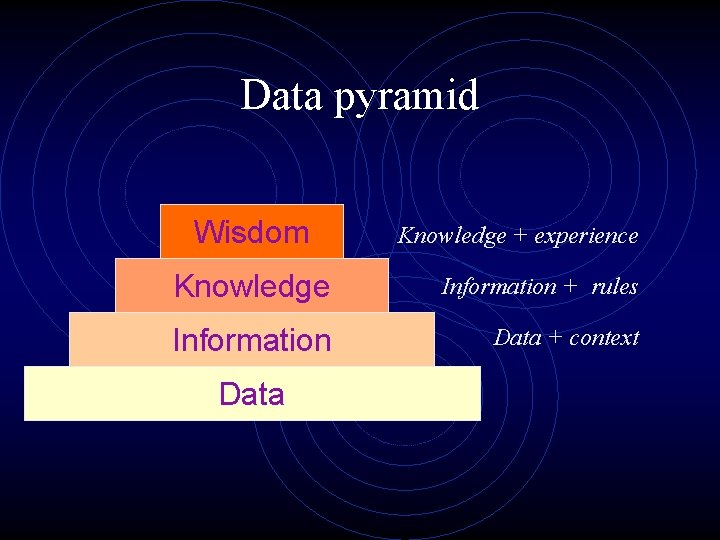
Data pyramid Wisdom Knowledge + experience Knowledge Information + rules Information Data + context Data
What Is Data Mining? • Data mining (knowledge discovery in databases - KDD, business intelligence): • Extraction of interesting ( non-trivial, implicit, previously unknown and potentially useful) information from data in large databases • “Tell me something interesting about the data. ” • “Describe the data. ”
Potential Applications • Database analysis and decision support • Market analysis and management • Risk analysis and management • Fraud detection and management • Text analysis - Text Mining • Web analysis - Web Mining • Intelligent query answering
Market Analysis and Management • Where are the data sources for analysis? • Credit card transactions, loyalty cards, discount coupons, customer complaint calls, plus (public) lifestyle studies. • Target marketing: • Find clusters of “model” customers who share the same characteristics: interest, income level, spending habits, etc. • Determine customer purchasing patterns over time: • Conversion of single to a joint bank account: marriage, etc.
Analysis and Risk Management • Finance planning and asset evaluation: • cash flow analysis and prediction • time series analysis (trend analysis, etc. ) • Resource planning: • summarize and compare the resources and spending • Competition: • Monitor competitors and market directions • Set pricing strategy in a highly competitive market

Fraud Detection and Management • Use historical data to build models of fraudulent behavior and use data mining to help identify similar instances • Examples application: • Auto Insurance: detect a group of people who stage accidents to collect on insurance • Money Laundering: detect suspicious money transactions • Detecting telephone fraud: detecting suspicious patterns (generate call model - destination, time, duration)
Other Areas of application • Sports • Analysis of game in NBA (eg. , detect the opponent’s strategy) • Astronomy • discovery and classification of new objects • Internet • analysis of Web access logs, discovery of user behavior patterns, analyzing effectiveness of Web marketing, improving Web site organization • Text • news analysis, medical record analysis, automatic email sorting and filtering, automatic document categorization
Data mining: intersection of multiple disciplines • • Database systems, data warehouse and OLAP Statistics Machine learning Visualization Information science High performance computing Other disciplines: • Neural networks, mathematical modeling, information retrieval, pattern recognition, . . .
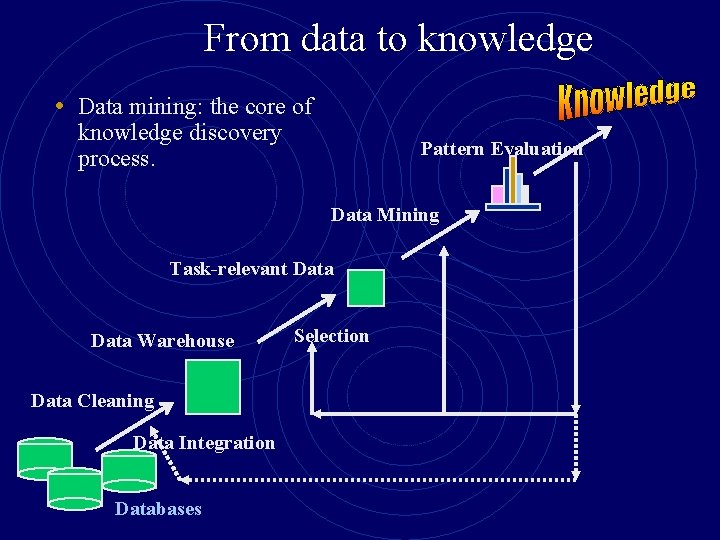
From data to knowledge • Data mining: the core of knowledge discovery process. Pattern Evaluation Data Mining Task-relevant Data Warehouse Data Cleaning Data Integration Databases Selection
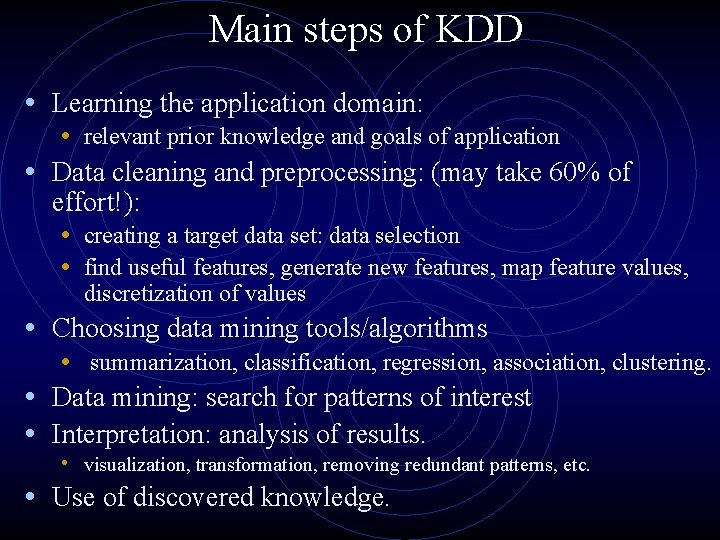
Main steps of KDD • Learning the application domain: • relevant prior knowledge and goals of application • Data cleaning and preprocessing: (may take 60% of effort!): • creating a target data set: data selection • find useful features, generate new features, map feature values, discretization of values • Choosing data mining tools/algorithms • summarization, classification, regression, association, clustering. • Data mining: search for patterns of interest • Interpretation: analysis of results. • visualization, transformation, removing redundant patterns, etc. • Use of discovered knowledge.
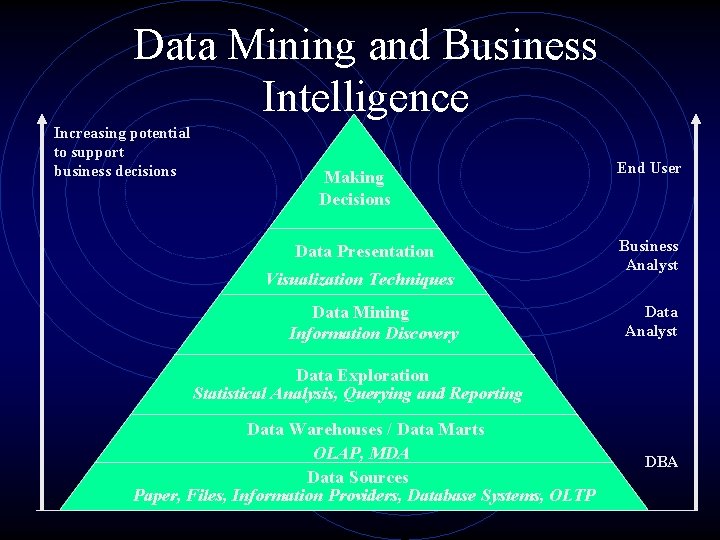
Data Mining and Business Intelligence Increasing potential to support business decisions Making Decisions Data Presentation Visualization Techniques Data Mining Information Discovery End User Business Analyst Data Exploration Statistical Analysis, Querying and Reporting Data Warehouses / Data Marts OLAP, MDA Data Sources Paper, Files, Information Providers, Database Systems, OLTP DBA
Mining the data: what kind of data? • • Relational databases Data warehouses Transactional databases Advanced DB systems and information repositories: object-oriented and object-relational databases, spatial databases, time-series data and temporal data, text databases and multimedia databases, heterogeneous and legacy databases, WWW
Data mining algorithms (I) • Association: • finding rules like “if the customer bought item A, then in X% of transactions she/he also bought item B”. This holds for Y% of all transactions • Classification and Prediction: • classify data based on the values in a classifying attribute, e. g. , classify countries based on climate, or classify cars based on gas mileage • predict some unknown or missing attribute values based on other information
Data mining algorithms (II) • Clustering: • group data to form new classes, e. g. , find groups of customers with similar behavior • Time-series analysis: • trend and deviation analysis: find and characterize evolution trend, sequential patterns, similar sequences, and deviation data, e. g. , stock analysis. • similarity-based pattern-directed analysis: find and characterize user-specified patterns in large databases. • cyclicity/periodicity analysis: find segment-wise or total cycles or periodic behaviors in time-related data. • Other pattern-directed or statistical analysis
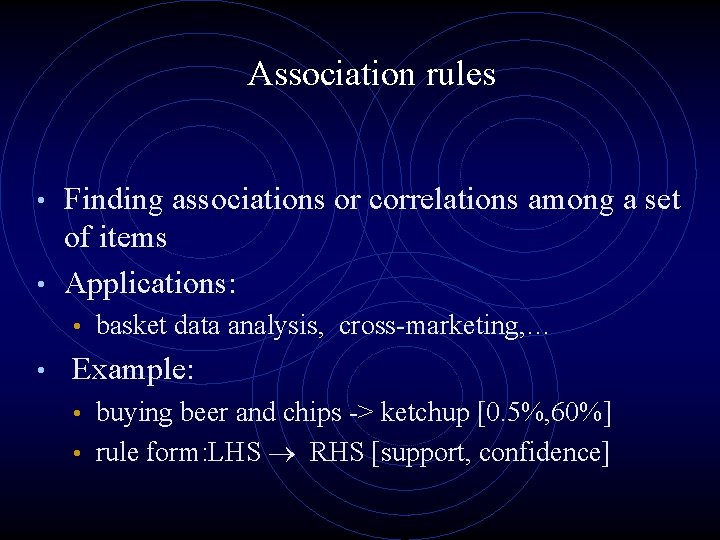
Association rules Finding associations or correlations among a set of items • Applications: • • • basket data analysis, cross-marketing, … Example: buying beer and chips -> ketchup [0. 5%, 60%] • rule form: LHS ® RHS [support, confidence] •
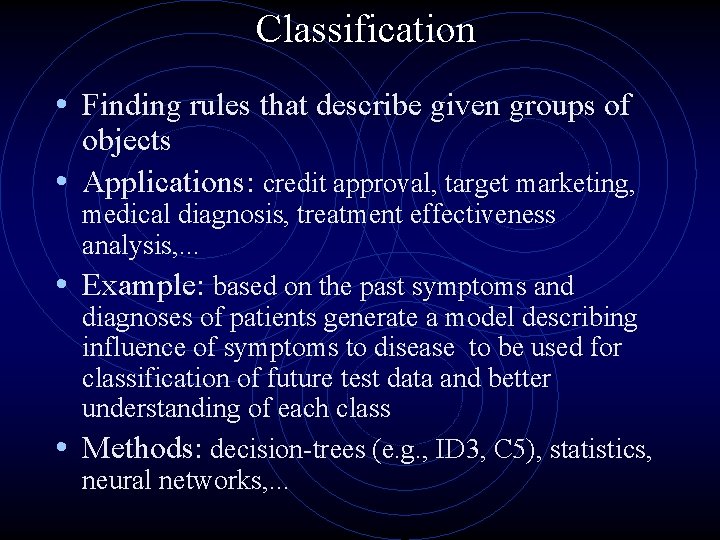
Classification • Finding rules that describe given groups of objects • Applications: credit approval, target marketing, • • medical diagnosis, treatment effectiveness analysis, . . . Example: based on the past symptoms and diagnoses of patients generate a model describing influence of symptoms to disease to be used for classification of future test data and better understanding of each class Methods: decision-trees (e. g. , ID 3, C 5), statistics, neural networks, . . .

Classification using decision trees • A decision tree: outlook sunny humidity N P rain overcast windy P N P • Top-down decision tree generation algorithm, at each step: • partition examples based on the selected attribute value • select attribute favoring the partitioning which makes the majority of examples belong to a single class
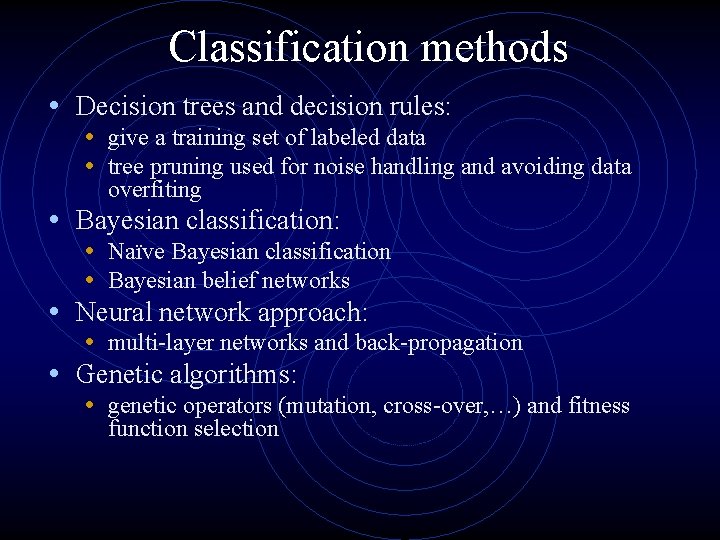
Classification methods • Decision trees and decision rules: • give a training set of labeled data • tree pruning used for noise handling and avoiding data overfiting • Bayesian classification: • Naïve Bayesian classification • Bayesian belief networks • Neural network approach: • multi-layer networks and back-propagation • Genetic algorithms: • genetic operators (mutation, cross-over, …) and fitness function selection
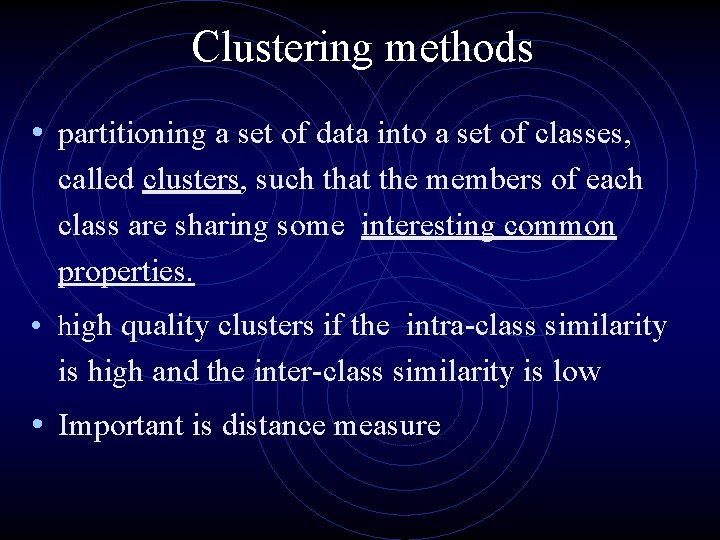
Clustering methods • partitioning a set of data into a set of classes, called clusters, such that the members of each class are sharing some interesting common properties. • high quality clusters if the intra-class similarity is high and the inter-class similarity is low • Important is distance measure
Data-Mining tools • Main producers of Data-Mining software: • • IBM – Intelligent Miner, extender for DB 2 SAS – Enterprise Miner SPSS – Clementine Microsoft – Analysis Server (…part of SQL Server 2000) • …many more smaller producers
Data Mining standards • PMML (Predictive Modelling Markup Language) • XML like language for saving and sharing models (most widely accepted standard) • CRISP • standardized methodology for building Data Mining applications • OLE DB for Data Mining • Microsoft’s standard for developing OLEDB/COM components for extending Analysis server with new Data Mining functionality (uses customized SQL language) • IBM and Oracle prepared standard extensions to SQL language to support Data Mining functionality
…conclusion • Data Mining is an area in the rapid development • Who and Why needs Data Mining? • …(almost) everybody having the data? • …to get something more out of the data • More information: • http: //www. kdnuggets. com/
- Slides: 25