
Introduction to Databases Todd S Bacastow IST 210
Introduction to Databases Todd S. Bacastow IST 210: Organization of data 2/19/2021 Todd S. Bacastow 1
Database Management Systems n A set of software programs that allows users to: n n n 2/19/2021 create database files edit and update data in database files store and retrieve data from database files Todd S. Bacastow 2
Uses n DBMSs are commonly used to manage things like: n n n n 2/19/2021 Membership and subscription mailing lists Accounting and bookkeeping information The data obtained from scientific research Customer information Inventory information Personal records Library information You name it……………… Todd S. Bacastow 3
The Diversity of DBMS Products n n DBMSs come in many shapes and sizes. DBMSs vary in terms of their scalability n DBMSs can be run on everything from n n 2/19/2021 Handhelds Laptops UNIX servers cluster of mainframes Todd S. Bacastow 4
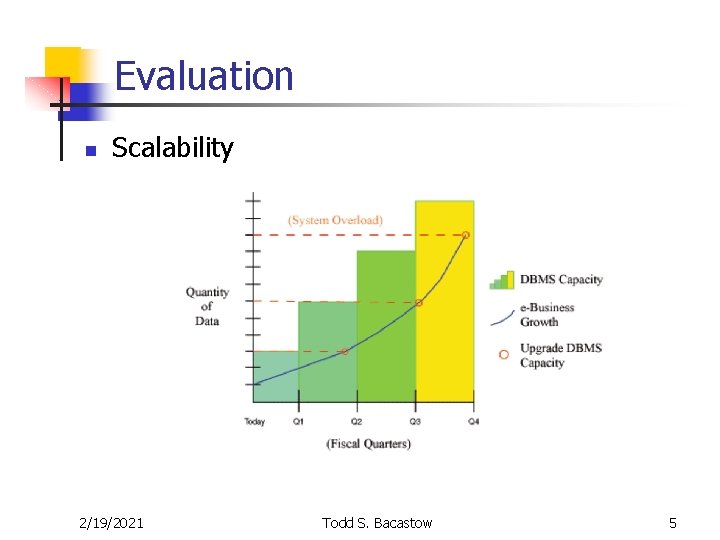
Evaluation n Scalability 2/19/2021 Todd S. Bacastow 5

n Functionality n n IE, store images, music, geographic data, drawings Future application development n 2/19/2021 Capabilities in terms of application development, e. g. , Java may be used in certain systems to code database logic Todd S. Bacastow 6
n Cost n PC and ‘mainframe’ n n 2/19/2021 Difficult to clearly differentiate DBMSs for personal and ‘mainframe’ computers Single user, enterprise, or web-based Todd S. Bacastow 7
n Usability n n Capability n n How easily or how difficult the DBMS can be learned, modified, and used to accomplish key tasks that are performed frequently. Breadth and depth of features and functions that a DBMS can perform. Interoperability n 2/19/2021 How well a DBMS supports other database access standards and defines the ability of software on multiple machines from multiple vendors to communicate. Todd S. Bacastow 8
n Reliability and Availability n n Recover from unplanned outages, facilitate planned database maintenance to occur while the database is available to users, improve system serviceability, and disaster planning Cost n n 2/19/2021 Acquisition Cost Maintenance Costs Todd S. Bacastow 9
Benefits of a Database n n n Foster data integrity because updates and changes to the data only have to be made in one place Promote consistency where file formats and system programs are standardized Data are easier to access and manipulate 2/19/2021 Todd S. Bacastow 10
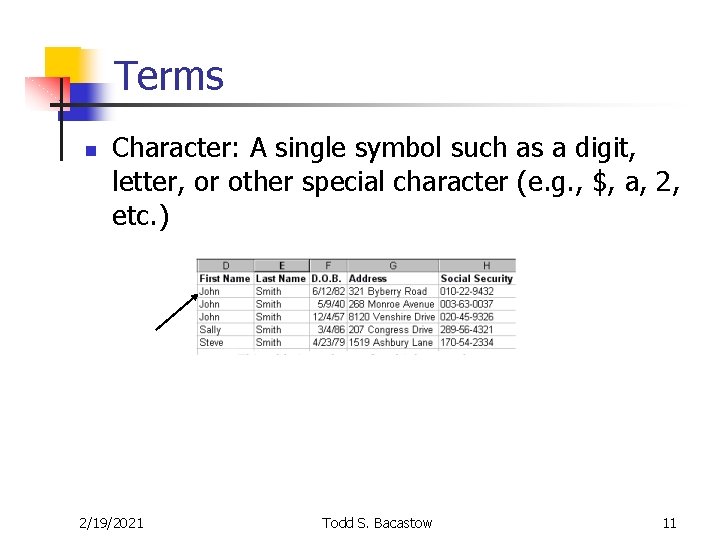
Terms n Character: A single symbol such as a digit, letter, or other special character (e. g. , $, a, 2, etc. ) 2/19/2021 Todd S. Bacastow 11
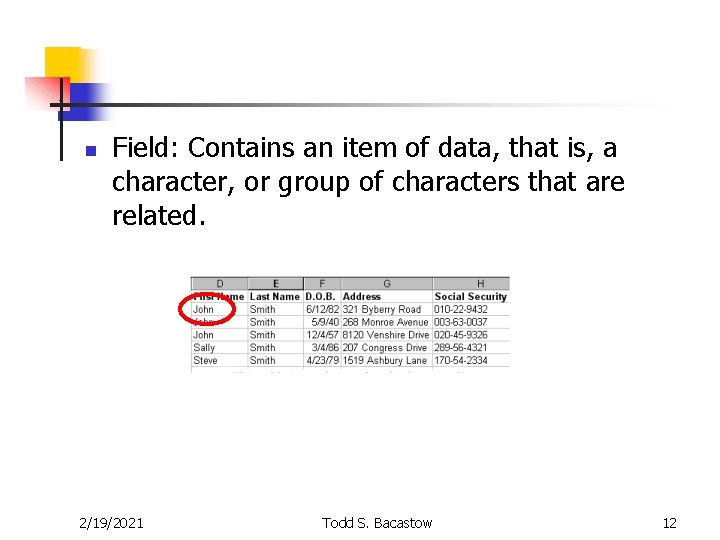
n Field: Contains an item of data, that is, a character, or group of characters that are related. 2/19/2021 Todd S. Bacastow 12
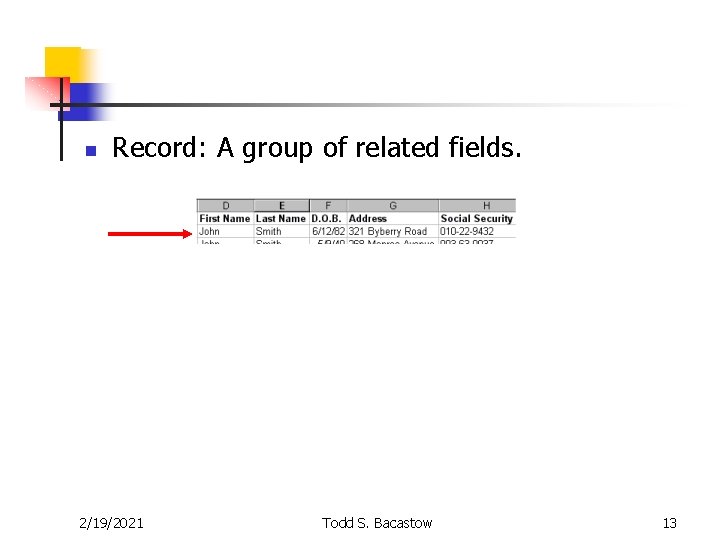
n Record: A group of related fields. 2/19/2021 Todd S. Bacastow 13
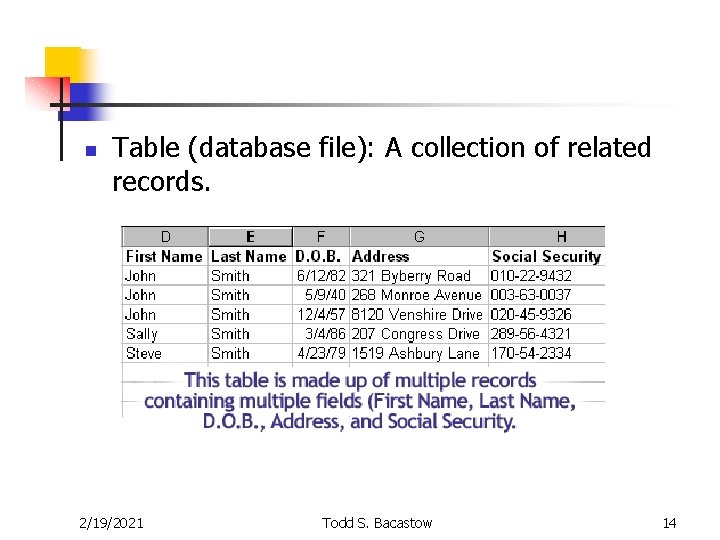
n Table (database file): A collection of related records. 2/19/2021 Todd S. Bacastow 14
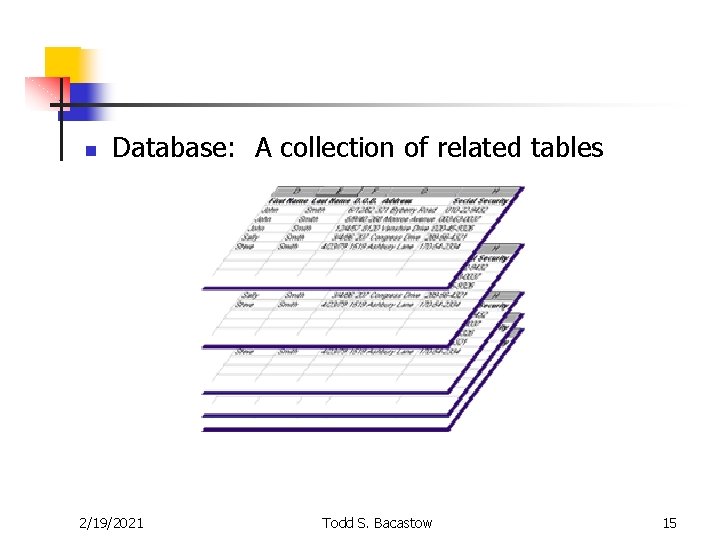
n Database: A collection of related tables 2/19/2021 Todd S. Bacastow 15
Data Concerns n n Timeliness Accuracy Relevance Volume 2/19/2021 Todd S. Bacastow 16
Data Collection Concerns n n n Validity – is it measuring the right thing? Reliability – can the measure be repeated? Accuracy – is the measure close to ‘truth’? 2/19/2021 Todd S. Bacastow 17
Question? ? ? n How do you know what data you should be collecting? n n 2/19/2021 Just guess? Talk to so called in-house experts? Do it by the seat of your pants? Use a method? Todd S. Bacastow 18
Integration Definition (IDEF) n n IDEF or Integrated Definition is the modeling technique used to model functional processes and corresponding information to support Functional Process Improvement. Do. D uses IDEF as the technique for functional managers to use for function (activity) and information (data) modeling 2/19/2021 Todd S. Bacastow 19
IDEF Family of Methods n n n n IDEFØ - Function Modeling IDEF 1 - Information Modeling IDEF 2 - Simulation Modeling IDEF 1 X - Data Modeling IDEF 3 - Process Description Capture IDEF 4 - Object-oriented Design IDEF 5 - Ontology Description Capture IDEF 6 - Design Rationale Capture IDEF 7 - Information System Audit Method IDEF 8 - User Interface Modeling IDEF 9 - Scenario-driven Info Sys Design Spec IDEF 10 - Implementation Architecture Modeling IDEF 11 - Information Artifact Modeling IDEF 12 - Organization Modeling IDEF 13 - Three Schema Mapping Design IDEF 14 - Network Design 2/19/2021 Todd S. Bacastow 20
IDEF 1 Information Modeling n The IDEF 1 approach is to: n n Build an integrated information model Design database(s) from the information model Implement and install the data base(s) and associated functional and procedural components There are two fundamental components of an information model: n n 2/19/2021 Diagrams Dictionary Todd S. Bacastow 21
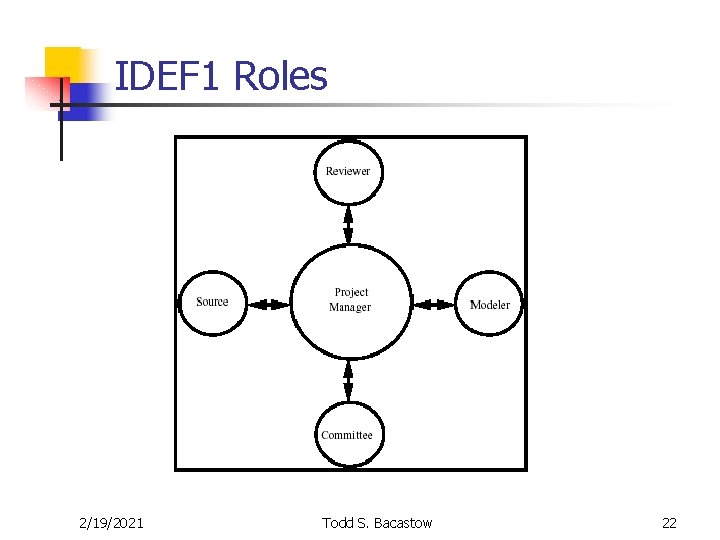
IDEF 1 Roles 2/19/2021 Todd S. Bacastow 22
Multi-Phase Development n Five phases: Phase Zero – scope of the model is defined and its objectives are stated. Phase One – define the Entity Classes which are readily apparent at this stage of the model development. Phase Two – define the Relation Classes which exist between the entity classes of which the model is comprised at this level. Phase Three – identify the Key Classes for each Entity Class of which the model is comprised at this time and to define each Attribute Class which is used in a Key Class. Phase Four – identify which Non-Key Attribute Classes should be associated with which entity classes in the model and to fully define each of these Non-Key Attribute Classes. 2/19/2021 Todd S. Bacastow 23
So What? n n Entity Relationship Diagrams (ERDs) are the parent of the IDEF 1 Diagrams You will be doing ERDs 2/19/2021 Todd S. Bacastow 24
NOMO Auto Problem n The goal of this problem is to create a database design solution that meets the needs of a small automobile company, NOMO Auto group 2/19/2021 Todd S. Bacastow 25
Objectives (Modified) n n n n n Operate as a team Evaluate needs to develop a database solution State the anticipated impact the new database solution will have on the business Develop a project plan Identify the target audience for creation of a database solution Design a database that meets the needs of the organization Generate the SQL statements needed to create the database structure Discuss for migrating data into a new database system Anticipate the organizational, legal, and ethical issues revolving around the creation of the database solution. Discuss the plans for providing access to data and security measure for the database solution 2/19/2021 Todd S. Bacastow 26
- Slides: 26