
Introduction to Databases 2122022 Databases Intro to DBs
Introduction to Databases 2/12/2022 Databases: Intro. to DBs 1
Objectives n n n n n 2/12/2022 Data + Managing Data + Database Management System + Characteristics of database approach + Database Management System (DBMS) + Advantages of Using DBMS + Workers Involved in DBMSs + When Not to Use A DBMS + Databases: Intro. to DBs 2
- Data n Data: is known recorded facts which has specific meanings or interpretation. n n Information: is a precise specific representation of data. n n Example: The temperature of room 119 in building 22 is 10. 5, is information Knowledge: is something which is derived or inferred from available information using some level of intelligence. n 2/12/2022 Example: the numbers 10. 5, 22, and 119 are data Example: Based on experience, the above information can be used to infer that the room is quite cold and could cause some inconvenience if we work on that room for a long period of time with out wearing worm clothes. Databases: Intro. to DBs 3
- Managing Data n There are two approaches to manage data n n 2/12/2022 File-based approach: An approach that utilizes a collection of application programs which performs services to end-users (e. g. Reports). Each program defines and manages its own data. Database approach: An approach that data is collected and manipulated using specific software called Database Management System, and many programs share this data. Databases: Intro. to DBs 4

-- File-Based Approach User 1 User 2 2/12/2022 Application programs Databases: Intro. to DBs Data 5
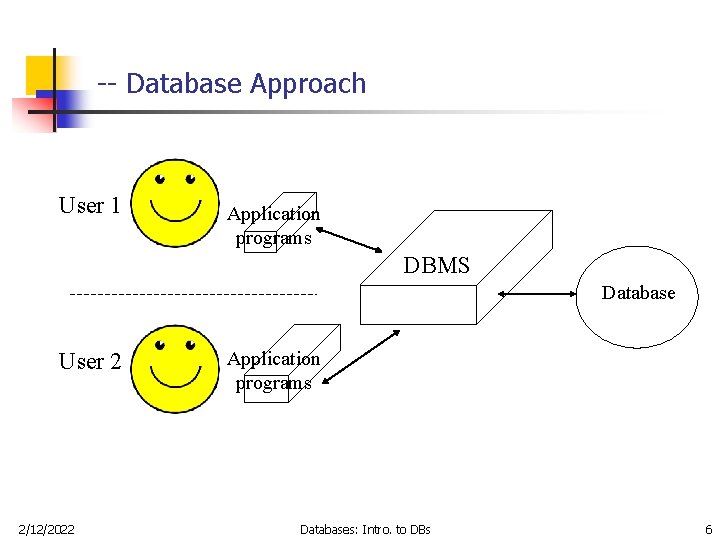
-- Database Approach User 1 Application programs DBMS Database User 2 2/12/2022 Application programs Databases: Intro. to DBs 6
- Database n A database is a collection of inter-related data, and it has the following implicit properties: n n Examples n 2/12/2022 A database represents some aspects of the real world, sometimes called the miniworld. A database is a logically coherent collection of data with some inherent meaning. A database is designed, built, and populated with data for specific purpose. University database Databases: Intro. to DBs 7
- Characteristics of Database Approach… n Self-describing nature of a database system n n n Insulation between programs and data, and data abstraction. n n 2/12/2022 In addition to the database itself, the database system also contains a complete definition or description of the database structure and constraints. It is stored in a system catalog. The information such as the structure of each file, the type and storage format of each data item, and various constraints on the data that is stored in the system catalog is called meta-data. The structure of data files is stored in the DBMS catalog separately from the access programs. This property is called program-data independence. The characteristics that allows program-data independence is called dataabstraction. A DBMS provides users with a conceptual representation of data that does not include many of the details of how the data is stored or how the operations are implemented. Databases: Intro. to DBs 8
… - Characteristics of Database Approach n Support of multiple views of the data n n Sharing of data and multi-user transaction processing. n n n 2/12/2022 A database has many users. Each user may require a different perspective of view of the database. A view may be a subset of a database or it may contain a virtual data that is derived form the database files but is not explicitly stored. A multi-user DBMS whose users have a variety of applications must provide facilities for defining multiple views. A multi-user DBMS must allow multiple users to access the database at the same time. This is essential if data for multiple applications is to be integrated and maintained in a single database. The database must include concurrency control feature to insure that several users trying to update the same data do so in a controlled manner so that the result of the updates is correct. This fundamental role of multi-user DBMS software is to ensure that the concurrent transactions operate correctly. Databases: Intro. to DBs 9
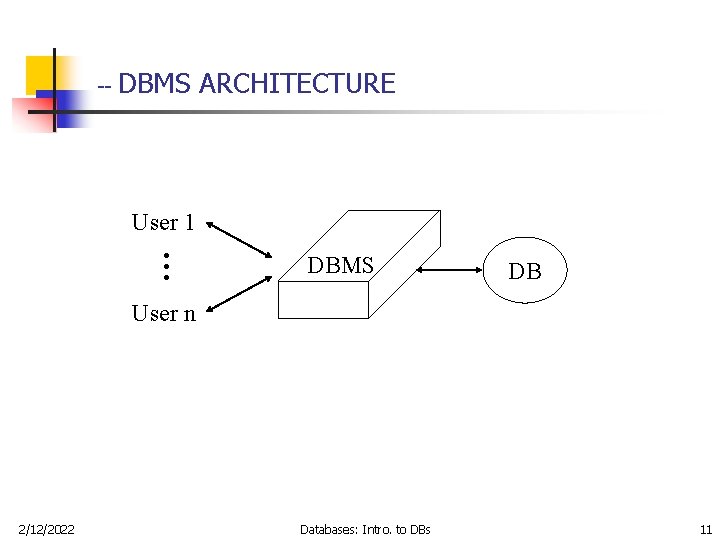
- Database Management System (DBMS) n DBMS is a software package that enables user to create and maintain databases. It facilitates: n n Example of DBMS: n n 2/12/2022 Defining a database that involves specifying the data types, structures, and constraints for the data to be stored in the database. Constructing a database which is the process of storing the data. Manipulating a database such as functions of querying the database, updating the database, and generating reports from the data. Oracle, access, DB 2, Ingress, Teradata Database and DBMS software together constitute a database system. Databases: Intro. to DBs 10
-- DBMS ARCHITECTURE User 1 … DBMS DB User n 2/12/2022 Databases: Intro. to DBs 11
- Advantages of Using DBMS … n n n 2/12/2022 Controlling redundancy: A DBMS has capacity of controlling redundancy that leads to prevent inconsistency and waste of storage. Providing data consistency: A DBMS provides and assures the consistency of stored data. Enabling sharing of data: A DBMS is designed to enable many users to share the same stored data. Supporting multiple views of the same stored data: A DBMS provides multiple views for different users from the available stored data. Restricting unauthorized access: A DBMS provides a security and authorization subsystem, which DBA uses to create accounts and specify account restrictions that are then enforced by the DBMS automatically. Databases: Intro. to DBs 12
- Advantages of Using DBMS … n n 2/12/2022 Providing multiple user interfaces: A DBMS provides a variety of user interfaces for users with varying levels of technical knowledge to use a database. Presenting complex relationships among data: A database may include numerous varieties of data that are inter-related in many ways. A DBMS has the capability to representing a variety of complex relationships among the data as well as to retrieve and update related data easily and efficiently. Enforcing integrity constraints: Most databases has certain integrity constraints that must hold for the data. A DBMS provides capabilities for defining and enforcing these constraints. Providing backup and recovery: A DBMS provides facilities for recovering from hardware or software failures. The backup and recovery subsystem of the DBMS is responsible for recovery. Databases: Intro. to DBs 13
- Advantages of Using DBMS n Potential for enforcing standards: In the database approach, the DBA defines standards and the DBMS enforces these standards among database users in a large organization. n Reduces application development time: Application development time using a DBMS is estimated to be one-sixth to one-fourth of that for file-based approach. n Flexibility: Modern DBMS allow certain types of changes to the structure of the database without affecting the stored data and the existing application programs. n n 2/12/2022 Availability of up-to-date information: A DBMS makes the database available to multiple users. As soon as one user’s update is applied to the database, all other users can immediately see this update. Economies of Scale: The DBMS approach permits consolidation of data and applications, thus reducing the amount of wasteful overlap between activities of data processing personnel in different projects or departments. Databases: Intro. to DBs 14
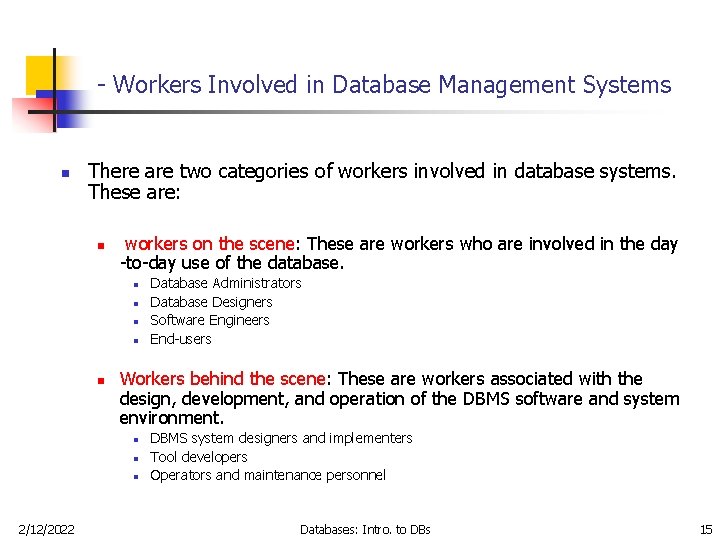
- Workers Involved in Database Management Systems n There are two categories of workers involved in database systems. These are: n workers on the scene: These are workers who are involved in the day -to-day use of the database. n n n Workers behind the scene: These are workers associated with the design, development, and operation of the DBMS software and system environment. n n n 2/12/2022 Database Administrators Database Designers Software Engineers End-users DBMS system designers and implementers Tool developers Operators and maintenance personnel Databases: Intro. to DBs 15
-- Workers on the Scene … n n n Database Administrators (DBAs): Are responsible for authorizing access to the database, for coordinating and monitoring its use, and for acquiring software and hardware resources as needed. Database Designers: Are responsible for identifying the data to be stored in the database and for choosing appropriate structures to represent and store these data. Software Engineers: n n 2/12/2022 System analysts: who determine the requirements of end users and develop specifications for standard type of queries that meet these requirements. Application programmers: Who implement these specifications as programs; they test, debug, document, and maintain them. Databases: Intro. to DBs 16
… -- Workers on the Scene n End-users: Are those who require access to the database for querying, updating, and generating reports. They are categorized as: n Casual end-users: occasionally access the database, but they may need different information each time. n Naïve or parametric end-users: constantly update and query databases, using standard types of queries and updates. n n 2/12/2022 Sophisticated end-users: thoroughly familiarize themselves with the facilities of the DBMS so as to implement their application to meet their complex requirements. Stand-alone end-users: maintain personal databases by using easy-touse ready-made program packages. Databases: Intro. to DBs 17
-- Workers Behind the Scene n n n 2/12/2022 DBMS system designers and implementers: are those who design and implement the DBMS modules and interfaces as software packages. Tool developers: are those who design and develop tools – the software packages that facilitate database system design and use, and help to improve performance. Operators and maintenance personnel: are those who are responsible for the actual running and maintenance of the hardware and software environment for the database system. Databases: Intro. to DBs 18
- When Not to Use A DBMS n n n 2/12/2022 Overhead cost: There are requirements of high initial in hardware, software, and training. High impact of failure: The database designers and DBA may not properly design the database or the database systems applications might not be implemented properly. The requirements of the application are simple, well defined, and not expected to change. There are strict real-time requirements for some programs that might not be met because of DBMS overhead. Multiple-use access to data is not required. Databases: Intro. to DBs 19
- Slides: 19