
Introduction to DataBased Individualization DBI Considerations for Implementation
Introduction to Data-Based Individualization (DBI): Considerations for Implementation in Academics and Behavior

What is intensive intervention? Intensive intervention is designed to address severe and persistent learning or behavior difficulties. Intensive interventions should be: (a) Driven by data (b) Characterized by increased intensity (e. g. , smaller group, expanded time) and individualization of academic instruction and/or behavioral supports 2
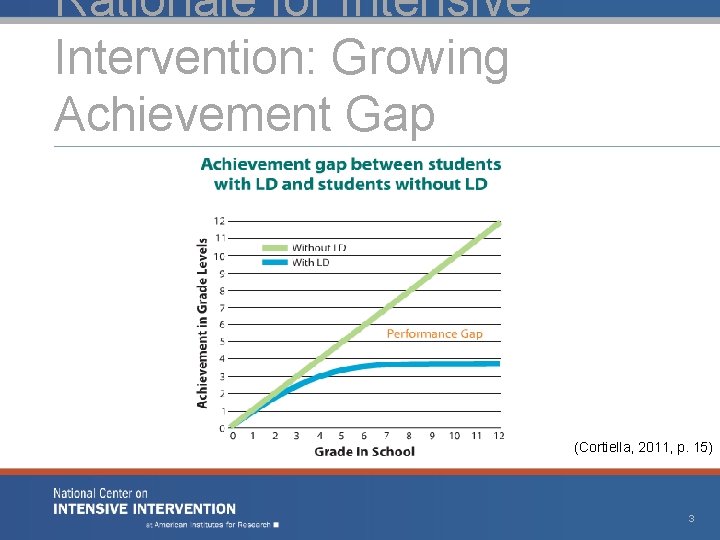
Rationale for Intensive Intervention: Growing Achievement Gap (Cortiella, 2011, p. 15) 3
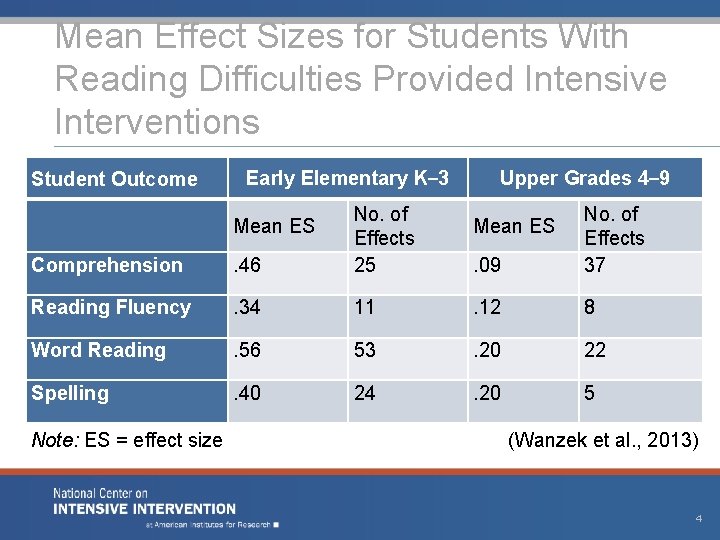
Mean Effect Sizes for Students With Reading Difficulties Provided Intensive Interventions Student Outcome Early Elementary K– 3 Comprehension . 46 No. of Effects 25 Reading Fluency . 34 Word Reading Spelling . 09 No. of Effects 37 11 . 12 8 . 56 53 . 20 22 . 40 24 . 20 5 Mean ES Note: ES = effect size Upper Grades 4– 9 Mean ES (Wanzek et al. , 2013) 4
Introduction to Data-Based Individualization (DBI) 5
NCII’s Approach to Intensive Intervention: Data-Based Individualization (DBI) is a systematic method for using data to determine when and how to provide more intensive intervention: § DBI is a process, not a single intervention program or strategy. § Not a one-time fix—ongoing process comprising intervention and assessment adjusted over time. 6
Who needs intensive intervention? § § § Students with disabilities who are not making adequate progress in their current instructional program Students who present with very low academic achievement and/or high-intensity or high-frequency behavior problems (typically those with disabilities) Students in a tiered intervention program who have not responded to secondary intervention programs delivered with fidelity 7
Five DBI Steps 1. Secondary intervention program, delivered with greater intensity 2. Progress monitoring 3. Informal diagnostic assessment 4. Adaptation 5. Continued progress monitoring, with adaptations occurring whenever needed to ensure adequate progress 8
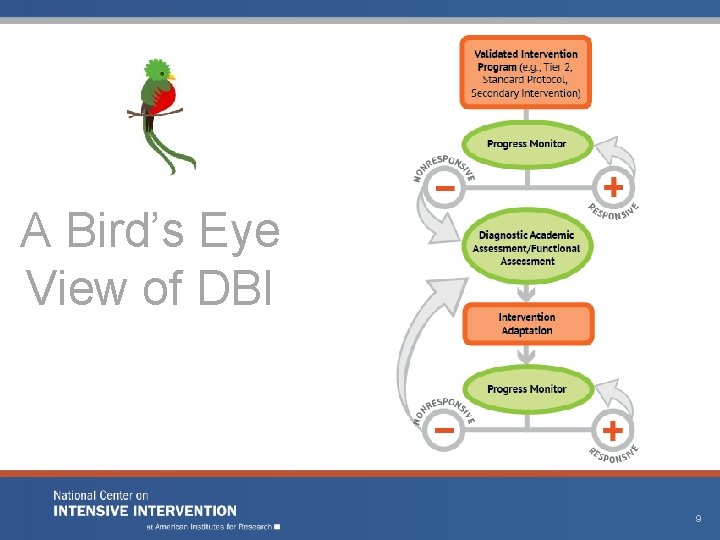
A Bird’s Eye View of DBI 9
Before we begin DBI… § Start with a standardized secondary program (if available; e. g. , Check-in/Check-out, Good Behavior Game, Number Rockets*). § Progress monitor to evaluate the student’s response to the secondary intervention. *NCII does not endorse products. These are noted for illustrative purposes only. 10
What are secondary interventions? § Standardized, evidence-based interventions designed for at-risk students § Often referred to as… • Tier 2 or strategic intervention • Remedial curriculum § Common examples • • Leveled Literacy Intervention (LLI) Wilson Just Words Check-in/Check-out Corrective Math 11
Key Questions About the Secondary Intervention § § Has the student been taught using an evidence-based secondary intervention program (if available) that is appropriate for his or her needs? Has the program been implemented with fidelity? • Content • Dosage/schedule • Group size § Has the program been implemented for a sufficient amount of time to determine response? 12
Academic Illustration of DBI 13
Secondary Intervention Program: Student Example—Kelsey Background: Kelsey presented serious reading problems, reading at an early second-grade level at the beginning of fourth grade. Intervention program: Kelsey’s teacher selected a research-validated program that addressed phonological awareness, word study, and fluency skills. 14
Secondary Intervention Program: Kelsey Fidelity § Group size: six students § Session length: 20– 40 minutes per session § Frequency: three to four sessions per week § Program duration: seven weeks § Instructional content and delivery: explicit instruction covering all components laid out in the instruction manual § Progress monitoring: Passage Reading Fluency (PRF) 15
Progress Monitoring: Does Kelsey need DBI? Reliable and valid tool: Kelsey’s teacher implemented formal progress monitoring using assessments that were a match for her reading skills. Detect improvement: This progress monitoring tool is appropriate to her skill level, allowing her teacher to detect changes in Kelsey’s reading. Rate of progress: Based on Kelsey’s progress monitoring graph, she was not progressing at the rate needed to meet her goal. 16
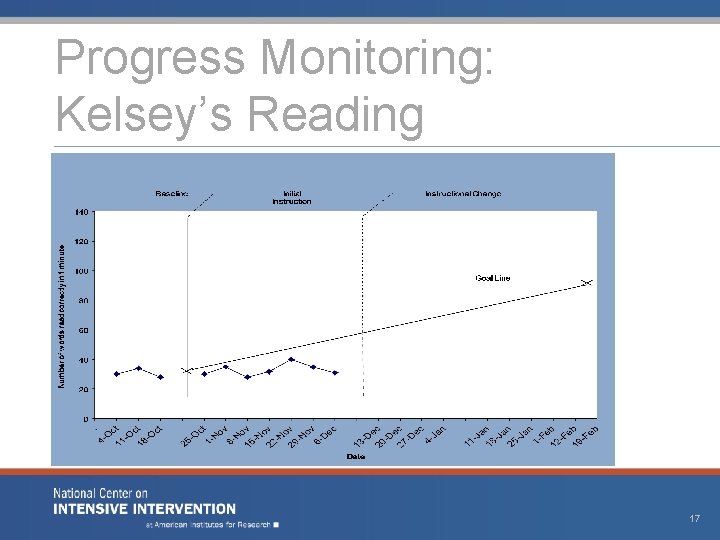
Progress Monitoring: Kelsey’s Reading 17
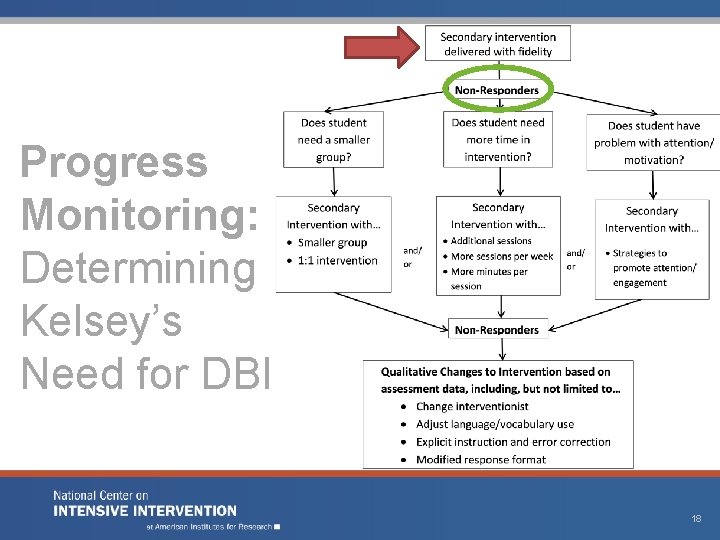
Progress Monitoring: Determining Kelsey’s Need for DBI 18
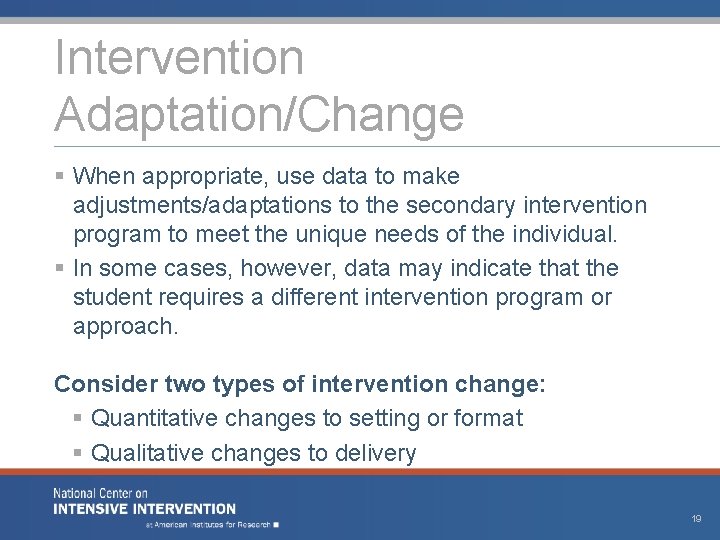
Intervention Adaptation/Change § When appropriate, use data to make adjustments/adaptations to the secondary intervention program to meet the unique needs of the individual. § In some cases, however, data may indicate that the student requires a different intervention program or approach. Consider two types of intervention change: § Quantitative changes to setting or format § Qualitative changes to delivery 19
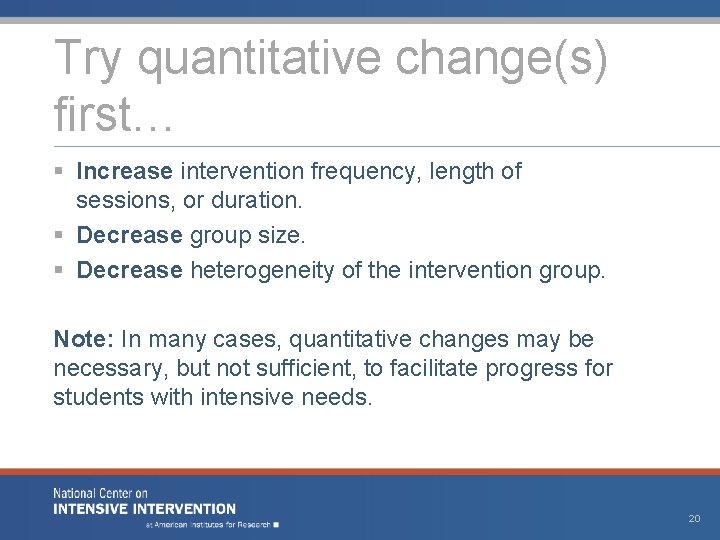
Try quantitative change(s) first… § Increase intervention frequency, length of sessions, or duration. § Decrease group size. § Decrease heterogeneity of the intervention group. Note: In many cases, quantitative changes may be necessary, but not sufficient, to facilitate progress for students with intensive needs. 20
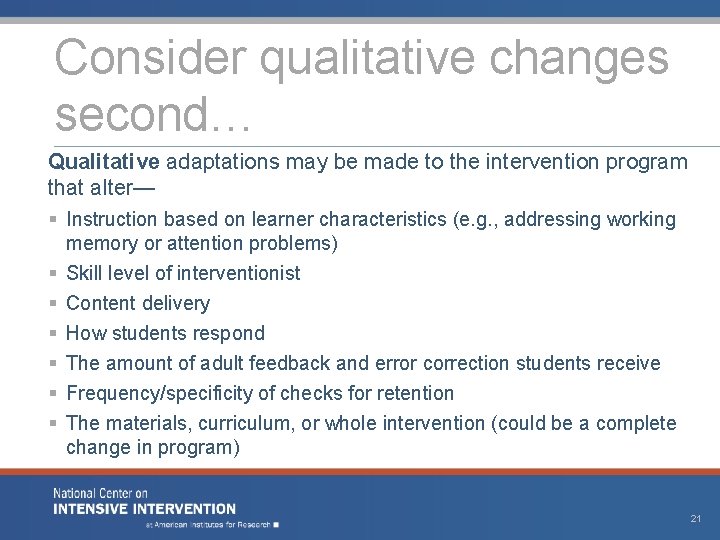
Consider qualitative changes second… Qualitative adaptations may be made to the intervention program that alter— § Instruction based on learner characteristics (e. g. , addressing working memory or attention problems) § Skill level of interventionist § Content delivery § How students respond § The amount of adult feedback and error correction students receive § Frequency/specificity of checks for retention § The materials, curriculum, or whole intervention (could be a complete change in program) 21
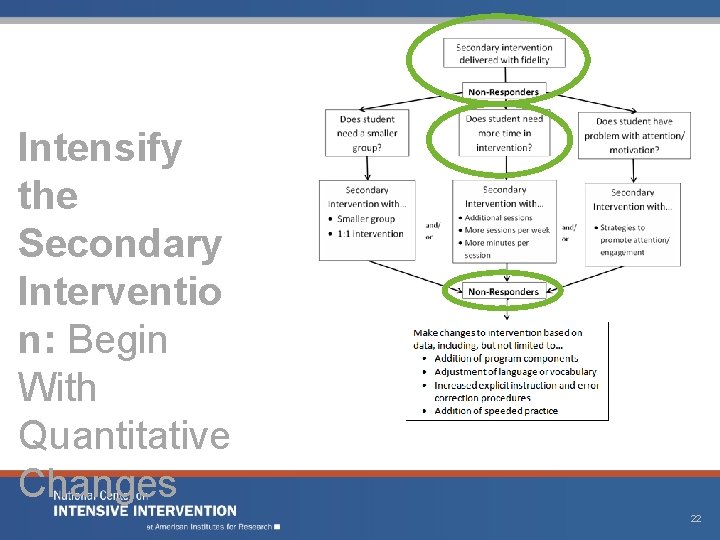
Intensify the Secondary Interventio n: Begin With Quantitative Changes 22
Quantitative Intervention Adaptation: Kelsey’s teacher intensified her instruction by adding an additional 15 minutes of instruction per session. Despite this change in intervention length, Kelsey continued to make insufficient progress. 23
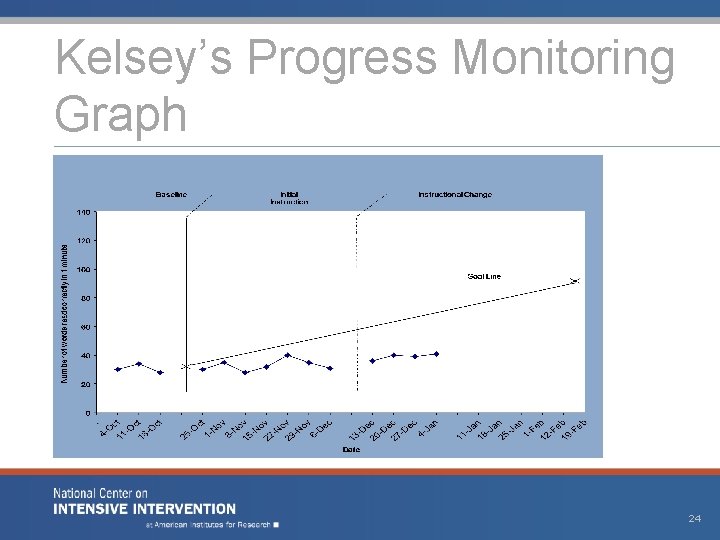
Kelsey’s Progress Monitoring Graph 24
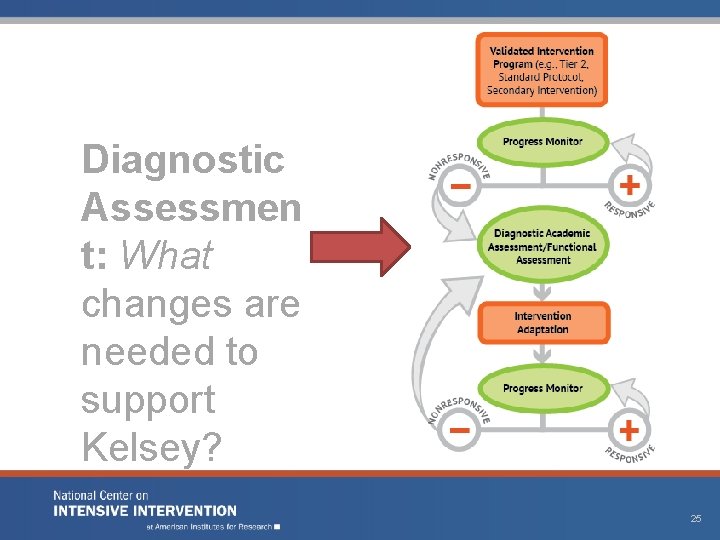
Diagnostic Assessmen t: What changes are needed to support Kelsey? 25
Informal Diagnostic Assessment § Progress monitoring assessments help teams determine when an instructional change is needed. § Informal diagnostic assessments allow teams to use available data (e. g. , progress monitoring data, informal skill inventories, work samples) to help determine the nature of the intervention change needed. 26
Informal Diagnostic Assessment Potential data sources: § Classroom-based assessments § Error analysis of progress monitoring data § Student work samples § Standardized measures (if feasible) 27
Informal Diagnostic Assessment: Kelsey § To determine the nature of the instructional change needed, Kelsey’s teacher conducted an error analysis of Kelsey’s most recent PRF data. § She also administered a phonics survey to determine Kelsey’s decoding strengths and weaknesses. 28
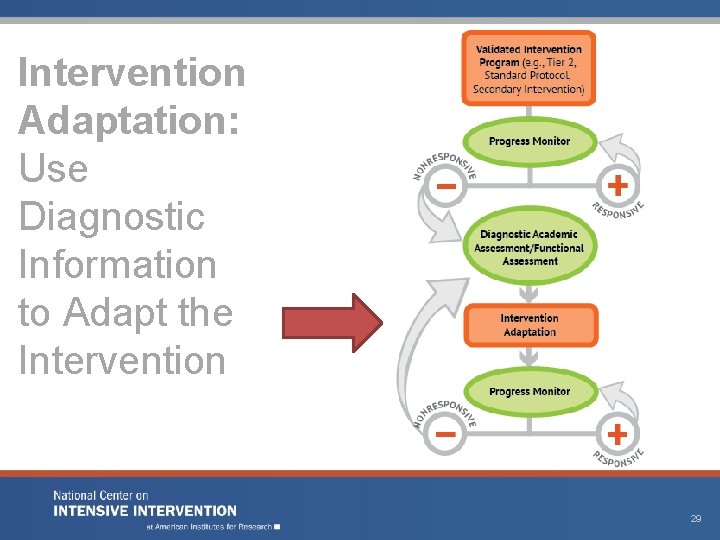
Intervention Adaptation: Use Diagnostic Information to Adapt the Intervention 29
Intervention Adaptation: Kelsey Diagnostic assessment showed that Kelsey had difficulty applying decoding strategies to vowel teams. Her teacher applied the following intensive intervention principles to intensify her decoding instruction: § Incorporated fluency practice of newly taught teams, with specified mastery criteria § Provided explicit instruction and error correction § Frequently checked for retention with reteaching as needed 30
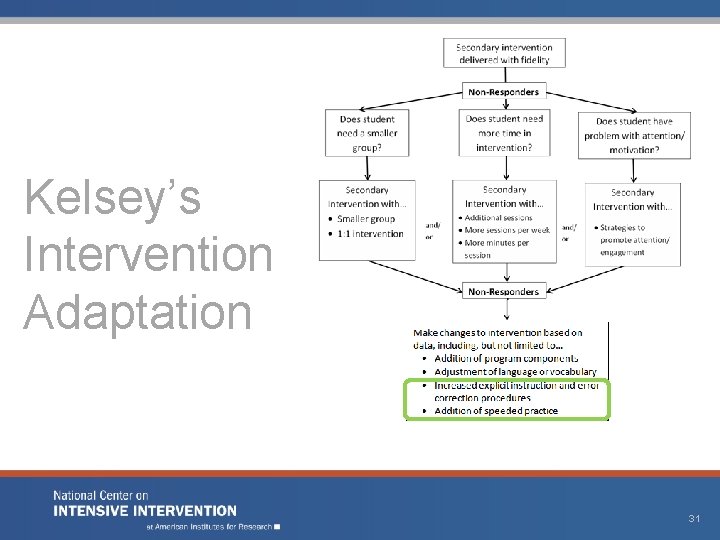
Kelsey’s Intervention Adaptation 31
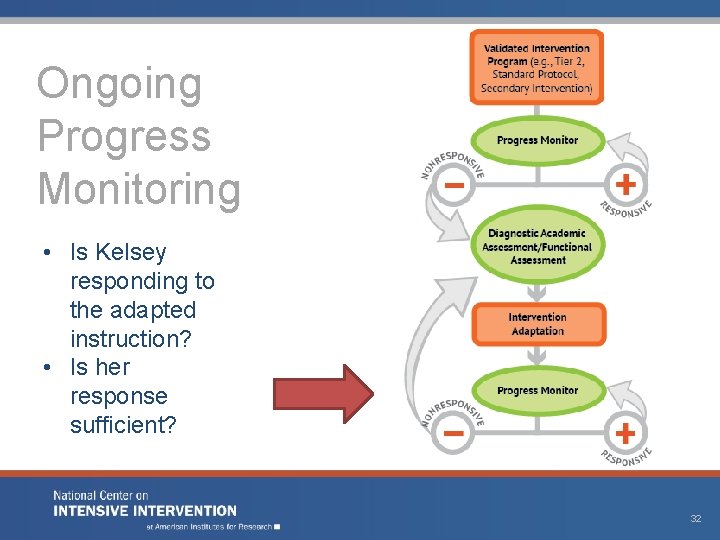
Ongoing Progress Monitoring • Is Kelsey responding to the adapted instruction? • Is her response sufficient? 32
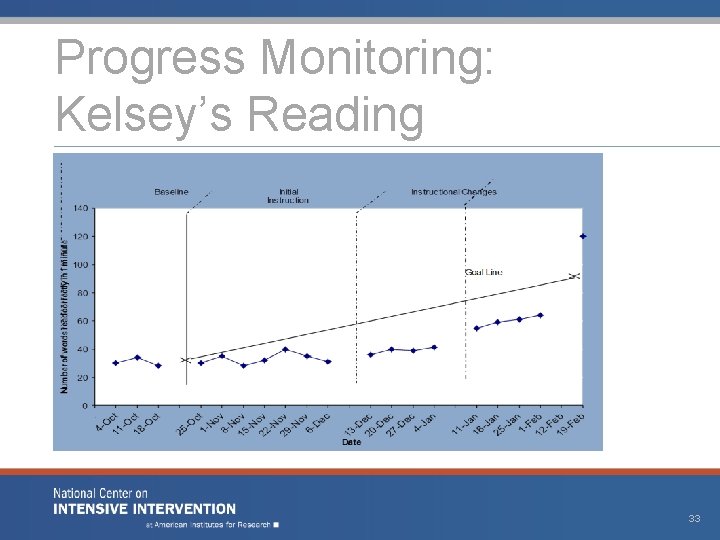
Progress Monitoring: Kelsey’s Reading 33
Evaluation of Kelsey’s Progress § Kelsey’s reading is improving but not fast enough to achieve her goal. Another instructional change is needed. § Kelsey’s teacher may collect additional diagnostic data if needed to make an informed instructional change. § Kelsey’s teacher will continue to collect progress monitoring data and meet with the intervention team to evaluate progress and modify the plan as needed. 34
In Summary § DBI is an ongoing process that comprises ongoing assessment, intervention, evaluation, and adjustment to maximize student outcomes. § Intensive interventions will not look the same for all students. They are individualized based on unique needs. § Students requiring intensive intervention are likely to need it for a significant time. 35
Things to Remember § DBI is intense—relatively few students should need it (3 percent to 5 percent of the school population). § Academic and behavior supports do not exist in isolation. § Don’t make too many intervention adaptations at the same time. 36
References Aud, S. , Hussar, W. , Johnson, F. , Kena, G. , Roth, E. , Manning, et al. (2012). The condition of education 2012 (NCES 2012 -045). Washington, DC: National Center for Education Statistics, Institute of Education Sciences, U. S. Department of Education. Retrieved from http: //nces. ed. gov/pubs 2012/2012045. pdf Capizzi, A. M. , & Fuchs, L. S. (2005). Effects of curriculum-based measurement with and without diagnostic feedback on teacher planning. Remedial and Special Education, 26(3), 159– 174. Cortiella, C. (2011). The state of learning disabilities. New York: National Center for Learning Disabilities. Retrieved from http: //www. ncld. org/images/stories/On. Capitol. Hill/Policy. Related. Publications/stateofld/2 011_state_of_ld_final. pdf Deno, S. L. , & Mirkin, P. K. (1977). Data-based program modification: A manual. Minneapolis, MN: Leadership Training Institute for Special Education. 37
References Fuchs, L. S. , Deno, S. L. , & Mirkin, P. K. (1984). The effects of curriculum-based measurement evaluation on pedagogy, student achievement, and student awareness of learning. American Educational Research Journal, 21(2), 449– 460. Fuchs, L. S. , Fuchs, D. , & Hamlett, C. L. (1989). Effects of instrumental use of curriculumbased measurement to enhance instructional programs. Remedial and Special Education, 10, 43– 52. Planty, M. , Hussar, W. , Snyder, T. , Provasnik, S. , Kena, G. , Dinkes, R. , et al. (2008). The condition of education 2008 (NCES 2008 -031). Washington, DC: National Center for Education Statistics, Institute of Education Sciences, U. S. Department of Education. Retrieved from http: //nces. ed. gov/pubs 2008/2008031. pdf 38
References Sanford, C. , Newman, L. , Wagner, M. , Cameto, R. , Knokey, A. -M. , and Shaver, D. (2011). The post-high school outcomes of young adults with disabilities up to 6 years after high school: Key findings from the National Longitudinal Transition Study-2 (NLTS 2) (NCSER 2011 -3004). Menlo Park, CA: SRI International. Retrieved from http: //www. nlts 2. org/nlts 2/reports/2011_09/nlts 2_report_2011_09_complete. pdf Wanzek, J. , Vaughn, S. , Scammacca, N. K. , Metz, K. L. , Murray, C. S. , Roberts, G. , et al. (2013). Extensive reading interventions for students with reading difficulties after grade 3. Review of Educational Research, 83, 163– 195. doi: 10. 3102/0034654313477212 39
- Slides: 40