
Introduction to Database Systems Relational Algebra Irvanizam Zamanhuri
Introduction to Database Systems Relational Algebra Irvanizam Zamanhuri, M. Sc Informatics (Computer Science) Study Program Syiah Kuala University http: //www. informatika. unsyiah. ac. id Email: irvanizam. zamanhuri@informatika. unsyiah. ac. id 1
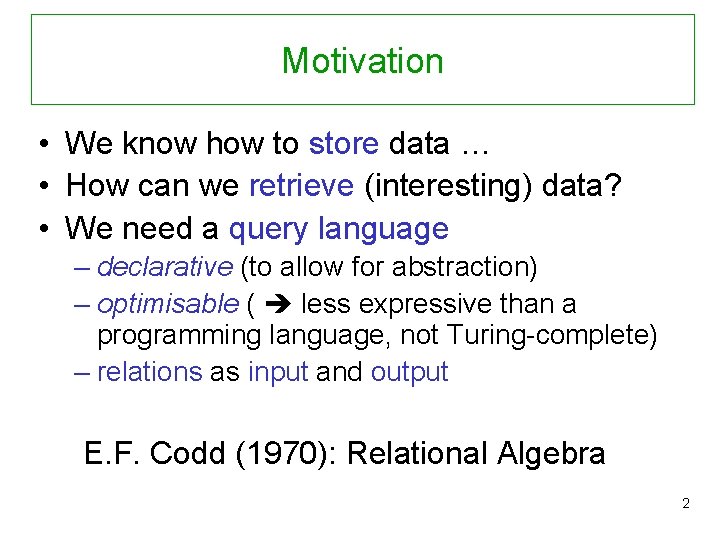
Motivation • We know how to store data … • How can we retrieve (interesting) data? • We need a query language – declarative (to allow for abstraction) – optimisable ( less expressive than a programming language, not Turing-complete) – relations as input and output E. F. Codd (1970): Relational Algebra 2
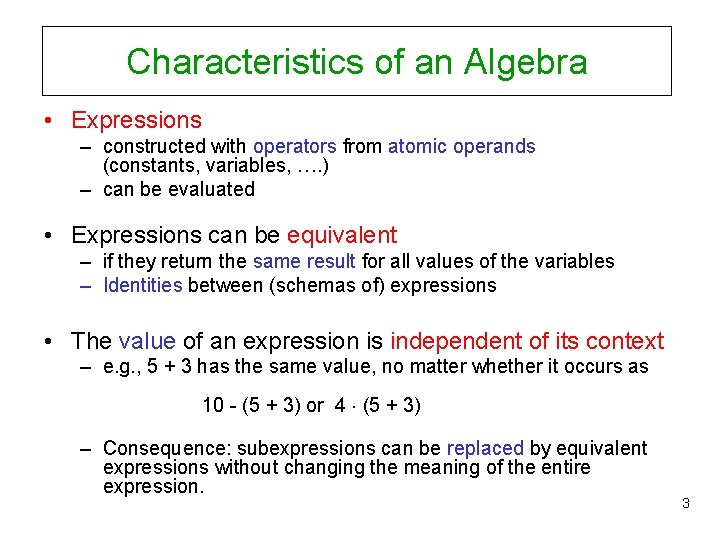
Characteristics of an Algebra • Expressions – constructed with operators from atomic operands (constants, variables, …. ) – can be evaluated • Expressions can be equivalent – if they return the same result for all values of the variables – Identities between (schemas of) expressions • The value of an expression is independent of its context – e. g. , 5 + 3 has the same value, no matter whether it occurs as 10 - (5 + 3) or 4 (5 + 3) – Consequence: subexpressions can be replaced by equivalent expressions without changing the meaning of the entire expression. 3
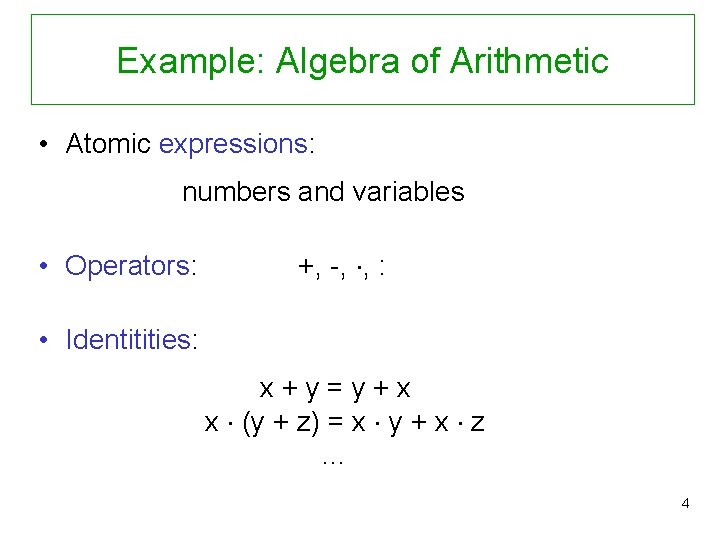
Example: Algebra of Arithmetic • Atomic expressions: numbers and variables • Operators: +, -, , : • Identitities: x+y=y+x x (y + z) = x y + x z … 4
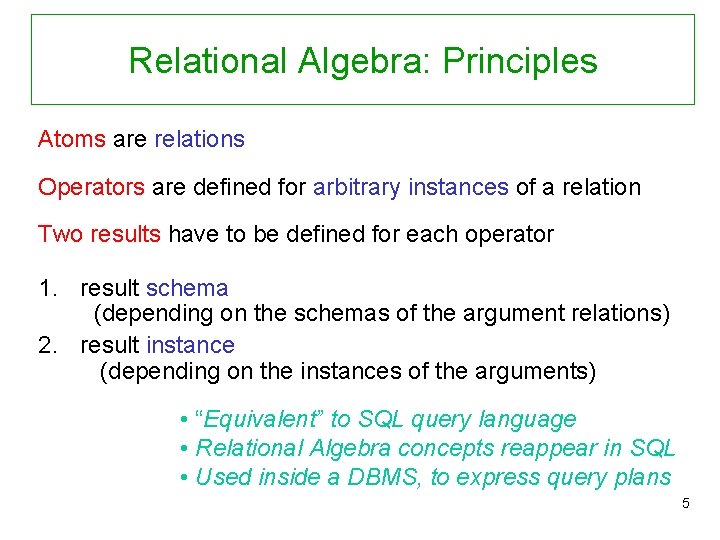
Relational Algebra: Principles Atoms are relations Operators are defined for arbitrary instances of a relation Two results have to be defined for each operator 1. result schema (depending on the schemas of the argument relations) 2. result instance (depending on the instances of the arguments) • “Equivalent” to SQL query language • Relational Algebra concepts reappear in SQL • Used inside a DBMS, to express query plans 5
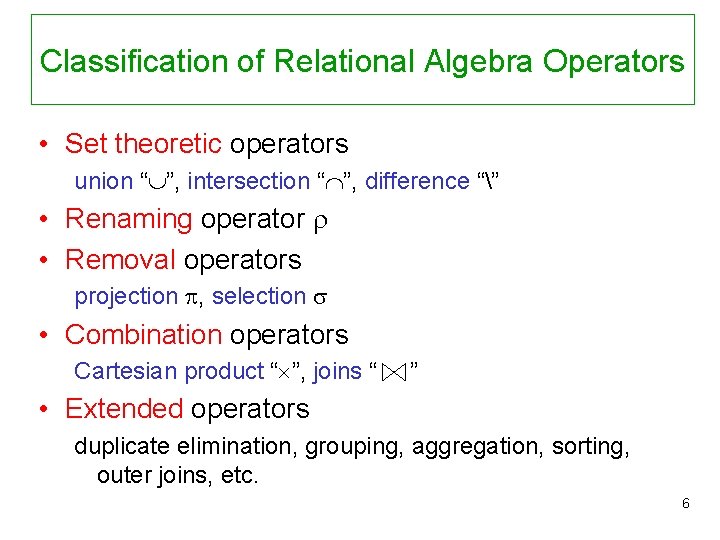
Classification of Relational Algebra Operators • Set theoretic operators union “ ”, intersection “ ”, difference “” • Renaming operator • Removal operators projection , selection • Combination operators Cartesian product “ ”, joins “ ” • Extended operators duplicate elimination, grouping, aggregation, sorting, outer joins, etc. 6
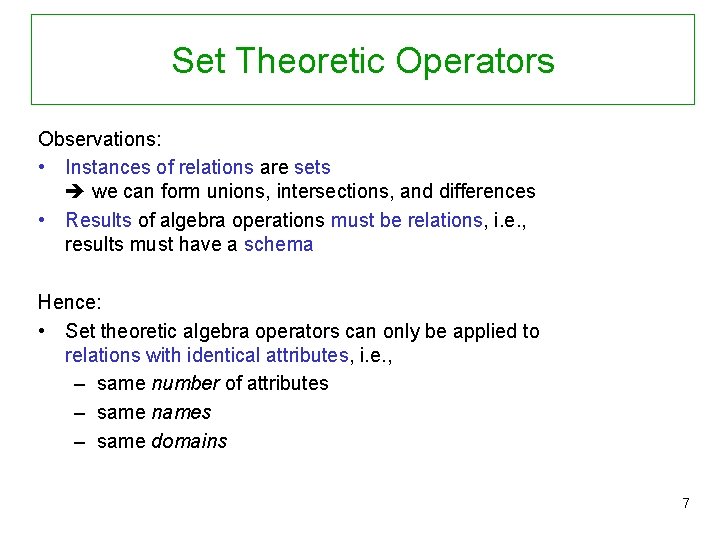
Set Theoretic Operators Observations: • Instances of relations are sets we can form unions, intersections, and differences • Results of algebra operations must be relations, i. e. , results must have a schema Hence: • Set theoretic algebra operators can only be applied to relations with identical attributes, i. e. , – same number of attributes – same names – same domains 7
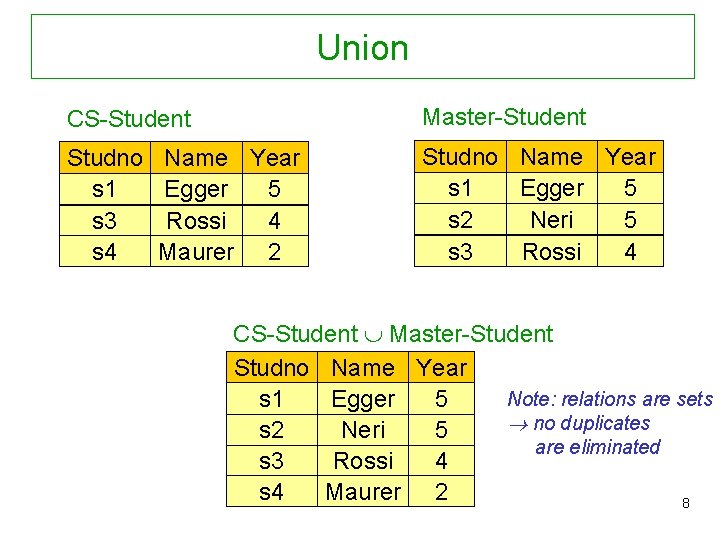
Union CS-Student Master-Student Studno s 1 s 3 s 4 Studno Name Year s 1 Egger 5 s 2 Neri 5 s 3 Rossi 4 Name Year Egger 5 Rossi 4 Maurer 2 CS-Student Master-Student Studno Name Year Note: relations are sets s 1 Egger 5 no duplicates s 2 Neri 5 are eliminated s 3 Rossi 4 s 4 Maurer 2 8
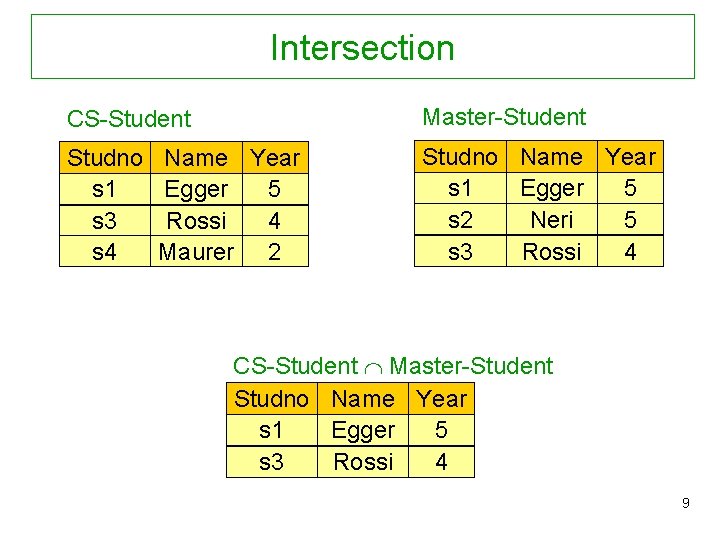
Intersection CS-Student Master-Student Studno s 1 s 3 s 4 Studno Name Year s 1 Egger 5 s 2 Neri 5 s 3 Rossi 4 Name Year Egger 5 Rossi 4 Maurer 2 CS-Student Master-Student Studno Name Year s 1 Egger 5 s 3 Rossi 4 9
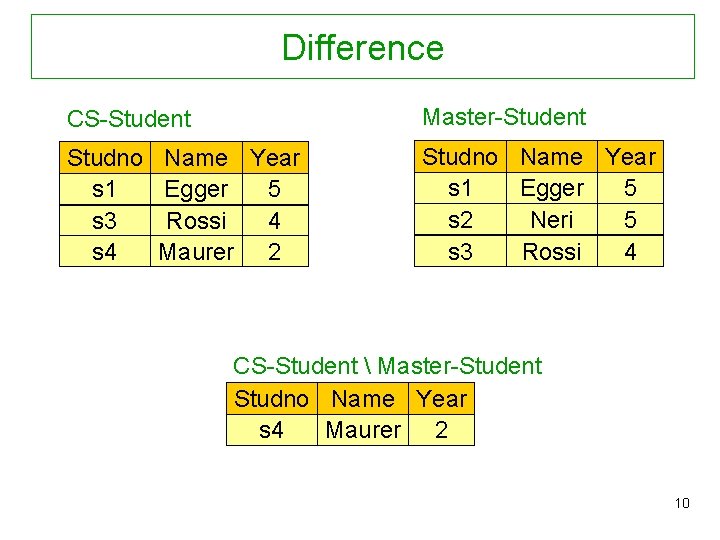
Difference CS-Student Master-Student Studno s 1 s 3 s 4 Studno Name Year s 1 Egger 5 s 2 Neri 5 s 3 Rossi 4 Name Year Egger 5 Rossi 4 Maurer 2 CS-Student Master-Student Studno Name Year s 4 Maurer 2 10
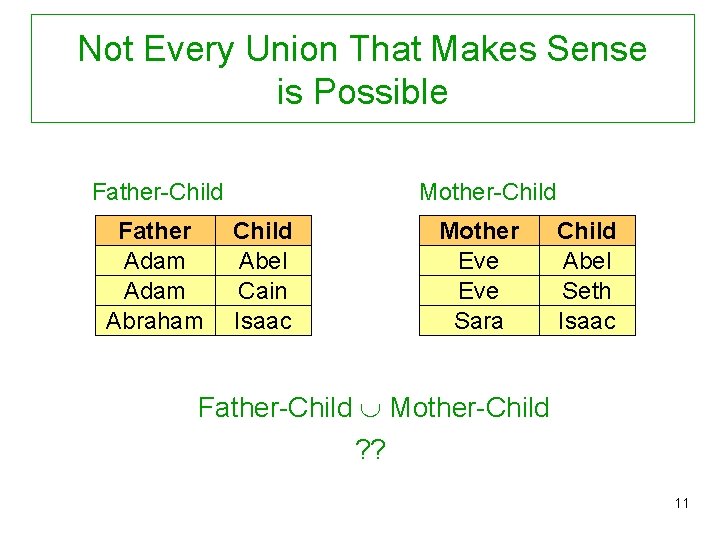
Not Every Union That Makes Sense is Possible Father-Child Father Adam Abraham Mother-Child Abel Cain Isaac Mother Eve Sara Child Abel Seth Isaac Father-Child Mother-Child ? ? 11
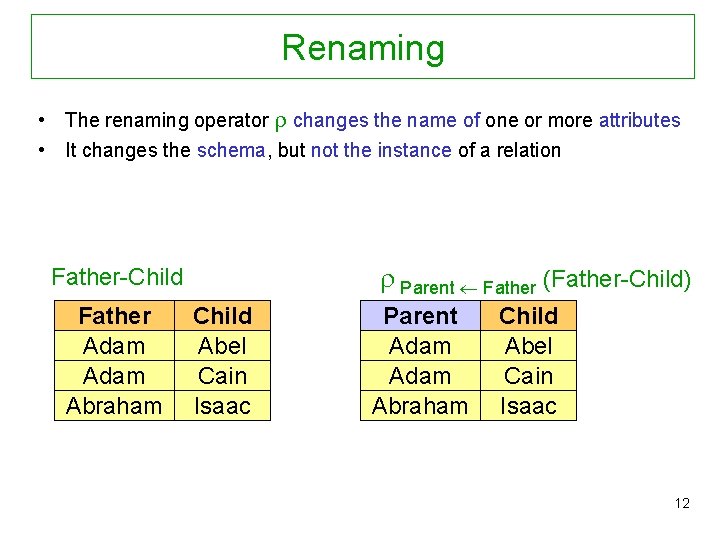
Renaming • The renaming operator changes the name of one or more attributes • It changes the schema, but not the instance of a relation Parent Father (Father-Child) Father-Child Father Adam Abraham Child Abel Cain Isaac Parent Adam Abraham Child Abel Cain Isaac 12
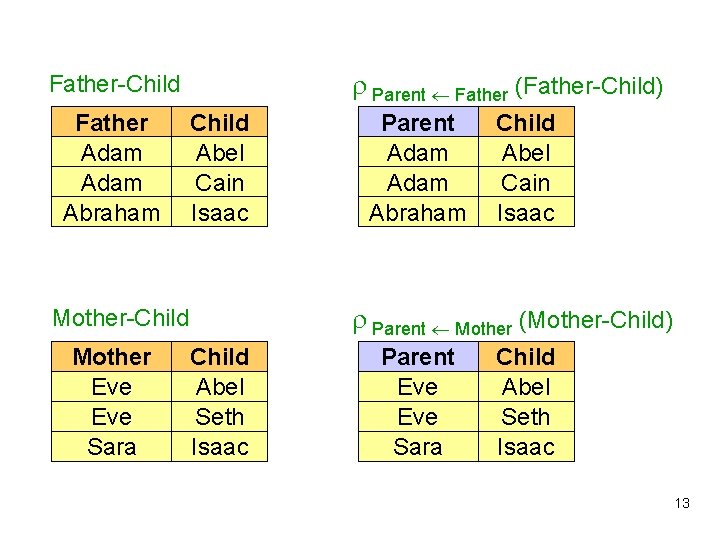
Parent Father (Father-Child) Father-Child Father Adam Abraham Child Abel Cain Isaac Parent Mother (Mother-Child) Mother-Child Mother Eve Sara Parent Adam Abraham Child Abel Seth Isaac Parent Eve Sara Child Abel Seth Isaac 13
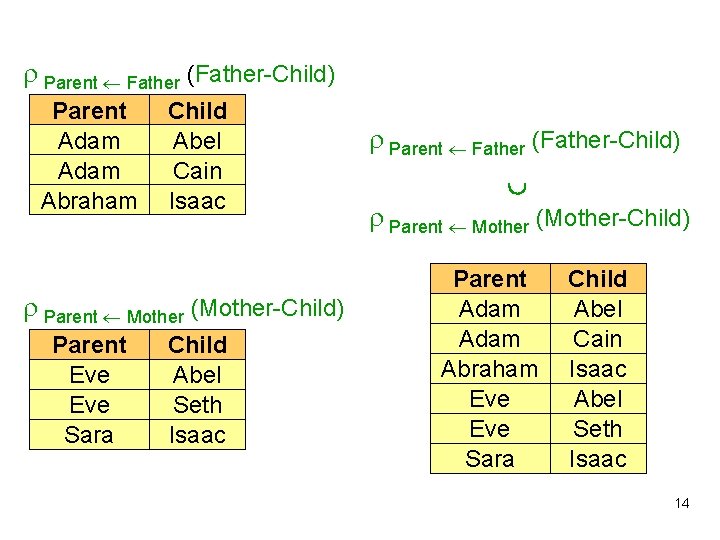
Parent Father (Father-Child) Parent Adam Abraham Child Abel Cain Isaac Parent Mother (Mother-Child) Parent Eve Sara Child Abel Seth Isaac Parent Father (Father-Child) Parent Mother (Mother-Child) Parent Adam Abraham Eve Sara Child Abel Cain Isaac Abel Seth Isaac 14
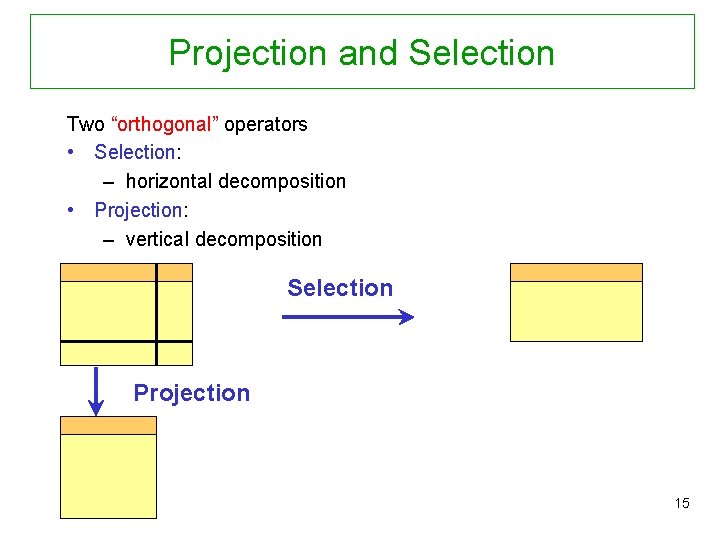
Projection and Selection Two “orthogonal” operators • Selection: – horizontal decomposition • Projection: – vertical decomposition Selection Projection 15
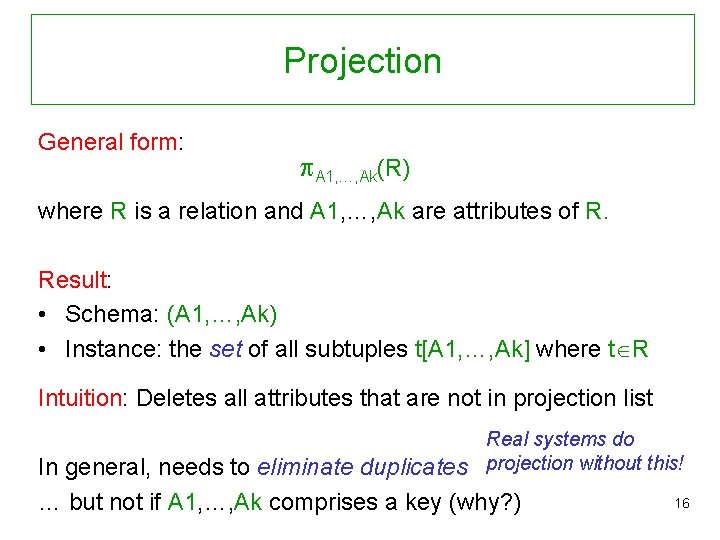
Projection General form: A 1, …, Ak(R) where R is a relation and A 1, …, Ak are attributes of R. Result: • Schema: (A 1, …, Ak) • Instance: the set of all subtuples t[A 1, …, Ak] where t R Intuition: Deletes all attributes that are not in projection list Real systems do projection without this! In general, needs to eliminate duplicates … but not if A 1, …, Ak comprises a key (why? ) 16
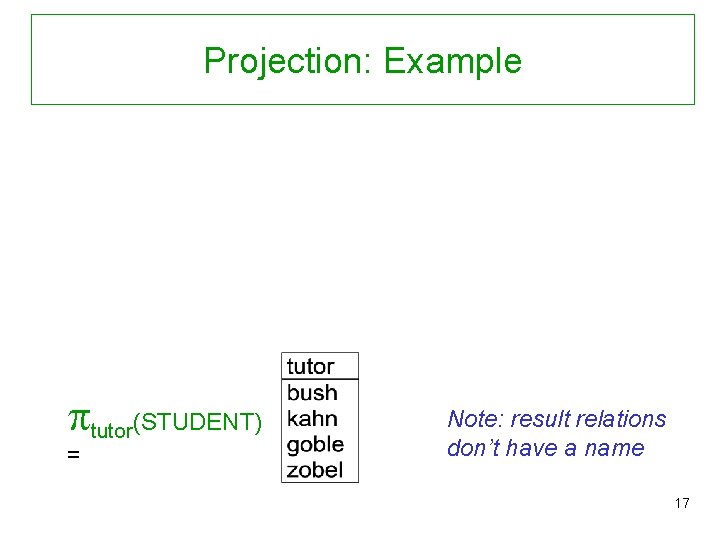
Projection: Example tutor(STUDENT) = Note: result relations don’t have a name 17
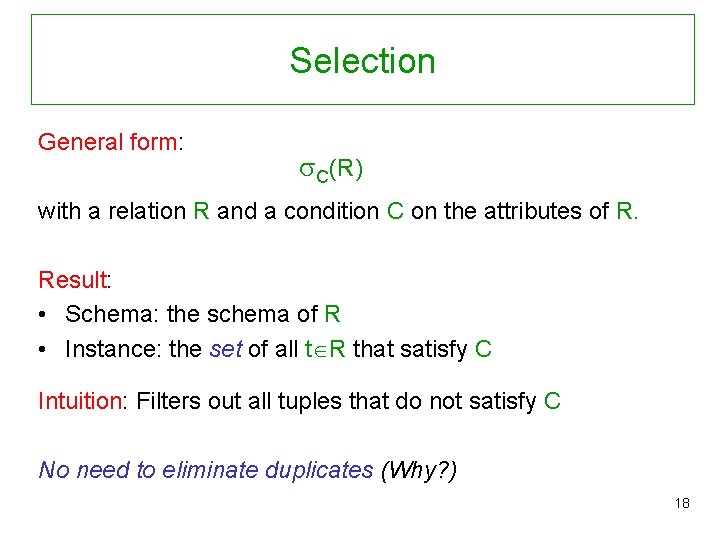
Selection General form: C(R) with a relation R and a condition C on the attributes of R. Result: • Schema: the schema of R • Instance: the set of all t R that satisfy C Intuition: Filters out all tuples that do not satisfy C No need to eliminate duplicates (Why? ) 18
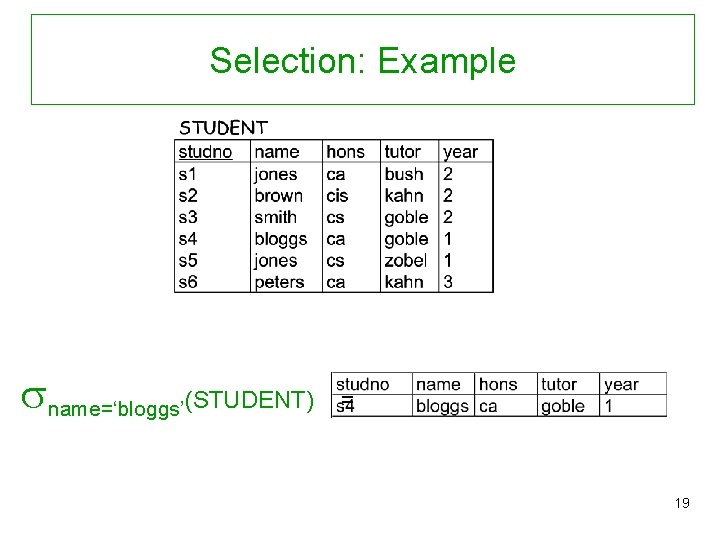
Selection: Example name=‘bloggs’(STUDENT) = 19
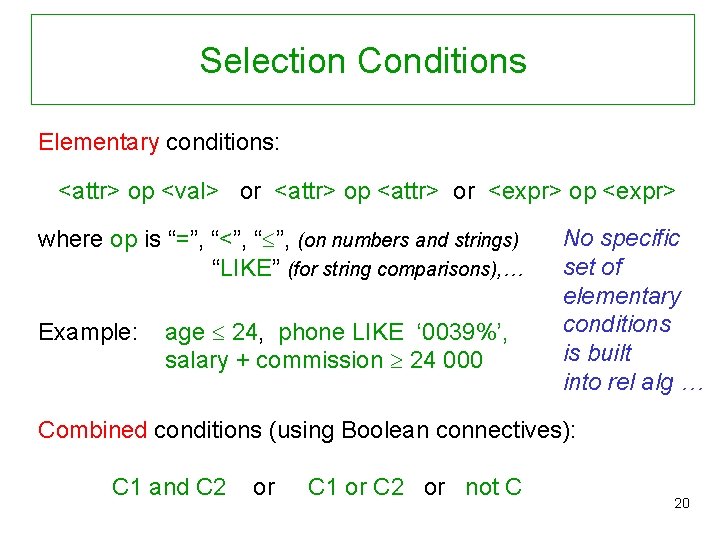
Selection Conditions Elementary conditions: <attr> op <val> or <attr> op <attr> or <expr> op <expr> where op is “=”, “<”, “ ”, (on numbers and strings) “LIKE” (for string comparisons), … Example: age 24, phone LIKE ‘ 0039%’, salary + commission 24 000 No specific set of elementary conditions is built into rel alg … Combined conditions (using Boolean connectives): C 1 and C 2 or C 1 or C 2 or not C 20
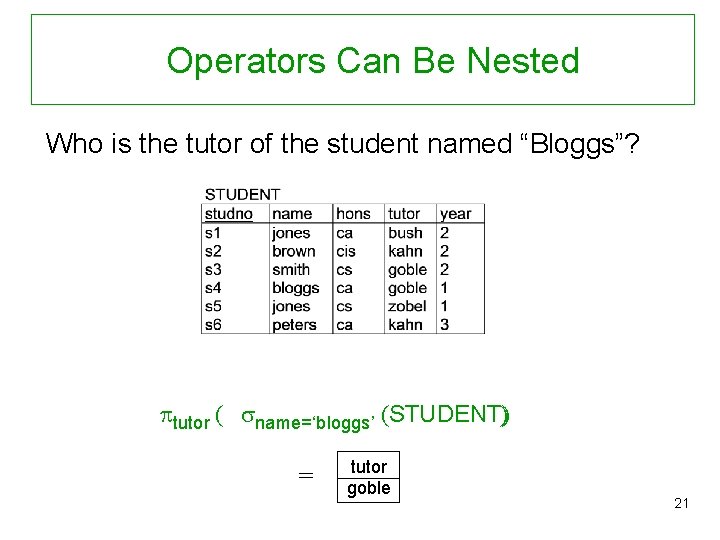
Operators Can Be Nested Who is the tutor of the student named “Bloggs”? tutor ( name=‘bloggs’ (STUDENT)) = tutor goble 21
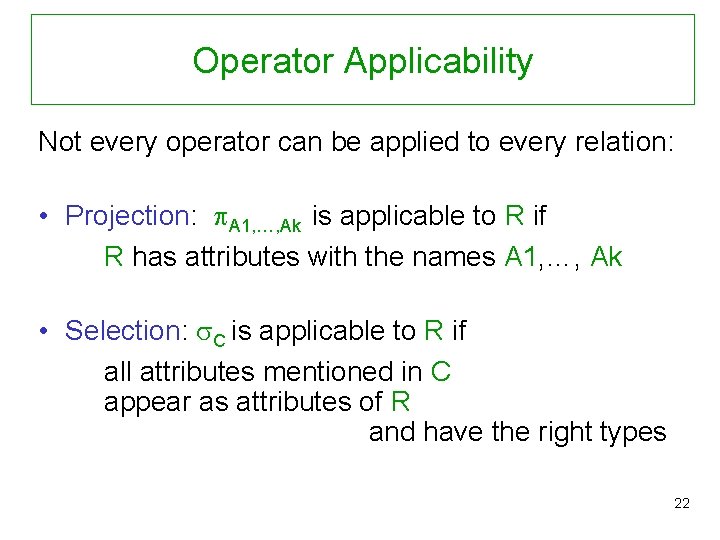
Operator Applicability Not every operator can be applied to every relation: • Projection: A 1, …, Ak is applicable to R if R has attributes with the names A 1, …, Ak • Selection: C is applicable to R if all attributes mentioned in C appear as attributes of R and have the right types 22
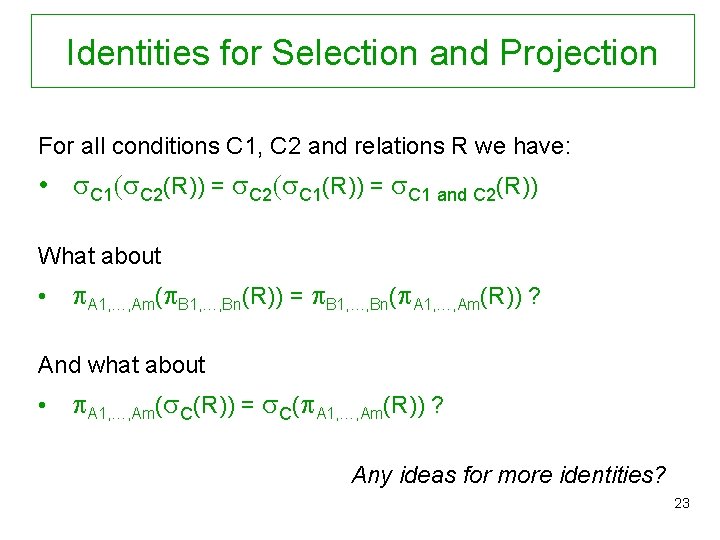
Identities for Selection and Projection For all conditions C 1, C 2 and relations R we have: • C 1( C 2(R)) = C 2( C 1(R)) = C 1 and C 2(R)) What about • A 1, …, Am( B 1, …, Bn(R)) = B 1, …, Bn( A 1, …, Am(R)) ? And what about • A 1, …, Am( C(R)) = C( A 1, …, Am(R)) ? Any ideas for more identities? 23
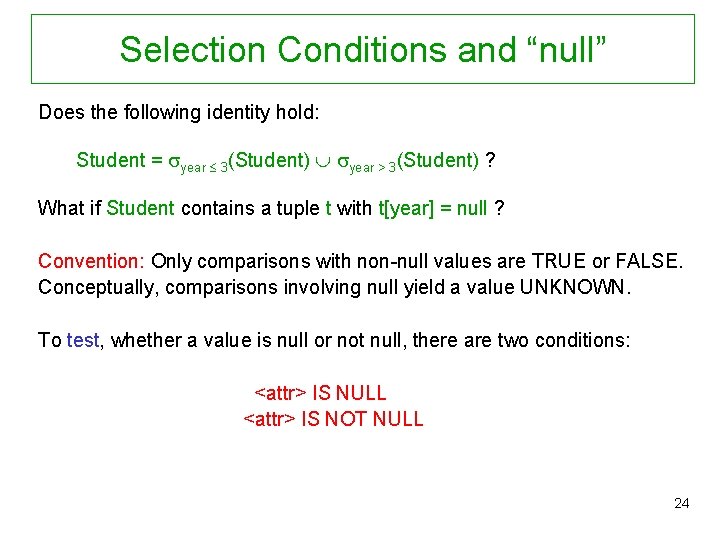
Selection Conditions and “null” Does the following identity hold: Student = year 3(Student) year > 3(Student) ? What if Student contains a tuple t with t[year] = null ? Convention: Only comparisons with non-null values are TRUE or FALSE. Conceptually, comparisons involving null yield a value UNKNOWN. To test, whether a value is null or not null, there are two conditions: <attr> IS NULL <attr> IS NOT NULL 24
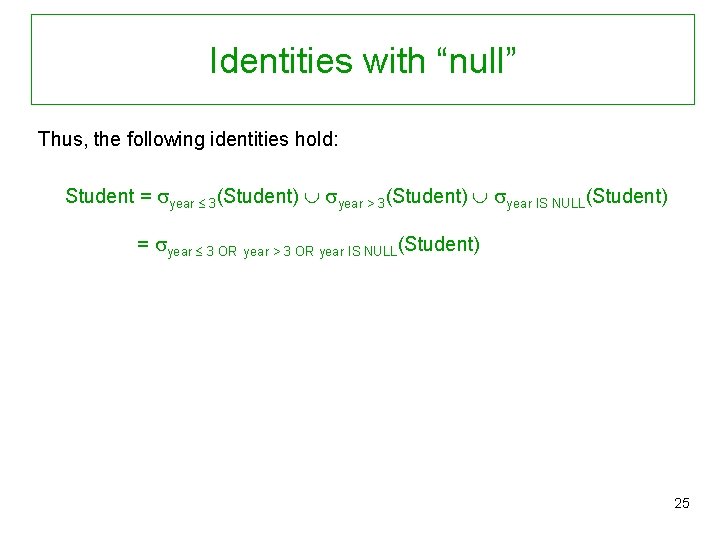
Identities with “null” Thus, the following identities hold: Student = year 3(Student) year > 3(Student) year IS NULL(Student) = year 3 OR year > 3 OR year IS NULL(Student) 25
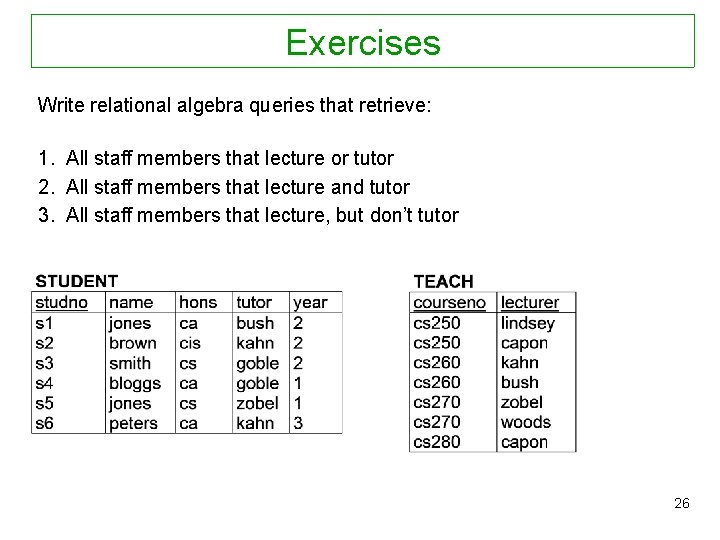
Exercises Write relational algebra queries that retrieve: 1. All staff members that lecture or tutor 2. All staff members that lecture and tutor 3. All staff members that lecture, but don’t tutor 26
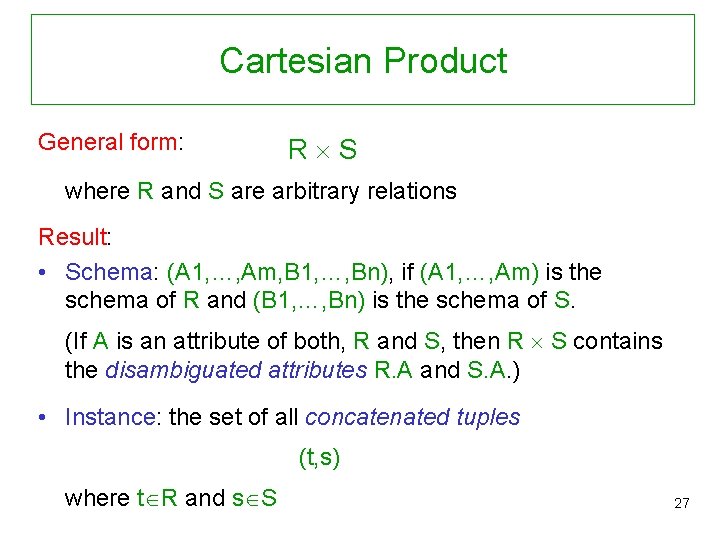
Cartesian Product General form: R S where R and S are arbitrary relations Result: • Schema: (A 1, …, Am, B 1, …, Bn), if (A 1, …, Am) is the schema of R and (B 1, …, Bn) is the schema of S. (If A is an attribute of both, R and S, then R S contains the disambiguated attributes R. A and S. A. ) • Instance: the set of all concatenated tuples (t, s) where t R and s S 27
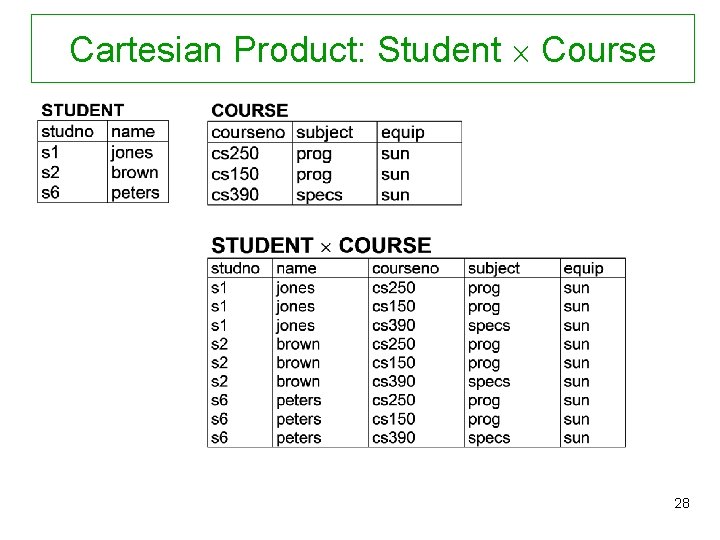
Cartesian Product: Student Course 28
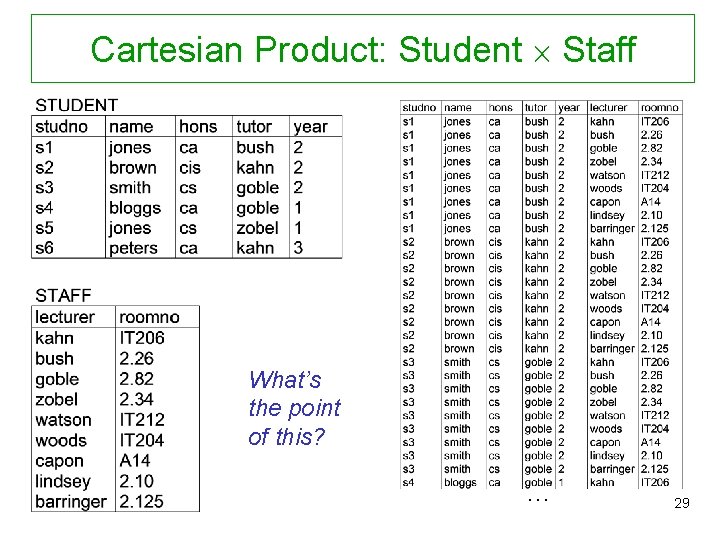
Cartesian Product: Student Staff What’s the point of this? … 29
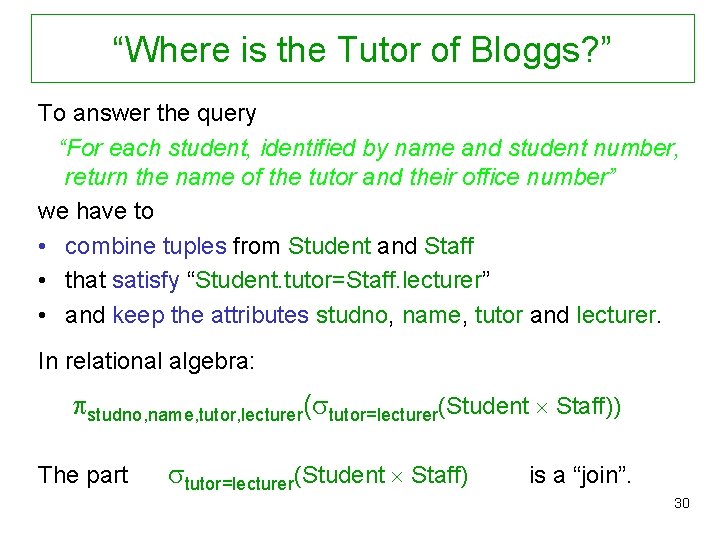
“Where is the Tutor of Bloggs? ” To answer the query “For each student, identified by name and student number, return the name of the tutor and their office number” we have to • combine tuples from Student and Staff • that satisfy “Student. tutor=Staff. lecturer” • and keep the attributes studno, name, tutor and lecturer. In relational algebra: studno, name, tutor, lecturer( tutor=lecturer(Student Staff)) The part tutor=lecturer(Student Staff) is a “join”. 30
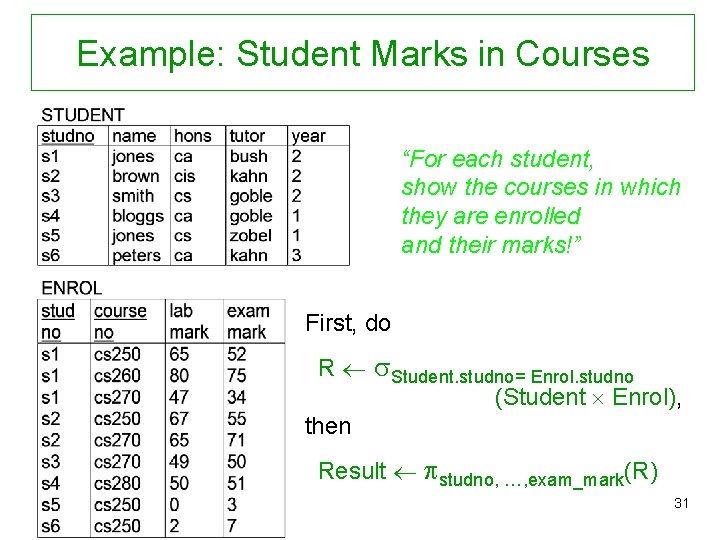
Example: Student Marks in Courses “For each student, show the courses in which they are enrolled and their marks!” First, do R Student. studno= Enrol. studno (Student Enrol), then Result studno, …, exam_mark(R) 31
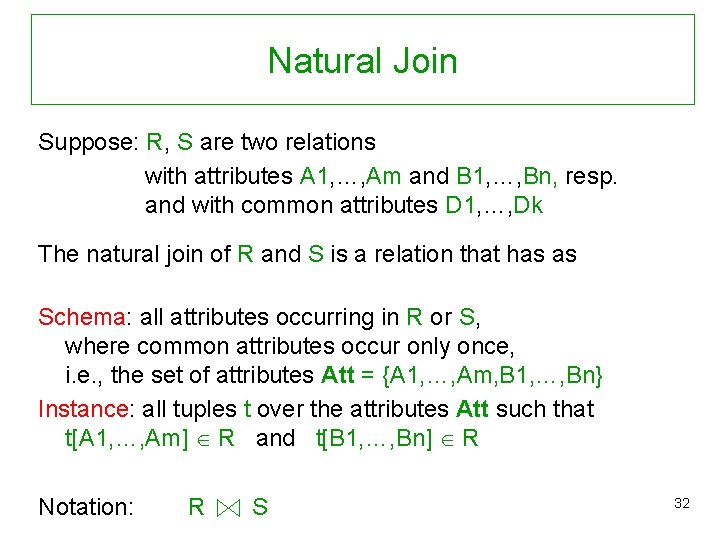
Natural Join Suppose: R, S are two relations with attributes A 1, …, Am and B 1, …, Bn, resp. and with common attributes D 1, …, Dk The natural join of R and S is a relation that has as Schema: all attributes occurring in R or S, where common attributes occur only once, i. e. , the set of attributes Att = {A 1, …, Am, B 1, …, Bn} Instance: all tuples t over the attributes Att such that t[A 1, …, Am] R and t[B 1, …, Bn] R Notation: R S 32
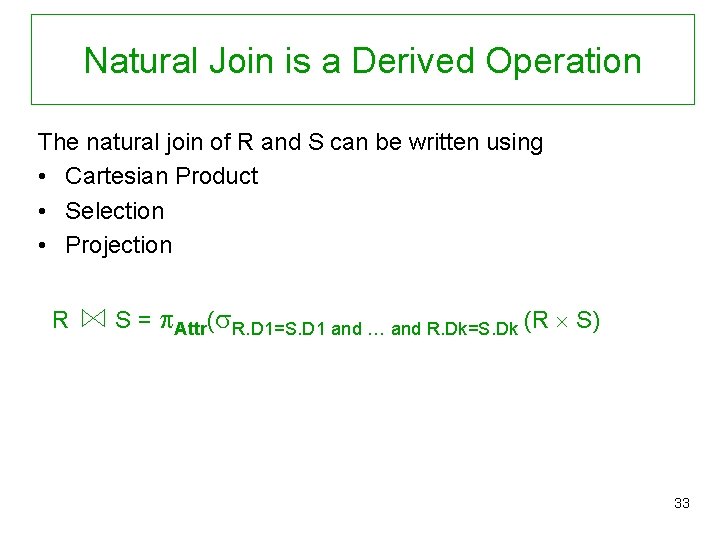
Natural Join is a Derived Operation The natural join of R and S can be written using • Cartesian Product • Selection • Projection R S = Attr( R. D 1=S. D 1 and … and R. Dk=S. Dk (R S) 33
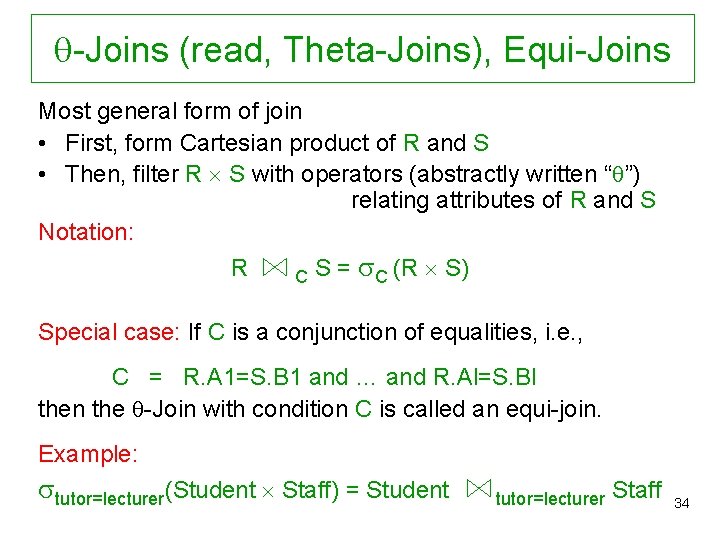
-Joins (read, Theta-Joins), Equi-Joins Most general form of join • First, form Cartesian product of R and S • Then, filter R S with operators (abstractly written “ ”) relating attributes of R and S Notation: R C S = C (R S) Special case: If C is a conjunction of equalities, i. e. , C = R. A 1=S. B 1 and … and R. Al=S. Bl then the -Join with condition C is called an equi-join. Example: tutor=lecturer(Student Staff) = Student tutor=lecturer Staff 34
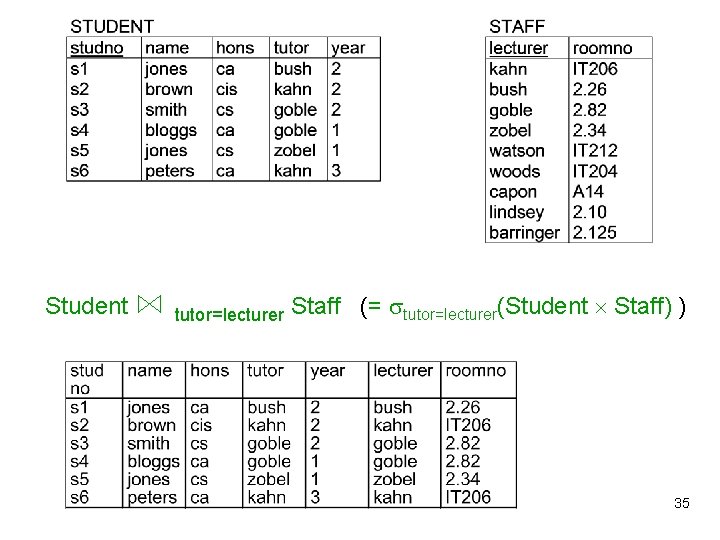
Student tutor=lecturer Staff (= tutor=lecturer(Student Staff) ) 35
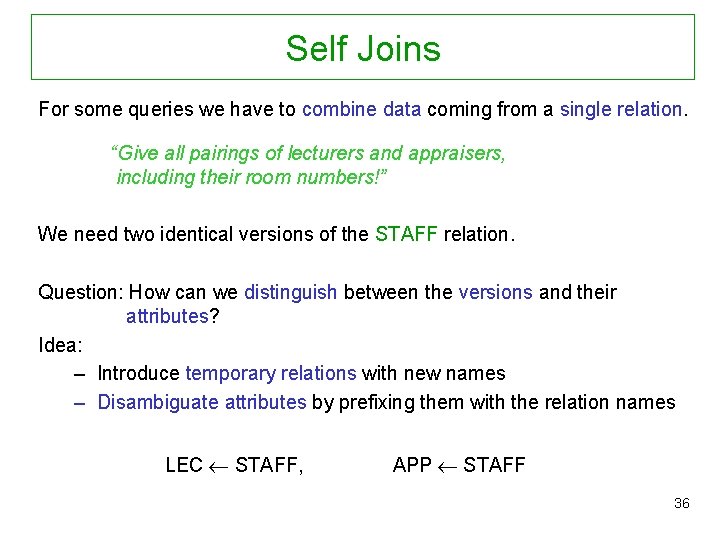
Self Joins For some queries we have to combine data coming from a single relation. “Give all pairings of lecturers and appraisers, including their room numbers!” We need two identical versions of the STAFF relation. Question: How can we distinguish between the versions and their attributes? Idea: – Introduce temporary relations with new names – Disambiguate attributes by prefixing them with the relation names LEC STAFF, APP STAFF 36
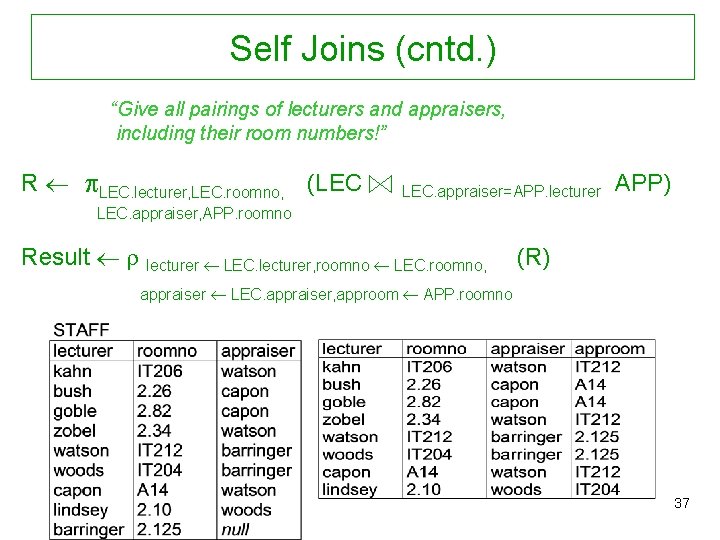
Self Joins (cntd. ) “Give all pairings of lecturers and appraisers, including their room numbers!” R LEC. lecturer, LEC. roomno, (LEC LEC. appraiser=APP. lecturer APP) LEC. appraiser, APP. roomno Result lecturer LEC. lecturer, roomno LEC. roomno, (R) appraiser LEC. appraiser, approom APP. roomno 37
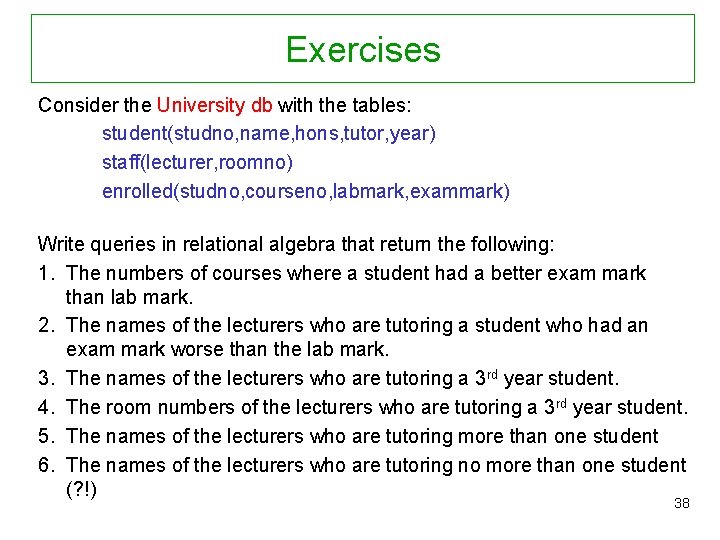
Exercises Consider the University db with the tables: student(studno, name, hons, tutor, year) staff(lecturer, roomno) enrolled(studno, courseno, labmark, exammark) Write queries in relational algebra that return the following: 1. The numbers of courses where a student had a better exam mark than lab mark. 2. The names of the lecturers who are tutoring a student who had an exam mark worse than the lab mark. 3. The names of the lecturers who are tutoring a 3 rd year student. 4. The room numbers of the lecturers who are tutoring a 3 rd year student. 5. The names of the lecturers who are tutoring more than one student 6. The names of the lecturers who are tutoring no more than one student (? !) 38
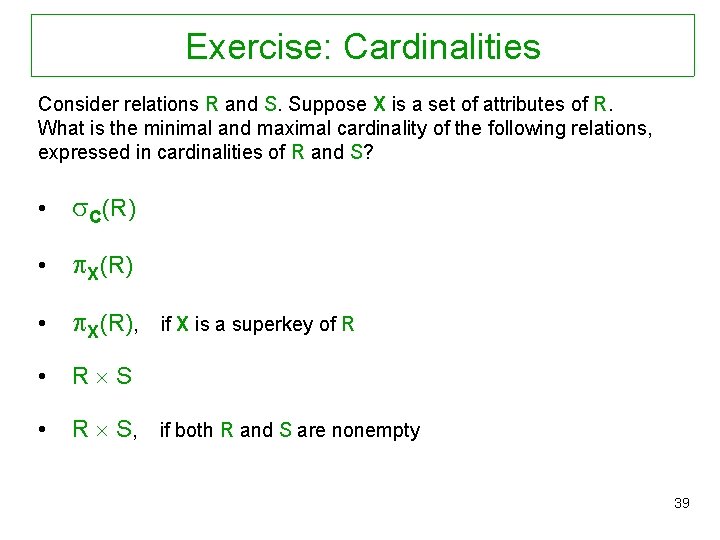
Exercise: Cardinalities Consider relations R and S. Suppose X is a set of attributes of R. What is the minimal and maximal cardinality of the following relations, expressed in cardinalities of R and S? • C(R) • X(R), • R S • R S, if both R and S are nonempty if X is a superkey of R 39
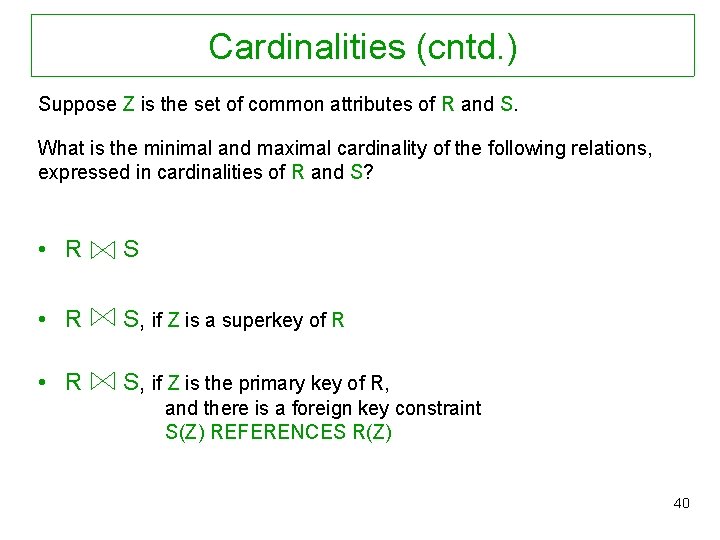
Cardinalities (cntd. ) Suppose Z is the set of common attributes of R and S. What is the minimal and maximal cardinality of the following relations, expressed in cardinalities of R and S? • R S, if Z is a superkey of R • R S, if Z is the primary key of R, and there is a foreign key constraint S(Z) REFERENCES R(Z) 40
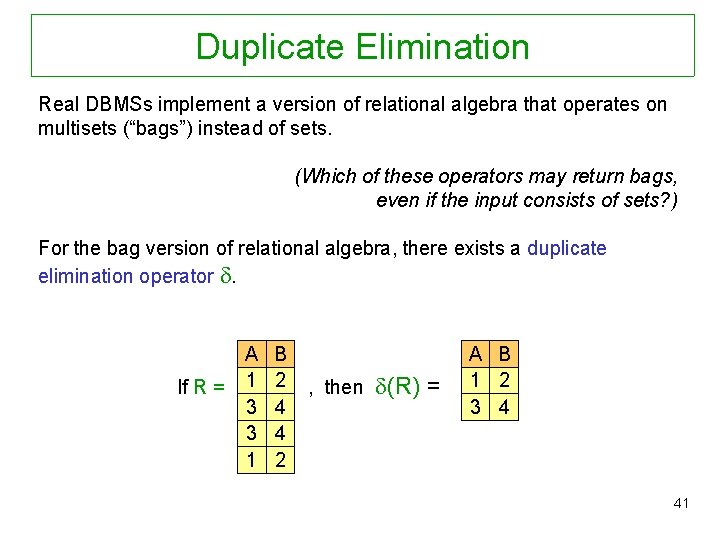
Duplicate Elimination Real DBMSs implement a version of relational algebra that operates on multisets (“bags”) instead of sets. (Which of these operators may return bags, even if the input consists of sets? ) For the bag version of relational algebra, there exists a duplicate elimination operator . If R = A 1 3 3 1 B 2 4 4 2 , then (R) = A B 1 2 3 4 41
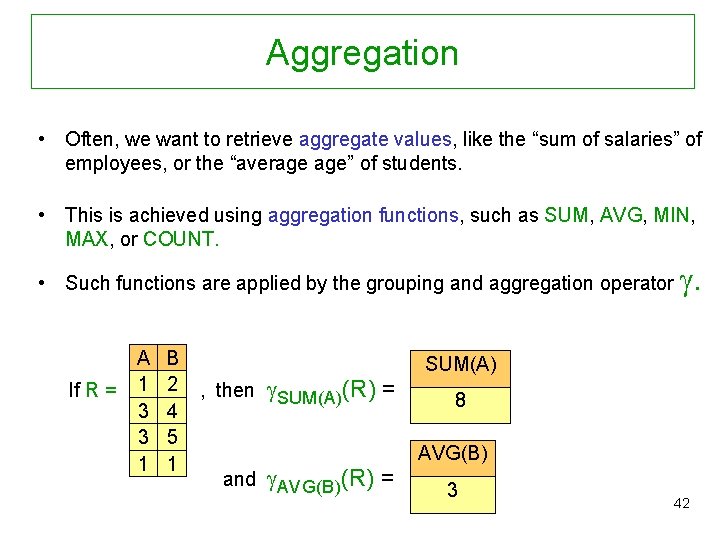
Aggregation • Often, we want to retrieve aggregate values, like the “sum of salaries” of employees, or the “average age” of students. • This is achieved using aggregation functions, such as SUM, AVG, MIN, MAX, or COUNT. • Such functions are applied by the grouping and aggregation operator . If R = A 1 3 3 1 B 2 4 5 1 , then and SUM(A)(R) = AVG(B)(R) = SUM(A) 8 AVG(B) 3 42
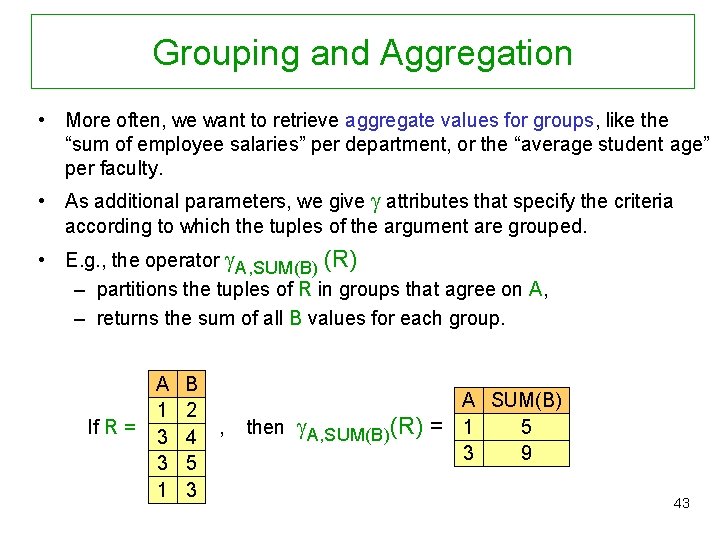
Grouping and Aggregation • More often, we want to retrieve aggregate values for groups, like the “sum of employee salaries” per department, or the “average student age” per faculty. • As additional parameters, we give attributes that specify the criteria according to which the tuples of the argument are grouped. • E. g. , the operator A, SUM(B) (R) – partitions the tuples of R in groups that agree on A, – returns the sum of all B values for each group. If R = A 1 3 3 1 B 2 4 5 3 , then A, SUM(B)(R) = A SUM(B) 1 5 3 9 43
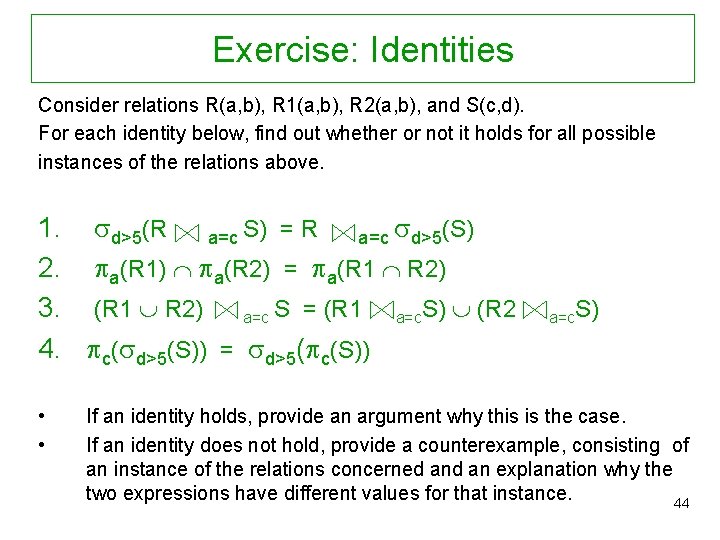
Exercise: Identities Consider relations R(a, b), R 1(a, b), R 2(a, b), and S(c, d). For each identity below, find out whether or not it holds for all possible instances of the relations above. 1. d>5(R a=c S) = R a=c d>5(S) 2. a(R 1) a(R 2) = a(R 1 R 2) 3. (R 1 R 2) a=c S = (R 1 a=c. S) (R 2 4. c( d>5(S)) = d>5( c(S)) • • a=c. S) If an identity holds, provide an argument why this is the case. If an identity does not hold, provide a counterexample, consisting of an instance of the relations concerned an explanation why the two expressions have different values for that instance. 44
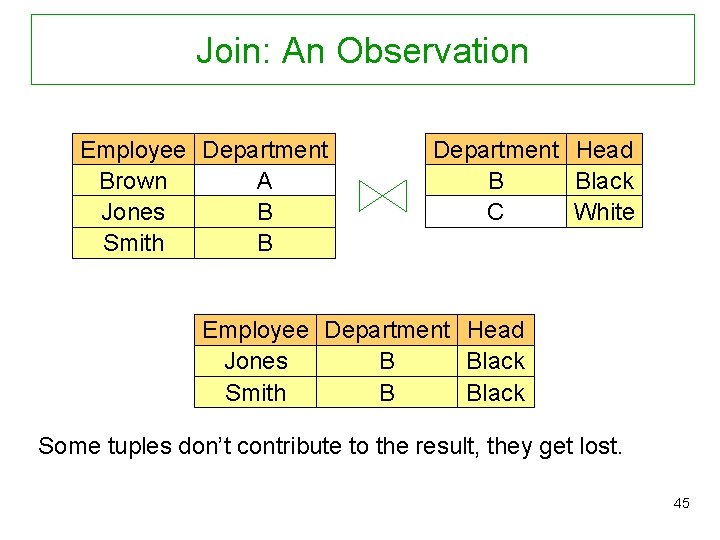
Join: An Observation Employee Department Brown A Jones B Smith B Department Head B Black C White Employee Department Head Jones B Black Smith B Black Some tuples don’t contribute to the result, they get lost. 45
Outer Join • An outer join extends those tuples with null values that would get lost by an (inner) join. • The outer join comes in three versions – left: keeps the tuples of the left argument, extending them with nulls if necessary – right: . . . of the right argument. . . – full: . . . of both arguments. . . 46
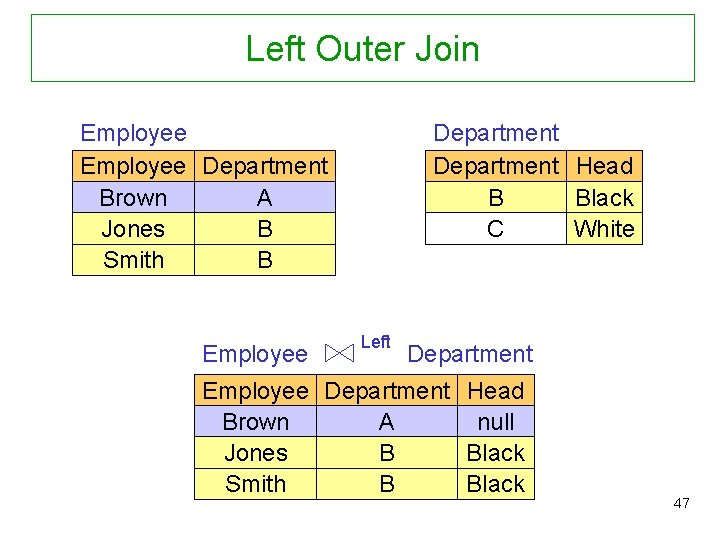
Left Outer Join Employee Department A Brown Jones B Smith B Employee Department Head B Black C White Left Department Employee Department Head Brown A null Jones B Black Smith B Black 47
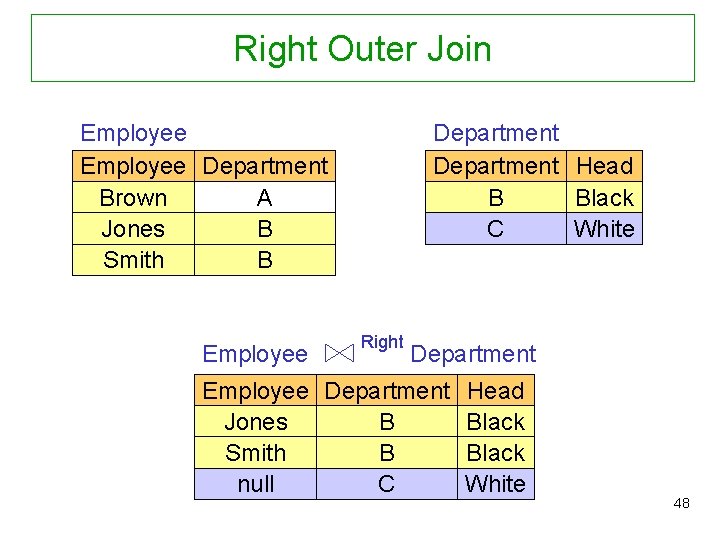
Right Outer Join Employee Department A Brown Jones B Smith B Employee Department Head B Black C White Right Department Employee Department Head Jones B Black Smith B Black null C White 48
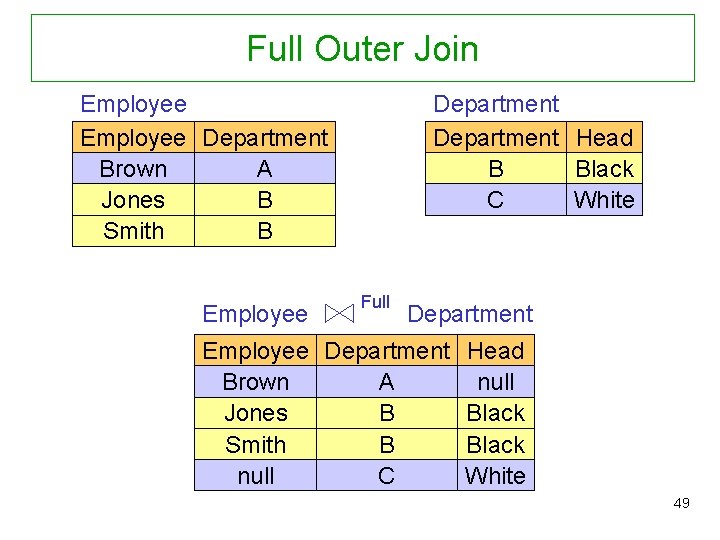
Full Outer Join Employee Department A Brown Jones B Smith B Employee Department Head B Black C White Full Department Employee Department Head Brown A null Jones B Black Smith B Black null C White 49
Summary • Relational algebra is a query language for the relational data model • Expressions are built up from relations and unary and binary operators • Operators can be divided into set theoretic, renaming, removal and combination operators (plus extended operators) • Relational algebra is the target language into which user queries are translated by the DBMS • Identities allow one to rewrite expressions into equivalent ones, which may be more efficiently executable ( query optimization) 50
References In preparing these slides I have used several sources. The main ones are the following: Books: • A First Course in Database Systems, by J. Ullman and J. Widom • Fundamentals of Database Systems, by R. Elmasri and S. Navathe Slides from Database courses held by the following people: • Enrico Franconi (Free University of Bozen-Bolzano) • Warner Nutt (Free University of Bozen-Bolzano) • Carol Goble and Ian Horrocks (University of Manchester) • Diego Calvanese (Free University of Bozen-Bolzano) and Maurizio Lenzerini (University of Rome, “La Sapienza”) In particular, a number of figures are taken from their slides. 51
- Slides: 51